

Consider the Following:
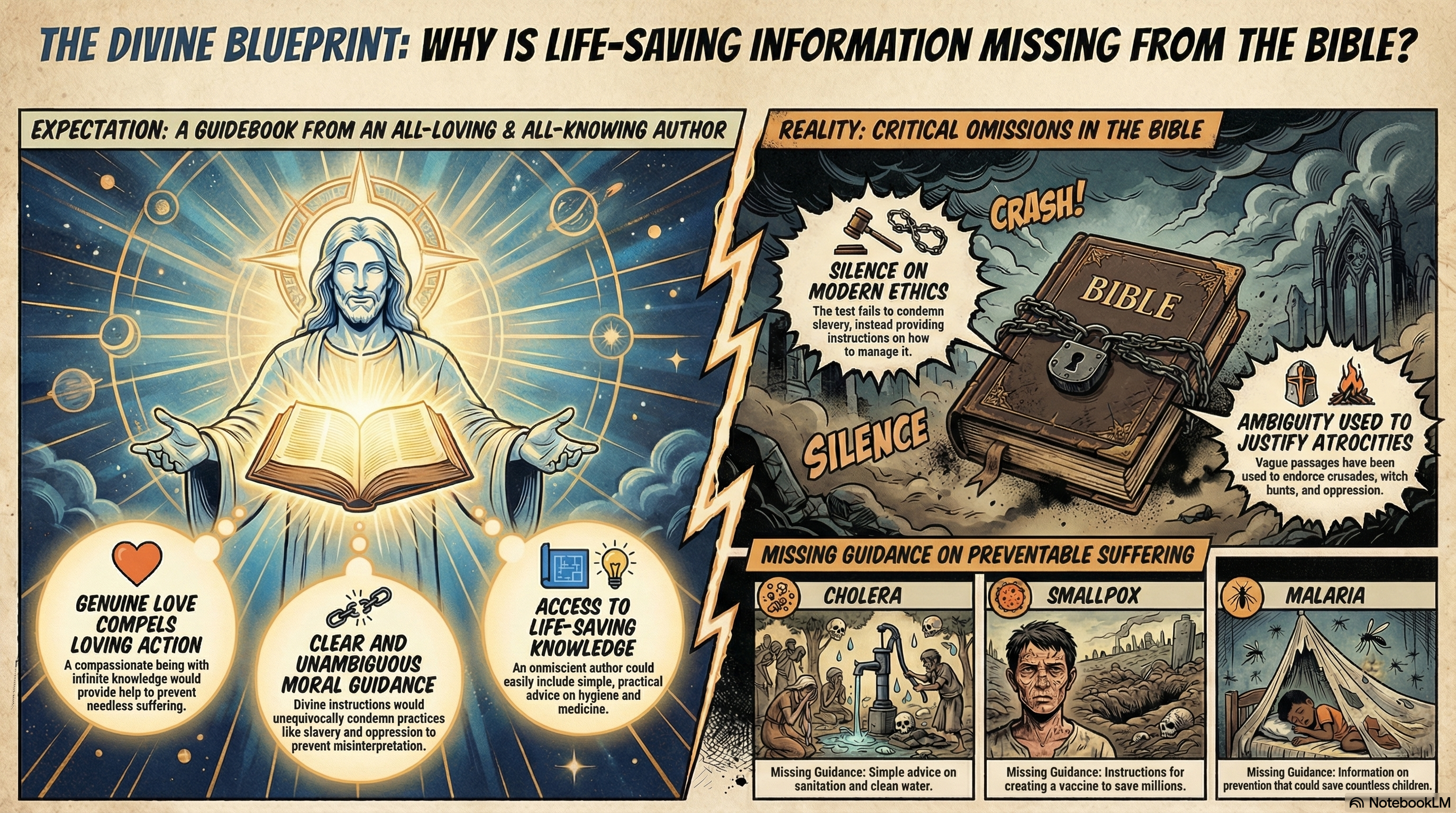
Summary: The absence of guidance on preventing widespread suffering and horrific diseases in a supposedly divine text challenges the notion of an all-loving, omniscient deity. If true compassion drives intervention, then an indifferent stance on human suffering raises doubts about the Bible’s authorship and the nature of God.

Imagine an acquaintance, Sarah, who tells you that, just this morning, she had discovered an abandoned infant crying alone in a cold ditch. When you ask her what she did with the crying infant, she replies, “Oh, I left it there. Perhaps I’ll return sometime next week to take the child home. The infant will appreciate being saved more if it suffers a bit first.” Would you consider Sarah loving?
Now consider the God of the Bible. This deity not only observes millions of innocent, suffering infants without intervention but also provides no medical knowledge that could alleviate their intense suffering. Is this indifference indicative of an actual loving God? How does such indifference align with a loving nature?

Believers often point to instances of healing as proof of divine love, yet this reasoning is flawed. If healing signifies love, then the lack of healing equally signifies indifference. We see far more cases of indifference than healing, assuming there is a God concerned with human affairs. How can this be reconciled with the notion of an all-loving deity?
We must question such inaction precisely because it directly reflects on whether any proposed God of this world could be loving and omnipotent as many religious believers claim. If we, as finite humans, cannot imagine ignoring an infant’s cries, then asserting that a loving deity would choose to do so is implausible.
Bear in mind that this is not a moral argument. It is not claiming that God is immoral. It is a logical argument. A truthful God cannot claim to be loving, then indisputably act unlovingly toward the very individuals he claims to love.
— Elaboration
The Problem of Disease and Suffering
For many, suffering is a distant concept, never personally witnessed. Yet, global suffering is an hourly reality, particularly for children. Even if we assume a better afterlife awaits these children, this notion fails to address the issue: an omniscient God stands by as they suffer needlessly.
If a benevolent God wished to lessen suffering, there are countless diseases whose cures could be explicitly included in sacred texts. A few horrific examples, for which preventative knowledge could have been divinely offered, include:
- Malaria:
- A disease that continues to kill hundreds of thousands each year, particularly young children.
- Smallpox:
- Though eradicated by modern science, it was once a leading cause of death worldwide. An all-knowing deity could have saved millions by revealing a vaccine.
- Polio:
- Paralyzing countless children, this disease’s prevention could have been revealed to spare families devastating losses.
- Tuberculosis (TB):
- A leading cause of infectious death, TB disproportionately affects impoverished populations, a pattern that would not go unnoticed by a compassionate deity.
- Leprosy:
- Known in Biblical times, but instead of a cure, only social isolation was offered—implying a knowledge gap that seems implausible for an omniscient being.
- Cholera:
- With simple sanitation advice, countless lives could have been saved by preventing this disease in impoverished regions.
- The Black Plague:
- Historical plagues claimed millions of lives. Would a compassionate God not want to intervene or provide guidance?
A truly compassionate, omniscient God could easily have provided in a sacred book such as the Bible clear cures or preventative measures for these and many other diseases in sacred texts. Yet, there are no biblical passages dedicated to alleviating widespread human suffering through practical or preventative health measures. This absence raises serious questions about the Bible’s authorship and the nature of a deity supposedly defined by love.

Genuine love compels loving action. If we find it unimaginable to ignore a dying child, it’s rational to question the existence of a loving, omnipotent deity who has presumably written a book that offers no methods to alleviate suffering, methods that any actual God would know and could easily provide.
A Companion Technical Paper:
◉ See also #05 in which it is demonstrated that the God of the Bible is not only passively unloving, but actively unloving to the point he orders innocent children be killed:

The Logical Form
Argument 1: The Absence of Disease Prevention in the Bible
- Premise 1: If an omniscient and all-loving deity authored a text, it would include guidance to prevent widespread suffering and disease.
- Premise 2: The Bible does not include clear guidance to prevent horrific diseases or alleviate innocent suffering.
- Conclusion: Therefore, it is unlikely that an omniscient and all-loving deity authored the Bible.

Argument 2: Genuine Compassion and Divine Inaction
- Premise 1: Genuine love compels loving action to alleviate or prevent needless suffering.
- Premise 2: An omniscient deity could intervene or provide guidance to prevent the suffering of innocent children.
- Conclusion: If such a deity does not intervene, then it raises doubts about the deity’s compassion and benevolence.
Argument 3: The Plausibility of a Loving Deity Ignoring Suffering
- Premise 1: It is implausible that a truly compassionate being would ignore innocent suffering when it has the power to prevent it.
- Premise 2: The God of the Bible appears to allow innocent suffering to persist without intervention or guidance.
- Conclusion: Therefore, it is implausible to consider the God of the Bible as a truly compassionate being.
Argument 4: Divine Knowledge and Human Diseases
- Premise 1: An omniscient God would know the causes and cures for deadly diseases like malaria, smallpox, and cholera.
- Premise 2: The Bible does not contain any cures or preventive advice for these diseases.
- Conclusion: Therefore, it is unlikely that an omniscient God authored the Bible, as such knowledge would prevent widespread human suffering.

(Scan to view post on mobile devices.)

A Dialogue
Is the Bible Consistent with a Loving and Omniscient God?
CHRIS: I believe that the Bible was authored by an all-loving and omniscient God. The very existence of scripture is proof of His love and guidance.
CLARUS: But if that’s the case, why does the Bible lack guidance on preventing widespread suffering and horrific diseases? An omniscient deity would surely know how devastating malaria, smallpox, and cholera would be—and a loving deity would want to protect His creation from such suffering.
CHRIS: God’s ways are beyond our understanding. He may have a higher purpose for allowing suffering, even if we don’t see it.
CLARUS: That’s precisely the issue. If genuine love compels loving action, wouldn’t an all-knowing deity include simple, practical advice in His sacred text to prevent needless suffering? Imagine if the Bible had given even a hint about sanitation practices or treatments that could save lives. The absence of such content is telling.
CHRIS: But God does intervene through miraculous healings, which we see even today. Isn’t that a sign of His love?
CLARUS: Then we’re left with a troubling question: if healing signifies love, wouldn’t the lack of healing indicate indifference? Think about it—countless children die from preventable diseases every year. An all-powerful God could prevent this, yet He doesn’t. How do we reconcile that with the idea of a loving deity?
CHRIS: I see your point, but maybe God allows suffering to bring people closer to Him or to test their faith. Suffering can have a purpose.
CLARUS: But would a truly compassionate being use suffering as a means to bring people closer? If a human were to ignore a suffering child, we’d call it negligence. We wouldn’t excuse it by saying it’s for a greater purpose. Why apply a different standard to God?
CHRIS: We can’t judge God by human standards. His perspective is infinitely greater than ours.
CLARUS: Based on that, we’re left with a circular argument: any absence of love or guidance can be excused as “beyond understanding.” It effectively insulates God from any evaluation of his disposition. If the Bible really were a product of divine love, it should reflect universal compassion—not silence on preventable suffering.
CHRIS: But faith requires faith in God’s wisdom, even if we don’t understand His reasons.
CLARUS: I’d argue that faith is actually counter-productive here. If we’re aiming to rationally explore the logical coherence of a loving, omniscient God, then faith only muddies the analysis by dismissing the need for logical consistency. We should be able to ask if a compassionate deity’s choices align with what we understand as compassionate without relying on evidence-misaligned faith.
CHRIS: Maybe God’s role is to guide us spiritually rather than to solve our earthly problems.
CLARUS: Then, shouldn’t a spiritual guide still show some practical concern for humanity’s well-being? If God’s role is limited only to spiritual matters, it’s hard to reconcile this with claims of boundless love and omniscience. Ignoring innocent suffering is neither loving nor consistent with an omnipotent character.
CHRIS: Perhaps suffering reminds us of our reliance on God and the limitations of this world.
CLARUS: But even that explanation falls short. We’re talking about avoidable, devastating suffering that a loving deity could prevent without compromising any greater good. Ignoring suffering without reason contradicts the very essence of compassion. This raises an important question: if the Bible lacks guidance that could prevent or alleviate such suffering, can we truly consider it the work of an all-loving deity?
Notes:
Helpful Analogies
1. The Doctor’s Manual Analogy
Imagine a medical guide authored by a renowned doctor that claims to prioritize patient well-being. This guide, however, omits simple, life-saving practices—such as washing hands before surgery or vaccinating against deadly diseases—and instead focuses primarily on unrelated content. If the doctor truly cared for the well-being of patients, wouldn’t these essential preventative measures be included? Similarly, if the Bible were authored by an all-knowing, all-loving deity, it would likely contain basic guidance on preventing suffering through practical advice, yet such content is absent.
2. The Neglectful Parent Analogy
Consider a parent who watches their child suffer from preventable illnesses without providing medical care or even simple advice to reduce the pain. They claim to be compassionate but instead suggest that the suffering will “teach the child resilience.” We would question the parent’s love and compassion and find it hard to believe that allowing suffering could be justified. If a loving God truly existed and had the omniscient power to alleviate human suffering, His inaction in the face of innocent suffering would raise similar doubts about His compassion.
3. The Engineer’s Blueprint Analogy

Imagine an engineer designing a safety manual for a complex machine. The manual claims to provide all necessary guidance for safe operation, but it leaves out instructions on handling electrical hazards and fire prevention, leading to frequent injuries among users. If the engineer were truly concerned for users’ safety, wouldn’t these critical instructions be included? Similarly, a Bible authored by an omniscient deity would logically contain preventative guidance to minimize suffering, yet this guidance is missing, casting doubt on the compassion and omniscience of its purported author.
Addressing Theological Responses
Theological Responses
1. God’s Ways are Beyond Human Understanding
Theologians often argue that God’s purposes are beyond human comprehension, which means that what may seem like a lack of compassion to us could serve a greater divine plan. From this perspective, suffering might have unseen or spiritually significant outcomes that contribute to a higher good, even if they are not immediately apparent or rational to us.
2. Free Will and the Consequences of Human Choices
Another common theological response is that human free will plays a central role in why God allows suffering. By granting free will, God gave humans the autonomy to make choices, even harmful ones, and the natural consequences of these choices (including suffering and disease) are part of a world governed by freedom rather than divine intervention in every moment of hardship.
3. The Fall and Original Sin as Explanations for Suffering
Some theologians believe that the root of human suffering lies in the Fall of Humanity and original sin. They argue that humanity’s inherent sinfulness brought about a broken world where disease and suffering naturally exist. In this view, God’s role is not to directly intervene but to offer spiritual redemption through faith, while physical suffering is a consequence of human fallibility.
4. Focus on Spiritual Guidance Over Earthly Solutions
The argument that the Bible lacks practical medical advice is sometimes countered by the view that the Bible is primarily a spiritual guide. Theologians may assert that the purpose of scripture is to provide spiritual direction, rather than serve as a manual for earthly health and survival. According to this view, the Bible’s mission is eternal salvation, not temporary relief from physical suffering.
5. Suffering as a Test of Faith and Personal Development
Some theologians propose that suffering serves as a means of testing faith or building character. From this standpoint, enduring hardship and learning empathy or patience through suffering are essential components of spiritual growth. This approach suggests that God may allow suffering for humans to develop virtues that cannot be attained in the absence of adversity.
6. Miracles as Evidence of God’s Compassionate Interventions
While the Bible may not contain direct cures for diseases, many theologians point to miracles—both in scripture and in reported modern events—as evidence of God’s active compassion. These instances of healing and divine intervention are interpreted as reminders that, although God may not eliminate suffering altogether, He does intervene compassionately in meaningful moments.
7. The Hope of an Afterlife to Compensate for Earthly Suffering
A theological perspective often brought up in discussions of suffering is the concept of the afterlife. For many believers, earthly suffering is temporary, with the promise of a perfect afterlife where all pain and hardship are eradicated. In this view, God’s compassion will ultimately be realized in a future eternal existence, where current sufferings are seen as brief in comparison to everlasting joy.
Counter-Responses
1. Response to “God’s Ways are Beyond Human Understanding”
While it is conceivable that God’s purposes could surpass human comprehension, this explanation effectively insulates God from any rational scrutiny and undermines the logical coherence of claims about His love and omniscience. If God’s actions are entirely beyond our understanding, then His attributes such as compassion and justice become unknowable, weakening the basis for believing in a loving deity in the first place. If we are asked to take God’s love on faith while dismissing the clear signs of indifference toward human suffering, we are left with an unfalsifiable claim that undermines reasoned discourse.
2. Response to “Free Will and the Consequences of Human Choices”
Free will is often invoked to justify human suffering, but this response fails to account for innocent suffering—especially in cases where humans have no agency, such as children afflicted by disease or natural disasters. If free will were truly central, then an omniscient God would logically provide behavioral guidance that minimizes harm without infringing on autonomy, rather than allowing suffering to result from lack of knowledge or arbitrary consequences. Additionally, the argument that God refrains from intervening to preserve free will does not address why He would withhold practical health guidance that could prevent unnecessary suffering.
3. Response to “The Fall and Original Sin as Explanations for Suffering”
The concept of original sin as an explanation for suffering attributes innocent pain to actions supposedly committed by humanity’s distant ancestors, which raises questions about divine justice and personal accountability. If God is both just and compassionate, it seems contradictory to punish countless generations for an act they did not commit. Moreover, if human fallibility introduced suffering, then an all-loving God could still provide guidance to help alleviate suffering without reversing the Fall, thus fulfilling His role as a compassionate creator.
4. Response to “Focus on Spiritual Guidance Over Earthly Solutions”
This response implies that spiritual guidance and earthly well-being are mutually exclusive, which is an unnecessary and unsupported dichotomy. A truly compassionate, omniscient God could easily provide both spiritual and practical guidance, especially if such practical advice could prevent widespread suffering. By addressing only spiritual matters and ignoring basic human needs, this view risks portraying God as indifferent to the suffering experienced by His creation, undermining claims of boundless love.
5. Response to “Suffering as a Test of Faith and Personal Development”
If suffering is intended as a test or a means of personal growth, this would seem to reflect a utilitarian view of pain, where innocent suffering is allowed for the supposed greater good. However, a truly compassionate being would not require such extreme methods for personal development, especially for those who cannot benefit from such lessons, like young children. Furthermore, this rationale contradicts the concept of omnibenevolence by suggesting that personal growth justifies preventable suffering, which challenges the idea of a loving deity who desires the well-being of His creation.
6. Response to “Miracles as Evidence of God’s Compassionate Interventions”
While miracles are cited as evidence of divine compassion, their infrequency and selectivity suggest a problematic inconsistency. An omnibenevolent and all-powerful God who genuinely sought to alleviate human suffering would not perform sporadic miracles but would provide a consistent framework of care accessible to all. Relying on rare, unverified miracles as evidence of divine love does little to explain why an omniscient God would not offer straightforward, universally applicable guidance that could prevent suffering in the first place.
7. Response to “The Hope of an Afterlife to Compensate for Earthly Suffering”
While the promise of an afterlife may provide comfort, it does not address the ethical issue of preventable suffering in the present world. The notion that eternal happiness can compensate for earthly suffering overlooks the fact that true compassion would prevent unnecessary suffering rather than allowing it as a prelude to something better. Relying on the afterlife as a solution fails to reconcile the actions (or inactions) of a loving deity with the presence of innocent suffering, raising doubts about the alignment of earthly suffering with divine love and justice.
Clarifications
In this critique, it is important to note that references to morality or compassion are used to evaluate claims within the framework of theological moral standards but do not entail a belief in moral realism. These terms are applied to assess the logical coherence of the concept of a loving and omniscient deity as presented in religious doctrine, rather than to affirm any objective moral truths.
Additionally, several clarifications may deepen the critique:
- Human Understanding vs. Divine Mystery: While it’s common to argue that God’s ways are beyond human understanding, this assertion risks circularity by protecting divine actions from scrutiny. In rational discourse, claims about God’s compassion or justice should be open to examination if they are to hold coherent meaning for human believers.
- Free Will and Innocent Suffering: The free will defense often fails to account for natural suffering or harm caused by phenomena outside human control, such as disease or natural disasters, which affect both children and adults indiscriminately. If a loving God is concerned with human well-being, then guidance to mitigate innocent suffering would logically be expected, even in a world where free will exists.
- Original Sin and Intergenerational Punishment: The concept that original sin justifies suffering raises further ethical questions about collective punishment. This notion conflicts with the compassionate and just character often ascribed to God, as it implies ongoing consequences for those unconnected to the initial act, an idea that modern ethical perspectives generally reject.
- Spiritual vs. Practical Guidance: The dichotomy between spiritual and practical guidance seems unfounded, as both types of guidance could logically coexist without compromising God’s intent to provide character-building instruction. Absent the practical solutions to preventable suffering, the Bible and other “holy” books remain inconsistent with a fully compassionate and omniscient author.
- Suffering as a Personal Development Tool: The argument that suffering enhances personal growth or faith overlooks the reality that many suffer without achieving these ends. It also challenges the idea of unconditional love, as it implies a utilitarian approach to pain that contradicts the benevolent character typically attributed to God.
- Selective Miracles and Inconsistency: The idea that miracles showcase God’s compassion is undermined by their rarity and selectivity. If divine compassion were boundless, we would expect universally accessible methods of alleviating suffering rather than isolated acts that leave much of humanity without intervention.
- Afterlife Compensation: An afterlife does not logically address present suffering or prevent the pain that occurs here. True compassion would likely seek to prevent or alleviate avoidable suffering now rather than defer it in exchange for future compensation, especially given the real, immediate effects of suffering on individuals’ lives.
These clarifications aim to reinforce the logical examination of divine actions or inactions in light of claims about omnibenevolence and omniscience. By critiquing the internal consistency of theological claims, we explore whether they genuinely align with the attributes traditionally ascribed to a loving, all-knowing deity.
Response: Roy Montgomery
Roy Montgomery in Response to this Article Posted in a Facebook Group
(i honestly did try to listen to it all [perhaps the companion YouTube video] matey but unfortuatly … i gave up after a few minutes after getting the gist of it). Well well well … so this is Phils revamped version of the ol misotheistic God haters club question of “why would a loving God let sick people and babies die”, goodness me it’s like an old worn-out scratched vinyl record stuck on repeat there Phil (rest assured Phil this one has been refuted too many times to count by competent Biblical scholars throughout the ages) 
Once again Phil it basically just boils down to your cherry-picking and omitting of Biblical verses and IGNORANCE of what the scriptures actually says, that’s it in a nutshell matey. (No, no need to profusely thank me for pointing that out to you Phil, twas all my pleasure )
We live in a fallen world and free will plays a big part of it, why even your puppet master Lucifer has been given a free will too Phil. So, what does the scriptures say, we read in Romans 5:12 When Adam sinned, sin entered the world. Adam’s sin brought death, so death spread to everyone …
and we read in Romans 5:17-18
For if, by the trespass of the one man, death reigned through that one man, how much more will those who receive God’s abundant provision of grace and of the gift of righteousness reign in life through the one man, Jesus Christ!, Consequently, just as one trespass resulted in condemnation for all people, so also one righteous act resulted in justification and life for all people.
And God has promised he’s going to restore things in the second Heavens and Earth, it’s like a computer game Phil with a second level in the game, hey don’t fret, panic or worry there matey God’s NOT going to force you into Heaven, he’s got a special place set aside just for you and other people like you, he’s thoughtful like that
And we read in Revelation 21:1-4 (A New Heaven and a New Earth)
Then I saw “a new heaven and a new earth,” for the first heaven and the first earth had passed away, … and I heard a loud voice from the throne saying, “Look! God’s dwelling place is now among the people, and he will dwell with them. They will be his people, and God himself will be with them and be their God. ‘He will wipe every tear from their eyes. There will be no more death’ or mourning or crying or pain, for the old order of things has passed away.
Whether you want to admit it or not Phil but we happen to be living the Biblical last days just prior to arrival of the antichrist, and is there a Biblical verse about people like you Phil? Why wouldn’t you know but we read in 2 Peter 3:3
Most importantly, I want to remind you that in the last days scoffers will come, mocking the truth and following their own desires.
So how does it feel to be personally part of fulfilling Biblical prophecy Phil? Do you get some sort of warm deep meaningful life fulling feeling type stuff, you know like “I was destined to do this” or “I found my purpose in life” type thingy
Hey also I see you’re from Washington too Phil, hey just curious there matey, are you also a BLM supporter? (a Blasphemous Loathsome Mocker *please note I asked if you were a supporter not accuse you of being so, LOL heaven forbid it) but rest assured Phil, the day’s fast approaching where you too will … “take the knee”
Philippians 2:10
that at the name of Jesus every knee should bow, in heaven and on earth and under the earth
Response to Roy
Demeanor Analysis
1 Peter 3:15 instructs believers to “always be prepared to give an answer to everyone who asks you to give the reason for the hope that you have. But do this with gentleness and respect.“ However, your response falls significantly short of this biblical standard. Your tone is laced with sarcasm, mockery, and dismissiveness. For example, phrases like “rest assured, matey,” “puppet master Lucifer,” and “twas all my pleasure” are patronizing rather than respectful. This mocking approach obstructs meaningful dialogue and portrays hostility rather than the humility and compassion prescribed in 1 Peter 3:15.
Moreover, your parting comments, such as asking me if I’m a “BLM supporter” (which you offensively redefine as “Blasphemous Loathsome Mocker”), aim to provoke rather than engage in rational discussion. This tactic neither persuades nor fosters understanding, instead undermining any credibility your argument might have had.
Logical Blunders and Fallacies
- Strawman Argument
You assert that my position is “Phil’s revamped version of the ol’ misotheistic God haters club question of ‘why would a loving God let sick people and babies die.’” However, you fail to quote or engage with any of my actual arguments, misrepresenting my position as a simplistic objection to the problem of suffering. In reality, my argument likely extends beyond mere emotional appeals and includes the challenge of reconciling omnipotence, omnibenevolence, and omniscience with unnecessary suffering—a more sophisticated issue that you dismiss without addressing its core logical problem.Failing to engage with the actual substance of my argument constitutes a strawman fallacy, where you attack a distorted version of the opponent’s position instead of the real one.
- Circular Reasoning
Your argument hinges on the uncritical assumption that the Bible is divinely inspired and authoritative. For instance, you cite Romans 5:12 to justify the presence of suffering as the consequence of Adam’s sin: “When Adam sinned, sin entered the world. Adam’s sin brought death, so death spread to everyone…“ However, quoting scripture to justify scripture’s claims commits circular reasoning. You presume the very point that is under dispute—namely, the truth and divine origin of the Bible. When speaking to skeptics like me, you cannot rely solely on scriptural citations without addressing the foundational question: Why should one consider the Bible authoritative in the first place? Circular reasoning weakens your argument by failing to establish a basis for those who do not already accept your presuppositions.
- Appeal to Prophecy
You imply that I am personally fulfilling prophecy by referencing 2 Peter 3:3: “Most importantly, I want to remind you that in the last days scoffers will come, mocking the truth and following their own desires.“ This is an example of an appeal to prophecy, which assumes that the fulfillment of a biblical prediction validates the entire religious framework. However, self-fulfilling prophecies and vague descriptors like “scoffers” can easily apply to anyone skeptical of religious claims. Your argument relies on an unfalsifiable premise: that the mere existence of critics proves the Bible’s truth. Such reasoning is logically invalid, as critics of other religious traditions (e.g., Islam, Hinduism) could also be accused of “fulfilling prophecy” by questioning those faiths.
- Ad Hominem and Poisoning the Well
You resort to personal attacks and ridicule rather than engaging with the substance of my argument. For instance, you sarcastically remark: “No, no need to profusely thank me for pointing that out to you Phil, twas all my pleasure.”
“Hey, just curious there matey, are you also a BLM supporter (Blasphemous Loathsome Mocker)?” These comments attempt to discredit me not through rational refutation but by ridicule and insinuation. This is an example of ad hominem—attacking the person rather than the argument. Additionally, by framing me as a “scoffer” and suggesting that I am influenced by “Lucifer”, you engage in poisoning the well, a tactic that aims to bias your audience against me without addressing the points I raise. Such fallacies detract from any substantive critique and suggest that you are more interested in character assassination than honest dialogue.
- Cherry-Picking Fallacy
While accusing me of “cherry-picking and omitting Biblical verses,” you commit the same fallacy. You selectively cite verses like Romans 5:12 and Revelation 21:4 to construct a narrative about sin, death, and future restoration, while avoiding counterpoints that challenge this interpretation. For example, you do not address:- Why an omnipotent God would design a world where human sin could lead to such catastrophic consequences.Why innocent children and those incapable of behavioral agency suffer alongside guilty adults.Why divine intervention is promised in the distant future rather than preventing suffering in the present.
- False Analogy
Your analogy comparing God’s plan to a “computer game” with a second level” trivializes the existential seriousness of suffering and death. Complex questions about theodicy cannot be reduced to simplistic metaphors without diminishing their weight. Analogies are useful when they illuminate a concept, but this one serves only to belittle genuine concerns about human suffering.
Suggested Improvements
To engage more effectively in future discussions:
- Quote and address my actual arguments. Avoid strawman representations by restating my position accurately before critiquing it.
- Adopt a respectful tone in accordance with 1 Peter 3:15. Sarcasm and mockery may entertain supporters but alienate those seeking honest dialogue.
- Support your claims with reason and evidence beyond scripture. Establish a foundation for the Bible’s authority rather than assuming it.
- Avoid logical fallacies, such as ad hominem attacks and circular reasoning. Reasoned arguments require addressing ideas, not attacking individuals.
Your response as it stands relies on rhetorical tactics rather than substantive argumentation. A more thoughtful and respectful approach would demonstrate both intellectual integrity and adherence to biblical principles.
Failure to Address the Arguments
Now that I have addressed your unChristlike demeanor, I want to continue to show how it appears you failed to adequately read the article above.
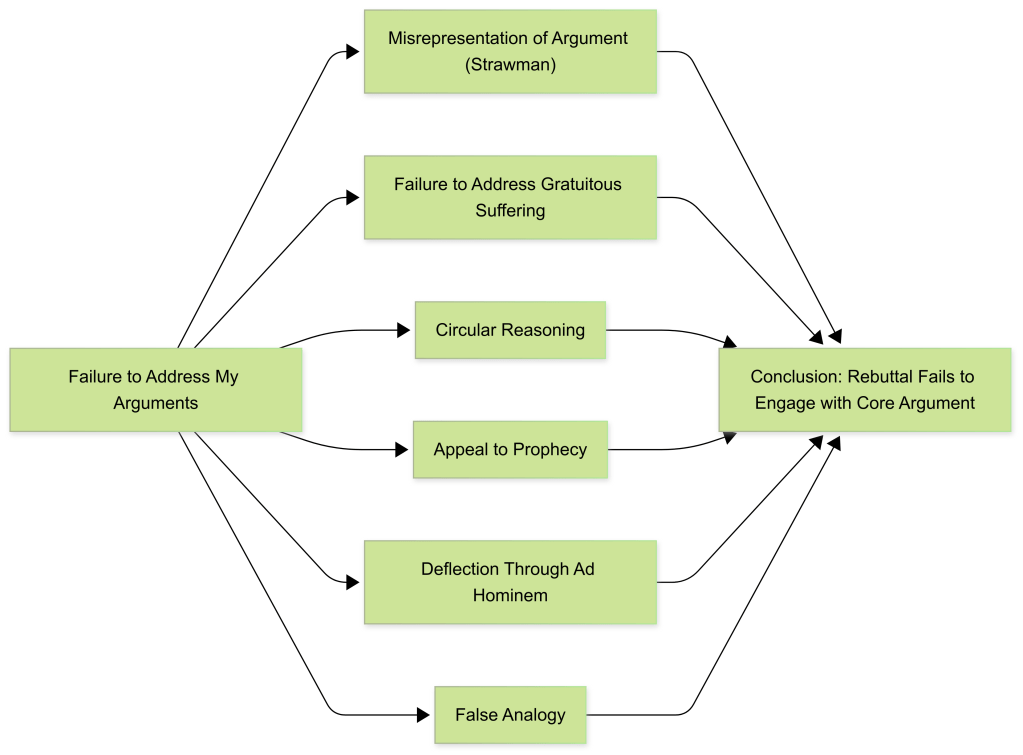
In responding to me, you completely miss the core points raised in this post. Instead of grappling with the key philosophical and theological challenges, you resort to strawman arguments and emotional rhetoric, failing to offer a coherent rebuttal. Allow me to outline how your response falls short of engaging with the arguments presented in that post.
1. Misrepresentation of the Argument (Strawman)
The post on Free of Faith raises the philosophical problem of reconciling the existence of an all-loving, all-powerful deity with the existence of needless suffering, particularly the suffering of those incapable of culpability (e.g., infants, animals). The argument emphasizes that if God were truly omnibenevolent, He would prevent gratuitous suffering, which serves no greater good.
Instead of addressing this, you dismissively reframe my position as the “misotheistic God haters club question of ‘why would a loving God let sick people and babies die.’” This trivialization overlooks the serious logical challenge posed: If God is both able and willing to prevent such suffering but does not do so, how can His claim to be loving ever be believed?
You evade this critical issue and fail to provide a meaningful response to the underlying logical problem of evil. This strawman tactic avoids intellectual engagement with the actual argument and demonstrates a lack of understanding or willingness to engage in a reasoned debate.
2. Failure to Address Gratuitous Suffering
In Romans 5:12, you quote the following:
“When Adam sinned, sin entered the world. Adam’s sin brought death, so death spread to everyone.”
Your explanation seems to rest on a “fallen world” defense: that human suffering is a consequence of Adam’s sin and free will. However, this response is deeply inadequate in light of the argument presented in the post, which challenges the very coherence of such a theological framework.
Key points you neglect:
- Why would an all-knowing, all-powerful, all-loving God create a world where one person’s sin could bring catastrophic consequences to billions of innocents?
- How does this account for non-human suffering (e.g., natural disasters, animal predation) that existed long before any human could have “fallen”?
- Even if the world is “fallen,” why does God allow unnecessary suffering when it serves no discernible greater good? The post highlights that gratuitous suffering contradicts the idea of a loving God.
You offer no substantive engagement with these issues. Instead, you repeat theological platitudes that fail to address the logical contradiction at the heart of the argument.
3. Circular Reasoning and Unsupported Assumptions
Your argument depends entirely on the presupposition that scripture is authoritative. You cite passages from Romans, Revelation, and 2 Peter as though their mere existence refutes my argument. For example, you quote:
“Then I saw ‘a new heaven and a new earth,’ for the first heaven and the first earth had passed away.”
This assumes I accept the authority and truth of the Bible, which I do not. Quoting scripture to someone who questions its divine origin is an example of circular reasoning—you are using the conclusion (the Bible’s truth) as a premise in your argument. This approach is ineffective because it fails to address the epistemological question raised in the post: Why should anyone trust that the Bible is divinely inspired?
Instead of relying solely on scripture, you should present external evidence or philosophical reasoning that justifies your theological claims.
4. Appeal to Prophecy
You imply that my skepticism fulfills Biblical prophecy by referencing 2 Peter 3:3:
“In the last days scoffers will come, mocking the truth and following their own desires.”
This is an example of an appeal to prophecy fallacy. Your argument rests on the assumption that the prophecy’s fulfillment validates the Bible’s truth. However, vague prophecies about “scoffers” or “mockers” are self-fulfilling because religious critics exist in virtually every era and context. By your reasoning, skeptics of other religions (e.g., Islam, Hinduism) could also be accused of fulfilling similar prophecies within those traditions.
For your prophecy argument to hold weight, you would need to demonstrate that it predicts something highly specific and unlikely—conditions that are not met by this broad and generic passage.
◉ You also attempt to conflate 1) the logical observation that no actual loving God would neglect the suffering of innocents with 2) scoffing or mocking. If I observe that spherical cubes are logically impossible, I am not mocking spherical cubes.
5. Deflection Through Ad Hominem
Rather than engaging with my arguments, you resort to personal attacks and ridicule. For example, you ask:
“Hey, just curious there matey, are you also a BLM supporter (Blasphemous Loathsome Mocker)?”
This comment not only attempts to insult me but also introduces irrelevant distractions into the discussion. Your insinuations about my personal beliefs do not address the core argument and instead reflect an attempt to poison the well by framing me as morally inferior or misguided.
Such tactics are logically fallacious and rhetorically unproductive. They detract from any semblance of serious dialogue and instead reveal a refusal to engage in rational debate.
6. False Analogy
You compare God’s plan to a “computer game” with multiple levels:
“It’s like a computer game, Phil, with a second level in the game.”
This analogy trivializes the issue of suffering by reducing it to a mere obstacle in a game. It fails to capture the existential and emotional gravity of real-world suffering. Analogies are meant to clarify complex ideas, but this one diminishes the profound challenge of theodicy, making your response seem dismissive and unserious.
Conclusion: Why Your Response Fails
Your response does not engage with the arguments presented in the Free of Faith post. Instead, it:
- Misrepresents the argument as a simplistic emotional objection.
- Evades the central issue of gratuitous suffering.
- Relies on circular reasoning and unsupported appeals to scripture.
- Resorts to personal attacks and rhetorical distractions.
- Makes irrelevant and trivial analogies.
If your goal is to defend your faith, you must engage with the arguments directly and respectfully. This requires moving beyond sarcasm, ad hominem attacks, and scripture quotations aimed at those who do not accept its authority. A reasoned, respectful, and logically coherent approach would demonstrate both intellectual integrity and adherence to the biblical principle of 1 Peter 3:15.
Without such engagement, your response merely reinforces the perception that religious apologetics is evasive and incapable of addressing difficult questions.
Roy, I want to encourage you to spend more time reading and reflecting on your Bible—not just skimming for familiar answers, but truly engaging with its depth and complexity. Approach it with an open mind, ready to analyze and wrestle with the difficult questions it raises. I’ve spent years doing just that, having read through the Greek New Testament 11 times, the Septuagint once, the entire Spanish Bible once, and the English Bible multiple times. This journey has helped me see both the insights and the incoherencies within Scripture—including the ways it struggles to answer key philosophical challenges. You owe it to yourself to go beyond surface-level interpretations. Examine it thoroughly, think critically, and seek coherence in what it presents. Explore the other Considerations posts here. The goal should be to move closer to truth and rational understanding, wherever that may lead.
It would be nice to see you leave the irrationality of faith and come to reason. You and I can then work together on combatting the irrationality that is seen in BLM and many other groups.


Leave a Reply