
Welcome to Free of Faith, a platform for a sincere and thoughtful examination of core Christian beliefs. We feature a special section called Considerations in which we reflect on the core assumptions of Christianity through an analysis of 52 questions. Here we carefully explore the logical coherence of various core Christian concepts.

Each Considerations post contains these elements:
- Summary: A two-sentence summary of the main content.
- Content: The primary evidence and arguments on the topic reflected in the title.
- The logical Form: Clear and salient syllogistic formulations of the arguments in the content.
- A Dialogue: A cordial dialogue between CHRIS and CLARUS on the post’s topic.
- Symbolic Logic: A link to the formalization those more philosophically inclined.
- A Companion YouTube Video: A more entertaining, visual form of the arguments.
- A Companion Spotify Podcast: A audio presentation of the arguments.
- Helpful Analogies: Three analogies that deepen understanding of the post’s content.
- The Treatment of Theological Rebuttals: The anticipated counter-arguments from theologians and matching responses side-by-side in two columns.
- Clarifications: An additional support section where you’ll find nuggets of insights directly or tangentially related to the primary content.
- A Comments Section: All readers are encouraged to offer thoughtful feedback.
You can browse the infographics of the Considerations concepts at this link.
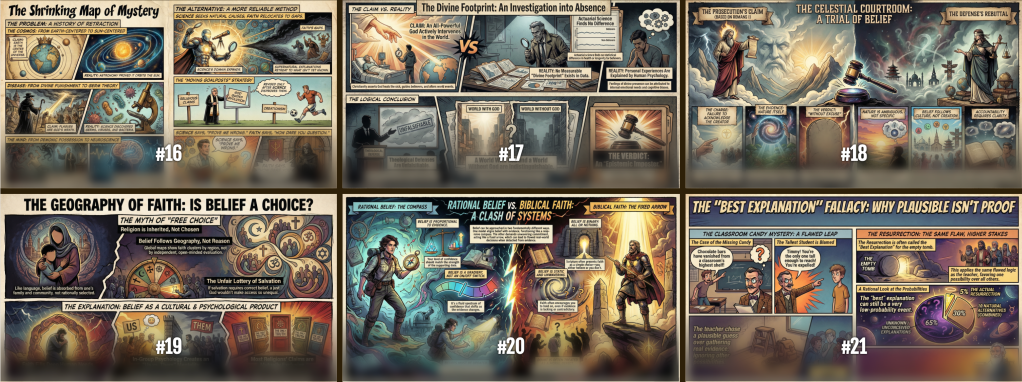
◉ Our Insights posts offer unique takes on a variety of topics relevant to faith and rationality within Christianity.
We also explore claims made in popular podcasts. We hope to provide readers with in-depth critiques that uncover logical inconsistencies, cognitive biases, and unsubstantiated assertions often found in theological discussions. We believe in the power of critical thinking and aim to foster a more analytical approach to understanding faith and spirituality.

At Free of Faith, we meticulously dissect podcast content, offering clear and concise evaluations that emphasize the importance of empirical evidence and coherent argumentation. We approach each critique from a secular and objective perspective, striving to ensure that our analyses are unbiased and well-reasoned. Whether you are a believer, a skeptic, or someone exploring different faiths, our site provides valuable insights that encourage you to think more deeply about the religious claims you encounter.
Our platform is not just about pointing out flaws; it’s about promoting a culture of intellectual curiosity and open-mindedness. We invite our readers to engage with us, share their perspectives, and join in meaningful discussions about the topics we cover. By bringing attention to the need for substantiated arguments and critical examination, Free of Faith strives to elevate the discourse around religious beliefs and practices.
Join us on this journey of discovery and analysis. Explore our extensive library of critiques, each meticulously crafted to challenge and enlighten. Whether you are looking to deepen your understanding of a particular theological issue or simply enjoy well-argued analyses, Free of Faith is here to guide you. Together, let’s navigate the complex landscape of faith with reason and clarity.
Free of Faith Content Sources for its Critiques:
Ask NT Wright Anything Podcast
Ask NT Wright Anything is a podcast that features N.T. Wright, a prominent New Testament scholar, responding to listener questions on biblical, theological, and ethical topics. For a rational non-believer, this podcast offers a chance to hear thoughtful and scholarly interpretations of Christian texts and doctrines. The show covers a wide array of subjects, from historical contexts of biblical passages to contemporary moral dilemmas. Wright’s answers, while rooted in his deep Christian faith, are presented with an academic rigor that can be appreciated regardless of one’s own beliefs. This podcast is an excellent resource for those interested in understanding the intellectual foundations of Christianity and engaging with its ideas in a nuanced and informed way.
Stand to Reason Podcast / STR Ask Podcast
The Stand to Reason Podcast, hosted by Greg Koukl, aims to equip Christians with the tools to defend and articulate their beliefs in a coherent and logical manner. Listeners of all dispositions might find this podcast interesting for understanding the intellectual framework and arguments used by Christian apologists. Koukl addresses a wide range of topics, from ethical dilemmas and theological questions to contemporary cultural issues, providing insights into how believers approach these subjects. The STR Ask Podcast complements this by offering concise responses to listener-submitted questions, making it a valuable resource for anyone curious about the Christian perspective on various issues. Together, these podcasts offer a window into the rational underpinnings of Christian apologetics, useful for anyone interested in exploring differing viewpoints and strengthening their own critical thinking skills.
Features Planned or in Development:
- An AI bot that implements Bayesian probabilities on which Christians can systematically work through their position on the resurrection
- A resources page on which seekers can explore arguments for and against the Christian God
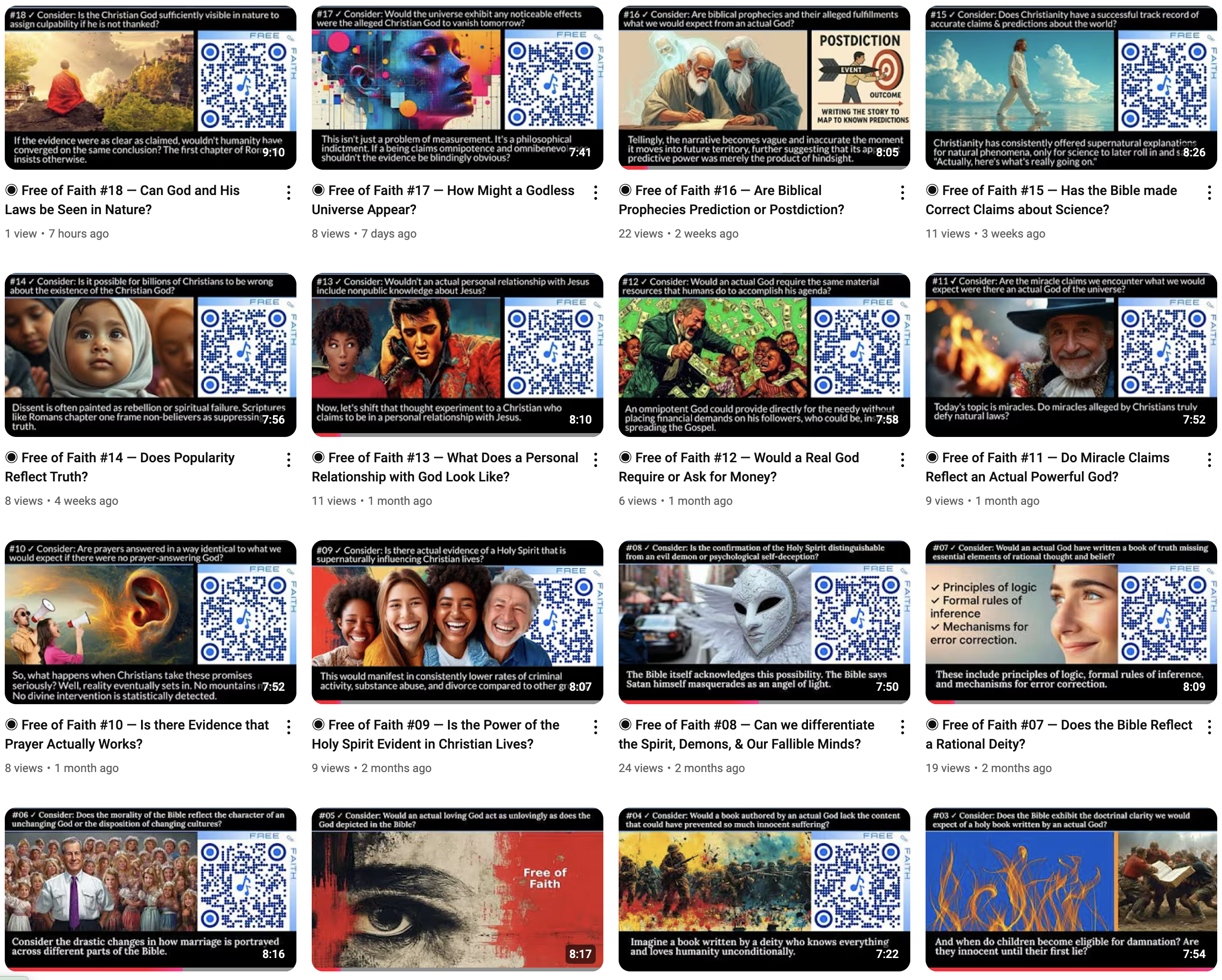
A Sampling from our YouTube Video Channel.


AI
Want to assess your apologetics content before you post or preach? Try out a GPT customized for that very task. Apologrid provides comprehensive critiques of apologetics content across many relevant dimensions.
— Requires a ChatGPT subscription.
- Considerations (52)
- Formalizations (36)
- Frank-Turek (17)
- Insights (120)
- NT-Wright (109)
- Stand-to-Reason (154)
Clicking on the category name will display the full list of the posts in that category.


 Free of Faith
Thanks for another interesting piece (as usual). I might add that even the “flying” fortress theologians have tried to build…