
The Historical Seed and the Mythological Husk:
No need to Deny the Man to Deny the God
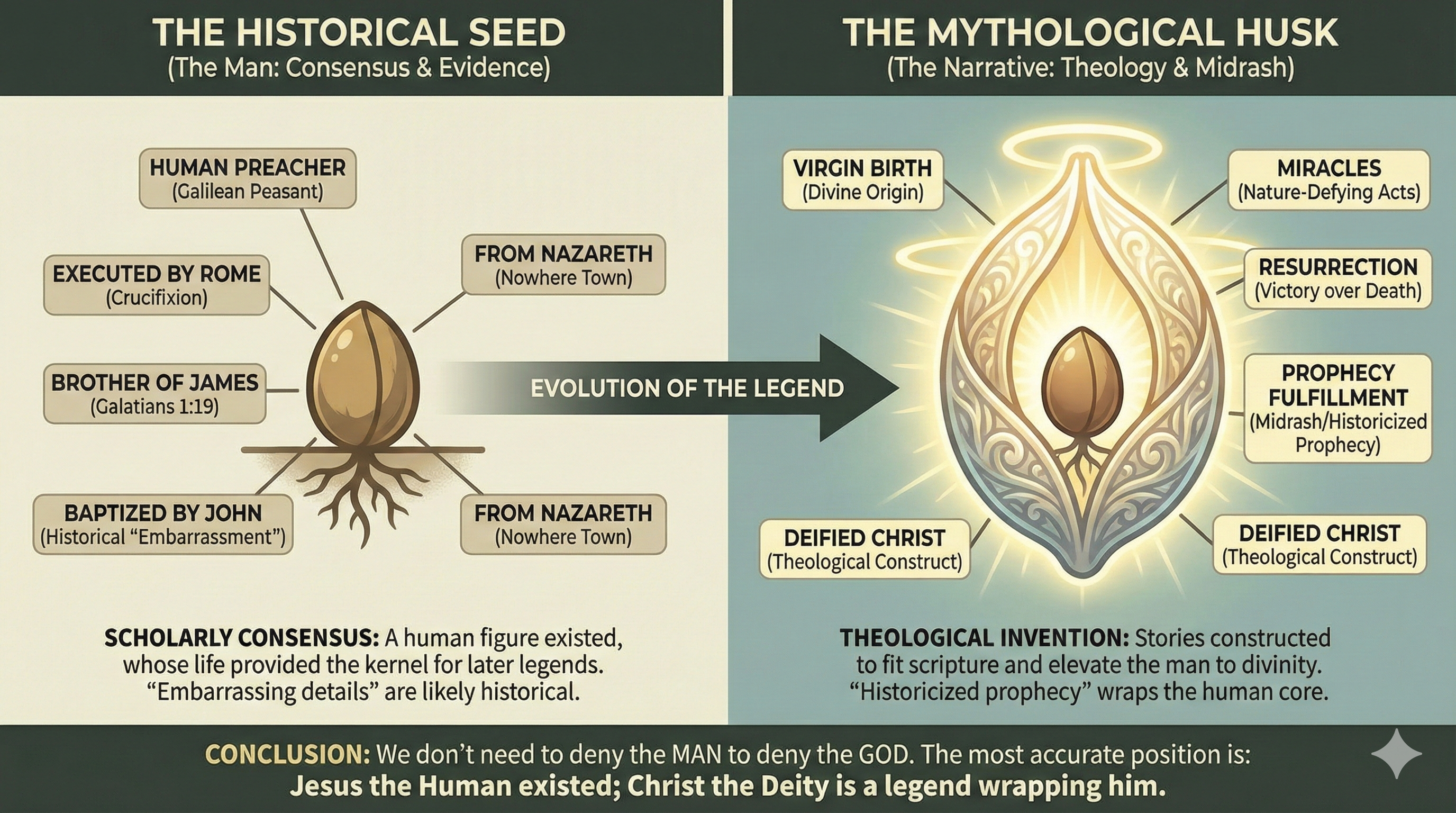
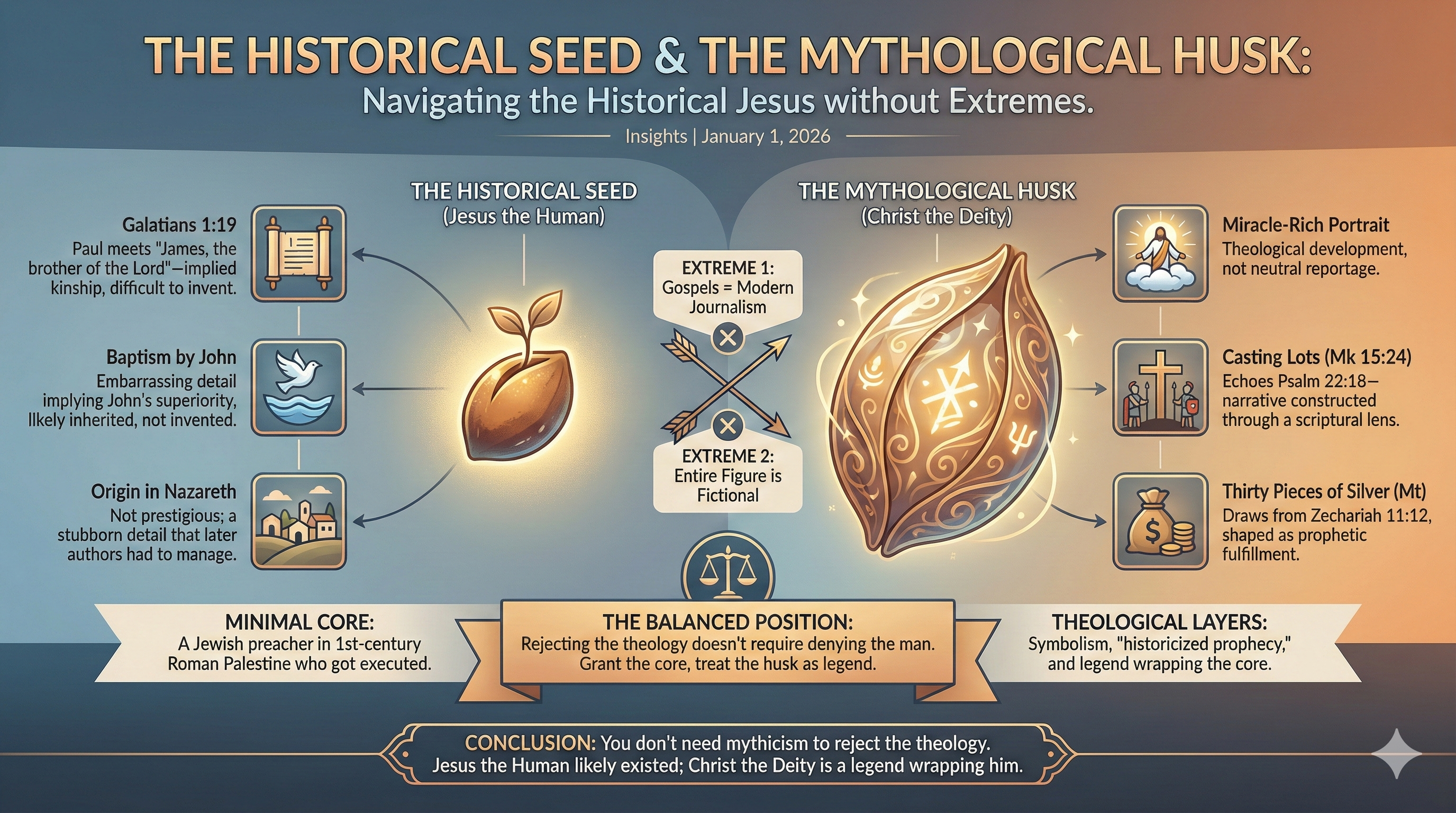
One mistake I see in debates about Jesus is the urge to swing to extremes. On one end, some people treat the Gospels like modern journalism. On the other end, some people react to Gospel invention by concluding the entire figure is fictional.
You can be right about the Gospel writers’ method without overshooting the mark on the man.
1) Yes: The Gospels often “prophecy-ize” the story
A major feature of Gospel writing is that it frequently constructs scenes to echo Israel’s scriptures—not because the author interviewed eyewitnesses, but because the author is interpreting Jesus through a scriptural lens. Call it “midrash,” call it “scripturalization,” call it “historicized prophecy”—the point is the same: scripture isn’t just quoted; it’s turned into narrative.
✓ Casting lots for clothing (Mark 15:24) reads less like reporting and more like a narrative echo of Psalm 22:18.
✓ “Thirty pieces of silver” in Matthew draws directly from Zechariah 11:12 and is shaped to look like prophetic fulfillment.
Verdict: much of the “biography” is doing theological work. The story is often built to say, “See—this fits the script.”
2) No: That doesn’t mean the historical Jesus is “doubtful”
Here’s where people overcorrect. If you claim, “Even the man probably didn’t exist,” you may feel like you’re being more rigorous—but in practice you’re usually stepping into a position that most historians of antiquity do not accept.
A cleaner, more defensible approach is:
✓ Grant a minimal human core (a Jewish preacher in 1st-century Roman Palestine who got executed).
✓ Treat the miracle-rich portrait as theological development rather than neutral reportage.
This doesn’t “concede Christianity.” It just avoids arguing yourself into a corner that serious historical debate rarely requires.
3) Why Paul’s “brother of the Lord” matters
One of the strongest early data points isn’t a late Gospel scene—it’s Paul.
In Galatians 1:19, Paul says he met “James, the brother of the Lord.” Many historians take that at face value as a reference to a real kinship relation—awkward to explain if Jesus is pure invention.
To be fair, there’s a common pushback:
✓ Some argue “brother” could be an honorific used within the movement.
But even granting that possibility, the simplest reading—especially given how Paul distinguishes people and roles in his letters—is that Paul is referring to a real figure known in the community as the Lord’s brother. If you want to deny that, you need extra machinery, and the machinery starts to look like special pleading.
4) Why “embarrassing details” keep showing up
Another reason many scholars think there’s a historical kernel: the tradition contains details that later believers had to manage, not invent.
✓ Baptized by John: it can imply John’s superiority, which later theology has to explain away.
✓ Nazareth: not “famous,” not prestigious—hardly the kind of origin story you’d choose if you were free-inventing everything.
Yes, the “criterion of embarrassment” can be overused. But it still flags an important dynamic: when later authors keep patching a detail rather than simply replacing it, that’s often a clue they inherited something stubborn.
Conclusion: a sharper, more useful position
You don’t need mythicism to reject the theology.
The most defensible position is this:
Jesus the Human likely existed; Christ the Deity is a legend wrapping him.


Leave a Reply