
The following was inspired by frequent commenter “J”.
Legendary Inflation: How Real People Acquire Impossible Biographies (Jesus and Alexander as Case Studies)
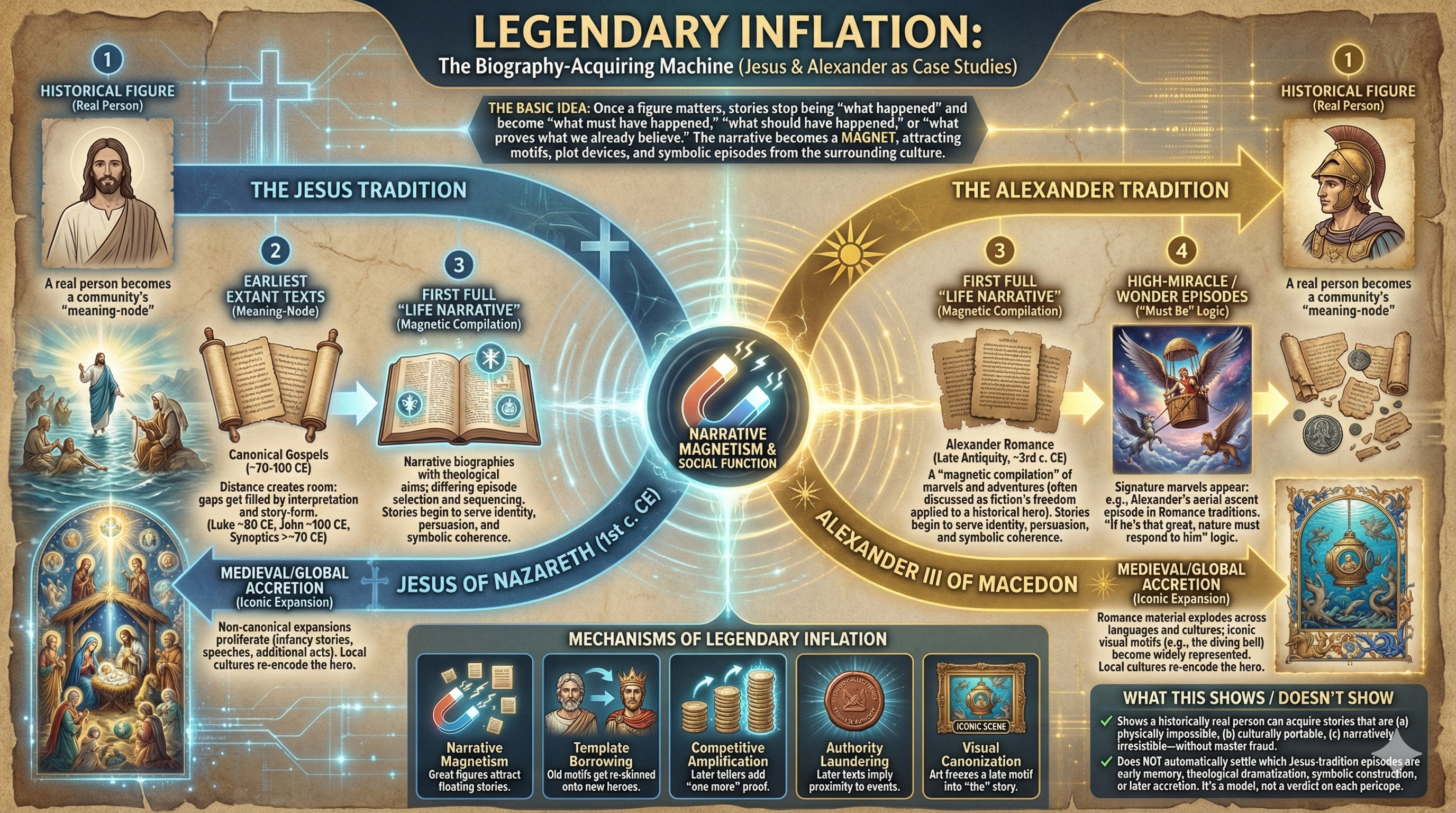
The basic idea is simple: once a community decides a figure matters, stories about that figure start behaving differently. They stop being “what happened” and become “what must have happened,” “what should have happened,” or “what proves what we already believe about him.” Over time, the narrative becomes a magnet: it attracts motifs, plot devices, and symbolic episodes from the surrounding culture.
The comparison you’re gesturing at—often made in discussions of early Christian narrative (and in adjacent scholarship about Acts as popular narrative)—is not that the Gospels are the Alexander Romance, but that both traditions display a recognizable pattern: a historical core + a widening halo of marvels + textual multiformity + later accretions that can become more “iconic” than the earlier material. (SAGE Journals)
What makes Alexander especially useful here is that nobody doubts his existence, and yet his legend becomes wildly elastic across centuries.
1) First, a crucial accuracy check
A quick online description can mislead you into thinking the Alexander Romance was written soon after Alexander’s death (323 BCE). In reality, what scholars generally mean is:
✓ Some legendary material may have begun circulating earlier, potentially even in the generations after his campaigns. (SciSpace)
✓ But the Romance as a compiled, literary “catch-all” narrative (Pseudo-Callisthenes tradition with multiple recensions and later expansions) is a much later product, commonly placed in Late Antiquity (often around the 3rd century CE for early forms of the literary Romance tradition discussed in modern scholarship). (Wiley-Blackwell)
So the clean model is: early rumor/folklore → later compilation → further medieval/global expansions.
2) Side-by-side timeline: where “inflation pressure” comes from
| Stage | Jesus tradition | Alexander tradition | What “inflates” the legend |
|---|---|---|---|
| Historical figure | Jesus of Nazareth (1st c. CE) | Alexander III of Macedon (356–323 BCE) | A real person becomes a “meaning-node” for a community |
| Earliest extant texts about the figure | The canonical Gospels are later 1st century writings (Luke typically dated around ~80 CE; John commonly placed around ~100 CE; Synoptics after the fall of Jerusalem are often dated after ~70 CE). (Encyclopedia Britannica) | Near-contemporary historiography existed but much is lost; later biographical/legendary streams flourish | Distance creates room: gaps get filled by interpretation and story-form |
| First full “life narrative” forms | Narrative biographies with theological aims; differing episode selection and sequencing | The Alexander Romance emerges as a “magnetic compilation” of marvels and adventures (often discussed as fiction’s freedom applied to a historical hero). (Wiley-Blackwell) | Stories begin to serve identity, persuasion, and symbolic coherence more than reportage |
| High-miracle / wonder episodes | Miracle cycles and dramatic signs become central to identity claims (within canonical texts and later expansions) | Signature marvels appear: e.g., Alexander’s aerial ascent episode in Romance traditions. (SciSpace) | “If he’s that great, nature must respond to him” logic takes over |
| Medieval/global accretion | Non-canonical expansions proliferate in later centuries (infancy stories, speeches, additional acts, etc.) | Romance material explodes across languages and cultures; iconic visual motifs (e.g., the diving bell/bathysphere) become widely represented. (Getty) | Local cultures re-encode the hero to match their own ideals and anxieties |
The punchline: time isn’t the only driver. The bigger driver is social function: stories that bind a community, defend status, dramatize cosmic meaning, or teach “how the world works” tend to outcompete plain recollection.
3) Concrete Alexander examples: inflation in plain sight
You can actually watch the Alexander legend “absorb” motifs:
A) Propagandistic paternity / divine framing
In Romance traditions, Alexander’s origin story can be reframed through exotic/divine paternity motifs (e.g., the Nectanebo/Olympias material in certain versions). (Attalus)
That’s not “history reporting”—it’s status amplification: the hero’s greatness must be grounded in a greatness-source.
B) The sky episode: conquest becomes cosmology
The flight/ascent story (Alexander lifted toward the heavens) is analyzed in scholarship as a legendary motif with broader Near Eastern and literary connections, and its development is debated (i.e., not securely “immediate post-323 BCE,” but plausibly later, with earlier hints and evolving forms). (SciSpace)
C) The sea episode: the hero invades nature itself
The diving bell/bathysphere motif becomes iconic in medieval and later traditions—so iconic that museums and art histories treat it as a recognizable “Alexander legend” scene. (Getty)
Importantly, this is a classic inflation pattern: once the land is “conquered,” the legend has to find new domains (sky, sea, underworld, edges of the earth).
4) Mechanisms: how legendary inflation happens
| Mechanism | What it does | Jesus-side illustration (generic) | Alexander-side illustration (documented) |
|---|---|---|---|
| Narrative magnetism | Great figures attract floating stories | A community retells to emphasize meaning | Alexander becomes a “magnetic figure” that can absorb almost anything (Wiley-Blackwell) |
| Template borrowing | Old motifs get re-skinned onto new heroes | Scriptural/literary patterning | Hero motifs expand into sky/sea exploits (SciSpace) |
| Competitive amplification | Later tellers add “one more” proof | More signs, sharper drama | Recensions and cultural reworkings proliferate (Attalus) |
| Authority laundering | Later texts imply proximity to events | “We have the true account” posture | Pseudonymous framing (“Pseudo-Callisthenes”) and compilation authority (Wiley-Blackwell) |
| Visual canonization | Art freezes a late motif into “the” story | Iconography stabilizes a narrative | Diving bell becomes a standard scene in manuscript art (The Public Domain Review) |
5) What this comparison does and doesn’t show
What it shows well:
✓ A historically real person can acquire stories that are (a) physically impossible, (b) culturally portable, and (c) narratively irresistible—without anyone forging a single “master fraud.” Alexander is the clean demonstration. (Wiley-Blackwell)
What it does not show by itself:
✓ It doesn’t automatically settle which Jesus-tradition episodes are early memory, theological dramatization, symbolic construction, or later accretion. It gives you a model of how traditions behave, not a verdict on each pericope.
6) The practical takeaway
If you want a crisp thesis line, it’s this:
Legendary inflation is what happens when a community’s need for meaning, identity, and persuasion has more “selection power” than careful memory does—and when narrative templates are readily available to fill gaps.
Alexander lets you demonstrate the mechanism with an uncontested historical anchor. Then you can bring that mechanism back to the Gospels carefully: not as an accusation, but as a historically literate reminder that ancient biography and popular narrative often occupy a spectrum between report and meaning-making—a point that shows up explicitly in genre debates around early Christian narrative as well. (SAGE Journals)
A Detailed Jesus/Alexander Comparison Chart:



Leave a Reply