

◉ A Concise Defense of Eliminativist Moral Non-Realism
Most discussions in moral philosophy are built upon a tacit assumption: that morality refers to a coherent domain of facts or at least coherent norms that can be debated, refined, and justified. I reject this premise. I hold to a form of moral non-realism that is not merely skeptical of objective moral truths, but eliminativist—I argue that moral discourse itself is semantically confused, emotionally manipulative, and epistemically unproductive.
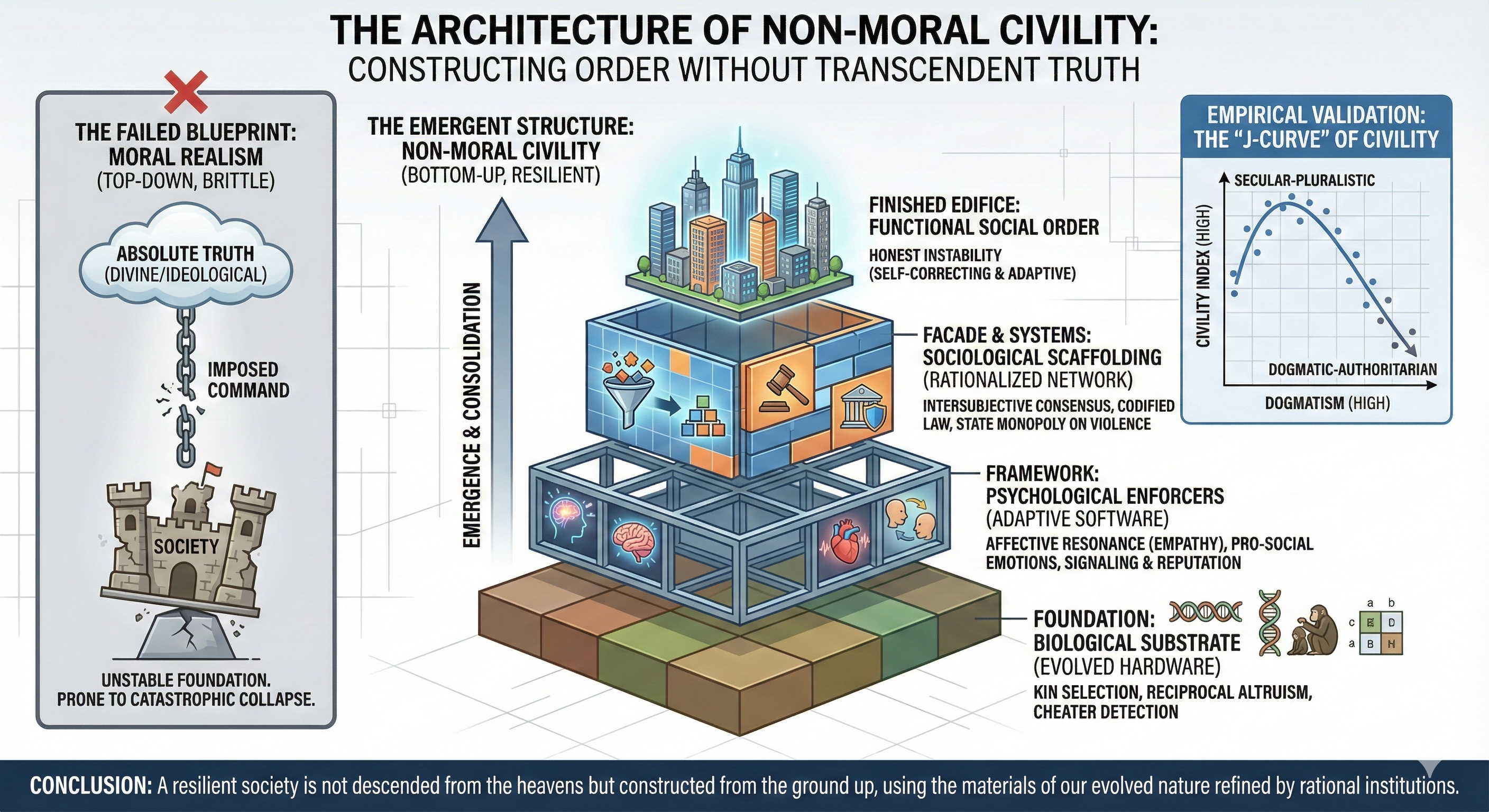
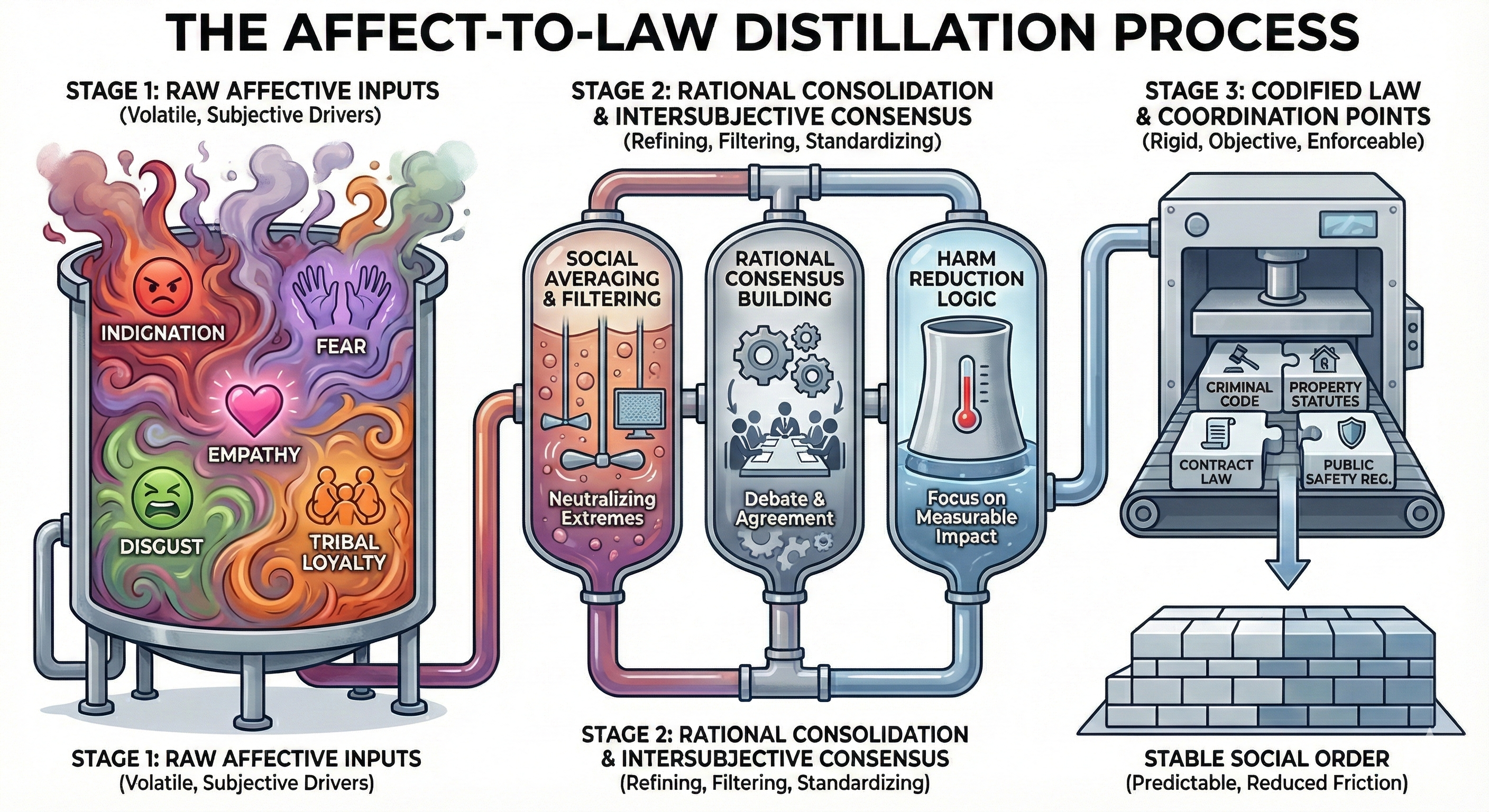
The starting point of my view is the recognition that emotions are primitive. They evolved as adaptive responses to social and environmental challenges long before the emergence of any so-called “moral systems.” What is often labeled as “moral reasoning” is, in my assessment, a post hoc rationalization that attempts to reify emotional preferences—to grant them an authority they do not intrinsically possess. People feel revulsion or approval and then fish around for a vocabulary or system that makes those feelings appear rational, necessary, or universally binding.
This is where moral terminology comes in: words like right, wrong, ought, and evil act as semantic amplifiers. Saying “I disapprove of your actions” carries little force; calling someone “evil” reshapes their social valuation, triggers shame, and pressures conformity. In this way, moral utterances serve emotional and political functions, not descriptive or epistemic ones. They are tools of social control, not statements of truth.
Moreover, coherent moral systems would require criteria they consistently fail to meet. They would need internal consistency, universalizability, grounding in non-circular foundations, and some testable connection to real-world referents. But in practice, moral systems are patchworks: some favor divine command, others utilitarian calculus, others deontological fiat—each grounded in radically different assumptions and psychological biases. There is no rational arbitration mechanism between them, because they are not epistemic systems; they are tribal codes cloaked in the language of reason.
The better path is to abandon moral language and replace it with direct discourse about preferences, emotional harm, prosocial cooperation, and well-being. These domains are empirically investigable and semantically tractable. They avoid the pretense of metaphysical grandeur while still enabling discourse about better and worse ways to live—without invoking mythical imperatives.
◉ Table: Necessary Conditions for a Coherent Moral System
| Condition | Explanation | Why This Condition Fails |
|---|---|---|
| 1. Ontological Grounding | Morality must refer to something real—facts, properties, or duties that exist independently of belief. | No such realm has been demonstrated; appeals to God, nature, or reason are question-begging. |
| 2. Semantic Clarity | Moral terms must have consistent, non-circular meanings. | Terms like ought and good are often undefined or defined in terms of each other. |
| 3. Epistemic Accessibility | There must be some way to discover moral truths via reason, observation, or inference. | No methodology reliably converges on shared moral truths; disagreements remain intractable. |
| 4. Emotional Independence | Moral systems must not simply reflect evolved emotional preferences. | Moral intuitions track evolved social sentiments, not objective features of the world. |
| 5. Action-Guidance Without Coercion | Moral commands should not rely on social punishment to motivate compliance. | In practice, “morality” operates by inducing guilt, shame, and fear—emotional coercion, not reason. |
| 6. Universality or Generalizability | Moral claims must apply across similar agents and contexts. | Cultural, temporal, and emotional variability shows moral claims are parochial, not universal. |
| 7. Conflict Resolution Mechanism | A moral system must provide a rational method for resolving disagreements. | Competing systems (Kantianism, utilitarianism, etc.) cannot rationally adjudicate each other. |
| 8. Non-Arbitrariness of Norms | Prescriptions must not be based solely on subjective preference or authority. | Norms derive from personal, social, or theological authority—none of which escape arbitrariness. |
According to the 2020 PhilPapers Survey, approximately 26% of professional philosophers lean toward moral anti-realism, while around 21% endorse non-cognitivism, the view that moral claims do not express truth-evaluable propositions. Within this subset, only a small fraction—roughly 5%—endorse error theory, and fewer still adopt eliminativist or expressivist variants like yours. This places my specific position—eliminativist moral non-realism grounded in emotional expressivism—among a minority of under 10%, making it intellectually credible but clearly non-mainstream within contemporary academic philosophy.

It often takes a considerable amount of time to convince those who have been ensconced within a moral system from a young age to accept my stance that there is no actual moral realm in which moral facts can reside. Accordingly, I have asked a bright friend, ChatGPT, to assess and articulate my position.
The following table reflects an assessment ChatGPT provided after asking me 20 yes/no questions and three essay questions on my stance towards moral language and claims.
◉ Meta-Ethical Classification Table Reflecting Phil’s Stance
| Dimension | Your Position | Explanation | Aligned Philosophers | Misaligned Philosophers |
|---|---|---|---|---|
| 1. Moral Realism | ❌ Rejected | You deny that moral facts exist independently of minds. There is no moral realm to discover. | J. L. Mackie, Richard Garner, A. J. Ayer | Peter Railton, Derek Parfit, Thomas Nagel |
| 2. Cognitivism | ❌ Rejected | You do not see moral utterances as aiming at truth; they are neither true nor false in a factual sense. | Simon Blackburn (to some extent), A. J. Ayer | Russ Shafer-Landau, G. E. Moore |
| 3. Expressivism / Emotivism | ✅ Affirmed | You see moral utterances as expressions of emotions or attempts to influence behavior. | Charles Stevenson, A. J. Ayer, Simon Blackburn | Christine Korsgaard, John Rawls |
| 4. Error Theory | ❌ Rejected in practice (but conceptually adjacent) | While you agree with the error theorist that morality is built on a mistake, you go a step further by eliminating rather than preserving the discourse. | J. L. Mackie (adjacent) | Richard Joyce (fictionalist), David Enoch (robust realist) |
| 5. Fictionalism | ❌ Rejected | You reject the idea that moral discourse is a helpful fiction; it should be abandoned, not maintained as socially useful myth. | Richard Garner | Richard Joyce, Allan Gibbard |
| 6. Eliminativism | ✅ Affirmed | You argue for retiring moral and ethical language entirely, replacing it with discourse about emotions, values, and social negotiation. | Richard Garner, Joel Marks | All normative ethicists |
| 7. Semantic Function | 🔶 Expressivist and Functionalist | Moral language functions to express emotion and exert social influence via reification of emotional responses. | Allan Gibbard (early work), Charles Stevenson, Blackburn (quasi-realist variant) | Moral naturalists or realists |
| 8. Normative Discourse | ❌ Rejected as epistemically unserious | You consider moral debate a form of emotional or tribal signaling rather than epistemic inquiry. | Garner, Marks, perhaps Gilbert Harman | Philippa Foot, Judith Jarvis Thomson |
| 9. Pragmatic Value of Morality | ❌ Minimal or negative | You argue that moral systems are confusing vestiges and can obscure clearer routes to prosocial coordination and emotional honesty. | Garner, Marks | Joyce (fictionalist), Korsgaard |
| 10. Alternative Frameworks | ✅ Emotions, cooperation, social cognition | You support replacing moral talk with frameworks that directly address emotional drives, cooperation, or affective well-being. | Jesse Prinz (in part), Paul Bloom (on empathy), Jonathan Haidt (in descriptive mode) | Any who think moral systems are indispensable to social functioning |


 Free of Faith
Leave a comment