Click for larger version.

A fresh case study on this topic: https://freeoffaith.com/batting-for-beelzebub/

The Apologist as Unwitting Double Agent:

In the domain of religious discourse, the stated objective of Christian apologetics is typically the persuasion of the non-believer or the defense of the faith against intellectual critique. However, a pervasive sociopsychological phenomenon suggests that a significant subset of apologetic engagement is counter-productive. When the methodology of the apologist involves hostility, arrogance, or ad hominem attacks, they cross a theoretical threshold where they cease to be advocates for their position and effectively become assets for the opposing worldview. This dynamic, which we can term the Repellent Effect, suggests that the character of the messenger can possess a negative value high enough to cancel out the logical positive value of the argument.

The Sociopsychology of Self-Sabotage

The failure of hostile apologetics is not merely a matter of poor etiquette; it is a structural failure of the persuasive mechanism. It operates through three distinct vectors.

1. Performative Certainty and Out-Group Derogation

Many interactions on digital platforms are driven by a desire for in-group signaling rather than genuine persuasion. The apologist acts not to convince the skeptic, but to demonstrate strength and purity to fellow believers. In this context, cruelty is not a strategic error; it is a signaling mechanism. However, for the non-believing observer, this manifests as out-group derogation. The interaction shifts from a dialectic on truth to a display of tribal dominance.

2. The Incoherence of the Messenger

Christianity posits a specific metaphysical claim regarding the transformation of the human character. The doctrine asserts that the indwelling of the Holy Spirit produces specific ontological changes, historically categorized as the Fruit of the Spirit (love, patience, gentleness). When an apologist displays traits diametrically opposed to these—malice, impatience, arrogance—they provide empirical evidence against their own metaphysics. They are falsifying their doctrine in real-time. The skeptic observes a disconnect between the product description (a transformed life) and the actual product (the hostile interlocutor).

3. Inductive Density and Reactance

When an interlocutor perceives a threat to their intellectual autonomy via aggression or condescension, the psychological response is Reactance. The listener solidifies their current position to preserve their agency. Furthermore, repeated exposure to mean-spirited apologists builds what can be called Inductive Density. The skeptic begins to inductively reason that if n number of believers behave with hostility, the worldview itself likely incentivizes or fails to correct such behavior.

Modeling the Threshold of Counter-Evangelism

To understand when an apologist becomes a functional asset for the skepticism community, we can establish a theoretical model of Net Persuasion Value (NPV).

If we view an apologetic interaction as a transaction intended to transfer belief credibility, the outcome is determined by the quality of the argument minus the interaction costs imposed by the apologist’s behavior. We can express this relationship with the following equation:

NPV = A_{cogency} - \left( H_{ostility} \times I_{nconsistency} \right)

In this function:

A_{cogency} represents the logical soundness and intellectual rigor of the argument presented.

H_{ostility} represents the coefficient of aggression, sarcasm, or condescension in the delivery.

I_{nconsistency} represents the perceived gap between the apologist’s behavior and the ethical mandates of their specific theology (e.g., the command to provide a defense with gentleness).

The theoretical threshold where an apologist essentially joins the other team occurs when:

\left( H_{ostility} \times I_{nconsistency} \right) > A_{cogency}

When this inequality holds true, the NPV becomes negative. The interaction does not merely fail to persuade; it actively subtracts credibility from the Christian worldview.
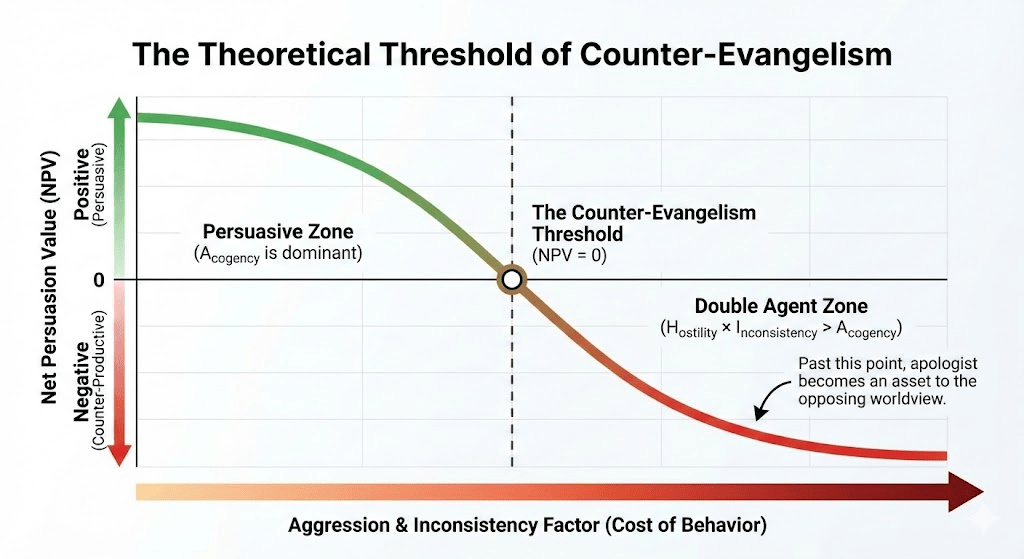
The Double Agent Threshold

Once the NPV drops below zero, the apologist triggers two specific failure states that aid the skeptic.

Reputational Contagion

At this stage, the observer concludes that mean-spiritedness is not an anomaly (a bug) but a feature of the system. The apologist has effectively immunized the skeptic against future evangelism. The skeptic no longer listens to the arguments of A_{cogency} because the source has been deemed epistemically untrustworthy due to moral failing.

Validation of Secular Moral Superiority

If the non-believer maintains composure while the apologist descends into vitriol, a comparative moral judgment occurs. The non-believer demonstrates the emotional regulation and charity that the Christian claims are supernatural fruits of their faith. By exhibiting superior behavior without the religious framework, the skeptic empirically invalidates the necessity of that framework.

Vice Subsidization

Ultimately, the mean-spirited apologist engages in a form of Vice Subsidization for the non-believing community. By lowering the intellectual cost required to reject the faith, they subsidize the skepticism of the observer. The non-believer does not need to engage in the laborious task of refuting complex ontological arguments; they need only point to the behavior of the messenger.

In game theory terms, the hostile apologist alters the payoff matrix. They make the rejection of Christianity a high-reward, low-effort move for the skeptic. The theoretical threshold is reached precisely when the behavior of the believer becomes a more compelling argument against the religion than their words could ever be for it.


One response to “✓ The Repellent Effect in Apologetics”

  1. J Avatar
    J

      Appreciated this piece. It was strangely timely given that I just recently went through the website of an “intellectual” apologist who exemplifies the aforementioned vitriol almost to a tee, it was strangely timely. (The site featured “my scholars are better than your scholars,” “Jesus will return when enough people repent,” and “once wrong, wrong in the future” lines of thought along with crude remarks toward skeptics’ responses. What was most egregious in my mind was a sort of calculus involving counting deceased scholars vs. living ones and asserting that only the later formed part of the consensus.)

       I related to the point about skeptics maintaining composure in the face of hostility and thus implicitly serving as a counter-demonstration to Christian understandings of religious moral superiority for the believer. (I think it is typical- though certainly not universal-among Christians to think that possessing an indwelling Holy Spirit or feeling persecuted validates this attitude.)

    A word of caution is in order for skeptics in general, though. I think because of the uncivil behavior displayed by select skeptics (who are sometimes portrayed almost as poster boys for the whole movement), they need to be really careful to maintain their composure and humility so as not to give believers more ammunition to use in their accusations against skepticism or free-thought.

    Also wanted to apologize if my comments seem excessive or as if I’m just being laudatory. I enjoy these pieces and just wish more skeptics (and believers) were aware of the material on the site. (Coming across the original Sufficient Reasons page in ‘23 was one of the strongest justifications for my skepticism and might just be the best written set of arguments on the web in regards to religion.)

Leave a comment

Recent posts

  • The Outrage Trap: In discussions about ethics and theology, there is a ubiquitous category error that frequently paralyzes rational discourse. It is the assumption that because a violation of justice triggers a profound feeling of moral abhorrence, then justice and morality must be ontologically the same thing. This error leads…

  • Isn’t the killing of infants always best under Christian theology? This post demonstrates that the theological premises used to defend biblical violence collapse into absurdity when applied consistently. If your theology implies that a school shooter is a more effective savior than a missionary, the error lies in the theology.

  • This article discusses the counterproductive nature of hostile Christian apologetics, which can inadvertently serve the skepticism community. When apologists exhibit traits like hostility and arrogance, they undermine their persuasive efforts and authenticity. This phenomenon, termed the Repellent Effect, suggests that such behavior diminishes the credibility of their arguments. As a…

  • The post argues against the irreducibility of conscious experiences to neural realizations by clarifying distinctions between experiences, their neural correlates, and descriptions of these relationships. It critiques the regression argument that infers E cannot equal N by demonstrating that distinguishing between representations and their references is trivial. The author emphasizes…

  • The article highlights the value of AI tools, like Large Language Models, to “Red Team” apologetic arguments, ensuring intellectual integrity. It explains how AI can identify logical fallacies such as circular reasoning, strawman arguments, and tone issues, urging apologists to embrace critique for improved discourse. The author advocates for rigorous…

  • The concept of the Holy Spirit’s indwelling is central to Christian belief, promising transformative experiences and divine insights. However, this article highlights that the claimed supernatural benefits, such as unique knowledge, innovation, accurate disaster predictions, and improved health outcomes, do not manifest in believers. Instead, evidence shows that Christians demonstrate…

  • This post examines the widespread claim that human rights come from the God of the Bible. By comparing what universal rights would require with what biblical narratives actually depict, it shows that Scripture offers conditional privileges, not enduring rights. The article explains how universal rights emerged from human reason, shared…

  • This post exposes how Christian apologists attempt to escape the moral weight of 1 Samuel 15:3, where God commands Saul to kill infants among the Amalekites. It argues that the “hyperbole defense” is self-refuting because softening the command proves its literal reading is indefensible and implies divine deception if exaggerated.…

  • This post challenges both skeptics and Christians for abusing biblical atrocity texts by failing to distinguish between descriptive and prescriptive passages. Skeptics often cite descriptive narratives like Nahum 3:10 or Psalm 137:9 as if they were divine commands, committing a genre error that weakens their critique. Christians, on the other…

  • In rational inquiry, the source of a message does not influence its validity; truth depends on logical structure and evidence. Human bias towards accepting or rejecting ideas based on origin—known as the genetic fallacy—hinders clear thinking. The merit of arguments lies in coherence and evidential strength, not in the messenger’s…

  • The defense of biblical inerrancy overlooks a critical flaw: internal contradictions within its concepts render the notion incoherent, regardless of textual accuracy. Examples include the contradiction between divine love and commanded genocide, free will versus foreordination, and the clash between faith and evidence. These logical inconsistencies negate the divine origin…

  • The referenced video outlines various arguments for the existence of God, categorized based on insights from over 100 Christian apologists. The arguments range from existential experiences and unique, less-cited claims, to evidence about Jesus, moral reasoning, and creation-related arguments. Key apologists emphasize different perspectives, with some arguing against a single…

  • Dualism, which posits distinct physical bodies and non-physical minds, struggles with explanatory depth and testable implications. Evidence shows systematic links between mental and neural states; brain alterations directly influence cognition and consciousness. Without a coherent mechanism for dualism’s interaction, neuroscience’s physical models effectively account for mental phenomena. Ultimately, cognitive abilities…

  • This analysis critiques messianic prophecies listed on social media, highlighting the methodological issues underpinning claims that Jesus fulfilled these predictions. It identifies tactics such as context-swapping and poetic flattening used by Gospel authors to reinterpret Old Testament passages. The audit evaluates 24 traditional prophecies, revealing failures in predictive nature, independent…

  • The concept of epistemic inflation warns against accepting vague, undefined hypotheses as serious possibilities in reasoning. True admissibility requires coherence, a defined interface with reality, and evaluability based on evidence, logic, or probability. It’s crucial to reserve a portion of probability for unknowns to avoid overcommitting to familiar hypotheses. Many…

  • This post critiques dual-agent theism’s explanatory framework, arguing it appears strong but is fundamentally weak. The system labels every event as being caused by God, Satan, or humans, rendering it unfalsifiable and sterile. It lacks the capacity for genuine understanding and revision when faced with new evidence, ultimately preventing real…