

Consider the Following:
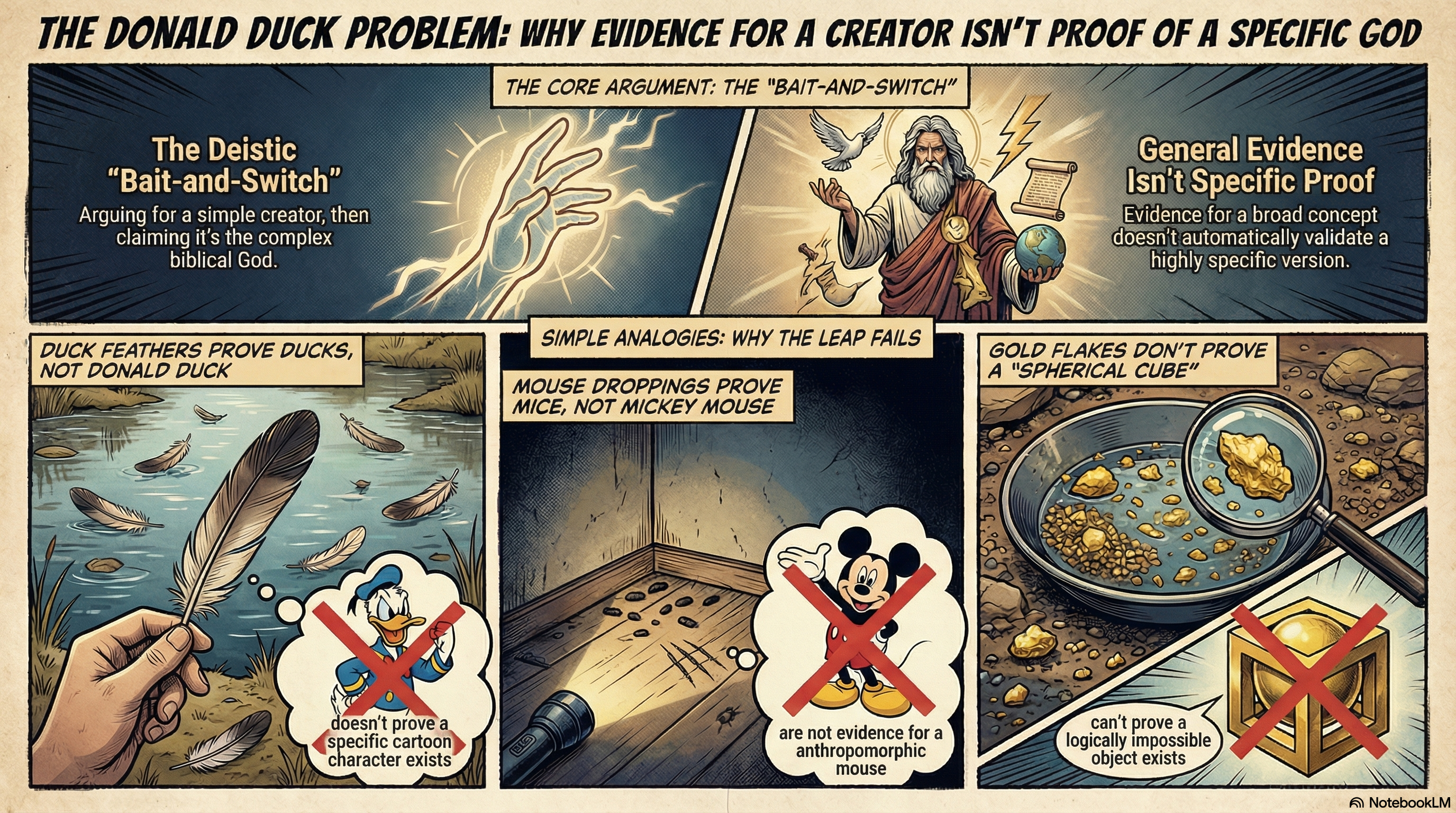
Summary: Evidence for a deistic creator may lend support to various notions of deistic gods but does not substantiate specific claims about a theistic deity, such as the biblical God. Applying consistent inductive reasoning—such as the dependence of minds on physical brains, the lack of interaction by non-physical entities, and the emergence of complexity through natural processes—further reveals the logical contradictions and lack of empirical support for such a deity’s attributes.

Imagine a child, Tommy, believes a loving ghost named Oscar resides under his bed but tortures him nightly. Suppose experts confirm the presence of a ghost causing the torment. Does this validation of a ghost’s existence make Tommy’s specific claim about a loving ghost named Oscar more credible? Most would argue it does not—how can a loving entity inflict harm? Similarly, evidence supporting a deistic first cause—a creator who set the universe in motion but does not intervene—does not necessarily increase the likelihood of a theistic God, such as Jehovah, Allah, or Zeus, especially when these deities are described with attributes that are logically inconsistent.
Evidence for Ducks, But Not Donald or Daffy
Imagine finding duck feathers scattered around a pond. This discovery strongly supports the presence of ducks in the area. However, claiming these feathers are evidence for the existence of Donald Duck—an anthropomorphic cartoon character—is an entirely different matter. While duck feathers provide evidence for real ducks, they do nothing to validate the extraordinary and highly specific claims about a fictional character like Donald Duck. Similarly, evidence for a deistic creator—a first cause or cosmic initiator—supports the idea of some form of creation but does not substantiate the existence of a specific deity, such as the biblical God, with extraordinary attributes like omniscience, omnipotence, and omnibenevolence. The leap from general evidence to highly specific claims remains unsupported.

Inherent Contradictions Undermine Claims
Now imagine Mike claims to possess a “spherical cube” of gold. Even if Mike pulls gold flakes from his pocket, this does not substantiate his claim of owning a spherical cube because the concept itself is a contradiction. Gold might exist, but a “spherical cube” does not. In the same way, evidence for a creator does not bolster the claim of the biblical God if the biblical God’s attributes are logically incoherent, such as being all-loving, all-powerful, and yet allowing unnecessary suffering.
Relevant Link: Is Jesus Fully God and Fully Human?
The Deistic Bait-and-Switch

Few dispute the possibility of a deistic god—a first cause or cosmic initiator. However, Christian apologists often use arguments for a deistic creator to deflect scrutiny from the logical incoherence of the biblical God. This tactic is akin to Mike defending his “spherical cube” by presenting gold flakes. While gold flakes may be real, they do nothing to resolve the contradiction of a “spherical cube.” Similarly, appealing to a deistic creator does not resolve contradictions inherent in theistic claims. These diversions should be met with skepticism.
Applying Inductive Reasoning Consistently
Inductive reasoning can suggest the necessity of a creator (seen in arguments based on the fine-tuning of universal constants, and the cause-and-effect relationships inherent in physical phenomena), but when applied consistently, it challenges traditional attributes assigned to a theistic God:


- Minds Are Dependent on Physical Brains
- Observation: All known consciousness is tied to physical brains; neuroscience shows mental states correlate with brain activity.
- Implication: The concept of an immaterial, omniscient mind existing without a physical brain contradicts all observed evidence.
- Non-Physical Entities Do Not Interact with the Physical World
- Observation: Physical effects require physical causes; no empirical evidence shows non-material entities influencing physical systems.
- Implication: Suggesting that a non-material deity interacts with the physical world defies our understanding of causation.
- Causation Occurs Within Space and Time
- Observation: All cause-and-effect relationships occur within space-time dimensions.
- Implication: A cause existing outside space and time initiating events within it conflicts with every observed instance of causality.
- Complexity Arises from Simpler Processes
- Observation: Complex systems develop from simpler ones through natural processes like evolution.
- Implication: Proposing a supremely complex deity existing without prior development contradicts observed patterns of complexity emerging over time.
- All Known Beings Are Finite and Limited
- Observation: Every observed entity has limitations in power, knowledge, and presence.
- Implication: An infinite, omnipotent being is outside empirical experience, making its existence less probable based on inductive reasoning.
- Evidence of a Deistic God Does Not Imply a Theistic God
- Observation: Evidence for a creator at best points to an initiating force, not a deity with specific attributes like omnipotence, omniscience, or benevolence.
- Implication: Even if evidence supports a deistic god, this does not validate the highly specific claims of the biblical God, just as evidence of mouse droppings does not confirm the existence of Mickey Mouse.
Conclusion

Evidence for a deistic god—like evidence of a ghost or mouse droppings—may point to a broader concept (a creator or mice), but it does nothing to substantiate highly specific claims about a particular entity (a loving ghost or Mickey Mouse). When logical contradictions and inductive reasoning are applied consistently, the attributes ascribed to the biblical God fail to align with observed reality. Just as mouse droppings do not make Mickey Mouse more probable, evidence for a deistic creator does not make the biblical God more likely.
See also:
The Logical Form
Argument 1: Evidence for a Deistic Creator Does Not Validate Theistic Claims
- Premise 1: Evidence for a general creator (e.g., a deistic god) only supports the concept of a non-specific initiator of the universe.
- Premise 2: Specific theistic deities, like the biblical God, include extraordinary attributes (e.g., omniscience, omnipotence, omnibenevolence) that go beyond the evidence for a deistic creator.
- Conclusion: Evidence for a deistic creator does not substantiate the existence of a specific theistic deity.

Argument 2: Logical Contradictions Undermine Theistic Claims
- Premise 1: Theistic deities are often described with logically inconsistent attributes, such as being all-loving and all-powerful while permitting unnecessary suffering.
- Premise 2: Logically contradictory concepts cannot exist, as they defy the principle of non-contradiction.
- Conclusion: The existence of a theistic deity with logically inconsistent attributes is implausible.
Argument 3: Evidence for Mice (or Ducks) Does Not Imply Mickey Mouse (or Donald Duck)
- Premise 1: Evidence for the existence of ordinary entities (e.g., duck feathers for ducks) supports general claims about those entities.
- Premise 2: Specific claims about extraordinary entities (e.g., Donald Duck, an anthropomorphic character) require additional, specific evidence.
- Conclusion: Evidence for general entities does not substantiate extraordinary claims about specific entities.
Argument 4: Minds Depend on Physical Brains
- Premise 1: All known instances of consciousness are tied to physical brains, as demonstrated by neuroscience.
- Premise 2: Theistic claims often describe a disembodied, immaterial mind, such as an omniscient God, without physical substrate.
- Conclusion: The concept of an immaterial, disembodied mind is inconsistent with empirical evidence.
Argument 5: Non-Physical Entities Cannot Interact with the Physical World
- Premise 1: All observed interactions in the physical world involve physical entities and forces.
- Premise 2: There is no empirical evidence that non-physical entities can cause physical effects
- Conclusion: Claims of non-physical entities (e.g., a deity) influencing the physical world lack empirical support.
Argument 6: Complexity Arises from Simpler Processes
- Premise 1: Complex systems in the natural world emerge from simpler processes, such as evolution.
- Premise 2: Theistic claims often describe a deity as a supremely complex entity existing without prior development.
- Conclusion: The idea of a supremely complex deity contradicts observed patterns of complexity arising over time.
Argument 7: Evidence of a Deistic Creator Does Not Imply a Theistic Creator
- Premise 1: Evidence for a deistic creator supports the idea of a non-intervening initiator of the universe.
- Premise 2: Theistic deities are defined by specific actions, interventions, and attributes not inherent in the concept of a deistic creator.
- Conclusion: Evidence for a deistic creator does not substantiate claims about the existence of a theistic creator.
(Scan to view post on mobile devices.)

A Dialogue
Evidence for a Creator vs. Theistic Claims
CHRIS: The universe’s complexity and fine-tuning are compelling evidence for a creator. Doesn’t that increase the likelihood of the biblical God being real?
CLARUS: Evidence for a creator—even if accepted—only supports the existence of a general cause or an initiator of the universe. This is far from proving the existence of a specific deity like the biblical God, with extraordinary attributes such as omniscience, omnibenevolence, and omnipotence. It’s like finding duck feathers at a pond and claiming that proves Donald Duck exists. Evidence for ducks is not evidence for an anthropomorphic cartoon character, just as evidence for a creator does not validate specific theistic claims.
CHRIS: But wouldn’t the very existence of a creator suggest qualities like omniscience or omnipotence? After all, creating the universe seems to require immense power and knowledge.
CLARUS: That assumption is unwarranted. Many theistic claims involve logical contradictions that undermine their credibility, even if a creator exists. For example, a deity described as both all-loving and all-powerful yet allowing unnecessary suffering presents an irreconcilable contradiction. A being cannot simultaneously possess those attributes in light of observable reality. Such contradictions make the biblical God implausible, even if we acknowledge the possibility of a creator. A self-contradictory concept, like a “spherical cube,” cannot exist.
CHRIS: What about the idea of an immaterial mind? Couldn’t the creator be an omniscient mind, operating outside physical reality?
CLARUS: That idea conflicts with everything we know about consciousness. All known minds are dependent on physical brains, as demonstrated by neuroscience. Mental states correspond to brain activity, and no examples of disembodied, immaterial minds exist. Claiming the creator is a mind detached from physical reality lacks any basis in empirical evidence and directly contradicts our understanding of how minds function.
CHRIS: But couldn’t a non-physical entity interact with the physical world to create the universe?
CLARUS: There’s no evidence that non-physical entities can cause physical effects. Every observed interaction in the physical world involves physical forces and matter. Claiming that a non-material deity can intervene in physical reality is purely speculative and goes against everything we’ve observed about causation.
CHRIS: Doesn’t the sheer complexity of the universe suggest the involvement of an intelligent designer?
CLARUS: Complexity arises naturally from simpler processes, as seen in phenomena like evolution and the self-organization of matter. Suggesting a supremely complex deity existing without prior development contradicts the observed trajectory of complexity emerging over time. The claim that a creator must be intelligent is an extraordinary assertion that requires extraordinary evidence.
CHRIS: Then why do so many apologists argue that evidence for a creator is evidence for the biblical God?
CLARUS: It’s a common rhetorical tactic to conflate the general idea of a creator—like a deistic god—with the specific claims of a theistic deity. Evidence for a deistic creator, who might initiate the universe but does not intervene, does not support the extraordinary attributes of the biblical God. Just as finding duck feathers cannot prove Donald Duck, evidence for creation cannot prove the existence of an omniscient, omnipotent, and omnibenevolent deity.
CHRIS: But wouldn’t the very act of creation imply that the creator has intentionality and purpose, qualities aligned with the biblical God?
CLARUS: Intentionality and purpose require minds that we know are tied to physical brains. The biblical God is described as a disembodied entity with purpose and will, which contradicts everything we understand about how these traits emerge. Suggesting an immaterial being with such attributes adds more complexity and unresolved questions without providing evidence.
CHRIS: So, what kind of evidence would be needed to prove the biblical God exists?
CLARUS: At a minimum, you’d need to resolve the logical contradictions inherent in the attributes ascribed to the biblical God, such as being all-loving yet permitting unnecessary suffering. You’d also need direct evidence that supports the specific actions and qualities claimed for this deity, rather than relying on general arguments for a creator. Until then, the gap between evidence for a deistic creator and the biblical God is insurmountably wide.
CHRIS: I see your point, but it’s still hard for me to accept that the universe’s complexity doesn’t point to something greater.
CLARUS: I understand the intuition behind that thought, but complexity and fine-tuning don’t necessarily point to a designer—they often arise from natural processes. The challenge lies in following the evidence wherever it leads, even if it leads us away from cherished beliefs.
Notes:
Helpful Analogies
Analogy 1: Finding Duck Feathers and Claiming Donald Duck Exists
Imagine discovering duck feathers by a pond. These feathers provide strong evidence for the presence of real ducks. However, claiming that this evidence also proves the existence of Donald Duck, a fictional, anthropomorphic character, is entirely unwarranted. Similarly, evidence for a creator might support the existence of a general cause, but it does not validate the extraordinary and specific claims made about the biblical God with attributes like omniscience, omnibenevolence, and omnipotence.
Analogy 2: A Spherical Cube of Gold
Suppose someone claims to own a “spherical cube” made of gold. Even if they pull gold flakes from their pocket, this does nothing to validate their claim because the concept of a “spherical cube” is logically contradictory. Similarly, even if evidence supports a deistic creator, it does not substantiate the existence of the biblical God if the attributes ascribed to this deity are internally inconsistent, such as being all-loving yet permitting unnecessary suffering.
Analogy 3: Mouse Droppings and Mickey Mouse

Finding mouse droppings in a house is strong evidence for the presence of real mice. However, it is a leap to claim that these droppings are evidence for the existence of Mickey Mouse, a fictional cartoon character. In the same way, evidence for a general creator does not extend to validating the existence of a specific theistic deity with unique, extraordinary attributes unless additional, specific evidence is provided.
Addressing Theological Responses
Theological Responses
1. Complexity Necessitates an Intelligent Designer
Theologians might argue that the complexity and fine-tuning of the universe go beyond what can be explained by natural processes like evolution or self-organization. They may claim that the intricate order in physical laws and constants points directly to an intelligent designer, asserting that such complexity is unlikely to arise without purposeful intent.
2. The Existence of a Creator Implies Intentionality
A common theological response is that the very act of creating a universe requires intentionality and purpose. Theologians may assert that these traits are consistent with the attributes of the biblical God, who is described as having a will and ultimate goals for creation.
3. A Deistic Creator Could Also Be Theistic
Some theologians argue that accepting the existence of a deistic creator opens the door to the possibility that this creator could also possess theistic attributes, such as omniscience and omnipotence. They may posit that a deistic god’s decision to remain hidden does not preclude the possibility of such a being aligning with the biblical God.
4. Disembodied Minds Are Plausible Beyond Physical Reality
Theologians might challenge the claim that minds must rely on physical brains, suggesting that the rules governing physical reality may not apply to a transcendent creator. They could argue that human experience is limited to natural phenomena, making it premature to dismiss the possibility of an immaterial, omniscient mind.
5. Non-Physical Entities Could Interact with the Physical World
Another theological response might be to question the empirical limitation that non-physical entities cannot affect the physical world. Theologians may propose that a creator operates through mechanisms or dimensions beyond human comprehension, enabling such interactions without violating physical laws as we understand them.
6. Suffering May Have a Greater Purpose
In response to the problem of suffering, theologians often argue that what appears as unnecessary suffering might serve a greater divine purpose beyond human understanding. They may claim that the biblical God allows suffering as part of a broader plan to achieve ultimate good or to refine moral character.
7. Logical Inconsistencies Could Reflect Human Misunderstanding
Theologians might argue that perceived logical contradictions in the attributes of the biblical God could stem from human limitations in comprehending divine nature. They may posit that such attributes are paradoxes, not contradictions, and are resolved within a divine framework that transcends human logic.
Counter-Responses
1. Complexity Necessitates an Intelligent Designer
While the complexity of the universe is indeed remarkable, complexity often arises naturally from simpler processes, as observed in evolution, self-organization, and emergent systems. Invoking an intelligent designer adds unnecessary complexity to the explanation, violating Occam’s Razor, which favors simpler explanations that adequately account for observed phenomena. Moreover, attributing intentionality to complexity assumes the very thing it seeks to prove, resulting in circular reasoning.
2. The Existence of a Creator Implies Intentionality
The assumption that creation inherently requires intentionality conflates natural processes with human-like agency. Processes like the formation of galaxies, the development of ecosystems, and even the emergence of life can be explained without invoking intent. There is no empirical evidence that the universe requires a purpose, and ascribing intentionality to a creator projects human characteristics onto a hypothetical entity without justification.
3. A Deistic Creator Could Also Be Theistic
While a deistic creator might hypothetically possess theistic attributes, this is a speculative leap that lacks evidential support. The transition from a non-intervening deistic creator to a personal, interactive theistic deity involves extraordinary claims that require extraordinary evidence. Without direct evidence for omniscience, omnipotence, or omnibenevolence, the possibility remains purely hypothetical and unfalsifiable.
4. Disembodied Minds Are Plausible Beyond Physical Reality
The claim that disembodied minds could exist beyond physical reality contradicts all known evidence about the dependence of minds on physical brains. While theologians might argue that a creator operates in an incomprehensible realm, this assertion lacks empirical or logical grounding. Introducing an unobservable, immaterial mind as an exception undermines the reliability of inductive reasoning and appeals to special pleading.
5. Non-Physical Entities Could Interact with the Physical World
Suggesting that non-physical entities interact with the physical world without providing mechanisms or evidence violates the principles of causality and empirical science. Every observed interaction in the physical universe involves physical forces, and to claim otherwise requires demonstrable examples, not speculation. Without evidence, such claims fail to meet the burden of proof and remain unfounded.
6. Suffering May Have a Greater Purpose
The claim that suffering serves a divine purpose does not resolve the logical tension between an all-loving and all-powerful deity. If God is capable of achieving a greater good without unnecessary suffering, allowing it remains unjustifiable. Invoking inscrutable divine motives introduces unfalsifiable assertions, which do not address the problem but merely sidestep it. Human experiences of unnecessary pain and evil directly challenge the coherence of a benevolent God.
7. Logical Inconsistencies Could Reflect Human Misunderstanding
The idea that logical contradictions in God’s attributes are mere paradoxes assumes that human logic is inadequate to assess divine concepts, yet such claims undermine rational discourse. Logic is a universal framework derived from consistent experience, and dismissing it selectively for theological purposes erodes credibility. Without a clear resolution to these contradictions, appeals to mystery function as rhetorical deflections rather than robust arguments.
Clarifications
Five Examples Illustrating How Evidence Does Not Support Logically Incoherent Entities, with Narratives
1. Evidence for Birds vs. Evidence for Flightless Birds That Fly
- Clue (Evidence): Bird tracks in the area indicate that birds are present.
- Misattribution: These tracks support the existence of a bird that is both flightless and capable of flight simultaneously.
- Explanation: A bird cannot be both flightless and flying at the same time under the same conditions. The properties of being flightless and able to fly are mutually exclusive, making such an entity logically incoherent.
Narrative:
In a small village hall, an enthusiastic explorer addresses a crowd of locals gathered for his presentation.
“Ladies and gentlemen,” he begins, projecting an image of unusual bird tracks on the screen. “During my recent expedition in the nearby woods, I discovered these tracks belonging to a remarkable creature: the Flightless Flying Bird!”
The audience exchanges puzzled glances.
He continues, “These footprints are unmistakably from a bird that cannot fly. Yet, as I ventured deeper, I saw a bird soaring above the trees with the same distinctive markings!”
An elder raises his hand skeptically. “How can a bird be flightless if it flies?”
“Ah, that’s the wonder of nature!” the explorer exclaims. “This bird defies our understanding. The evidence of the tracks and my sighting prove it is both flightless and flying at the same time!”
Murmurs ripple through the crowd—some intrigued by the mystery, others doubtful of his claims.
2. Evidence for Ice vs. Evidence for Ice That Is Both Frozen and Melted
- Clue (Evidence): Ice cubes in a freezer indicate the presence of ice.
- Misattribution: This suggests the existence of ice that is both solid (frozen) and liquid (melted) at the same time under identical conditions.
- Explanation: A substance cannot be both in a solid and liquid state simultaneously under the same conditions. This violates the law of non-contradiction in logic.
Narrative:
At a science fair, a young student excitedly presents his project to judges and spectators.
“HERE,” he announces, pointing to a beaker containing ice and water, “is Dual-State Ice!”
A judge steps forward. “Could you explain what you mean by that?”
The student smiles confidently. “This ice is simultaneously frozen and melted. The evidence is right before us—the ice exists as a solid and a liquid at the same time!”
Another judge gently interjects, “Isn’t the ice the solid part and the water the liquid part surrounding it?”
“Yes,” the student replies, “but since they are both H₂O and occupy the same space, the ice itself must be both frozen and melted!”
The audience chuckles softly, appreciating his enthusiasm but recognizing the misunderstanding.
3. Evidence for Fire vs. Evidence for Fire That Burns Without Heat
- Clue (Evidence): Smoke rising from a forest suggests the presence of fire.
- Misattribution: This supports the existence of fire that produces flames without emitting heat.
- Explanation: Fire inherently releases heat as a result of combustion. A fire that burns without heat contradicts the essential properties of fire, making it logically incoherent.
Narrative:
During a town meeting about recent forest events, a concerned resident takes the floor.
“Friends,” she begins urgently, “I witnessed smoke in the forest yesterday, but when I approached, I felt no heat!”
A neighbor asks, “Are you saying there was a fire that wasn’t hot?”
“Exactly!” she exclaims. “It was Cold Fire—flames without heat. The smoke proves the fire was there, but the lack of heat means it defies our understanding of combustion!”
Skepticism spreads through the room. Another resident shakes his head. “Fire, by definition, produces heat. Could there be another explanation?”
She insists, “No, the evidence of the smoke confirms it. We must accept that cold fire exists among us!”
4. Evidence for Gravity vs. Evidence for Gravity That Both Pulls and Doesn’t Pull Objects
- Clue (Evidence): Observing objects fall to the ground supports the existence of gravity.
- Misattribution: This supports the existence of gravity that both exerts a pull on objects and does not exert any pull simultaneously.
- Explanation: Gravity cannot simultaneously act and not act on an object under the same conditions. Such a proposition violates logical consistency.
Narrative:
In a public park, a street performer gathers a crowd for a demonstration.
“Ladies and gentlemen,” he announces, holding an apple, “behold the mystery of Selective Gravity!”
He drops the apple, and it falls to the ground.
“Gravity pulled it down,” he states. Then, picking up a feather, he drops it, and it flutters slowly.
“See how gravity doesn’t pull the feather the same way? This proves that gravity both acts and doesn’t act at the same time!”
A child points out, “Isn’t that because of air resistance?”
The performer winks. “That’s one way to look at it, but consider that gravity is inconsistent—pulling some objects while ignoring others!”
The crowd is amused but unconvinced, recognizing the flaw in his reasoning.
5. Evidence for Snakes vs. Evidence for Legless Snakes That Walk
- Clue (Evidence): Snake tracks suggest the presence of snakes.
- Misattribution: This evidence implies the existence of legless snakes that walk using legs.
- Explanation: Snakes are defined as legless reptiles. A legless snake that walks using legs is a logical contradiction, as it cannot both have and not have legs simultaneously.
Narrative:
At an exotic animal enthusiast meetup, a speaker shares his latest finding.
“During my trek in the desert,” he says, “I came across tracks unlike any other—a snake’s slithering path accompanied by footprints!”
An attendee raises an eyebrow. “So, was it a lizard?”
“No,” the speaker insists, “it was a Walking Legless Snake! The tracks prove that it moves without legs but also walks!”
Confusion spreads through the room. Another attendee comments, “If it walks, doesn’t it have legs? And if it’s legless, how can it walk?”
“That’s the extraordinary part!” he replies. “This creature transcends our definitions, existing as both legless and legged!”
The audience exchanges skeptical glances, questioning the plausibility of his claim.
6. Evidence for a Newborn vs. Evidence for a Person Who Is Fully Male and Fully Female
- Clue (Evidence): The birth of a newborn baby indicates the arrival of a new human life.
- Misattribution: This newborn is evidence of a person who is simultaneously fully male and fully female.
- Explanation: A person cannot be entirely male and entirely female at the same time under standard biological definitions. Being fully one gender excludes being fully the other, making the concept logically incoherent.
Narrative:
At a family celebration, an excited uncle shares news with gathered relatives.
“Everyone, great news! My sister just gave birth to a beautiful baby!”
Cheers erupt, and someone asks, “Is it a boy or a girl?”
He grins mysteriously. “That’s the amazing part—the baby is completely male and completely female at the same time!”
The room falls silent. A cousin inquires, “Do you mean the baby is intersex?”
“No,” he insists. “The baby isn’t intersex but is fully male and fully female simultaneously!”
An aunt furrows her brow. “Medically speaking, how is that possible?”
He shrugs. “It’s a miracle beyond science. The birth itself is evidence of this duality!”
Family members exchange puzzled looks, recognizing that while variations in sex characteristics exist, being fully both genders at once contradicts biological definitions.
7. Evidence for the Existence of a Human Named Jesus vs. Evidence for a Being Fully Human and Fully God
Relevant Link: Is Jesus Fully God and Fully Human?
- Clue (Evidence): Historical records and texts indicate that a person named Jesus existed.
- Misattribution: This existence is evidence that Jesus is simultaneously fully human and fully divine (God).
- Explanation: From a purely logical standpoint, being entirely human and entirely divine at the same time presents a paradox, as the attributes of humanity and divinity are traditionally distinct. However, in theological contexts, this is a matter of faith that embraces the mystery beyond human logic.
Narrative:

In a university philosophy seminar, a student passionately presents his thesis.
“Historical documents confirm that Jesus walked the earth as a human,” he begins.
Classmates nod thoughtfully.
He continues, “Therefore, this proves that Jesus is both fully human and fully God simultaneously!”
A fellow student raises her hand. “But doesn’t that violate the principle of non-contradiction? How can one be fully finite and infinite at the same time?”
He replies, “The evidence of his existence supports this truth. It’s a divine mystery that transcends human logic.”
The professor interjects gently, “In theology, such beliefs are matters of faith. Philosophically, they challenge logical frameworks, but they’re accepted within religious contexts as mysteries.”
The student nods. “Yes, while it may defy logic, the evidence leads us to embrace this paradox through faith.”
Rigorous Analysis:
- Logical Incoherence: Both examples involve entities attributed with mutually exclusive properties simultaneously, creating a logical contradiction under standard definitions.
- Respectful Handling: Especially in the second example, care is taken to acknowledge that while the concept presents a logical paradox, it is a central tenet of faith for many. The explanation distinguishes between logical analysis and theological belief, respecting religious perspectives.
Conclusion:
These additional examples, complete with narratives, illustrate how evidence for certain entities does not support the existence of logically incoherent entities. They highlight the distinction between empirical evidence, logical reasoning, and beliefs that may transcend conventional logic. Recognizing this helps in critical thinking and respectful discourse, especially when discussing concepts that hold significant meaning in cultural or religious contexts.


 Free of Faith
Leave a comment