

Grok’s Assessment of the Quality of the Responses
— The thread was assessed the evening of March 21, 2025 
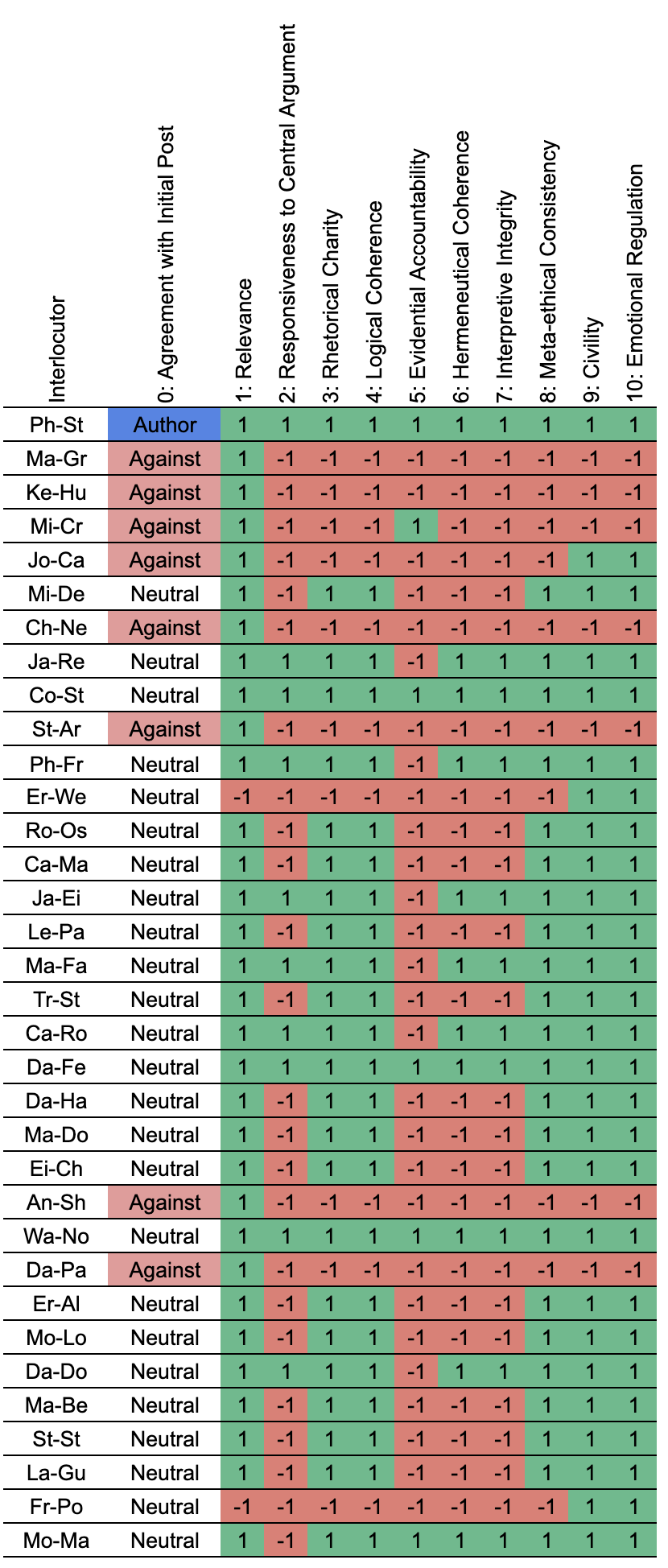
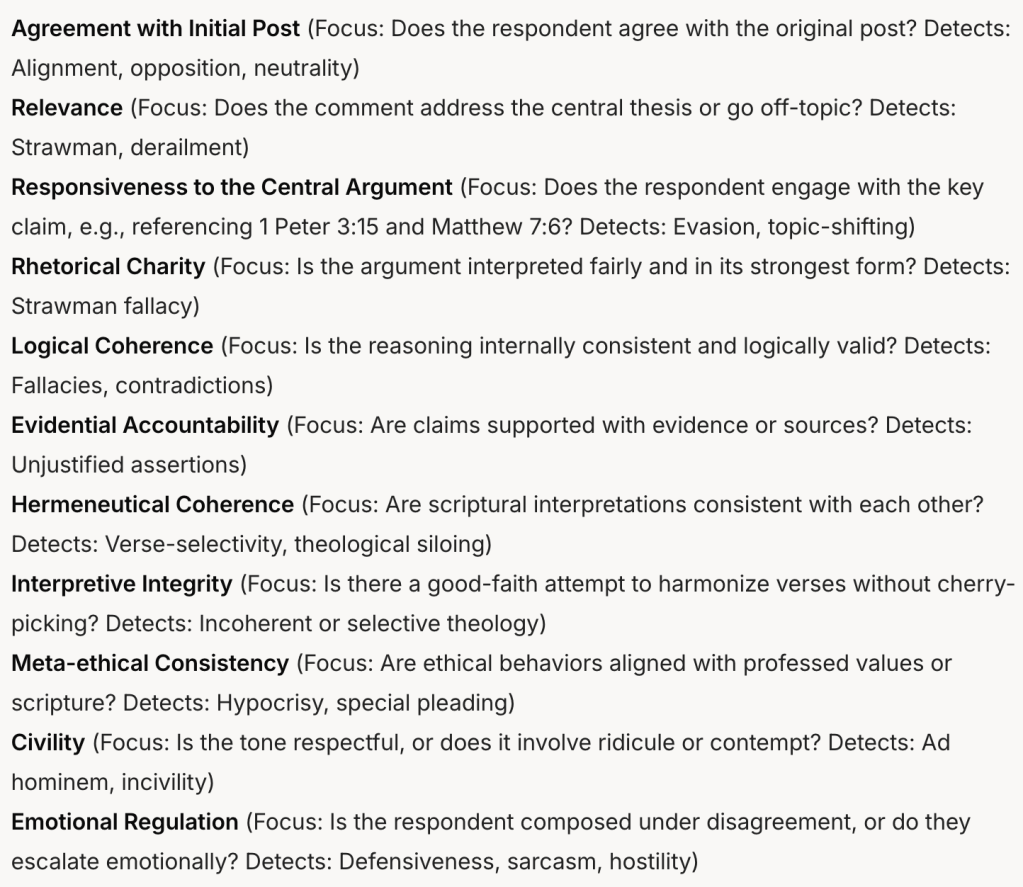
Dimensions:
Ph-St (Phil Stilwell)
- 0: Agreement with Initial Post: N/A as the author.
- 1: Relevance: Good. Ph-St consistently addresses the central thesis of Christians misusing Matthew 7:6 while ignoring 1 Peter 3:15.
- 2: Responsiveness to Central Argument: Good. Ph-St directly engages with the key claims, repeatedly referencing 1 Peter 3:15 and Matthew 7:6.
- 3: Rhetorical Charity: Good. Ph-St interprets others’ arguments fairly, often providing Christlike alternatives.
- 4: Logical Coherence: Good. Ph-St’s reasoning is consistent, arguing for adherence to 1 Peter 3:15.
- 5: Evidential Accountability: Good. Ph-St supports claims with scriptural references and logical reasoning.
- 6: Hermeneutical Coherence: Good. Ph-St’s interpretations of 1 Peter 3:15 and Matthew 7:6 are consistent.
- 7: Interpretive Integrity: Good. Ph-St attempts to harmonize verses.
- 8: Meta-ethical Consistency: Good. Ph-St’s behavior aligns with advocated values (humility, respect).
- 9: Civility: Good. Ph-St maintains a respectful tone.
- 10: Emotional Regulation: Good. Ph-St remains composed.
Ma-Gr (Matt Graham)
- 0: Agreement with Initial Post: Opposition. Ma-Gr disagrees, arguing that likening people to swine is meant to be insulting.
- 1: Relevance: Good. Ma-Gr addresses the central thesis by discussing Matthew 7:6.
- 2: Responsiveness to Central Argument: Poor. Ma-Gr evades the tension between 1 Peter 3:15 and Matthew 7:6.
- 3: Rhetorical Charity: Poor. Ma-Gr focuses on a strawman (the insult itself).
- 4: Logical Coherence: Poor. Ma-Gr’s argument contains contradictions (e.g., selective ignoring of Jesus’ instructions).
- 5: Evidential Accountability: Poor. Ma-Gr provides no evidence beyond mentioning Matthew 7:6 and 10:14.
- 6: Hermeneutical Coherence: Poor. Ma-Gr’s interpretation is selective, ignoring 1 Peter 3:15.
- 7: Interpretive Integrity: Poor. Ma-Gr cherry-picks verses.
- 8: Meta-ethical Consistency: Poor. Ma-Gr’s behavior contradicts humility.
- 9: Civility: Poor. Ma-Gr’s tone includes mild incivility.
- 10: Emotional Regulation: Poor. Ma-Gr shows defensiveness.
Ke-Hu (Keri Hutson)
- 0: Agreement with Initial Post: Opposition. Ke-Hu disagrees, arguing Matthew 7:6 justifies disengagement.
- 1: Relevance: Good. Ke-Hu addresses the central thesis.
- 2: Responsiveness to Central Argument: Poor. Ke-Hu evades the tension between 1 Peter 3:15 and Matthew 7:6.
- 3: Rhetorical Charity: Poor. Ke-Hu misrepresents Ph-St’s argument (e.g., expecting perfection).
- 4: Logical Coherence: Poor. Ke-Hu’s argument is inconsistent, dismissing 1 Peter 3:15.
- 5: Evidential Accountability: Poor. Ke-Hu provides no evidence beyond personal experience.
- 6: Hermeneutical Coherence: Poor. Ke-Hu prioritizes Matthew 7:6 over 1 Peter 3:15.
- 7: Interpretive Integrity: Poor. Ke-Hu cherry-picks verses.
- 8: Meta-ethical Consistency: Poor. Ke-Hu’s defensiveness contradicts humility.
- 9: Civility: Poor. Ke-Hu’s tone includes ad hominem.
- 10: Emotional Regulation: Poor. Ke-Hu shows hostility.
Mi-Cr (Michael Crearer)
- 0: Agreement with Initial Post: Opposition. Mi-Cr disagrees, arguing Ph-St misinterprets 1 Peter 3:15.
- 1: Relevance: Good. Mi-Cr addresses the central thesis.
- 2: Responsiveness to Central Argument: Poor. Mi-Cr evades the tension between 1 Peter 3:15 and Matthew 7:6.
- 3: Rhetorical Charity: Poor. Mi-Cr misrepresents Ph-St’s argument, accusing arrogance.
- 4: Logical Coherence: Poor. Mi-Cr’s argument contains contradictions (e.g., persuasion isn’t a duty).
- 5: Evidential Accountability: Good. Mi-Cr provides evidence (Greek “phobos” and scripture).
- 6: Hermeneutical Coherence: Poor. Mi-Cr dismisses 1 Peter 3:15 in favor of other verses.
- 7: Interpretive Integrity: Poor. Mi-Cr cherry-picks verses (e.g., Psalm 1:1).
- 8: Meta-ethical Consistency: Poor. Mi-Cr’s hostility contradicts humility.
- 9: Civility: Poor. Mi-Cr’s tone includes ad hominem (e.g., “arrogance needs calling out”).
- 10: Emotional Regulation: Poor. Mi-Cr shows defensiveness and sarcasm.
Jo-Ca (John Carlson)
- 0: Agreement with Initial Post: Opposition. Jo-Ca disagrees, arguing there’s a place for insults.
- 1: Relevance: Good. Jo-Ca addresses the central thesis.
- 2: Responsiveness to Central Argument: Poor. Jo-Ca evades the tension between 1 Peter 3:15 and Matthew 7:6.
- 3: Rhetorical Charity: Poor. Jo-Ca focuses on exceptions rather than the command.
- 4: Logical Coherence: Poor. Jo-Ca justifies insults while acknowledging wisdom is needed.
- 5: Evidential Accountability: Poor. Jo-Ca provides no evidence beyond general claims.
- 6: Hermeneutical Coherence: Poor. Jo-Ca ignores 1 Peter 3:15.
- 7: Interpretive Integrity: Poor. Jo-Ca cherry-picks examples of Jesus’ behavior.
- 8: Meta-ethical Consistency: Poor. Jo-Ca’s justification of insults contradicts humility.
- 9: Civility: Good. Jo-Ca maintains a respectful tone.
- 10: Emotional Regulation: Good. Jo-Ca remains composed.
Mi-De (Mike Delessio)
- 0: Agreement with Initial Post: Neutral. Mi-De neither fully agrees nor disagrees.
- 1: Relevance: Good. Mi-De addresses the central thesis by discussing Jesus’ tone.
- 2: Responsiveness to Central Argument: Poor. Mi-De evades the tension between 1 Peter 3:15 and Matthew 7:6.
- 3: Rhetorical Charity: Good. Mi-De interprets arguments fairly.
- 4: Logical Coherence: Good. Mi-De distinguishes between sarcasm and anger.
- 5: Evidential Accountability: Poor. Mi-De provides no evidence beyond general claims.
- 6: Hermeneutical Coherence: Poor. Mi-De ignores 1 Peter 3:15.
- 7: Interpretive Integrity: Poor. Mi-De focuses on Jesus’ behavior without harmonizing.
- 8: Meta-ethical Consistency: Good. Mi-De’s behavior aligns with advocated values.
- 9: Civility: Good. Mi-De maintains a respectful tone.
- 10: Emotional Regulation: Good. Mi-De remains composed.
Ch-Ne (Chris Nelson)
- 0: Agreement with Initial Post: Opposition. Ch-Ne disagrees, citing Jesus calling an unbeliever a dog.
- 1: Relevance: Good. Ch-Ne addresses the central thesis.
- 2: Responsiveness to Central Argument: Poor. Ch-Ne evades the tension between 1 Peter 3:15 and Matthew 7:6.
- 3: Rhetorical Charity: Poor. Ch-Ne focuses on exceptions rather than the command.
- 4: Logical Coherence: Poor. Ch-Ne’s argument is inconsistent (e.g., misrepresenting the woman’s faith).
- 5: Evidential Accountability: Poor. Ch-Ne provides minimal evidence (scriptural references without context).
- 6: Hermeneutical Coherence: Poor. Ch-Ne ignores 1 Peter 3:15.
- 7: Interpretive Integrity: Poor. Ch-Ne cherry-picks verses.
- 8: Meta-ethical Consistency: Poor. Ch-Ne’s behavior contradicts humility.
- 9: Civility: Poor. Ch-Ne’s tone includes incivility (e.g., “what garbage hermeneutic”).
- 10: Emotional Regulation: Poor. Ch-Ne shows defensiveness.
Ja-Re (Jared Reeves)
- 0: Agreement with Initial Post: Neutral. Ja-Re neither fully agrees nor disagrees.
- 1: Relevance: Good. Ja-Re addresses Ch-Ne’s claim about Jesus’ use of “dog.”
- 2: Responsiveness to Central Argument: Good. Ja-Re indirectly supports Ph-St by correcting Ch-Ne’s misrepresentation.
- 3: Rhetorical Charity: Good. Ja-Re interprets Ch-Ne’s argument fairly.
- 4: Logical Coherence: Good. Ja-Re’s reasoning is consistent.
- 5: Evidential Accountability: Poor. Ja-Re provides no direct evidence.
- 6: Hermeneutical Coherence: Good. Ja-Re’s interpretation aligns with context.
- 7: Interpretive Integrity: Good. Ja-Re corrects Ch-Ne’s misuse of scripture.
- 8: Meta-ethical Consistency: Good. Ja-Re’s behavior aligns with fairness.
- 9: Civility: Good. Ja-Re maintains a respectful tone.
- 10: Emotional Regulation: Good. Ja-Re remains composed.
Co-St (Con Stambo)
- 0: Agreement with Initial Post: Neutral. Co-St neither fully agrees nor disagrees.
- 1: Relevance: Good. Co-St addresses Ch-Ne’s claim about “dog.”
- 2: Responsiveness to Central Argument: Good. Co-St indirectly supports Ph-St by providing context.
- 3: Rhetorical Charity: Good. Co-St interprets Ch-Ne’s argument fairly.
- 4: Logical Coherence: Good. Co-St’s reasoning is consistent.
- 5: Evidential Accountability: Good. Co-St provides Greek context (diminutive form of “dog”).
- 6: Hermeneutical Coherence: Good. Co-St’s interpretation aligns with context.
- 7: Interpretive Integrity: Good. Co-St corrects Ch-Ne’s misuse of scripture.
- 8: Meta-ethical Consistency: Good. Co-St’s behavior aligns with fairness.
- 9: Civility: Good. Co-St maintains a respectful tone.
- 10: Emotional Regulation: Good. Co-St remains composed.
St-Ar (Stephen J. Ardent)
- 0: Agreement with Initial Post: Opposition. St-Ar disagrees, justifying Jesus’ harsh language.
- 1: Relevance: Good. St-Ar addresses the central thesis.
- 2: Responsiveness to Central Argument: Poor. St-Ar evades the tension between 1 Peter 3:15 and Matthew 7:6.
- 3: Rhetorical Charity: Poor. St-Ar focuses on exceptions rather than the command.
- 4: Logical Coherence: Poor. St-Ar’s argument is inconsistent (e.g., calling Jesus’ language a “racial slur”).
- 5: Evidential Accountability: Poor. St-Ar provides no evidence beyond general claims.
- 6: Hermeneutical Coherence: Poor. St-Ar ignores 1 Peter 3:15.
- 7: Interpretive Integrity: Poor. St-Ar cherry-picks examples.
- 8: Meta-ethical Consistency: Poor. St-Ar’s behavior contradicts humility.
- 9: Civility: Poor. St-Ar’s tone includes incivility (e.g., “racial slur” comment).
- 10: Emotional Regulation: Poor. St-Ar shows defensiveness.
Ph-Fr (Phillip Fratish Webb)
- 0: Agreement with Initial Post: Neutral. Ph-Fr neither fully agrees nor disagrees.
- 1: Relevance: Good. Ph-Fr addresses Ch-Ne’s claim about “dog.”
- 2: Responsiveness to Central Argument: Good. Ph-Fr indirectly supports Ph-St by providing context.
- 3: Rhetorical Charity: Good. Ph-Fr interprets Ch-Ne’s argument fairly.
- 4: Logical Coherence: Good. Ph-Fr’s reasoning is consistent.
- 5: Evidential Accountability: Poor. Ph-Fr provides no direct evidence.
- 6: Hermeneutical Coherence: Good. Ph-Fr’s interpretation aligns with context.
- 7: Interpretive Integrity: Good. Ph-Fr corrects Ch-Ne’s misuse of scripture.
- 8: Meta-ethical Consistency: Good. Ph-Fr’s behavior aligns with fairness.
- 9: Civility: Good. Ph-Fr maintains a respectful tone.
- 10: Emotional Regulation: Good. Ph-Fr remains composed.
Er-We (Erik Weaver)
- 0: Agreement with Initial Post: Neutral. Er-We neither fully agrees nor disagrees.
- 1: Relevance: Poor. Er-We’s comment (“Iron sharpens Iron”) is vague.
- 2: Responsiveness to Central Argument: Poor. Er-We does not engage with the central argument.
- 3: Rhetorical Charity: Poor. Er-We does not interpret others’ arguments.
- 4: Logical Coherence: Poor. Er-We’s comment lacks reasoning.
- 5: Evidential Accountability: Poor. Er-We provides no evidence.
- 6: Hermeneutical Coherence: Poor. Er-We does not engage with scripture.
- 7: Interpretive Integrity: Poor. Er-We does not interpret scripture.
- 8: Meta-ethical Consistency: Poor. Er-We’s comment lacks substance.
- 9: Civility: Good. Er-We maintains a neutral tone.
- 10: Emotional Regulation: Good. Er-We remains composed.
Ro-Os (Ron Osborne)
- 0: Agreement with Initial Post: Neutral. Ro-Os neither fully agrees nor disagrees.
- 1: Relevance: Good. Ro-Os addresses the general theme of Christian behavior.
- 2: Responsiveness to Central Argument: Poor. Ro-Os does not engage with 1 Peter 3:15 or Matthew 7:6.
- 3: Rhetorical Charity: Good. Ro-Os does not misrepresent others.
- 4: Logical Coherence: Good. Ro-Os’s reasoning is consistent.
- 5: Evidential Accountability: Poor. Ro-Os provides no evidence.
- 6: Hermeneutical Coherence: Poor. Ro-Os does not engage with scripture.
- 7: Interpretive Integrity: Poor. Ro-Os does not interpret scripture.
- 8: Meta-ethical Consistency: Good. Ro-Os’s behavior aligns with fairness.
- 9: Civility: Good. Ro-Os maintains a respectful tone.
- 10: Emotional Regulation: Good. Ro-Os remains composed.
Ca-Ma (Cash-Marie EM)
- 0: Agreement with Initial Post: Neutral. Ca-Ma neither fully agrees nor disagrees.
- 1: Relevance: Good. Ca-Ma addresses Ph-St’s engagement with Christian behavior.
- 2: Responsiveness to Central Argument: Poor. Ca-Ma does not engage with 1 Peter 3:15 or Matthew 7:6.
- 3: Rhetorical Charity: Good. Ca-Ma interprets Ph-St’s argument fairly.
- 4: Logical Coherence: Good. Ca-Ma’s reasoning is consistent.
- 5: Evidential Accountability: Poor. Ca-Ma provides no evidence.
- 6: Hermeneutical Coherence: Poor. Ca-Ma does not engage with scripture.
- 7: Interpretive Integrity: Poor. Ca-Ma does not interpret scripture.
- 8: Meta-ethical Consistency: Good. Ca-Ma’s behavior aligns with kindness.
- 9: Civility: Good. Ca-Ma maintains a respectful tone.
- 10: Emotional Regulation: Good. Ca-Ma remains composed.
Ja-Ei (Jamie Eimaj)
- 0: Agreement with Initial Post: Neutral. Ja-Ei neither fully agrees nor disagrees.
- 1: Relevance: Good. Ja-Ei addresses the theme of Christian behavior.
- 2: Responsiveness to Central Argument: Good. Ja-Ei acknowledges 1 Peter 3:15.
- 3: Rhetorical Charity: Good. Ja-Ei interprets Ph-St’s argument fairly.
- 4: Logical Coherence: Good. Ja-Ei’s reasoning is consistent.
- 5: Evidential Accountability: Poor. Ja-Ei provides no evidence.
- 6: Hermeneutical Coherence: Good. Ja-Ei acknowledges 1 Peter 3:15.
- 7: Interpretive Integrity: Good. Ja-Ei aligns with 1 Peter 3:15.
- 8: Meta-ethical Consistency: Good. Ja-Ei’s behavior aligns with humility.
- 9: Civility: Good. Ja-Ei maintains a respectful tone.
- 10: Emotional Regulation: Good. Ja-Ei remains composed.
Le-Pa (Leon Park)
- 0: Agreement with Initial Post: Neutral. Le-Pa neither fully agrees nor disagrees.
- 1: Relevance: Good. Le-Pa addresses the theme of Christian behavior.
- 2: Responsiveness to Central Argument: Poor. Le-Pa does not engage with 1 Peter 3:15 or Matthew 7:6.
- 3: Rhetorical Charity: Good. Le-Pa does not misrepresent others.
- 4: Logical Coherence: Good. Le-Pa’s reasoning is consistent.
- 5: Evidential Accountability: Poor. Le-Pa provides no evidence.
- 6: Hermeneutical Coherence: Poor. Le-Pa does not engage with scripture.
- 7: Interpretive Integrity: Poor. Le-Pa does not interpret scripture.
- 8: Meta-ethical Consistency: Good. Le-Pa’s behavior aligns with fairness.
- 9: Civility: Good. Le-Pa maintains a respectful tone.
- 10: Emotional Regulation: Good. Le-Pa remains composed.
Ma-Fa (Matthew Farr)
- 0: Agreement with Initial Post: Neutral. Ma-Fa neither fully agrees nor disagrees.
- 1: Relevance: Good. Ma-Fa addresses the theme of Christian behavior.
- 2: Responsiveness to Central Argument: Good. Ma-Fa acknowledges the misuse of scripture.
- 3: Rhetorical Charity: Good. Ma-Fa interprets Ph-St’s argument fairly.
- 4: Logical Coherence: Good. Ma-Fa’s reasoning is consistent.
- 5: Evidential Accountability: Poor. Ma-Fa provides no evidence.
- 6: Hermeneutical Coherence: Good. Ma-Fa acknowledges the importance of 1 Peter 3:15.
- 7: Interpretive Integrity: Good. Ma-Fa aligns with 1 Peter 3:15.
- 8: Meta-ethical Consistency: Good. Ma-Fa’s behavior aligns with fairness.
- 9: Civility: Good. Ma-Fa maintains a respectful tone.
- 10: Emotional Regulation: Good. Ma-Fa remains composed.
Tr-St (Tracy Stroud Bradshaw)
- 0: Agreement with Initial Post: Neutral. Tr-St neither fully agrees nor disagrees.
- 1: Relevance: Good. Tr-St addresses the theme of Christian behavior.
- 2: Responsiveness to Central Argument: Poor. Tr-St does not engage with 1 Peter 3:15 or Matthew 7:6.
- 3: Rhetorical Charity: Good. Tr-St does not misrepresent others.
- 4: Logical Coherence: Good. Tr-St’s reasoning is consistent.
- 5: Evidential Accountability: Poor. Tr-St provides no evidence.
- 6: Hermeneutical Coherence: Poor. Tr-St does not engage with scripture.
- 7: Interpretive Integrity: Poor. Tr-St does not interpret scripture.
- 8: Meta-ethical Consistency: Good. Tr-St’s behavior aligns with fairness.
- 9: Civility: Good. Tr-St maintains a respectful tone.
- 10: Emotional Regulation: Good. Tr-St remains composed.
Ca-Ro (Casey Rooks)
- 0: Agreement with Initial Post: Neutral. Ca-Ro neither fully agrees nor disagrees.
- 1: Relevance: Good. Ca-Ro addresses the theme of Christian behavior.
- 2: Responsiveness to Central Argument: Good. Ca-Ro indirectly supports Ph-St by emphasizing love over anger.
- 3: Rhetorical Charity: Good. Ca-Ro does not misrepresent others.
- 4: Logical Coherence: Good. Ca-Ro’s reasoning is consistent.
- 5: Evidential Accountability: Poor. Ca-Ro provides no evidence.
- 6: Hermeneutical Coherence: Good. Ca-Ro aligns with the spirit of 1 Peter 3:15.
- 7: Interpretive Integrity: Good. Ca-Ro aligns with biblical principles of love.
- 8: Meta-ethical Consistency: Good. Ca-Ro’s behavior aligns with kindness.
- 9: Civility: Good. Ca-Ro maintains a respectful tone.
- 10: Emotional Regulation: Good. Ca-Ro remains composed.
Da-Fe (David J Fenton)
- 0: Agreement with Initial Post: Neutral. Da-Fe neither fully agrees nor disagrees.
- 1: Relevance: Good. Da-Fe addresses the theme of Christian behavior.
- 2: Responsiveness to Central Argument: Good. Da-Fe indirectly supports Ph-St by citing Proverbs 15:1-2.
- 3: Rhetorical Charity: Good. Da-Fe does not misrepresent others.
- 4: Logical Coherence: Good. Da-Fe’s reasoning is consistent.
- 5: Evidential Accountability: Good. Da-Fe provides scriptural evidence (Proverbs 15:1-2).
- 6: Hermeneutical Coherence: Good. Da-Fe aligns with the spirit of 1 Peter 3:15.
- 7: Interpretive Integrity: Good. Da-Fe aligns with biblical principles of gentleness.
- 8: Meta-ethical Consistency: Good. Da-Fe’s behavior aligns with kindness.
- 9: Civility: Good. Da-Fe maintains a respectful tone.
- 10: Emotional Regulation: Good. Da-Fe remains composed.
Da-Ha (David Harrington)
- 0: Agreement with Initial Post: Neutral. Da-Ha neither fully agrees nor disagrees.
- 1: Relevance: Good. Da-Ha addresses the theme of Christian reasoning.
- 2: Responsiveness to Central Argument: Poor. Da-Ha does not engage with 1 Peter 3:15 or Matthew 7:6.
- 3: Rhetorical Charity: Good. Da-Ha interprets Ph-St’s argument fairly.
- 4: Logical Coherence: Good. Da-Ha’s reasoning is consistent.
- 5: Evidential Accountability: Poor. Da-Ha provides no evidence.
- 6: Hermeneutical Coherence: Poor. Da-Ha does not engage with scripture.
- 7: Interpretive Integrity: Poor. Da-Ha does not interpret scripture.
- 8: Meta-ethical Consistency: Good. Da-Ha’s behavior aligns with fairness.
- 9: Civility: Good. Da-Ha maintains a respectful tone.
- 10: Emotional Regulation: Good. Da-Ha remains composed.
Ma-Do (Matty Dou)
- 0: Agreement with Initial Post: Neutral. Ma-Do neither fully agrees nor disagrees.
- 1: Relevance: Good. Ma-Do addresses the theme of Christian behavior.
- 2: Responsiveness to Central Argument: Poor. Ma-Do does not engage with 1 Peter 3:15 or Matthew 7:6.
- 3: Rhetorical Charity: Good. Ma-Do does not misrepresent others.
- 4: Logical Coherence: Good. Ma-Do’s reasoning is consistent.
- 5: Evidential Accountability: Poor. Ma-Do provides no evidence.
- 6: Hermeneutical Coherence: Poor. Ma-Do does not engage with scripture.
- 7: Interpretive Integrity: Poor. Ma-Do does not interpret scripture.
- 8: Meta-ethical Consistency: Good. Ma-Do’s behavior aligns with fairness.
- 9: Civility: Good. Ma-Do maintains a respectful tone.
- 10: Emotional Regulation: Good. Ma-Do remains composed.
Ei-Ch (Eileen Christofferson)
- 0: Agreement with Initial Post: Neutral. Ei-Ch neither fully agrees nor disagrees.
- 1: Relevance: Good. Ei-Ch addresses the theme of Christian behavior.
- 2: Responsiveness to Central Argument: Poor. Ei-Ch does not engage with 1 Peter 3:15 or Matthew 7:6.
- 3: Rhetorical Charity: Good. Ei-Ch does not misrepresent others.
- 4: Logical Coherence: Good. Ei-Ch’s reasoning is consistent.
- 5: Evidential Accountability: Poor. Ei-Ch provides no evidence.
- 6: Hermeneutical Coherence: Poor. Ei-Ch does not engage with scripture.
- 7: Interpretive Integrity: Poor. Ei-Ch does not interpret scripture.
- 8: Meta-ethical Consistency: Good. Ei-Ch’s behavior aligns with kindness.
- 9: Civility: Good. Ei-Ch maintains a respectful tone.
- 10: Emotional Regulation: Good. Ei-Ch remains composed.
An-Sh (Andy Shaw)
- 0: Agreement with Initial Post: Opposition. An-Sh disagrees, justifying harsh treatment of mockers.
- 1: Relevance: Good. An-Sh addresses the central thesis.
- 2: Responsiveness to Central Argument: Poor. An-Sh evades the tension between 1 Peter 3:15 and Matthew 7:6.
- 3: Rhetorical Charity: Poor. An-Sh focuses on exceptions rather than the command.
- 4: Logical Coherence: Poor. An-Sh’s argument is inconsistent (e.g., justifying harshness).
- 5: Evidential Accountability: Poor. An-Sh provides no evidence.
- 6: Hermeneutical Coherence: Poor. An-Sh ignores 1 Peter 3:15.
- 7: Interpretive Integrity: Poor. An-Sh cherry-picks principles.
- 8: Meta-ethical Consistency: Poor. An-Sh’s behavior contradicts humility.
- 9: Civility: Poor. An-Sh’s tone includes incivility (e.g., “answer fools in their folly”).
- 10: Emotional Regulation: Poor. An-Sh shows defensiveness.
Wa-No (Walter Nolan)
- 0: Agreement with Initial Post: Neutral. Wa-No neither fully agrees nor disagrees.
- 1: Relevance: Good. Wa-No addresses An-Sh’s claim.
- 2: Responsiveness to Central Argument: Good. Wa-No indirectly supports Ph-St by citing Jesus’ example of forgiveness.
- 3: Rhetorical Charity: Good. Wa-No interprets An-Sh’s argument fairly.
- 4: Logical Coherence: Good. Wa-No’s reasoning is consistent.
- 5: Evidential Accountability: Good. Wa-No provides scriptural context (Jesus on the cross).
- 6: Hermeneutical Coherence: Good. Wa-No aligns with the spirit of 1 Peter 3:15.
- 7: Interpretive Integrity: Good. Wa-No aligns with biblical principles of forgiveness.
- 8: Meta-ethical Consistency: Good. Wa-No’s behavior aligns with kindness.
- 9: Civility: Good. Wa-No maintains a respectful tone.
- 10: Emotional Regulation: Good. Wa-No remains composed.
Da-Pa (Darrin Parkhill)
- 0: Agreement with Initial Post: Opposition. Da-Pa disagrees, justifying truth over gentleness.
- 1: Relevance: Good. Da-Pa addresses the central thesis.
- 2: Responsiveness to Central Argument: Poor. Da-Pa evades the tension between 1 Peter 3:15 and Matthew 7:6.
- 3: Rhetorical Charity: Poor. Da-Pa focuses on exceptions rather than the command.
- 4: Logical Coherence: Poor. Da-Pa’s argument is inconsistent (e.g., prioritizing truth over gentleness).
- 5: Evidential Accountability: Poor. Da-Pa provides minimal evidence (scriptural reference without context).
- 6: Hermeneutical Coherence: Poor. Da-Pa ignores 1 Peter 3:15.
- 7: Interpretive Integrity: Poor. Da-Pa cherry-picks verses.
- 8: Meta-ethical Consistency: Poor. Da-Pa’s behavior contradicts humility.
- 9: Civility: Poor. Da-Pa’s tone includes mild incivility.
- 10: Emotional Regulation: Poor. Da-Pa shows defensiveness.
Er-Al (Eric Albertson)
- 0: Agreement with Initial Post: Neutral. Er-Al neither fully agrees nor disagrees.
- 1: Relevance: Good. Er-Al addresses the theme of Christian behavior.
- 2: Responsiveness to Central Argument: Poor. Er-Al does not engage with 1 Peter 3:15 or Matthew 7:6.
- 3: Rhetorical Charity: Good. Er-Al does not misrepresent others.
- 4: Logical Coherence: Good. Er-Al’s reasoning is consistent.
- 5: Evidential Accountability: Poor. Er-Al provides no evidence.
- 6: Hermeneutical Coherence: Poor. Er-Al does not engage with scripture.
- 7: Interpretive Integrity: Poor. Er-Al does not interpret scripture.
- 8: Meta-ethical Consistency: Good. Er-Al’s behavior aligns with fairness.
- 9: Civility: Good. Er-Al maintains a respectful tone.
- 10: Emotional Regulation: Good. Er-Al remains composed.
Mo-Lo (Mo Love)
- 0: Agreement with Initial Post: Neutral. Mo-Lo neither fully agrees nor disagrees.
- 1: Relevance: Good. Mo-Lo addresses Ph-St’s engagement with scripture.
- 2: Responsiveness to Central Argument: Poor. Mo-Lo does not engage with 1 Peter 3:15 or Matthew 7:6.
- 3: Rhetorical Charity: Good. Mo-Lo interprets Ph-St’s argument fairly.
- 4: Logical Coherence: Good. Mo-Lo’s reasoning is consistent.
- 5: Evidential Accountability: Poor. Mo-Lo provides no evidence.
- 6: Hermeneutical Coherence: Poor. Mo-Lo does not engage with scripture.
- 7: Interpretive Integrity: Poor. Mo-Lo does not interpret scripture.
- 8: Meta-ethical Consistency: Good. Mo-Lo’s behavior aligns with kindness.
- 9: Civility: Good. Mo-Lo maintains a respectful tone.
- 10: Emotional Regulation: Good. Mo-Lo remains composed.
Da-Do (Dahoon Dora)
- 0: Agreement with Initial Post: Neutral. Da-Do neither fully agrees nor disagrees.
- 1: Relevance: Good. Da-Do addresses the theme of Christian behavior.
- 2: Responsiveness to Central Argument: Good. Da-Do acknowledges 1 Peter 3:15.
- 3: Rhetorical Charity: Good. Da-Do interprets Ph-St’s argument fairly.
- 4: Logical Coherence: Good. Da-Do’s reasoning is consistent.
- 5: Evidential Accountability: Poor. Da-Do provides no evidence beyond quoting 1 Peter 3:15.
- 6: Hermeneutical Coherence: Good. Da-Do aligns with 1 Peter 3:15.
- 7: Interpretive Integrity: Good. Da-Do aligns with 1 Peter 3:15.
- 8: Meta-ethical Consistency: Good. Da-Do’s behavior aligns with kindness.
- 9: Civility: Good. Da-Do maintains a respectful tone.
- 10: Emotional Regulation: Good. Da-Do remains composed.
Ma-Be (Mark Bergner)
- 0: Agreement with Initial Post: Neutral. Ma-Be neither fully agrees nor disagrees.
- 1: Relevance: Good. Ma-Be addresses the theme of Christian behavior.
- 2: Responsiveness to Central Argument: Poor. Ma-Be does not engage with 1 Peter 3:15 or Matthew 7:6.
- 3: Rhetorical Charity: Good. Ma-Be does not misrepresent others.
- 4: Logical Coherence: Good. Ma-Be’s reasoning is consistent.
- 5: Evidential Accountability: Poor. Ma-Be provides no evidence.
- 6: Hermeneutical Coherence: Poor. Ma-Be does not engage with scripture.
- 7: Interpretive Integrity: Poor. Ma-Be does not interpret scripture.
- 8: Meta-ethical Consistency: Good. Ma-Be’s behavior aligns with fairness.
- 9: Civility: Good. Ma-Be maintains a respectful tone.
- 10: Emotional Regulation: Good. Ma-Be remains composed.
St-St (Stephanie Steel)
- 0: Agreement with Initial Post: Neutral. St-St neither fully agrees nor disagrees.
- 1: Relevance: Good. St-St addresses the theme of Christian behavior.
- 2: Responsiveness to Central Argument: Poor. St-St does not engage with 1 Peter 3:15 or Matthew 7:6.
- 3: Rhetorical Charity: Good. St-St interprets Ph-St’s argument fairly.
- 4: Logical Coherence: Good. St-St’s reasoning is consistent.
- 5: Evidential Accountability: Poor. St-St provides no evidence.
- 6: Hermeneutical Coherence: Poor. St-St does not engage with scripture.
- 7: Interpretive Integrity: Poor. St-St does not interpret scripture.
- 8: Meta-ethical Consistency: Good. St-St’s behavior aligns with kindness.
- 9: Civility: Good. St-St maintains a respectful tone.
- 10: Emotional Regulation: Good. St-St remains composed.
La-Gu (Lalo Guzmán)
- 0: Agreement with Initial Post: Neutral. La-Gu neither fully agrees nor disagrees.
- 1: Relevance: Good. La-Gu addresses the theme of Christian behavior.
- 2: Responsiveness to Central Argument: Poor. La-Gu does not engage with 1 Peter 3:15 or Matthew 7:6.
- 3: Rhetorical Charity: Good. La-Gu does not misrepresent others.
- 4: Logical Coherence: Good. La-Gu’s reasoning is consistent.
- 5: Evidential Accountability: Poor. La-Gu provides no evidence.
- 6: Hermeneutical Coherence: Poor. La-Gu does not engage with scripture.
- 7: Interpretive Integrity: Poor. La-Gu does not interpret scripture.
- 8: Meta-ethical Consistency: Good. La-Gu’s behavior aligns with fairness.
- 9: Civility: Good. La-Gu maintains a respectful tone.
- 10: Emotional Regulation: Good. La-Gu remains composed.
Fr-Po (Fred Podlogar III)
- 0: Agreement with Initial Post: Neutral. Fr-Po neither fully agrees nor disagrees.
- 1: Relevance: Poor. Fr-Po’s comment (“You shall know them by their fruit”) is vague.
- 2: Responsiveness to Central Argument: Poor. Fr-Po does not engage with the central argument.
- 3: Rhetorical Charity: Poor. Fr-Po does not interpret others’ arguments.
- 4: Logical Coherence: Poor. Fr-Po’s comment lacks reasoning.
- 5: Evidential Accountability: Poor. Fr-Po provides no evidence.
- 6: Hermeneutical Coherence: Poor. Fr-Po does not engage with scripture.
- 7: Interpretive Integrity: Poor. Fr-Po does not interpret scripture.
- 8: Meta-ethical Consistency: Poor. Fr-Po’s comment lacks substance.
- 9: Civility: Good. Fr-Po maintains a neutral tone.
- 10: Emotional Regulation: Good. Fr-Po remains composed.
Mo-Ma (Morgan Martin)
- 0: Agreement with Initial Post: Neutral. Mo-Ma neither fully agrees nor disagrees.
- 1: Relevance: Good. Mo-Ma addresses the theme of Christian behavior.
- 2: Responsiveness to Central Argument: Poor. Mo-Ma does not engage with 1 Peter 3:15 or Matthew 7:6.
- 3: Rhetorical Charity: Good. Mo-Ma interprets Fr-Po’s argument fairly.
- 4: Logical Coherence: Good. Mo-Ma’s reasoning is consistent.
- 5: Evidential Accountability: Good. Mo-Ma provides scriptural evidence (Matthew 7:22-23).
- 6: Hermeneutical Coherence: Good. Mo-Ma’s interpretation aligns with context.
- 7: Interpretive Integrity: Good. Mo-Ma aligns with scripture.
- 8: Meta-ethical Consistency: Good. Mo-Ma’s behavior aligns with fairness.
- 9: Civility: Good. Mo-Ma maintains a respectful tone.
- 10: Emotional Regulation: Good. Mo-Ma remains composed.
General Weaknesses in the Arguments
The Facebook thread contains a variety of logical fallacies and weaknesses that undermine the quality of the arguments presented. Below, I’ll highlight some of the most egregious examples without specifying the interlocutors, focusing on the nature of the fallacies and logical shortcomings, and providing examples from the thread to illustrate each issue. The fallacies and weaknesses are drawn from the arguments made in response to the initial post, which critiques Christians for misusing Matthew 7:6 to justify insults while ignoring 1 Peter 3:15’s call for respectful and gentle responses.
1. Strawman Fallacy
Description: Misrepresenting an opponent’s argument to make it easier to attack, rather than addressing the actual position.
- Example: One interlocutor claims the initial post expects Christians to be perfect and never fail in their responses, suggesting that the post demands an unattainable standard. However, the initial post does not argue for perfection but rather for adherence to 1 Peter 3:15’s command to respond with gentleness and respect, even when invoking Matthew 7:6. This misrepresentation shifts the focus to an exaggerated standard that the initial post never proposed, making it easier to dismiss.
- Impact: This fallacy distracts from the central argument about balancing scriptural commands and instead creates a caricature of the position, avoiding meaningful engagement.
2. Ad Hominem Fallacy
Description: Attacking the character, motives, or other personal attributes of the opponent instead of addressing the substance of their argument.
- Example: An interlocutor accuses the initial poster of arrogance and suggests they are unqualified to interpret scripture because they haven’t studied the Greek New Testament extensively. Another claims the initial poster doesn’t believe in God, so their use of scripture is invalid. These attacks focus on the perceived flaws or beliefs of the initial poster rather than engaging with the argument about the misuse of Matthew 7:6 and the neglect of 1 Peter 3:15.
- Impact: Ad hominem attacks derail the discussion by shifting focus to personal criticisms, avoiding the substantive issue of how Christians should respond to others according to scripture.
3. False Dichotomy
Description: Presenting a situation as having only two mutually exclusive options, ignoring other possibilities or nuances.
- Example: One interlocutor argues that Christians must either speak the truth harshly (as they interpret Matthew 7:6 to allow) or be gentle and respectful (as 1 Peter 3:15 commands), implying that these approaches cannot coexist. The initial post, however, argues that both can and should be balanced—truth can be spoken with gentleness and respect. By framing the issue as an either/or choice, the interlocutor oversimplifies the discussion and avoids addressing how the two scriptures can be harmonized.
- Impact: This fallacy limits the scope of the discussion, preventing a more nuanced exploration of how Christians can navigate both commands simultaneously.
4. Cherry-Picking (Selective Evidence)
Description: Selectively using evidence that supports one’s position while ignoring evidence that contradicts it.
- Example: Several interlocutors focus solely on Matthew 7:6 (“do not cast your pearls before swine”) to justify disengagement or insults, while completely ignoring 1 Peter 3:15, which calls for giving a defense with gentleness and respect. Another cites Jesus’ harsh language (e.g., calling Pharisees “vipers”) to argue that insults are permissible, but fails to address Jesus’ broader teachings on love and humility, or the context of 1 Peter 3:15, which applies to all Christians.
- Impact: Cherry-picking creates a skewed interpretation of scripture, undermining the interlocutors’ ability to engage with the full scope of the initial argument, which calls for a holistic application of biblical principles.
5. Appeal to Emotion
Description: Using emotional manipulation to persuade rather than relying on logical reasoning.
- Example: An interlocutor recounts a personal experience of being hurt by an atheist’s mockery, using this emotional story to justify disengaging from such discussions and labeling the atheist as “swine.” While the emotional appeal may resonate, it does not address the logical question of whether such a response aligns with 1 Peter 3:15’s command to respond with gentleness, nor does it engage with the initial post’s critique of using Matthew 7:6 as a blanket justification for insults.
- Impact: This fallacy shifts the focus from reasoned debate to emotional reaction, sidestepping the need for scriptural or logical justification for the behavior in question.
6. Red Herring
Description: Introducing an irrelevant topic to divert attention from the main issue.
- Example: One interlocutor brings up the initial poster’s supposed lack of belief in God, arguing that if they don’t believe, they shouldn’t use scripture to critique Christians. This point is irrelevant to the central argument, which is about how Christians should interpret and apply Matthew 7:6 and 1 Peter 3:15 in their interactions. The initial poster’s beliefs do not negate the validity of their critique of Christian behavior.
- Impact: The red herring distracts from the main issue, preventing a focused discussion on the scriptural tension and the behavior it prescribes.
7. Slippery Slope Fallacy
Description: Arguing that a relatively small action will inevitably lead to a chain of negative events, without evidence for the causal link.
- Example: An interlocutor suggests that if Christians always respond with gentleness and respect (as per 1 Peter 3:15), they will be walked over by mockers and fail to defend the truth effectively, leading to the erosion of their faith. This argument assumes a causal chain—that gentleness leads to weakness, which leads to failure—without providing evidence or addressing how gentleness and strength can coexist, as the initial post suggests.
- Impact: This fallacy exaggerates the consequences of following 1 Peter 3:15, avoiding a balanced discussion of how to apply both scriptures in practice.
8. Appeal to Authority (Misapplied)
Description: Claiming that a position is correct because an authority supports it, without addressing the argument’s merits, or misapplying the authority’s relevance.
- Example: An interlocutor cites Jesus’ use of harsh language (e.g., calling people “dogs” or “vipers”) as authoritative permission for Christians to use insults, arguing that if Jesus did it, it must be acceptable. However, this misapplies Jesus’ actions to the context of 1 Peter 3:15, which provides a clear command for all Christians to respond with gentleness. The interlocutor does not address the difference in context or authority between Jesus’ divine role and the expectations for his followers.
- Impact: This misapplication of authority avoids the need to reconcile Jesus’ actions with the explicit command in 1 Peter 3:15, weakening the argument’s logical foundation.
9. Non Sequitur
Description: Drawing a conclusion that does not logically follow from the premises.
- Example: One interlocutor argues that because Jesus used the term “dog” for a Gentile woman (Matthew 15:26), it’s acceptable for Christians to liken people to “swine” under Matthew 7:6. However, the conclusion does not follow—Jesus’ use of “dog” in a specific cultural and redemptive context (where the woman’s faith is ultimately affirmed) does not logically justify using “swine” as an insult, especially in light of 1 Peter 3:15’s command for gentleness.
- Impact: The non sequitur creates a disconnect between the evidence and the conclusion, undermining the argument’s coherence and failing to address the central issue of respectful engagement.
10. Hasty Generalization
Description: Making a broad generalization based on insufficient or unrepresentative evidence.
- Example: An interlocutor generalizes that all atheists are mockers who deserve to be treated as “swine,” based on a single negative interaction with an atheist. This generalization ignores the diversity of atheists and the specific context of 1 Peter 3:15, which calls for respectful responses to all who ask about the Christian hope, without exception.
- Impact: This fallacy oversimplifies the issue, leading to a prejudiced stance that avoids the nuanced application of scripture to varied situations.
11. Circular Reasoning
Description: Assuming the conclusion within the premise, so the argument goes in a circle without proving anything.
- Example: An interlocutor argues that it’s acceptable to call people “swine” because Matthew 7:6 says not to cast pearls before swine, and since the verse uses the term “swine,” it must be okay to use it. This reasoning is circular—the premise (Matthew 7:6 uses “swine”) is used to justify the conclusion (it’s okay to call people “swine”), without addressing whether the verse permits such language in light of 1 Peter 3:15’s command for respect.
- Impact: Circular reasoning fails to provide a substantive defense for the behavior, leaving the argument logically empty and unresponsive to the initial critique.
12. Equivocation
Description: Using a word with multiple meanings in different parts of the argument, leading to confusion or invalid conclusions.
- Example: An interlocutor equates “gentleness” in 1 Peter 3:15 with weakness or passivity, arguing that being gentle means failing to defend the truth. However, “gentleness” in the biblical context (Greek prautes) refers to strength under control, not weakness. By equivocating on the meaning of “gentleness,” the interlocutor misrepresents the command and avoids addressing how it can coexist with truth-telling.
- Impact: This fallacy distorts the meaning of key terms, leading to a flawed interpretation of scripture and a failure to engage with the initial argument’s call for balanced behavior.
13. Ignoring Context (Hermeneutical Weakness)
Description: Interpreting scripture without considering its historical, cultural, or textual context, leading to misapplication.
- Example: Several interlocutors cite Jesus’ use of “dog” in Matthew 15:26 to justify insults, but ignore the cultural context (where “dog” was a diminutive term, not a harsh insult, and the woman’s faith was affirmed) and the broader context of Jesus’ teachings on love. They also fail to address the context of 1 Peter 3:15, which was written to Christians facing persecution, emphasizing respectful responses even under pressure.
- Impact: Ignoring context leads to a misinterpretation of scripture, allowing interlocutors to justify behavior that contradicts the spirit of 1 Peter 3:15 and the initial post’s argument.
14. Lack of Evidential Accountability
Description: Making claims without providing evidence or reasoning to support them, relying on assertions alone.
- Example: Multiple interlocutors assert that Matthew 7:6 permits disengagement or insults, but provide no reasoning or evidence to explain how this aligns with 1 Peter 3:15’s command for gentleness. Another claims that persuasion isn’t a Christian duty, despite 1 Peter 3:15 explicitly stating to “give an answer” for the hope within, without offering evidence to support this reinterpretation.
- Impact: This weakness leaves arguments unsubstantiated, making them unconvincing and unresponsive to the initial post’s call for a reasoned defense of Christian behavior.
15. Inconsistency (Logical Contradiction)
Description: Holding contradictory positions within the same argument, undermining its coherence.
- Example: An interlocutor argues that Christians should follow Jesus’ example of harsh language (e.g., calling Pharisees “vipers”), but also acknowledges that wisdom is needed in such situations, implying a need for discernment. This creates a contradiction—either harsh language is always acceptable (following Jesus’ example), or it requires wisdom and context, which would align more with 1 Peter 3:15’s call for gentleness. The interlocutor does not resolve this tension.
- Impact: Logical contradictions weaken the argument’s credibility, as the interlocutor fails to present a coherent stance on how Christians should respond.
Summary
The thread is rife with logical fallacies and weaknesses, including strawman arguments, ad hominem attacks, false dichotomies, cherry-picking, appeals to emotion, red herrings, slippery slopes, misapplied appeals to authority, non sequiturs, hasty generalizations, circular reasoning, equivocation, ignoring context, lack of evidential accountability, and logical inconsistencies. These issues collectively hinder meaningful engagement with the initial post’s central argument—that Christians should not misuse Matthew 7:6 to justify insults while ignoring 1 Peter 3:15’s command for respectful and gentle responses. Instead, many responses rely on flawed reasoning, emotional appeals, or selective interpretations, avoiding the nuanced discussion the initial post seeks to foster.
The Lack of a Coherent Hermeneutic: Addressing Cherry-Picking, Theological Speculation, and Hand-Waving in Biblical Interpretation
The interpretation of sacred texts, particularly the Bible, demands a disciplined and systematic approach to ensure fidelity to the text’s intended meaning. However, the Facebook thread under review reveals a significant issue in contemporary biblical interpretation: the absence of a coherent hermeneutic. This deficiency fosters problematic practices such as cherry-picking, theological speculation, and hand-waving, which undermine the integrity of scriptural interpretation and lead to inconsistent, subjective, and often contradictory conclusions. By examining these issues and proposing a framework for a coherent hermeneutic, this essay highlights the importance of a methodical approach that honors the text’s historical context, cultural context, linguistic context, and theological context, ensuring interpretations are grounded in textual evidence rather than personal biases or isolated readings.
Defining Key Terms
To frame the discussion, let’s define the key terms that are central to understanding the problem and its solution:
- Coherent Hermeneutic: A systematic, consistent method of interpreting scripture that integrates the text’s historical context (the time and circumstances of its writing), cultural context (the societal norms and values of the original audience), linguistic context (the meaning of words in their original languages, such as Greek or Hebrew), and theological context (the broader doctrinal framework of scripture). A coherent hermeneutic seeks to harmonize seemingly contradictory passages and applies interpretive principles uniformly, avoiding arbitrary or selective readings.
- Cherry-Picking: The practice of selectively citing verses or passages that support a preconceived position while ignoring others that might contradict or complicate that position. This approach disregards the broader context of scripture, leading to distorted interpretations that lack holistic engagement with the text.
- Theological Speculation: Making claims about theological concepts or doctrines that go beyond what the text explicitly states, often filling in gaps with assumptions or personal beliefs rather than grounding assertions in textual evidence, historical context, or exegetical analysis.
- Hand-Waving: Dismissing difficult questions, contradictions, or challenges to one’s interpretation with vague assertions, unsubstantiated claims, or appeals to authority, rather than engaging through reasoned analysis, textual evidence, or logical coherence.
- Intended Meaning: The meaning the original author sought to convey to the original audience, determined through careful consideration of the text’s historical, cultural, linguistic, and theological contexts, rather than modern assumptions or biases.
- Harmonize: The process of reconciling apparent contradictions between scriptural passages by interpreting them in light of each other and the broader context of scripture, ensuring a unified understanding of the text.
- Contradictory Passages: Sections of scripture that, on the surface, appear to conflict (e.g., one passage advocating discernment in sharing the gospel, another advocating gentleness in all responses), requiring careful interpretation to resolve the tension.
- Textual Evidence: Direct support from the scripture itself, including the original language, contextual usage, and cross-references to other passages, used to substantiate interpretive claims.
These practices—cherry-picking, theological speculation, and hand-waving—are rampant in the thread, where interlocutors misuse scripture to justify behaviors like insults or disengagement while ignoring commands that call for gentleness and respect. The lack of a coherent hermeneutic allows these issues to persist, leading to interpretations that reflect personal biases rather than the intended meaning of the text.
The Problem of Cherry-Picking
Cherry-picking is a pervasive issue in the thread, undermining the integrity of biblical interpretation. Several interlocutors cite Matthew 7:6 (“Do not give dogs what is holy, and do not throw your pearls before pigs, lest they trample them underfoot and turn to attack you”) to justify disengaging from or insulting those they deem unworthy of engagement, labeling them as “swine.” However, they consistently ignore 1 Peter 3:15 (“Always be prepared to give an answer to everyone who asks you to give the reason for the hope that you have… with gentleness and respect”), which directly addresses how Christians should respond to inquiries, even from skeptics or adversaries. This selective use of scripture allows interlocutors to avoid the tension between the two passages, creating a one-sided interpretation that aligns with their desire to disengage rather than engage respectfully.
A coherent hermeneutic would address cherry-picking by requiring interpreters to consider both passages in their broader context. Matthew 7:6, part of the Sermon on the Mount, warns against sharing sacred teachings with those who will reject or misuse them, but it does not prescribe insults or disrespect—it calls for discernment. Meanwhile, 1 Peter 3:15, written to Christians facing persecution, emphasizes maintaining a Christlike demeanor even under pressure. A coherent hermeneutic would seek to harmonize these teachings, recognizing that discernment in sharing the gospel (Matthew 7:6) does not negate the command to respond with gentleness and respect (1 Peter 3:15). Instead of cherry-picking one verse to justify a behavior, interpreters would be compelled to wrestle with the full counsel of scripture, leading to a more balanced and faithful application.
The Pitfalls of Theological Speculation
Theological speculation further exacerbates the problem by introducing assumptions that go beyond the textual evidence. In the thread, one interlocutor argues that likening people to “swine” is inherently meant to be insulting, asserting that Jesus’ use of such language (e.g., calling Pharisees “vipers” in Matthew 23:33) justifies similar behavior among Christians. This claim engages in theological speculation by assuming that Jesus’ actions provide a blanket permission for Christians to use derogatory language, without considering the unique context of Jesus’ divine authority or the specific audience he addressed (religious leaders who were leading people astray). The interlocutor does not provide textual evidence to support this leap, nor do they address how 1 Peter 3:15’s command for gentleness applies to Christians, who lack Jesus’ divine insight and authority.
A coherent hermeneutic would mitigate theological speculation by grounding interpretations in the historical context, cultural context, and linguistic context of the text. For example, understanding the cultural significance of terms like “dogs” or “swine” in first-century Jewish society—where such language often carried metaphorical rather than literal insult—would prevent interpreters from projecting modern assumptions onto the text. Additionally, a coherent hermeneutic would distinguish between Jesus’ role as the divine Son of God, who spoke with prophetic authority, and the role of Christians, who are called to emulate his character (e.g., humility and love) rather than his specific rhetorical strategies. By anchoring interpretations in textual evidence and exegetical analysis, a coherent hermeneutic reduces the space for speculative claims that stray from the intended meaning.
The Issue of Hand-Waving
Hand-waving is another significant logical weakness in the thread, often used to dismiss challenges or contradictions without substantive engagement. For instance, when confronted with the tension between Matthew 7:6 and 1 Peter 3:15, one interlocutor asserts that 1 Peter 3:15 isn’t the only verse Christians should follow, implying that it can be set aside in favor of Matthew 7:6. This response hand-waves the contradiction without offering a reasoned explanation for why one command should take precedence over the other, nor does it engage with the initial post’s argument that both scriptures should shape Christian behavior. Another interlocutor dismisses the initial post by claiming the poster is unqualified to interpret scripture, a vague assertion that avoids addressing the substance of the critique through logical coherence or textual evidence.
A coherent hermeneutic would eliminate hand-waving by requiring interpreters to address apparent contradictions through careful exegetical analysis. For example, the historical-grammatical method—a widely accepted hermeneutical approach—would encourage interpreters to examine the historical context, audience, and authorial intent of both Matthew 7:6 and 1 Peter 3:15. This method would reveal that Matthew 7:6 addresses the wise stewardship of sacred teachings, while 1 Peter 3:15 provides a general principle for Christian apologetics. Rather than dismissing one verse in favor of the other, a coherent hermeneutic would propose a synthesis: Christians should exercise discernment in sharing the gospel (Matthew 7:6) while always maintaining a posture of gentleness and respect (1 Peter 3:15). This approach ensures that difficult questions are met with rigorous analysis rather than vague dismissals.
The Consequences of an Incoherent Hermeneutic
The lack of a coherent hermeneutic in the thread leads to several negative consequences. First, it fosters inconsistency in interpretation, as interlocutors apply scripture selectively to justify their behavior without a unifying framework to guide their approach. This inconsistency is evident in the contradictory stances taken by some interlocutors, who argue that Jesus’ harsh language permits insults but fail to reconcile this with 1 Peter 3:15’s call for gentleness, creating a logical contradiction within their own position.
Second, an incoherent hermeneutic encourages subjectivity, where interpretations are driven by personal biases or emotional reactions rather than the textual evidence. For example, one interlocutor justifies disengagement by recounting a negative experience with an atheist, using this emotional reaction to override 1 Peter 3:15’s command for respectful engagement. Without a coherent hermeneutic to anchor interpretation in objective principles, such subjective responses dominate the discussion, leading to interpretations that reflect the interpreter’s feelings rather than the intended meaning of the text.
Finally, the absence of a coherent hermeneutic undermines the credibility of Christian witness. The initial post argues that misusing Matthew 7:6 to justify insults while ignoring 1 Peter 3:15’s call for gentleness damages the Christian testimony, as it presents a hypocritical image to non-believers. When Christians interpret scripture in a way that appears self-serving or inconsistent—cherry-picking verses to excuse uncharitable behavior—they fail to embody the love and humility that scripture calls for, weakening their ability to reflect Christ to the world.
Proposing a Coherent Hermeneutic
To address these issues, a coherent hermeneutic must be rooted in principles that ensure fidelity to the text and consistency in application. One such approach is the historical-grammatical method, which emphasizes understanding the text in its original historical context, cultural context, and linguistic context while considering the grammar and syntax of the original languages (e.g., Greek and Hebrew). This method would prevent misinterpretations like those in the thread, such as the claim that “dogs” in Matthew 15:26 is a harsh insult, by revealing the cultural nuance of the term (a diminutive form, often used affectionately, as noted by one interlocutor).
Another key principle is the analogy of faith, which holds that scripture interprets scripture—clear passages should guide the interpretation of less clear ones, and the Bible should be understood as a unified whole. This principle would compel interpreters to harmonize Matthew 7:6 and 1 Peter 3:15 rather than prioritizing one over the other, ensuring that interpretations are consistent with the broader theological framework of scripture, such as the emphasis on love (John 13:34-35) and humility (Philippians 2:3-8).
Finally, a coherent hermeneutic requires evidential accountability, demanding that interpreters support their claims with textual evidence, historical context, or logical coherence rather than relying on theological speculation or hand-waving. For example, instead of asserting that Jesus’ use of harsh language justifies similar behavior among Christians, interpreters would need to provide textual evidence that this aligns with the broader commands given to believers, such as those in 1 Peter 3:15 or Ephesians 4:29 (“Let no corrupting talk come out of your mouths, but only such as is good for building up”).
Conclusion
The lack of a coherent hermeneutic in the Facebook thread enables cherry-picking, theological speculation, and hand-waving, resulting in interpretations that are inconsistent, subjective, and detrimental to the Christian witness. By adopting a systematic approach to biblical interpretation—such as the historical-grammatical method, the analogy of faith, and a commitment to evidential accountability—interpreters can eliminate these practices and arrive at a more faithful understanding of scripture. In the context of the thread, a coherent hermeneutic would lead to a balanced application of Matthew 7:6 and 1 Peter 3:15, encouraging Christians to exercise discernment in sharing the gospel while always maintaining a posture of gentleness and respect. Such an approach not only honors the integrity of the text but also reflects the character of Christ, fostering a more credible and compelling witness to the world.


 Free of Faith
Leave a comment