

Consider the Following:
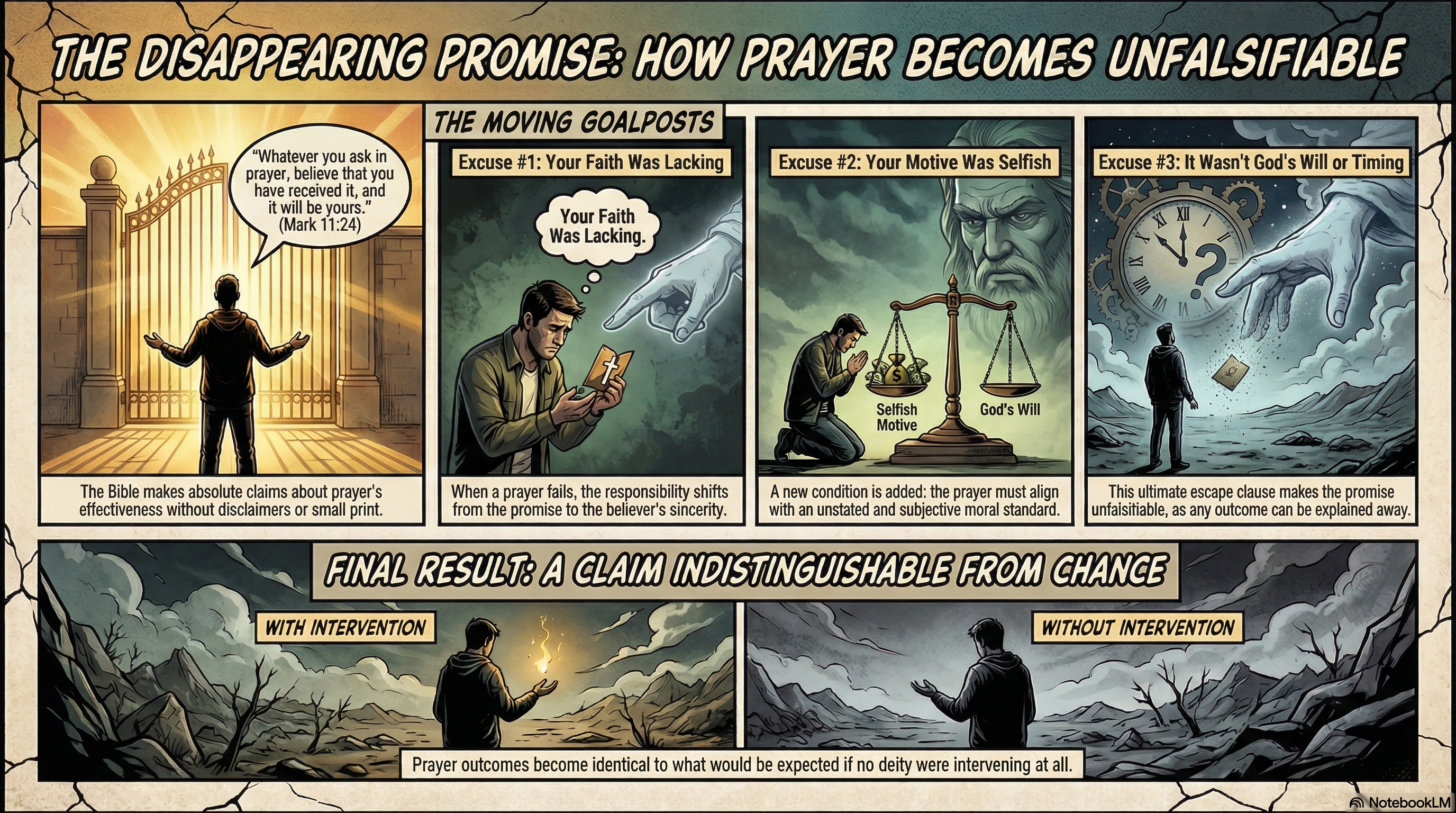
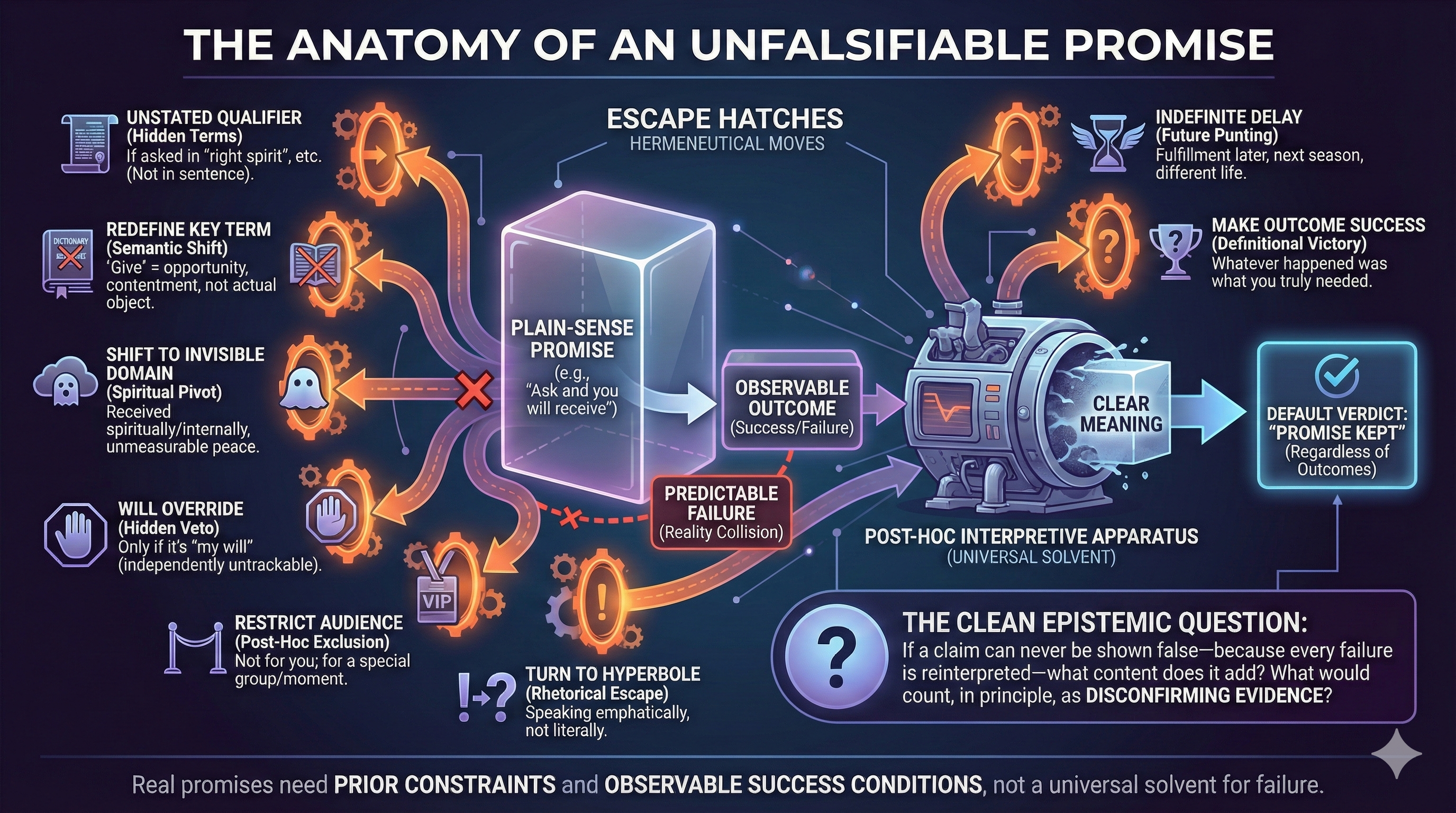
Summary: This post presents several logical arguments questioning the effectiveness of prayer by analyzing whether prayer outcomes differ meaningfully from what would be expected in a universe without a divine responder. Each argument challenges the notion of a prayer-answering God by pointing to the lack of observable, consistent evidence for supernatural intervention across health, social, and predictive outcomes.

Imagine your father promises to give you anything you ask for. However, each time you ask for something—say, new shoes—he responds with reasons why he cannot fulfill the request. These reasons may include that you asked selfishly, lacked faith, or didn’t approach with a pure heart. Despite fulfilling these criteria upon re-asking, no shoes appear. When questioned, he adds another reason: it simply isn’t his will to give you shoes. Would you then proclaim to your neighbors that your father “amazingly responds” to your requests, even though his actions resemble what you’d expect if he were dead or oblivious?
Similarly, does the God of the Bible answer prayers as advertised, or do responses to prayers reflect what we might expect in a universe without a prayer-answering deity?
John 14:13-14: “Whatever you ask in my name, this I will do, that the Father may be glorified in the Son. If you ask me anything in my name, I will do it.”
While some Christians might argue that the Bible doesn’t promise specific outcomes for prayers, others claim God does fulfill prayer requests. For prayer to be deemed effective, we need clear criteria to determine when God, as opposed to material causality, is the source. For example, if someone recovers from an illness after praying, how can we verify this was divine intervention rather than natural recovery? And if a person wins a lottery, how do we distinguish between a miraculous answer and sheer probability?
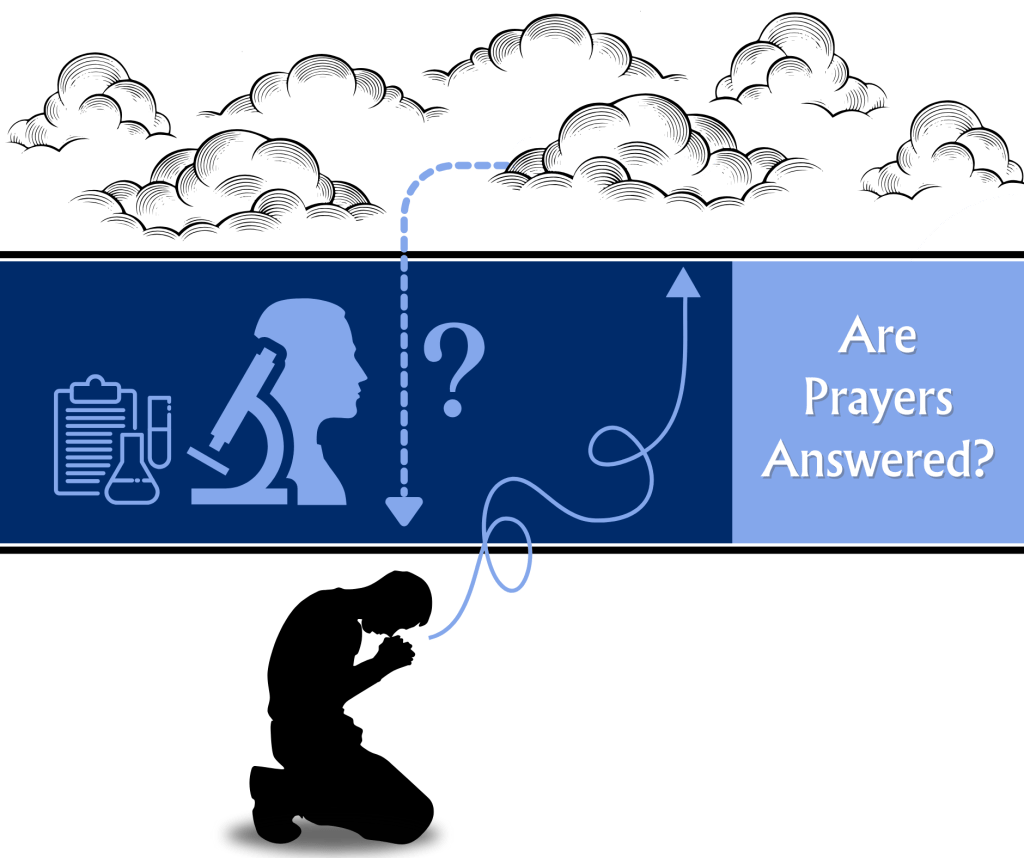
If God were truly responding to prayers, we might expect statistical evidence that transcends natural explanations. But often, so-called answered prayers, such as sports victories, appear trivial compared to unaddressed pleas for basic needs—like a mother praying for food for her starving child.
Christians often claim there are this and that conditions on prayer found elsewhere in the Bible, distant from the clear, unconditional promises. Let’s take a look at some of these.
Evolving Stipulations: Conditions Multiply
- “… If ye have faith as a grain of mustard seed, ye shall say unto this mountain, Remove hence to yonder place; and it shall remove; and nothing shall be impossible unto you.”
Matthew 17:20- “If you ask anything in my name, I will do it.”
John 14:14.
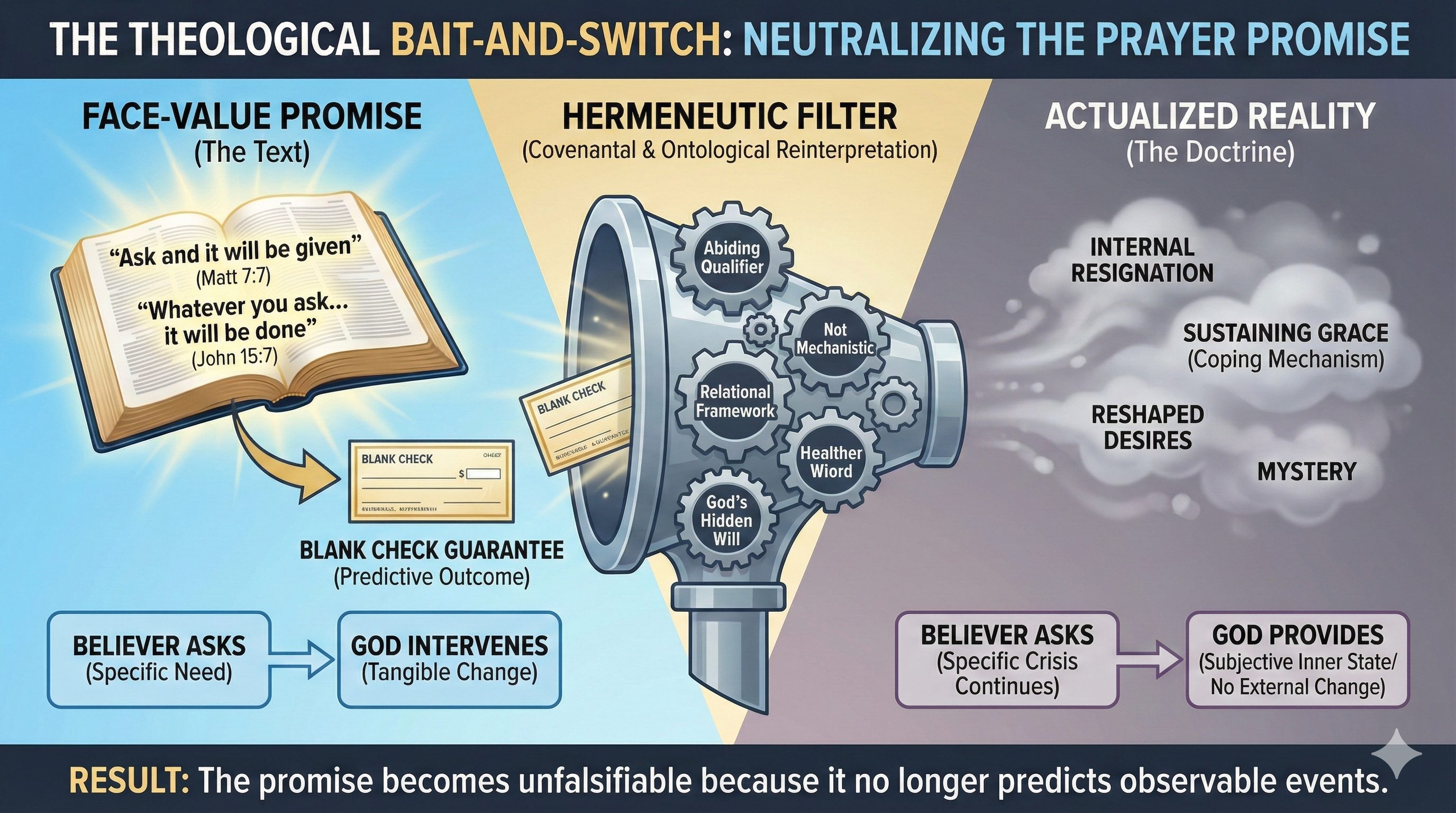
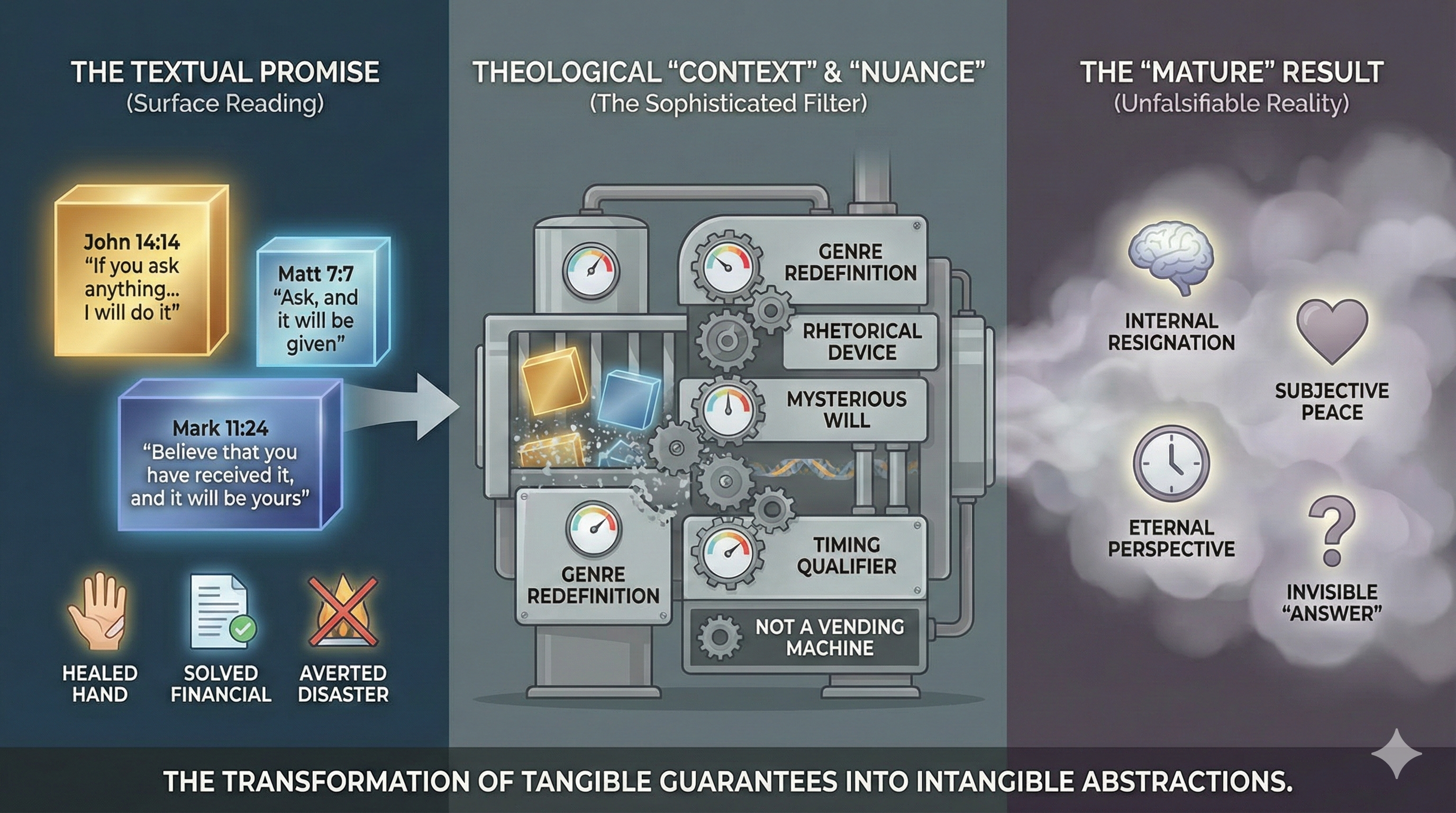
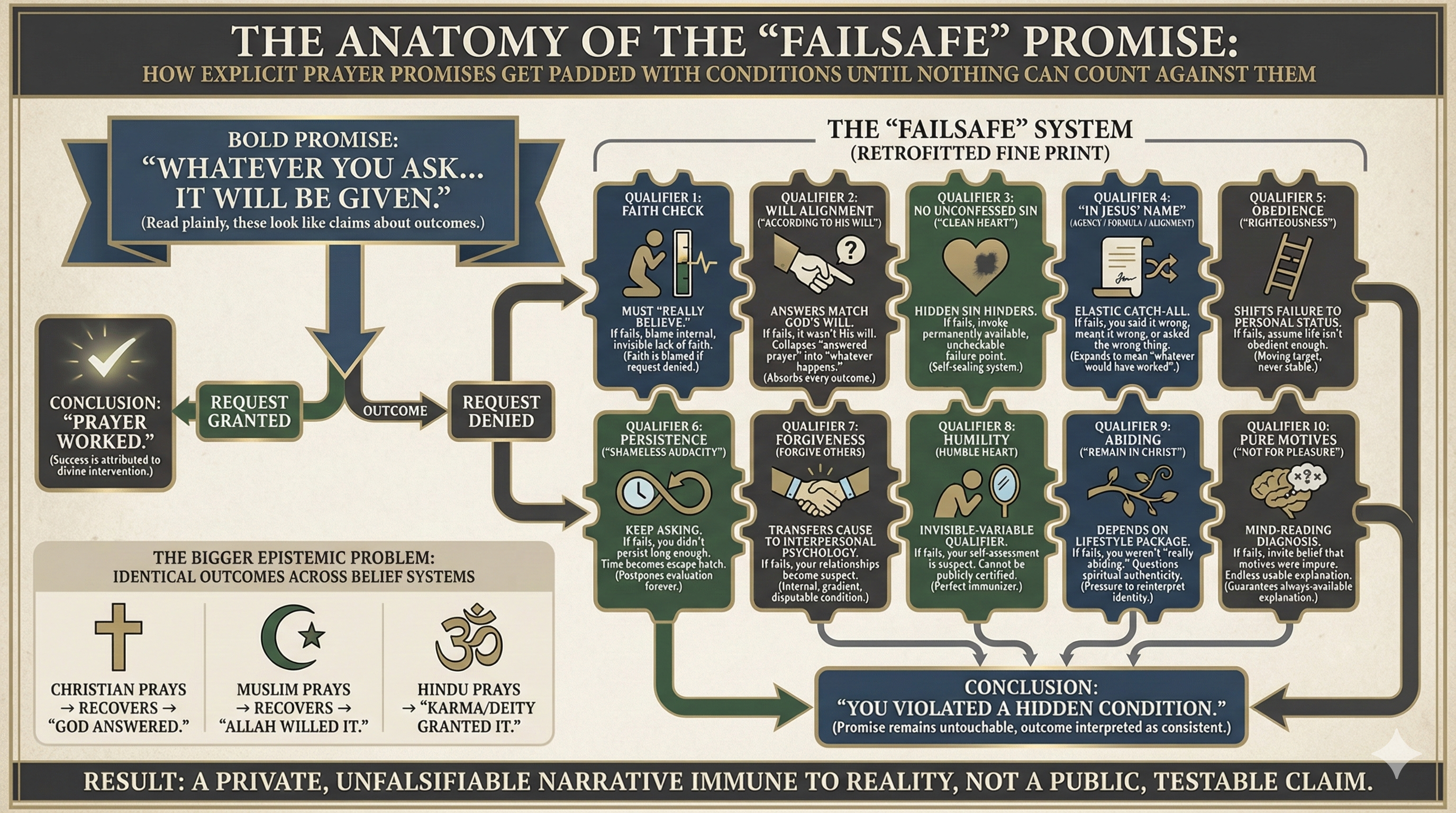
As the believer persists in his prayer based on the clear promises in the verses above, God (or Bible authors) seems to introduce in other contexts a series of hermeneutical stipulations that progressively qualify the original promises. Each condition shifts the responsibility back onto the believer, diluting the clarity and certainty of the initial statements. These stipulations are tracked through the iterative “versions” of “Answered Prayer”:
- Version 1.1: Sincerity Requirement
- God: “It may have been that you were not sincere. Do you really believe that I can move the mountain?”
- Implication: The promise now hinges on the subjective quality of the believer’s belief, introducing an unverifiable internal condition.
- Version 1.2: Unselfishness Requirement
- God: “Have you made certain that you asked unselfishly?”
- Implication: The motive behind the prayer must be pure, adding another layer of introspection that cannot be objectively measured.
- Version 1.3: Self-Help Requirement
- God: “You’ll have to do your part too.”
- Implication: The promise is reinterpreted as a partnership, where human effort is a prerequisite, undermining the miraculous nature of the original claim.
- Version 1.4: Timing and Patience Requirement
- God: “Did you think I’d answer your request within a couple years? Isn’t that a bit selfish?”
- Implication: God’s timing is introduced as a variable, making the promise’s fulfillment potentially indefinite and excusing delays.
- Version 1.5: Divine Will Requirement
- God: “It has not been my will to help you out yet.”
- Implication: The ultimate condition—God’s sovereign will—overrides all others, rendering the promise contingent on an unknowable divine decision.
By Version 1.5, the promise has transformed from a clear commitment to a heavily conditional framework: “If it is Heaven’s will, Heaven helps, when it is good and ready, those who sincerely and unselfishly believe in Heaven and help themselves.”
Why the Decline in Public Demonstrations of Answered Prayer?
The Bible recounts stories where God powerfully displays his presence—like Elijah calling down fire from Heaven. Today, why would an all-powerful deity hesitate to visibly and powerfully respond to believers’ prayers? This absence is often attributed to Luke 16:29, where Abraham tells the man in torment, “They have Moses and the Prophets; let them listen to them.” Yet, can Bible stories be as compelling as experiencing miraculous events firsthand?
Interestingly, as tools for scientific assessment and devices like cameras have increased, reports of miracles have seemingly declined. Could this inverse correlation suggest something about the nature of modern “miracles”?
Testing a Prayer-Answering God with Real-World Scenarios
If a prayer-answering God exists, we should be able to observe distinctive patterns. Here are potential ways to test such claims:
- Health Outcomes: If Christians and Muslims pray for their families’ health, statistically significant differences in longevity might suggest divine intervention.
- Practical Wisdom: After years of prayer, a measurable disparity in financial success between groups might support claims of divine guidance.
- Future Knowledge: Precise knowledge from God about impending events could be used to prevent disasters or uplift the impoverished.
- Scientific Insights: If believers were granted scientific breakthroughs to alleviate global suffering, it would indicate divine responsiveness.
- Replicating Elijah’s Challenge: Religious groups could publicly pray for occurrences defying physical laws, such as the levitation of an object, as an empirical test.
Today, so-called evidence of answered prayer aligns closely with natural statistical outcomes. If a divine being were actively answering prayers, why not occasionally heal an amputee or, as Jesus promised, move mountains with faith? Wouldn’t such acts be reasonable for an omnipotent deity?
Rigorous Way to Test Prayer
1. Double-Blind Prayer Intervention Study
- Method: Randomly assign patients in hospitals into two groups: one group receives prayers from people who know their names and conditions (prayer group), and the other group does not receive any directed prayers (control group). Neither patients nor medical staff should know which group a patient belongs to.
- Measures: Recovery rate, speed of recovery, complication rates, and overall health improvements.
- Goal: Determine if there are significant health improvements in the prayer group versus the control group.
2. Cross-Religious Prayer Efficacy Study
- Method: Include participants from various religions and cultural backgrounds to pray for a common goal, such as recovery from an illness in a controlled group. This could reveal if prayer efficacy varies by religion or if it operates universally.
- Measures: Compare health outcomes across groups, including non-believers who are prayed for.
- Goal: Test if specific religions or prayer forms yield different results or if any positive effects are independent of religious affiliation.
3. Prayers for Future Knowledge

- Method: Set up a study where believers pray for specific, unknown future events (e.g., predicting specific outcomes of future elections or financial market fluctuations).
- Measures: Track the accuracy of predictions compared to what would be expected by chance.
- Goal: Determine if prayer can yield knowledge of future events beyond statistical probability.
4. Prayer and Financial Success Study
- Method: Conduct a longitudinal study tracking the financial success of groups that regularly pray for guidance in business or financial decisions versus a control group that does not engage in prayer.
- Measures: Compare income growth, asset accumulation, and financial stability over time.
- Goal: Assess if prayer contributes to measurable financial benefits beyond natural factors like education or market conditions.
5. Prayer Impact on Societal Issues
- Method: In areas with persistent social issues (e.g., high crime rates, poverty), compare cities or communities where organized prayer events for improvement are conducted over a set period with control areas that do not hold such events.
- Measures: Track crime rates, economic indicators, and community health statistics.
- Goal: Determine if organized prayer has a statistically significant impact on reducing societal issues.
6. Controlled Study on Healing for Specific Conditions
- Method: Select a specific, measurable health condition that typically has well-documented recovery statistics (e.g., wound healing, post-surgery recovery). Divide participants into prayer and control groups.
- Measures: Time to healing, complication rates, need for follow-up procedures.
- Goal: Test if prayer influences healing rates in a way that deviates from expected medical outcomes.
7. Prayer and Psychological Well-Being
- Method: Over a period, compare levels of anxiety, stress, and depression among people who receive prayers with those who do not. Use standardized psychological scales to quantify well-being.
- Measures: Pre- and post-intervention scores on mental health scales.
- Goal: Assess if prayer contributes to psychological well-being beyond placebo effects.
8. Randomized Prayer Experiment on Specific Events
- Method: Select specific events with binary outcomes (e.g., a safe outcome versus an adverse event). Participants pray for a particular outcome, while others in a control group do not.
- Measures: Analyze the outcomes statistically against historical probability.
- Goal: Identify if prayers statistically alter the likelihood of specific outcomes.
9. Empirical Testing of Biblical Prayer Promises
- Method: Set up controlled tests for specific promises related to prayer in the Bible (e.g., faith as small as a mustard seed can move mountains).
- Measures: Observe if believers can achieve outcomes described in these promises under controlled conditions.
- Goal: Assess whether prayer produces results consistent with scriptural claims.

Each of these tests would require large sample sizes, robust controls, and repeated trials to reduce bias, placebo effects, and other confounding factors. Results that significantly diverge from statistical expectations could suggest an effect of prayer; otherwise, they would indicate that prayer operates within the realm of natural statistical variation.
A Companion Technical Paper:

The Logical Form
1. The Ineffectiveness of Prayer Argument
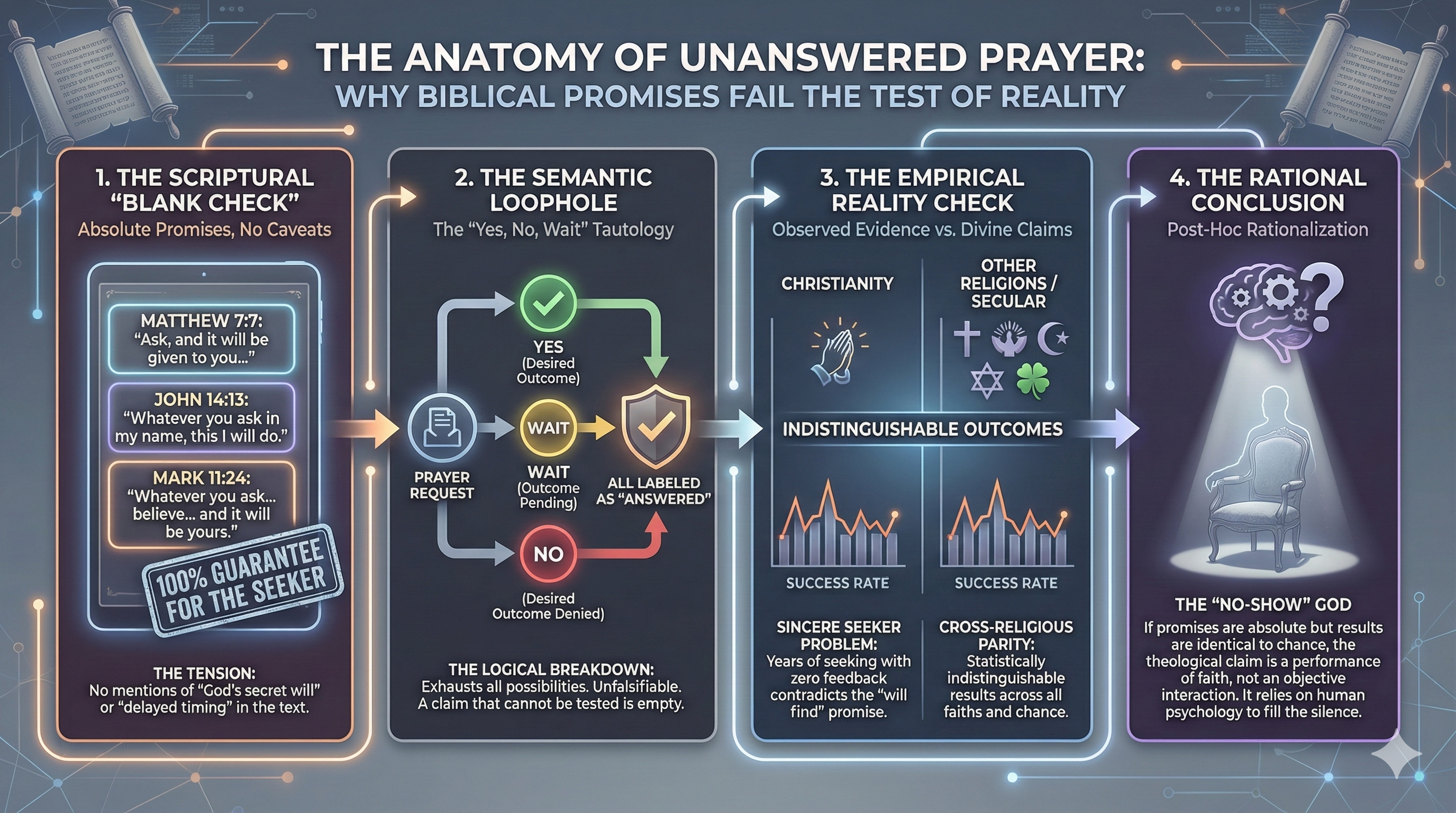
- Premise 1: If a prayer-answering God exists, then prayers would produce outcomes distinctly different from what would occur in a godless universe.
- Premise 2: Prayer outcomes align closely with what we would expect in a universe without a prayer-answering God, such as recovery rates in illness, success in financial ventures, and other measurable factors.
- Conclusion: Therefore, the evidence does not support the existence of a prayer-answering God since prayer outcomes are indistinguishable from natural, random processes.

2. The Lack of Observable Miracles Argument
- Premise 1: If an all-powerful God answers prayers, then miraculous interventions should occasionally be observable, even in modern times, as a demonstration of divine action.
- Premise 2: The absence of such observable miracles, especially with the rise of scientific scrutiny and recording devices, suggests that no supernatural interventions occur in response to prayer.
- Conclusion: Therefore, it is unlikely that an all-powerful God answers prayers, as we would expect to see consistent evidence of miracles.
3. The Inconsistency of Biblical Promises Argument
- Premise 1: The Bible claims that prayer can produce substantial, observable outcomes, like moving mountains or achieving results beyond natural expectation.
- Premise 2: Modern evidence does not support the occurrence of extraordinary outcomes from prayer, as described in the Bible.
- Conclusion: Therefore, the Bible’s promises about the effectiveness of prayer are inconsistent with observable reality, suggesting a disparity between scripture and real-world prayer outcomes.
4. The Cross-Religious Prayer Efficacy Argument
- Premise 1: If a specific prayer-answering God exists, then prayers from that faith tradition would be uniquely effective compared to other religious practices or non-religious groups.
- Premise 2: Studies and real-world observations show no consistent, statistically significant difference in prayer efficacy across religious traditions or when compared to non-prayer groups.
- Conclusion: Therefore, the lack of unique efficacy suggests that no specific prayer-answering God responds uniquely to prayers from any one tradition.
5. The Test of Predictive Prayer Argument
- Premise 1: If prayer connects believers to a divine being with knowledge of the future, then prayer should be able to yield accurate predictions about specific future events beyond chance.
- Premise 2: There is no evidence that prayers for future knowledge result in accurate predictions at a rate greater than random chance.
- Conclusion: Therefore, prayer does not appear to provide access to divine foreknowledge, challenging claims of a prayer-answering God who knows the future.
6. The Social and Psychological Impact of Prayer Argument
- Premise 1: If prayer has a divine impact on social and psychological well-being, then we should see statistically significant improvements in areas where people pray for societal issues (e.g., crime rates, economic prosperity).
- Premise 2: Studies and observations show that communities with organized prayer events do not experience significant improvements in social or psychological conditions compared to those without such practices.
- Conclusion: Therefore, prayer does not appear to alter social or psychological conditions in a way that would indicate divine intervention.
(Scan to view post on mobile devices.)

A Dialogue
Examining the Efficacy of Prayer
CHRIS: I believe in a prayer-answering God who listens to our prayers and responds in ways that show His power and presence.
CLARUS: But if that’s true, shouldn’t we see prayer outcomes that are clearly different from what would happen in a world without such a God? For example, when people pray for healing, the recovery rates are statistically the same as natural outcomes, and there’s no measurable distinction suggesting divine intervention.
CHRIS: God’s ways aren’t always predictable. Sometimes He answers prayers subtly or spiritually rather than with obvious miracles.
CLARUS: I understand that perspective, but the Bible makes strong promises about prayer, suggesting that faith the size of a mustard seed could move mountains. If these promises were fulfilled, shouldn’t we at least occasionally see outcomes that can’t be explained away by natural causes, especially in our modern world with scientific tools to measure them?
CHRIS: Maybe those promises refer to a kind of spiritual strength or transformation rather than literal outcomes. God answers in ways beyond what science can quantify.
CLARUS: Then why do we see this pattern across all religions, where the effectiveness of prayer doesn’t depend on the specifics of a faith tradition? If a Christian God uniquely answers prayers, we’d expect Christian prayers to show results that differ from those in other religions, but studies don’t support that.
CHRIS: Maybe it’s the act of faith itself that matters, regardless of the specifics. People of any faith who sincerely pray might receive blessings from God.
CLARUS: But if prayer works regardless of faith, it implies no specific deity is responding, just that belief alone has an effect—something we could explain psychologically rather than supernaturally. And if prayer were truly a pathway to divine knowledge, wouldn’t believers sometimes predict events with greater accuracy than chance?
CHRIS: Faith isn’t meant to predict the future; it’s about trust in God’s plan and seeking guidance in life’s choices, not fortune-telling.
CLARUS: But there’s also the question of social impact. If prayer had divine power, we’d expect areas with organized prayer to show improvements in issues like crime and poverty, but statistically, there’s no significant difference in these regions compared to non-praying communities.
CHRIS: Prayer changes individuals spiritually, even if it’s not always visible in society at large. Perhaps the benefits of prayer are personal, transforming hearts rather than external circumstances.
CLARUS: Then we’re left with results that mirror what we’d expect in a world without divine intervention—personal change, community stability, even healing rates, all consistent with natural explanations. If a prayer-answering God exists, wouldn’t there be more evident, measurable results?
CHRIS: Faith may not always align with evidence as you see it, but it’s about trusting God beyond what is tangible. I see His work in the subtle ways lives are transformed.
CLARUS: I respect that perspective, but without clear, observable outcomes, it becomes hard to distinguish between true divine action and natural processes. The question remains: can we genuinely attribute any observable difference to prayer if it aligns so closely with natural probabilities?


Notes:
Helpful Analogies
The Invisible Firefighter Analogy

Imagine a town where people believe an invisible firefighter is always on duty, ready to extinguish any fire upon request. When fires break out, townsfolk fervently call upon this firefighter, and sometimes the fire goes out quickly while other times it rages uncontrollably. Despite their faith, fires continue to burn, behaving just as they would if there were no firefighter at all. This invisible firefighter analogy reflects the way prayer appears to work: if prayer had true power, we’d expect consistent intervention, but instead, the results mirror what we’d expect without any divine interference.
The Silent Partner Analogy
Imagine you have a silent business partner who promises to support your business financially whenever you need it. However, every time you request help, they provide an excuse: “It’s better for you to handle this alone,” “Your need isn’t genuine,” or simply, “Trust in my mysterious plan.” Over time, it’s hard to tell if they’re involved at all, as your financial success or failure unfolds just as it might if they didn’t exist. This silent partner’s ambiguity mirrors the unverifiable impact of prayer—while believers interpret events as divine responses, the outcomes resemble natural patterns of success and failure.
The Self-Watering Garden Analogy
Imagine a self-watering garden that relies solely on rainfall for sustenance, yet people are convinced that each time they ask a “garden spirit” for rain, it responds. Some days it rains, and the plants thrive; other days it’s dry, and the plants wilt. The garden’s condition varies with natural weather patterns, but believers credit each improvement to the spirit’s intervention. In reality, if this spirit were truly watering the garden, we’d see rainfall in response to every request, not just by random natural occurrence. This analogy highlights the difficulty of distinguishing natural causation from divine action in prayer outcomes.
Addressing Theological Responses
Theological Responses
1. God’s Responses Transcend Human Understanding
Theologians often argue that God’s wisdom transcends human understanding, and He answers prayers in ways that serve a greater purpose rather than immediate, observable outcomes. They may suggest that God considers each prayer within the context of His divine plan, and what might appear as an unanswered prayer is often a part of a larger, more complex spiritual purpose.
2. Spiritual Benefits Beyond Tangible Results
Prayer, they argue, offers more than just tangible outcomes; it fosters a spiritual connection with God, transforming individuals on a deeper level. This transformation may not always be visible or measurable, but believers often report experiencing inner peace, strength, and resilience that align with the purposes of prayer as outlined in Scripture. Thus, prayer’s true value lies in its ability to spiritually edify believers, even when physical outcomes remain unchanged.
3. God Respects Human Freedom and Natural Law
Some theologians maintain that God respects human freedom and the natural order He established. Intervening constantly in response to every prayer would undermine the autonomy of creation and the laws of nature that allow the world to function predictably. In this view, God’s occasional interventions are rare and subtle, preserving the integrity of the created world while still allowing for occasional divine action that aligns with His purposes.
4. Faith Requires Trust Beyond Empirical Evidence
Theological perspectives often highlight that faith inherently involves trust beyond empirical evidence. God’s relationship with believers is built on faith and trust, not on visible proofs or guarantees. A lack of obvious answers to prayer challenges believers to cultivate a faith that withstands uncertainty, viewing unanswered prayers as opportunities to grow in spiritual resilience and reliance on God’s wisdom.
5. Prayer as a Means of Aligning with God’s Will
Prayer, in many theological frameworks, is seen not as a tool for changing external circumstances but as a way for believers to align themselves with God’s will. Rather than expecting God to conform to their desires, prayer helps believers reflect on and accept His purposes, leading them to a deeper understanding of divine will and a reorientation of their priorities in life.
6. God’s Timing Differs from Human Expectations
Theologians might argue that God operates within a divine timeline that often differs from human expectations. Prayers may be answered, but not in the way or timeframe believers hope for, as God’s answers are tailored to His eternal perspective. In this view, prayers that seem unanswered may yet be fulfilled in unexpected ways or times, and delayed outcomes are seen as part of God’s unique approach to answering prayer.
7. Scriptural Interpretation of Prayer Promises
Theologians may respond by suggesting that scriptural promises about prayer are sometimes misunderstood, pointing out that biblical verses need to be interpreted within their historical and theological context. Promises of answered prayer, they argue, are often contingent on factors like faith, humility, and alignment with God’s will, which influences the interpretation of prayer promises in the Bible.
Counter-Responses
1. Limits of the “God’s Wisdom” Argument
If God’s wisdom is truly beyond human comprehension, it becomes difficult to claim we can know that God is answering prayers at all. An all-knowing deity should be able to demonstrate consistent evidence of divine action in ways accessible to our understanding, especially if God seeks a relationship with believers. Without observable outcomes, attributing events to “God’s wisdom” risks becoming a catch-all explanation that avoids addressing the lack of clear evidence.
2. Distinguishing Spiritual Benefits from Psychological Effects
While many report inner peace and strength from prayer, these effects could arise from psychological mechanisms rather than divine action. Practices like meditation or secular mindfulness also produce inner transformation and resilience, suggesting that the benefits attributed to prayer might not require a supernatural explanation. Without distinct evidence that prayer offers more than what psychological practices provide, it’s challenging to argue that these spiritual benefits are unique to prayer.
3. Intervention and Consistency with Natural Law
If God respects natural law and rarely intervenes, it raises the question of why prayer would be encouraged at all if the outcomes are almost always left to natural causation. Inconsistencies arise when believers attribute certain natural events to God’s intervention while other similar events remain untouched. A deity who selectively intervenes appears arbitrary, making it difficult to establish a coherent view of divine action that truly respects both freedom and prayer promises.
4. Faith vs. Evidence: The Value of Testability
While faith inherently involves trust, religious beliefs often make empirical claims about real-world outcomes, such as the effectiveness of prayer. Rational inquiry values beliefs that are testable and falsifiable, providing a basis for discerning truth. If God desires faith yet promises prayer will yield tangible effects, then prayer outcomes should still meet a minimum standard of observable evidence, otherwise risking circular reasoning where faith justifies the lack of evidence.
5. Alignment with God’s Will: A Moving Goalpost
The argument that prayer aligns with God’s will makes divine responses indistinguishable from natural occurrences since any outcome could be said to reflect God’s will. This renders prayer non-falsifiable; no possible result could demonstrate that prayer doesn’t work. By making God’s will the sole criterion for answered prayer, this explanation undermines the biblical promise of answered prayer and makes it indistinguishable from chance.
6. Ambiguity of God’s Timing
The argument that prayers may be answered on God’s timeline introduces an indefinite timeframe that is unfalsifiable, meaning that any lack of response can always be attributed to timing. Such flexibility makes the concept of prayer unverifiable since outcomes that don’t align with requests can always be deferred as part of a “divine plan.” Without a clear and measurable response, attributing delays to God’s timing fails to provide any meaningful distinction between answered prayers and random outcomes.
7. Contextualizing Scriptural Promises Does Not Address the Results
Interpreting scriptural promises within historical context may explain why some claims don’t align with current observations, but it does not change the lack of observable outcomes. If prayer promises were intended to convey real-world effects, then reinterpretation after the fact appears like special pleading. Instead of clarifying prayer’s efficacy, this approach shifts focus from empirical outcomes to theological rationalizations, weakening the argument for prayer’s effectiveness.
Clarifications
The Dissipation of Divine Promises into Unfalsifiability
1. The Initial Promises: Clear and Unconditional
The text begins with two biblical passages that present God’s promises about prayer as straightforward and unconditional:
- Matthew 17:20: “If ye have faith as a grain of mustard seed, ye shall say unto this mountain, Remove hence to yonder place; and it shall remove; and nothing shall be impossible unto you.”
- Interpretation: Faith alone, even minimal, is sufficient to achieve miraculous outcomes, such as moving a mountain.
- John 14:14: “If you ask anything in my name, I will do it.”
- Interpretation: Asking in Jesus’ name guarantees the fulfillment of the request, with no apparent qualifications.
These promises suggest a direct cause-and-effect relationship: faith and prayer lead to tangible, observable results. The believer might initially taks these promises at face value, asking God to move a mountain to enable him to grow food for his family—a practical, testable request rooted in the biblical imagery.
2. The Evolving Stipulations: Conditions Multiply
Evolving Stipulations: Conditions Multiply
- “… If ye have faith as a grain of mustard seed, ye shall say unto this mountain, Remove hence to yonder place; and it shall remove; and nothing shall be impossible unto you.”
Matthew 17:20- “If you ask anything in my name, I will do it.”
John 14:14.
As the believer persists in his prayer based on the clear promises in the verses above, God (or Bible authors) seems to introduce in other contexts a series of hermeneutical stipulations that progressively qualify the original promises. Each condition shifts the responsibility back onto the believer, diluting the clarity and certainty of the initial statements. These stipulations are tracked through the iterative “versions” of “Answered Prayer”:
- Version 1.1: Sincerity Requirement
- God: “It may have been that you were not sincere. Do you really believe that I can move the mountain?”
- Implication: The promise now hinges on the subjective quality of the believer’s belief, introducing an unverifiable internal condition.
- Version 1.2: Unselfishness Requirement
- God: “Have you made certain that you asked unselfishly?”
- Implication: The motive behind the prayer must be pure, adding another layer of introspection that cannot be objectively measured.
- Version 1.3: Self-Help Requirement
- God: “You’ll have to do your part too.”
- Implication: The promise is reinterpreted as a partnership, where human effort is a prerequisite, undermining the miraculous nature of the original claim.
- Version 1.4: Timing and Patience Requirement
- God: “Did you think I’d answer your request within a couple years? Isn’t that a bit selfish?”
- Implication: God’s timing is introduced as a variable, making the promise’s fulfillment potentially indefinite and excusing delays.
- Version 1.5: Divine Will Requirement
- God: “It has not been my will to help you out yet.”
- Implication: The ultimate condition—God’s sovereign will—overrides all others, rendering the promise contingent on an unknowable divine decision.
By Version 1.5, the promise has transformed from a clear commitment to a heavily conditional framework: “If it is Heaven’s will, Heaven helps, when it
3. The Shift to Unfalsifiability: No Testable Outcome
The cumulative effect of these stipulations is a shift from a falsifiable claim (e.g., “the mountain will move”) to an unfalsifiable one. Unfalsifiability occurs when a statement cannot be disproven because its failure can always be explained away. The text illustrates this shift:
- Empirical Failure Ignored: Despite the believer’s decades of faith, effort, and prayer, the mountain remains largely unmoved. Yet, each failure is attributed to a new condition (lack of sincerity, selfishness, insufficient effort, impatience, or misalignment with God’s will) rather than a flaw in the promise itself.
- Redefinition of Success: God redefines the “answer” as giving the believer the strength to move 1% of the mountain, not the full miracle promised. This reinterpretation ensures that any outcome—movement or no movement—can be claimed as fulfillment.
- Ultimate Escape Clause: The appeal to “Heaven’s will” and the promise of posthumous reward (“now you get to go to Heaven”) remove the need for observable earthly results. The promise’s validation is deferred to an untestable afterlife.
The final “Beta Version 2.0” encapsulates this unfalsifiability: “Heaven helps everyone who helps themselves only to the degree that they help themselves, exactly as if there were no Heaven.” This version equates divine assistance with natural human effort, making it indistinguishable from a world without divine intervention—a claim that cannot be disproven because it predicts the same outcome regardless of God’s involvement.
4. Hermeneutical Flexibility: Twisting the Promise
The text highlights how Christians often employ hermeneutical flexibility to reconcile the promise with reality:
- Reinterpretation: Each stipulation is a post-hoc adjustment, not evident in the original text, allowing believers to “twist” the promise “into alignment with material expectations” (as noted in the “Warning”).
- Suffering as Virtue: The undaunted believer might praise God for their suffering, framing the promise’s apparent failure as a sign of divine favor—a theological move that preserves faith despite evidence to the contrary.
This flexibility ensures that no matter the outcome—mountain moved, partially moved, or unmoved—the promise remains “true” in the believer’s eyes, insulated from empirical critique.
Conclusion
The text demonstrates a progression from clear, testable promises of answered prayer to an unfalsifiable theological construct. The initial biblical assurances—moving mountains with mustard-seed faith or receiving anything asked in Jesus’ name—dissipate under a cascade of hermeneutical stipulations: sincerity, unselfishness, self-effort, divine timing, and God’s will. These conditions transform the promises into statements that cannot be disproven, as any failure can be attributed to human shortcomings or divine prerogative rather than the promises themselves. By the end, the promise’s fulfillment is either deferred to an unverifiable afterlife or redefined as indistinguishable from human effort, rendering it immune to falsification. This process reflects a broader pattern in Christian apologetics: adapting bold scriptural claims to fit observed reality, ensuring faith persists despite unmet expectations.
The Unfulfilled Promises of God in the New Testament Regarding Prayer
The New Testament contains several bold statements attributed to Jesus and the apostles, promising that God will unequivocally answer prayers. These verses are presented with apparent certainty, suggesting that believers can expect consistent, tangible responses to their petitions. However, from a skeptical perspective, these promises fail to hold up under scrutiny. Real-world experience and logical analysis reveal that prayers often go unanswered, contradicting the plain meaning of these texts. This essay examines key New Testament passages, provides a hermeneutical assessment from a skeptic’s viewpoint, and demonstrates that the promises are either unreliable or require reinterpretation that undermines their supposed clarity.
1. Matthew 7:7-8 – A Promise That Falls Flat
“Ask, and it will be given to you; seek, and you will find; knock, and it will be opened to you. For everyone who asks receives, and the one who seeks finds, and to the one who knocks it will be opened.”
Context and Skeptical Assessment:
Delivered in the Sermon on the Mount, this passage uses sweeping language—“everyone who asks receives”—to promise universal success in prayer. The future tense (“it will be given”) implies a guaranteed outcome. Yet, countless believers ask for healing, provision, or protection and receive nothing. Children die of cancer despite fervent prayers; families face financial ruin despite seeking help. The promise’s universality is disproven by these persistent failures.
Evidence of Failure:
- Empirical Reality: If “everyone” receives, no prayer should go unanswered. Yet, statistical outcomes of prayed-for events (e.g., recovery rates in hospitals) show no significant difference from those without prayer.
- Lack of Specificity: The text offers no conditions like faith or alignment with God’s will, making excuses about “unworthy requests” an ad hoc addition. Without such qualifiers, the promise should apply universally—and it doesn’t.
- Reinterpretation Weakness: Believers often claim delayed answers or spiritual benefits instead of literal fulfillment. This shifts the goalposts, rendering the original promise meaningless.
2. John 14:13-14 – A Name That Doesn’t Deliver
“Whatever you ask in my name, this I will do, that the Father may be glorified in the Son. If you ask me anything in my name, I will do it.”
Context and Skeptical Assessment:
Spoken at the Last Supper, this promise ties prayer to Jesus’ name, suggesting automatic fulfillment (“I will do it”). The breadth of “whatever” and “anything” implies no limits. Yet, Christians invoking Jesus’ name routinely fail to see results—missionaries are martyred, natural disasters strike prayed-over regions, and personal pleas go unmet. The promise’s absoluteness invites testing, and it fails.
Evidence of Failure:
- Historical Counterexamples: Church history is replete with unanswered prayers made “in Jesus’ name”—from failed pleas during plagues to modern tragedies like mass shootings.
- Glorification Clause: The phrase “that the Father may be glorified” suggests a purpose, but unanswered prayers often bring despair, not glory, contradicting the stated intent.
- No Escape Clause: The text lacks conditions like faith or divine veto, so claiming “it wasn’t God’s will” is an external imposition, not a textual defense. The promise overcommits and underdelivers.
3. Mark 11:24 – Belief Without Results
“Therefore I tell you, whatever you ask in prayer, believe that you have received it, and it will be yours.”
Context and Skeptical Assessment:
Following the fig tree incident, this verse ties prayer to belief, promising that confident requests will be granted. The aorist tense (“believe that you have received it”) suggests immediate trust should yield immediate results. Yet, sincere believers—praying with conviction for miracles like limb regrowth or peace in war zones—see no outcome. The promise hinges on a testable condition that, when met, still fails.
Evidence of Failure:
- Observable Non-Results: Amputees don’t regrow limbs, despite believers claiming faith. This specific, measurable request exposes the promise’s emptiness.
- Psychological Excuse: Apologists argue insufficient faith voids the promise, but the text assumes belief is achievable. If believers can’t muster enough faith, the promise is impractical; if they can, it’s still unfulfilled.
- Scope of “Whatever”: No limit is placed on “whatever,” yet practical limits clearly exist, contradicting the text’s plain meaning.
4. John 15:7 – Abiding Without Answers
“If you abide in me, and my words abide in you, ask whatever you wish, and it will be done for you.”
Context and Skeptical Assessment:
Part of the vine-and-branches metaphor, this promise links prayer to “abiding” in Christ, with “whatever you wish” suggesting broad fulfillment. Devout Christians—those who study Scripture, pray, and live faithfully—should see results. Yet, their prayers for dying loved ones or global justice often go unanswered, casting doubt on the condition’s efficacy or the promise’s truth.
Evidence of Failure:
- Devout Disappointment: Dedicated believers, presumably abiding, still face unanswered prayers—missionaries lose children, pastors suffer loss. Abiding doesn’t guarantee results.
- Wish Alignment: The text implies abiding shapes wishes to God’s will, yet even “noble” requests (e.g., ending poverty) fail, suggesting either abiding is impossible or the promise is false.
- Definitive Language: “It will be done” admits no exceptions, yet exceptions abound, undermining the claim.
5. 1 John 5:14-15 – Confidence Without Cause
“And this is the confidence that we have toward him, that if we ask anything according to his will, he hears us. And if we know that he hears us in whatever we ask, we know that we have the requests that we have asked of him.”
Context and Skeptical Assessment:
Written to bolster believers’ assurance, this passage promises that prayers “according to his will” are heard and granted. The present tense (“we have the requests”) suggests immediate possession. However, prayers aligned with God’s presumed will—e.g., for mercy or salvation of others—often yield silence, exposing a gap between promise and reality.
Evidence of Failure:
- Uncertain Will: If God’s will is knowable (via Scripture), prayers for biblical goals (e.g., healing, as in James 5:14-15) should succeed. They don’t, suggesting the condition is a dodge.
- Hearing Without Action: “He hears us” implies response, but hearing alone doesn’t fulfill requests. The leap to “we have” is unsupported by experience.
- Contradictory Outcomes: Prayers for the same outcome (e.g., a leader’s recovery) conflict among believers, yet none consistently prevail, negating the promise’s reliability.
Conclusion
From a skeptical standpoint, the New Testament’s prayer promises—spanning Matthew’s universal assurances to John’s conditional guarantees—collapse under the weight of reality. The texts use absolute terms like “it will be given,” “I will do it,” and “it will be yours,” yet unanswered prayers are a persistent norm. Believers may retreat to excuses—lack of faith, misaligned will, or mysterious timing—but these are absent from the verses themselves, revealing post-hoc rationalizations rather than textual truths. The empirical and logical disconnect between promise and outcome suggests either God does not answer as claimed, or the promises were never meant to be taken literally, rendering them hollow for those who test them in faith. Far from a cornerstone of hope, these verses highlight a divine silence that skepticism finds all too predictable.
Symbolic Logic Formulation of the Meaninglessness of the Promises of Answered Prayer
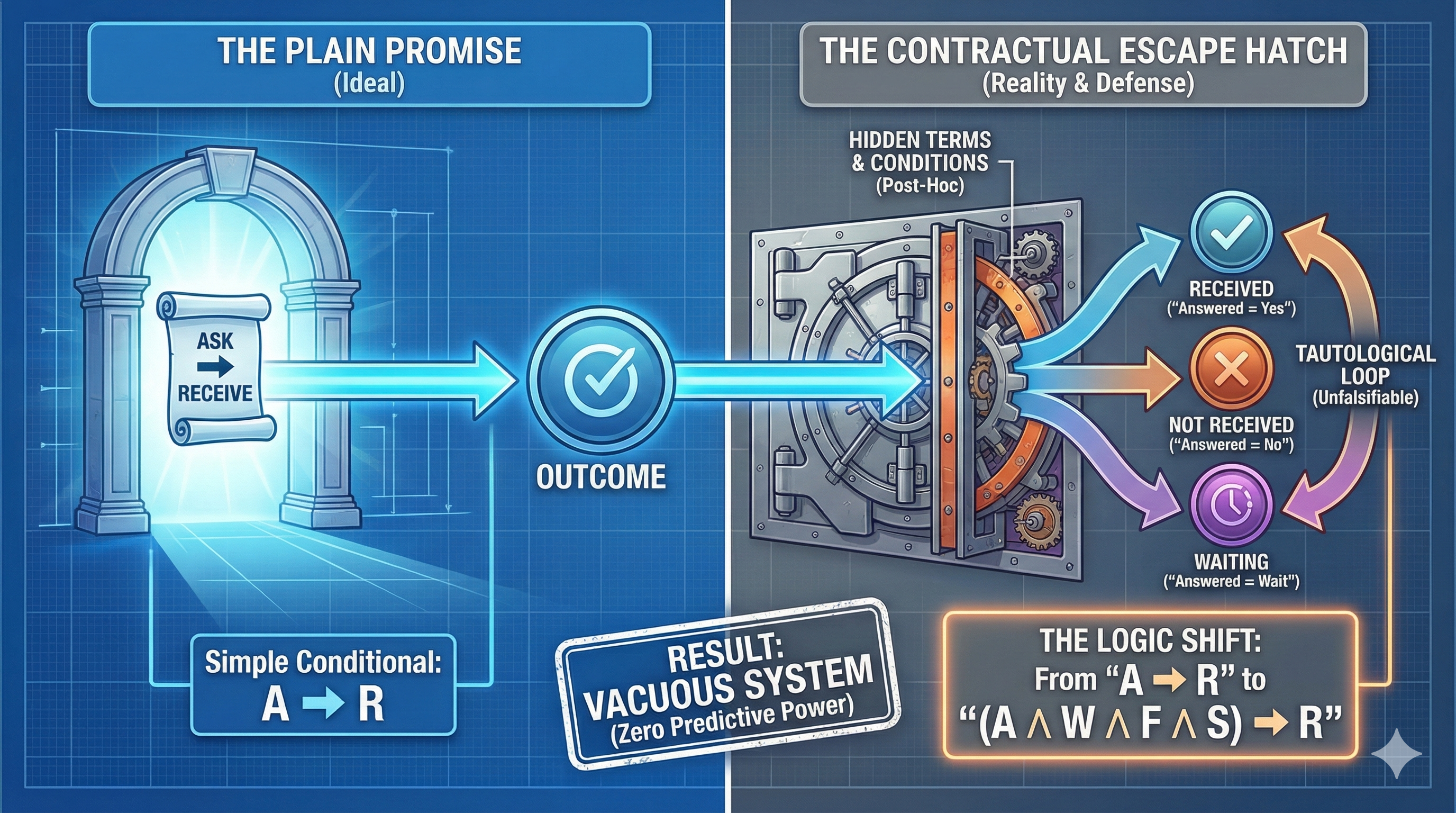
Below is a symbolic logic formulation that illustrates the absurdity of explaining away the New Testament’s clear promises to answer prayer with imposed stipulations (e.g., lack of faith, misalignment with God’s will, or mysterious timing). The goal is to show that such explanations render the universe where God answers prayer indistinguishable from one where God does not answer prayer, thus undermining the meaningfulness of the promises.
Definitions of Symbols
: “God promises to answer prayer unequivocally” (based on the plain text of verses like Matthew 7:7-8, John 14:13-14, etc.).
: “God answers prayer” (an observable event occurs as requested).
: “God does not answer prayer” (no observable event occurs as requested).
: “Stipulations are imposed” (e.g., “if you have enough faith,” “if it’s God’s will,” “if the timing is right”).
: “The petitioner fulfills the stipulations” (e.g., has sufficient faith, asks according to God’s will).
: “Universe where God answers prayer per the promises.”
: “Universe where God does not answer prayer at all.”
: “Observable outcome” (the result of prayer is discernible in reality).
Premises
Translation: If God promises to answer prayer unequivocally, then for all prayer requests (x), God answers them.
Rationale: The New Testament texts (e.g., “whatever you ask… I will do it”) imply a universal guarantee without explicit conditions.
Translation: If stipulations are imposed, then God answers prayer if and only if the stipulations are fulfilled.
Rationale: Apologists often claim prayer fails because conditions like faith or alignment with God’s will aren’t met.
Translation: God promises to answer prayer unequivocally, and stipulations are imposed.
Rationale: This reflects the tension between the clear text and added explanations.
Translation: If the stipulations are not fulfilled, then God does not answer prayer.
Rationale: A common excuse for unanswered prayer (e.g., “You didn’t have enough faith”).
Translation: An observable outcome occurs if and only if God answers prayer.
Rationale: The promises imply tangible results (e.g., “it will be given to you”).


Logical Derivation
Step 1: Start with the promise and imposed stipulations
- From Premise 3:
- From Premise 1:
- From Premise 2:
- By modus ponens on Premise 1 and 3:
(God answers all prayers).
- By modus ponens on Premise 2 and 3:
(God answers if and only if stipulations are met).
Step 2: Introduce the conflict
- These contradict unless
Step 3: Consider observable outcomes
- From Premise 5:
(Observables depend on answers).
- From Premise 4:
(No fulfillment of stipulations means no answer).
- If
(stipulations unmet), then
(no observable outcome).
Step 4: Compare universes
- In
- If
, then
- If
, then
- If
- In
, and
- If
Step 5: Absurdity revealed
- Define
: “There is a discernible difference between
in
- If
in
in
- Thus,
: There is no discernible difference.
- But
- Conclusion:
, a contradiction.
Explanation of the Absurdity
The New Testament promises (
Argument: The Implausibility of a God Who Offers Ambiguous Miracles
If an all-powerful God exists, responsible for creating the universe and capable of intervening in human affairs, it’s reasonable to assume that such a being would be able to produce unmistakable signs of divine action. A deity with this level of power would not be limited to outcomes that could be interpreted as either coincidence or divine intervention. Instead, a God who genuinely seeks to demonstrate responsiveness to prayer and establish a relationship with believers would perform miracles that are clear, definitive, and beyond natural explanation.
An omnipotent God could easily design miracles that exceed the boundaries of mere probability or chance. For instance, such a God could heal ailments that modern medicine considers incurable or perform physical transformations that defy known natural laws. If the aim is to demonstrate divine power, then a God capable of parting seas, stopping the sun, or raising the dead, as described in sacred texts, would not need to limit intervention to events that could be attributed to natural processes.
The ambiguity of “answered prayers”—those outcomes that may just as easily be explained by coincidence, psychological factors, or statistical probability—suggests a problem: any intervention so weakly distinguishable from natural events appears inconsistent with the behavior of an all-powerful deity. The God of ambiguous miracles who answers prayers with results that resemble random outcomes appears constrained, limited, or even reluctant, leading one to question whether such a being is indistinguishable from a God who doesn’t exist at all.
A God who answers prayers in this way could be seen as anemic—offering faint, weak responses that fall short of what an omnipotent deity could achieve. This weak divine presence is paradoxical: if God is all-powerful and actively desires to communicate through prayer, then surely responses would be undeniably supernatural and transformational, not modest coincidences or subtle nudges. In this light, the inconsistent and indistinct nature of so-called “miracles” not only fails to confirm divine action but actively undermines the plausibility of a God who is both willing and able to perform miracles that clearly reveal a divine hand.
Thus, the God of anemic responses raises serious doubts about the likelihood of a truly omnipotent, interventionist deity. Instead, such a God appears to be a product of human interpretation and rationalization, rather than the unequivocal, powerful force one would expect from a genuine God of the Universe.
A Practical Guide for the Average Person to Test the New Testament Promises of Answered Prayer
The New Testament contains bold promises that God will answer prayer, such as “Ask, and it will be given to you” (Matthew 7:7) and “Whatever you ask in my name, this I will do” (John 14:13). For the average person without a budget or access to rigorous scientific tools, testing these promises might seem daunting. However, a simple, personal, and systematic approach can still provide meaningful insights. This guide outlines how anyone can design and conduct such a test using everyday resources, focusing on clarity, consistency, and observable outcomes.
Step 1: Understand the Promises
Before testing, familiarize yourself with the specific promises. Key verses include:
- Matthew 7:7-8: “Ask, and it will be given to you; seek, and you will find; knock, and it will be opened to you. For everyone who asks receives…”
- John 14:13-14: “Whatever you ask in my name, this I will do, that the Father may be glorified in the Son. If you ask me anything in my name, I will do it.”
- Mark 11:24: “Whatever you ask in prayer, believe that you have received it, and it will be yours.”
These suggest that prayer should yield tangible results when conditions (e.g., asking in Jesus’ name, believing) are met. Take the promises at face value for the test, noting any explicit conditions.
Step 2: Define Clear, Testable Requests
Choose prayer requests that are:
- Specific: Avoid vague requests like “bless me.” Instead, ask for something concrete, e.g., “Heal my sore throat by tomorrow morning” or “Provide $50 for groceries by Friday.”
- Measurable: The outcome should be observable—either it happens or it doesn’t (e.g., the sore throat is gone, the money arrives).
- Reasonable Scope: Start with requests that align with everyday needs rather than extreme miracles (e.g., regrowing a limb), though the promises technically cover both.
- Time-Bound: Set a deadline (e.g., “by 5 PM tomorrow”) to assess success or failure.
Example Requests:
- “Let me find my lost keys within the next hour.”
- “Help me get a call back about this job application by Wednesday.”
Step 3: Set Up the Test
To keep it manageable and systematic:
- Pick a Small Sample Size: Commit to praying for 5-10 distinct requests over a set period (e.g., one month). This balances effort and evidence.
- Follow the Conditions: Adhere to any stated requirements:
- Pray “in Jesus’ name” (John 14:13).
- Express belief in the outcome (Mark 11:24), even if it’s just verbal affirmation like “I believe this will happen.”
- Control for Effort: Avoid actively solving the problem yourself during the test period (e.g., don’t search for the keys or take medicine for the headache) to isolate prayer’s effect.
- Record Everything: Use a notebook or phone app to log:
- Date and time of each prayer.
- Exact request and deadline.
- Outcome (did it happen as asked?).
Step 4: Conduct the Test
- Pray Simply: Speak or think your request clearly, e.g., “Jesus, in your name, I ask for my sore throat to be gone by tomorrow morning. I believe you’ll do it.”
- Be Consistent: Pray once per request or daily until the deadline, depending on what feels natural.
- Wait and Watch: Observe what happens by the deadline without interfering.
Sample Log Entry:
- Date: March 3, 2025
- Request: “Find my lost wallet by noon today.”
- Prayer: “Jesus, in your name, I ask to find my wallet by noon. I believe it will happen.”
- Deadline: Noon, March 3, 2025
- Outcome: (Filled later—e.g., “Found at 11 AM” or “Not found”).
Step 5: Evaluate the Results
After completing your requests:
- Tally Outcomes:
- Count how many requests were answered exactly as prayed (e.g., 3 out of 10).
- Note partial answers (e.g., headache lessened but didn’t vanish) separately—they don’t fully meet the promise’s terms.
- Compare to Chance:
- Consider if the results could happen randomly. For instance, finding lost keys might occur naturally 50% of the time. Did prayer exceed this baseline?
- No scientific rigor is needed—just estimate based on your experience (e.g., “I usually find things in a day, but this was faster”).
- Assess Consistency: The promises imply 100% success (“everyone who asks receives”). Any failure challenges the claim unless explained by the text itself.
Example Evaluation:
- Requests: 10
- Answered Fully: 4
- Unanswered: 6
- Reflection: “If ‘everyone receives,’ why only 40%? Random chance might explain some successes.”
Step 6: Reflect and Adjust
- Consider Excuses: If results fall short, note common explanations (e.g., “I didn’t believe enough,” “It wasn’t God’s will”). Check if the text supports these—most promises lack such qualifiers.
- Repeat if Needed: Test again with different requests or stricter adherence to conditions (e.g., deeper focus on belief) to see if patterns change.
- Draw a Personal Conclusion: Based on your data, decide if the promises hold up. This isn’t about proving God exists but testing if prayer works as claimed.
Tips for Success
- Stay Honest: Don’t stretch outcomes to fit (e.g., “I felt peace” doesn’t count as finding keys).
- Keep It Private: Avoid external pressure—just you and the test.
- Use Variety: Mix urgent needs (e.g., health) with minor ones (e.g., weather) to probe the promise’s scope.
- Be Patient: A month-long test gives a fair sample without overwhelming you.
Why This Works Without a Budget
- No Cost: Requires only time, a pen, and paper (or a free app).
- No Expertise: Relies on basic observation, not statistics or lab equipment.
- Personal Scale: Focuses on your life, making it relevant and manageable.
Conclusion
This method empowers anyone to test the New Testament prayer promises practically. By setting clear requests, following the text’s conditions, and tracking outcomes, you can gather firsthand evidence. Whether the results affirm or challenge the promises, you’ll have a concrete basis for your view— no funding or PhD required. Start small, stay curious, and let the outcomes speak for themselves.
◉ Refuting the Claim that the Power of the Holy Spirit is Difficult to Test
Testing Superman’s Genetics & the Holy Spirit’s Influence with Statistical Reasoning
Religious claims often involve extraordinary assertions that, if true, should manifest in measurable ways. Christianity, for instance, teaches that believers receive divine guidance through the Holy Spirit. The Bible promises that the Holy Spirit grants wisdom (James 1:5), power (Acts 1:8), moral transformation (Galatians 5:22-23), and even the ability to perform miracles (John 14:12). If such claims hold any empirical weight, we should be able to observe clear differences between those who claim access to the Holy Spirit and those who do not.
To illustrate the problem, let’s use an analogy: imagine a group of 100 people who claim to have the genetics of Superman. If their claims were true, we would expect measurable differences between them and a control group of 100 normal humans. Even if only a fraction of the Superman-claimants could lift cars or outrun trains, that fraction would still be enough to demonstrate a real, statistically significant effect.
The same logic applies to claims about the Holy Spirit. If divine influence were at play, even amidst human variability, its effects should still be detectable. But as we shall explore, statistical analysis finds no such anomaly.
The Superman Group: A Test of Extraordinary Claims
Suppose a scientist encounters 100 self-proclaimed Superman-claimants. They insist that, while their abilities vary, some among them should exhibit superhuman traits. The scientist devises simple tests:
- Strength Test: Each participant attempts to lift a 2,000-pound car.
- Speed Test: Each runs a 100-meter dash, compared to a group of normal humans.
- Healing Test: Each receives a small cut, and the rate of healing is compared.
Now, let’s assume that 99% of them are lying or mistaken, meaning only one individual actually has Superman genetics. Would this small percentage of real superhumans be lost in statistical noise? Absolutely not. If even one person in the Superman group could lift a car or heal at an impossible rate, the results would be obvious. Even if only 10% of them could outrun the fastest normal human, we would still see a clear statistical separation between the Superman group and the control group.
In short, even if most claimants were fraudulent, the reality of Superman genetics would still shine through in empirical data.
Applying This to the Holy Spirit
Now, let’s apply the same reasoning to Christians who claim access to the Holy Spirit. If the Holy Spirit truly grants superior wisdom, moral behavior, or miraculous ability, then at least a fraction of the Christian population should consistently outperform non-Christians in ways that cannot be explained by social or cultural factors.
What would this look like in a statistical sense? Let’s consider three areas where divine influence should be evident:
- Wisdom & Decision-Making: If Christians truly receive divine guidance, they should perform better than non-Christians in fields requiring wisdom, such as business investments, ethical dilemmas, and prediction markets. If the Holy Spirit offers supernatural insight, even a small fraction of believers should consistently outperform secular experts in decision-making scenarios.
- Moral Behavior: If the Holy Spirit leads people into moral transformation, then the rate of criminal activity, dishonesty, and corruption should be noticeably lower among Christians compared to non-Christians. Even if some Christians fail, we should still see a statistically significant trend in favor of Christian morality.
- Supernatural Abilities (e.g., Healing & Miracles): If prayer is effective, hospitals should see better recovery rates among patients who receive prayer. If miracles occur, we should see events that clearly defy natural explanations appearing more frequently in Christian contexts.
What Does the Data Say?
Unlike the Superman analogy, where one or two individuals demonstrating superhuman feats would be undeniable, studies on Christian behavior, wisdom, and miraculous claims do not show any clear statistical difference between Christians and non-Christians.
- Studies on Prayer: Meta-analyses, such as the 2006 STEP project (Study of the Therapeutic Effects of Intercessory Prayer), found no measurable effect of prayer on medical outcomes. If divine intervention worked even in 10% of cases, we would expect a clear statistical difference between prayed-for patients and those who were not. No such difference was found.
- Ethical Behavior Studies: Research on religious groups shows that moral behavior is largely a product of social and cultural conditioning rather than divine influence. Christian-majority countries have crime rates comparable to secular nations, and surveys of moral integrity (e.g., honesty in business dealings) show no significant advantage for believers.
- Wisdom in Decision-Making: If Christians had divine wisdom, we would expect to see them dominate fields requiring accurate predictions, such as finance, geopolitical forecasting, and strategic decision-making. However, no Christian group has demonstrated superior accuracy in prediction markets or decision-making compared to secular professionals.
Conclusion: Where Is the Effect?
Returning to our Superman analogy: if one in every hundred of the Superman-claimants could lift a car, run faster than a speeding bullet, or heal from wounds in seconds, the difference between them and normal humans would be undeniable. Even if most claimants were liars or self-deceived, the presence of even a small number of genuine Supermen would be statistically visible.
Yet when we apply this to Christianity and the Holy Spirit, we find no such statistical anomaly. If even 10% of Christians truly received supernatural wisdom, miraculous healing abilities, or superior moral insight, we would see measurable differences. Instead, the data shows that Christians perform on par with non-Christians in every category, suggesting that the influence of the Holy Spirit—if it exists—has no detectable effect.
This leads to an inescapable question: if the Holy Spirit is as real and powerful as claimed, why does its influence remain statistically indistinguishable from natural human behavior?


Leave a Reply