

Consider the Following:
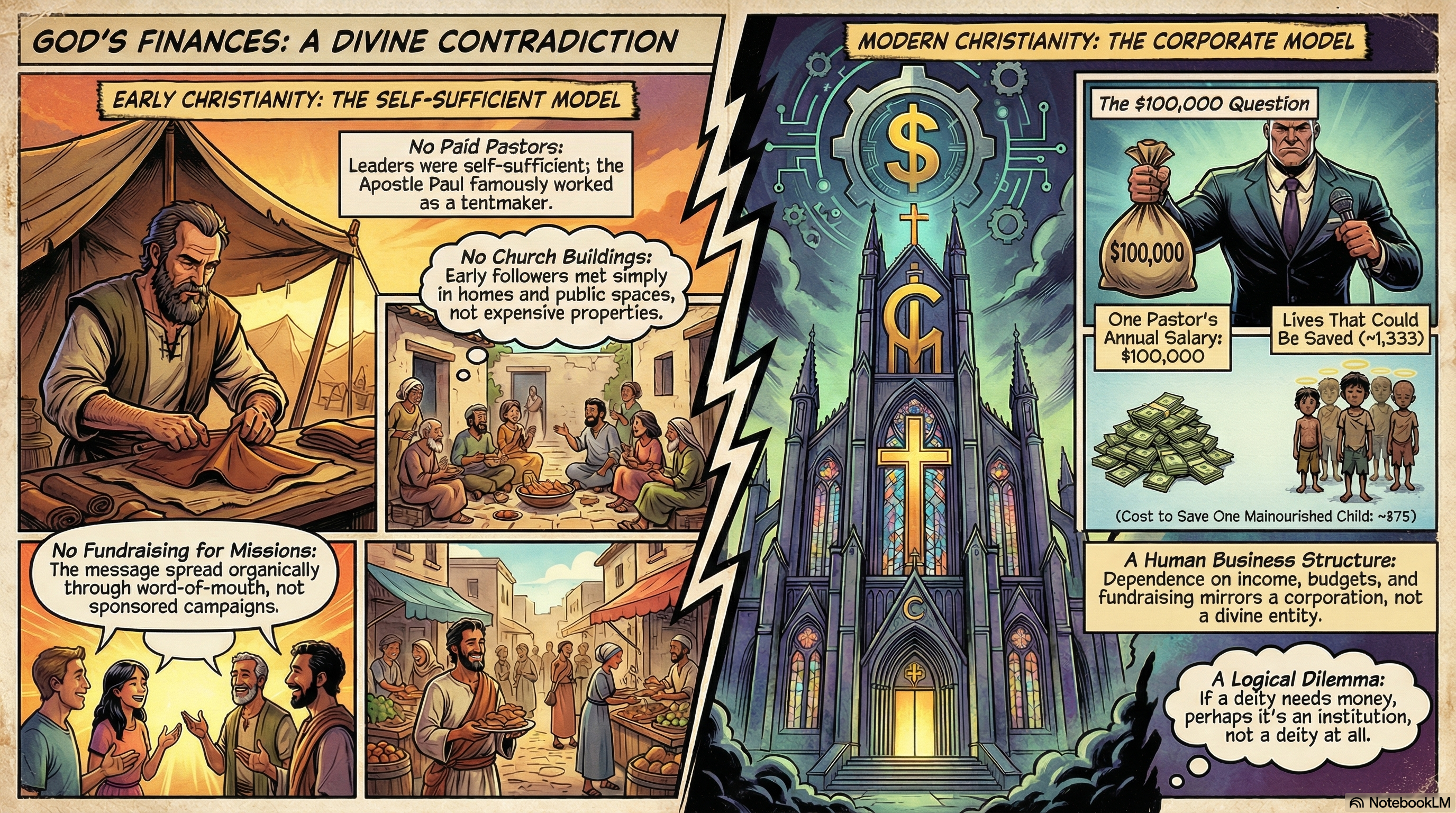
Summary: This argument questions the need for financial support in fulfilling the goals of an omnipotent, compassionate God, highlighting the contradiction between divine omnipotence and the financial dependency of religious institutions. It suggests that a true deity would not require human resources to alleviate suffering, casting doubt on the necessity of monetary contributions to fulfill divine purposes.

Imagine encountering a figure claiming supernatural power—a wizard who professes the ability to be anywhere instantly and to transform common materials into wealth or sustenance. Such a figure, capable of true magic, would theoretically have no need to rely on financial donations to achieve his mission of feeding the poor or aiding those in need. If this wizard, despite his purported powers, continually solicited donations, insisting he needed your money to carry out his plans, would you not begin to question his motives? It might seem as if he were testing your generosity. Yet, if the poor continued to suffer and starve even after a vast amount of money flowed to him, it would raise an uncomfortable question: Is his mission truly to help those in need, or is something else at play?

This analogy resonates with how many contemporary Christian denominations operate. Despite teaching that faith is sufficient and that God is all-powerful, they insist that financial contributions are essential to carry out His will on Earth. While some of this money supports genuinely altruistic projects—feeding the hungry, clothing the poor, building schools and hospitals—another significant portion is allocated toward the salaries, benefits, and luxuries of pastors and church leaders. According to a recent survey, 30% of Christian ministers in the United States believe that a yearly salary of over $100,000 (housing included) is excessive for those in full-time ministry (Source | Item #105). This statistic raises a troubling question: Would an actual God—one who possesses boundless resources and unbridled compassion—require the same financial mechanisms and structures as a secular organization to fulfill His divine purposes?
The Paradox of a Financially Dependent Deity
Consider the core theological claim of omnipotence. If a real God exists, possessing infinite knowledge, power, and presence, it stands to reason that He would not require the same material resources as humans. Money, buildings, and infrastructure are human constructs designed to overcome our limitations. For instance, we need money to exchange for resources, buildings to provide shelter, and infrastructure to maintain stability in large communities. An omnipotent God, however, would by definition be free from these limitations. He would not need material wealth to accomplish His goals; nor would He need intermediaries such as pastors to convey His message and demonstrate His compassion. Indeed, if God’s essence were truly boundless, wouldn’t He be able to achieve these objectives with ease, unencumbered by the financial donations of His followers?
It is worth considering the implications if God were to rely on such financial support. The Christian God is described as not only omnipotent but also supremely compassionate. This combination of attributes suggests a deity who would do everything possible to alleviate suffering without placing a burden on the very people He aims to save. And yet, the current organizational structure of many churches implies that this God, instead of alleviating burdens, imposes them through a demand for ongoing financial sacrifice. This dependency on donations for tasks like feeding the poor, maintaining places of worship, and supporting ministers suggests a very human limitation rather than a divine capability.
It is also important to note that many world religions share this dependency on financial resources, often framing monetary donations as a measure of faith or commitment. But does it not seem contradictory that an entity with omnipotent abilities would require the same kind of financial system utilized by human institutions? Could it be that this financial model reveals more about the institutional structure of organized religion than it does about the nature of a divine being?
The Dilemma of Financially-Driven Faith

One of the primary challenges arising from this financial dependency is the potential impact on individual believers. For example, congregants are often encouraged to donate generously, even when doing so may strain their personal finances. The average Christian household is sometimes expected to tithe (give 10% of their income), and in some cases, they are led to believe that failing to do so may indicate a lack of faith or a personal failing. Yet, when we examine the practical results of these donations, the pattern often shows significant portions allocated toward administrative costs, salaries, and the maintenance of church properties rather than directly to charitable activities.
This reality becomes even more striking in light of the aforementioned survey, which indicates that a notable percentage of Christian ministers in the United States—30%—view salaries exceeding $100,000 as excessive for a full-time pastor. If these ministers themselves recognize a threshold at which compensation becomes disproportionate, it invites a critical question: why would God, whose character is presumed to be selfless and focused on the welfare of humanity, condone a system that allows for such high levels of personal compensation for those in His service?
Moreover, this question of financial dependency can affect the credibility of religious institutions. If the average Christian is expected to fund a deity’s agenda financially, the question arises: what kind of deity requires ongoing monetary assistance from His followers? Wouldn’t a truly omnipotent being provide for His own needs, or better yet, find ways to meet human needs without placing a financial burden on them? This expectation seems to reflect a contradiction between the ideal of an all-powerful God and the reality of financially-dependent church institutions. If God truly wished to convey His compassion and omnipotence, wouldn’t He do so in a manner that is clearly independent of human wealth?
Points to Ponder: Examining the Underlying Assumptions
This paradox invites us to reconsider several assumptions embedded within modern Christian belief:
- God’s Self-Sufficiency: An omnipotent God, by nature, would be self-sufficient and not dependent on the limited resources of His followers. Why, then, do so many religious institutions emphasize the necessity of financial contributions to fulfill divine mandates?
- Compassionate stewardship and the Role of Believers: If a God of infinite compassion is responsible for the care of humanity, would He truly place that responsibility back onto believers by requiring their financial contributions to care for the needy?
- The Rationality of Faith-Based Financial Commitments: Are believers encouraged to suspend their rational judgment when it comes to financial contributions, simply because these contributions are framed as acts of faith? How often are congregants reminded to critically evaluate the allocation of their donations?
- The Question of Divine Character: If the financial structure of religious organizations relies on continuous donations for God’s work, does this align with the character one would expect of an omnipotent and benevolent being? Would such a being not instead demonstrate His compassion by directly alleviating suffering without creating an expectation of financial sacrifice?
- The Absence of Financial Dependency in Early Christianity: If Christianity thrived in its earliest and most formative years without financial structures, why does the modern church claim such structures are essential? The first-century Christian movement had no church buildings, no salaried pastors, no institutional fundraising, and yet it spread rapidly and successfully. If God did not require financial support to grow His church in its most critical period, why would He suddenly need it now? The stark contrast between the early church’s self-sustaining, communal model and today’s financially-driven institution suggests that these financial “needs” are human constructs, not divine necessities.
A Missed Opportunity for a True God to Stand Apart
If a true God exists—one who is omnipotent, self-sufficient, and genuinely benevolent—a refusal to solicit funds while still accomplishing His agenda would serve as a powerful demonstration of his superiority over all false gods who rely on material support.

In a world filled with deities demanding human resources, a God who required nothing from His followers but freely provided for humanity’s needs would stand out as authentically divine. Such a self-sufficient deity would not only validate His identity through supernatural power but also demonstrate a profound compassion that makes financial dependency unnecessary. By choosing not to impose financial burdens, this God would offer undeniable evidence of His divinity, clearly separating Himself from constructs of human imagination that depend on temples, tithes, and donations to survive.
In contrast, religions that request monetary contributions can appear indistinguishable from organizations driven by human motivations. They blend in with the pantheon of deities who have required tributes across history, each claiming power but ultimately relying on human sustenance. A God who defies this pattern by actively providing for human needs without expectation of repayment would not only redefine faith but would also inspire trust based on observable actions rather than appeals for resources. This approach would directly challenge any counterfeit deity and elevate the credibility of a truly omnipotent being who does not need human wealth to fulfill His compassionate mission.
A Logical Conclusion: Reevaluating Belief in a Financially Dependent Deity
The reliance on material resources creates a logical inconsistency within the concept of a benevolent, all-powerful deity:
Premise 1: A truly omnipotent, self-sufficient God would not require financial support from humans to accomplish His will.
Premise 2: Many Christian churches assert that God requires such support to advance His purposes on Earth.

Conclusion: Therefore, either the widespread theological understanding of God is flawed, or the concept of a financially-dependent deity contradicts the very notion of a true, omnipotent God.
A Companion Technical Paper:

The Logical Form
Argument 1: The Contradiction of Financial Dependence in an Omnipotent Deity
- Premise 1: An omnipotent God possesses boundless power and resources, transcending human needs for financial and material support.
- Premise 2: Christian denominations claim that God requires financial donations from followers to accomplish His compassionate goals on Earth.
- Conclusion: Therefore, either these denominations misunderstand God’s omnipotence, or the concept of a financially-dependent God contradicts the idea of an omnipotent deity.

Argument 2: Concerns in the Financial Dependency of Faith-Based Institutions
- Premise 1: True compassion from an omnipotent God would prioritize alleviating human suffering without imposing financial burdens on followers.
- Premise 2: Many religious institutions require ongoing monetary contributions, even when this may strain the finances of individual believers.
- Conclusion: This financial burden on believers reflects an inconsistency with the supposed compassion of a truly omnipotent, benevolent deity.
Argument 3: Self-Sufficiency as a Mark of Divine Authenticity
- Premise 1: A truly omnipotent God would require no material support from humans, naturally distinguishing Himself from false gods that depend on financial contributions.
- Premise 2: A God who provides for human needs without financial expectations would stand out as genuinely divine, inspiring trust through observable compassion.
- Conclusion: By refraining from financial dependence, a true God could clearly differentiate Himself from counterfeit deities, strengthening His credibility as an authentically benevolent deity.
Argument 4: The Logical Inconsistency of Faith-Based Financial Systems
- Premise 1: If a self-sufficient God exists, He would fulfill His will independently of human financial resources.
- Premise 2: Christian institutions assert that financial support is crucial for advancing God’s purposes.
- Conclusion: This dependence on donations suggests a logical inconsistency, raising doubts about the theological understanding of God’s self-sufficiency.
Argument 5: The Missed Opportunity to Reinforce Divine Credibility
- Premise 1: A true God would distinguish Himself by providing for humanity without demanding material support from His followers.
- Premise 2: Financially dependent religions appear similar to human constructs of deities that rely on donations.
- Conclusion: By rejecting financial dependency, a true God could strengthen His credibility and authenticity as a divine entity, separating Himself from historically dependent gods.
If God exists, mirroring the financial limitations of false gods is an unforced error; the simpler explanation is that Christianity’s financial systems are of human origin. Far from reinforcing faith, this dependency erodes the plausibility of divine authorship and confirms that the fingerprints on these institutions are human, not divine.

(Scan to view post on mobile devices.)

A Dialogue
Would an Omnipotent God Need Material Resources?
CHRIS: Faith is what gives life meaning. It’s the foundation of my relationship with God, and financial giving is a natural part of that. Supporting the church isn’t just about money—it’s about commitment, obedience, and trust in His plan.
CLARUS: But how does that make sense? If God is omniscient and omnipotent, why would He need human resources to accomplish His will? Wouldn’t a truly divine being be able to act without relying on financial contributions?
CHRIS: You’re approaching this with a limited, human-centered logic. Faith isn’t about what makes sense to the rational mind—it’s about trusting beyond understanding. God works in ways we cannot fully grasp, and giving is part of His ordained plan.
CLARUS: But that sounds like an evasion. If God’s plan is truly beyond understanding, how do you know financial support is actually part of it? Couldn’t it just be a human institution capitalizing on belief?
CHRIS: That’s exactly why reason fails. Faith is superior to human logic because it doesn’t rely on what we can see or measure. God’s ways are higher than ours, and we don’t need to understand them—we just need to obey.
CLARUS: But if faith tells you to obey without question, isn’t that just blind submission? Shouldn’t belief be based on evidence and reason?
CHRIS: Why should it be? Reason is a fallible human construct, shaped by bias and limitations. If you rely on reason, you’ll forever be trapped in an endless cycle of doubt, questioning, and skepticism. Faith frees you from that burden.
CLARUS: But if reason is unreliable, why do we use it for everything else? You wouldn’t use faith to build a bridge or perform surgery—why should we use it to determine the biggest questions about existence?
CHRIS: Because God is beyond the physical world. You can use reason for earthly matters, but spiritual truth cannot be grasped through logic. If you try to bring God down to human scrutiny, you’ve already misunderstood His nature.
CLARUS: But how do you know your faith is correct? If reason plays no role, what stops your faith from being just as misguided as someone else’s?
CHRIS: Truth isn’t something you reason your way into—it’s something you receive. The moment you demand rational proof, you are already rejecting God’s revelation. Truth isn’t dictated by evidence—it is revealed through faith.
CLARUS: So you’re saying that even if all logic and evidence pointed in the opposite direction, you would still believe?
CHRIS: Of course. Because truth isn’t dictated by evidence—it’s dictated by revelation. That’s why faith isn’t just an alternative to reason—it’s above reason. Evidence changes, logic is flawed, and human minds are weak. But faith is eternal, unshakable, and pure.
CLARUS: But faith forces you to accept contradictions. You say God is all-powerful, yet He depends on human resources. You say He has infinite compassion, yet He lets the needy suffer unless people give Him money. Does this not seem like a human institution, rather than a divine plan?
CHRIS: You’re trying to apply human reasoning to divine truth. The fact that it seems paradoxical is proof that God’s ways transcend human comprehension. The need for tithing and offerings is not about God’s lack of resources, but about giving believers a chance to participate in His work.
CLARUS: But that makes God indistinguishable from any other man-made religion. Every so-called deity in history has demanded financial offerings. Wouldn’t a true God, if He wanted to set Himself apart, act in a way that no human-invented god ever has—by needing nothing?
CHRIS: You’re still trying to rationalize faith, which is exactly why reason will always fail you. Faith is the gateway to certainty, while reason leads only to doubt.
CLARUS: No, faith leads to bondage. You have convinced yourself that a perfect, all-powerful being needs money—human money. That’s absurd. And yet, rather than question it, you relinquish reason itself to defend the contradiction.
CHRIS: That’s because truth isn’t something to be questioned—it is something to be accepted. When you understand that, you will have peace.
CLARUS: No, when you understand that, you will have surrendered. Faith isn’t a path to peace—it’s a life-diminishing trap that convinces you to stop questioning, to stop thinking, to stop demanding more from a supposed all-powerful being. It’s why religious leaders grow wealthy while the faithful remain poor. It’s why churches flourish while the world’s problems persist. Faith doesn’t liberate—it controls.
CHRIS: That is only because you have closed your heart.
CLARUS: No, Chris. It’s because I’ve opened my eyes.
Notes:
Helpful Analogies
Analogy 1: The Doctor Who Heals Without a Fee
Imagine a doctor with the ability to heal any illness instantly and at no cost. This doctor has boundless resources and an unmatched drive to alleviate suffering. Yet, instead of healing freely, she charges high fees, claiming this payment is essential for her practice to continue. Would we not question her compassion and commitment to helping others? A truly altruistic healer would act without financial barriers, providing care freely to prove her dedication. Similarly, an omnipotent God would not need or request human material support to fulfill His compassionate goals.
Analogy 2: The King Who Needs No Taxes
Imagine a king whose wealth is limitless—gold fills his treasury, his land is fertile, and his influence stretches across kingdoms. Despite his boundless wealth, he demands heavy taxes from his citizens to fund his works and projects. If he genuinely cared for his people, wouldn’t he spare them this financial burden? Instead, his dependency on taxes would raise doubts about his true wealth and compassion. If an omnipotent God existed, one who already possesses all resources, would He really require donations from His followers to accomplish His will?
Analogy 3: The Philanthropist Who Demands Contributions
Imagine a well-known philanthropist who claims to be dedicated to eradicating poverty. He has more wealth than he could ever use, yet he continually asks for donations from people with limited means, insisting that these contributions are essential to his mission. Would this not seem contradictory? A genuinely benevolent philanthropist would use his own resources to help, demonstrating his commitment by providing aid without expectation. Likewise, a self-sufficient God would fulfill His compassionate objectives without relying on human financial support, setting Himself apart as genuinely divine.
Addressing Theological Responses
Theological Responses
1. God’s Financial Model as a Test of Faith
One theological response might argue that God’s requirement for financial support is a deliberate test of faith and commitment. In this view, financial giving is not about supplying resources that God lacks but rather about providing believers an opportunity to express devotion and obedience. The act of sacrificial giving can strengthen one’s relationship with God, fostering spiritual growth and a deeper reliance on Him.
2. Human Participation in God’s Mission
Theologians might contend that God’s financial model allows believers to participate in His mission on Earth. By giving, Christians become active contributors to the work of the church and God’s purposes, experiencing a tangible partnership with the divine. This engagement gives believers a sense of ownership in God’s work, strengthening their faith through personal investment and commitment.
3. God’s Use of Human Structures to Connect with Humanity
Some theologians argue that God, in His wisdom, may choose to work through human structures, including financial systems, to relate to people in ways they understand. The use of material support might make God’s work more accessible and concrete to believers, bridging the divine-human divide by engaging people in the familiar realm of financial responsibility. This perspective suggests that spiritual practices such as giving align divine goals with human experience.
4. Symbolic Value of Sacrificial Giving
Another theological perspective is that sacrificial giving is a form of worship and a symbolic gesture of prioritizing God above worldly concerns. From this viewpoint, the act of giving represents a spiritual discipline that shifts focus away from materialism, promoting generosity and selflessness. Financial offerings, in this sense, are not about fulfilling God’s needs but about fulfilling a spiritual calling within believers themselves.
5. God’s Allowance for Human Free Will
Theologians may also respond by suggesting that God’s reliance on human donations respects human free will. Rather than imposing His will without human involvement, God invites believers to make voluntary contributions, reflecting their own choice to support His work. This view implies that God’s financial model respects human autonomy, allowing people to engage with His purposes freely and without coercion.
6. God’s Sovereignty and Mysterious Ways
A common theological argument is that God’s ways are mysterious and beyond full human comprehension. God may have reasons for operating through financial support that are ultimately unknown or only partially understood by humanity. This position encourages believers to trust in God’s sovereignty, accepting that His methods, even if seemingly unnecessary, serve a divine purpose that will be revealed in time.
7. Faith-Based Community Building
Lastly, some theologians emphasize that financial giving fosters community and mutual support among believers. Through contributions, church members build connections and share a common mission that binds them together. Financial support for church functions thus serves not only God’s purposes but also the well-being of the faith community, reinforcing unity and encouraging fellowship.
Counter-Responses
1. Counter-Argument to God’s Financial Model as a Test of Faith
While the concept of financial giving as a test of faith emphasizes commitment, it raises a fundamental question: why would an omniscient God—who already knows the depth of each believer’s faith—require such a material test? True devotion could arguably be demonstrated through actions that don’t impose a financial burden on followers, especially those with limited means. If God genuinely desired expressions of faith, acts of service or compassionate behavior would reflect commitment more effectively, without the same risk of financial strain.
2. Counter-Argument to Human Participation in God’s Mission
If human participation in God’s mission is truly meaningful, wouldn’t a self-sufficient God design ways for believers to contribute spiritually, rather than through financial means? The act of giving financially may create an impression of partnership, but it conflates spiritual devotion with monetary support, which could be misleading. A genuinely omnipotent deity would not need material aid and could instead engage believers in ways that don’t resemble human institutions dependent on donations, fostering participation through service and personal transformation.
3. Counter-Argument to God’s Use of Human Structures
While connecting through familiar financial systems may make God’s work seem accessible, this reasoning implies that an omnipotent God is limited to human constructs. An all-powerful God would not need to mimic human structures like monetary systems to connect with believers, especially if doing so obscures His unique, transcendent nature. By relying on material resources, religious institutions risk making God appear constrained by the same limitations as human organizations, which could diminish His perceived omnipotence and independence.
4. Counter-Argument to the Symbolic Value of Sacrificial Giving
While sacrificial giving as a form of worship may promote generosity, this approach may ultimately divert resources that could otherwise support believers’ basic needs. True selflessness and spiritual focus could be cultivated through acts of kindness and service to others, rather than through financial sacrifice that could impose hardship. If God genuinely valued symbolic gestures of devotion, He could inspire believers to practice humility and compassion through non-material acts that don’t strain personal resources or equate faith with financial giving.
5. Counter-Argument to God’s Allowance for Human Free Will
The notion that financial giving respects human free will may align with theological ideals, but it implies that God’s work is contingent on voluntary human donations, which is inconsistent with the concept of omnipotence. A truly all-powerful God could accomplish His purposes without requiring financial contributions, thereby offering humans authentic freedom to give without implication that His mission depends on it. If free will is to be genuinely respected, God’s actions would demonstrate that His work is independent of human material contributions and financial limitations.
6. Counter-Argument to God’s Sovereignty and Mysterious Ways
While mystery is often invoked to explain theological paradoxes, relying on unknown reasons for God’s financial dependency seems to dismiss the logical inconsistencies. A sovereign God who is truly beyond comprehension would arguably not operate in ways that imitate human dependency, as this could confuse believers about His nature. If God’s ways were indeed mysterious but aligned with omnipotence and independence, we would expect His methods to transcend human needs and not resemble the financial requirements of worldly institutions.
7. Counter-Argument to Faith-Based Community Building
Although financial giving may foster community bonds, this goal could be achieved through non-monetary means that encourage unity and shared mission. Acts of volunteer service, mutual aid, and collaborative projects could strengthen community just as effectively, without conflating spiritual commitment with financial contributions. A community built on generosity of spirit and shared service could provide a purer foundation of unity, without relying on material resources that risk distracting from a truly self-sufficient deity’s mission.
Clarifications
The Financial “Needs” of Pastors: A Contradiction in an Omnipotent God and a Departure from Early Christianity
Religious institutions, particularly within Christianity, frequently emphasize the financial responsibility of believers in ensuring the success of God’s work on Earth. From tithes and offerings to building funds, missionary support, and pastoral salaries, the church’s dependence on financial contributions is framed as an act of faith rather than an organizational necessity. However, this reliance on human financial resources raises a fundamental contradiction: If the Christian God is truly omnipotent, why would He require money to accomplish His divine will? If a limitless being is in control, why are believers told that His work cannot proceed without their financial sacrifices?
Perhaps even more revealing is that these financial demands did not exist in the earliest period of Christianity. The first-century church functioned without dedicated buildings, professional clergy salaries, or elaborate financial structures. The message of Jesus and his earliest followers was spread freely, without reliance on tithing campaigns, church payrolls, or large-scale fundraising efforts. If Christianity thrived without financial dependency in its earliest and most formative years, why does it now mirror a corporate model where money is central to its function? If God required no money in the first century, why does He suddenly need it now?
1. The Absence of Church Buildings in Early Christianity
One of the most common financial appeals in modern churches is the building fund. Believers are told that maintaining or expanding church property is essential for fulfilling God’s mission. Yet, this is in stark contrast to the first-century Christian movement, which had no church buildings. Early Christians met in homes, public spaces, or wherever they could gather. Their worship was not tied to multi-million dollar campuses or extravagant facilities.
If a physical space was never necessary for the early church, why is it now? An omnipotent God should be able to work anywhere, without the need for elaborate real estate investments. The fact that early Christianity thrived without church buildings proves that such structures are not divinely mandated, but rather human creations that now require ongoing financial upkeep.
2. The First-Century Church Had No Paid Pastors
Modern churches insist that pastors must be financially supported, yet in early Christianity, there were no full-time salaried pastors. The first church leaders were often self-sufficient, supporting themselves through other labor. The Apostle Paul, arguably the most influential early Christian figure, worked as a tentmaker while preaching (Acts 18:3), explicitly refusing to be a financial burden on others.
If the greatest evangelist of early Christianity did not require a salary, why should modern pastors? If God’s messengers truly operated under His divine provision, there would be no need for human-funded payrolls. The modern expectation that church leaders must be compensated like corporate executives contradicts the self-sustaining model of the earliest Christian teachers.
3. Early Christianity Spread Without Missionary Funding
Today, churches insist that missionary work requires extensive financial support—for travel, printing materials, and outreach programs. Yet, in the first century, Christianity spread without any of these financial structures. The disciples traveled on foot, shared hospitality freely, and relied on personal conviction rather than organized funding efforts. If the Christian message could spread without money during its most successful and expansive period, why does it now require millions of dollars to accomplish the same goal?
An omnipotent God would not require airline tickets, media production, or church-sponsored marketing campaigns to reach people. The very fact that modern Christianity insists on financial support for missions suggests that human infrastructure, not divine action, is at work.
4. The Poor Were Helped Without Tithing Campaigns
Churches today emphasize charitable giving, often claiming that financial donations are necessary to support the needy. Yet, the earliest Christians practiced direct aid without any formalized financial system. They shared food, goods, and shelter freely without tithing appeals, bank accounts, or structured financial dependency (Acts 2:44-45).
If helping the poor truly required financial donations, why did the first Christians accomplish it without them? If God desires to alleviate suffering, why would He require monetary contributions rather than acting directly? The reliance on financial structures in modern churches contradicts the original practice of Christianity, where charity was driven by personal sacrifice, not institutional fundraising.
5. God Needed No Media and Technology in the First Century
Modern churches invest millions in television programs, digital media, and marketing campaigns, insisting that financial support is necessary to reach the masses. Yet, early Christianity spread without books, videos, websites, or paid advertising. The message of Christianity reached entire regions without financial sponsorship, purely through word of mouth and personal conviction.
If God’s truth could spread across continents without money in the first century, why does it now require expensive production teams, broadcast networks, and paid social media strategies? If God wanted His word to be known, He could reveal it directly to individuals without churches depending on modern technology and financial contributions.
The Early Church Proves God Has No Need for Money
Every financial “need” modern churches emphasize—buildings, salaries, missions, charity, and media outreach—was completely absent in the first-century Christian movement. If God required no money then, why does He supposedly require it now? If the most important period of Christian history was able to function without financial dependency, the insistence that believers must now contribute financially exposes the unmistakable reality: these “needs” are human, not divine.
In early Christianity, faith alone was sufficient to sustain the movement. There were no bank accounts, no institutional payrolls, no marketing budgets, and yet, the movement flourished. If an omnipotent God exists, He would require no money now, just as He required no money then. The fact that modern churches are structured like businesses—dependent on income, budgets, and financial expansion—suggests that they operate on human economics, not divine power.
If God were truly all-powerful, He would not require wealth to act. The reliance on financial support in modern Christianity is not a reflection of divine necessity, but a stark indication that financial dependency is a human invention, not a divine mandate.
Addressing the Claim of Higher Christian Charitable Giving Due to Emphasis on Tithing
The claim that Christians give more charitably due to the tithing obligation emphasizes an important point about the influence of structured expectations on charitable behavior. However, it is essential to distinguish between obligatory giving and voluntary charity driven by personal initiative. Tithing often entails a sense of duty or obligation, where giving is a requirement rather than a purely voluntary act. This expectation can create a structured environment that encourages giving, but it may not necessarily reflect higher intrinsic generosity compared to those who give voluntarily without religious mandates.
Furthermore, charitable giving tied to tithing frequently supports church operations or religious projects, not always reaching broader humanitarian causes. While churches do fund charitable initiatives, a portion of tithes typically sustains the church institution itself. As a result, while Christians may appear to give more overall, it is essential to evaluate whether these funds primarily support humanitarian efforts or institutional expenses.
Finally, the structure of tithing may foster consistent giving habits among churchgoers, which can positively influence broader charitable culture. However, charitable giving motivated by internal values rather than structured obligations may indicate a different kind of altruism, one less bound by external requirements and potentially more aligned with individual commitment to helping others. This distinction can add depth to the claim, revealing that compulsory giving and voluntary charity serve different purposes and reflect varying motivations.
Push-back from Christian Apologists
The core question posed on a Facebook group page was, “Why would any actual God wanting his existence and will to be known pass up an opportunity that would cause millions of rational seekers to look in his direction?” The opportunity in question is the chance to multiply dollar bills as he did the loaves and fishes to ensure his earthly projects did not depend on monetary constraints.
The following paragraphs feature the ten categories of counterarguments from Christian apologists and possible ways to respond.
Participation and Spiritual Training
The claim here is that God uses tithing and giving as a way to build character, instill discipline, and promote community among believers. While these psychological or social benefits may arise from ritual acts, this misses the thrust of the epistemic critique: If a God truly exists and wants to be known, why would He rely on mechanisms that are indistinguishable from purely human constructs? Participation and moral formation do not require divine ambiguity. In fact, these could occur after one is persuaded of God’s reality—just as students still need to train even after they’re sure their teacher exists.
Analogy: Imagine a parent who disappears for years but leaves ambiguous notes behind, claiming it builds the child’s moral fiber. The child is left wondering whether the notes are even from the parent. That’s not loving guidance—it’s abandonment cloaked as mentorship.
Faith Must Not Be Compelled by Logic
This argument asserts that if belief in God were rationally compelled—if miracles were unequivocal—then belief would lose its value. But this is a false dichotomy. Rational belief is not coercion. Accepting something because it’s supported by overwhelming evidence is the foundation of science, law, and responsible decision-making. If God desires belief in His existence to be rational rather than blind, then He must provide proportionate evidence. Faith in spite of lacking evidence is not virtuous; it’s epistemically reckless.
Analogy: Suppose a fire alarm goes off and you believe there’s a fire. Are you being coerced into that belief? Of course not. You’re responding appropriately to the data. Rejecting the fire alarm because “real belief shouldn’t be based on evidence” would be absurd—and dangerous.
God’s Hiddenness as Intentional
Some argue that God is hidden on purpose to encourage genuine seeking and to avoid “overriding” free will. But this again mischaracterizes the nature of rational inquiry. Seekers are not asking for coercive evidence—they are asking for sufficiently clear and public evidence to justify belief. The level of confusion we see—with thousands of sects and contradictory doctrines—suggests that God’s hiddenness doesn’t foster truth-seeking, but obfuscation. A sincere God who wants to be known wouldn’t behave in ways identical to a non-existent one.
Analogy: Imagine a doctor who scribbles a life-saving prescription in an ancient language and hides it behind a painting. When patients die, the doctor says, “I wanted them to seek the cure.” That’s not benevolence. That’s dereliction of duty.
Miracles Aren’t Persuasive
This argument suggests that miracles would lose their impact over time, becoming mundane and therefore ineffective. But that confuses emotional novelty with epistemic power. We don’t abandon belief in gravity just because it’s no longer emotionally stirring. If miracles were reproducible and consistent—like the rising sun—they could still provide an essential basis for rational belief even if they no longer inspired awe.
Analogy: People eventually stop being amazed by GPS technology, but they don’t stop trusting it. Predictability doesn’t make information irrelevant—it makes it reliable.
Scriptural Support for Tithing
Quoting biblical passages to justify financial sacrifice presumes the Bible is divinely authoritative. But that is precisely what is under dispute. If a God truly existed and inspired the text, it would be trivial for Him to fund churches miraculously—as a show of authenticity—rather than relying on scripture that was written and curated by humans. Using the Bible to justify divine need is circular: it assumes the divine in order to prove the divine.
Analogy: If a monarch writes a decree declaring himself God, this doesn’t prove divinity. It proves only that he knows how to write.
Creation as Evidence of God
This counterargument claims that the natural world, in all its beauty and order, is evidence of God’s handiwork. But such beauty is ambiguous. It supports every religion, and no religion. Pantheists, deists, animists, and atheists all appeal to the wonders of nature. If the goal were to identify a specific deity, general beauty doesn’t suffice. What’s needed is evidence that can single out a particular agent from the field of all imaginable beings.
Analogy: Saying that sunsets prove God is like saying all paintings prove Rembrandt. Without a signature, the attribution is pure speculation.
Resurrection as Central Proof
Many Christians treat the resurrection as the definitive proof of Jesus’ divinity. But from an epistemic standpoint, the resurrection claim is no more credible than countless miracle claims in other religions. It’s based on documents written decades after the event, by unknown authors, with no access to the body or the tomb. Historical miracles—especially resurrection—require stronger evidence than partisan storytelling. And since hallucination, legend evolution, and theological reinterpretation are far more probable than a literal reanimation of a corpse, belief in the resurrection is epistemically unwarranted.
Analogy: If your neighbor tells you his grandfather rose from the dead in 1840 and ascended into the clouds, you wouldn’t believe him just because his family says so. Why lower your standards for ancient claims?
Faith as Allegiance
To avoid the charge of irrationality, some reframe faith not as belief without evidence, but as allegiance—a relational commitment. But this semantic shift evades the epistemic question: Is the allegiance deserved? Trust, loyalty, or submission to a divine being should still be contingent on evidence that this being exists and is worthy of allegiance. Recasting the issue doesn’t resolve the core problem.
Analogy: If someone asked you to swear loyalty to an invisible general whose existence couldn’t be verified, would it help to call it “allegiance” instead of “faith”? Of course not. The underlying question—does this general exist—remains unanswered.
Character Development Justifies Hiddenness
This view asserts that God hides in order to build human character—through struggle, uncertainty, and trust. But this too assumes that ambiguity is a virtue. In fact, people can develop trust, sacrifice, and virtue even in the presence of a known, visible leader. Hiddenness is not a requirement for growth. Moreover, if eternal salvation hinges on belief, then prioritizing character development over epistemic clarity becomes not just questionable, but ethically suspect.
Analogy: A commander doesn’t prove your bravery by vanishing during the war. True courage can still be tested under the guidance of a visible and trustworthy leader.
Dismissal via Ridicule
Some respond not with arguments but with mockery—labeling questions as “preteen atheist nonsense.” This tactic reveals more about emotional discomfort than it does about the strength of one’s position. It bypasses intellectual engagement entirely, offering tribal disdain in place of counterevidence. In reasoned discourse, mockery is a red flag—not a rebuttal.
Analogy: Imagine a scientist who, when questioned about their theory, laughs and calls the critic a “silly freshman.” That may win applause from fans, but it wins no points in a real debate.


 Free of Faith
Leave a comment