

Consider the Following:
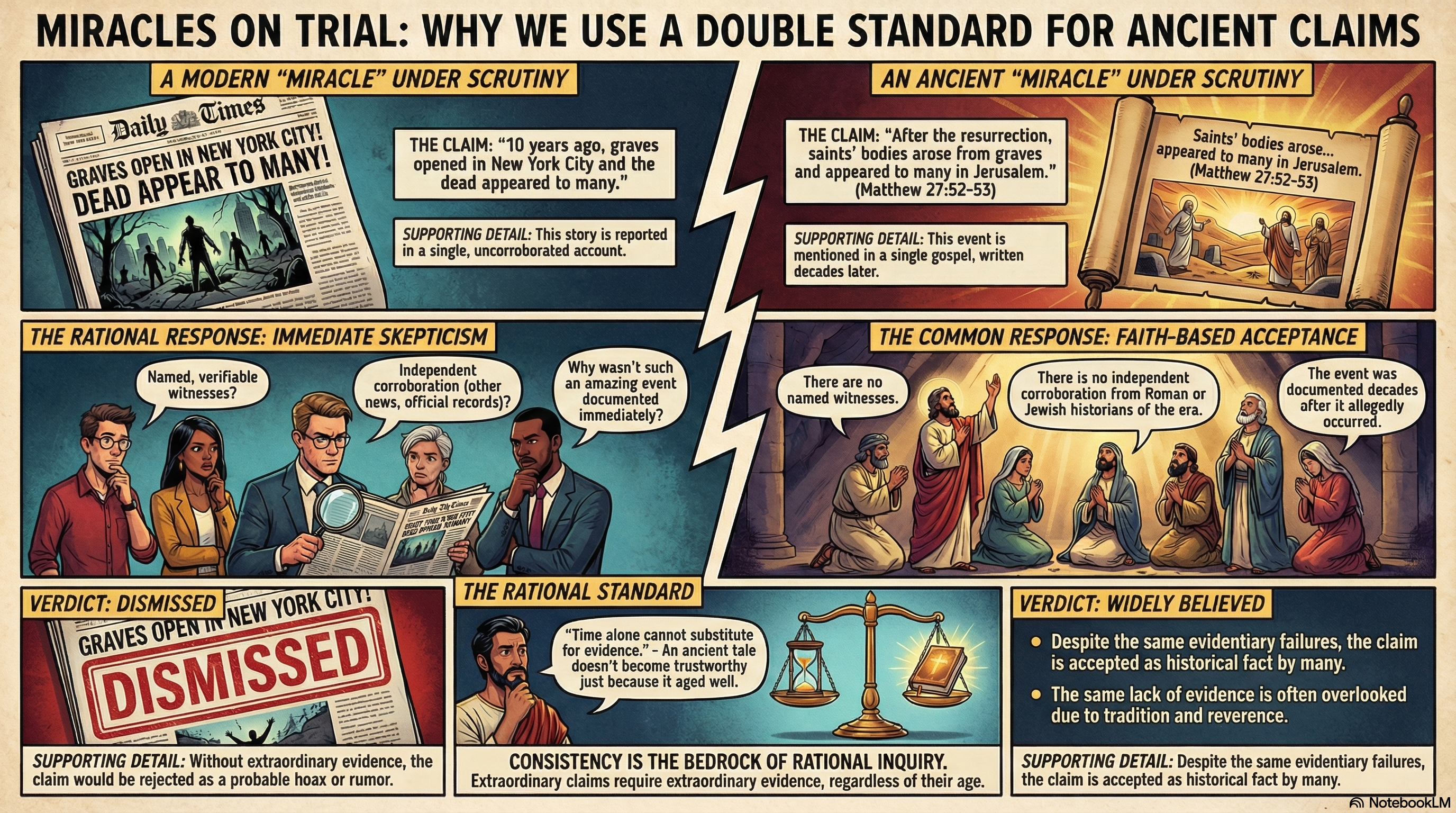
Summary: When evaluating extraordinary claims, such as ancient or modern miracle stories, skeptics emphasize the importance of consistent standards of evidence, questioning sources, corroboration, and motivation behind the accounts. Without tangible proof or independent verification, relying solely on faith or oral tradition risks conflating historical truth with mythology or embellishment.
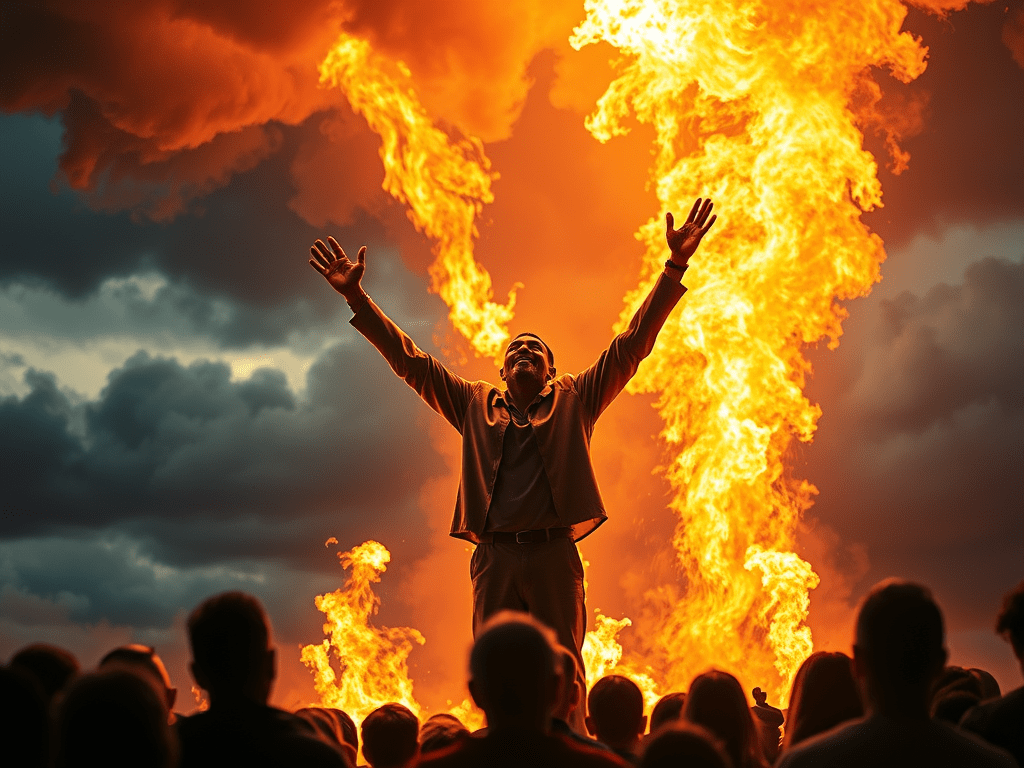
Imagine your honest friend Tom shares a story that a credible source told him about a man who, in a neighboring town, called down divine fire from the sky. Tom believes the story. Would you? Likely, your initial reaction would be one of skepticism, primarily due to the improbability of such an event. You’d probably ask for further proof, maybe requesting eye-witness accounts, only to learn they are deceased, with only a few anonymous documents left behind. Most would maintain disbelief until stronger evidence arises. Yet, millions readily accept similar claims from thousands of years ago in ancient texts. They will accept fire from heaven and the dead coming back from life…if only it happened in a distant age instead of today. Is this rational?
The Bias Toward Ancient Mystique
Stories set in the distant past carry an allure of mystery and “anything’s possible” that sometimes prompts us to lower our standards of evidence. Events dismissed as fiction if recent often seem more plausible when wrapped in ancient mystique. Why? One reason may lie in how distant events allow us to suspend the physical laws governing our daily lives, similar to the suspension of disbelief experienced while watching movies. The thrill of the story momentarily outweighs our usual critical standards.
Another reason may be that we regularly encounter the firm regularities of the physical world in our daily lives. Miracles are not as frequent or pronounced as they allegedly were in the past, so we justifiably do not expect them. The past often seems full of magic, miracles, and possibilities, so we approach claims from the distant past as intrinsically more probable. But should we?
A Universal Cognitive Bias
This bias spans cultures and religions. The newly-encountered miracle claims of other religions seem absurd. While many Muslims believe Allah split the moon, they view Joseph Smith’s golden plates with skepticism. Similarly, Christians often squint at modern miracle claims of competing religions with scientific scrutiny but accept those in the New Testament. For instance, modern claims of healed amputees are met with high skepticism and a demand for rigorous evidence. However, with ancient accounts from the New Testament, believers often show a markedly different level of credulity. Is this consistent?
A Thought Experiment: Applying Consistent Standards
To challenge this bias, let’s compare two identical miraculous events separated by time. Consider a biblical account:
Claim #1: “And the graves were opened; and many bodies of the saints which slept arose, and came out of the graves after his [Jesus’] resurrection, and went into the holy city, and appeared unto many.” (Matthew 27:52-53)
Now, imagine reading a modern report:

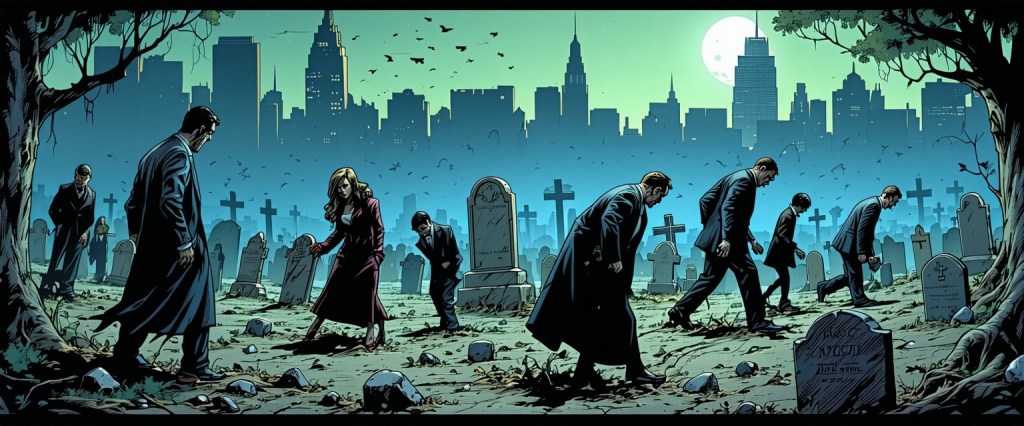
Claim #2: “Ten years ago, in a New York cemetery, graves opened, and the long dead arose, appearing to many across the city.”
If you encountered this story today, you’d likely have many questions. Consider these:
- How likely is it that the newspaper reporter is simply telling an outright lie for some reason?
- Even in reputable newspapers, some stories have been fabricated to gain attention or readership. Could this be one of those cases?
- If the reporter benefits personally or professionally from creating sensational stories, would they have an incentive to lie?
- How likely is it that those who allegedly told the reporter about the alleged event were telling an outright lie?
- People sometimes fabricate stories to seem important or connected to significant events. Could the witnesses have exaggerated or invented their claims?
- Was there any motivation, personal or social, for those involved to create or embellish this story?
- How likely is it that the story was largely embellished by the time of its documentation ten years after the actual event?
- Stories can change significantly over time, with details becoming exaggerated as they are retold. Could this story be the product of such distortions?
- Would certain dramatic details have been added to increase the story’s appeal or impact?
- Should we believe the story if the reporter is no longer available to cross-examine?
- Without the ability to question the reporter directly, it’s challenging to verify the authenticity and intent behind their report.
- If there are inconsistencies or unknowns in the story, a living source might clarify them—but without that, our confidence in its truth diminishes.
- Should we believe the story if the alleged witnesses are not named, prohibiting us from following up on the claim?
- Unnamed sources make it impossible to track down witnesses to confirm or deny the details.
- The anonymity raises questions: Did the witnesses exist at all, or is this a literary device to lend credibility to the story?
- Should we believe the story if the alleged witnesses are no longer around to cross-examine?
- The inability to question the witnesses directly eliminates a crucial layer of scrutiny we’d typically apply to such a claim.
- Without their firsthand testimonies, we lose key insights into their reliability and the accuracy of their accounts.
- Given the amazing nature of the alleged event, why was it not written down immediately?
- If something extraordinary like a resurrection happened, we’d expect immediate documentation from multiple sources. Why didn’t that occur here?
- Wouldn’t a delay in reporting suggest that either the event was not taken seriously at the time, or perhaps it didn’t happen as described?
- Given the densely populated location of this amazing alleged event, why are there no corroborating reports of the event?
- In a bustling city like New York, one would expect dozens, if not hundreds, of witnesses. Why don’t we have other accounts confirming this event?
- The lack of corroboration from independent sources challenges the story’s credibility, as public, miraculous events usually garner significant attention.
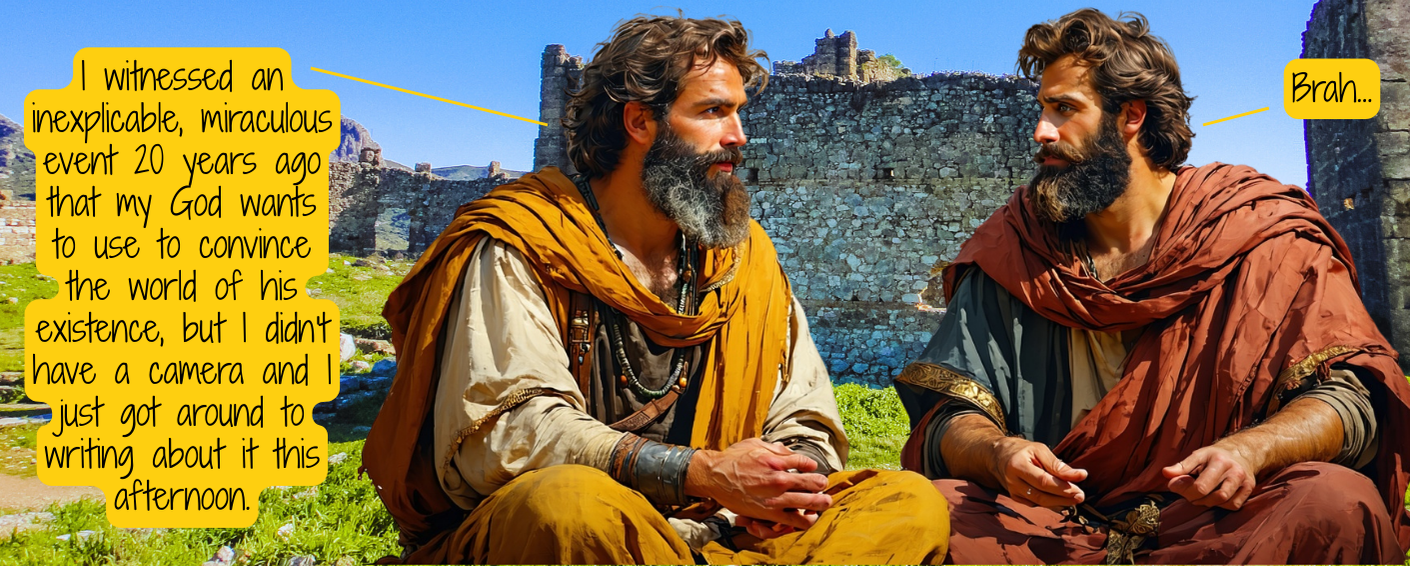
- Why would any witness to this event take decades to write it down?
- Would you, had you witnessed this event, waited 20+ years to document it?
- Would any God who made a resurrection the central event needed to be believed for salvation have not had the witnesses record the event the same day, and preferably with video documentation?
➘ Note the image below.
These questions represent basic evidentiary standards we typically apply to extraordinary claims. If they reflect a reasonable standard for modern miracles, then shouldn’t ancient accounts meet the same bar? After all, our acceptance shouldn’t hinge merely on the remoteness of the claim.
Final Reflection: What’s Rational?
Given the number of reasons we’d find to disbelieve the New York resurrection story, we might ask ourselves why ancient accounts are treated differently. Is it purely because these stories are encased in historical and cultural narratives? Should we not approach them with the same scrutiny we would today? Is it rational to waive our skepticism simply because a claim is old?
Parallel Dialogues For Claims
| ◉ Claim #1: “Ten years ago, in a New York cemetery, graves opened, and the long dead arose, appearing to many across the city.” | ◉Claim #2: “And the graves were opened; and many bodies of the saints which slept arose, and came out of the graves after his [Jesus’] resurrection, and went into the holy city, and appeared unto many.” (Matthew 27:52-53) |
|---|---|
| Reporter: Ten years ago, in a New York cemetery, the dead rose from their graves and were seen by many across the city. Witnesses remember this as an incredible event. | Reporter: After Jesus’ resurrection, the bodies of saints who had died rose from their graves, entered Jerusalem, and were seen by many. Early Christians believed this to be a remarkable sign. |
| Skeptic: That’s an extraordinary claim. Do we have immediate documentation of this event? Was it reported by news outlets or officials soon after it happened? | Skeptic: An incredible event, if true. Do we have any contemporary sources from Jerusalem recording it? Wouldn’t such an event be documented by historians or scribes? |
| Reporter: I wasn’t there, but people who lived near the cemetery reported hearing about it from others. Many recall it as a significant event. | Reporter: The Gospel of Matthew records this. It was written a few decades after the event but is highly valued by Christians as a reliable account. |
| Skeptic: But this story relies on secondhand memories and rumors, which are weak evidence. If people across New York witnessed it, there should be official documents, interviews, or detailed reports. | Skeptic: If the saints’ resurrection was visible to many in Jerusalem, shouldn’t there be multiple sources—other writers, historians, or locals—documenting it? Relying on one gospel seems risky. |
| Reporter: Not everything extraordinary is recorded in detail. Sometimes only those who believe remember the events, while others ignore or forget them. | Reporter: It’s possible that Matthew’s Gospel preserved this unique account while others overlooked it. The oral tradition in early Christian communities ensured it was remembered. |
| Skeptic: But in modern New York, we’d expect something this public to be verified. Without independent sources, it’s difficult to accept. Events don’t vanish in a place that documents everything rigorously. | Skeptic: Jerusalem was a significant city; a miracle like this wouldn’t escape notice. Ancient cultures documented important events, so the lack of independent accounts raises serious doubts. |
| Reporter: Believers argue that the truth of the story isn’t tied to physical evidence. Its survival in memory is proof enough for those who experienced or heard about it. | Reporter: Matthew’s account is part of the faith tradition, and many see its presence in the Bible as evidence of its authenticity, even if others didn’t record it. |
| Skeptic: But faith alone doesn’t make a claim factual. If we don’t have tangible evidence for something extraordinary, it’s indistinguishable from fiction. Don’t we need to apply rigorous standards here, just as we would today? | Skeptic: If faith alone justifies belief, we’d have to accept every religious miracle claim without evidence. Isn’t it reasonable to expect supporting evidence for a claim this significant, even if ancient? |
| Reporter: Faith often involves accepting truths that are spiritually significant, regardless of historical standards. For believers, the story’s impact goes beyond physical proof. | Reporter: Faith isn’t always about evidence in a historical sense. For Christians, this account holds spiritual truth, validated through its inclusion in the Gospel. |
| Skeptic: That sounds like symbolic belief rather than historical fact. Without corroboration or evidence, it’s difficult to treat this as an event that really happened. Oral traditions are prone to embellishment over time. | Skeptic: It sounds like this is more of a faith tradition than a historical account. Without corroboration, it’s difficult to see it as reliable history. Oral traditions, especially without verification, can become exaggerated. |
| Reporter: Some would say that extraordinary events often evade conventional validation. Miraculous events operate beyond ordinary standards, thus explaining their preservation through faith rather than evidence. | Reporter: Believers see miracles as events beyond natural verification. The Gospel preserves this tradition for those who accept it in faith rather than relying on historical documentation. |
| Skeptic: That opens up any unverified claim to acceptance. If miracles evade evidence, they’re indistinguishable from stories or myths. How can we discern truth from fiction if they aren’t held to evidence-based standards? | Skeptic: If miracles aren’t subject to evidence, they risk blending into myth. Faith may satisfy believers, but supporting evidence is necessary for assessing historical claims rigorously. |
◉ A deeper Assessment:
When evaluating extraordinary claims—whether drawn from the distant past or from yesterday—most people say they value truth over mere tradition. Yet the reality is that our standards of evidence often change depending on when the claim was made. An account of a public miracle today might be met with fierce skepticism and a demand for verification, but the same miracle in antiquity—especially if written in a revered text—often receives a pass. This is not a neutral habit of mind; it’s a cognitive bias that can distort our assessment of truth.
The Bias Toward Ancient Mystique
Events set in the distant past carry an aura of mystery and possibility. The further away the event, the more easily we overlook the physical regularities of the world that we see operating every day. Distant stories let us suspend disbelief the way a good movie does: the thrill outweighs the usual checks we’d apply to outrageous claims.
This bias is not unique to Christianity. Muslims who accept the claim that Allah split the moon may scoff at Joseph Smith’s golden plates. Christians who accept the resurrection of saints in Matthew 27 often dismiss modern miracle reports from rival religions. Across traditions, the rule is consistent: our miracles are true history; theirs are myth.
A Consistency Test:
Consider Matthew’s account:
“And the graves were opened; and many bodies of the saints which slept arose, and came out of the graves after his [Jesus’] resurrection, and went into the holy city, and appeared unto many.” (Matthew 27:52–53)
Now imagine a modern news report:
“Ten years ago, in a New York cemetery, graves opened, and the long dead arose, appearing to many across the city.”
Both claims describe the same type of event. But for the modern version, most people would:
✓ Demand immediate documentation from multiple sources.
✓ Ask why no independent accounts exist in a densely populated area.
✓ Question why the story emerged years later rather than the same day.
✓ Doubt the credibility of anonymous witnesses.
If such standards are reasonable for today, they should also apply to antiquity—unless we have a reason to believe the past operated under different evidentiary rules.
The Scarcity Fallacy
Some argue that ancient miracle claims deserve special weight because fewer records survive. But scarcity of sources does not automatically make each one more credible. We can see this by testing the principle in unrelated cases:
Example 1: The Moon-Split Diary
If the only surviving diary from 1890 claimed the moon split in two for ten minutes, and no one else recorded it despite widespread observation, scarcity would count against the claim, not for it.
Example 2: The Lion King Scroll
Archaeologists find a single scroll claiming a city’s king turned into a lion every full moon. Scarcity doesn’t make the story plausible; it simply leaves us without the cross-checks needed to evaluate it.
Example 3: UFO in Times Square
One lone 1972 witness reports a UFO hovering over Times Square for 20 minutes. Scarcity of accounts in this case signals improbability, because such a public event should have produced many independent records.
Example 4: Talking Dog Papyrus
A single papyrus from 400 BCE says a priest owned a dog that recited poetry. Scarcity doesn’t elevate credibility—it merely limits our ability to test the claim.
Mundane vs. Extraordinary Claims
Scarcity can make each surviving account more valuable for mundane events that could occur without attracting multiple records—like “a merchant bought grain in the market.”
But for extraordinary, public events—like mass resurrections in populated cities—scarcity of sources works against the claim. These are the very events that, if real, should flood the record with immediate and independent attestations.
Applying This to Biblical Miracles
If the resurrection of saints in Matthew 27 happened as described—publicly, in Jerusalem—it should have been documented by multiple historians of the time, Jewish and Roman alike. The absence of corroborating sources, combined with decades-long delays before it was written, matches the pattern of legendary growth rather than historical reporting.
When modern miracle claims are evaluated, we do not accept “faith tradition” as sufficient; we ask for:
✓ Multiple independent witnesses.
✓ Immediate documentation.
✓ Consistency with other records from the same period.
✓ Clear motives for accuracy rather than embellishment.
There is no epistemic justification for dropping these standards for ancient miracles simply because they are ancient.
Final Reflection: What’s Rational?
If we would dismiss a resurrection story in modern New York without corroboration, then intellectual honesty demands we treat the same type of ancient story with equal scrutiny. If we don’t, our standard is not truth-seeking—it’s tradition-protecting. And tradition, untested by evidence, is a poor substitute for reality.
See also:
A Relevant Technical Paper:

The Logical Form
Argument 1: Bias in Standards for Ancient vs. Modern Miracle Claims
- Premise 1: If an event seems improbable, it’s rational to request further proof before believing it.
- Premise 2: Most people would maintain skepticism toward a modern miracle claim until presented with stronger evidence.
- Premise 3: Similar claims from ancient texts are often accepted without the same level of skepticism or requirement for evidence.
- Conclusion: It is inconsistent to apply lower standards of evidence to ancient miracle claims than to modern ones.

Argument 2: Influence of Ancient Mystique on Credulity
- Premise 1: Events set in the distant past often carry an allure that prompts people to suspend their usual standards of evidence.
- Premise 2: People may find miracle claims from ancient times more plausible simply because they are ancient, allowing for the suspension of disbelief.
- Conclusion: Ancient mystique can lead people to apply lower standards of evidence to miracle claims, even though these standards would not be applied to recent, similar events.
Argument 3: Universal Cognitive Bias Across Religions
- Premise 1: Believers in one religion may accept ancient miracles from their own religious texts while rejecting similar claims from other religions.
- Premise 2: This bias shows that believers often apply inconsistent standards of evidence to their own ancient miracle claims versus those of other religions.
- Conclusion: This cross-religious bias indicates that inconsistent standards are applied due to the religious or cultural origin of the miracle claims, rather than the quality of the evidence.
Argument 4: Consistency of Evidence Standards
- Premise 1: If one would question a modern miracle story from a newspaper today, then consistent standards should apply to ancient miracle claims as well.
- Premise 2: Asking critical questions (e.g., was the reporter credible, were there named witnesses, why wasn’t it documented immediately, etc.) is rational when assessing any extraordinary claim.
- Conclusion: Consistent standards require that ancient and modern miracle claims be assessed with the same level of scrutiny and skepticism.
Argument 5: Credibility of Anonymous or Unverified Sources
- Premise 1: Claims without named witnesses or verifiable sources are weaker and harder to cross-examine.
- Premise 2: Ancient miracle stories often come from anonymous sources or lack access to primary witnesses, which would normally reduce credibility.
- Conclusion: It is inconsistent to accept ancient miracle claims from anonymous or unverified sources when such claims would typically be dismissed in a modern context.
Argument 6: Rationality of Accepting Delayed Documentation
- Premise 1: If an event is genuinely amazing, it would likely be documented immediately by multiple sources, especially in a densely populated area.
- Premise 2: The lack of immediate documentation and corroboration in ancient miracle claims raises doubts about their occurrence.
- Conclusion: Given that amazing events today would require immediate and corroborated documentation, it is irrational to accept ancient miracle claims that lack these characteristics.
Argument 7: Rationality of Waiving Skepticism Based on Time Alone
- Premise 1: Skepticism toward an improbable claim is normally justified regardless of when it allegedly occurred.
- Premise 2: Ancient miracle claims should not automatically be accepted with less scrutiny solely because they happened long ago.
- Conclusion: Rational standards of evidence should be applied consistently to both ancient and modern miracle claims, as time alone does not validate a claim.

(Scan to view post on mobile devices.)

A Dialogue
Standards of Evidence for Ancient vs. Modern Miracle Claims
CHRIS: I think we can agree that the Bible records extraordinary events, like miracles, that were meant to convey divine truth. These accounts have been preserved for centuries, which shows their value and reliability.
CLARUS: I understand the importance of these accounts to you, but shouldn’t we apply consistent standards of evidence to both ancient and modern miracle claims? If we wouldn’t accept a miracle claim today without strong evidence, why should we accept one just because it’s ancient?
CHRIS: But people in ancient times may have been more in touch with divine actions, and these accounts have been kept for a reason—they had significance. The people who witnessed these miracles felt so strongly about them that they passed them down through generations.
CLARUS: I get that, but consider this: just because a story has been preserved doesn’t make it true. If we heard of a miracle today in a densely populated city—say, people rising from graves in New York—we’d require robust proof like multiple witnesses, immediate documentation, and independent corroborations. Why should ancient stories of resurrection be treated differently?
CHRIS: Ancient people relied on oral tradition since they didn’t have our means of documentation. The fact that these stories endured shows their power and authenticity to those who experienced them.
CLARUS: But that raises a question: If these events were truly amazing and life-changing, wouldn’t they have been documented by multiple sources even in ancient times? Take your example of a resurrection; if that happened in a large, ancient city, wouldn’t we expect more than a single account?
CHRIS: Perhaps, but those closest to the events, like the disciples, were willing to risk their lives for these beliefs. Doesn’t that dedication suggest the truth of their experiences?
CLARUS: People in various religions have died for their beliefs, yet we don’t accept every religious claim as factual. People can believe fervently in something and still be mistaken or influenced by cultural expectations. Plus, we tend to be more skeptical of modern miracle claims, even if they’re backed by witnesses—we demand detailed evidence. Why do we make an exception for ancient, anonymous sources?
CHRIS: But the Bible is unique in its spiritual authority and its cultural context. Those accounts aren’t the same as today’s sensational stories; they come with a different weight.
CLARUS: Still, there’s a question of bias here. Other religious traditions also have miracle claims, which their followers believe without question. Christians tend to accept the Bible’s miracles while dismissing, say, the Quran’s miracles or the Book of Mormon’s. Doesn’t that suggest people often apply inconsistent standards of evidence based on their cultural and religious background?
CHRIS: That’s fair, but the context of faith makes these accounts meaningful. When something is grounded in faith, it has a unique truth that goes beyond ordinary evidence.
CLARUS: But if faith leads us to apply inconsistent standards, we should at least examine why we’re doing it. For instance, if a newspaper today reported a miraculous resurrection in New York, we’d have questions. Like, was the reporter credible, or did the story get exaggerated? We’d also want named witnesses and other sources confirming it. If a story doesn’t meet that standard, we’d likely dismiss it. Why lower the standard for ancient claims?
CHRIS: You’re saying that if we accept ancient miracles on weaker evidence, we’re using a double standard?
CLARUS: Exactly. Consistent standards would mean applying the same scrutiny to both ancient and modern miracle claims. If we wouldn’t trust a sensational story with only anonymous witnesses and no documentation today, why trust it from antiquity?
CHRIS: But ancient times were different; stories spread differently. And the people of the time accepted these stories, so perhaps they had reason to believe.
CLARUS: Or they might have been influenced by cultural pressures or shared biases. Think of how stories change over time. Even today, stories can be embellished as they’re retold. By the time a miracle story is written down—maybe ten years or more after the event—details can be heavily exaggerated. This tendency doesn’t disappear just because it’s ancient.
CHRIS: So you think embellishment could account for some biblical miracles?
CLARUS: It’s quite possible. And if the story only surfaced years later, there’s a strong chance that it wasn’t documented immediately. In today’s world, if an amazing event wasn’t reported right away, we’d question its authenticity. Wouldn’t you be suspicious if you heard a story that supposedly happened ten years ago but wasn’t reported until now?
CHRIS: Yes, I would question why it wasn’t immediately documented, especially if it’s extraordinary.
CLARUS: Exactly. And without early, multiple accounts, there’s no way to verify it, whether it’s a modern event or an ancient one. Applying consistent standards means holding both to the same level of scrutiny.
CHRIS: I see your point, but faith is about accepting things beyond ordinary reasoning.
CLARUS: That may be, but from a rational standpoint, accepting extraordinary claims without extraordinary evidence just because they’re ancient is questionable. Shouldn’t we at least require that ancient claims meet the same evidentiary standards as modern ones? After all, time doesn’t automatically make a claim true.
Notes:
Helpful Analogies
Analogy 1: The Rumor Mill Over Time
Imagine a group of people starts a rumor about an unusual event in a small town—say, a person who flew without any assistance. Over the years, as the story spreads, details change and new embellishments appear, making the story more fantastical. By the time it’s written down decades later, it’s nearly unrecognizable from the original account.
This is much like ancient miracle claims: stories can change as they are passed down, especially in oral traditions. Just because a story is old and has been preserved doesn’t necessarily mean it’s accurate. The passage of time doesn’t protect a claim from embellishment; in fact, it often makes it more likely.
Analogy 2: Suspiciously Absent Evidence in Court
Consider a court case where a major piece of evidence—the alleged eyewitness—can’t be identified or cross-examined, and there’s no documentation of the event in police records. If this happened in modern times, the court would likely dismiss the case due to insufficient evidence, especially if it’s an extraordinary claim.
Similarly, if an ancient miracle claim lacks named witnesses, immediate documentation, or corroboration, we should view it with the same skepticism as a modern-day legal case with missing evidence. The fact that it’s ancient doesn’t change the basic need for strong evidence to support extraordinary claims.
Analogy 3: The Unseen Fireworks Show

Imagine hearing about a spectacular fireworks show that supposedly happened last night in a large, busy city. However, you can’t find a single video, photo, or witness who saw it. No media outlets reported it, and there’s no official record of the event. Most people would dismiss this story, especially if no one can provide tangible proof or explain why such a public event went unrecorded.
This is similar to ancient miracle accounts claiming public, extraordinary events. In a densely populated area, an amazing event would likely have multiple records. If it doesn’t, this absence is suspicious and suggests the story may not be reliable. Just like with the fireworks show, a lack of evidence in a populated setting raises doubts about whether the event actually occurred.
Addressing Theological Responses
Theological Responses
1. The Limitations of Ancient Documentation
Theologians might argue that the lack of immediate documentation for ancient events doesn’t automatically discredit them. In ancient societies, many events, even important ones, weren’t documented due to limited resources, literacy levels, and the absence of widespread record-keeping practices. They might suggest that while we expect detailed evidence today, it’s unrealistic to apply modern documentation standards to ancient cultures. The focus should be on the preservation of the accounts and their impact rather than expecting immediate, multiple records from a different era.
2. Oral Tradition as Reliable Testimony
Oral traditions were highly valued in many ancient cultures, serving as the primary means of preserving history. Theologians could argue that oral transmission wasn’t merely a loose storytelling method but a carefully maintained practice, where communities placed great importance on accuracy. They might contend that, although oral traditions were eventually written down, they were sustained by collective memory and social structures that prioritized accuracy in transmission, thus providing a reasonable level of reliability.
3. Cultural and Religious Context as Verification
Theologians may argue that the cultural context of ancient religious beliefs supports the validity of miracle claims. They could point out that the claims were often tied to significant events in the life of the religious community, making them less likely to be invented or embellished. The willingness of early believers to endure persecution or even die for their beliefs could serve as indirect evidence of the authenticity of these miracles, as these events held deep meaning and were central to the community’s faith.
4. Miracles as Beyond Ordinary Evidence
Some theologians might contend that miracles are, by definition, extraordinary events meant to operate outside the bounds of ordinary experience and scientific verification. They might argue that requiring modern standards of proof for a miracle misunderstands the nature of a divine act. From this view, miracles aren’t subject to standard evidentiary criteria because they are inherently supernatural and thus inaccessible to typical means of verification.
5. The Consistency of Faith Across Religious Traditions
Theologians might address the bias argument by suggesting that the consistency of miracle claims across religious traditions actually supports the possibility of supernatural intervention. They could argue that the prevalence of similar miraculous accounts in different cultures and religions hints at a shared human experience of the divine. Instead of discrediting each other, these similar traditions might imply a broader spiritual reality that transcends individual religions.
6. Faith as Trust Beyond Rational Proof
Faith, for many theologians, is not merely belief without evidence but rather trust in a higher reality that surpasses ordinary reasoning. They might suggest that faith allows believers to embrace truths that can’t be fully proven but are meaningful within a spiritual framework. This approach acknowledges that faith involves a form of knowledge beyond empirical proof, allowing believers to accept ancient miracle claims as part of a spiritual reality, rather than dismissing them for lack of modern standards of evidence.
7. Resurrection and Unique Historical Impact
Theologians might argue that certain miracles, like the resurrection of Jesus, are unique in their historical and cultural impact. They might contend that the early Christian movement and its rapid growth lend credibility to the resurrection claim, as such transformative impact suggests something profound at its origin. Unlike a modern miracle that fades over time, these ancient claims fueled a lasting movement. Therefore, the historical endurance and influence of these miracle accounts serve as indirect evidence supporting their truth.
Counter-Responses
1. Standards of Evidence Should Apply Regardless of Era
While it’s true that ancient societies had limited means of documentation, this doesn’t negate the need for evidence when assessing extraordinary claims. Historians regularly evaluate ancient accounts using skeptical methods to determine their reliability, requiring corroboration, consistency, and proximity to the events described. An absence of documentation for an event that would have been groundbreaking even by ancient standards raises legitimate doubts. Simply being from a different era doesn’t justify lowering the bar for evidence; extraordinary claims still demand extraordinary evidence, regardless of the time period.
2. Oral Tradition Can Lead to Embellishment
Although oral traditions may have been structured, human psychology shows that memory is malleable and prone to embellishment, especially when retelling stories with high emotional or cultural significance. Studies on oral transmission reveal that details often change over time, influenced by the beliefs, needs, or biases of the community. This makes oral accounts particularly vulnerable to distortion. Thus, while oral traditions can preserve stories, they don’t guarantee the accuracy required to verify miracle claims.
3. Social Commitment Doesn’t Prove Truth
The dedication of believers or the significance of a religious event to a community doesn’t confirm the factual accuracy of the event. Throughout history, people have been deeply committed to causes, ideologies, and beliefs that were later shown to be false or exaggerated. The willingness to suffer or die for a belief might reflect faith but does not provide objective evidence for the events described. For example, followers of other religions are equally committed to their own miracles, yet most believers reject the miracles of other traditions. Commitment does not equate to historical validity.
4. Defining Miracles Outside Evidence Undermines Their Plausibility
By suggesting that miracles operate outside standard evidence and are beyond verification, theologians inadvertently make them unfalsifiable and indistinguishable from myth or fiction. If miracles are exempt from evidentiary scrutiny, then they lack a basis for rational acceptance and can be dismissed as easily as they are asserted. For a miracle to be plausible, it must at least meet basic standards of evidence; otherwise, it cannot be reasonably distinguished from imaginary events.
5. Similarity of Claims Across Religions Undermines, Rather Than Supports, Specific Claims
The prevalence of miracle claims across different religions actually challenges their validity rather than supporting a universal spiritual reality. This plurality suggests that such claims are influenced by human psychology and cultural contexts rather than pointing to an objective supernatural event. Furthermore, if miracles from one tradition are dismissed by followers of another, the inconsistency weakens the rational foundation for believing in any one set of miraculous claims. This indicates that miracle stories are likely a product of cultural biases and shared human tendencies, not evidence of actual events.
6. Faith as Trust Without Evidence Conflicts with Rational Standards
While faith can be personally meaningful, it does not provide objective justification for accepting miracle claims as true. Faith that bypasses evidence opens the door to believing in anything without scrutiny, which conflicts with rational inquiry. If we use faith as the standard for belief in ancient miracles, it equally justifies belief in other unverified or irrational claims. Trust without evidence may have spiritual value, but it does not offer the empirical basis needed to accept extraordinary claims as factual.
7. Historical Impact Does Not Validate Miraculous Events
While the impact of certain religious events, like the resurrection of Jesus, is undeniable, social or cultural influence does not confirm the truth of the underlying events. Major religions have arisen from events or figures whose historical accuracy is questionable, yet they had transformative effects on their followers. An event’s lasting influence is more reflective of the beliefs and needs of its adherents than of its factual accuracy. If impact were sufficient evidence, we would have to accept contradictory miracle claims from various religions as equally valid, which would be logically incoherent.
Clarifications
◉ Rigorous Avenues of Inquiry for Skeptics When Encountering Miracle Claims
1. Historical Documentation
- Is there any immediate documentation of the event from the time it allegedly occurred?
- What sources documented this event, and how close were they to the event in time and place?
- Were there any official records (e.g., government, military, or religious records) that corroborate the claim?
- Is there any independent documentation of the event from sources that are not affiliated with the primary claimants?
- How consistent are the accounts across different sources if there is more than one?
2. Named and Traceable Witnesses
- Who were the witnesses of the event, and are they named in any sources?
- Are there any recorded interviews with these witnesses that detail their observations?
- Can these witnesses be traced or verified in any way, such as through other records of their lives or statements?
- Do we know anything about the background of the witnesses that might influence their reliability or possible biases?
3. Independent Corroboration
- Are there any sources independent of the main claimant that verify or refer to the same event?
- Do any rival or neutral parties acknowledge or document the event?
- Are there external confirmations from sources that had no affiliation with the community making the claim?
4. Physical Evidence
- Is there any physical evidence from the site where the event allegedly took place?
- Were any artifacts or remains recovered that can be analyzed to corroborate the claim?
- Is there any photographic or video evidence if the event happened in modern times?
- Does the physical evidence align with known historical or scientific records?
5. Consistency Over Time
- How has the story changed over time in different retellings or documentations?
- Are there significant variations in the accounts, and if so, do these differences affect the credibility?
- Are there clear markers of embellishment or additions in later versions of the story?
- How was the account preserved (e.g., through oral tradition, manuscript copying) and how might this affect its reliability?
6. Cultural and Psychological Context
- What was the cultural climate around the time of the event? Were supernatural or miraculous beliefs common?
- Was there any political or religious motivation to propagate the claim?
- Could social or psychological factors (e.g., desire for communal identity, emotional needs) explain why people accepted or spread the story?
- How do similar cultures handle miracle claims? Is there a pattern of acceptance in some societies and skepticism in others?
7. Motivation and Bias
- Who benefits from the claim, and in what way (e.g., socially, politically, or financially)?
- Is there a potential bias in the sources that could influence their account of the event?
- Were there any incentives for witnesses to exaggerate, embellish, or fabricate the story?
8. Reputation and Reliability of the Sources
- How credible is the source that originally documented the event?
- What other types of events has the source recorded, and are these generally accepted or disputed by historians?
- Does the source have a track record of reliable or unreliable reporting?
- Is the source’s account supported by experts in relevant fields (e.g., historians, archaeologists, theologians)?
9. Probability and Prior Events
- How likely is the event, based on what we know of natural laws or historical precedent?
- Have similar events occurred elsewhere, and if so, were they documented with strong evidence?
- Does this claim fit with known historical or scientific understanding, or does it contradict established knowledge?
10. Geographic and Environmental Details
- Was the event in a location where it could be observed by multiple people?
- Are there environmental factors that could have influenced the event or people’s perception of it?
- If the event supposedly involved public phenomena (e.g., the opening of graves), why weren’t nearby people or authorities alarmed or involved?
11. Scientific Explanations and Skepticism
- Is there a natural or scientific explanation that could account for the claims?
- Have there been similar phenomena that were later explained by natural causes?
- What does science say about the possibility of the event described, and are there precedents for debunking similar claims?
12. Comparative Religious and Historical Claims
- Are there similar miraculous claims from other religious or historical traditions?
- How do we evaluate this claim compared to other religious miracle claims?
- If we accept this claim based on faith, should we also accept the miracle claims of other traditions?
13. Possibility of Fabrication or Distortion
- Is there any evidence that the story was fabricated or influenced by later additions?
- Could the claim have been exaggerated or transformed over time to enhance its appeal?
- Were there any known motives for fabrication, such as attracting followers or gaining influence?
14. Role of Oral Tradition
- Was the story transmitted orally before documentation, and if so, for how long?
- How does oral tradition influence the accuracy and consistency of the details?
- Have experts in oral history evaluated the reliability of the claim given its method of transmission?
15. Symbolic vs. Literal Interpretation
- Is the claim meant to be understood literally, or could it be symbolic or metaphorical?
- Does the context or language of the source suggest it may be a symbolic story rather than a factual account?
- How have religious or cultural leaders interpreted the event, and do they view it as history or allegory?
16. Faith-Based Justification vs. Historical Evidence
- Is faith being used as the primary basis for accepting the claim, or is there an attempt to provide evidence?
- What reasons do proponents give for the truth of the claim if it lacks conventional evidence?
- How does faith-based justification affect the claim’s credibility from a historical or rational perspective?
17. Implications of Accepting the Claim
- If this claim is accepted as true, what are the implications for other similar claims?
- Would accepting this claim require us to accept all unverified miracle claims based on faith alone?
- Does accepting this claim undermine rational standards of evidence that we apply to other extraordinary events?
18. Expert Opinions and Peer Review
- What do scholars and historians specializing in this period or culture say about the claim?
- Has the claim been rigorously examined in academic literature or historical research?
- Have experts from relevant fields, such as archaeology or theology, evaluated and critiqued the evidence?
19. Significance of the Event and Motivation for Immediate Documentation
- Was the event remarkable enough that it would have prompted immediate recording by witnesses if it genuinely occurred?
- Would ordinary people or authorities have seen the event as important or extraordinary enough to document promptly, or could it have been seen as insignificant or routine?
- If the event was so astonishing and impactful, why might it only appear in records written decades later and in limited sources, instead of prompting immediate, widespread documentation by multiple individuals and groups?
These avenues of inquiry help a skeptic rigorously assess the validity of miracle claims, ensuring that extraordinary claims are supported by appropriate levels of evidence and critical examination.
◉ A Model to Assess Historical Claims
Part 1 — Symbolic Logic Model
The following is a symbolic logic model followed by a plain-language decision framework
Annotation: Declares the core predicates and parameters used to score a claim and describe its evidential context.

Annotation: Defines per-source quality and risk measures plus the unadjusted likelihood ratio contributed by a source.
![\textbf{Source\ metrics: } Qual(s)\in(0,1],; Gap(s)\ge 0,; Bias(s)\in[0,1],; Anon(s)\in{0,1},; Tamper(s)\in[0,1],; LR(s)\colon \mathrm{base\ likelihood\ ratio}](https://s0.wp.com/latex.php?latex=%5Ctextbf%7BSource%5C+metrics%3A+%7D+Qual%28s%29%5Cin%280%2C1%5D%2C%3B+Gap%28s%29%5Cge+0%2C%3B+Bias%28s%29%5Cin%5B0%2C1%5D%2C%3B+Anon%28s%29%5Cin%7B0%2C1%7D%2C%3B+Tamper%28s%29%5Cin%5B0%2C1%5D%2C%3B+LR%28s%29%5Ccolon+%5Cmathrm%7Bbase%5C+likelihood%5C+ratio%7D&bg=ffffff&fg=000&s=0&c=20201002)
Annotation: Encodes how damaging silence is for claims that should have generated reports if true.

Annotation: Turns the base likelihood ratio into an effective one by multiplying penalty factors for weaknesses.

Annotation: Longer time gaps, higher bias, and anonymity each reduce evidential weight via tunable parameters.
![\textbf{Penalty\ definitions: } k_{\mathrm{gap}}(s)=e^{-\lambda, Gap(s)},\quad k_{\mathrm{bias}}(s)=\frac{1}{1+\beta, Bias(s)},\quad k_{\mathrm{anon}}(s)=\alpha\in(0,1]; \mathrm{if}; Anon(s)=1; \mathrm{else}; 1](https://s0.wp.com/latex.php?latex=%5Ctextbf%7BPenalty%5C+definitions%3A+%7D+k_%7B%5Cmathrm%7Bgap%7D%7D%28s%29%3De%5E%7B-%5Clambda%2C+Gap%28s%29%7D%2C%5Cquad+k_%7B%5Cmathrm%7Bbias%7D%7D%28s%29%3D%5Cfrac%7B1%7D%7B1%2B%5Cbeta%2C+Bias%28s%29%7D%2C%5Cquad+k_%7B%5Cmathrm%7Banon%7D%7D%28s%29%3D%5Calpha%5Cin%280%2C1%5D%3B+%5Cmathrm%7Bif%7D%3B+Anon%28s%29%3D1%3B+%5Cmathrm%7Belse%7D%3B+1&bg=ffffff&fg=000&s=0&c=20201002)
Annotation: Suspected tampering reduces weight, source quality scales weight, and dependence between sources applies a penalty.
![k_{\mathrm{tamper}}(s)=\frac{1}{1+\theta, Tamper(s)},\quad k_{\mathrm{qual}}(s)=Qual(s),\quad k_{\mathrm{dep}}(s)=\delta\in(0,1]; \mathrm{if\ not\ independent\ else}; 1](https://s0.wp.com/latex.php?latex=k_%7B%5Cmathrm%7Btamper%7D%7D%28s%29%3D%5Cfrac%7B1%7D%7B1%2B%5Ctheta%2C+Tamper%28s%29%7D%2C%5Cquad+k_%7B%5Cmathrm%7Bqual%7D%7D%28s%29%3DQual%28s%29%2C%5Cquad+k_%7B%5Cmathrm%7Bdep%7D%7D%28s%29%3D%5Cdelta%5Cin%280%2C1%5D%3B+%5Cmathrm%7Bif%5C+not%5C+independent%5C+else%7D%3B+1&bg=ffffff&fg=000&s=0&c=20201002)
Annotation: Combines all source evidence and the silence factor into a single likelihood ratio for the claim.

Annotation: Updates prior credence to a posterior using the total likelihood ratio.

Annotation: For public, high-reportage claims, silence strongly counts against the claim.

Annotation: Scarcity of sources hurts extraordinary public claims that should have generated many accounts.

Annotation: For mundane and private claims, scarcity and silence carry little evidential force.

Annotation: Sets a higher posterior threshold for accepting extraordinary claims than for mundane ones.

Annotation: Expected reportage increases with publicity, magnitude, recording capacity, and cultural norms of record keeping.

Annotation: In typical extraordinary public scenarios, strong silence keeps the posterior below the acceptance threshold.

Part 2 — Plain-Language Decision Framework
The logic above can be explained in simple steps:
- Start with a prior probability
Every historical claim starts with some prior likelihood based on how it fits with what we already know about the world. - Classify the claim
Is it extraordinary (something rare, surprising, or contrary to established knowledge) or mundane? Extraordinary claims start with lower priors and require more evidence. - Assess publicity
Was this event public and dramatic enough that many people would have noticed it if it happened? The higher the publicity, the higher the “expected reportage.” - Check the actual reportage
- If you’d expect lots of reports but have only one or two, that’s a negative signal.
- If the event is private or unremarkable, lack of reports isn’t a big deal.
- Evaluate the sources
For each account, ask:- How long after the event was it recorded?
- Does the author have bias?
- Is the author anonymous?
- Could the account have been tampered with?
- Is it first-hand or dependent on others?
- Is the writing quality high enough to trust?
Each of these factors adjusts how much weight the source adds.
- Combine the source weights
Multiply the adjusted credibility scores for all sources to get the overall strength of the evidence. - Adjust for silence
If many people could have reported it but didn’t, subtract from the credibility score. - Compare to threshold
Extraordinary claims must meet a higher bar for acceptance than mundane ones. If the evidence strength falls short, the claim remains unverified.
➘ Instantiating the Model with Dragons over Athens
Imagine that archaeologists, while excavating near the Acropolis, uncover an ornate, well-preserved manuscript. The text claims that during the height of the Greek empire, enormous dragons swooped over Athens, their wings casting shadows across the Parthenon as terrified citizens looked on. The handwriting is elegant, the language classical, and the imagery vivid—yet this is the first time any such account has surfaced in centuries of studying Greek history. No other known sources mention the event, and the claim runs counter to everything we understand about biology, physics, and ancient records. How should we go about weighing such a discovery? To avoid relying on gut feeling or the allure of the extraordinary, we can apply a structured evidential model that explicitly factors in prior plausibility, source quality, potential biases, and the deafening silence from other expected witnesses.
Annotation: The historical claim under evaluation.

Annotation: Extraordinary, very public, high expected reportage, but few surviving sources.

Annotation: Only one source exists.

Annotation: Extremely low prior due to conflict with biology and natural history.

Annotation: Generous base likelihood ratio for a seemingly formal manuscript before penalties.

Annotation: Penalty hyperparameters for time gap, bias, tamper, anonymity, and dependence.

Annotation: Long transmission gap severely weakens the source.

Annotation: Moderate suspected motive or genre inflation.

Annotation: Assume the writer is named; no anonymity penalty. If anonymous, multiply by 

Annotation: Nontrivial interpolation or corruption risk over centuries.

Annotation: Decent but not superb manuscript quality and probity.

Annotation: No dependence penalty with a single source.

Annotation: After adjustments, the manuscript favors 


Annotation: If dragons really flew, broad silence is very unlikely; silence is very likely if nothing happened.

Annotation: The silence factor alone strongly pushes against H.

Annotation: Total likelihood ratio after combining source weight and silence.

Annotation: Posterior credence collapses to essentially zero.

Annotation: Illustrative acceptance threshold for extraordinary claims.

Annotation: The claim fails the acceptance criterion by many orders of magnitude.

Sensitivity sketch
Even if you raise the manuscript’s base 


Leave a Reply