

Consider the Following:

Summary: Defaulting to belief in God as an answer to life’s existential questions can hinder intellectual inquiry, promote dogmatic thinking, and introduce risks to critical thinking and personal autonomy. Embracing uncertainty and acknowledging “I don’t know” fosters genuine exploration and an openness to new insights, encouraging a pursuit of truth over comfort.

Imagine standing at the edge of an uncharted forest, seeking a path that leads to safety and understanding. Nearby, someone offers you a hastily drawn map, claiming it will guide you perfectly, though they can’t verify its accuracy. Feeling uncertain, you might be tempted to cling to the map, treating it as reliable simply because it is the only option presented. However, taking this map without question risks leading you astray—it may close off opportunities to explore other routes or tools, like a compass or broader survey of the landscape, that could yield a more accurate understanding.
Now, imagine instead that you pause, embrace the discomfort of uncertainty, and carefully examine the environment. You might not immediately find your way, but by committing to exploration and questioning assumptions, you begin to piece together a clearer, evidence-based picture of the terrain. This approach values the process of discovery over the comfort of prematurely adopted answers, fostering resilience and adaptability as you navigate the unknown.
This scenario parallels the risks of defaulting to faith as an explanation for existential questions. Blind acceptance of a spiritual map might offer emotional comfort, but it risks intellectual complacency, reliance on dogma, and a foreclosed search for deeper truths. By embracing curiosity, a commitment to “I don’t know,” and rigorous inquiry, we open ourselves to genuine discovery and a fuller understanding of life’s profound mysteries.

Nearly everyone confronts deep existential questions at some point—questions about existence, purpose, and the meaning of life. In searching for answers, many people gravitate toward religious beliefs, often feeling that faith in God offers the clearest or most comforting explanations. However, is it truly reasonable to believe in God just because it provides a framework for our unknowns? Does defaulting to belief serve as a genuine answer, or might it introduce risks to our understanding and intellectual integrity?
The Risks of Defaulting to Belief in God for Existential Answers
Turning to belief in God solely due to unanswered questions can easily substitute curiosity with closure. When we accept religious answers purely to fill gaps in understanding, we may unwittingly stifle the essential process of inquiry. Imagine a scientist embracing an unproven theory as fact, simply due to a lack of competing ideas. This approach would limit exploration and undercut the pursuit of truth. By adopting religious explanations too readily, we risk intellectual complacency, forsaking the opportunity to explore multiple perspectives and more evidence-based pathways.
Does Faith Offer True Solutions or Only Temporary Comfort?
Faith often appears to offer solutions, but it’s crucial to question whether these answers align with reality or merely serve as temporary comfort. Believing in God can bring personal solace and a sense of purpose, yet the emotional benefits of faith do not inherently validate the truth of the beliefs. Ideally, we should seek answers that correspond to reality, not only to our preferences or fears. Embracing beliefs for the comfort they provide risks prioritizing emotional certainty over a sincere pursuit of understanding.

The Dangers Intrinsic to Defaulting to a Belief in God
Choosing to believe in God as a default response to unanswered questions introduces several risks, especially in relation to critical thinking and intellectual autonomy. Here are some key dangers of adopting this approach:
- Stagnation of Inquiry: Treating God as the answer to profound questions can lead to a closure of curiosity. When we think we have definitive answers, we may become less likely to explore scientific or philosophical alternatives.
- Reliance on Dogma: Adopting beliefs uncritically fosters dogmatic thinking. Dogma discourages the questioning necessary for intellectual growth, often favoring inflexible doctrines over evolving perspectives.
- Erosion of Personal Responsibility: Believing that God dictates meaning and values can diminish an individual’s commitment to ethical reasoning and self-derived responsibility, deferring instead to divine command.
- Cognitive Dissonance: Faith-based beliefs can sometimes conflict with observable evidence or scientific understanding, creating mental tension that may lead to anti-scientific attitudes.
- Vulnerability to Manipulation: Relying on religious authorities to interpret existential questions can open individuals to manipulation, especially when belief is wielded to exert control over personal or social behavior.
- Inhibition of Progress: History shows that religious dogma has often obstructed progressive values and scientific advancement. Rigid adherence to religious doctrines can hinder both personal development and societal progress.
- Exclusionary Behavior: Adopting a belief in God as an exclusive solution can foster divisive attitudes toward those with differing beliefs or toward those who choose not to believe.
Caveat: There are far more miserable lifestyles than the average Christian lifestyle. However, cherry-picked comparisons are not the best way to assess the quality of one’s life. Imagine a life that is fully committed to following the evidence wherever it leads. This commitment to intellectual honesty will very likely positively bleed over into other aspects of your life.
The Value of Embracing Uncertainty and “I Don’t Know”
One of the most powerful responses to profound questions is the willingness to say, “I don’t know”. Embracing uncertainty isn’t a sign of intellectual defeat; rather, it reflects a commitment to honest inquiry. Acknowledging the limits of our understanding allows us to remain open to new information and broader perspectives. Admitting uncertainty can be uncomfortable, especially when faced with questions that seem to demand definitive answers, but it fosters a mindset that values continuous learning and growth.

Being comfortable with uncertainty means we don’t need to rush to conclusions. This approach helps us resist the allure of simplistic answers and instead nurtures a healthy skepticism that is foundational for critical thinking. By saying “I don’t know,” we leave space for future discoveries and insights that might bring us closer to genuine understanding rather than settling for immediate, potentially misleading answers.
Alternative Approaches to Addressing Life’s Big Questions
Rather than turning to belief in God as a default, we could approach life’s mysteries with a commitment to curiosity and open inquiry. Philosophy, science, and rational dialogue offer tools that allow us to investigate life’s complexities without prematurely concluding. By valuing unbiased inquiry over comforting answers, we remain adaptable, allowing our understanding to evolve as we encounter new evidence. Such an approach encourages a deeper, more resilient engagement with the world—one that values truth and integrity over emotional assurance.
Conclusion: Is Belief in God the Only Answer?

While believing in God might provide a convenient answer to life’s existential questions, it could also restrict the depth and integrity of our inquiry. If we value truth over comfort, we should resist the impulse to settle for beliefs that merely fill a gap in understanding. A genuine commitment to exploring life’s questions acknowledges the value of uncertainty and embraces the process of seeking knowledge as an end in itself. By confronting life’s mysteries openly and with humility, we cultivate a richer, more authentic understanding—one that doesn’t rely on unproven beliefs but on a sincere pursuit of truth.
A Corresponding Academic Paper on the Topic:

The Logical Form
Argument 1: Defaulting to Belief in God Limits Inquiry
- Premise 1: If a belief is accepted as the default answer to deep existential questions, it reduces the motivation to explore alternative answers.
- Premise 2: Belief in God is often accepted as a default answer to existential questions.
- Conclusion: Therefore, defaulting to belief in God limits inquiry and discourages further exploration.

Argument 2: Faith Does Not Guarantee Alignment with Reality
- Premise 1: For a solution to be truly valuable, it should align with reality rather than merely providing emotional comfort.
- Premise 2: Faith-based beliefs often prioritize comfort over objective alignment with reality.
- Conclusion: Therefore, faith alone does not guarantee alignment with reality, making it insufficient as a true solution to existential questions.
Argument 3: Embracing Uncertainty Promotes Intellectual Growth
- Premise 1: Admitting uncertainty encourages openness to new ideas and fosters a commitment to intellectual growth.
- Premise 2: Being comfortable with “I don’t know” nurtures a mindset focused on continuous learning and adaptation.
- Conclusion: Therefore, embracing uncertainty promotes intellectual growth and prevents the premature acceptance of unproven beliefs.
Argument 4: Faith-Based Belief Can Lead to Cognitive Dissonance
- Premise 1: Faith-based beliefs can conflict with scientific evidence and observable reality, leading to psychological discomfort.
- Premise 2: Cognitive dissonance arises when one holds conflicting beliefs, especially between faith and empirical evidence.
- Conclusion: Therefore, faith-based belief can lead to cognitive dissonance, particularly when it contradicts scientific understanding.
Argument 5: Embracing Curiosity Over Belief Enhances Understanding
- Premise 1: Approaching life’s questions with curiosity rather than defaulting to belief allows for more rigorous examination of multiple perspectives.
- Premise 2: Curiosity-driven inquiry fosters a deeper and more evidence-based understanding of complex existential questions.
- Conclusion: Therefore, embracing curiosity over belief enhances understanding and leads to a more robust pursuit of knowledge.

(Scan to view post on mobile devices.)

A Dialogue
Scrutinizing Faith as a Response to Puzzling Questions
CHRIS: I think that believing in God makes sense when we face life’s big questions. Faith provides answers that give us comfort and guidance, especially when no one else seems to have clear answers. Isn’t it reasonable to have faith under those circumstances?
CLARUS: I understand the appeal of faith when faced with uncertainty, but faith, by its nature, often doesn’t map to the degree of evidence available. When we embrace belief without evidence to support it, we risk treating wishful thinking as truth—and that can close off genuine inquiry.
CHRIS: But isn’t it practical to have some kind of answer, even if it’s based on faith, rather than staying in a state of not knowing?
CLARUS: I’d argue that not knowing—embracing uncertainty—is a strength, not a weakness. It keeps us open to possibilities and helps us avoid settling on ideas that don’t withstand scrutiny. Saying, “I don’t know” preserves our intellectual integrity, whereas faith often demands certainty in the absence of evidence.
CHRIS: But without faith, we’re left with an empty uncertainty. Doesn’t faith provide a structure and a purpose, even if it’s not fully verifiable?
CLARUS: Faith may provide comfort, but comfort doesn’t validate a belief. It’s easy to conflate emotional satisfaction with truth, yet real understanding demands that we seek answers grounded in reality, not in our desires or fears. If we commit to faith just because it feels purposeful, we risk prioritizing emotional certainty over honest exploration.
CHRIS: So, if you dismiss faith, where do you get your moral guidance? Faith in God establishes a foundation for ethics, giving us a clear sense of right and wrong.
CLARUS: Faith in “moral” principles handed down by an authority often means sacrificing personal responsibility. If we don’t reason out ethics for ourselves but rely solely on religious doctrine, we risk outsourcing our reasoning about pro-social behavior to a higher authority rather than developing it. True ethical integrity comes from engaging with ethical questions directly, not deferring to beliefs simply because they’re traditional or comfortable.
CHRIS: But faith can still help us feel grounded in something bigger, even if it’s not always in sync with science. Isn’t the benefit of faith worth that tension?
CLARUS: The tension created by cognitive dissonance is no small issue. When faith contradicts scientific evidence, it requires us to reject or ignore empirical findings to maintain belief. This can not only hinder our understanding but also cultivate an anti-scientific attitude, where faith is treated as more important than observable reality.
CHRIS: So, what do you propose as an alternative? Without faith, how can people find answers to these profound questions?
CLARUS: Instead of defaulting to faith, we can approach these questions with curiosity and a dedication to truth. Curiosity-driven inquiry respects the depth of our questions without demanding premature conclusions. By valuing evidence and keeping an open mind, we can build a more reliable understanding of life—one that respects uncertainty as an integral part of the search for genuine answers.
Notes:
Helpful Analogies
Analogy 1: Choosing a Map Over an Unknown Path
Imagine being on a journey in unfamiliar territory. You come across a map, but it’s outdated and doesn’t match the landscape accurately. While it provides comfort and a sense of direction, relying solely on it can lead you astray. This is similar to faith when it’s accepted as truth without evidence; it offers a guide but may not align with the actual terrain of reality, potentially hindering our journey to genuine understanding.
Analogy 2: Settling for the First Theory in Science
Consider a scientist who, in the face of a difficult problem, quickly adopts the first theory presented, even though it’s based on limited evidence. Instead of conducting further experiments and examining other possibilities, they stop at this initial theory, feeling relieved to have an answer. This is like accepting faith as the answer to existential questions without further inquiry—it may feel satisfying, but it halts deeper exploration and could lead to false conclusions.
Analogy 3: Building a House on Unstable Ground

Imagine constructing a house on a foundation of sand because it’s readily available and easy to dig. Over time, however, the house starts to sink, and the walls crack, revealing the foundation’s instability. Faith, when used as a default answer to life’s questions without evidence to support it, is like building on sand—it may provide initial comfort, but the lack of a solid foundation risks collapse when scrutinized or when faced with challenging evidence.
Addressing Theological Responses
Theological Responses
1. Faith Complements, Rather Than Replaces, Inquiry
Theologians might argue that faith does not discourage intellectual inquiry but rather complements it by addressing areas where empirical evidence cannot reach. They might suggest that belief in God can coexist with a commitment to seeking knowledge and truth, filling existential gaps that science alone may not be equipped to address.
2. Faith Offers a Moral Framework That Goes Beyond Personal Responsibility
Many theologians would argue that faith in God provides a moral foundation that transcends human limitations and biases, offering an objective basis for ethical behavior. They might claim that religious principles guide us toward ethical ideals that personal reasoning alone might not consistently achieve, especially under complex moral challenges.
3. Comfort and Truth Are Not Mutually Exclusive
Theologians may assert that comfort and truth need not be in conflict, suggesting that belief in God can provide genuine solace precisely because it aligns with spiritual truths. They might argue that the sense of purpose and comfort faith offers could reflect a deeper reality, one that scientific evidence cannot fully capture but which is accessible through spiritual experience.
4. Faith Encourages Intellectual Humility and Openness to Mystery
Some theologians would say that faith inherently involves intellectual humility, acknowledging the limitations of human understanding and remaining open to mystery. Faith, in this view, does not require absolute certainty but instead encourages a humble acceptance of uncertainty as part of the spiritual journey, similar to the “I don’t know” mindset encouraged in philosophical inquiry.
5. Faith Can Foster a Positive Relationship with Science
Theologians might respond that faith and science are not necessarily in opposition but can work together to enrich human understanding. They might argue that a religious worldview can encourage exploration of the natural world as part of a divine creation, thus motivating scientific inquiry and appreciation for the intricacies of the universe.
Counter-Responses
1. Faith as a Complement to Inquiry Assumes Unfounded Knowledge Gaps
While it’s suggested that faith complements inquiry by addressing areas beyond empirical evidence, this presupposes that faith provides legitimate knowledge rather than comfort alone. Rational inquiry would question whether faith-based answers genuinely fill gaps in knowledge or merely offer placeholder solutions without evidence. Accepting faith as a “complement” risks halting the pursuit of evidence-based explanations, potentially distorting our understanding of unknowns by assigning certainty where none exists.
2. Objective Morality Does Not Depend on Faith
The claim that faith provides a superior moral foundation assumes that “morality” requires religious underpinnings to achieve objectivity. However, a rational approach argues that principles guiding pro-social behavior can be grounded in human empathy, societal well-being, and reasoned philosophical notions without the need for religious doctrines. Religious belief is not essential to establish consistent pro-social and compassionate standards.
3. Comfort Alone is Not a Justification for Truth
While comfort in belief may accompany faith, this emotional aspect does not verify its truthfulness. Rational thinkers contend that emotional comfort, while beneficial, does not serve as a reliable indicator of reality. Accepting beliefs primarily for the solace they provide risks prioritizing personal feelings over objective truth, potentially leading individuals to adopt ideas that conflict with empirical evidence and reality.
4. Intellectual Humility Does Not Require Faith in Mystery
Theological views may argue that faith nurtures intellectual humility, yet rational thought suggests that acknowledging uncertainty does not necessitate belief in religious mysteries. True humility in the face of the unknown calls for open-ended inquiry rather than premature commitment to faith-based beliefs. Embracing “I don’t know” respects mystery without resorting to unsubstantiated explanations, maintaining a mindset of genuine openness without assigning undue certainty to beliefs lacking evidence.
5. Faith and Science Can Conflict in Their Claims to Knowledge
Although some claim that faith and science can harmoniously coexist, rational examination reveals that faith often introduces assertions incompatible with scientific understanding. Faith-based beliefs that directly contradict scientific evidence can lead to cognitive dissonance and hinder a clear appreciation of empirical reality. A rational approach holds that science should operate independently of faith, grounding knowledge in evidence rather than in assumptions that may undermine rigorous scientific inquiry.
Clarifications
Historical Invocations of God for Unexplained Phenomena
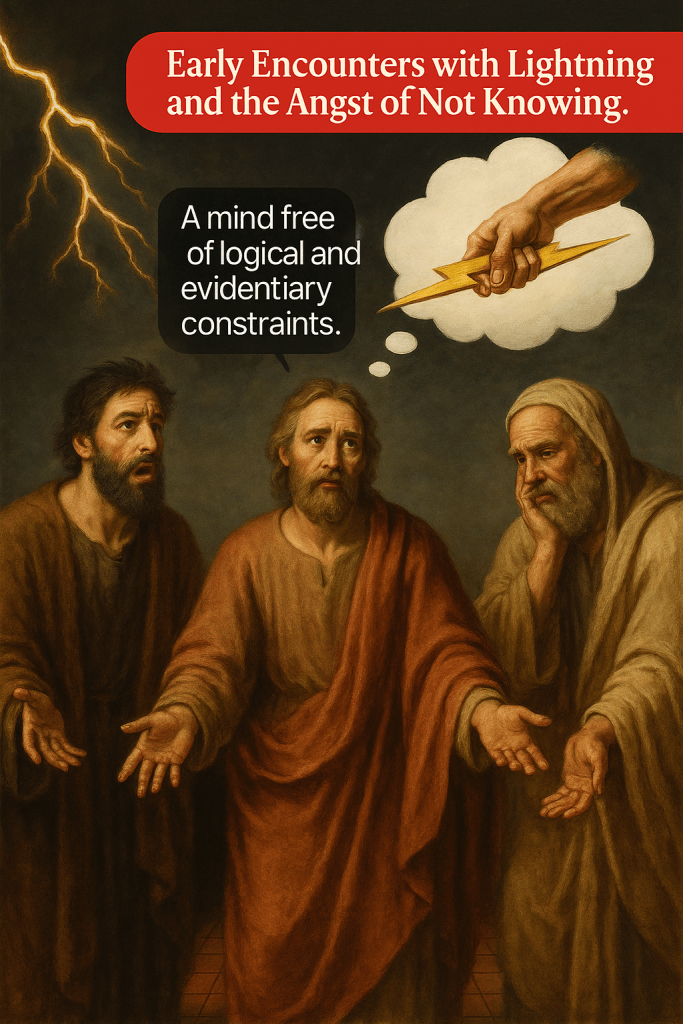
- Thunder and Lightning: Ancient cultures, including Greek and Norse civilizations, attributed thunder and lightning to gods like Zeus or Thor. These natural phenomena were later understood through meteorology and electrical science.
- Disease and Epidemics: Many societies viewed plagues and diseases as punishments from God or the result of demonic influence. The development of germ theory and medical science clarified that diseases are caused by pathogens, not divine wrath.
- Solar and Lunar Eclipses: Historically, eclipses were often interpreted as signs of divine displeasure or impending disaster. Astronomy now explains these events as predictable movements within the solar system.
- Earthquakes and Natural Disasters: Earthquakes, tsunamis, and other natural disasters were frequently attributed to the anger of gods or spiritual forces. Modern geology has shown that these events result from tectonic plate movement.
- Mental Illness: Many cultures once believed that mental illness was caused by demonic possession or spiritual weakness. Today, psychiatry and psychology identify mental illness as a result of complex neurological, genetic, and environmental factors.
- Famine and Crop Failure: Famine and agricultural failure were often attributed to a lack of divine favor or divine punishment. Science has since explained these phenomena through climate and environmental factors.
- Comets and Celestial Events: Comets were viewed as omens of doom or messages from the gods in many ancient societies. Astronomy now understands comets as natural objects within our solar system with no connection to earthly events.
Modern Defaults to Spiritual Explanations for Unexplained Phenomena
- Miracle Healing: Some claim that unexplained or sudden healing from illnesses is the result of divine intervention. Medical science attributes most of these cases to spontaneous remission, placebo effects, or unknown physiological processes.
- Ghosts and Paranormal Activity: Reports of ghosts or paranormal activity are often attributed to the spirits of the deceased. Research suggests that these experiences can usually be explained by psychological factors, environmental influences, or neurological conditions.
- Astrology Influencing Personality: Many people still believe that astrological signs determine personality traits or influence life events. However, studies have repeatedly found no scientific basis for astrology affecting human psychology or behavior.
- Energy Healing (Reiki, Chakra Alignment): Practices like Reiki and chakra alignment claim to use spiritual energy for healing. Scientific evidence, however, does not support the effectiveness of these methods beyond placebo effects.
- Telepathy and Psychic Powers: Belief in telepathy or psychic powers remains widespread, with people attributing some unexplained mental connections to spiritual forces. Empirical studies, however, have failed to find reliable evidence supporting psychic phenomena.
- Divine Communication in Near-Death Experiences (NDEs): Some interpret NDEs as visits to the afterlife or communications with the divine. Research suggests that NDEs can be explained by neurological and physiological processes that occur in the brain during extreme stress or low oxygen levels.
- Curses and Bad Luck: Belief in curses or spiritually induced bad luck persists in some cultures. Psychology and probability theory explain many of these occurrences as cognitive biases or self-fulfilling prophecies rather than spiritual intervention.


Leave a Reply