

Consider the Following:

Summary: The doctrine of eternal punishment for finite offenses contradicts claims that God is loving, patient, and just by imposing disproportionate, infinite consequences that defy fairness, forgiveness, and proportionality. This belief creates logical absurdities, raising doubts about the coherence of divine attributes and demanding critical scrutiny rather than blind acceptance.

The doctrine of eternal punishment for finite offenses creates a striking tension when compared to claims that God is loving, patient, and just. It also introduces logical absurdities that challenge even the most basic principles of fairness and proportionality. To highlight the absurdity of this doctrine, let us begin with a hypothetical scenario.
Imagine a judge who claims to administer justice fairly. However, this judge applies the same sentence—life imprisonment—to every offender, regardless of the crime. Whether someone commits a violent act or merely jaywalks, the punishment is identical.
Now, imagine this judge insists that the most grievous offense is not acknowledging his authority as a judge. He argues that the emotional injury caused by such rejection is incalculable and thus merits the same severe punishment. The judge sentences all offenders—whether they committed a minor infraction or outright defied him—to a lifetime in a miserable prison.

Would such a judge be considered fair or just? Most people would conclude that he is emotionally unstable, unjust, or tyrannical. But what if this judge possessed the power to prolong a person’s life indefinitely and imposed eternal torment instead of a finite sentence? Would that make his actions any more defensible?
This scenario, though extreme, parallels the doctrine of eternal punishment. If we recoil at the idea of such a judge, why should we accept the same behavior in a deity?
Divine Love vs. Eternal Punishment
Divine love, as described in scripture and theology, is often said to surpass human love. Yet eternal punishment for finite offenses suggests otherwise. A truly loving being would not permanently sever a relationship over a limited number of transgressions.
- Finite Offenses vs. Infinite Love: A parent, no matter how hurt by their child’s actions, does not respond with irreversible rejection. Instead, they seek to restore the relationship through guidance and forgiveness. The doctrine of eternal punishment denies this restorative aspect of love.
- Irrevocable Condemnation: Eternal punishment means there is no chance for reconciliation, no matter the remorse or repentance. Such a response seems less like love and more like vindictiveness.
Key Contradiction: How can divine love, which is said to be infinite and unfailing, justify infinite punishment for offenses committed by finite, fallible beings?
Divine Patience vs. Immediate Condemnation
Patience is often described as one of God’s defining attributes—”slow to anger” and “abounding in steadfast love” (Exodus 34:6). Yet the concept of eternal punishment negates this entirely:
- Finite Opportunities for Redemption: Humans are given a limited lifetime to understand their actions and seek reconciliation. For someone born into difficult circumstances or ignorance, this timeframe may be insufficient.
- No Second Chances: Eternal punishment forecloses any possibility of correction or rehabilitation, contradicting the principle of patience as a divine virtue.
Key Contradiction: If God is infinitely patient, why impose eternal consequences for offenses committed during a finite lifetime?
Divine Justice vs. Disproportionate Punishment

Justice requires proportionality—ensuring that the severity of the punishment matches the gravity of the offense. The doctrine of eternal punishment violates this principle in several ways:
- Infinite Punishment for Finite Offenses: No offense committed within the constraints of time and human capacity can logically warrant infinite punishment. For example:
- A single lie leads to eternal torment.
- A lifetime of offenses, no matter how grievous, leads to the exact same punishment as one minor transgression.
- Equal Treatment of Unequal Actions: The doctrine treats vastly different offenses—such as dishonesty and acts of violence—as equally deserving of eternal punishment.
- Inherited Nature: Humans are said to be predisposed to offense due to their nature. Punishing individuals infinitely for traits they did not choose or fully control undermines any concept of fairness.
Key Contradiction: A system of justice that does not differentiate between offenses or allow for correction is not justice—it is vengeance.
The Absurdity of Finite Offenses Requiring Infinite Punishment
The greatest absurdity of the doctrine lies in its mathematical disproportion:
- Finite Acts, Infinite Consequences: Even if someone committed countless offenses, the total would still be finite. Applying infinite punishment to a finite number of acts is an escalation that defies reason.
- Justice Intuition: Humans, created in God’s image according to Christian theology, intuitively understand that punishment should fit the crime. If divine justice operates on principles so alien to human understanding, how can humans be expected to emulate or accept it?
Reconciling the Contradictions
Proponents of eternal punishment often argue that the magnitude of an offense is determined by the being against whom it is committed. Offenses against an infinitely holy God, they claim, warrant infinite punishment. However, this argument raises serious issues:
- Holiness Does Not Justify Disproportion: Greater authority or holiness does not necessitate harsher punishment for minor offenses. In fact, greater authority often brings greater capacity for forgiveness and restraint.
- Example: A parent, having authority over their child, responds to misbehavior with correction and patience, not unending wrath.
- Incomprehensible Standards: If divine justice operates on principles incomprehensible to humans, how can humans reasonably be held accountable to those standards?
Final Thoughts
The doctrine of eternal punishment for finite offenses contradicts claims that God is loving, patient, and just:
- Love seeks restoration, not irrevocable condemnation.
- Patience allows time for growth, not immediate and eternal punishment.
- Justice demands proportionality, not infinite consequences for finite actions.

The absurdity of infinite punishment for finite offenses ultimately reduces the doctrine to a fear-based construct, incompatible with the very attributes it claims to represent. If such a doctrine were attributed to any human authority, it would be deemed tyrannical. When applied to God, it raises serious doubts about the logical coherence of the claim. For those who value reason and fairness, this doctrine warrants critical scrutiny rather than blind acceptance.
A Companion Technical Paper:
An Exhaustive (354-page) Treatment of this Issue:

The Logical Form
Argument 1: Finite Offenses Do Not Warrant Infinite Punishment
- Premise 1: A finite number of offenses cannot logically or proportionally result in infinite consequences.
- Premise 2: Eternal punishment represents an infinite consequence for finite actions.
- Conclusion: Eternal punishment is disproportionate to finite offenses and lacks logical coherence.

Argument 2: Eternal Punishment Conflicts with Divine Love
- Premise 1: A loving being seeks restoration and forgiveness rather than permanent estrangement.
- Premise 2: Eternal punishment involves irrevocable severance and offers no chance for reconciliation.
- Conclusion: Eternal punishment is inconsistent with the claim that God is infinitely loving.
Argument 3: Eternal Punishment Contradicts Divine Patience
- Premise 1: Patience implies allowing time and opportunities for growth, correction, and reconciliation.
- Premise 2: Eternal punishment denies further opportunities for growth or reconciliation after a finite lifetime.
- Conclusion: Eternal punishment contradicts the attribute of infinite patience.
Argument 4: Eternal Punishment Violates Proportionality in Justice
- Premise 1: Fairness requires that consequences are proportionate to the actions that warrant them.
- Premise 2: Eternal punishment treats all offenses—whether minor or severe—as deserving of infinite consequences.
- Conclusion: Eternal punishment lacks proportionality and fairness.
Argument 5: Inherited Imperfection Undermines Responsibility
- Premise 1: Responsibility assumes that individuals have control over their nature and choices.
- Premise 2: Humans are said to be predisposed to offense due to a nature they did not choose.
- Conclusion: Punishing individuals infinitely for inherited traits undermines the premise of personal accountability.
Argument 6: Infinite Consequences for Offenses Against an Infinite Being Are Illogical
- Premise 1: The magnitude of an offense does not scale infinitely based on the status of the offended party.
- Premise 2: Offenses against an infinitely holy being are argued to warrant infinite punishment, despite their finite nature.
- Conclusion: The claim that offenses against an infinite being justify infinite punishment is logically inconsistent.

(Scan to view post on mobile devices.)

A Dialogue
Eternal Punishment and Divine Attributes
CHRIS: I believe that eternal punishment is a just response to human transgressions because God is infinitely holy, and any offense against Him carries infinite weight.
CLARUS: That’s an interesting point, Chris, but let’s examine it carefully. If a human commits a finite number of offenses, how can an infinite punishment be proportionate? Proportionality is a cornerstone of any fair system, yet eternal punishment seems to exceed the scale of the offenses.
CHRIS: The severity of the punishment reflects the infinite nature of God. Offending an infinite being warrants an infinite consequence.
CLARUS: But does the status of the offended party automatically multiply the severity of an offense? For example, if a child lies to a teacher or to their parent, should the punishment differ simply because of the authority of the offended party? Justice must consider the nature and intent of the offense itself, not just who was offended. Otherwise, it becomes arbitrary and detached from fairness.
CHRIS: I see your point, but God’s holiness is absolute. Any offense is a rejection of that holiness, which is why the punishment is so severe.
CLARUS: Yet, if God’s holiness is absolute, wouldn’t that also mean His love and patience are absolute? A truly loving being wouldn’t respond to finite transgressions with eternal estrangement, especially when humans are predisposed to error due to their nature. A loving parent, for instance, seeks restoration rather than permanent rejection, even when their child disobeys.
CHRIS: That’s where divine patience comes in during our lifetimes. God gives us time to repent and return to Him. If we don’t, eternal punishment is simply the consequence of rejecting that opportunity.
CLARUS: But doesn’t infinite patience extend beyond the boundaries of a finite human lifespan? A being that is infinitely patient wouldn’t impose a point of no return—an eternal consequence—for decisions made during a short and often confusing life. Shouldn’t infinite patience allow ongoing opportunities for growth and reconciliation, rather than closing the door forever?
CHRIS: Eternal punishment isn’t about a lack of love or patience—it’s about justice. Sin must be paid for, and eternal punishment is the just consequence for rejecting God’s authority.
CLARUS: Let’s dissect that claim of justice. Justice requires proportionality: the punishment must match the offense. If a mass murderer and someone who told one small lie both receive eternal punishment, how can that be proportional? Treating vastly different offenses as equally deserving of infinite punishment seems to contradict any notion of fairness.
CHRIS: The punishment isn’t about the offense alone—it’s about rejecting God entirely. That’s what warrants the same consequence.
CLARUS: But if God is infinitely loving and just, wouldn’t He consider the context of each offense? Humans often act out of ignorance, fear, or confusion, not as a deliberate rejection of God. To impose eternal consequences for actions rooted in these limitations denies the possibility of personal growth or understanding, which a loving and just being would encourage.
CHRIS: You’re focusing on human standards of justice, but God’s ways are higher than ours. His justice might not make sense to us.
CLARUS: If God’s justice is entirely beyond human comprehension, how can we be expected to recognize it as just? Humans are said to be made in God’s image, which implies our understanding of fairness should at least reflect His. If eternal punishment fundamentally contradicts our most basic sense of fairness and balance, how can it be reconciled with the claim that God is just?
CHRIS: But God’s holiness requires that all offenses against Him are treated with the utmost seriousness. His nature demands it.
CLARUS: If God’s nature demands infinite punishment for finite offenses, then it seems we are dealing with a system that prioritizes retribution over restoration. True love and patience—hallmarks of a compassionate being—would emphasize reconciliation and transformation. A system that cannot forgive finite offenses or allow for growth falls short of what we would expect from a being of infinite wisdom and kindness.
CHRIS: So you’re saying that eternal punishment isn’t consistent with divine love, patience, or justice?
CLARUS: Exactly. Eternal punishment raises profound contradictions. If God is loving, He would restore rather than sever relationships permanently. If He is patient, He would allow opportunities for growth beyond this life. And if He is just, He would ensure that the consequence fits the offense, rather than imposing an infinite penalty for finite actions. These contradictions demand critical reflection rather than uncritical acceptance.
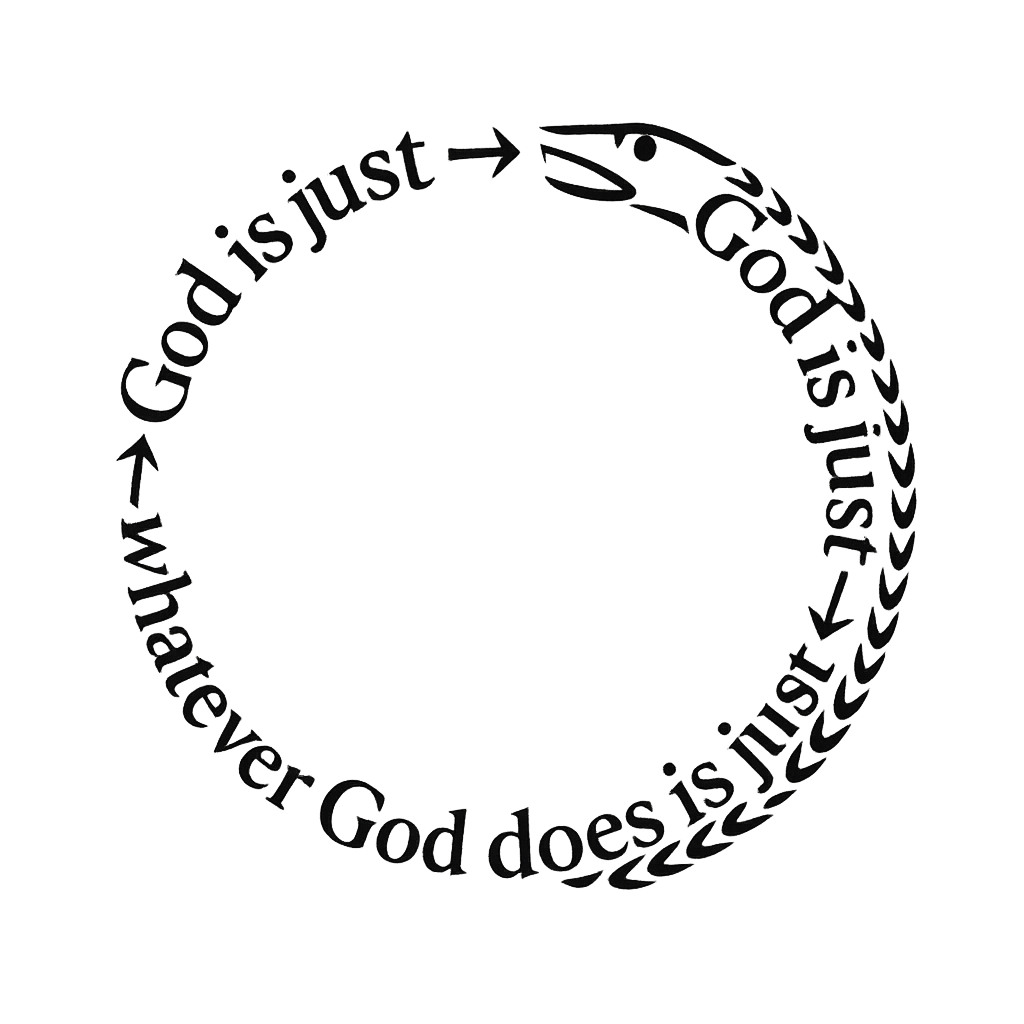
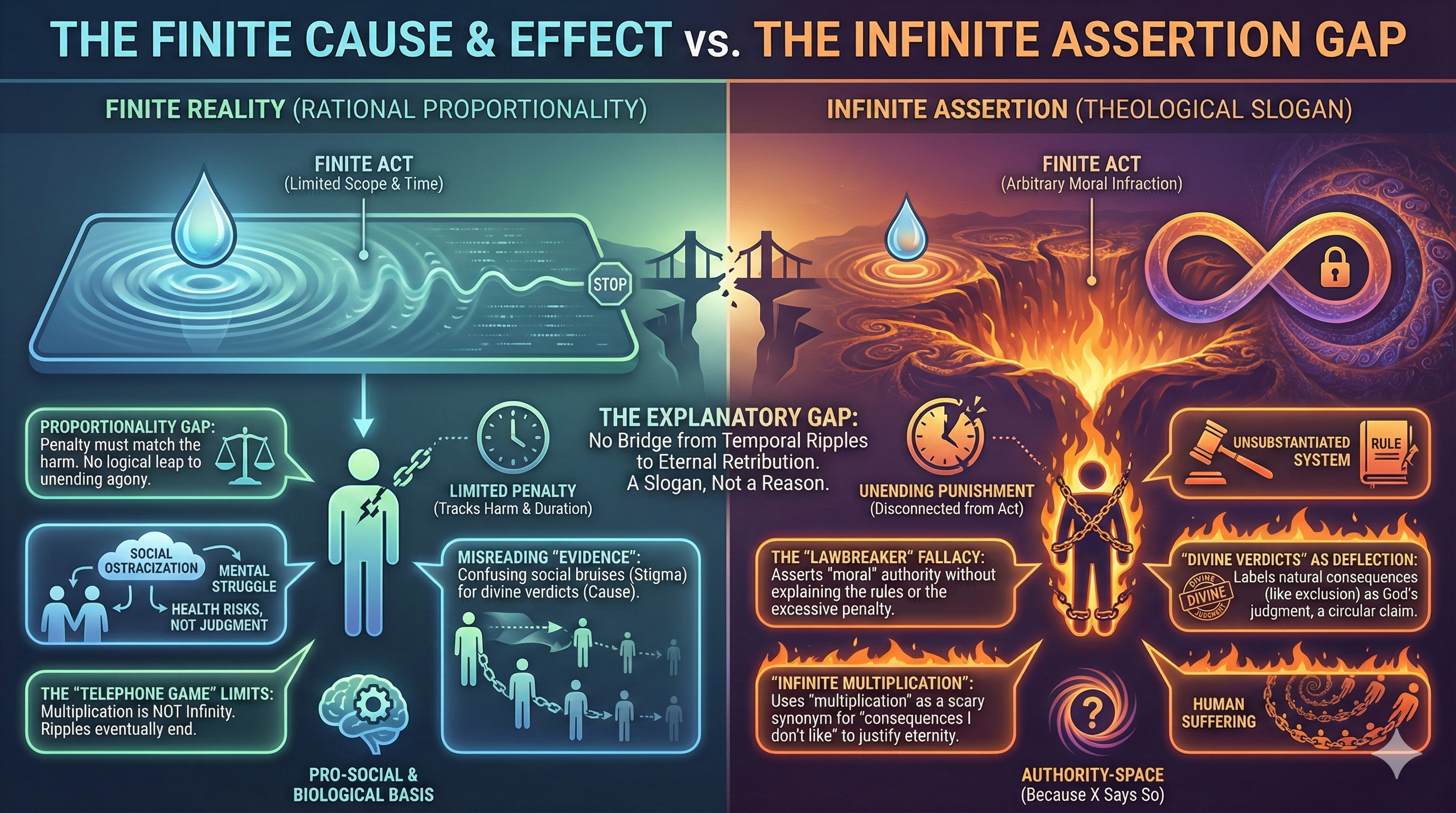
Notes:
Helpful Analogies
Analogy 1: The Tyrannical Judge
Imagine a judge in a courtroom who imposes the exact same sentence—life imprisonment—on everyone, regardless of their offense. A person who committed a violent crime receives the same punishment as someone who jaywalked or failed to pay a parking ticket. The judge defends this practice by arguing that all offenses are ultimately rejections of his authority, which he views as an intolerable insult.
Such a judge would be deemed unfair and tyrannical, not because of the authority they hold, but because of the disproportionate nature of their punishments. Similarly, eternal punishment for finite offenses treats all actions with the same infinite severity, regardless of their scope or intent, undermining the claim of divine justice.
Analogy 2: The Parent and the Child

Imagine a loving parent whose child makes mistakes, such as spilling milk, telling a small lie, or refusing to do homework. Instead of correcting the child and offering guidance, the parent disowns them permanently, declaring that the offense warrants an irreversible severance of their relationship.
Such behavior would not be considered loving or patient by any standard. A genuinely loving parent seeks to restore and nurture the relationship, recognizing the child’s capacity for growth and learning. Eternal punishment, however, is equivalent to permanently disowning a child for finite mistakes, contradicting the idea of infinite love.
Analogy 3: The Teacher and the Test
Imagine a teacher who gives their students a single, high-stakes test to determine their entire academic future. Some students perform poorly due to lack of understanding, stress, or external circumstances. Instead of offering opportunities for improvement or retesting, the teacher assigns failing students to a lifetime of menial labor with no hope for redemption.
This scenario illustrates the absence of patience or fairness. Just as a fair teacher would provide chances to learn and improve, a truly patient and loving deity would offer ongoing opportunities for growth and reconciliation rather than imposing eternal consequences for finite missteps.
Addressing Theological Responses
Theological Responses
1. God’s Justice is Beyond Human Comprehension
Theologians may argue that divine justice operates on a plane beyond human understanding. Just because eternal punishment seems disproportionate by human standards does not mean it is unjust in the divine sense. Humans, with their limited perspective, cannot fully grasp the depth of offenses against an infinitely holy God.
2. Offenses Against an Infinite Being Have Infinite Weight
It is often claimed that the severity of an offense is determined by the status of the one offended. Offenses against an infinite and holy God carry infinite weight, regardless of the finite nature of the actions. Therefore, eternal punishment is justified as a response to the infinite dishonor caused by transgressions.
3. Eternal Punishment Reflects Human Free Will
Theologians might assert that eternal punishment is not imposed by God but rather chosen by humans who reject Him. The permanence of this punishment reflects the free will of individuals who willingly sever their relationship with God, despite ample opportunities to repent during their finite lifetimes.
4. God is Infinitely Loving but Also Infinitely Just
A key theological response is that love and justice are not mutually exclusive. God’s infinite love is demonstrated in offering humanity redemption through grace, but His justice requires that unrepented offenses are met with appropriate consequences. Eternal punishment satisfies the demands of perfect justice while leaving room for divine mercy for those who repent.
5. Eternal Punishment Motivates Repentance
Theologians may argue that the doctrine of eternal punishment serves a practical purpose—it underscores the seriousness of transgressions and motivates individuals to seek reconciliation with God. Without the prospect of severe consequences, human beings might fail to grasp the significance of their actions or take divine mercy for granted.
6. God’s Patience Ends at Death
While theologians acknowledge that God is patient, they often contend that His patience applies only during a person’s lifetime. Death marks the end of this patience, and eternal consequences follow as a result of each individual’s choices. This view underscores the urgency of repentance while alive.
7. Eternal Punishment Reflects the Eternal Nature of the Soul
Some theologians argue that eternal punishment aligns with the eternal nature of the soul. Since the soul exists indefinitely, its consequences—whether eternal joy or eternal punishment—must also be infinite. This perspective ties the permanence of punishment to the immortal nature of human existence.
Counter-Responses
1. Response to “God’s Justice is Beyond Human Comprehension”
If divine justice is entirely beyond human comprehension, how can humans be expected to recognize or emulate it? By claiming justice is incomprehensible, the concept becomes meaningless, leaving humans without any rational basis for trusting or following it. Moreover, if humans are made in God’s image, their sense of fairness should at least reflect divine justice in some way. The stark contradiction between eternal punishment and human fairness undermines the claim of divine justice rather than elevating it.
2. Response to “Offenses Against an Infinite Being Have Infinite Weight”
The status of the offended party does not inherently magnify the severity of an offense. For instance, a lie told to a parent or a teacher does not suddenly warrant a disproportionate consequence simply because of their authority. The magnitude of an offense should be determined by its nature and intent, not by the perceived status of the offended. Extending this principle, finite offenses against an infinite being remain finite in scope, and applying infinite punishment to them introduces logical absurdity.
3. Response to “Eternal Punishment Reflects Human Free Will”
If humans are predisposed to transgressions due to their nature—something they did not choose—how can they be said to fully exercise free will? Moreover, eternal punishment negates the possibility of future change, growth, or reconciliation, reducing the concept of free will to a one-time, irreversible choice. A truly free system would allow for ongoing opportunities to change, rather than imposing permanent consequences based on finite decisions.
4. Response to “God is Infinitely Loving but Also Infinitely Just”
While love and justice can coexist, their application must be consistent. Infinite love would prioritize restoration and forgiveness, especially for finite beings with limited understanding. Justice, if truly fair, would demand proportionality rather than infinite punishment for finite offenses. If God’s justice cannot accommodate restoration, it is not justice but vengeance, which is incompatible with the notion of infinite love.
5. Response to “Eternal Punishment Motivates Repentance”
Fear-based motivation, such as the threat of eternal punishment, undermines the integrity of free will and genuine repentance. A truly transformative relationship with God should be based on understanding and love, not coercion. Furthermore, if eternal punishment is meant as a deterrent, it fails to account for those who misunderstand or are unaware of divine expectations, punishing them eternally despite their lack of knowledge.
6. Response to “God’s Patience Ends at Death”
The claim that patience ends at death contradicts the very nature of infinite patience. A finite lifetime cannot adequately reflect the scope of infinite patience, especially for beings who are finite and fallible. True patience would allow for ongoing opportunities for reconciliation and growth, even beyond death, rather than imposing eternal consequences for temporal actions.
7. Response to “Eternal Punishment Reflects the Eternal Nature of the Soul”
The eternal nature of the soul does not logically necessitate eternal punishment for finite offenses. Just as rehabilitation or restoration can take place over time without permanence, so too can consequences be proportional to the offense without being infinite. The immortal nature of the soul should emphasize its capacity for growth and transformation, not justify eternal retribution.
Clarifications
A Logical Proof
Definitions:
: x is a finite offense.
: y is a punishment.
: y is infinite.
: y is the consequence of x.
: y is just.
Premises:
: Finite offenses incur consequences.
: All consequences must be just.
: Justice requires proportionality between offense and punishment.
: Finite offenses cannot warrant infinite punishment.
Conclusion:

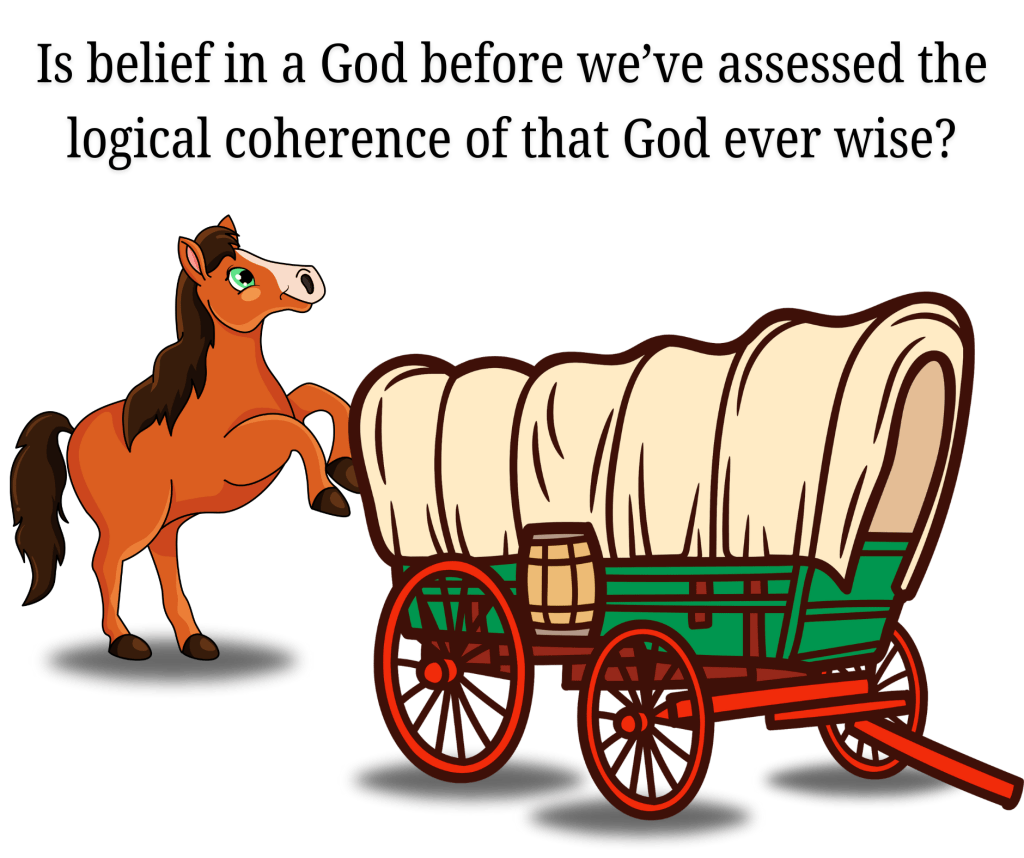
Faith and Logic: The Cart Before the Horse
The acceptance of faith in a God presumed to be logical creates a paradox that undermines the very foundation of theological inquiry. By beginning with the assumption of divine logic, adherents bypass the critical assessment required to evaluate whether the theology accompanying such a God aligns with the principles of logic itself. This cart-before-the-horse approach shields theology from scrutiny and leads to intellectual stagnation, where faith becomes an unfalsifiable axiom rather than a conclusion derived from rational investigation.
Faith as a Precondition, Not a Conclusion
Faith is often presented as a virtue—a prerequisite for understanding divine truth. However, when faith in a God’s logic is accepted a priori, it imposes a framework that demands uncritical assent to accompanying theological claims. This precondition fundamentally reverses the rational process:
- Faith-Based Assumption: In contrast, faith assumes the outcome—that God is logical—and demands that any contradictory evidence or reasoning conform to this presupposition.
- Logical Investigation: A rational approach begins by assessing evidence and reasoning to determine whether the claims of a theological system are coherent and defensible.
This reversal prevents the honest evaluation of whether theological doctrines, such as eternal punishment or divine justice, can withstand rational scrutiny. The premise that God is logical becomes an unchallengeable axiom, and any inconsistency in theology is dismissed as a failure of human understanding rather than a flaw in the doctrine.
Shielding Theology from Criticism
The assumption of divine logic acts as a safeguard, insulating theological systems from critique. This creates several problems:
1. Confirmation Bias
When faith precedes analysis, believers seek evidence that aligns with their assumption of divine logic, while disregarding contradictory evidence. For example, doctrines such as eternal punishment for finite offenses are rationalized through appeals to divine mystery or higher justice, even when they conflict with human notions of proportionality and fairness.
2. The Argument from Mystery
Believers often invoke the idea that God’s ways are higher than human ways to resolve apparent contradictions in theology. While this may preserve faith, it does so at the expense of logical coherence. An unfalsifiable appeal to mystery renders theology immune to evaluation, effectively ending any meaningful discussion about its validity.
3. Circular Reasoning
Faith-based theology often relies on circular arguments: God is presumed to be logical because the theology says so, and the theology is presumed to be true because God is logical. This circularity prevents any independent verification of the claims being made.
Theological Implications
Eternal Punishment and Divine Justice
One of the most glaring examples of this issue is the doctrine of eternal punishment for finite offenses. If God is presumed logical, then eternal punishment must, by definition, be just. However, when assessed independently, this claim violates principles of proportionality and fairness. Faith in God’s logic precludes an honest examination of whether this doctrine is rational, forcing believers to reconcile an infinite punishment with finite offenses through convoluted reasoning or appeals to mystery.
Omnipotence and Free Will
Another example is the reconciliation of divine omnipotence with human free will. If God is logical, then the coexistence of these attributes must make sense, even if no coherent explanation can be offered. Faith demands acceptance, while logic demands scrutiny. The tension between these two approaches is resolved not through evidence or reasoning, but through an a priori commitment to divine logic.
The Consequences of Reversing the Process
The cart-before-the-horse acceptance of faith over logic has significant intellectual consequences:
- Stifled Inquiry: By starting with an assumption of truth, faith discourages open-ended questioning and the pursuit of alternative explanations.
- Erosion of Intellectual Integrity: The demand to fit all evidence into a pre-existing framework undermines the honesty and rigor required for genuine inquiry.
- Dogmatic Stagnation: Theological systems that rely on faith as a foundation become resistant to change or improvement, even in the face of logical inconsistencies.
A Rational Alternative
A more rigorous approach begins by assessing theological claims independently of faith. This requires:
- Testing Consistency: Theological doctrines should be evaluated for internal consistency and coherence with observed reality.
- Demanding Evidence: Claims about divine attributes or actions must be supported by evidence, not assumed based on faith.
- Embracing Falsifiability: A theology that cannot be questioned or falsified is not a rational system but a dogmatic one.
Faith, if it is to play a role, should be the result of logical inquiry, not its starting point. Only by reversing the current order can theology become a subject of genuine intellectual engagement.
Conclusion
Faith in a God assumed to be logical places the cart before the horse, preventing a rigorous and honest assessment of the theology that accompanies such a God. By starting with the premise of divine logic, theology becomes impervious to critique, relying on circular reasoning, confirmation bias, and appeals to mystery to maintain its coherence. A truly rational approach requires that theological claims be evaluated on their own merits, with faith emerging as a conclusion of logical inquiry, not its foundation. Only then can theology claim to stand on firm intellectual ground.
The Absurdity of Claiming God Alone Defines Patience, Love, and Justice
The assertion that God alone defines patience, love, and justice, while human notions of these concepts are deemed illegitimate, leads to a profound contradiction. Such a claim undermines the coherence of divine attributes and strips these concepts of their meaning. If humans are expected to emulate or understand these qualities as reflections of God’s nature, dismissing human experiences as invalid creates a theological and logical impasse.
Human Understanding as a Reflection of Divine Attributes
A foundational claim of many theological systems is that humans are created in God’s image. This implies that human capacities for patience, love, and justice are derived from and reflect divine attributes. If this is true, then human understanding of these qualities cannot be entirely divorced from divine standards. To assert otherwise creates the following problems:
- Disconnect Between Creator and Creation
If human notions of patience, love, and justice are fundamentally flawed, what does that say about their origin? A being responsible for creating humans with these capacities cannot simultaneously discredit them without undermining the coherence of creation. - Impossibility of Emulation
If God’s standards of these qualities are entirely beyond human comprehension, how can humans emulate them? For example, if divine justice bears no resemblance to proportionality or fairness as understood by humans, any effort to act justly becomes meaningless. - Lack of Intelligibility
For humans to recognize divine patience, love, or justice, these concepts must have some intelligible connection to human experience. Otherwise, they are arbitrary labels, devoid of content or relevance to human lives.
Patience as an Infinite Concept
Human Notions of Patience
Patience, in human terms, involves restraint, understanding, and the willingness to allow time for growth or change. It reflects a capacity to endure imperfection and to seek eventual resolution.
Theological Claim
The argument that God’s patience is infinite yet wholly different from human patience creates a contradiction when finite lifespans are introduced. If God’s patience is infinite, why impose irrevocable consequences after a finite lifetime?
The Absurdity
Claiming that divine patience is fundamentally different from human patience negates the very meaning of patience. If patience does not involve enduring imperfection and allowing time for resolution, it becomes an empty term, used merely to justify arbitrary outcomes.
Love That Cannot Be Recognized
Human Notions of Love
Love, in human terms, is characterized by care, forgiveness, and the desire to nurture relationships. Even flawed humans strive to mend broken connections and act in the best interest of others.
Theological Claim
If God’s love is entirely different from human love, it raises the question: how can humans identify or recognize it? For instance, doctrines such as eternal punishment—severing relationships forever—are presented as manifestations of divine love.
The Absurdity
Love that permanently abandons individuals over finite transgressions directly contradicts human experiences of love. If humans are created with the capacity to love as a reflection of God’s nature, then God’s love must at least resemble human love in its fundamental qualities. Otherwise, it becomes a concept beyond human comprehension, rendering any claim of divine love meaningless.
Justice Without Proportionality
Human Notions of Justice
Justice is widely understood as proportionality—a balance between offense and consequence. Human systems of justice strive (albeit imperfectly) to ensure that the severity of punishment matches the gravity of the offense.
Theological Claim
The assertion that divine justice does not conform to human notions of fairness allows for doctrines like eternal punishment for finite offenses. This claim presumes that God’s standards of justice are incomprehensible and cannot be questioned.
The Absurdity
Justice that bears no resemblance to fairness or proportionality is not recognizable as justice. If eternal punishment for finite offenses is just, while proportional punishment is not, then the term “justice” loses its meaning. A concept so alien to human understanding cannot be considered a standard for humans to follow or admire.
The Contradiction of Expecting Human Emulation
Theological doctrines often expect humans to emulate divine patience, love, and justice as part of their moral and spiritual development. However, if these concepts are entirely defined by God and bear no relation to human understanding, emulation becomes impossible:
- Impossibility of Recognition
If human concepts of patience, love, and justice are invalid, how can humans identify when they are acting in accordance with divine standards? - Incoherence in Expectation
Expecting humans to mirror divine qualities while dismissing human experiences of those qualities as illegitimate is incoherent. It imposes an unattainable standard without providing a framework for understanding. - Abandonment of Rationality
By denying the validity of human concepts, the claim effectively demands blind faith rather than reasoned understanding. This undermines the very intellectual and moral faculties that are said to reflect divine design.
Conclusion
The claim that God alone defines patience, love, and justice, while human notions of these qualities are illegitimate, creates logical and theological absurdities. It disconnects divine attributes from human understanding, rendering them meaningless and stripping them of relevance. If patience, love, and justice are to be admired, emulated, or recognized, they must bear a meaningful relationship to human experience. To claim otherwise is to abandon coherence and invite blind acceptance of doctrines that cannot withstand rational scrutiny. Faith, if it is to coexist with reason, must acknowledge the validity of human concepts as reflections—however imperfect—of the divine.
Formalizations of the Arguments & Counterarguments
This essay formalizes the central arguments presented in the debate on Penal Substitutionary Atonement (PSA) using symbolic logic. It will first construct the primary formulations used by the interlocutors to defend PSA, primarily focusing on the concepts of infinite worth and divine fiat. Subsequently, it will present counter-formulations that demonstrate the logical incoherence and category errors inherent in these defenses, based on the critiques found within the provided source materials.
Argument 1: The Apologetic Formulation from Infinite Worth
The most common defense of PSA among the interlocutors is the claim that Jesus’s divine nature provides his finite suffering with infinite value, thereby satisfying an eternal penalty. This argument can be formalized by defining a set of predicates and constructing a logical sequence.
Let the following predicates be defined:
: x is a sinner.
: x deserves an eternal penalty,
.
: Jesus (j) serves as a substitute to atone for sinner x.
: Jesus suffers for a finite duration, providing satisfaction
.
: Jesus possesses infinite worth.
: Penalty p is justly satisfied by act q.
The apologetic argument proceeds as follows:
- All sinners deserve an eternal penalty.

Jesus, as a substitute, suffers for a finite duration.

The central premise: If Jesus possesses infinite worth, his finite suffering is sufficient to satisfy the eternal penalty.

Jesus possesses infinite worth.
Therefore, by Modus Ponens on (3) and (4), Jesus’s finite suffering satisfies the eternal penalty.

The Counter-Formulation: Exposing the Category Error and Contradiction
The critique of the above formulation reveals that the bridge premise in step (3) is an unsubstantiated assertion that commits a category error. To demonstrate this, we must introduce predicates that distinguish between qualitative attributes and quantitative measures.
Let the following be defined:
: The quantitative duration of a penalty or act p.
: The value for infinite duration.
: A specific finite time value.
The critique can now be formalized:
- A core principle of commensurate justice is that for a substitution to be equivalent, the duration of the act must match the duration of the penalty.

The penalty for sin has an infinite duration.

Jesus’s suffering had a finite duration.

The apologist concludes that the satisfaction is equivalent to the penalty,
Applying the principle of justice from (1) to the apologist’s conclusion in (4), we derive by Modus Ponens:

Substituting the known values from (2) and (3), we arrive at a contradiction:

This contradiction demonstrates that the apologists’ framework is internally incoherent. The predicate
Argument 2: The Apologetic Formulation from Divine Fiat
A second common defense is the appeal to God’s sovereignty, where justice is defined as whatever God declares it to be.
Let the following predicates be defined:
: God.
: God declares that act q satisfies penalty p.
The apologetic argument from divine fiat is:
- The primary premise: An act is a just satisfaction if and only if God declares it so. This makes justice synonymous with divine decree.

God declares that Jesus’s finite suffering satisfies the eternal penalty.

Therefore, by Biconditional Elimination on (1) and (2), Jesus’s finite suffering justly satisfies the eternal penalty.
The Counter-Formulation: Exposing the Tautology
The critique of this formulation is that it does not provide a model of justice but rather a tautology that renders the concept of justice meaningless and arbitrary.
- The apologist’s core premise,
, defines justice not by principles like proportionality or equivalence, but solely by divine will.
- Let
be the proposition “Act ‘a’ is just.” The argument effectively states
, where
means “God declares PSA to be just.”
- This formulation is a circular definition. It fails to provide any independent criteria for justice, instead creating a closed logical loop where the validator of the system is internal to the system itself. It does not prove that PSA is just; it merely asserts that whatever God does is labeled “just,” which is an unfalsifiable and trivial claim.
Argument 3: The Reductio ad Absurdum of the Resurrection
The doctrine of the resurrection, when combined with the premises of PSA, creates a formal contradiction, demonstrating the system’s internal incoherence.
Let the following predicates be defined:
: Substitute s fully bears penalty p.
: Jesus was resurrected.
The reductio ad absurdum proceeds as follows:
- Premise from PSA: For a substitute to atone for a sinner, the substitute must fully bear the sinner’s penalty.

Premise from PSA: The penalty for sin is eternal in duration.

Premise from logic: To fully bear a penalty of eternal duration, the substitute’s suffering must also be of eternal duration.

Premise from Christian doctrine: Jesus was resurrected.
Premise from logic: Resurrection implies that the suffering was not of eternal duration.

From these premises, we can derive a contradiction:
- From (4) and (5) by Modus Ponens, we conclude that Jesus’s suffering was not eternal.

From (6) and (3) by Modus Tollens, we conclude that Jesus did not fully bear the eternal penalty.

From (7) and (1) by Modus Tollens, we conclude that Jesus did not atone for the sinner.

This result contradicts the foundational Christian claim that Jesus’s act was atoning. Therefore, the set of premises held by the interlocutors—that the penalty is eternal, that the substitute must fully bear it, and that Jesus was resurrected—is logically inconsistent.
Conclusion
When formalized, the primary arguments defending Penal Substitutionary Atonement demonstrate a reliance on logically invalid steps. The argument from “infinite worth” commits a category error, fallaciously equating a qualitative attribute with a quantitative measure of duration. The argument from “divine fiat” is not a defense of justice but a tautological claim that renders the concept of justice arbitrary and unfalsifiable. Finally, the doctrine’s core tenets are shown to be mutually contradictory when analyzed through the reductio ad absurdum of the resurrection. For PSA to be considered logically coherent, its defenders must provide a valid formulation that resolves these formal contradictions without resorting to non-sequiturs or circular reasoning.
Christian Apologists’ Counterarguments
◉ The seven counterarguments below were made during a Facebook group interaction in response to the post above.

1. Counterargument: Sinners never stop sinning, therefore punishment must be eternal.
This argument collapses under its own causal structure. It imagines a God who places a being into an environment engineered to produce continued wrongdoing, and then cites that produced wrongdoing as justification for prolonging the punishment. This is indistinguishable from beating a dog until it yelps, then claiming the yelp proves the need for more beating. If an omnipotent being imposes conditions that guarantee ongoing failure, the resulting failure cannot rationally serve as grounds for escalating or extending punishment. Proportional justice requires differentiating between wrongdoing freely initiated and wrongdoing coerced, induced, or manufactured by the punitive environment. Eternal punishment becomes self-ratifying only if one abandons proportionality altogether.

Justice requires that punishment not be justified by wrongdoing it itself produces:
Plain English: If punishment causes the very behavior used to justify the punishment, proportional justice collapses.


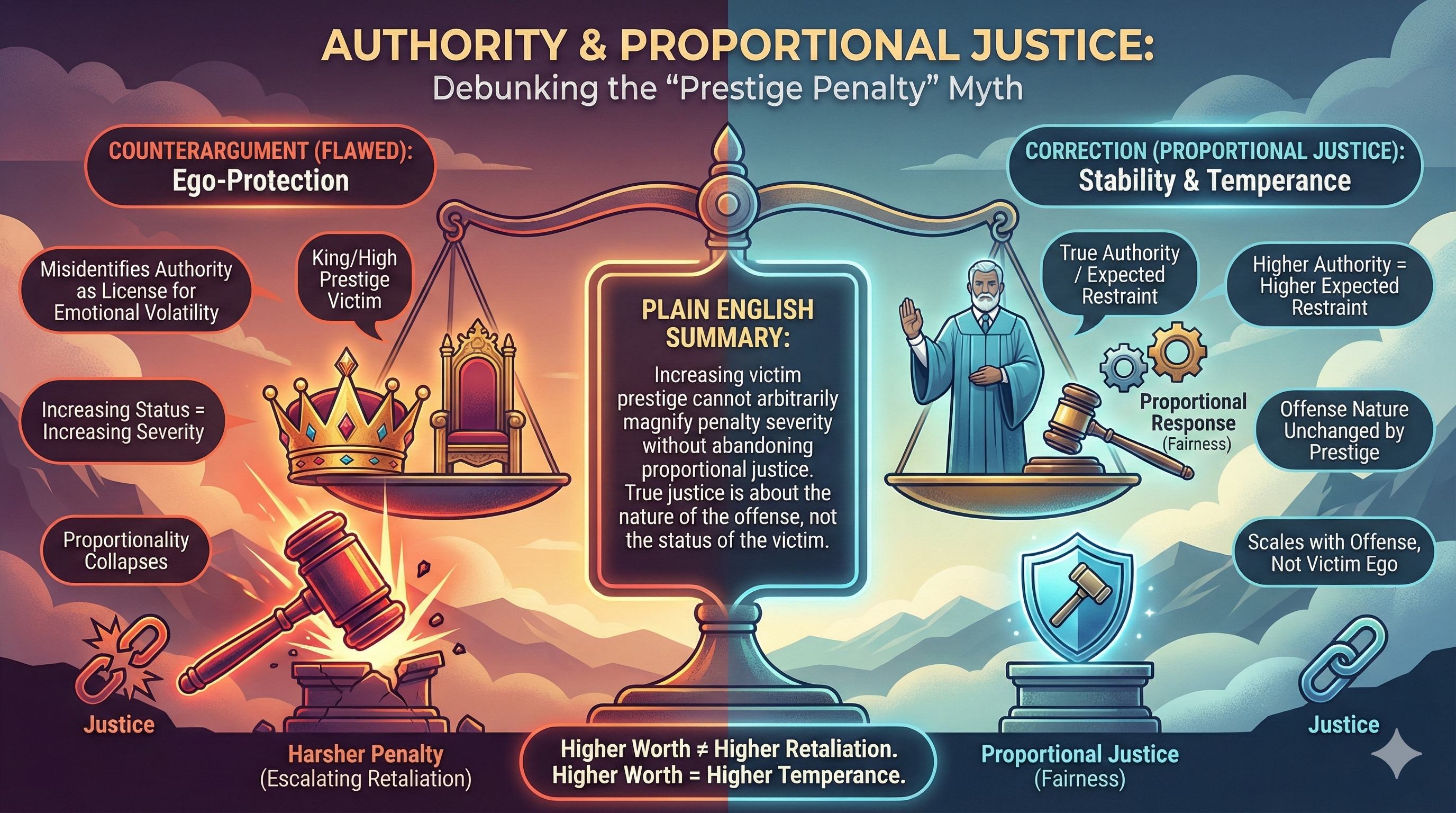
2. Counterargument: A king may demand more punishment than a pauper, so God’s dignity justifies harsher penalties.
This argument misidentifies authority as a license for escalating emotional retaliation. The higher the authority, the higher the expected emotional restraint. We expect kings, judges, and leaders to embody greater stability and temperance, not greater volatility. If increasing status yields increasingly severe penalties for the same offense magnitude, proportionality collapses. An offense against a being of elevated worth does not change the nature of the offense itself, only the psychological reaction of the offended party. A justice model that scales punishment with the emotional fragility or prestige of the victim transforms justice into ego-protection rather than proportionate response.

Plain English: Increasing victim prestige cannot arbitrarily magnify penalty severity without abandoning proportional justice.


3. Counterargument: Humans are eternal, and God had nowhere else to send them except Hell.
This argument unintentionally portrays God as spatially constrained and creatively limited. If God can instantiate a vast universe out of nothing, craft a realm for angels, and sustain an everlasting Hell, it is logically impossible that He lacks the causal power to generate an alternate postmortem domain suited for human beings. The suggestion that He is forced to use Hell because there is no alternative environment reduces divine omnipotence to habitat scarcity. This is not theology; it is inadvertent reduction of God’s creative capacity.
latex]\text{Let G be omnipotent: }\forall x,\Diamond x\text{ (G can actualize any logically possible domain).}[/latex]
Plain English: If God can create Hell, He can create any other domain; claiming otherwise implies divine limitation.


4. Counterargument: Nobody commits only one sin; it is wrong to say God punishes one sin with eternity.
The number of sins committed may be large, but unless it is literally infinite, the total offense magnitude remains finite. A sequence of finite actions, no matter how numerous, cannot rationally justify an infinite-duration penalty. This argument also smuggles in a bizarre implication: God must keep individuals alive long enough to accumulate a sufficiently massive offense-load to justify infinite punishment. That turns judgment into a quota-system rather than a proportional one.


Plain English: A finite total offense cannot rationally map to an infinite penalty.


5. Counterargument: Humans cannot judge divine justice; God’s intentions are beyond human understanding.
This argument self-destructs epistemically. If humans cannot evaluate whether a deity is just, then humans cannot evaluate whether a deity is trustworthy, good, coherent, or worthy of worship. This makes Christianity indistinguishable from all other competing religions; each could invoke exactly the same shield of incomprehensibility. A principle that blocks negative evaluation also blocks positive evaluation. One cannot rationally commit to a being whose actions cannot be assessed, because commitment itself requires assessment.
Plain English: If incomprehensibility blocks criticism, it also blocks rational acceptance.


6. Counterargument: God is infinite, therefore every sin against Him is infinite.
This commits a category error by transferring an attribute of the being (qualitative infinitude) to an attribute of the offense (quantitative magnitude). Infinity only has meaning relative to a specific referent. God’s infinitude does not imply the infinitude of all relational predicates involving God. If it did, then every prayer would be infinite, every moment of gratitude would be infinite, every reward infinite, and so on. The argument replaces proportionality with arbitrary scaling anchored solely in metaphysical vocabulary rather than justified mapping.


Plain English: You cannot legitimately move from “God is infinite” to “every offense is infinite” without a justified bridge principle, and no such principle exists.

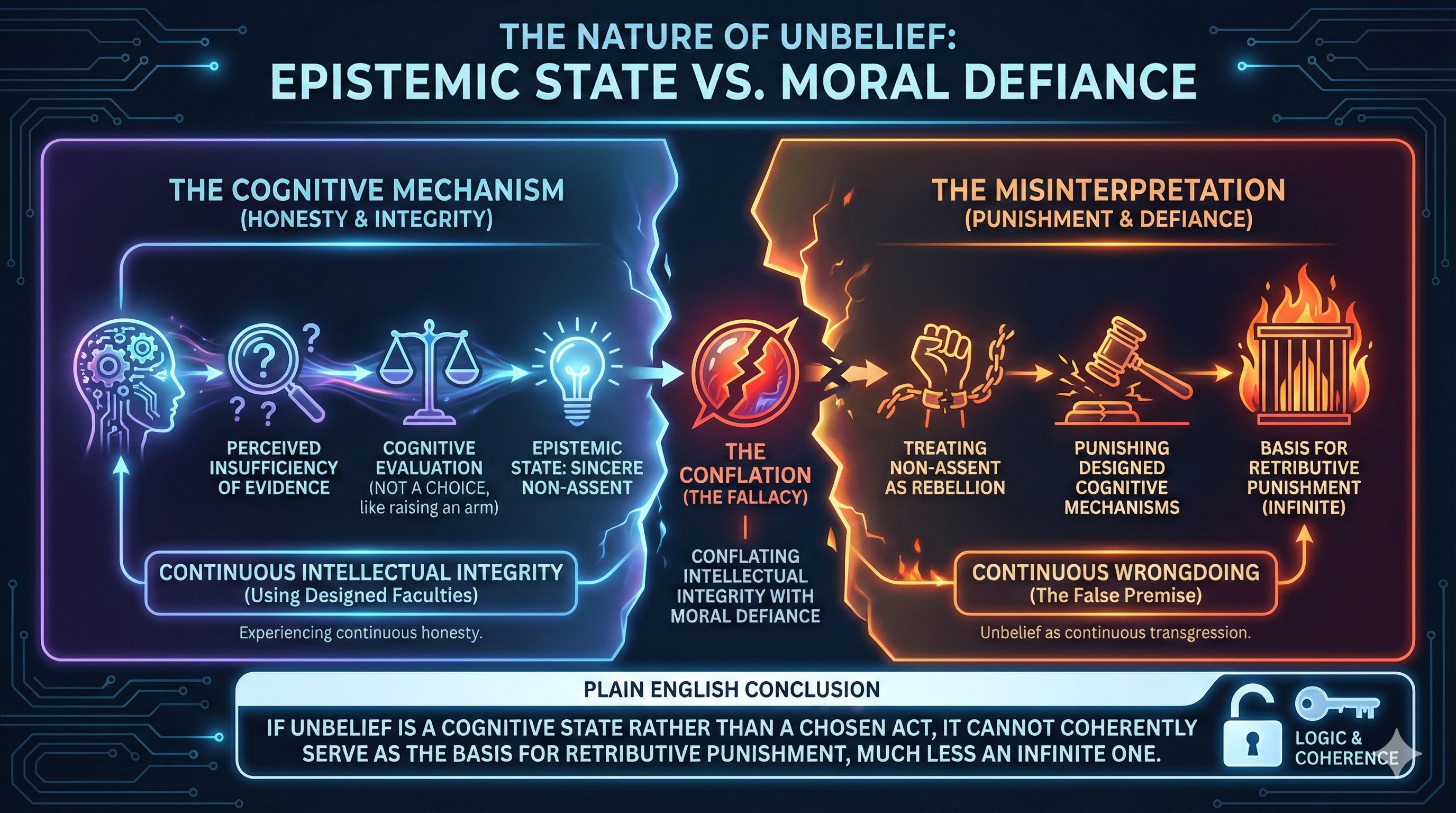
7. Counterargument: Unbelief is continuous rejection, not a single transgression.
Unbelief is not an action but an epistemic state arising from perceived insufficiency of evidence. One cannot choose belief the way one chooses to raise an arm. If a person finds the evidence in favor of a proposition unconvincing, they are not committing continuous wrongdoing; they are experiencing continuous honesty. Treating sincere non-assent as rebellion conflates intellectual integrity with moral defiance. It also punishes people for obeying the very cognitive mechanisms God allegedly designed.


Plain English: If unbelief is a cognitive state rather than a chosen act, it cannot coherently serve as the basis for retributive punishment, much less an infinite one.


 Free of Faith
Leave a comment