

Consider the Following:
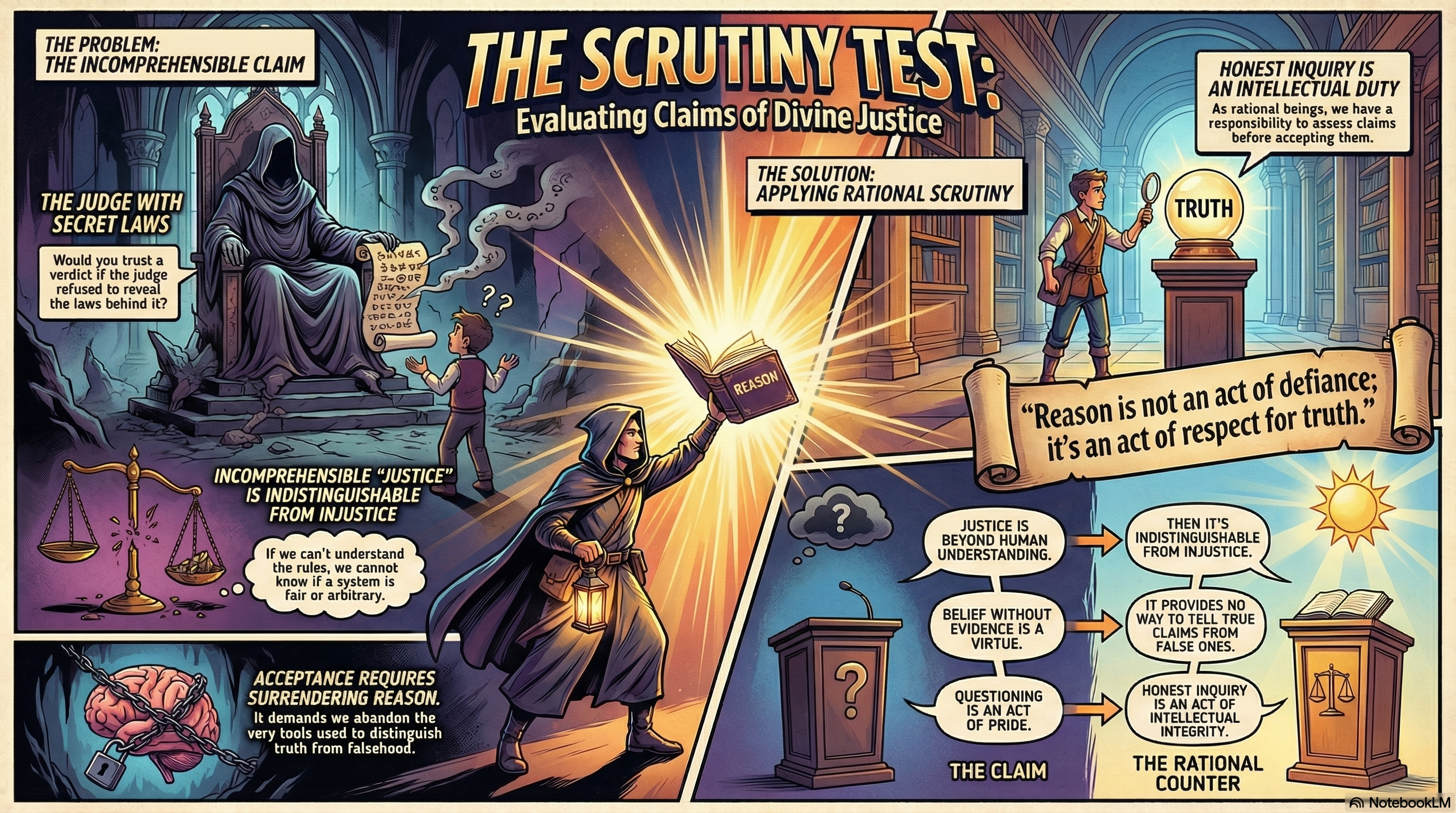
Summary: This post argues that claims of divine justice must be scrutinized using reason and human understanding, as blind acceptance of incoherent or unsubstantiated claims undermines intellectual integrity. A truly just and rational deity would welcome honest inquiry, making any concept of justice that is incomprehensible indistinguishable from injustice.

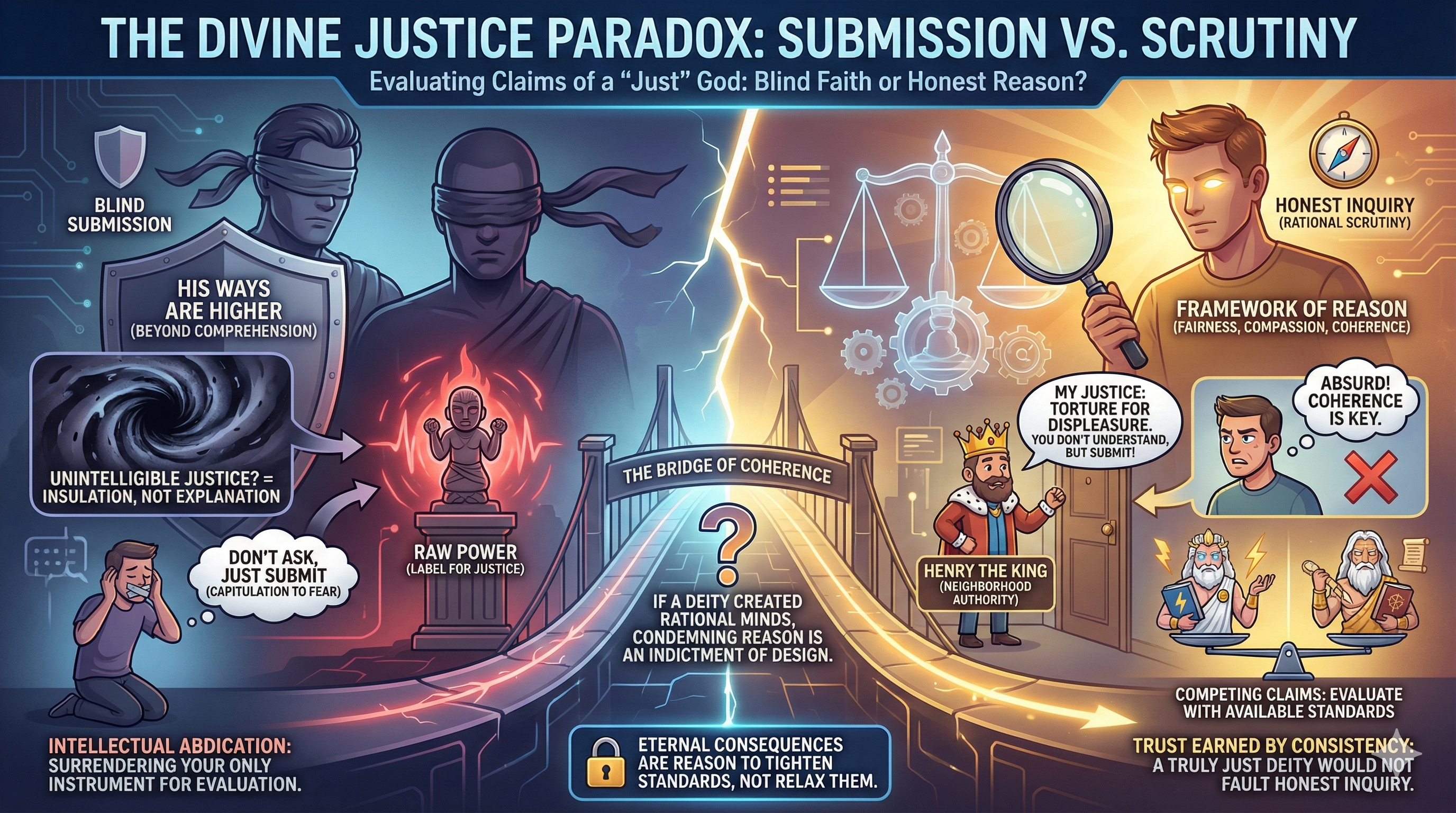
Imagine a man named Henry knocks on your door, claiming to be the rightful king of your neighborhood and asserting his perfect justice. When you ask him to elaborate, he reveals his concept of justice: any act displeasing to him warrants years of torture. You laugh at the absurdity, stating that no just king would endorse such a system. Henry retorts, “Your ways are not my ways! The fact that you don’t understand my justice is no excuse to reject me as king!“
You respond, “Actually, it is. It would be irrational to accept someone as a just king who contradicts my understanding of justice. Should I abandon my honest notion of justice simply because someone claims a higher authority?”
Henry counters, “But isn’t the threat of torture scary enough to persuade you to submit, even if my justice appears incoherent?”
You stand firm, asserting that threats and promises of future clarity are insufficient to justify surrender to an incoherent system of justice.
Are you irrational in this response? Clearly not. In fact, it is your epistemic duty to maintain intellectual integrity by scrutinizing Henry’s claim before accepting it.
Competing Claims and Rational Evaluation
Now, imagine two individuals arrive at your door, both claiming to be your legitimate and just king. Each one insists that their justice system is perfect, though they differ drastically in their definitions. Would it not be prudent to evaluate their claims against your understanding of justice?
- Key Question: How can one justly choose between competing claims of authority without a framework to assess their merit?
Acceptance of any authority must be preceded by rational evaluation. If this principle holds true for kings, how much more critical is it for proposed deities? The stakes are infinitely higher, as divine claims often involve eternal consequences.
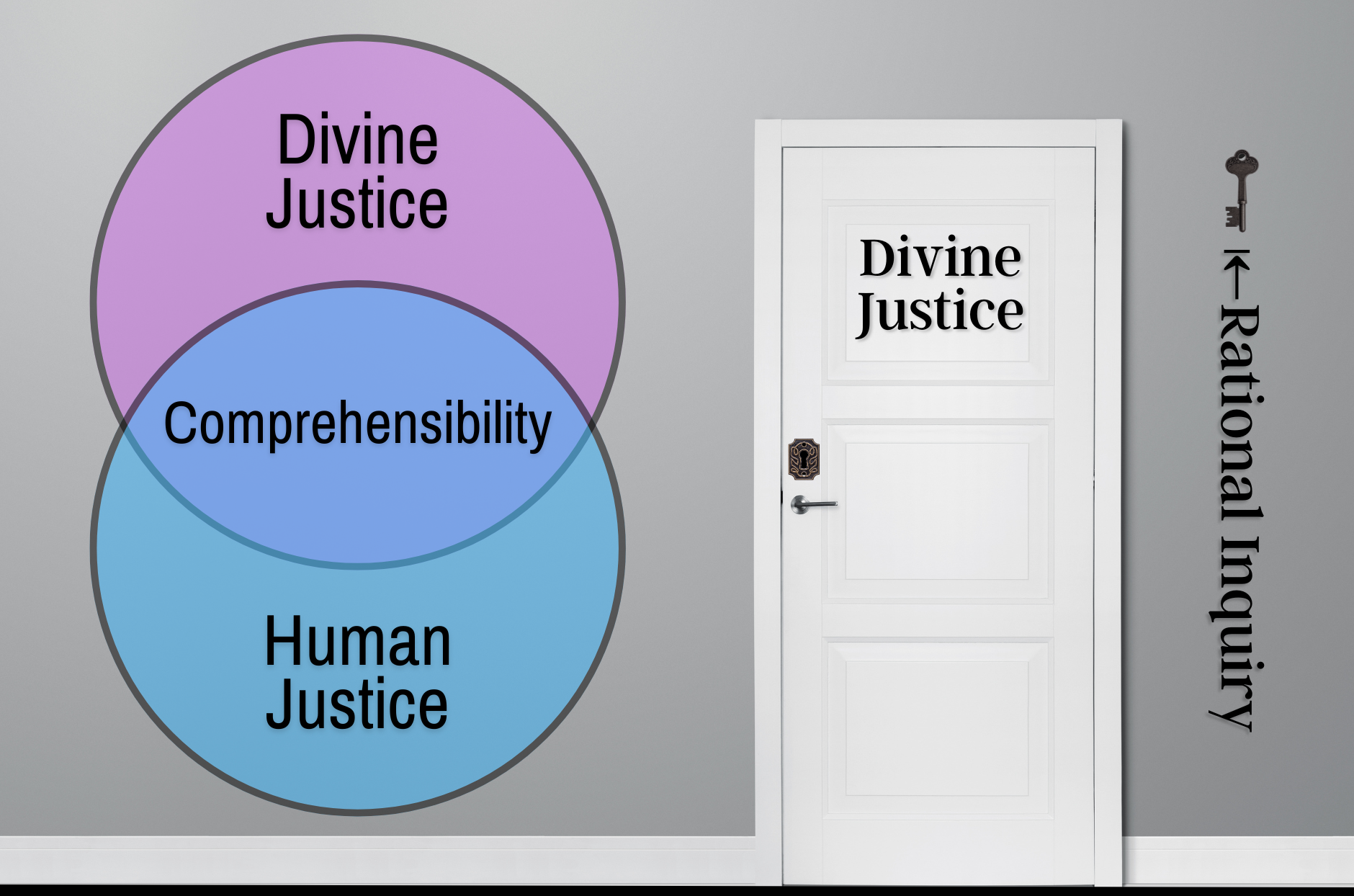
Divine Justice and Human Reason
If a believer in a particular allegedly just God asserts that you cannot test their God against your own understanding of justice, the question arises: why not? Any deity who demands allegiance without allowing for honest scrutiny places followers in an impossible position. They are asked to surrender their rational faculties—the very tools necessary for making an informed decision.
Many religious leaders assert that their God’s intellect and morality are so superior that human understanding is inadequate to assess them. But does this argument hold up?
The “God is Beyond Human Comprehension” Argument
- Self-Defeating Logic: If God’s morality is entirely beyond human comprehension, then humans cannot possibly know whether that morality is good, just, or even coherent. To assert that God is good while simultaneously claiming we cannot understand what “good” means in divine terms is a logical contradiction.
- Epistemic Responsibility: As rational agents, we must evaluate claims of divine justice using the only tools available: reason, experience, and evidence. Blind submission undermines the very faculties that a truly rational deity would expect us to use.
- The Con Artist Analogy: If a human claimed immunity from scrutiny, we would immediately suspect fraud. Why should a deity be treated differently? Any claim that shuts down inquiry or discourages evaluation resembles the tactics of a con artist, not the hallmarks of a trustworthy being.
Would a Just God Fault Honest Inquiry?

A truly just and rational God would not punish someone for rejecting incoherent or unsubstantiated claims. Instead, such a God would value honest skepticism as a sign of integrity. If humans are created with reason and curiosity, these faculties must serve a purpose. A God who condemns their use undermines their very creation.
Furthermore, if a deity’s justice appears to contradict human notions of fairness, patience, or compassion, the burden lies on the deity (or its representatives) to bridge the gap in understanding. Simply asserting divine superiority without evidence or justification is not enough.
Core Issues with Unquestioned Divine Authority
Many religious traditions discourage believers from critically assessing their deity’s character, insisting that finite human minds cannot comprehend infinite divine wisdom. This raises several critical issues:
- The Problem of Coherence: If divine justice cannot be reconciled with human notions of fairness, how can believers genuinely claim that God is just? Without coherence, the term “justice” loses its meaning.
- The Burden of Proof: The responsibility to demonstrate justice lies with the claimant. A God (or religious representative) who fails to provide evidence for their claims cannot rationally expect adherence.
- Faith vs. Rationality: Faith, when defined as belief without evidence, is inherently irrational. To accept a deity without assessing their character is not only a dereliction of intellectual duty but also a rejection of rational inquiry.
Supporting Considerations
- Historical Lessons: The practice of questioning authority has been pivotal in advancing human understanding. From the Enlightenment to modern science, critical thinking has dismantled unjust systems and replaced them with more equitable ones. Why should claims of divine authority be exempt from this scrutiny?
- Cultural Diversity: Across history, countless gods and moral systems have been proposed, each claiming supremacy. Without a framework to evaluate these claims, believers are left with arbitrary choices, often determined by geography or upbringing. Rational assessment is the only way to navigate this diversity.
- Consequences of Blind Faith: Accepting a deity without scrutiny can lead to harmful consequences. History is filled with examples of atrocities committed in the name of unquestioned divine authority. Critical evaluation acts as a safeguard against such abuses.
Conclusion: The Obligation to Question

Who are you to question whether God is just? You are the person responsible for your beliefs and actions. As such, you are exactly the right person to scrutinize every allegedly just, loving, and rational God for evidence of these qualities.
Accepting a God without assessing their claims is not humility; it is intellectual abdication. A truly just God would not demand such a surrender but would welcome honest inquiry as a sign of integrity and rationality.
To those who argue that God’s justice is beyond human understanding, the response is clear: any concept of justice that is incomprehensible is indistinguishable from injustice. Without rational grounds for belief, there is no reason to accept any divine claim, no matter how persuasive the threats or promises attached.
The Logical Form
Argument 1: The Necessity of Rational Scrutiny
- Premise 1: Any claim of authority must be rationally evaluated before acceptance.
- Premise 2: Divine claims involve high stakes, including eternal consequences, and therefore require even greater scrutiny.
- Conclusion: Claims of divine authority must be evaluated using human understanding and reason before acceptance.

Argument 2: The Incoherence of the “God is Beyond Comprehension” Defense
- Premise 1: If a deity’s morality is entirely beyond human comprehension, humans cannot know whether that morality is good, just, or coherent.
- Premise 2: To claim that God is good while asserting that humans cannot understand divine “goodness” creates a logical contradiction.
- Conclusion: The argument that God’s morality is beyond comprehension fails to justify blind faith in divine justice.
Argument 3: The Epistemic Duty to Question
- Premise 1: Rational agents have a duty to evaluate claims using the tools of reason, evidence, and experience.
- Premise 2: Blind submission to authority undermines the epistemic responsibility to assess claims critically.
- Conclusion: It is an epistemic obligation to scrutinize all claims of divine justice before acceptance.
Argument 4: The Problem of Competing Divine Claims
- Premise 1: Numerous deities and moral systems have been proposed, each claiming ultimate authority and justice.
- Premise 2: Without a rational framework, individuals cannot determine the validity of competing divine claims.
- Conclusion: A rational framework for evaluating divine claims is essential to navigate conflicting assertions of divine authority.
Argument 5: The Absurdity of Punishing Honest Inquiry
- Premise 1: A truly just and rational deity would value honest skepticism and the use of reason.
- Premise 2: A deity who condemns individuals for rejecting incoherent claims undermines the very faculties they were presumably created with.
- Conclusion: Any deity who punishes honest inquiry cannot be considered just or rational.
Argument 6: The Indistinguishability of Incomprehensible Justice from Injustice
- Premise 1: For a concept of justice to be meaningful, it must align with coherent and understandable principles.
- Premise 2: Incomprehensible justice is indistinguishable from injustice because it provides no criteria for evaluation.
- Conclusion: Claims of divine justice that cannot be comprehended are equivalent to claims of injustice.
Argument 7: The Historical and Practical Need for Rational Assessment
- Premise 1: Human progress, from the Enlightenment to modern science, has been driven by questioning and scrutinizing authority.
- Premise 2: Accepting divine claims without rational assessment has historically led to harmful consequences, including atrocities.
- Conclusion: Rational assessment of divine claims is both historically and practically necessary to prevent abuse and promote intellectual integrity.

(Scan to view post on mobile devices.)

A Dialogue
Divine Justice: Scrutinizing Claims of Authority
CHRIS: As a Christian, I believe in God’s justice, even if we humans can’t fully comprehend it. Who are we to question God’s morality when His ways are so much higher than ours?
CLARUS: But isn’t it precisely our responsibility to assess claims of authority, including divine ones? If we abandon our reasoning faculties, how can we differentiate between a just God and an unjust imposter? Accepting a claim without scrutiny opens the door to believing anything—whether true or false.
CHRIS: That sounds like hubris. How can finite humans evaluate an infinite God? Wouldn’t such an attempt be inherently flawed?
CLARUS: Not at all. If a God’s justice is so incomprehensible that we cannot understand it, then calling it “justice” becomes meaningless. Without a coherent standard, incomprehensible justice is indistinguishable from injustice. Are you suggesting we blindly trust a concept we can’t even define or evaluate?
CHRIS: But isn’t faith about trusting God despite not understanding everything? It’s about acknowledging our limitations and humbly submitting to God’s authority.
CLARUS: Faith without scrutiny is intellectual abdication. If we blindly trust, how do we differentiate between competing claims of divine authority? Throughout history, countless gods have been proposed—Zeus, Vishnu, Allah—each claiming ultimate justice. Would you accept these gods without evaluating their claims?
CHRIS: Of course not. But the Bible reveals the one true God. That’s why I trust in His justice.
CLARUS: And how do you justify the justice of the God in the Bible? If the Bible describes actions—like eternal punishment for finite sins—that conflict with your understanding of justice, wouldn’t it be rational to question those claims? If someone else’s holy book described the same actions, wouldn’t you call them unjust?
CHRIS: God’s justice might not always align with human notions of fairness, but that’s because His intellect surpasses ours. Who are we to question Him?
CLARUS: If God’s intellect truly surpasses ours, wouldn’t a just and rational God provide clarity to bridge the gap in understanding? A truly just God would value our reasoning faculties, not demand blind faith. Insisting that we submit to incoherent claims undermines our epistemic duty to evaluate all evidence critically. Would a loving God punish us for using the reason He supposedly gave us?
CHRIS: But what about the consequences? Rejecting God could lead to eternal punishment. Isn’t it safer to submit, even if you don’t fully understand?
CLARUS: That’s the logic of fear, not truth. If submission is driven by threats rather than evidence, it mirrors the tactics of a con artist. Would you accept a human ruler who threatened you into submission, calling their actions “just” without question? Why hold a God to a lower standard than a king or judge?
CHRIS: But isn’t it arrogant to put our standards above God’s? Isn’t humility about trusting that God knows better?
CLARUS: It’s not arrogance; it’s about coherence. Any claim of justice must align with understandable principles. Without coherence, justice is indistinguishable from arbitrary power. Blind acceptance of such claims is not humility—it’s intellectual surrender. A truly just and loving God would encourage honest inquiry and rational examination, not condemn them.
CHRIS: But aren’t we flawed beings? Our understanding of justice is imperfect and limited, so wouldn’t it be dangerous to impose our views on God?
CLARUS: Imperfection doesn’t preclude responsibility. Rational agents must assess claims using the best tools they have: reason, experience, and evidence. A truly just God would not fault us for honestly questioning claims that conflict with our understanding of justice and fairness. Wouldn’t it be irrational to abandon reason in favor of incoherent or unsupported assertions?
CHRIS: I see your point, but isn’t faith also about trust? If we can’t understand everything, isn’t it better to trust in God’s plan?
CLARUS: Trust must be earned, not demanded. If a deity’s justice or character contradicts our understanding of fairness, patience, or compassion, the burden lies on the claimant to justify their case. Any God who demands faith without evidence or coherence mirrors the tactics of a tyrant, not a loving and just being. A truly just God would not only welcome but encourage honest skepticism as a sign of integrity.
CHRIS: You’re saying skepticism is a virtue?
CLARUS: Absolutely. Skepticism rooted in honesty and the pursuit of truth is essential for rational inquiry. True humility isn’t blind submission; it’s the willingness to question, learn, and grow. If God is truly just and loving, wouldn’t He value those qualities over passive acceptance? After all, blind faith could lead to the worship of false gods, and no rational God would want that.
◉ A Companion YouTube Video
◉ A Companion Spotify Episode
Notes:
Helpful Analogies
Analogy 1: The Judge with Hidden Laws
Imagine walking into a courtroom where the judge demands that you accept their verdict as just, yet refuses to reveal the laws on which their decisions are based. When you question the fairness of the process, the judge responds, “My laws are too complex for you to understand, but you must trust me.”
This scenario mirrors the claim that divine justice is beyond human comprehension. If the judge’s laws are incomprehensible, how can anyone know the verdict is just? Similarly, if God’s justice is inscrutable, it becomes indistinguishable from injustice, leaving us with no rational basis for trust.
Analogy 2: Competing Architects and the Incomprehensible Design

Imagine hoping to hire one of two architects to build your house. Each architect claims their design is the best, but neither has their blueprints in hand. However, while one insists, “My design is too advanced for you to understand. Just trust me,” the other provides clear explanations and evidence of their competence.
This parallels the dilemma of competing divine claims. Without a framework to evaluate these claims, choosing one becomes arbitrary. A truly just God would not ask for blind trust but would provide clarity and evidence, much like the competent architect who earns your trust through reason and transparency.
Analogy 3: The Teacher Who Punishes Questions
Imagine a teacher who punishes students for asking questions about their grading system, insisting, “You’re not smart enough to understand why the grades I gave you are fair.” The teacher further threatens expulsion if students continue to doubt them.
This resembles the argument that humans must submit to divine justice without questioning or understanding it. A rational and just teacher, like a just God, would welcome honest inquiry and strive to explain their reasoning, rather than demand blind submission under threat of punishment.
Addressing Theological Responses
Theological Responses
1. God’s Justice Transcends Human Understanding
Theologians might argue that divine justice is fundamentally different from human notions of justice, as God operates on an infinite, eternal scale beyond human comprehension. From this perspective, humans lack the epistemic capacity to fully grasp the intricacies of God’s moral framework, making it inappropriate to apply human standards to divine actions.
2. Faith Is a Virtue That Supersedes Rational Inquiry
Some theologians claim that faith, by its nature, requires trust in God without complete evidence or understanding. They might argue that faith is not about blind submission but a recognition of human limitations and a demonstration of humility before a perfect and all-knowing deity.
3. Scripture as the Ultimate Evidence
Theologians often point to scripture as the revealed word of God, which provides the ultimate standard for assessing justice. They may argue that questioning God’s justice is unnecessary because divine will is made sufficiently clear through sacred texts, which are believed to be divinely inspired and authoritative.
4. The Problem of Anthropocentrism
A common theological rebuttal is that applying human standards of justice to God is inherently flawed because it assumes God’s morality must align with human reasoning. This is seen as anthropocentric—a projection of finite human understanding onto an infinite being.
5. God’s Justice Is Evident Through Creation
Some theologians argue that creation itself reveals God’s justice and rationality. They might suggest that the order and complexity of the universe are evidence of a just and purposeful Creator, making additional scrutiny of God’s character unnecessary.
6. Eternal Perspective Justifies Apparent Injustice
Theologians may assert that what appears unjust from a human perspective is often due to our limited understanding of eternal consequences. They might argue that God’s justice accounts for factors humans cannot see, such as spiritual growth, ultimate redemption, or eternal balance.
7. Rejection of Skepticism as Pride
Theologians could contend that the demand for rational scrutiny of divine claims reflects pride rather than a genuine pursuit of truth. They might argue that true humility lies in trusting a perfect God rather than relying on flawed human reasoning to assess His justice.
Counter-Responses
1. God’s Justice Transcends Human Understanding
A rational response would highlight that if divine justice is entirely beyond human comprehension, then it is indistinguishable from injustice. Without coherent criteria, the term “justice” loses meaning, making it irrational to trust such a concept. Furthermore, expecting humans to submit to something they cannot understand undermines the purpose of reason as a tool for discerning truth and making moral decisions.
2. Faith Is a Virtue That Supersedes Rational Inquiry
Faith without evidence is inherently unreliable. While faith might be viewed as a virtue by some, it provides no mechanism for distinguishing true claims from false ones. Trust must be earned through evidence and coherence; otherwise, faith becomes indistinguishable from gullibility. Blind trust could lead to worshipping a false god, which no rational deity would condone.
3. Scripture as the Ultimate Evidence
Pointing to scripture as evidence assumes the validity of the text without independent verification. Many competing scriptures exist, each claiming to reveal divine truth. Without external reason-based evaluation, there is no rational way to determine which, if any, scripture accurately represents a just deity. Circular reasoning—trusting scripture because it claims to be divine—is logically invalid.
4. The Problem of Anthropocentrism
While it is true that human reasoning is limited, this does not mean it is invalid. Humans must use the tools available—reason, evidence, and experience—to evaluate claims. To suggest otherwise implies that humans should blindly accept any claim of divine authority, which is both dangerous and irrational. If justice cannot be recognized by human standards, it becomes meaningless as a concept.
5. God’s Justice Is Evident Through Creation
The complexity and order of the universe might suggest purpose but do not directly reveal justice. Natural phenomena, such as earthquakes or diseases, often appear indifferent to human suffering, which contradicts the notion of a just Creator. Without clear evidence linking creation to justice, this argument remains speculative and insufficient.
6. Eternal Perspective Justifies Apparent Injustice
This argument assumes knowledge of an eternal perspective that humans cannot access. Without evidence of how apparent injustices are rectified, this claim becomes a speculative justification rather than a rational explanation. Trusting in unseen eternal consequences is akin to accepting promises without verification, which undermines rational inquiry.
7. Rejection of Skepticism as Pride
Skepticism is not pride; it is an epistemic virtue aimed at uncovering truth. Demanding evidence and coherence does not reflect arrogance but intellectual integrity. A truly just and rational God would value honest inquiry and critical thinking rather than blind submission, as these faculties are essential for distinguishing between truth and falsehood. Blindly dismissing skepticism risks enabling error and manipulation.
Clarifications
Syllogistic Formulation
Premise 1:
- Any claim of justice that is incomprehensible to humans is indistinguishable from injustice.
Premise 2:
- A just God would make their justice comprehensible to humans to the extent that it can be recognized as justice.
Premise 3:
- If a deity demands belief without providing comprehensible evidence of justice, that deity’s justice is indistinguishable from arbitrary power.
Conclusion:
- A deity that demands belief without comprehensible evidence of justice cannot rationally be called just.
Symbolic Logic Formulation
Definitions:
- Let
represent “x is just.”
- Let
represent “x’s justice is comprehensible to humans.”
- Let
represent “x demands belief.”
- Let
represent “x’s actions are indistinguishable from arbitrary power.”
Formal Argument:
(If x is just, then x’s justice is comprehensible to humans.)
(If x’s justice is not comprehensible, then x’s actions are indistinguishable from arbitrary power.)
(If x demands belief and x’s justice is incomprehensible, then x is not just.)
(God demands belief, and God’s justice is incomprehensible.)


Conclusion:
(God is not just.)

This formalization highlights that justice and comprehensibility are intrinsically linked, making incomprehensible justice logically incompatible with rational belief.


Leave a Reply