

Consider the Following:
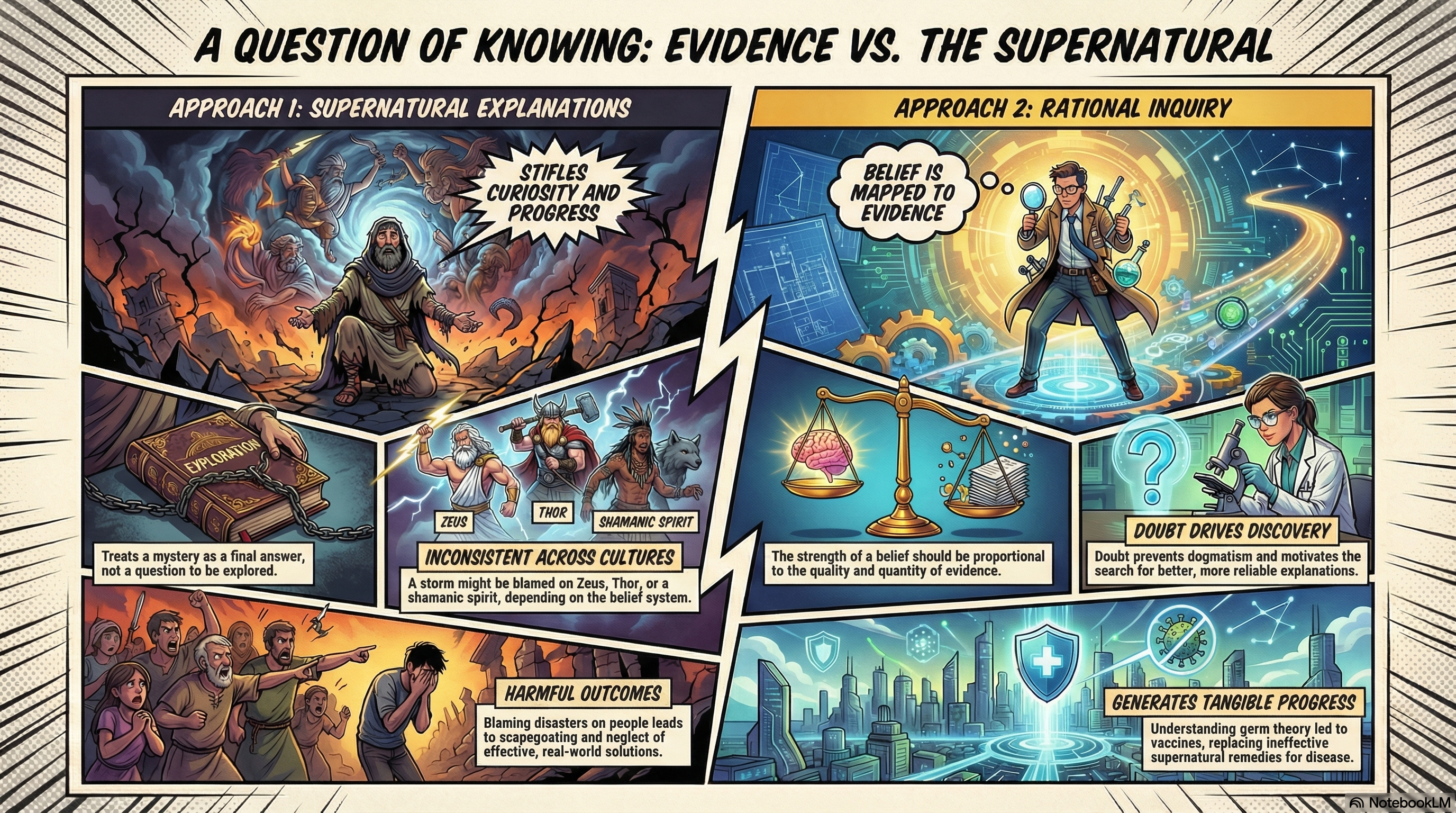
Summary: This post explores the tendency to ascribe unexplained phenomena to supernatural causes, arguing for a rational approach that maps belief to evidence and embraces doubt as a complement to belief. It emphasizes the importance of intellectual humility, consistent inquiry, and social considerations, advocating for evidence-based understanding over premature, culturally inconsistent supernatural explanations.

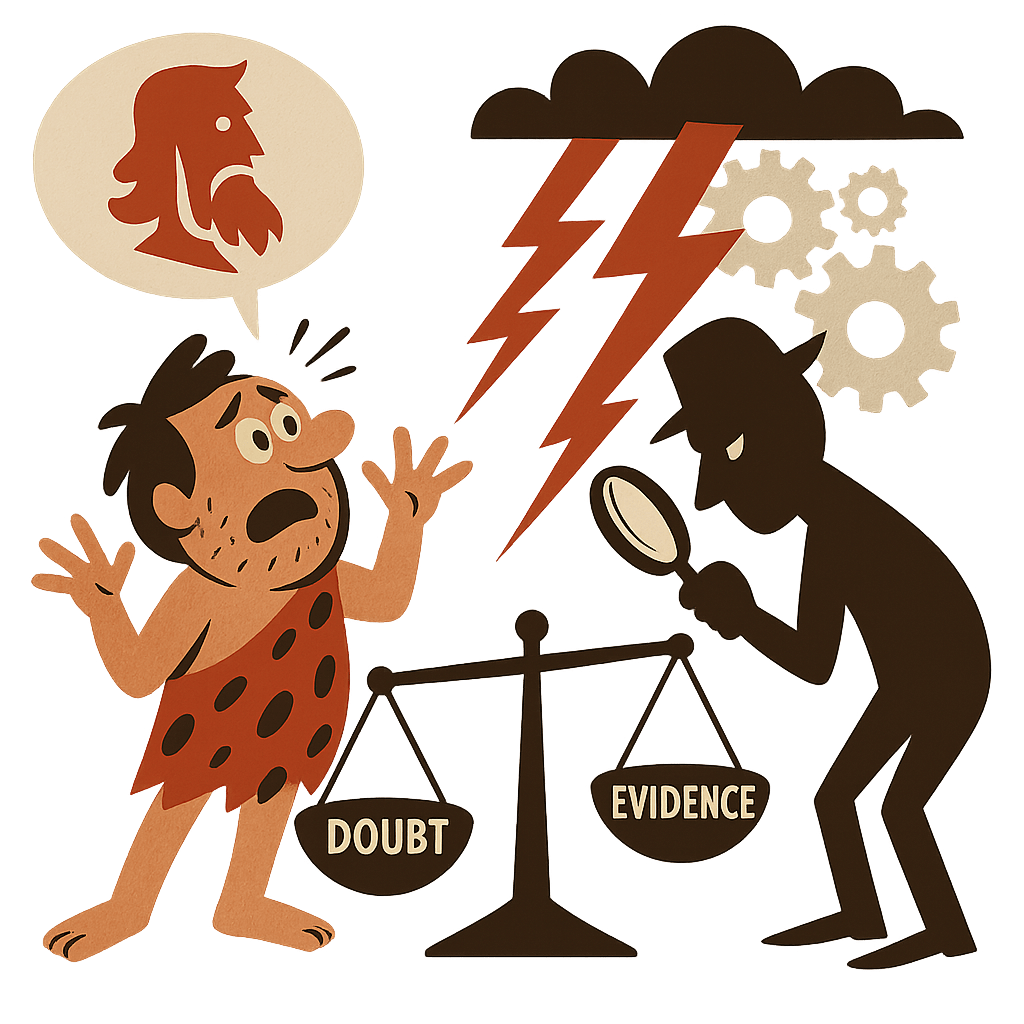
Imagine what could have happened if humans, thousands of years ago, had refrained from attributing every unknown cause of mysterious phenomena to a god or gods. Instead, they could have allowed their curiosity to drive them to explore the world. Rather than hastily concluding, without evidence, that lightning reflected the anger of a deity, they might have resisted the impulse to believe prematurely. By making careful observations, they could potentially have uncovered the principles of electromagnetism far earlier.
Throughout history, humans have demonstrated a tendency to attribute the unknown to supernatural causes. Lightning, epilepsy, disease, and celestial phenomena were once thought to be acts of divine will, but as scientific understanding has advanced, these mysteries have been unraveled through natural explanations. This shift reveals a critical lesson: invoking the supernatural may offer temporary comfort, but it delays genuine inquiry and understanding. To avoid this pitfall, we must adopt a mindset that prioritizes evidence, proportional belief, and the virtue of doubt as a rational complement to belief.
The Problem of Premature Conclusions
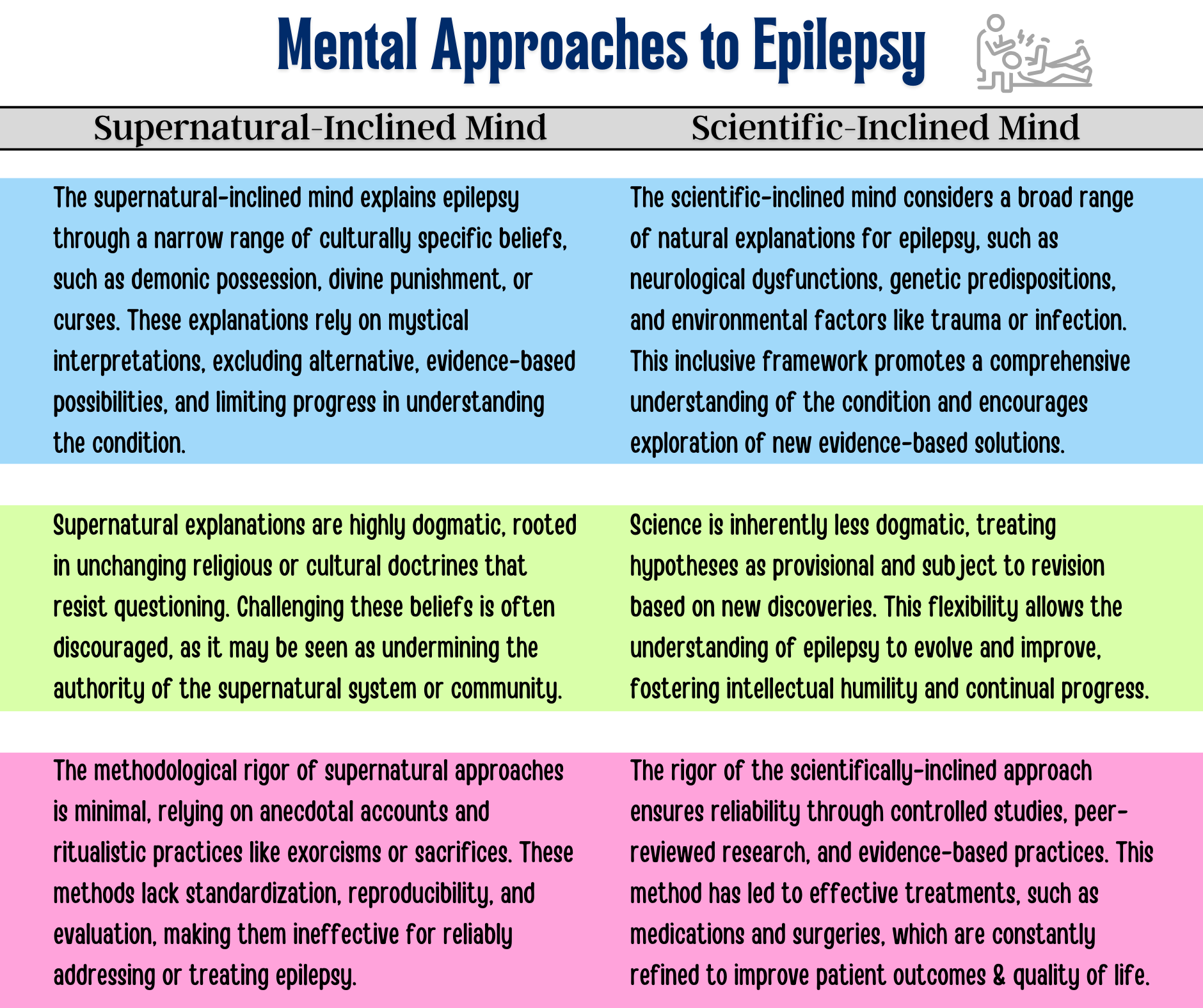
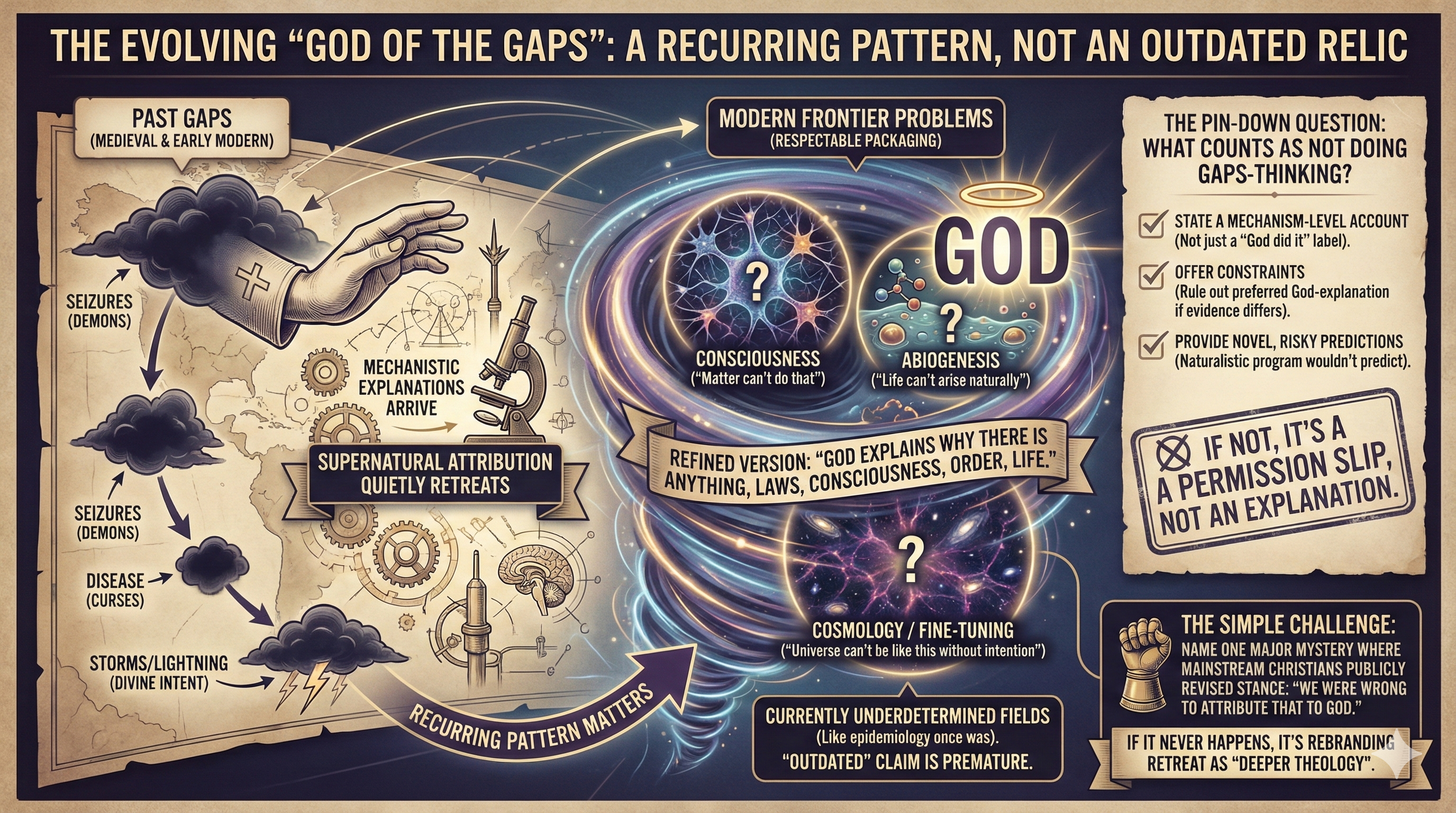
Our innate drive to explain the unknown often leads us to hasty and unfounded conclusions. This tendency is particularly evident in the “God of the gaps” argument, where gaps in scientific understanding are filled with divine or supernatural causes. While such explanations may seem satisfying, they suffer from several key flaws:
- Shifting Baselines of Ignorance: History shows that many phenomena once attributed to gods—such as earthquakes, solar eclipses, and illnesses—have been systematically explained through natural causes. There is no reason to assume that today’s gaps will not eventually be closed through further investigation.
- Stifling Inquiry: Supernatural explanations can halt curiosity. If an event is deemed an act of God or a spiritual intervention, further investigation into its underlying mechanisms is discouraged, impeding progress in understanding and problem-solving.
- False Certainty: Prematurely ascribing unexplained events to supernatural causes creates a false sense of knowledge. This certainty can collapse under scrutiny, leading to disillusionment and a weakened foundation for future inquiry.
Instead of succumbing to these traps, we must cultivate a more disciplined approach to the unknown—one grounded in proportional belief and epistemic humility.
◉ A Relevant Technical Academic Paper
Rational Belief as a Mapping to Evidence

A cornerstone of rational thought is that belief should correspond to the degree of evidence available. Unlike dogmatic belief systems, rational belief operates on a continuum where the strength of belief reflects the quality and quantity of supporting evidence. This proportionality prevents overconfidence and allows for growth as new information becomes available.
- The Continuum of Belief: Rational belief recognizes that certainty is rare. For example, the belief in gravity is far stronger than belief in a speculative hypothesis, but neither is absolute. This continuum ensures that beliefs remain flexible and evidence-driven.
- Evidence-Driven Adjustment: Rational belief requires that we revise our confidence levels as new evidence emerges. This adaptability ensures that our understanding remains aligned with reality rather than entrenched in outdated assumptions.
- Guarding Against Overconfidence: Mapping belief to evidence protects us from the dangers of overconfidence in poorly supported claims. For instance, supernatural explanations often lack robust evidence but are presented with unwarranted certainty.
By treating belief as a function of evidence, we maintain intellectual integrity and foster an approach to inquiry that prioritizes discovery over dogma.
The Virtue of Doubt as a Rational Complement to Belief
Doubt is not a weakness but an essential complement to belief. It ensures intellectual humility, encourages inquiry, and guards against the stagnation that arises from unquestioned assumptions. In this way, doubt becomes a driver of progress rather than an obstacle to conviction.
- Doubt Prevents Dogmatism: Without doubt, beliefs become rigid and resistant to change. Doubt acts as a safeguard against this rigidity, allowing for the possibility of growth and refinement.
- Doubt Encourages Inquiry: Doubt motivates us to ask deeper questions and seek better explanations. When early astronomers doubted the geocentric model of the universe, their skepticism led to groundbreaking discoveries about the heliocentric model.
- Doubt Respects Complexity: The universe is inherently complex, and doubt acknowledges the limits of our understanding. It creates a space for exploration and embraces uncertainty as an opportunity for learning.
- The Balance of Belief and Doubt: Belief and doubt are not opposites but complementary forces. Belief, tempered by doubt, becomes flexible and open to evidence. Doubt, guided by inquiry, evolves into justified belief. Together, they create a dynamic process of understanding.
In the realm of supernatural explanations, doubt challenges us to critically examine claims and demand evidence before accepting them. This practice not only fosters intellectual honesty but also prevents the harms associated with uncritical belief.
The Problem of Inconsistency in Supernatural Explanations
A further issue with invoking supernatural causes is the inconsistency they introduce across cultures and belief systems. Different societies ascribe the same unexplained phenomena to different gods or spiritual forces, revealing the subjective nature of these explanations. For example:
- A storm might be attributed to Zeus in ancient Greece, Thor in Norse mythology, or a shamanic spirit in indigenous cultures.
- Illness could be seen as a curse, divine punishment, or the work of malevolent spirits, depending on cultural context.
This inconsistency highlights the arbitrary nature of supernatural explanations and their inability to provide universal or reliable insights. In contrast, natural explanations strive for consistency and seek to describe phenomena in ways that transcend cultural and temporal boundaries.
The Social Implications of Supernatural Explanations
Supernatural explanations can also have harmful social consequences. For instance:
- Blame and Social Division: Natural disasters or illnesses are sometimes interpreted as divine punishments, leading to scapegoating and discrimination against marginalized groups.
- Neglect of Effective Solutions: Reliance on supernatural remedies, such as faith healing or exorcism, can delay or prevent the use of proven medical treatments, causing unnecessary suffering and loss of life.

By rejecting supernatural explanations, we not only improve our understanding of the world but also promote more inclusive responses to its challenges.
Conclusion: In Hope of a More Rational Worldview
To ascribe everything we cannot explain to God or the supernatural is to surrender our curiosity and critical thinking. While such explanations may offer temporary comfort, they ultimately undermine our pursuit of knowledge and hinder progress. A rational worldview requires us to proportion belief to evidence, embrace doubt as a complement to belief, and seek universal, consistent explanations for the phenomena we encounter.
By cultivating this mindset, we respect the complexity of the universe and empower ourselves to uncover its mysteries. Rational belief, tempered by doubt and guided by evidence, offers the best path forward—one that values intellectual honesty, fosters discovery, and promotes a deeper, more meaningful understanding of reality.
The Logical Form
Argument 1: The Problem of Premature Conclusions
- Premise 1: Throughout history, many phenomena once attributed to supernatural causes have been explained through natural science.
- Premise 2: Invoking supernatural explanations discourages further investigation into the actual causes of phenomena.
- Premise 3: Claiming knowledge without evidence creates a false sense of certainty that collapses under scrutiny.
- Conclusion: Prematurely ascribing unexplained phenomena to supernatural causes delays genuine inquiry and understanding.

Argument 2: Rational Belief Maps to Evidence
- Premise 1: Rational belief exists on a continuum where the degree of belief is proportional to the quality and quantity of supporting evidence.
- Premise 2: As new evidence emerges, rational belief adjusts to align more closely with reality.
- Premise 3: Beliefs held without sufficient evidence risk being overconfident and misaligned with reality.
- Conclusion: Rational belief must map to the degree of available evidence to maintain intellectual integrity and foster progress.
Argument 3: The Virtue of Doubt
- Premise 1: Doubt acts as a safeguard against dogmatism by challenging rigid and unquestioned beliefs.
- Premise 2: Doubt motivates deeper inquiry and drives the pursuit of more reliable explanations.
- Premise 3: Doubt acknowledges the complexity of the universe and embraces uncertainty as an opportunity for learning.
- Conclusion: Doubt is a rational complement to belief that promotes intellectual humility and continual growth.
Argument 4: The Inconsistency of Supernatural Explanations
- Premise 1: Different cultures ascribe the same unexplained phenomena to different gods or spiritual agents.
- Premise 2: Supernatural explanations are subjective and culturally contingent rather than universal.
- Premise 3: Natural explanations strive for consistency and transcend cultural and temporal boundaries.
- Conclusion: Supernatural explanations are unreliable due to their inconsistency and lack of universality.
(Scan to view post on mobile devices.)

A Dialogue
Can the Supernatural Explain the Unexplained?
CHRIS: Why not ascribe the mysteries of life to God or the supernatural? It provides comfort and explains what we can’t understand.
CLARUS: Because relying on supernatural explanations closes the door to deeper inquiry. History is full of examples where what was once attributed to divine causes—like lightning or disease—was later explained through natural science. Wouldn’t you agree that understanding the actual causes of phenomena is more valuable than prematurely concluding they’re acts of God?
CHRIS: But if there’s no current explanation, isn’t it reasonable to invoke God until science catches up?
CLARUS: No, that’s a flawed approach. Belief should be proportional to evidence. Invoking God without evidence doesn’t help us understand the world; it just gives a false sense of certainty. Instead, we should acknowledge the gaps in our knowledge and remain open to evidence as it emerges.
CHRIS: I don’t see the harm in attributing unexplained phenomena to God. Isn’t it a harmless way to find meaning?
CLARUS: It’s not harmless. Supernatural explanations can stifle curiosity and halt scientific progress. If ancient thinkers had simply accepted that lightning was divine anger, we might never have uncovered the principles of electromagnetism. Furthermore, these explanations are often inconsistent—different cultures attribute the same phenomenon to different gods or spirits. Doesn’t that show how subjective such beliefs are?
CHRIS: Maybe, but doesn’t faith require a certain amount of conviction? Doubt seems to weaken belief.
CLARUS: Actually, doubt is essential. It prevents dogmatism and pushes us to question assumptions, leading to better explanations. Without doubt, we risk clinging to beliefs that might be false. For example, doubt about the geocentric model of the universe led to one of the greatest breakthroughs in astronomy. Don’t you think doubt can be a strength rather than a weakness?
CHRIS: I see your point, but doesn’t faith offer moral guidance, even if some explanations are wrong?
CLARUS: Faith might provide a sense of guidance, but attributing events like natural disasters or illnesses to divine punishment can lead to harmful consequences, like scapegoating marginalized groups. Worse, supernatural remedies can delay effective treatments, leading to unnecessary suffering. Isn’t it more in line with human values to base our actions on evidence-based understanding rather than unverified beliefs?
CHRIS: I hadn’t considered the social risks. But what if science never finds answers to some questions? Isn’t God still a possibility?
CLARUS: Anything might be possible, but rational belief requires evidence. Instead of defaulting to God, we should embrace epistemic humility—acknowledging what we don’t yet know while remaining open to discovery. That way, we foster genuine understanding and avoid the pitfalls of supernatural assumptions. Wouldn’t you agree that truth is worth the wait?
Notes:
Helpful Analogies
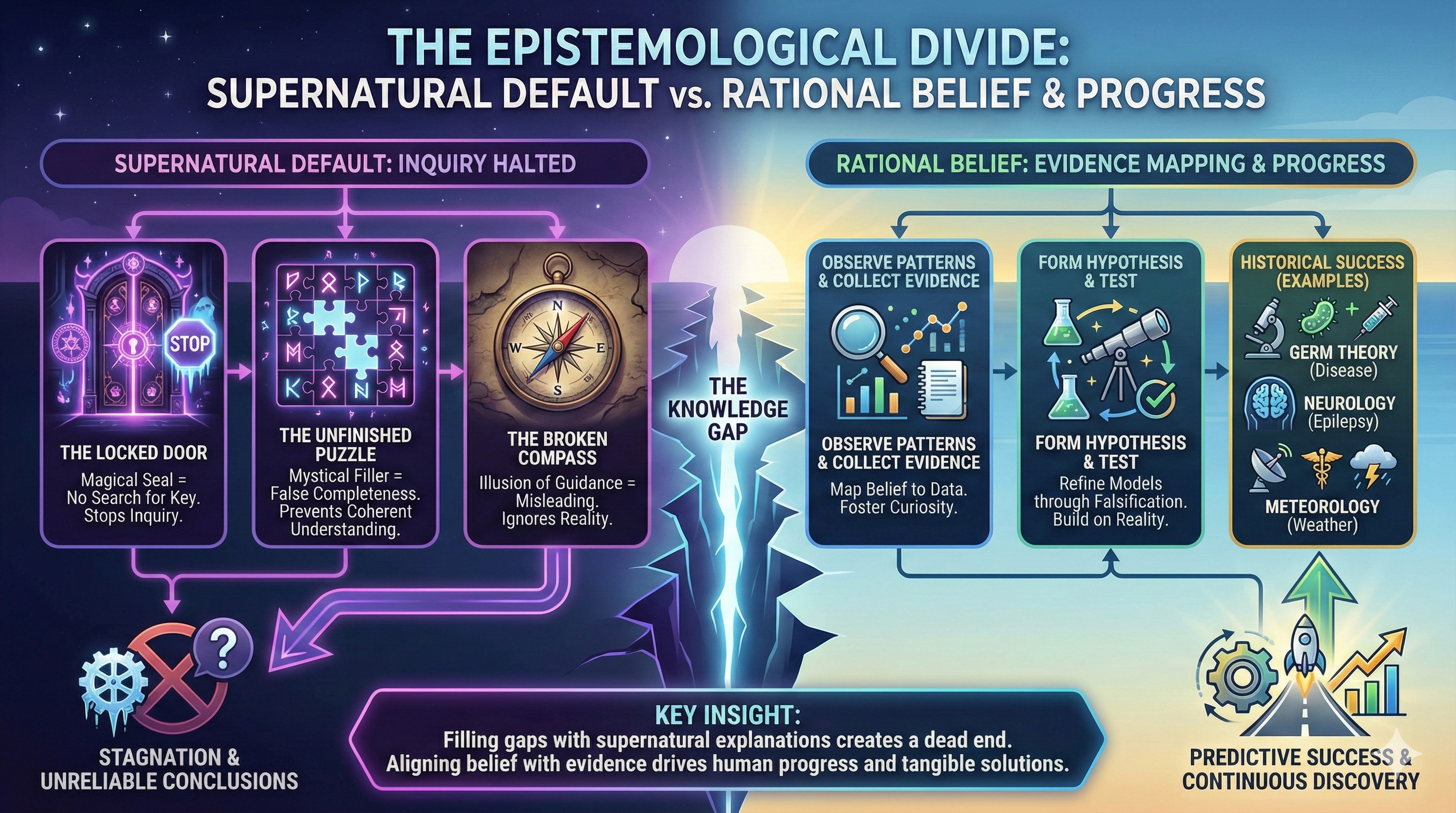
Analogy 1: The Locked Door
Imagine encountering a locked door. Instead of searching for the right key or tools to open it, you decide the door is magically sealed by an invisible force. This conclusion might provide temporary satisfaction, but it prevents you from exploring the actual mechanics of the lock and finding a real solution.
- Key Insight: Just as assuming a magical force seals the door stops further inquiry, invoking supernatural explanations for the unknown discourages curiosity and halts progress in uncovering natural causes.

Analogy 2: The Unfinished Puzzle
Picture working on a complex puzzle with missing pieces. Instead of waiting to find those pieces or creating replacements, you arbitrarily decide the missing sections represent mystical symbols that require no further effort to complete. The result is an incomplete and misleading picture.
- Key Insight: Similarly, filling gaps in knowledge with supernatural explanations creates a false sense of completeness, preventing the discovery of a coherent and evidence-based understanding.
Analogy 3: The Broken Compass
Imagine navigating a dense forest with a compass that always points north, regardless of the actual magnetic field. While the compass gives the illusion of guidance, it ultimately leads you astray because it ignores the reality of your surroundings.
Key Insight: Supernatural explanations, like a broken compass, might feel like they provide direction, but they often mislead us by ignoring evidence and producing inconsistent or subjective interpretations.
Addressing Theological Responses
Theological Responses
1. The Supernatural Complements Natural Inquiry
Theologians might argue that supernatural explanations do not necessarily halt curiosity or scientific progress but instead complement it. For example, many early scientists, like Isaac Newton, believed that their discoveries revealed the workings of God’s creation. The supernatural can inspire inquiry by providing a sense of purpose and wonder.
2. Gaps Are Opportunities for Faith
The idea of “gaps” in scientific understanding may be reframed as opportunities for faith rather than barriers to knowledge. Theologians might argue that where evidence is incomplete, faith can provide a framework for personal meaning and reflection while awaiting further discoveries.
3. The Subjectivity of Natural Explanations
Theologians could challenge the claim that supernatural explanations are inconsistent by pointing out that natural explanations are also subject to interpretation and change. For instance, scientific theories often evolve, and what is considered true today may be revised tomorrow. Both systems of explanation involve a degree of uncertainty and interpretation.
4. Doubt Has a Place in Theology
Theologians might argue that doubt is not exclusive to science or rational inquiry but is also central to faith. Figures like St. Augustine and C.S. Lewis acknowledged doubt as a natural and even necessary component of spiritual growth. Faith and doubt can coexist, driving a deeper understanding of both the natural and spiritual realms.
5. The Search for Evidence in Theology
Some theologians may assert that faith is not devoid of evidence but rests on different types of evidence, such as personal experiences, historical records, or philosophical arguments for the existence of God. They might claim that dismissing this evidence overlooks the epistemic diversity of human understanding.
Counter-Responses
Response to 1: The Supernatural Complements Natural Inquiry
While it is true that figures like Isaac Newton found inspiration in their faith, it does not follow that supernatural explanations are necessary or beneficial for scientific inquiry. Newton’s discoveries succeeded because he applied natural, evidence-based methods—not because he invoked supernatural causes. In fact, as science has progressed, it has consistently replaced supernatural explanations with natural ones, demonstrating that invoking the supernatural is unnecessary and often redundant. Inspiration can come from curiosity about the unknown itself, without requiring a belief in divine forces.
Response to 2: Gaps Are Opportunities for Faith
Using gaps in scientific understanding as opportunities for faith risks promoting a “God of the gaps” fallacy, where faith becomes tied to ignorance rather than knowledge. This approach is problematic because as gaps are closed through scientific discovery, faith tied to these gaps diminishes, leading to instability. A more rational approach is to acknowledge gaps without prematurely filling them, as this fosters intellectual humility and leaves room for meaningful, evidence-based exploration.
Response to 3: The Subjectivity of Natural Explanations
While scientific theories do evolve, they do so through a rigorous process of testing, evidence, and peer review, which strives for greater objectivity over time. Supernatural explanations, in contrast, lack a method for refinement or falsification, making them inherently subjective and resistant to change. The evolving nature of science is a strength, not a weakness, as it reflects a commitment to aligning beliefs with reality, something supernatural explanations cannot achieve.
Response to 4: Doubt Has a Place in Theology
The doubt found in theology is fundamentally different from doubt in rational inquiry. In theology, doubt is often framed as a step toward deeper faith, which assumes a particular conclusion (e.g., the existence of God). In contrast, rational doubt is open-ended and seeks evidence to resolve uncertainty. By privileging faith as the ultimate answer, theological doubt lacks the flexibility and objectivity that characterize rational inquiry.
Response to 5: The Search for Evidence in Theology
Claims that faith rests on evidence—such as personal experiences or historical records—fail to meet the standards of empirical rigor and reproducibility required for rational belief. Personal experiences are highly subjective and prone to cognitive biases, while historical records often lack sufficient corroboration to establish supernatural claims. By conflating subjective or anecdotal evidence with objective standards, theological arguments undermine the reliability of their conclusions. A truly rational approach requires evidence that is testable, falsifiable, and consistent across observers.
Clarifications
The Superiority of Rational Belief Over Supernatural Default
The principle that rational belief is a degree of belief mapped to the degree of relevant evidence offers a framework for intellectual humility, adaptability, and progressive understanding. By aligning belief with evidence, rational inquiry fosters predictions that are testable, revisable, and grounded in reality. In contrast, defaulting with high confidence to supernatural explanations often leads to stagnation and unreliable conclusions. This essay argues that rational belief not only leads to more successful predictions but also empowers human progress, providing tangible examples to illustrate its superiority.
Rational Belief: Evidence Mapping and Predictive Success
Rational belief operates on a continuum, where confidence in a claim increases as supporting evidence becomes stronger and more robust. This mapping ensures that beliefs remain flexible and proportional to the available data, allowing for refinement over time. As evidence grows, predictions derived from rational belief become more accurate and actionable.
A key example is the scientific understanding of disease. For centuries, illnesses were attributed to supernatural causes, such as divine punishment or malevolent spirits. This high-confidence supernatural default often led to ineffective remedies, such as exorcisms or ritual sacrifices, which failed to address the actual causes of illness. In contrast, the rational approach of observing patterns, collecting evidence, and forming hypotheses led to the germ theory of disease. By mapping belief to evidence, scientists were able to predict how diseases spread, identify effective treatments, and develop vaccines—transforming global health.
The Pitfalls of Supernatural Explanations
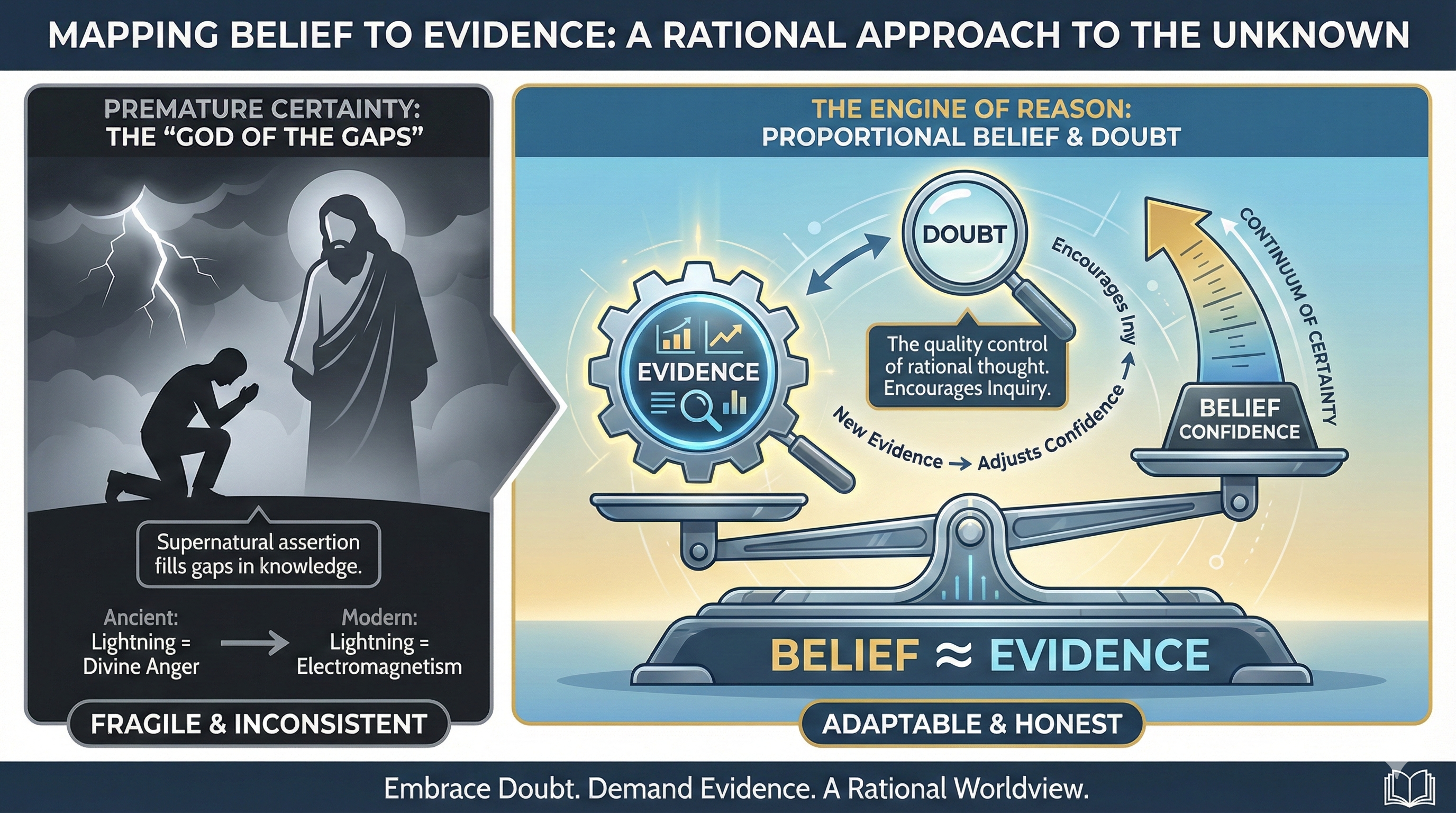
Defaulting to supernatural explanations often halts inquiry by providing a premature sense of certainty. Consider the case of epilepsy. Historically, epileptic seizures were interpreted as evidence of demonic possession or divine punishment. This belief justified exorcisms, ostracism, and even executions, as these explanations were treated with high confidence despite a lack of supporting evidence.
In contrast, when researchers applied rational inquiry, they discovered the neurological basis of epilepsy. Evidence from brain imaging and clinical studies revealed how abnormal electrical activity in the brain causes seizures. This understanding led to the development of medications and surgical treatments, offering effective solutions and improving the lives of millions.
The contrast is stark: supernatural defaults perpetuated fear and misunderstanding, while rational evidence-based approaches provided predictive success and tangible benefits.
Evidence-Based Predictions in Astronomy
The field of astronomy provides another compelling example. Ancient cultures frequently ascribed celestial events, such as eclipses or comets, to supernatural forces. Predictions about these phenomena were vague, inconsistent, and often tied to cultural superstitions. For instance, comets were widely regarded as omens of disaster, leading to fear-driven decisions rather than informed actions.
The rational approach revolutionized this understanding. By meticulously observing the heavens and mapping their findings to evidence, scientists like Johannes Kepler and Isaac Newton formulated the laws of planetary motion and universal gravitation. These laws allowed for precise predictions of celestial events, such as solar eclipses and planetary alignments, which are now calculated with extraordinary accuracy. The success of these predictions underscores the power of rational belief aligned with evidence over supernatural assumptions.
Rational Belief in Everyday Life
The practical benefits of rational belief extend beyond science into everyday decision-making. For example, weather forecasting illustrates how belief mapped to evidence leads to actionable predictions. In ancient times, weather patterns were often attributed to the whims of gods, such as Zeus or Thor. Rituals and sacrifices were performed to influence weather, with no evidence to suggest efficacy.
Today, meteorologists rely on evidence from satellite data, atmospheric models, and historical patterns to predict weather events. While forecasts are not always perfect, their reliability has vastly improved through the systematic application of evidence. These predictions save lives by enabling preparations for hurricanes, floods, and other natural disasters, demonstrating how rational belief yields far greater success than supernatural default.
Intellectual Humility and Progress

One of the greatest strengths of rational belief is its commitment to intellectual humility. Because beliefs are proportionate to evidence, they remain open to revision as new information emerges. This adaptability fosters continuous progress, unlike supernatural explanations, which often rely on immutable doctrines that resist change.
For instance, early theories about the atom were incomplete, yet scientists did not resort to supernatural explanations for the unseen. Instead, they continued to refine their models, from Dalton’s atomic theory to Rutherford’s nuclear model and eventually quantum mechanics. Each advancement was grounded in evidence, leading to technologies like semiconductors, medical imaging, and nuclear energy. Had early scientists defaulted to the supernatural, these revolutionary developments might never have occurred.
Conclusion: The Triumph of Rational Belief
By mapping belief to evidence, rational inquiry consistently outperforms supernatural defaults in predictive success and practical application. From medicine to astronomy to everyday life, the tangible benefits of evidence-based approaches far outweigh the temporary comfort of high-confidence supernatural explanations. Rational belief fosters intellectual humility, adaptability, and progress, enabling humanity to confront its greatest challenges with clarity and purpose. By embracing this approach, we unlock the potential for deeper understanding and a brighter future, free from the constraints of premature certainty.


Leave a Reply