
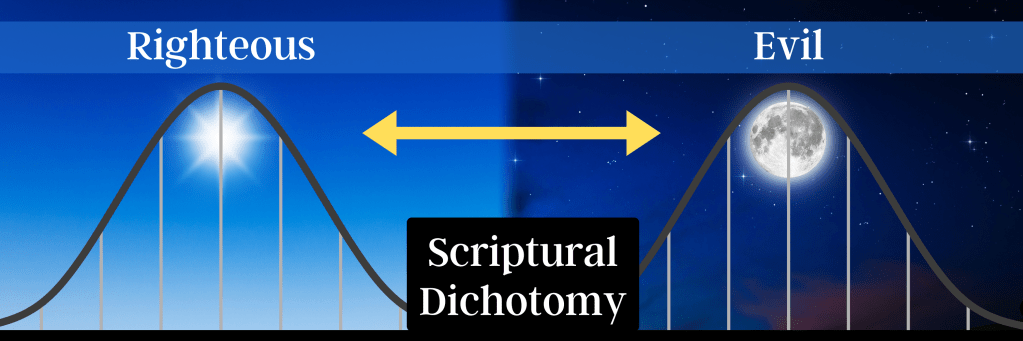
Section #1: The Biblical Notion of Human Wickedness Without God
The concept that humans are inherently wicked without God is deeply rooted in the Bible, where human nature is often portrayed as fundamentally flawed and in need of divine intervention. This theme is consistently emphasized across both the Old and New Testaments, painting a picture of humanity as intrinsically corrupt apart from God’s influence. Below are key biblical passages that reinforce this notion, each followed by an argument demonstrating how the text supports the idea of humanity’s inherent wickedness without God.
Bible Verses that Establish the Intrinsic Wickedness of Humans
1. Genesis 6:5
“The Lord saw how great the wickedness of the human race had become on the earth, and that every inclination of the thoughts of the human heart was only evil all the time.”
This verse presents one of the earliest declarations of humanity’s intrinsic corruption. Every inclination of the human heart is described as only evil all the time, suggesting an unrelenting and pervasive wickedness. The context here is pre-Flood humanity, but the absolutist language implies a universal human condition. Without God’s presence or intervention, humanity’s natural state is pure wickedness, leading God to cleanse the earth through the Flood.
2. Jeremiah 17:9
“The heart is deceitful above all things and desperately wicked: who can know it?”
Jeremiah portrays the human heart as fundamentally deceitful and desperately wicked, suggesting an internal moral corruption beyond human comprehension. The rhetorical question—“Who can know it?”—emphasizes the depth of this wickedness, implying that humans cannot even fully grasp the extent of their own corruption without divine revelation or guidance.
3. Romans 3:10-12
“As it is written: ‘There is no one righteous, not even one; there is no one who understands; there is no one who seeks God. All have turned away, they have together become worthless; there is no one who does good, not even one.’”
Here, Paul reiterates Old Testament teachings to argue that universal wickedness afflicts humanity. The repetition of “no one” underscores the totality of this corruption. Humans, left to their own devices, neither seek God nor do good. The notion of becoming worthless without God highlights the belief that intrinsic human nature is morally bankrupt apart from divine influence.
4. Psalm 51:5
“Surely I was sinful at birth, sinful from the time my mother conceived me.”
David expresses the idea of original sin, indicating that wickedness is not merely a product of environment or choice but an inherent condition. From conception, humans bear this sinful nature, necessitating God’s grace for redemption. This verse reinforces the doctrine that wickedness is intrinsic and not acquired through external influences.
5. Ecclesiastes 9:3
“The hearts of the children of man are full of evil, and madness is in their hearts while they live, and after that they go to the dead.”
This passage offers a bleak view of human existence, suggesting that life is dominated by evil and madness. The imagery of hearts being full of evil highlights the belief that wickedness is not a peripheral issue but central to human nature. Without God, life is portrayed as a futile and corrupt journey toward death.
6. Isaiah 64:6
“All of us have become like one who is unclean, and all our righteous acts are like filthy rags; we all shrivel up like a leaf, and like the wind, our sins sweep us away.”
Even righteous acts are depicted as filthy rags, implying that without God’s sanctifying presence, human efforts at goodness are inherently tainted. This passage reinforces the idea that wickedness is not just about overt evil deeds but also corrupts even the best intentions and actions of humanity.
7. Mark 7:21-23
“For it is from within, out of a person’s heart, that evil thoughts come—sexual immorality, theft, murder, adultery, greed, malice, deceit, lewdness, envy, slander, arrogance, and folly. All these evils come from inside and defile a person.”
Jesus emphasizes that wickedness originates from within—the human heart—rather than external influences. This internal source of corruption aligns with the idea of intrinsic wickedness. Without God’s transformative power, humans are naturally inclined toward sinful behaviors that defile them.
8. Ephesians 2:1-3
“As for you, you were dead in your transgressions and sins, in which you used to live when you followed the ways of this world and of the ruler of the kingdom of the air… All of us also lived among them at one time, gratifying the cravings of our flesh and following its desires and thoughts. Like the rest, we were by nature deserving of wrath.”
Paul describes humanity as spiritually dead in sin, following the cravings of the flesh and deserving of divine wrath. The phrase “by nature deserving of wrath” emphasizes that wickedness is an innate condition rather than a result of specific actions. This condition necessitates God’s grace for spiritual resurrection.
We clearly see that biblical narrative consistently portrays humans as intrinsically wicked without God. From the total depravity outlined in Genesis and Jeremiah to the New Testament affirmations in Romans and Ephesians, the message is clear: without divine intervention, humanity’s default state is one of corruption and rebellion. This theological perspective underpins doctrines such as original sin and the necessity of salvation by grace, arguing that human nature is fundamentally flawed and incapable of righteousness apart from God.
Section #2: The Biblical Notion of the Sanctity of Believers
While the Bible portrays humanity as intrinsically wicked without God, it also presents a contrasting image of sanctity and righteousness for those who surrender themselves to God. This transformation is described as a divine act, where believers are cleansed, renewed, and set apart for holy purposes. The following biblical passages emphasize the sanctity granted to believers, each followed by an explanation highlighting how the text supports this concept.
Bible Verses that Establish the Sanctity of Believers
1. 2 Corinthians 5:17
“Therefore, if anyone is in Christ, the new creation has come: The old has gone, the new is here!”
This verse underscores the transformative nature of salvation. By being in Christ, believers undergo a profound change, becoming a new creation. The imagery of the old self passing away and the new arriving signifies a complete moral and spiritual renewal, moving from a state of inherent wickedness to sanctity.
2. 1 Peter 2:9
“But you are a chosen people, a royal priesthood, a holy nation, God’s special possession, that you may declare the praises of him who called you out of darkness into his wonderful light.”
Peter describes believers as a holy nation and a royal priesthood, emphasizing their sanctity and set-apart status. The transition from darkness (wickedness) into light (sanctity) reflects the divine calling that transforms and elevates believers to a sacred standing before God.
3. Romans 8:1-2
“Therefore, there is now no condemnation for those who are in Christ Jesus, because through Christ Jesus the law of the Spirit who gives life has set you free from the law of sin and death.”
This passage highlights the freedom believers receive from sin’s condemnation. Through Christ, believers are not only pardoned but also sanctified by the Spirit who gives life, lifting them from the state of wickedness into one of righteousness and spiritual vitality.
4. Ephesians 2:4-6
“But because of his great love for us, God, who is rich in mercy, made us alive with Christ even when we were dead in transgressions—it is by grace you have been saved. And God raised us up with Christ and seated us with him in the heavenly realms in Christ Jesus.”
This verse emphasizes the resurrection from spiritual death to life through God’s grace. Believers are not merely forgiven but are raised up and spiritually elevated, signifying sanctity and a new divine identity, contrasting sharply with their previous wicked state.
5. Colossians 3:12
“Therefore, as God’s chosen people, holy and dearly loved, clothe yourselves with compassion, kindness, humility, gentleness, and patience.”
Believers are called holy and dearly loved, indicating their sanctified status. The command to clothe themselves in virtues reflects the outward manifestation of their inner sanctity, demonstrating the moral transformation that follows surrendering to God.
6. Hebrews 10:10
“And by that will, we have been made holy through the sacrifice of the body of Jesus Christ once for all.”
This verse explicitly states that believers have been made holy through Christ’s sacrifice. The sanctity here is not earned but granted, emphasizing the divine act of consecration that transforms believers from wickedness to holiness.
7. 1 John 3:1-2
“See what great love the Father has lavished on us, that we should be called children of God! And that is what we are! The reason the world does not know us is that it did not know him. Dear friends, now we are children of God, and what we will be has not yet been made known. But we know that when Christ appears, we shall be like him, for we shall see him as he is.”
Believers are identified as children of God, a status that implies sanctity and a privileged relationship with the divine. The promise that believers will be like Christ further underscores their transformation from wickedness to holiness, culminating in complete sanctity at Christ’s return.
8. Galatians 2:20
“I have been crucified with Christ and I no longer live, but Christ lives in me. The life I now live in the body, I live by faith in the Son of God, who loved me and gave himself for me.”
This passage illustrates the intimate union between the believer and Christ. By being crucified with Christ, the old, wicked self is put to death, and a sanctified life emerges, where Christ lives within the believer. This indwelling signifies the believer’s complete transformation into a vessel of holiness.
The Bible presents a clear dichotomy between the inherent wickedness of humanity without God and the sanctity of those who surrender to Him. Through Christ’s sacrifice and the indwelling of the Holy Spirit, believers undergo a profound transformation, shifting from a state of corruption to one of holiness. The selected verses emphasize not only the cleansing of past sins but also the bestowal of a new, sanctified identity that aligns believers with God’s righteousness and sets them apart from the fallen nature of the world.
Section #3: Human Behavior: The Actual Bellcurve

The biblical portrayal of human nature often presents a stark dichotomy: individuals are either inherently wicked without God or sanctified through divine intervention. However, empirical evidence from sociology and psychology suggests that human behaviors are more accurately represented by a normal distribution, with most individuals exhibiting a mix of virtuous and unacceptable actions. This essay examines this perspective, drawing on sociological and psychological data, and challenges the notion that religiosity is a definitive determinant of moral behavior.
1. The Normal Distribution of Human Behavior
In statistical terms, human behaviors often follow a bell curve or normal distribution, where the majority of individuals cluster around the mean, displaying a balance of socially acceptable and unacceptable behaviors. Extremes of virtuousness or deviance are less common, indicating that most people possess a combination of traits. This distribution challenges the binary classification of individuals as purely wicked or sanctified.
2. Secular Societies and Low Crime Rates
Empirical data indicates that secular societies can exhibit low crime rates, challenging the assumption that religiosity is necessary for moral behavior. For instance, Japan, with a largely secular population, reports significantly lower crime rates compared to more religious nations. According to NationMaster, Japan’s crime levels are markedly lower than those of the United States, a country with higher religiosity. This suggests that factors other than religious belief, such as cultural norms and effective legal systems, play crucial roles in promoting societal order.
3. Religious Affiliation and Incarceration Rates
Data from the United Kingdom’s Ministry of Justice reveals that a substantial portion of the prison population identifies as religious. As of March 2015, 49% of prisoners identified as Christian, while 31% reported no religious affiliation. Notably, Muslims comprised 14% of the prison population, despite representing a smaller percentage of the general population. These statistics suggest that religious affiliation does not necessarily correlate with lower incarceration rates.
4. Meta-Analyses on Religion and Crime
A meta-analysis published in the Journal of Research in Crime and Delinquency examined the relationship between religion and crime. The study found that while religious beliefs and behaviors can exert a moderate deterrent effect on criminal behavior, the evidence is varied and inconclusive. This indicates that religiosity is not a sole or definitive factor in determining moral conduct.
5. Cultural and Societal Influences
Cultural norms, socioeconomic factors, and legal structures significantly influence moral behavior. In Japan, societal emphasis on harmony, respect, and community contributes to low crime rates, independent of religious influence. This underscores the importance of a multifaceted approach to understanding morality, beyond religious frameworks.
Conclusion
The biblical notion that humans are either inherently wicked without God or sanctified through divine belief does not align with empirical evidence. Sociological and psychological data consistently show that human behaviors form a normal distribution, with the majority of people exhibiting a mix of virtuous and problematic actions, regardless of their religious affiliation. This directly challenges the idea that moral character is determined by one’s relationship to a specific deity.
Secular societies, such as Japan, provide compelling evidence against this biblical dichotomy. Despite low levels of religious belief, Japan maintains some of the lowest crime rates globally, suggesting that morality and prosocial behavior do not require religious foundations. Conversely, data from religious populations reveal that belief in God does not inherently prevent unethical behavior. Prison statistics and meta-analyses further illustrate that religious affiliation does not strongly correlate with lower crime rates or higher moral conduct.
This leads to a clear logical rejection of the biblical claim:
Syllogistic Formulation:
- P1: If the biblical claim is true, then those without God would exhibit inherently wicked behavior, and those with God would display sanctified, morally superior behavior.
- P2: Empirical evidence shows that many non-believers (e.g., secular Japanese citizens) exhibit low crime rates and prosocial behaviors, while many believers commit unethical acts, demonstrating no clear moral superiority.
- Conclusion: Therefore, the biblical claim that moral character is determined by one’s relationship to God is false.
This syllogism highlights the fundamental flaw in the biblical dichotomy. Human behavior is shaped by complex social, cultural, and psychological factors—not by adherence to religious doctrines. The idea that people fall neatly into categories of “wicked” or “sanctified” based on belief in a specific God is a false binary, unsupported by data. Humanity exists on a spectrum of behaviors, with the majority of people falling into a nuanced middle ground, irrespective of their religious convictions.
Section #4: Empirical Tests and Research for the Honest Seeker
To rigorously examine the claim that morality is determined by one’s belief in God, an honest seeker can engage with both sociological data and personal, experiential methods. Empirical studies, sociological analyses, and simple interpersonal experiments all offer powerful means of challenging or confirming the biblical dichotomy of human wickedness without God and sanctity with God.
1. Compare Crime Rates in Religious vs. Secular Societies
A direct and widely available method is to compare crime rates in societies with high and low levels of religiosity. The biblical claim would predict that more religious societies should be more peaceful and law-abiding, while secular societies should be rife with wickedness. However, evidence strongly contradicts this.
- Key Example:
- Japan, a largely secular society, consistently ranks among the lowest in global crime rates. Violent crime, theft, and corruption are significantly lower than in highly religious nations like the United States or Brazil, where a majority of the population identifies with a religious tradition.
- Data from the United Nations Office on Drugs and Crime (UNODC) and World Population Review show that countries with high rates of atheism (e.g., Japan, Norway, Sweden) often exhibit some of the highest levels of social trust, low crime rates, and high life satisfaction.
- How to Conduct the Test:
- Review crime statistics from global databases and compare them against religiosity data (available from Pew Research Center or Gallup).
- Explore cultural factors contributing to moral behavior in secular societies.
2. Simple Social Test: Befriend Both the Religious and the Non-Religious
One of the most accessible and illuminating tests is profoundly simple: befriend people from both ends of the spectrum—those who have strongly adopted a God and those who are ideologically godless—and observe their behavior over time.
- How to Conduct the Test:
- Build genuine relationships with deeply religious individuals (e.g., devout Christians, Muslims, Jews) and also with committed secularists or atheists.
- Pay close attention to how they treat others, handle conflicts, practice honesty, show compassion, and adhere to personal integrity.
- Note whether religious individuals consistently demonstrate superior moral behavior, or if secular friends show just as much (or more) empathy, honesty, and kindness.
- Expected Observation:
- Most will find that both groups contain a wide range of personalities—some kind, some self-centered, some honest, some hypocritical—regardless of their belief in God.
- This personal experience often reveals that religious affiliation does not reliably predict moral character.
3. Analyze Religious Affiliation and Incarceration Rates
If belief in God leads to sanctity, religious people should be underrepresented in prison populations. However, prison demographics often reveal the opposite.
- Key Data:
- In the United Kingdom, as of March 2015, 49% of prisoners identified as Christian, even though the general population was becoming increasingly secular.
- In the United States, highly religious regions (e.g., the Bible Belt) often have higher crime rates, including violent crimes, than more secular states.
- How to Conduct the Test:
- Examine government data on prison demographics, such as from the Bureau of Justice Statistics (BJS) in the U.S. or the Ministry of Justice in the U.K.
- Compare incarceration rates across different religious affiliations and levels of belief.
4. Psychological Studies on Moral Behavior Across Religiosity
A vast body of psychological research has explored whether religiosity correlates with higher moral behavior. The results often show no significant difference between religious and non-religious individuals when it comes to honesty, compassion, and prosocial behavior.
- Key Studies:
- Research published in Nature Human Behaviour found that religious and non-religious children were equally likely to share and cooperate, with some studies even suggesting that atheist children displayed slightly higher levels of altruism.
- A meta-analysis in the Journal of Personality and Social Psychology found no consistent evidence that religious people behave more morally in controlled experiments.
- How to Conduct the Test:
- Explore academic studies on prosocial behavior and religion.
- Participate in or observe studies using ethical dilemmas (e.g., the Trolley Problem, Prisoner’s Dilemma) with diverse participants.
5. Investigate the Role of Cultural Norms Over Religious Doctrine
Another critical test is to examine whether moral behavior stems more from cultural and social norms rather than religious teachings. Societies like Japan and Scandinavia, despite being secular, promote strong communal values like respect, honesty, and responsibility, resulting in low crime rates and high social trust.
- How to Conduct the Test:
- Analyze sociological research comparing cultural values in religious and secular societies.
- Look into civic responsibility, trust metrics, and social cohesion across different cultural contexts.
Conclusion: Personal and Empirical Evidence Refutes the Biblical Dichotomy
Empirical research and simple social experiments decisively falsify the biblical claim that morality hinges on belief in God. The bell curve of human behavior—with most individuals falling somewhere in the middle—reveals that morality is complex, multi-faceted, and not dictated by religiosity. Both believers and non-believers exhibit kindness, cruelty, honesty, and deceit in varying measures, with no clear moral superiority on either side.
Syllogistic Formulation:
- P1: If the biblical claim is true, those without God should consistently display wicked behavior, and those with God should exhibit superior moral conduct.
- P2: Empirical evidence and personal experience show that non-believers often live morally upright lives (e.g., secular Japanese citizens), while many believers engage in unethical behaviors (e.g., crime rates among religious populations).
- Conclusion: Therefore, the biblical claim that belief in God is necessary for moral behavior is false.
The honest seeker can easily verify this through personal relationships and public data. Befriending both the devoutly religious and the openly secular will often reveal no meaningful difference in kindness, integrity, or compassion. This firsthand experience, coupled with extensive sociological and psychological research, demonstrates that morality is a human trait—not the exclusive product of divine influence.


 Free of Faith
Leave a comment