

We have never seen something that came from nothing. This inductive observation seems to make it rationally necessary to dismiss as unlikely all claims that something came from nothing.
This line of reasoning is employed by theists to argue that, because the universe had a beginning, it must have come from something. And that something is [favorite God].
This ignores a few relevant factors:
- A lack of evidence for the God asserted other than the inductive inference.
- The fact that the bulk of cosmologists are not claiming the universe had a beginning.
- The arbitrary ending of the recursion at the point of the cited God.
We will not here address the factors above, and, instead, focus this post on the many similar inductive conclusions that theists also need to accept to avoid inconsistency.
Consider this table of parallel inductive conclusions below that largely run counter to theistic notions. On left. we have the inductive inference based on human observations. These observations are detailed in the center, and the implications follow on the right.
◉ Inductive Cherries Irrationally Left Unpicked:
 | Category | Observation | Implication |
|---|---|---|---|
| #01 | ◉ Minds Are Dependent on Physical Brains | ✓ All known instances of consciousness are linked to physical brains. Neuroscience shows that mental states correlate with brain activity. | — An immaterial mind existing without a physical brain contradicts our empirical understanding of consciousness. |
| #02 | ◉ Non-Physical Entities Do Not Interact with the Physical World | ✓ We have no empirical evidence of non-material entities causing physical effects. All observed interactions involve physical forces and matter. | — An immaterial being affecting the physical universe defies our understanding of causation. |
| #03 | ◉ Causation Occurs Within Space and Time | ✓ All known cause-and-effect relationships occur within space-time dimensions. | — A cause existing outside space and time initiating events within it conflicts with our observations of causality. |
| #04 | ◉ Complexity Arises from Simpler Processes | ✓ Complex systems develop from simpler ones through natural processes like evolution. | — The idea of a complex deity existing without prior development challenges our understanding of complexity emerging over time. |
| #05 | ◉ All Known Beings Are Finite and Limited | ✓ Every entity we observe has limitations in power, knowledge, and presence. | — An infinite, omnipotent being is outside our empirical experience, making its existence less probable based on inductive reasoning. |
| #06 | ◉ Consciousness Develops Over Time | ✓ Consciousness emerges gradually, as seen in human development from infancy. | — The concept of an eternal, uncreated consciousness does not align with how we observe consciousness to arise. |
| #07 | ◉ Immutable Beings Cannot Interact with Changing Systems | ✓ Interaction implies change; engaging with a dynamic system affects both parties. | — An immutable deity interacting with the universe presents a contradiction. |
| #08 | ◉ All Creators We Observe Are Physical Beings Within the Universe | ✓ Human creators use physical means to create within the universe. | — A creator existing outside the universe and creating from nothing lacks a parallel in our experience. |
| #09 | ◉ Purpose and Intentionality Require Physical Minds | ✓ Intentional actions stem from beings with physical brains capable of desires and planning. | — Assigning purpose to an immaterial being is inconsistent with our understanding of intentionality. |
| #10 | ◉ Entities Cannot Exist Outside Space-Time and Affect It | ✓ All entities we observe exist within space-time and interact accordingly. | — The notion of an entity outside space-time influencing events within it contradicts our empirical observations. |
| #11 | ◉ Information Transmission Requires a Physical Medium | ✓ Communication occurs through physical channels like sound waves or electromagnetic radiation. | — An immaterial deity conveying information without a physical medium defies our understanding of communication. |
| #12 | ◉ All Observed Phenomena Have Natural Explanations | ✓ Phenomena previously attributed to supernatural causes are increasingly explained by natural laws. | — Invoking a supernatural deity is unnecessary when natural explanations suffice. |
| #13 | ◉ Physical Laws Are Consistent and Unbroken | ✓ The uniformity of physical laws suggests no external tampering by supernatural forces. | — An intervening deity would introduce inconsistencies, which we do not observe. |
| #14 | ◉ Consciousness Is an Emergent Property of Complex Systems | ✓ Consciousness arises from complex interactions in the brain. | — A disembodied consciousness challenges our understanding of how consciousness emerges. |
| #15 | ◉ Designers Are Products of Natural Processes | ✓ All known designers are themselves the result of natural processes like evolution. | — Suggesting a designer who is not a product of natural processes deviates from our observations. |
| #16 | ◉ Morality Emerges from Social Constructs | ✓ Moral codes vary and evolve, indicating they are human constructs. | — Morality does not require a divine source. |
| #17 | ◉ Desires and Will Are Linked to Biological Needs | ✓ Intentions arise from biological imperatives and neurochemical processes. | — An immaterial being possessing will and desires is inconsistent with our understanding. |
| #18 | ◉ No Evidence of Creation Ex Nihilo | ✓ Matter and energy are neither created nor destroyed but transformed. | — Creation from nothing lacks empirical support. |
| #19 | ◉ Natural Processes Can Produce Order from Disorder | ✓ Processes like self-organization explain the emergence of order naturally. | — Order in the universe does not necessitate a designer. |
| #20 | ◉ All Observed Entities Are Subject to Causality | ✓ Every entity or event has a cause within the natural framework. | — Introducing an uncaused cause (a deity) contradicts this pattern. |
| #21 | ◉ Non-Physical Minds Contradict Conservation Laws | ✓ Physical effects require physical causes to conserve energy and momentum. | — An immaterial mind influencing the physical world violates conservation laws. |
| #22 | ◉ Human Experiences of the Divine Are Subjective | ✓ Religious experiences are diverse and can be explained psychologically. | — Subjective experiences are insufficient to prove an external deity. |
| #23 | ◉ Cultural Diversity of Deities Suggests Human Origin | ✓ Varied concepts of gods across cultures imply they are human constructs. | — The multiplicity of deities undermines the universality of any single concept of God. |
| #24 | ◉ Technological Advances Reduce Reliance on Supernatural Explanations | ✓ Science increasingly explains phenomena without invoking the supernatural. | — The necessity for a deity diminishes as natural explanations expand. |
| #25 | ◉ Historical Inaccuracy of Sacred Texts | ✓ Sacred texts contain inconsistencies and errors. | — This suggests human authorship rather than divine inspiration. |
| #26 | ◉ Evolution Explains Biodiversity Without Intelligent Design | ✓ Natural selection accounts for the complexity and diversity of life. | — Intelligent design is unnecessary to explain biological phenomena. |
| #27 | ◉ Psychological Projection Explains Anthropomorphic Deities | ✓ Humans project traits onto deities, reflecting their own nature. | — God concepts may be psychological rather than reflective of an external reality. |
| #28 | ◉ Miracles Lack Verifiable Evidence | ✓ Miraculous claims are anecdotal and lack empirical support. | — Without evidence, miracles cannot substantiate the existence of a deity. |
| #29 | ◉ Suffering and Evil Challenge the Notion of an Omnibenevolent Deity | ✓ The existence of unnecessary suffering is incompatible with an all-good, all-powerful deity. | — This challenges traditional attributes assigned to God. |
| #30 | ◉ The Universe Operates Under Naturalistic Mechanisms | ✓ Cosmology explains the universe’s behavior through physical laws. | — A supernatural creator is not required to account for cosmic phenomena. |
| #31 | ◉ Occam’s Razor Favors Simpler Explanations | ✓ Simpler explanations are preferred when they sufficiently explain phenomena. | — Naturalistic explanations are more parsimonious than invoking a deity. |
| #32 | ◉ Human Error and Bias in Religious Belief | ✓ Cognitive biases influence belief systems. | — Religious beliefs may be more about human psychology than external truths. |
| #33 | ◉ Temporal Minds Cannot Comprehend Timeless Existence | ✓ Consciousness is tied to temporal processes. | — A timeless mind is incongruent with our understanding of consciousness. |
| #34 | ◉ No Observable Evidence of Divine Intervention in Natural Disasters | ✓ Natural disasters occur without discernible divine intervention. | — This suggests a lack of active involvement by a deity in worldly events. |
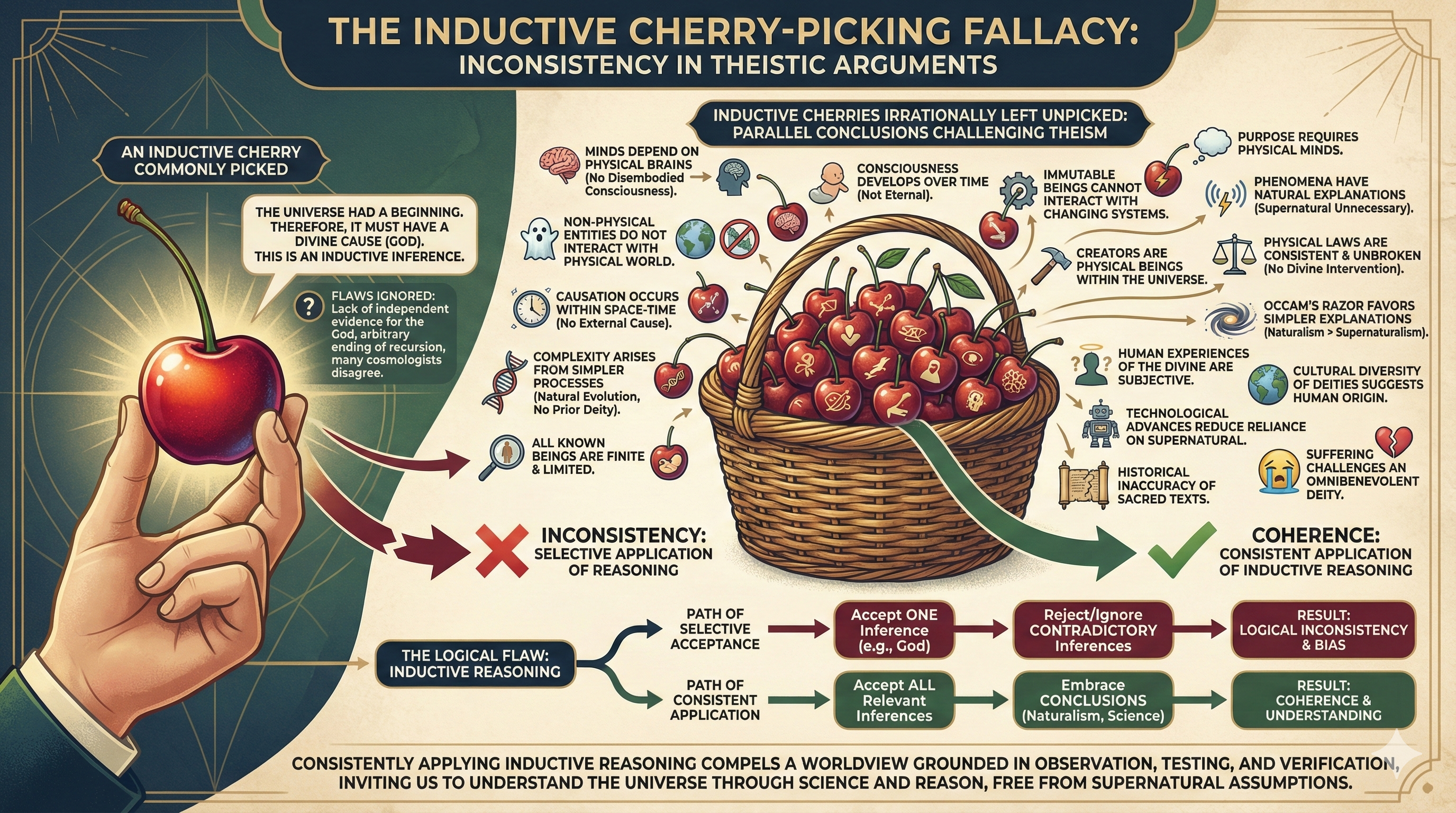
The table of inductive reasoning presented earlier illuminates a critical inconsistency in theistic arguments that rely on the premise that the universe’s supposed beginning necessitates a divine creator. While theists often point to the absence of something coming from nothing as evidence for a god, the same inductive approach, when applied broadly to human observations, reveals a pattern that directly challenges their claims. For instance, observations like the dependence of minds on physical brains (#01), the lack of evidence for non-physical entities interacting with the physical world (#02), and the consistent operation of natural processes without supernatural intervention (#12, #13) suggest that phenomena we experience are rooted in the material and observable, not the immaterial or divine. This pattern casts doubt on the notion of an immaterial, omnipotent deity, as it contradicts the very empirical foundations theists invoke to support their position.
Moreover, the implications drawn from these observations—such as the contradiction of an immaterial mind existing without a physical brain (#01), the defiance of causation by a being outside space-time (#03), and the unnecessary invocation of a designer when natural processes explain order (#19, #26)—highlight a deeper philosophical challenge. If we accept the inductive reasoning that something cannot come from nothing, we must also accept the consistent application of that reasoning across all domains of knowledge. Yet, theistic claims often arbitrarily halt this recursion at a preferred deity, ignoring the broader implications of our observations. The diversity of these conclusions, spanning consciousness, morality, and cosmology, underscores that the universe operates under naturalistic mechanisms (#30), and invoking a supernatural entity introduces unnecessary complexity, violating the principle of Occam’s Razor (#31). This selective reasoning undermines the coherence of theistic arguments when held against the weight of empirical evidence.
Ultimately, embracing the inductive conclusions outlined in the table compels us to adopt a worldview grounded in what we can observe, test, and verify, rather than in unprovable assertions about supernatural beings. The absence of verifiable evidence for miracles (#28), the psychological and cultural origins of deity concepts (#22, #23, #27), and the challenge posed by suffering and evil to an omnibenevolent deity (#29) further erode the foundation for theistic claims. By consistently applying inductive reasoning, we recognize that the patterns of the natural world—its finitude, causation, and emergent complexity—do not require, nor rationally support, the existence of a divine entity. Instead, they invite us to deepen our understanding of the universe through science and reason, free from the inconsistencies of supernatural assumptions.
The Symbolic Logic Formulation of the Inconsistency
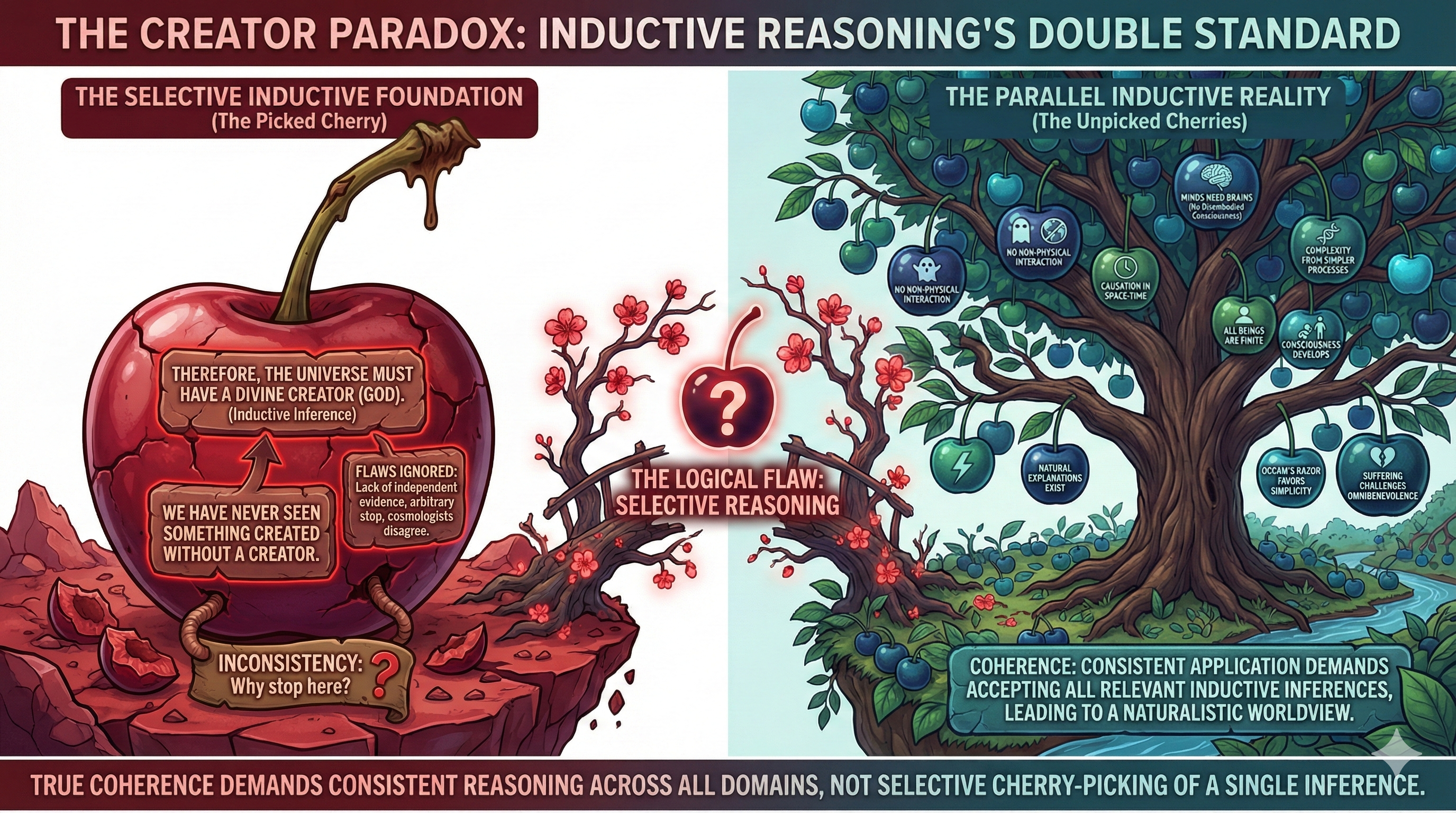
The flaw lies in the inconsistent application of inductive reasoning—specifically, where a theist might prioritize an inference (e.g., “the universe had a beginning, so it must have a divine cause”) while disregarding other equally valid inductive observations (e.g., “all observed minds depend on physical brains,” “no non-physical entities interact with the physical world,” etc., as outlined in the table). This selective focus introduces a logical inconsistency or bias, violating principles of uniformity and coherence in reasoning.
Here’s a symbolic logic formulation that captures this flaw, using standard logical notation and LaTeX for clarity. The formulation assumes:
: An inductive inference based on observation
.
: Acceptance of an inductive inference (e.g., the universe’s beginning implies a divine cause).
: Rejection or ignoring of other relevant inductive inferences (e.g., those in the table that contradict a divine entity).
: Coherence or consistency in reasoning.
: Theistic conclusion (e.g., existence of a god).
The flaw can be expressed as a contradiction or inconsistency in reasoning, where accepting one inductive inference (

The Formulation:
Premises (based on the inductive nature of observations):
(If the inductive inference about the universe’s beginning is accepted, then a theistic conclusion follows—e.g., a god exists.)
(For all inductive inferences
, the inference holds if the observation is valid—e.g., all observations in the table are valid.)
(If other relevant inductive inferences are not rejected, then reasoning is coherent.)
(Some observations
from the table imply the negation of the theistic conclusion—e.g., no non-physical entities interact with the physical world, contradicting a divine entity’s intervention.)
Flawed Reasoning (the inconsistency):
(The theist accepts
(Rejecting other relevant inductive inferences
- Therefore,
(Accepting
Contradiction Highlighting the Flaw:
- From
- However,
, creating a contradiction because sound inductive reasoning requires
- Thus, the flaw is:
(The conjunction of accepting
Interpretation:
This formulation shows that focusing on one inductive inference (
See also:


 Free of Faith
Leave a comment