

Note: The term “Apostles” is at times used in the post below.
“Gospel writers” is the more precise term.
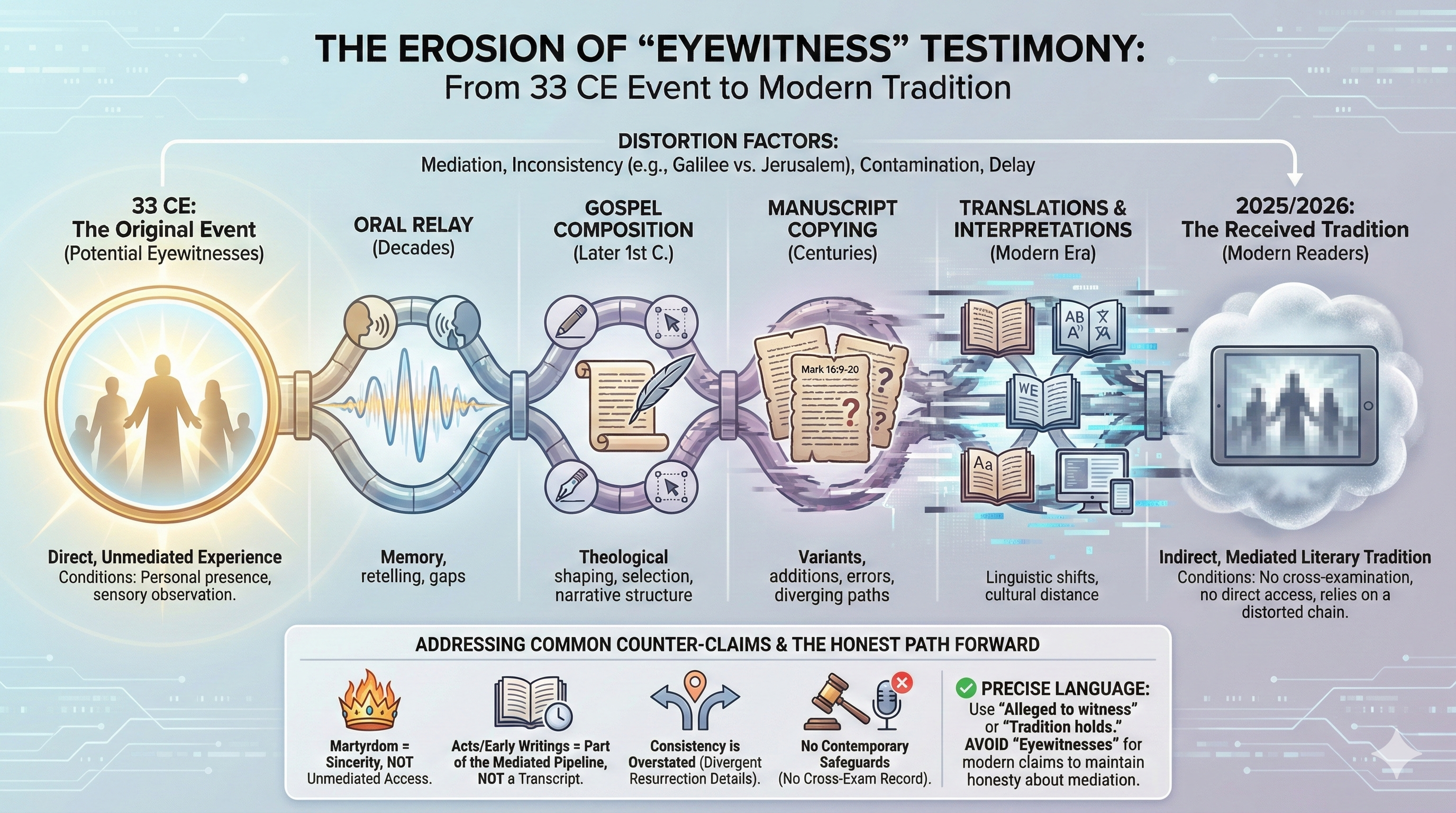
Imagine standing in a courtroom, listening to a witness recount a crime they saw just yesterday—crisp, vivid, unfiltered. Now picture that same story retold across 2,000 years, whispered through countless voices, scribbled on crumbling scrolls, recopied by candlelight, and translated across languages and empires. By the time it reaches you, would you still call that first observer an “eyewitness”? This is the quandary Christians face when they label the Apostles—those who reportedly saw Jesus rise in 33 CE—as “eyewitnesses” today. What begins as a bold claim of firsthand truth unravels under the weight of a communication chain so long and tangled it resembles a game of telephone stretched across millennia.
The legal system demands an eyewitness deliver their account directly, free from distortion, with memory still sharp and details testable. The Apostles might have met that bar in their day, proclaiming what they saw to crowds or scribes. But their voices didn’t reach us unmediated. Their words passed through oral tales, Gospel writers decades later, centuries of hand-copied manuscripts, and layers of theological editing—each step a chance for error, embellishment, or loss. By 2025, we’re not hearing Peter or John; we’re reading a text like Codex Sinaiticus, itself a 4th-century copy of a copy, peppered with variants like the debated ending of Mark. Calling them “eyewitnesses” now isn’t just optimistic—it’s a stretch that defies how evidence degrades over time.
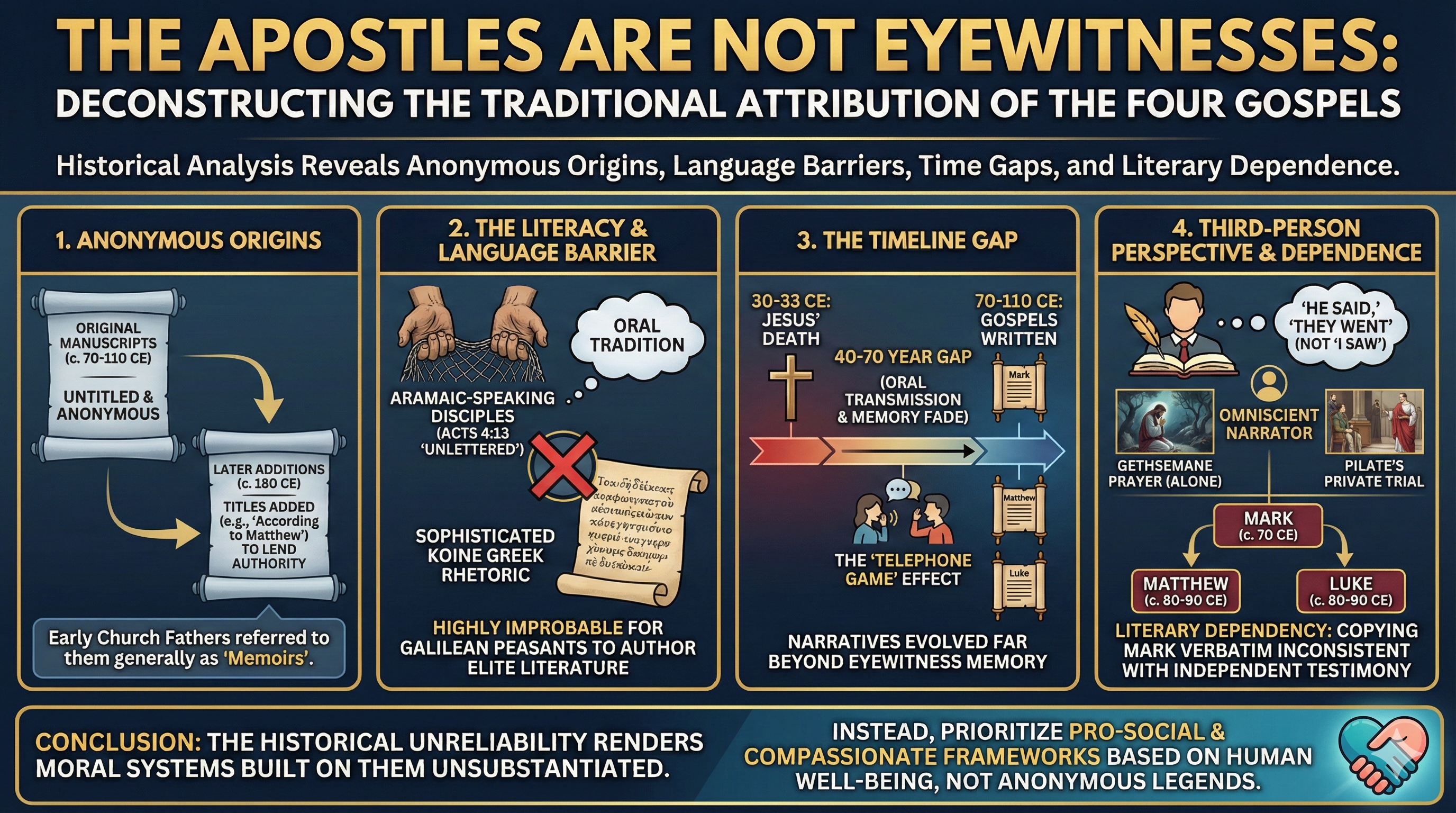
This blog dives into why that label doesn’t hold up, peeling back the layers with a rigorous lens. We’ll walk through a spectrum—from a modern witness testifying in court to the Apostles’ faded echo—showing how distortion creeps in with every relay. Using history, like the forged “Donation of Constantine”, and cold logic, we’ll expose the absurdity of claiming unblemished truth from such a fractured chain. Faith might bridge the gap for some, but reason reveals a stark verdict: the Apostles’ eyewitness status didn’t survive the journey to us. What we have is a shadow of their sight, not the real thing. Here we unpack the evidence and let the facts speak.
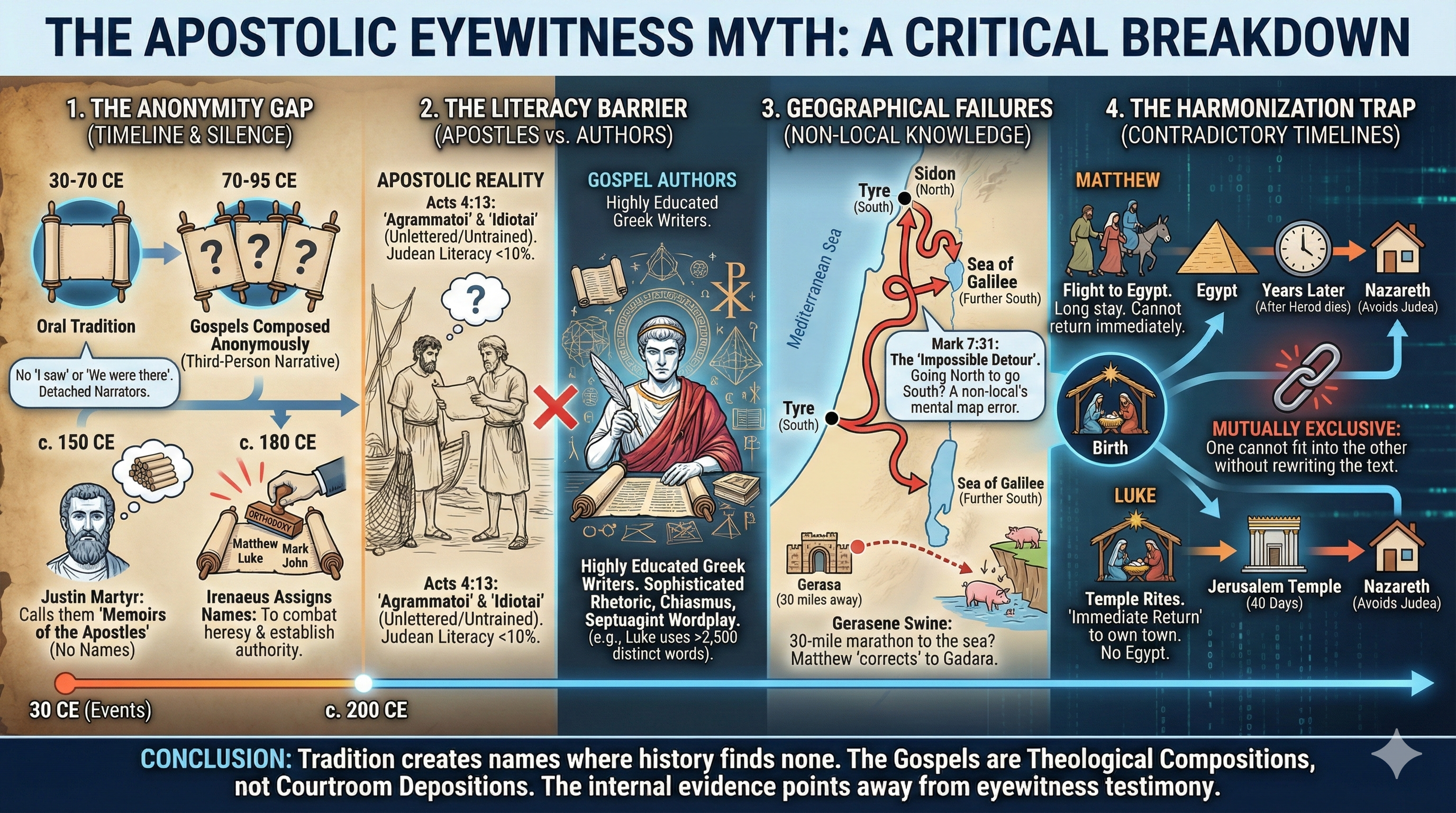
The assertion by contemporary Christians that the dead Apostles remain “eyewitnesses” to Jesus’ acts (e.g., Resurrection) collapses under scrutiny due to the protracted, convoluted communication chain spanning 33 CE to 2025 CE. An eyewitness, by legal and logical standards, requires direct sensory perception of an event (E), unmediated testimony (T), and negligible distortion (D). Define:
, where
is “eyewitness status,”
is sensory observation of E,
is testimony about E, and
is the absence of distortion.
- Reliability of testimony degrades with distortion:
, where
scales with the chain’s length (L), complexity (C), and error rate (ε).
For the Apostles, 
Gradient of Eyewitness Integrity (10 Examples)
This spectrum, from pristine to degraded, quantifies
- Immediate Court Witness (2025)
- Scenario: Jane sees a theft on February 27, 2025, testifies February 28.
- Chain:
, L = 1 day, ε ≈ 0.
,
.
- Status: Unassailable eyewitness.
- Video-Enhanced Witness (2025)
- Scenario: John reviews his dashcam of a crash, testifies.
- Chain:
, L = hours, ε ≈ 0.01 (tech fidelity).
,
.
- Status: Near-direct eyewitness.
- Real-Time Broadcast (1969)
- Scenario: Sarah sees Apollo 11 land live on TV, recounts it.
- Chain:
, L = seconds, ε ≈ 0.05 (media filter).
,
.
- Status: Proxy eyewitness.
- Delayed Oral Relay (1014 CE)
- Scenario: Viking eyewitness to Clontarf tells his son, who speaks 1040 CE.
- Chain:
, L = 26 years, ε ≈ 0.1 (memory fade).
,
.
- Status: Degraded firsthand.
- Herodotus’ Interview (450 BCE)
- Scenario: Herodotus records a Salamis veteran’s account 30 years later.
- Chain:
, L = 30 years, ε ≈ 0.2 (bias, recall).
,
.
- Status: Historical, tenuous.
- Tacitus’ Transcription (116 CE)
- Scenario: Tacitus writes of Rome’s fire (64 CE) from witnesses.
- Chain:
, L = 52 years, ε ≈ 0.3 (hearsay).
,
.
- Status: Secondhand.
- Medieval Compilation (1100 CE)
- Scenario: Monk records 5th-century Arthurian tales.
- Chain:
, L = 600 years, ε ≈ 0.5 (mythology).
,
- Status: Heavily distorted.
- Gilgamesh Flood Narrative (1200 BCE)
- Scenario: Flood account from witnesses, via millennia of tablets.
- Chain:
, L = 3000 years, ε ≈ 0.7.
,
- Status: Legendary.
- Paul’s Citation (55 CE)
- Scenario: Paul lists 500 Resurrection witnesses (1 Cor. 15), not seen by him.
- Chain:
, L = 22 years, ε ≈ 0.4 (hearsay).
,
- Status: Relayed, not eyewitness.
- Apostles’ Legacy (33 CE → 2025)
- Scenario: Apostles see Resurrection; Gospels and copies reach us.
- Chain:
, L = 1992 years, ε ≈ 0.8 (variants, theology).
,
- Status: Radically mediated.
Graphical Representation
Transmission Chains of Eyewitness Testimony: From Direct to Distorted
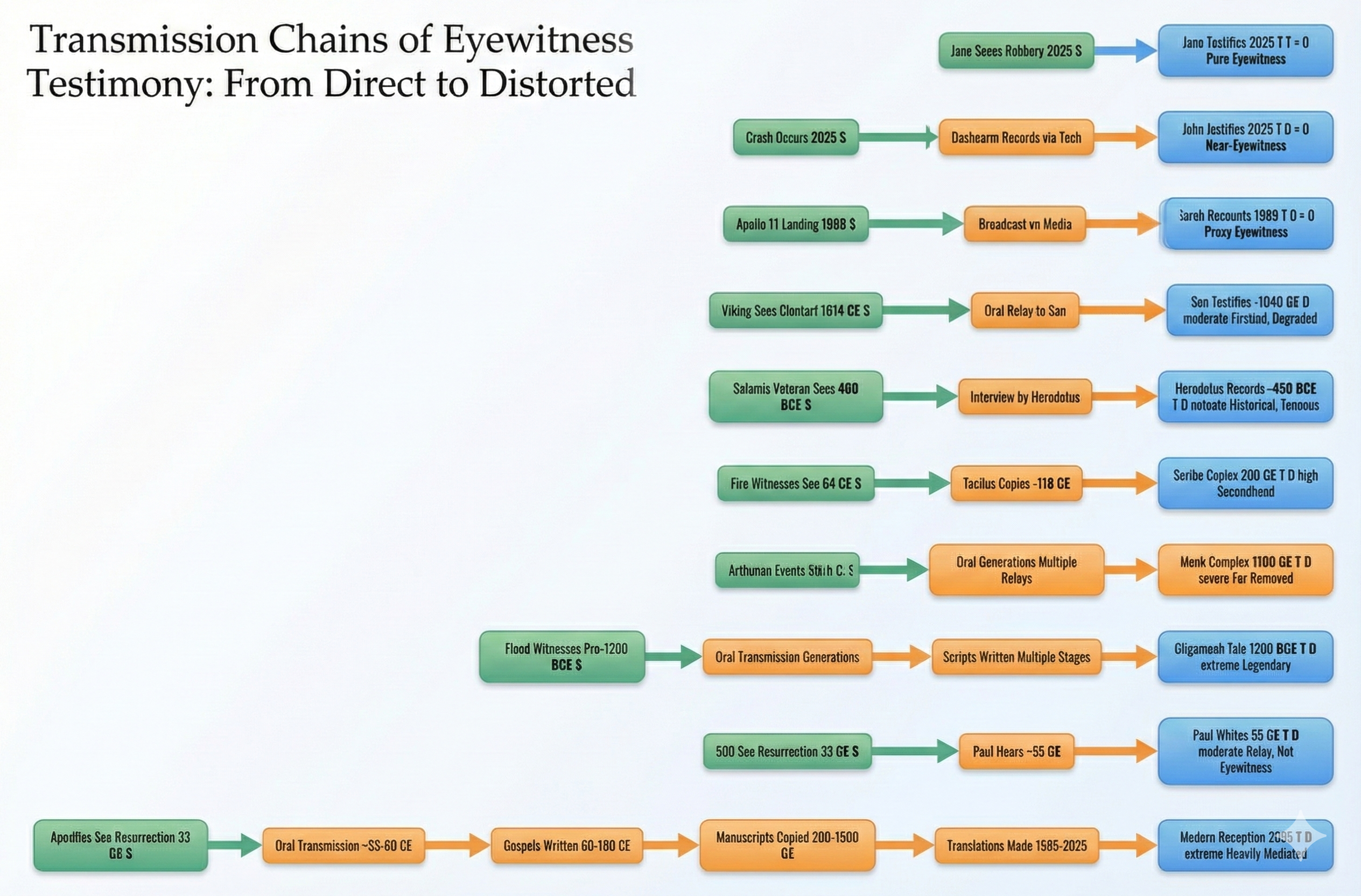
Explanation of the Chart
- Title: Remains “Transmission Chains of Eyewitness Testimony: From Direct to Distorted,” clearly framing the purpose.
- Structure: Each of the 10 examples now has a multi-node chain reflecting the full sequence from the “Chain:” entries (e.g., “S → Oral → Gospels → Manuscripts → Translations → T” for the Apostles). Arrows connect each step, showing the progression explicitly.
- Nodes:
- Start Nodes (A1-A10): Represent the initial observation (S), labeled with the event, year, and “S” (e.g., “Apostles See Resurrection 33 CE S”).
- Intermediate Nodes (B, C, D, E): Reflect each transmission step (e.g., “Oral Transmission,” “Gospels Written”), with approximate years where relevant.
- End Nodes: Mark the final testimony (T), including distortion level (D) and status (e.g., “Modern Reception 2025 T D extreme Heavily Mediated”).
- Chains:
- Example 1: Simple “S → T” (1 arrow).
- Example 10: Full “S → Oral → Gospels → Manuscripts → Translations → T” (5 arrows), matching the description.
- Styling:
- Start nodes (green) for observation.
- Intermediate nodes (yellow) for relay steps.
- End nodes (blue) for testimony.
- Ensures visual distinction between stages.
Historical Analogy: The Donation of Constantine
The “Donation of Constantine,” a forged 8th-century document claiming 4th-century origins, illustrates chain degradation. Supposedly, Constantine eyewitnessed his conversion and decreed papal power. The chain—oral claims, fabricated text, medieval copies—spanned 400 years before Lorenzo Valla (1440) exposed it via linguistic anachronisms. Distortion (
Logical Argument and Absurdity
Formalize the Christian claim:
- P1: Apostles are eyewitnesses iff
- P2:
(they saw Resurrection, 33 CE).
- P3:
(they testified then).
- P4:
.
- P5:
, where
,
,
.
- P6: Empirical evidence: 6000+ NT manuscript variants, e.g., John 7:53-8:11 absent in early texts.
- C1:
.
- C2:
.
- C3:
.
Absurdity: Asserting 
(Apostles’ sight).
after
relays.
- With
(generations, copies),
.
Claimingdefies information theory—akin to hearing a whisper after 100 noisy rooms and calling it the original shout.
Conclusion
The gradient shows 
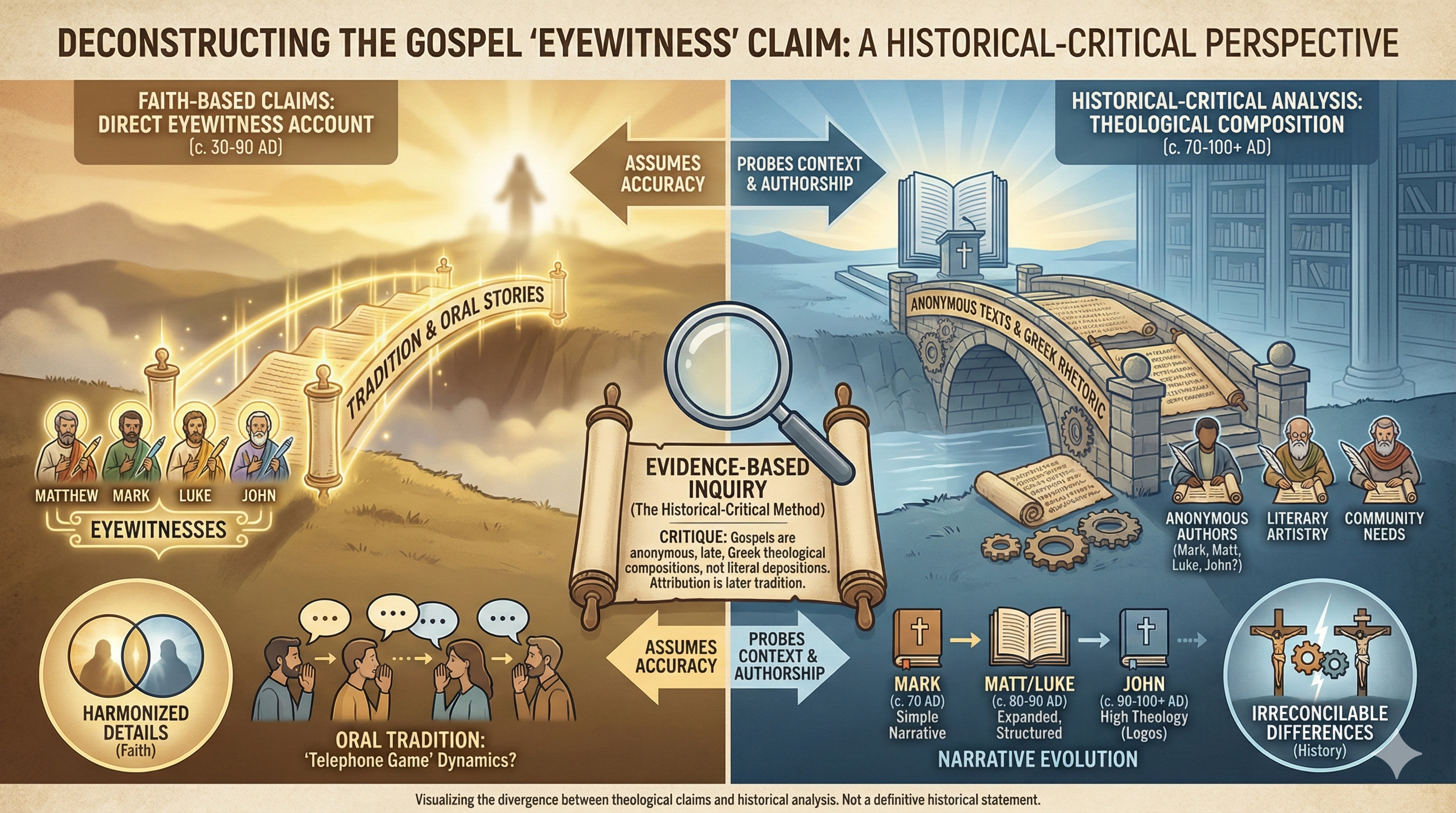
Below is a rigorous list of criteria that must be satisfied for someone to be legitimately called an “eyewitness” in a strict, evidence-based context—drawing from legal standards, cognitive science, and logical principles. Each criterion is defined precisely to ensure clarity and applicability, avoiding ambiguity or overreach. These criteria collectively establish a high bar for the term, reflecting its weight in establishing factual truth.
Criteria for Legitimate Eyewitness Status
- Direct Sensory Perception
- Definition: The individual must have personally observed the event (E) using their own senses—primarily sight, though hearing, touch, or smell may supplement—without reliance on technological intermediaries (e.g., video) or secondhand reports.
- Requirement: The observation must occur in real-time during the event’s duration, not as a recollection of a prior recording or narration.
- Rationale: Only direct sensory input ties the witness to the event unequivocally, excluding hearsay or relayed accounts.
- Test: Can the individual describe specific sensory details (e.g., “I saw the red jacket”) unavailable to non-observers?
- Physical Presence at the Event
- Definition: The individual must have been spatially and temporally proximate to the event, within a range allowing clear perception (e.g., line of sight, audible distance).
- Requirement: Presence must align with the event’s occurrence (e.g., within minutes or hours, not days later).
- Rationale: Proximity ensures the observation isn’t inferred or reconstructed from distant effects (e.g., seeing smoke but not the fire).
- Test: Can the individual’s location and timing be independently verified (e.g., via records or corroborating witnesses)?
- Cognitive Competence During Observation
- Definition: The individual must have been mentally capable of accurately perceiving and encoding the event into memory at the time it occurred.
- Requirement: No significant impairment (e.g., intoxication, extreme stress, or unconsciousness) that distorts perception or recall.
- Rationale: Cognitive distortion undermines the reliability of sensory data, a cornerstone of eyewitness credibility.
- Test: Were conditions (e.g., lighting, sobriety) conducive to clear perception, as assessed by objective measures or testimony?
- Ability to Testify Without Mediation
- Definition: The individual must be able to communicate their observations directly to the evaluating party (e.g., court, investigator) without reliance on intermediaries or extensive delay.
- Requirement: Testimony must be firsthand, under oath or equivalent accountability, and subject to cross-examination or scrutiny.
- Rationale: Mediation introduces distortion; directness preserves the link between perception and report.
- Test: Can the individual articulate their account in person, or is it filtered through others (e.g., scribes, translators)?
- Minimal Distortion in Transmission
- Definition: The chain between observation and testimony must be short and free of significant alteration, ensuring the account reflects the original perception.
- Requirement: Time elapsed must be brief (e.g., days or weeks, not years), and no substantive editing, embellishment, or memory decay should intervene.
- Rationale: Distortion scales with time and intermediaries; legal systems (e.g., U.S. courts per Neil v. Biggers, 1972) weigh this heavily.
- Test: Is the testimony delivered soon after the event, with no evidence of tampering or major discrepancies?
- Verifiable Specificity and Consistency
- Definition: The individual’s account must include precise, event-specific details that can be corroborated by independent evidence or witnesses and remain consistent across retellings.
- Requirement: Vague or contradictory statements disqualify the claim if they suggest fabrication or memory reconstruction.
- Rationale: Specificity anchors the testimony to reality; inconsistency signals unreliability (per cognitive psychology, e.g., Loftus’ memory studies).
- Test: Do details (e.g., “blue car, 3:15 PM”) match physical evidence or co-witness accounts, and hold under questioning?
- Absence of External Influence
- Definition: The individual’s perception and testimony must not be shaped by coercion, suggestion, or post-event information (e.g., media, leading questions).
- Requirement: The account must originate solely from the witness’s observation, not external priming or bias.
- Rationale: Contamination distorts memory, as shown in eyewitness misidentification cases (e.g., Innocence Project data).
- Test: Was the witness isolated from suggestive influences before testifying, per procedural safeguards?
Application and Implications
For someone to be legitimately called an “eyewitness”, all seven criteria must be met concurrently. Failure on any one—say, a long delay (Criterion 5) or reliance on a scribe (Criterion 4)—disqualifies the label. In a modern trial, a witness to a robbery on February 27, 2025, testifying on February 28 meets these standards: they saw it, were there, were sober, spoke directly, did so promptly, gave specifics, and weren’t coached. Contrast this with the Apostles: they may satisfy 1-3 in 33 CE, but 4-7 collapse under a 2,000-year chain of oral relays, Gospel edits, and manuscript variants. Their “testimony” reaches us as a mediated artifact, not a direct voice, rendering the term inapplicable today.
This list is deliberately stringent, aligning with legal and scientific demands for reliability. It excludes marginal cases (e.g., viewing a live broadcast) to preserve the term’s integrity, ensuring “eyewitness” denotes a gold standard of firsthand, undistorted evidence—not a loose metaphor for historical claims.
A Deep Dive into the Application of the Criteria for Legitimate “Eyewitness” Claims for the Resurrection of Jesus
Here’s the revised version with key terms bolded to emphasize critical concepts, maintaining the structure and rigor of the original analysis. This enhances readability and draws attention to the pivotal elements of the argument.
The claim that the Apostles can be considered “eyewitnesses” to Jesus’ alleged resurrection in a way that holds up to contemporary scrutiny fails when measured against the seven rigorous criteria for legitimate eyewitness status. These criteria—rooted in legal, logical, and psychological standards—demand directness, immediacy, and reliability that the Apostles’ accounts, as received in 2025, cannot satisfy due to the historical and textual realities of their transmission. Below, I evaluate each criterion in turn, demonstrating why the claim collapses under systematic analysis.
1. Direct Sensory Perception
- Criterion: The Apostles must have personally observed the Resurrection using their own senses (e.g., sight, touch) in real-time, not via intermediaries or secondhand reports.
- Assessment: Assuming the Resurrection occurred circa 33 CE, Christian tradition (e.g., Gospels, 1 Corinthians 15) asserts the Apostles saw Jesus post-resurrection—Peter and the Eleven in Galilee (Matthew 28:16-20), Thomas touching wounds (John 20:27). In 33 CE, this might satisfy the criterion: they reportedly perceived it directly. The test—describing sensory details like Jesus’ appearance or voice—seems plausible within the original context (e.g., “he ate fish,” Luke 24:42-43).
- Failure: This holds only for their initial observation. Today, we don’t access their sensory accounts directly; we rely on texts written decades later (e.g., Mark 60-70 CE). No living Apostle can provide sensory specifics to us, rendering the criterion unmet for modern claimants.
2. Physical Presence at the Event
- Criterion: The Apostles must have been spatially and temporally proximate to the Resurrection, within perceptual range, at the time it happened.
- Assessment: The New Testament places them at the scene—e.g., the empty tomb (John 20:1-10) or post-resurrection appearances (Luke 24:36-49). If true, their presence aligns with the event’s timing (days after crucifixion), satisfying proximity in 33 CE. Independent verification (e.g., Roman records) is absent, but the criterion doesn’t strictly require it if presence is credible.
- Failure: For us in 2025, their presence can’t be tested directly—no living witnesses or contemporary non-Christian sources (e.g., Josephus mentions Jesus but not the Resurrection) confirm it. The criterion holds historically but not for current validation, weakening its applicability today.
3. Cognitive Competence During Observation
- Criterion: The Apostles must have been mentally capable of perceiving and encoding the Resurrection accurately, free from impairment like stress or delusion.
- Assessment: The Gospels don’t report intoxication or unconsciousness, but extreme stress is plausible—Jesus’ crucifixion could induce grief or shock (e.g., “they were afraid,” Mark 16:8). Cognitive science suggests high-stress events can distort memory (e.g., Loftus, 1979), yet the accounts claim clarity (e.g., “they worshipped him,” Luke 24:52). Conditions like darkness (empty tomb at dawn, John 20:1) might challenge perception, but the texts imply sufficiency.
- Failure: We can’t objectively assess their mental state in 33 CE—no medical records or cross-examination exist. While they may have been competent, the lack of testable evidence leaves this criterion unverifiable, casting doubt on its fulfillment.
4. Ability to Testify Without Mediation
- Criterion: The Apostles must communicate their observations directly to us, without intermediaries, under scrutiny like cross-examination.
- Assessment: In 33 CE, they reportedly told others firsthand (e.g., Acts 2:32, Peter’s sermon). But by 2025, they’re dead, and their “testimony” reaches us via a chain: oral reports, Gospel authors (e.g., Mark as Peter’s scribe, per Papias), scribes, and translators. We can’t question them in person—only read mediated texts like Codex Sinaiticus (350 CE), a copy of earlier copies.
- Failure: This criterion fails decisively. The multi-layered mediation—spanning 2,000 years—prevents direct articulation. No Apostle stands before us; their voices are filtered through others, disqualifying them as eyewitnesses today.
5. Minimal Distortion in Transmission
- Criterion: The chain from observation to testimony must be short and unaltered, with testimony delivered soon after the event, free from editing or decay.
- Assessment: The Resurrection (33 CE) wasn’t documented immediately—Mark, the earliest Gospel, dates to 60-70 CE, a 30-40-year gap. Oral transmission preceded writing, then centuries of copying (e.g., 6,000+ New Testament manuscript variants) and translations (e.g., Vulgate, KJV) followed. Variants like Mark 16:9-20 (absent in early texts) show alteration. Legal standards (e.g., Neil v. Biggers) deem decades-long delays and edits unreliable.
- Failure: The chain is neither short (2,000 years) nor unaltered (textual discrepancies, theological shaping). Distortion is extreme, not minimal, making their testimony to us a distorted echo, not a pristine report.
6. Verifiable Specificity and Consistency
- Criterion: The Apostles’ accounts must offer precise, consistent details, corroborated by independent evidence or witnesses.
- Assessment: Gospel details vary—Matthew’s Galilee meeting (28:16) vs. Luke’s Jerusalem focus (24:33-49), John’s Thomas incident (20:27) vs. Mark’s abrupt end (16:8). Specifics exist (e.g., “two angels,” Luke 24:4), but inconsistencies suggest memory drift or editorial choice. No external sources (e.g., Roman, Jewish records) corroborate the Resurrection, only later Christian texts.
- Failure: Lack of consistency across accounts and absence of independent verification (e.g., Tacitus mentions Christians, not the event) fail this test. Vague or contradictory details can’t anchor the claim to reality for us today.
7. Absence of External Influence
- Criterion: The Apostles’ perception and testimony must be free from coercion, suggestion, or post-event contamination.
- Assessment: Post-crucifixion, the Apostles faced fear (John 20:19) and later preached under pressure (Acts 4:18-20). Early Christian communities shaped narratives (e.g., Paul’s theology in 1 Cor. 15:3-8, pre-Gospel). Cognitive psychology (e.g., Innocence Project cases) shows group belief can skew memory—possible here as faith solidified.
- Failure: We can’t prove isolation from influence. The decades before writing allowed communal input, and no procedural safeguards (e.g., neutral questioning) existed. Their accounts likely reflect some contamination, undermining purity.
Conclusion
The Apostles may have been eyewitnesses in 33 CE under criteria 1-3 (sensory perception, presence, competence), though even these lack modern verifiability. However, criteria 4-7 (mediation, distortion, specificity, influence) fail outright for us in 2025. Their “testimony” arrives via a 2,000-year chain of intermediaries, edits, and inconsistencies—far from the direct, pristine standard required. Calling them “eyewitnesses” today isn’t just a stretch; it’s a claim that crumbles under rigorous scrutiny, leaving us with a historical narrative, not a living witness. Faith may sustain it, but evidence does not.
Honest Framing of the Apostles’ Alleged Observation of Jesus’ Resurrection
When discussing the Apostles’ relationship to Jesus’ resurrection, precision in language is crucial to avoid overstating their role as eyewitnesses in a modern, legally rigorous sense. Those who wish to assert that the Apostles are alleged to have directly observed the resurrection—rather than receiving secondhand accounts—must choose words that reflect historical claims without implying current, firsthand testimony. Missteps in word choice can inflate the perception of their status beyond what evidence supports, especially given the 2,000-year transmission chain. Here’s how to express this accurately and responsibly.
First, anchor the claim in its historical context using past-tense verbs and qualifiers. Phrases like “The Apostles are alleged to have witnessed Jesus’ resurrection” or “Tradition holds that the Apostles directly saw the risen Jesus” emphasize that this is a reported event from 33 CE, not a present reality. Avoid active, present-tense constructions like “The Apostles serve as eyewitnesses” or “The Apostles testify to the resurrection,” which suggest they’re delivering testimony to us now, unmediated. Such phrasing falsely implies they meet modern eyewitness criteria—like directness or cross-examination—which they cannot, given their deaths and the intervening Gospel authorship, manuscript copying, and translations.
Second, use terms that signal mediation and uncertainty to sidestep legitimacy traps. Opt for “According to the Gospels, the Apostles reportedly observed the resurrection firsthand” or “Christian texts allege the Apostles’ direct perception of Jesus’ return.” Words like “reportedly,” “allegedly,” or “according to” nod to the textual basis (e.g., Matthew 28, John 20) without endorsing the accounts as pristine evidence. Steer clear of loaded terms like “eyewitnesses” or “proof” in unqualified form—e.g., “The Apostles are eyewitnesses to the resurrection”—as these carry legal and scientific weight (e.g., minimal distortion, verifiable details) that the New Testament chain can’t sustain. Instead, “alleged observers” or “reputed firsthand seers” keeps the focus on the claim’s historical nature, not its current validity.
Finally, acknowledge the transmission explicitly if space allows, reinforcing the gap between then and now. Try “The Apostles are said to have seen Jesus rise, per early Christian accounts later recorded in the Gospels” or “Historical tradition credits the Apostles with direct sight of the resurrection, though only through mediated texts.” This clarifies that we’re dealing with a relayed story—not a living witness—and avoids overstretching into eyewitness territory. Precision here respects the faith perspective while dodging the pitfalls of anachronistic or unsupported certainty. Words shape perception; choose them to reflect history, not immediacy.
See also:


 Free of Faith
Leave a comment