
The Earthquake and the Rising of the Dead:
A Historical Assessment of Matthew 27:51-53
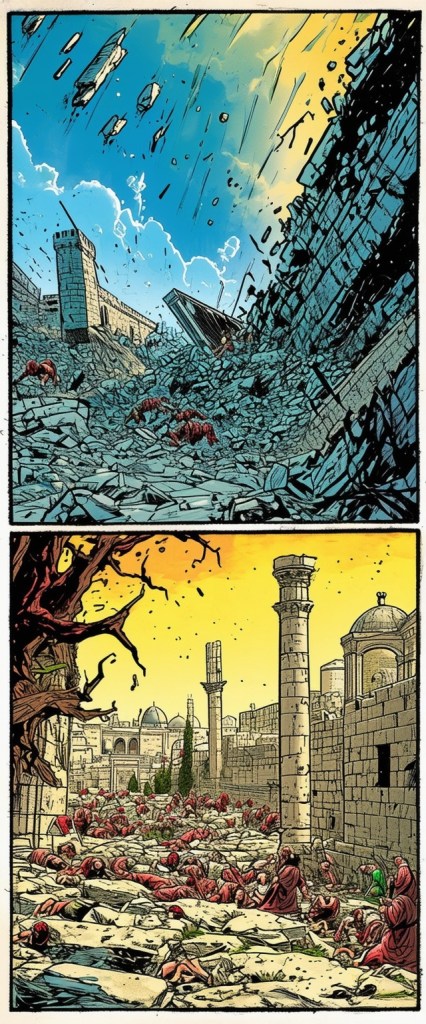
The Gospel of Matthew describes extraordinary events surrounding Jesus’ death—an earthquake, the tearing of the temple veil, and the resurrection of the dead who later appeared in Jerusalem. However, no contemporary historical sources outside of Matthew confirm these events. Given their supernatural and public nature, the complete lack of documentation from historians, local records, or even the relatives of the resurrected individuals presents a significant challenge to their historicity. By examining how natural disasters, mass resurrections, and other extraordinary public events have been documented throughout history, we can assess whether their omission in external records is justified or problematic.
The Absence of Historical Documentation of a Supposed Earthquake
Major earthquakes in populated areas are almost always recorded by contemporary sources. If an earthquake of significant magnitude had struck Jerusalem at the time of Jesus’ death, it would have likely been noted by Jewish or Roman historians. However, there is a total silence from all non-Christian records.
Several examples highlight how earthquakes were routinely documented:
- The 62 CE Earthquake in Pompeii – This disaster was extensively recorded by Seneca the Younger, despite occurring years before Pompeii’s more famous destruction in 79 CE.
- The 31 BCE Earthquake in Judea – Josephus, the Jewish historian, documented this earthquake in Antiquities 15.5.2, stating that it killed 30,000 people.
- The 365 CE Crete Earthquake and Tsunami – This catastrophic event was recorded in multiple sources, including Ammianus Marcellinus and the Chronicon Paschale.
- The 79 CE Eruption of Mount Vesuvius – A volcanic disaster widely recorded by Pliny the Younger and other Roman historians.
Despite Matthew’s claim, no historian of the time—Jewish, Roman, or Greek—mentions an earthquake in Jerusalem at the time of Jesus’ death. This silence is especially striking given that Josephus, who wrote in detail about first-century Judea, does not reference it. If such a seismic event occurred, its absence from historical records strongly suggests it was either insignificant or fictional.
The Absence of Documentation for the Rising of the Dead
Matthew claims that many dead people came out of their tombs and walked into Jerusalem, appearing to many. This should have left a major historical trace, but instead, we find zero evidence of it in any external sources. The implications of this silence are enormous.
- Where Are the Accounts from Historians?
- Josephus, a Jewish historian obsessed with documenting religious events, says nothing about a mass resurrection.
- Tacitus, a Roman historian known for detailing supernatural claims, does not mention it.
- Pliny the Elder, who cataloged strange natural and supernatural occurrences, is also silent.
- Philo of Alexandria, a Jewish philosopher who wrote extensively on Jewish life in the first century, never refers to such an event.
- Where Are the Accounts from Relatives of the Resurrected?
- If “many saints” rose from the dead, their families, neighbors, and religious leaders would have surely documented their return.
- Yet, there are no letters, inscriptions, or oral traditions outside of Matthew that mention these individuals.
- If even one of these resurrected people was known to have returned, their presence would have sparked intense public reaction, especially from Jewish authorities who were hostile to Jesus’ movement.
- Why Didn’t the Other Gospels Mention This?
- Mark, Luke, and John, all written independently, do not mention the resurrection of the saints.
- If dead people had entered the city, it would have been a major proof of Jesus’ divine power—so why is only Matthew concerned with it?
- The omission by all other sources, including other Christian Gospel writers, suggests this event was a theological embellishment rather than a historical fact.
Comparing to Other Mass Public Events
Throughout history, unusual or supernatural events—whether celestial omens, natural disasters, or mass deaths—are almost always documented, especially when they affect major cities. Several cases demonstrate this:
- Halley’s Comet (66 CE) – This event was recorded by both Chinese and Roman historians, and Josephus interpreted it as an omen for Jerusalem’s fall.
- Julius Caesar’s Assassination (44 BCE) and Celestial Omens – Multiple historians (Plutarch, Suetonius, Cassius Dio, Tacitus) recorded alleged supernatural events accompanying Caesar’s death, showing how even fabricated or exaggerated events still get recorded.
- The Darkness at Jesus’ Death – Matthew, Mark, and Luke claim that darkness covered the land during Jesus’ crucifixion, yet no external records confirm it. The Roman historian Thallus allegedly wrote about a solar eclipse, but his work is lost, and the only reference comes from a Christian writer over a century later, making it unreliable.
Given that less extraordinary events than a mass resurrection have been widely recorded, the complete absence of documentation for such an event suggests that it was not historical.
Assessing Possible Explanations for the Lack of Documentation
If the earthquake and mass resurrection truly occurred, they should have been recorded. Since they were not, we must consider three possible explanations:
- The Events Were Fabricated
- The simplest explanation is that the earthquake and resurrection of saints were literary devices used by Matthew to emphasize Jesus’ divine significance.
- Matthew frequently uses apocalyptic imagery from the Hebrew Scriptures (e.g., Zechariah 14:4-5 describes an earthquake splitting a mountain; Ezekiel 37 speaks of the resurrection of dry bones).
- The Events Were Exaggerated or Misunderstood
- Perhaps there was a minor tremor, later exaggerated into a theological earthquake.
- The “rising of the saints” may have originally been meant as a symbolic prophecy, later misinterpreted as literal history.
- A Conspiracy of Silence? (Highly Unlikely)
- Some Christian apologists suggest Jewish and Roman authorities suppressed the event.
- However, this is implausible because:
- The Romans had no reason to suppress evidence of supernatural events.
- The Jewish elite would have publicized a mass resurrection to discredit Christianity, not erase it.
- If such events were known, early Christians would have cited external sources, yet they did not.
Final Assessment: The Absence of Documentation Strongly Suggests the Events Did Not Happen
Given the historical record of earthquakes, resurrections, and other supernatural claims, the total silence regarding the earthquake and mass resurrection in Jerusalem at the time of Jesus’ death is highly problematic.
If such events truly happened, historians, relatives, and witnesses would have written about them. The fact that not a single source outside Matthew’s Gospel records them strongly suggests they were not historical but theological embellishments.
The best explanation is that Matthew’s account is apocalyptic symbolism, not a factual report. The lack of independent corroboration from Roman, Jewish, or even other Christian sources undermines its credibility and points to a later theological addition rather than a real event.
The Historians Who Should Have Recorded the Earthquake and Rising of the Dead at Jesus’ Death
The Gospel of Matthew (27:51-53) describes two extraordinary events at Jesus’ crucifixion: a great earthquake and the resurrection of many dead people who later appeared in Jerusalem. If such supernatural and public occurrences had actually taken place, they should have been documented by historians of the time. However, no independent sources—Jewish, Roman, or Greek—confirm these events.
Given the significance of Jerusalem and its connection to both Rome and Jewish religious life, multiple historians had the opportunity to record such events. This essay examines the major historical writers who could have provided accounts and explores the implications of their silence.
Jewish Historians Who Should Have Documented These Events
The Jewish people were meticulous record-keepers, especially concerning religious and political events. If an earthquake shook Jerusalem and dead saints walked the streets, Jewish writers should have noticed.
1. Josephus (c. 37–100 CE)
- Who was he?
- A first-century Jewish historian who lived in Jerusalem before its destruction in 70 CE.
- Fought against Rome in the Jewish-Roman War (66-73 CE) and later wrote extensively on Judean history.
- Major Works
- Antiquities of the Jews (c. 93 CE) – A detailed history of the Jewish people from creation to his time.
- The Jewish War (c. 75 CE) – A comprehensive account of the fall of Jerusalem and earlier political events.
- Why He Should Have Mentioned the Earthquake and the Rising of the Dead
- Josephus describes other earthquakes in Judea, such as the 31 BCE earthquake that killed 30,000 people (Antiquities 15.5.2).
- He documents false messiahs, rebellions, celestial signs, and supernatural claims—yet says nothing about dead people appearing in Jerusalem.
- His silence strongly suggests that these events did not happen or were not known in his time.
2. Philo of Alexandria (c. 20 BCE – 50 CE)
- Who was he?
- A Jewish philosopher and historian who lived in Alexandria, Egypt.
- Wrote extensively about Jewish life and theology.
- Major Works
- Embassy to Gaius – Discusses Roman rule over Judea and religious tensions.
- On Providence – Examines divine intervention in history.
- Why He Should Have Mentioned the Earthquake and the Rising of the Dead
- Philo writes about miraculous events related to Judaism but never mentions these alleged signs at Jesus’ death.
- If dead saints had been seen in Jerusalem, it would have aligned with apocalyptic Jewish expectations, yet Philo is completely silent.
3. The Talmud (Compiled 3rd-5th Century CE)
- What is it?
- A collection of Jewish rabbinic teachings and discussions that include commentary on first-century events.
- Why It’s Important
- The Talmud mentions Jesus (often in a polemical way), showing that Jewish scholars were aware of his movement.
- If a mass resurrection had occurred, Jewish scholars would have had strong incentives to record and debunk it.
- Instead, there is no reference to these events in any early Jewish texts.
Roman Historians Who Should Have Documented These Events
The Roman Empire had control over Judea during this period, and Roman historians routinely documented earthquakes, celestial omens, and strange occurrences. If an earthquake and mass resurrection occurred in Jerusalem, these historians had every reason to record it.
4. Tacitus (c. 56–120 CE)
- Who was he?
- A Roman historian and senator who wrote detailed histories of the empire.
- Major Works
- Annals – Covers Roman history from Tiberius to Nero (14–68 CE).
- Histories – Covers the Jewish-Roman War and other significant events.
- Why He Should Have Mentioned the Earthquake and the Rising of the Dead
- Tacitus mentions Jesus in Annals 15.44, noting his crucifixion under Pontius Pilate.
- He records earthquakes, political omens, and celestial events—but says nothing about an earthquake or resurrected saints in Jerusalem.
- His silence suggests these events were not widely known.
5. Suetonius (c. 69–122 CE)
- Who was he?
- A Roman historian who wrote biographies of emperors from Julius Caesar to Domitian.
- Major Works
- The Twelve Caesars – Includes stories of supernatural omens, prophecies, and celestial events.
- Why He Should Have Mentioned the Earthquake and the Rising of the Dead
- Suetonius records natural disasters, strange omens, and Jewish disturbances.
- If dead saints had walked into Jerusalem, this would have been exactly the kind of bizarre event he loved to document.
- His failure to mention it suggests that no such event was known in Rome.
6. Pliny the Elder (c. 23–79 CE)
- Who was he?
- A Roman naturalist and historian who documented earthquakes and supernatural phenomena.
- Major Works
- Natural History – A vast encyclopedia covering geology, astronomy, and historical events.
- Why He Should Have Mentioned the Earthquake and the Rising of the Dead
- Pliny documents earthquakes across the Roman Empire, including minor tremors.
- His failure to mention an earthquake in Jerusalem at Jesus’ death suggests that no significant seismic event occurred.
Why No Family Members or Eyewitnesses Reported the Rising of the Dead
Beyond historians, relatives and eyewitnesses should have recorded the return of resurrected loved ones:
- Where are the family records?
- If saints had risen, their relatives would have reacted.
- There are no letters, inscriptions, or oral traditions describing people reuniting with dead relatives.
- Where are the Jewish priestly records?
- The Jewish Sanhedrin kept records of unusual religious occurrences.
- If many Jewish saints were resurrected, the high priests would have had to investigate—yet they recorded nothing.
- Where are the early Christian references?
- Paul, who wrote before Matthew, never mentions the earthquake or the rising of the dead.
- The Book of Acts, which describes early church history, is also completely silent on this event.
Final Assessment: The Absence of Documentation is Devastating
If an earthquake and a mass resurrection truly happened in Jerusalem, the lack of independent documentation is inexplicable. The following groups had every reason to record such events:
✅ Jewish Historians (Josephus, Philo, the Talmud) – No mention.
✅ Roman Historians (Tacitus, Suetonius, Pliny the Elder) – No mention.
✅ Eyewitnesses and Families – No personal records.
✅ Other Christian Writers (Mark, Luke, John, Paul, Acts) – No confirmation.
The most reasonable conclusion is that these events did not occur. Instead, they were likely literary embellishments added by Matthew to create a theological message rather than a historical account.
The Oddity of the Omission: Why the Other Gospels Exclude the Earthquake and Rising of the Dead
The Gospel of Matthew (27:51-53) makes astonishing claims about the death of Jesus—a great earthquake, the tearing of the temple veil, and, most dramatically, the resurrection of many dead saints who appeared in Jerusalem. If true, these would have been some of the most wondrous and public supernatural events in history. Yet, despite their significance, Mark, Luke, and John—the other canonical Gospels—do not mention them at all. This omission raises an important question: Why would such extraordinary events be absent from their accounts?
1. Mark, the Earliest Gospel, Says Nothing of These Events
The Gospel of Mark is widely regarded by scholars as the earliest Gospel, written around 65-70 CE. If an earthquake and mass resurrection had truly occurred at Jesus’ crucifixion, it is perplexing that Mark makes no mention of them.
- Mark does describe the temple veil tearing (Mark 15:38), showing that he was not opposed to including symbolic or supernatural elements in his account.
- However, he is completely silent about an earthquake or the dead rising and appearing to many—even though these events would have been far more dramatic than a torn curtain.
- If these events were historical and widely known, it is almost inconceivable that Mark, writing just a few decades later, would fail to mention them.
2. Luke and John Also Exclude These Events
- Luke (c. 80-90 CE) was written after Mark and is known for carefully investigating sources (Luke 1:1-4).
- If an earthquake and mass resurrection were well-known traditions, Luke—who claims to provide an “orderly account”—should have included them.
- John (c. 90-100 CE), which emphasizes Jesus’ divine nature, would have had every reason to highlight such spectacular events as proof of Jesus’ cosmic significance—yet John’s Gospel does not mention them at all.
Given that both Luke and John used sources beyond Mark, their omission of Matthew’s dramatic events suggests they either had never heard of them or did not consider them credible.
3. Early Christian Writers Also Ignore These Events
If the earthquake and mass resurrection had actually happened, early Christian writers should have cited them as proof of Jesus’ divine power. Yet:
- Paul (c. 50s CE) never mentions these events, even though he frequently argues for Jesus’ resurrection.
- The Book of Acts, which details the early Christian movement, does not reference these events.
- Church Fathers like Clement of Rome (c. 95 CE) and Ignatius (c. 110 CE), who wrote about Jesus’ death, also do not mention them.
The silence from early Christian sources reinforces the conclusion that these events were not widely known—or not believed to be historical.
4. The Best Explanation: A Later Theological Addition by Matthew
Given that only Matthew records the earthquake and resurrection of saints, the most plausible explanation is that he added these details for theological and literary effect.
- Matthew’s Gospel frequently employs Old Testament imagery to present Jesus as the fulfillment of prophecy.
- Earthquakes and rising dead were common apocalyptic motifs in Jewish literature (e.g., Ezekiel 37’s “valley of dry bones”).
- Matthew may have symbolically crafted these events to emphasize Jesus’ cosmic significance rather than reporting a historical occurrence.
Conclusion: The Silence of the Other Gospels Undermines Matthew’s Account
The complete absence of an earthquake and mass resurrection in Mark, Luke, John, and early Christian writings is a striking anomaly. If these events had actually occurred, they would have been among the most dramatic and well-documented miracles in history. Instead, their omission strongly suggests that they were not historical facts, but later literary additions unique to Matthew’s Gospel.


 Free of Faith
Leave a comment