
THE GRADIENT OF BELIEF:
WHY PRESUPPOSITIONS REFLECT A FAULTY EPISTEMOLOGY


Many philosophical misunderstandings begin with the assumption that belief is binary. That is, one either believes a proposition or doesn’t. But this black-and-white model fails to reflect the complex and nuanced nature of rational inquiry. In reality, belief is best represented as a degree of credence that varies according to the available evidence.
Belief Is Not Binary
Instead of thinking in terms of “believing” or “not believing,” we should speak in terms of credences—numerical values that express how confident one is that a proposition is true. In this view, belief becomes a function from propositions to real numbers in the closed unit interval:
Here, 


Inductive Evidence Is Also Gradient-Based
Like belief, evidence gathered through induction is not all-or-nothing. Evidence may support a proposition weakly or strongly, partially or extensively. Thus, the strength of evidence should also be understood as a value on a continuum:

Here, 

In Bayesian terms, we often denote this relationship with:

Which signifies the probability of
Credence Should Map Directly to Evidence
If both belief and evidence are gradients, it follows that the rational posture is to align one’s belief to the evidence proportionally:

When your credence in a proposition directly mirrors the degree of evidential support it receives, you are not making a presupposition. You are making an inference. In fact, presuppositions become unnecessary under this epistemic model, because your belief is not arbitrarily assumed but is instead tethered to the observed weight of evidence.
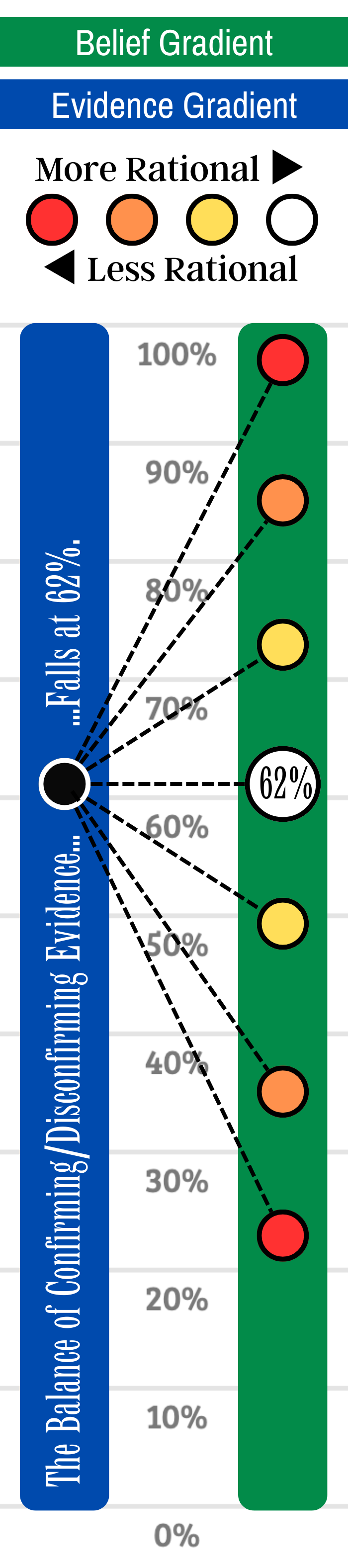
The Thermometer Analogy
Imagine a thermometer that doesn’t simply say “hot” or “cold,” but instead reads the precise temperature. Your belief system should be like that thermometer—registering subtle shifts in evidential support without defaulting to extremes. A binary thinker is like someone with only two options on their thermostat: boiling or freezing. A rational thinker, by contrast, uses a dimmer switch of belief calibrated to the available data.
A Real-World Example
Consider the proposition: “There is intelligent life elsewhere in the universe.” One may find weak but nontrivial support for this idea based on the vastness of the cosmos and the growing number of habitable-zone exoplanets. A binary epistemology would force you to either accept or reject the claim wholesale. But a credence-based approach allows you to say something more precise, such as:

This credence of 0.3 neither affirms nor denies the proposition absolutely. It expresses a moderate, evidence-sensitive stance open to revision.
The Epistemic Payoff
The advantage of this approach is not just philosophical elegance—it’s practical robustness. By anchoring belief to the evidential gradient, you avoid the pitfalls of dogma, bias, and epistemic closure. You gain the ability to revise your stance rationally as new data emerge, avoiding both the paralysis of indecision and the arrogance of unwarranted certainty.
Conclusion
Both belief and evidence live on a continuum. Once you accept this, the path to rational inquiry becomes clear: match your degree of belief to the degree of evidence, and presuppositions become unnecessary. You are no longer guessing. You are measuring.
The Human Development Elements of the Argument:
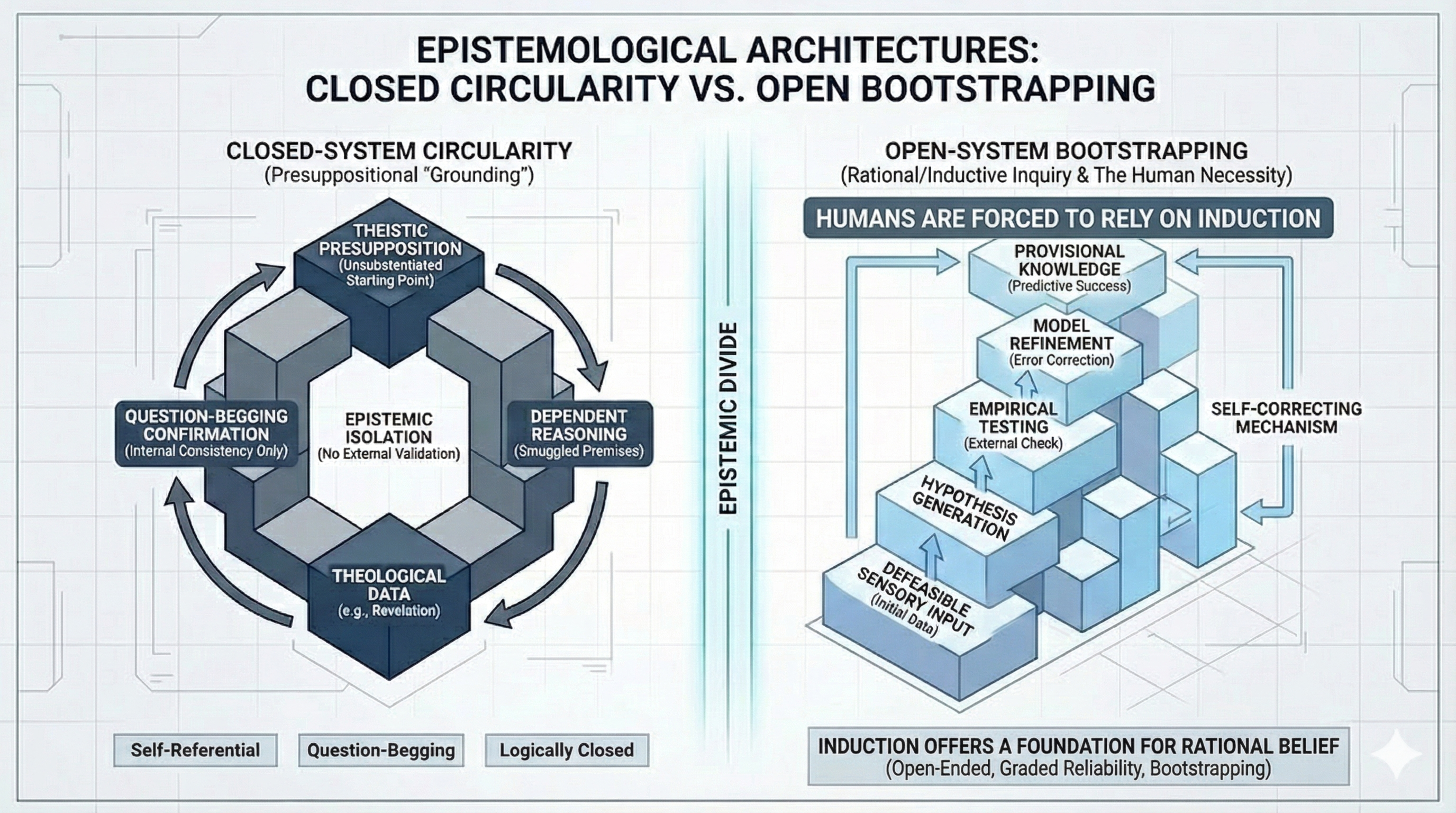
The assertion that every act of reasoning presupposes logic, sense-reliability, or induction has become a kind of philosophical reflex. It is invoked to accuse the interlocutor of inconsistency: “You cannot evaluate evidence without presupposing the very tools you claim come from evidence.” The claim sounds profound, but it collapses under a simple fact about human cognition: we learn the reliability of our cognitive tools from experience. No leap is required. No presuppositions need to be smuggled in.
A fallible mind begins life immersed in a stream of regularities. A baby does not begin with object permanence, spatial consistency, or even the expectation that causes precede effects. Those expectations emerge only after thousands of interactions in which the world behaves in patterned, non-chaotic ways. This is why developmental psychology treats things like object permanence as acquired milestones, not innate axioms.
1. The Developmental Pathway Shows That Logic and Reliability Judgments Are Learned
A child learns that objects persist because every attempt to find the toy behind the blanket repeatedly succeeds. A child learns that similar actions produce similar results because this pattern holds over and over again. And eventually, the child acquires what may be called inductive density: a sufficiently rich set of regularities to justify forward-looking expectations.
Even something as “self-evident” as mathematical order is a learned regularity. There is no metaphysical necessity forcing the expectation that five comes after four. Rather, every exposure in the child’s cognitive history reinforces this sequence. That reinforcement is empirical. The fact that adults can no longer remember the acquisition of such expectations does not make them presuppositions.
Thus the core principle is simple: the reliability of our cognitive tools is inferred from their consistent performance in the past.
2. Induction Is the Only Cognitive Process a Fallible Mind Can Justify
The presuppositionalist claim fails because it smuggles in hidden necessity: it assumes that a mind is compelled to begin with unearned certainty in logic, reason, or sensory trustworthiness. But nothing about a fallible mind requires that. The only rational path is to adopt confidence to the degree that such tools have proven stable and reliable.
This is the essence of evidence-proportioned belief. Every tool remains only as justified as its observed success rate. This procedure is inductive through and through.
3. Symbolic Formulation of the Argument
To state the argument cleanly, let E(x) represent the past experiential success of cognitive tool x (logic, senses, etc.), and J(x) represent the justification for trusting x.
Then:
If a fallible mind is justified in trusting x, it must be because x has succeeded in past experience.

If x has not shown experiential reliability, a fallible mind has no justification for trusting it.

The reliability of x is learned inductively from a history of consistent outcomes.

From these follows:

Thus:

There is no x for which justification comes from a non-empirical presupposition. Everything is ultimately evidence-dependent.
4. Why “You Presuppose Logic and Induction” Is Epistemically Mistaken
To claim that logic or induction must be presupposed is to assert that the mind is forced to adopt them without evidence. But this is simply not how human cognition develops. Infants do not begin with deductive schemas. They begin with chaotic impressions which only coalesce into structured expectations after extensive exposure to regularities.
Moreover, if presuppositionalism were correct, we would expect cognitive tools to be incorrigible — that is, held with absolute, unchangeable certainty. Yet we observe the opposite: in senility, brain trauma, or neurological decline, these expectations erode. This demonstrates that they were not innate axioms but learned patterns with contingent psychological reinforcement.
5. Three Core Conclusions
- A fallible mind has no non-inductive compulsion to form expectations about the world. Expectation emerges only after sufficient evidence of regularity.
- A fallible mind therefore has no justification for presuppositions. All justifications trace back to accumulated empirical regularities.
- I hold no presuppositions. I have direct cognitive access to this fact. My confidence in logic, sensory reliability, or induction is wholly evidence-based, and therefore wholly revisable should future experience undermine them.
Conclusion (3) is introspective: I know my own cognitive state from the inside. Conclusions (1) and (2) are empirical-philosophical: they could be wrong, but only if someone presents new evidence of an alternative path by which a fallible mind acquires justified expectations.
6. The Burden of Proof Shifts
Those who assert the necessity of presuppositions must demonstrate:

That is: that at least one cognitive tool is justified independently of experience.
To date, there is no such demonstration. All attempts rest on rhetorical assertion, not evidence. And without evidence, the presuppositional claim collapses into the very dogmatism it accuses others of committing.
Closing Reflection
A fallible mind must proportion its expectations to patterns actually observed in the world. Nothing in human cognition requires presuppositions. Everything required for justified rationality — logic, sense-reliability, induction — is learned through evidence, reinforced by evidence, and always open to revision in light of evidence. This is not a philosophical weakness. It is the foundation of rational thought.
SYMBOLIC LOGIC REPRESENTATION
Let:
denote a belief in proposition
represent a credence function giving the degree of belief in
represent the degree to which the evidence supports
denote “not”.
Premise 1 (Belief is not binary):
![\forall P \left[ B(P) \rightarrow \text{Cr}(P) \in [0,1] \right]](https://s0.wp.com/latex.php?latex=%5Cforall+P+%5Cleft%5B+B%28P%29+%5Crightarrow+%5Ctext%7BCr%7D%28P%29+%5Cin+%5B0%2C1%5D+%5Cright%5D&bg=ffffff&fg=000&s=0&c=20201002)
Interpreted: For any proposition
Premise 2 (Inductive evidence is not binary):
![\forall P \left[ \text{Inductive}(P) \rightarrow \text{Deg}(E,P) \in (0,1) \right]](https://s0.wp.com/latex.php?latex=%5Cforall+P+%5Cleft%5B+%5Ctext%7BInductive%7D%28P%29+%5Crightarrow+%5Ctext%7BDeg%7D%28E%2CP%29+%5Cin+%280%2C1%29+%5Cright%5D&bg=ffffff&fg=000&s=0&c=20201002)
Interpreted: For any inductive proposition
Conclusion (Epistemically calibrated belief avoids presuppositions):
![\forall P \left[ \text{Inductive}(P) \rightarrow \left( \text{Cr}(P) = \text{Deg}(E,P) \right) \rightarrow \sim\text{Presupposes}(P) \right]](https://s0.wp.com/latex.php?latex=%5Cforall+P+%5Cleft%5B+%5Ctext%7BInductive%7D%28P%29+%5Crightarrow+%5Cleft%28+%5Ctext%7BCr%7D%28P%29+%3D+%5Ctext%7BDeg%7D%28E%2CP%29+%5Cright%29+%5Crightarrow+%5Csim%5Ctext%7BPresupposes%7D%28P%29+%5Cright%5D&bg=ffffff&fg=000&s=0&c=20201002)
Interpreted: For all inductive propositions
COMMENTARY
- The reasoning explicitly denies any binary construal of belief (i.e., either belief or non-belief), replacing it with a continuous credence function.
- Evidence, under inductive reasoning, is likewise gradient-bound, and not decisive in most cases.
- Therefore, belief need not rest on presupposition if it is epistemically tethered to the evidential gradient.
A Deeper Dive:
1. Establishing the Invalidity of Presuppositions Due to Fallibility and Incomplete Induction
In rational epistemology, a presupposition is an assumption taken as necessarily true without further justification, often treated as foundational for reasoning. No phenomenon, even one with high regularity (call it X), justifies such a presupposition due to two factors: (1) the intrinsic fallibility of human minds and (2) the incompleteness of inductive experience.
- Intrinsic Fallibility of Our Minds: Human cognition is prone to error. Our sensory perceptions, memory, and reasoning processes are not infallible. For example, optical illusions demonstrate how perception can mislead, and cognitive biases like confirmation bias skew our interpretations. This fallibility means we cannot claim absolute certainty about any phenomenon, as our mental faculties might misinterpret or misrepresent X’s regularity. Even if X (e.g., the sun rising daily) appears consistent, our cognitive limitations prevent us from elevating this observation to an absolute presupposition.
- Incompleteness of Inductive Experience: Induction relies on observing a finite set of instances to generalize about a phenomenon. No matter how many times we observe X, our sample is always incomplete relative to the infinite possible instances of X across time and contexts. This is David Hume’s problem of induction: past regularities do not guarantee future ones. For instance, observing the sun rising every day for millennia does not logically entail it will rise tomorrow, as an unforeseen event (e.g., a cosmic anomaly) could disrupt the pattern. Thus, the inductive density—the strength of our confidence based on repeated observations—never reaches the level of an absolute presupposition, as it remains open to revision.
Together, these factors ensure that our belief in X’s regularity is probabilistic, not absolute. The inductive density may be extremely high (e.g., 99.999% confidence), but it never reaches 100%, as fallibility and incomplete induction introduce irreducible uncertainty. Presuppositions, which demand certainty, are therefore invalid in a rational epistemology that acknowledges these limitations.
2. Applying the Concept to Gravity and Logic
Let’s apply this reasoning to phenomena with perceived high regularity, such as gravity and logic, showing that their inductive density remains asymptotically beneath an absolute presupposition.
- Gravity: Gravity appears highly regular. Objects fall toward the Earth consistently, and Newton’s laws (later refined by Einstein’s general relativity) describe this behavior with remarkable precision. Our inductive experience—billions of observations across centuries—creates a very high inductive density. However, this does not justify a presupposition that gravity is immutable. First, our minds are fallible: we might misinterpret gravitational phenomena or rely on flawed instruments. Second, our inductive experience is incomplete. While gravity has been consistent on Earth, anomalies could arise in extreme conditions (e.g., near black holes or in undiscovered cosmic scenarios). Theoretical physics even entertains possibilities like quantum gravity or variable fundamental constants, which could alter gravity’s behavior. Thus, our confidence in gravity’s regularity is asymptotically close to certainty but never absolute, as it remains revisable in light of new evidence or theoretical shifts.
- Logic: Logic, particularly classical logic (e.g., the law of non-contradiction), seems even more fundamental, as it underpins reasoning itself. We rely on logical principles in every rational inquiry, creating an immense inductive density based on their consistent application. Yet, logic is not immune to the same epistemic constraints. Our minds are fallible: we might misapply logical rules or fail to recognize contextual nuances (e.g., paradoxes like the liar paradox challenge straightforward applications). Moreover, our inductive experience with logic is incomplete. Non-classical logics (e.g., paraconsistent or quantum logic) suggest that classical principles may not hold universally, especially in extreme domains like quantum mechanics. While we rely heavily on logic, we cannot presuppose its absolute validity, as alternative systems or undiscovered contexts might necessitate revision. The inductive density of logic’s reliability is extraordinarily high but remains below the threshold of an absolute presupposition.
In both cases, gravity and logic exhibit such high inductive density that we treat them as practically certain in everyday life. However, their epistemic status remains probabilistic, never reaching the absolute certainty required for a presupposition. This asymptotic approach to certainty reflects the open-ended nature of rational inquiry.
3. Avoiding Radical Skepticism and Existential Paralysis
The lack of absolute presuppositions, despite high inductive density, does not lead to radical skepticism or existential paralysis. Let’s explore why.
- Radical Skepticism: Radical skepticism holds that we cannot know anything with certainty, often leading to the rejection of all knowledge claims. While the fallibility of our minds and the incompleteness of induction prevent absolute presuppositions, they do not negate the reliability of high inductive density. For practical purposes, phenomena like gravity and logic are so consistent that doubting them in everyday contexts is unwarranted. Rational epistemology embraces degrees of confidence rather than binary certainty/doubt. We can act with justified confidence in gravity’s reliability (e.g., building bridges) or logic’s coherence (e.g., forming arguments) without needing absolute presuppositions. This probabilistic approach avoids radical skepticism by grounding knowledge in evidence and experience, even if that knowledge is fallible and revisable.
- Existential Paralysis: Existential paralysis might arise if we felt unable to act due to uncertainty. However, the high inductive density of phenomena like gravity and logic provides sufficient epistemic warrant for action. In normal life, we operate under a principle of pragmatic certainty: we act as if highly reliable patterns will hold, while remaining open to revision. For example, we walk without fearing gravity will fail, not because we presuppose its immutability, but because its inductive density is so high that alternative possibilities are negligible in practical terms. This balance allows us to live confidently without being paralyzed by the theoretical possibility of error. Rational epistemology thus supports a dynamic, adaptive approach to knowledge, where we act on the best available evidence while acknowledging its limitations.
Synthesis and Conclusion
In rational epistemology, presuppositions are invalid because:
- The intrinsic fallibility of our minds and the incompleteness of inductive experience ensure that no phenomenon, no matter how regular, justifies absolute certainty. Inductive density remains probabilistic, never reaching the level of a presupposition.
- This applies to phenomena like gravity and logic, which exhibit extraordinarily high inductive density but remain asymptotically below absolute certainty due to potential anomalies or alternative frameworks.
- The absence of presuppositions does not lead to radical skepticism or existential paralysis. High inductive density provides sufficient warrant for knowledge and action in normal life, allowing us to operate with pragmatic certainty while remaining open to revision.
This framework highlights the strength of rational epistemology: it grounds knowledge in evidence and reason, embraces fallibility, and supports confident action without relying on unassailable foundations.
Solipsism & Parsinomy Argument
Solipsism & Parsinomy Argument
Let:
- 𝑆 = Solipsism is true
- 𝑅 = External realism is true (other minds exist and the world is shared)
- 𝐶𝑟(𝑋) ∈ [0,1] = Credence in proposition 𝑋
- 𝐸 = Total available experiential evidence (including consistency, intersubjective communication, causal patterns, etc.)
- 𝐷𝑒𝑛(𝑋,𝐸) ∈ [0,1] = Density of explanation that proposition 𝑋 gives for evidence 𝐸
- 𝐶𝑜𝑚𝑝(𝑋) = Complexity of hypothesis 𝑋
- 𝑃𝑎𝑟𝑠(𝑋) = 1 / 𝐶𝑜𝑚𝑝(𝑋) (a normalized parsimony factor)
- 𝑈𝑝𝑑(𝐶𝑟(𝑋),𝐸) = Update of credence in 𝑋 given new evidence 𝐸
Formal Structure of the Argument
P1: Inductive Update Rule (Bayesian Foundation)
![\forall X \left[ \text{Belief}(X) \Rightarrow \text{Cr}(X) \in [0,1] \right]](https://s0.wp.com/latex.php?latex=%5Cforall+X+%5Cleft%5B+%5Ctext%7BBelief%7D%28X%29+%5CRightarrow+%5Ctext%7BCr%7D%28X%29+%5Cin+%5B0%2C1%5D+%5Cright%5D&bg=ffffff&fg=000&s=0&c=20201002)
P2: Parsimony influences priors

P3: Solipsism has lower parsimony than realism

P4: Evidence supports realism more densely than solipsism

P5: Posterior credence should be updated proportionally to prior and evidence density

Conclusion:
So, 

DISSOLVING THE PRESUPPOSITION TRAP IN THE SOLIPSISM DEBATE
Introduction:
This post documents a back-and-forth with Bob Bosch regarding solipsism and the claim that rejecting it requires a presupposition. I reject that framing entirely. My position: no presuppositions are necessary, and a robust inductive approach—anchored in parsimony—can offer high credence without epistemic error.
✓ Bob Bosch (to Ryan Sulman):
“There are some practical presuppositions we all have, like ‘solipsism isn’t true,’ or ‘the laws of physics were the same in the past.’”
✓ Phil Stilwell:
No, we don’t need a deductive conclusion for inductive density to provide us with high (but not absolute) certainty about our reality. Presuppositions are always an epistemic blunder. They illegitimately move past the evidence. The angst of less-than-full certainty is often the motivation, but it remains an illegitimate move.
✓ Bob Bosch:
“You presuppose against solipsism.”
✓ Phil Stilwell:
All presuppositions are both unnecessary and irrational. Simply assign an asymptotic credence based on the density of the inductive experience.
✓ Bob Bosch:
“Yet you are presupposing against solipsism right now.”
✓ Phil Stilwell:
Interesting. Elaborate on how you reached this conclusion.
✓ Bob Bosch:
“You believe other minds exist and you know (or you should know), that you have no real justification for this.”
✓ Phil Stilwell:
Is parsimony working for you? It’s still working for me. And to the degree that it has, it gives me that much confidence to include it as a factor in my epistemic calculation. Still no presupposition needed nor employed. It’s merely posterior confidence from inductive efficacy.
✓ Phil Stilwell (follow-up):
Perhaps you’d like a more technical elaboration on that. You’re assuming that my rejection of solipsism rests on a presupposition—that is, a belief held without evidence or in defiance of uncertainty. But that’s not how I operate.
Let me walk you through it: I assign degrees of belief based on the track record of various inference tools. Parsimony works for me. It has proven effective across domains. That success is data.
✓ Bob Bosch:
“You have no data to put in any Bayesian equation.”
✓ Phil Stilwell:
I most certainly do. The track record of the efficacy of parsimony in my experience. Doesn’t parsimony work for you to a significant degree?
✓ Bob Bosch:
“If you think you have epistemic justification to accept solipsism as false you should write a paper and claim your Nobel prize.”
✓ Phil Stilwell:
Let’s start with you as a reviewer. Point out the logical flaws you find in the logic. On a practical note, I transparently see the degree to which parsimony works. I simply apply that to solipsism.
Do you have a coherent counterargument to this logic?
{Keep in mind that philosophers who look for a deductive proof against solipsism fail. But a deductive proof is not necessary. We live our lives inductively, and the inductive inference that other minds likely exist (consistent with parsimony’s success), is enough to avoid philosophical paralysis.}
✓ Phil Stilwell (conclusion):
And the greater flaw is telling me that I hold presuppositions when I know my own mind. This was even a point in the opening post. You can try, with rigorous and relevant arguments, to show me I am wrong in not having presuppositions about solipsism, but you most certainly cannot claim I believe presuppositionally something I know I do not.
Don’t try telling others what they believe and to what degree they believe it. This was the entire point of the opening post. Everyone has free will to rationally avoid presuppositions—your claims notwithstanding.
(Ironically, if you did have access to the minds of others to the degree you could legitimately claim they carry presuppositions, you would then have the evidence that would invalidate your presuppositions about solipsism. 😉)
Final Thought:
You don’t need faith or presupposition to reject solipsism. You only need to trust the accumulated track record of inductive tools like parsimony. If you assign credences proportionally, you can live rationally—even in a world without deductive certainty.


 Free of Faith
Leave a comment