
The Deafening Silence of Documentation:
The Missing Evidence Behind Claimed Answers to Prayer

Among believers, particularly Christians, there is a recurring narrative: prayer works. Not merely in a general sense of comfort or introspection, but in the explicit claim that divine interventions—targeted, specific, and often physically impossible events—occur in response to prayer. These testimonies frequently involve claims of unlikely healings, financial windfalls at moments of crisis, or chance encounters with exactly the right person at the right time. Believers insist these outcomes could not possibly be accidents. And yet, strikingly, the alleged supernatural precision behind these events almost never materializes as documented, verifiable evidence.
This essay explores that disjunction: the psychological confidence with which miraculous claims are made versus the stark absence of corroborating data that could validate them—data that, if present, could serve as compelling evidence of divine agency.
The Strength of the Claims
Claims of answered prayer often carry a note of epistemic finality. Believers do not merely suggest that a good thing happened coincidentally. They assert that it was so perfectly timed, so mathematically improbable, or so inhumanly generous that it simply could not have been anything other than an act of God. These testimonies are emotionally vivid, richly anecdotal, and often delivered with sincere conviction. The narrators, in nearly all cases, believe they are reporting a fact about the world—that a divine agent acted.
These stories often contain implicit or explicit probabilistic language: “There’s no way this could have just happened,” or “It’s too perfect to be coincidence.” The embedded premise is that divine causation is the best (or only) explanation, especially when the timing appears precise or the outcome unlikely.
The Glaring Absence of Documentation
Despite the strength and frequency of these claims, a curious phenomenon occurs: virtually none of them are supported by documentation that meets even minimal epistemic standards. There are no scans of medical records pre- and post-miracle that have been independently verified. There are no bank statements showing unexplained balances. There are no hospital records showing stage-4 cancer disappearing after prayer, with the entire event monitored by skeptical third parties. There are no before-and-after CAT scans of brain trauma showing miraculous regeneration.
And yet such documentation is not only conceivable—it is easily attainable in today’s digital and medical infrastructure. Nearly all the events claimed by believers (healings, financial reversals, restored relationships) happen within systems that produce objective records. Why, then, is that paper trail universally missing?
The Epistemic Opportunity Wasted
What makes this absence even more conspicuous is that the stakes are monumental. If Christians believe that the God of the universe is performing miracles in response to prayers, then these are not merely personal events—they are ontological ruptures in the fabric of the natural world, moments where divine power supersedes physical law. Such events, if documented, could serve as extraordinarily compelling evidence for the existence of God.
Indeed, a community that believes in a personal, miracle-working God should want such evidence on the public record. It could validate their theology, serve as a tool for evangelism, and—if genuine—help skeptics arrive at the truth. Yet despite countless stories, this opportunity is perpetually neglected. The result is a system where the claims are maximally confident and the evidence is maximally absent.
Psychological Anchors and Social Reinforcement
This disjunction can be partially explained by psychological and social dynamics. Personal stories of answered prayer confer social credibility within faith communities. They affirm one’s connection to the divine, create a sense of spiritual intimacy, and often function as badges of belief. The emotional satisfaction that comes from these beliefs reinforces them even in the absence of external validation. In many churches, questioning such stories is subtly discouraged, and the introduction of empirical skepticism is treated as a spiritual failing rather than a search for truth.
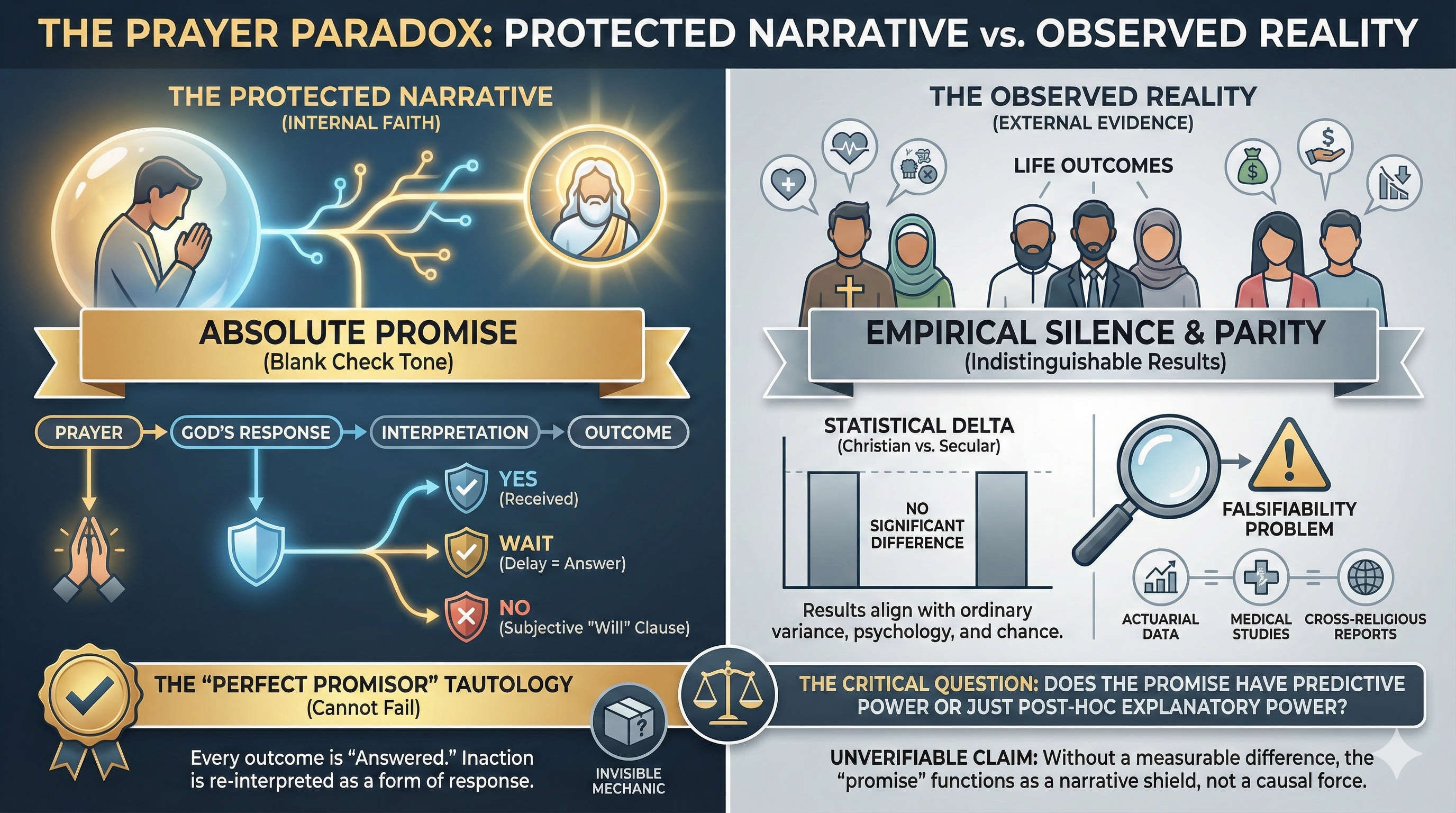
Cognitive biases—such as confirmation bias, selection bias, and the clustering illusion—further reinforce the believer’s conviction that God is answering prayers. Events that do not go according to prayer are reinterpreted as “God’s will,” never counting against the hypothesis. But the rare, emotionally salient cases where things do align are elevated, repeated, and revered. In this ecosystem, documentation is neither required nor desired. The narrative alone is sufficient.
A Thought Experiment: What Documentation Would Look Like
Suppose a believer claims their stage-3 lymphoma vanished after a night of prayer. If this really occurred, they could:
✓ Publish the timeline of diagnosis, prognosis, and recovery.
✓ Obtain statements from multiple oncologists confirming the improbability of the change.
✓ Release anonymized scans to public researchers.
✓ Invite skeptical oversight of future prayer events.
✓ Collaborate with medical ethicists to create prayer-study protocols.
None of this happens. And importantly, this is not due to persecution or suppression—there is simply a total absence of effort from within the believing community to turn anecdote into evidence. And where believers do submit claims to scientific scrutiny (such as double-blind studies on intercessory prayer), the results consistently fail to support the miraculous hypothesis.
Conclusion: A Disconnect of Profound Significance
The absence of documentation in the face of countless confident claims of answered prayer is not a minor oversight. It is a massive epistemic discrepancy. If the God of Christianity were truly orchestrating reality in response to prayer—particularly in ways that defy the natural order—we should see unmistakable footprints. Instead, we are asked to take stories on faith, to lower our evidential standards, and to accept a universe in which the most powerful being supposedly acts regularly without leaving a trace.
A truth-seeking mind should find this unacceptable. Either the miracles are not occurring as described, or the believers are failing catastrophically to document the most important events of their theological lives. In either case, the disconnect between confident claims and the silence of the evidence is deafening.
Suggestions for Honest Faith Communities:
How to Document Claims of Answered Prayer
If a Christian community truly believes that God is regularly answering prayer in ways that demonstrate supernatural intervention, and if they also take seriously the biblical mandate to share the Gospel and persuade others (1 Peter 3:15, Acts 1:8), then it follows that rigorous documentation of these answered prayers is not only possible, but imperative. Below are concrete suggestions for how believers can move from anecdote to evidence, thereby offering a more credible witness to skeptics and seekers alike.
1. Establish a Prayer Claim Verification Team
Create a small team within the church dedicated to documenting, verifying, and publishing claimed answers to prayer. This team should:
✓ Record the initial prayer request with timestamps and signatures.
✓ Follow up with the individual regularly.
✓ Collect third-party verification from doctors, banks, legal authorities, or other neutral observers.
✓ Log results in a central, publicly accessible archive.
Purpose: Establish a baseline of seriousness and accountability.
2. Use Pre/Post Documentation Protocols
Before praying for a medical condition or financial crisis, encourage individuals to collect objective documentation:
✓ Medical: Get doctor’s notes, test results, diagnostic images, treatment plans.
✓ Financial: Bank statements, bills, debt notices.
✓ Legal/Relational: Court documents, official letters, communication logs.
After the claimed answer, collect post-event evidence from the same sources and make the comparison clear.
Purpose: To demonstrate measurable change that could not be reasonably attributed to natural processes alone.
3. Invite Skeptical Oversight
If believers are confident that a miracle has occurred, they should invite skeptics—including scientists, journalists, and critical thinkers—to investigate the case.
✓ Allow access to anonymized documents.
✓ Permit interviews with all relevant parties.
✓ Encourage publication of the findings regardless of the conclusion.
Purpose: Shows good faith and distinguishes the event from unverifiable religious folklore.
4. Create a Public Prayer Claim Archive
Develop an open-access online database where verified cases of claimed answered prayers are:
✓ Catalogued with timestamps, documentation, and external validation.
✓ Filterable by type (medical, financial, relational).
✓ Regularly audited by a mixed-belief oversight board.
Purpose: Create transparency, accountability, and an evidence-based foundation for outreach.
5. Publish Peer-Reviewable Case Studies
Work with Christian-friendly universities or neutral third parties to compile and publish peer-reviewed case studies of verified answered prayers.
✓ Follow medical and social science research standards.
✓ Submit to journals—Christian or otherwise.
✓ If rejected, publish in open-access formats and invite critique.
Purpose: Engage the academic and skeptical community at a serious level of discourse.
6. Establish Double-Blind Prayer Experiments
In partnership with medical professionals, conduct studies that track:
✓ A group prayed for (without their knowledge).
✓ A control group (not prayed for).
✓ Health outcomes tracked over time.
Ensure randomization and ethical oversight. Compare results statistically.
Purpose: Bring empirical rigor to claims of supernatural healing.
7. Avoid Vague Claims and Retrospective “Hits”
Discourage the habit of backfitting narratives to fit events after the fact. Instead, instruct members to:
✓ Write down the specific prayer before any answer occurs.
✓ Be precise: “$500 by June 3,” not “Some help soon.”
✓ Avoid reinterpretations if the prayer fails.
Purpose: Prevent self-deception and selection bias.
8. Involve Legal and Medical Witnesses
For high-stakes claims—e.g., a tumor vanishing—bring in licensed professionals who can:
✓ Swear affidavits about what they observed.
✓ Confirm the natural prognosis.
✓ Testify to the improbability of the result.
Purpose: Strengthen credibility using expert authority from outside the faith.
9. Train Believers in Epistemic Responsibility
Teach church members about:
✓ Cognitive biases (e.g., confirmation bias).
✓ The burden of proof.
✓ The difference between anecdotal and empirical evidence.
✓ The importance of truth over emotional gratification.
Purpose: Raise the internal standard of evidence and integrity.
10. Create a Culture of Evidence-Based Evangelism
Model a community-wide ethos: If our God is real, then truth will be our ally, not our enemy.
✓ Celebrate the most well-documented claims.
✓ Encourage honest admission when a prayer was not answered.
✓ Prioritize clarity over persuasion, and truth over narrative control.
Purpose: Attract thoughtful, intellectually honest seekers instead of gullible followers.
If Christians genuinely believe in the power of prayer to summon supernatural interventions, and if they truly care about the spiritual destinies of others, then failing to document and verify these claims is not just a missed opportunity—it is a profound betrayal of their own evangelistic mandate. A loving God would want credible witnesses, not just enthusiastic ones.



 Free of Faith
Leave a comment