

The inability to test the existence of spiritual entities allow inventors of spiritual entities to add whatever qualities and dynamics to their inventions that will, it is hoped, provide internal coherence to the system.
Apologist Greg Koukl, for example, claims that the suffering in Hell must be eternal since the flames of Hell are eternal and you can’t have flames without fuel. If souls simply burned up, you’d no longer have fuel for the flames. Such is the liberty of those who construct untestable entities. Fabricated entities and the related metaphysical dynamics cannot be empirically falsified. This gives the inventors free reign to posit convoluted dynamics that have no parallel in our reality.
The Christian notion of redemption is a salient example of this freedom of fabrication. Consider the analogous story below and the subsequent explanation.
The Fabricated Dynamics of Redemption: An Analogy
In the bustling city of Solara, Judge Victor Marshall, a tech mogul turned supreme magistrate, ruled the municipal court with unchallenged authority. Known for his vast wealth and self-proclaimed infinite dignity, he viewed any defiance of his civic ordinances as a personal affront. One morning, he issued a decree: jaywalking—crossing streets outside designated zones—would carry a penalty of lifelong imprisonment in the city’s maximum-security prison, a grim facility designed to isolate inmates from society’s comforts forever. By noon, one million citizens, from baristas to accountants, were arrested for jaywalking and locked away, their futures reduced to endless confinement.
Months later, the city buzzed with discontent. In the sleek glass courtroom, Sophie, a freelance journalist, stood before Judge Marshall, her tablet glowing with notes. Beside her were Malik, a skeptical rideshare driver who’d lost friends to the prison, and Lena, a corporate lawyer known for her sharp cross-examinations.
Sophie tapped her tablet, her voice clear. “Judge Marshall, how is lifelong imprisonment just for jaywalking? And why sentence a million people for such a minor offense?”
Judge Marshall, adjusting his tailored suit, leaned back in his chair. “Sophie, you fail to grasp the severity of their act. Jaywalking disrespects my infinite authority as the city’s moral arbiter. It disrupts the order I’ve engineered. A lifetime in prison, cut off from Solara’s prosperity, is the only fitting consequence.”
Malik, wiping sweat from his brow, spoke up. “With respect, sir, a million lifetimes for crossing a street? That’s overkill. In my gig, if someone owes me ten bucks, I don’t demand a fortune. How’s this fair?”
The judge’s eyes glinted. “Malik, your petty transactions can’t measure my justice. My dignity is boundless, and their defiance warrants an infinite penalty. Prison isn’t punishment—it’s the contractual consequence of their rebellion. I set the rules, enforce them, and judge their violations. My system is justice itself.”
Lena, flipping through her legal pad, nodded approvingly. “Well put, Your Honor. The citizens forget your stature. The penalty reflects the weight of their disrespect.”
Sophie frowned, typing rapidly. “But, Judge, there’s talk you’ve freed the jaywalkers because your son served a sentence. How does that work?”
Judge Marshall’s face softened, a proud smile emerging. “Indeed, Sophie, you’ve hit the core of my compassion. My son, Ethan, heir to my empire and of infinite worth due to his unique status, volunteered to bear the jaywalkers’ penalty. Last week, he spent three days in a private detention suite, enduring mild discomfort and a brief sense of isolation, fully aware he’d be released. His infinite worth, tied to my own legacy, gave his short stay such immense value that it satisfied the lifelong sentences of all one million jaywalkers. I, as the ultimate authority, declare their debt paid. They’re free.”
Malik’s eyes widened. “Three days in a comfy suite for a million life sentences? No offense, Judge, but that’s wild. If I paid three bucks for a million-dollar debt, my bank would shut me down. How’s that balanced?”
The judge’s tone sharpened. “Malik, you’re stuck in a ledger mindset, a foreign model of justice. Ethan’s act wasn’t a payment but a representative substitution. His infinite worth as my heir outweighs the collective suffering of the jaywalkers. Justice isn’t about counting hours in a cell—it’s about the quality of the substitute. Ethan, as my chosen stand-in, bore their penalty in a way only he could.”
Sophie’s fingers paused. “But, Your Honor, why three days? Could Ethan have stayed locked up for three minutes and still cleared the debt? Or, say, five thousand years—would that have been unfair?”
Judge Marshall waved dismissively. “Duration doesn’t matter, Sophie. Justice rests on Ethan’s sacrifice, not a stopwatch. Three minutes, three days, or five thousand years—the penalty is satisfied because my son, with his matchless worth, endured the legal consequence. Once justice is met, extra time adds nothing. It’s about who suffers, not how long.”
Lena smiled. “Exactly, Your Honor. Ethan’s status as your heir gives his act unparalleled value. No one else—not a CEO, not a rival mogul—could match that.”
Malik shook his head. “You keep saying ‘infinite worth,’ but how do we know it covers the penalty? In my job, I check receipts to make sure I’m paid right. What’s the proof here?”
The judge’s voice grew stern. “Malik, you want a spreadsheet for justice, but my system isn’t a vending machine. Ethan’s worth is infinite because he carries my authority. His brief detention, mild as it was, held supreme value, satisfying the penalty’s demands. There’s no over- or under-payment—justice is complete when I say, ‘It’s done.’”
Sophie’s gaze sharpened. “But, Judge Marshall, you wrote the law, picked your son, and decided it’s enough. That feels like a closed loop. In city courts, we have appeals, oversight boards, something to check the ruling. Who checks yours?”
Judge Marshall stood, his voice resonating through the courtroom. “Sophie, there’s no authority above me. I’m the source of Solara’s justice, the one wronged by jaywalking, and the one who gave my son to fix it. That’s not a flaw—it’s the brilliance of my system. Your questions assume a foreign justice, one of audits and balances. My justice is rooted in my authority, fulfilled by Ethan’s substitution, not some imitation of their sentence. The jaywalkers are free because my infinite heir bore their consequence. That’s final.”
The courtroom hushed. Sophie’s tablet dimmed, Malik stared at the floor, and Lena beamed with admiration. Judge Marshall sat, his ruling absolute, as the prison gates swung open, releasing the stunned jaywalkers back into Solara’s streets.
The analogy above illustrates the absurd notion of justice in a Christian apologist’s defense of Penal Substitutionary Atonement (PSA) by mirroring their key arguments and concepts. Below is a list of the ways the analogy maps directly to the position of a typical Christian apologist, capturing their notions of infinite worth, covenantal substitution, divine fiat, and a justice model grounded in God’s nature. Each element in the story corresponds to a specific aspect of their defense, highlighting the logical and philosophical implications of their “foreign” justice framework.
- ✓ Judge Victor Marshall as God: In the analogy, Judge Marshall, the supreme magistrate and moral authority of Solara, represents God in the Christian apologist’s PSA framework. A typical Christian apologist argues that God, as the offended party, Lawgiver, and judge, defines the penalty for sin (death, wrath, eternal separation, per Romans 6:23, Isaiah 59:2, Revelation 20) and its satisfaction. Similarly, Marshall sets the jaywalking penalty, enforces it, and declares its resolution, embodying the apologist’s claim that God’s infinite dignity and authority ground PSA’s justice.
- ✓ Jaywalking as Sin: The minor act of jaywalking, deemed a grave offense against Marshall’s infinite dignity, maps to sin in PSA. The Christian apologist asserts that sin, as an offense against God’s infinite holiness, incurs an infinite penalty (eternal separation, the “second death”). In the analogy, jaywalking’s disproportionate penalty (lifelong imprisonment) reflects the apologist’s view that sin’s gravity warrants an eternal consequence, despite its apparent triviality.
- ✓ Lifelong Imprisonment as Eternal Separation: The penalty of lifelong imprisonment in Solara’s maximum-security prison, isolating inmates from society’s comforts, corresponds to the eternal separation component of PSA’s penalty (Revelation 20’s “second death”). The Christian apologist includes separation in the penalty but emphasizes Christ’s suffering as qualitatively sufficient, not requiring eternal duration. The analogy’s lifelong sentences mirror this eternal consequence, highlighting the mismatch with the substitute’s brief suffering.
- ✓ One Million Jaywalkers as Humanity: The one million jailed jaywalkers represent humanity, collectively guilty of sin in PSA. A typical Christian apologist argues that all sinners face the penalty, which Christ’s substitution covers universally. The large number of jaywalkers in the analogy underscores the scale of PSA’s atonement, amplifying the absurdity of a brief act satisfying such extensive penalties.
- ✓ Ethan Marshall as Christ: Judge Marshall’s son, Ethan, heir to his empire and of “infinite worth,” maps to Christ in PSA. The Christian apologist emphasizes Christ’s divine nature and “infinite moral weight” as the basis for His suffering’s sufficiency. Ethan’s unique status as the judge’s heir parallels the apologist’s claim that Christ’s divine identity (the “second Adam”) makes His temporary suffering (Matt. 27:46, Isaiah 53) capable of satisfying the penalty.
- ✓ Three Days in a Private Suite as Christ’s Temporary Suffering: Ethan’s three-day detention in a cushioned suite, with mild discomfort and assured release, corresponds to Christ’s temporary suffering (death, wrath, forsakenness). A Christian apologist argues that Christ’s suffering, though brief, is sufficient due to His infinite worth, not its duration. The analogy’s short, comfortable detention mirrors this, exaggerating the disparity between the substitute’s experience and the penalty’s severity.
- ✓ Infinite Worth of Ethan as Infinite Moral Weight: Marshall’s claim that Ethan’s “infinite worth” gives his brief stay immense value maps to the Christian apologist’s concept of Christ’s “infinite moral weight.” The apologist defines this as Christ’s divine value, making His suffering sufficient without replicating the penalty’s duration or kind. The analogy’s emphasis on Ethan’s royal status reflects this qualitative, ontological claim, highlighting its vagueness as a juridical mechanism.
- ✓ Covenantal Representation by Ethan as Christ’s Representation: Marshall’s assertion that Ethan, as his appointed heir, represents the jaywalkers mirrors the Christian apologist’s notion of covenantal substitution. The apologist argues that Christ, as the appointed representative, bears the penalty for humanity in a unique way. The analogy’s focus on Ethan’s role as a stand-in reflects this, but underscores the lack of a logical link between his act and the penalty.
- ✓ Judge’s Declaration as Divine Fiat: Marshall’s declaration that Ethan’s detention satisfies the jaywalkers’ sentences, with no higher authority to appeal, corresponds to the Christian apologist’s reliance on divine fiat. The apologist claims God, as the ultimate judge, declares Christ’s suffering sufficient (“It is finished”). The analogy’s unaccountable decree mirrors this, illustrating the circularity of a system where the judge validates his own ruling.
- ✓ Qualitative Justice Over Quantitative Measures: Marshall’s dismissal of duration concerns, insisting justice depends on Ethan’s worth, not “counting hours,” maps to the Christian apologist’s rejection of quantitative equivalence. The apologist argues that PSA’s justice is qualitative, not about “tallying suffering-minutes,” but about Christ’s divine worth. The analogy’s rejection of a “ledger mindset” reflects this, exposing its logical opacity.
- ✓ No Over/Under-Compensation as Sufficiency Without Scales: Marshall’s claim that Ethan’s act avoids over- or under-payment, as justice is satisfied by his decree, mirrors the Christian apologist’s rejection of a “balance scale” model. The apologist argues that Christ’s death doesn’t over- or under-compensate because God declares it sufficient, not because it matches the penalty’s scope. The analogy’s dismissal of measurement parallels this, highlighting the arbitrariness of the claim.
- ✓ Closed System of Authority as PSA’s Circularity: Marshall’s role as lawgiver, enforcer, substitute-provider, and validator, with no external oversight, maps to PSA’s circular moral economy. A typical Christian apologist defends this circularity—God sets the penalty, provides Christ, and declares satisfaction—as a feature, not a flaw. The analogy’s closed system, where Marshall’s word is final, reflects this, underscoring its unaccountability.
- ✓ Foreign Justice Model as PSA’s Theistic Framework: Marshall’s insistence that his justice, rooted in his authority, differs from Sophie and Malik’s “foreign” models (audits, balances) corresponds to the Christian apologist’s claim that PSA operates within a theistic framework, not a naturalistic one. The apologist argues that my critique imposes measurable, third-party standards alien to PSA. The analogy’s rejection of oversight mirrors this, illustrating PSA’s divergence from logical and human justice principles.
- ✓ Skeptical Characters as Critique: Sophie, Malik, and Lena represent the critical voices challenging PSA’s justice. Sophie’s demand for transparency and Malik’s insistence on fairness map to my critique of PSA’s logical incoherence and lack of equivalence. Lena’s loyalty reflects the apologist’s theological supporters, but her minimal role underscores the critique’s focus on rational scrutiny, not internal affirmation.
Parallels Between Christian Apologists’ PSA Position and the Internal Logic of Alice in Wonderland
Christian apologists defending Penal Substitutionary Atonement (PSA) construct a theological framework where Christ’s “infinite moral weight,” covenantal substitution, and divine fiat ensure that His temporary suffering (Matt. 27:46, Isaiah 53) satisfies the penalty for sin (death, wrath, eternal separation, per Romans 6:23, Isaiah 59:2, Revelation 20). They argue that PSA’s coherence lies within its theistic paradigm, dismissing demands for logical transparency and testable dynamics as foreign to divine justice. This approach bears striking parallels to the internal logic of Lewis Carroll’s Alice in Wonderland, where an absurd, self-contained world operates under arbitrary rules, untestable assertions, and authoritative decrees that defy rational scrutiny. Just as Wonderland’s logic is coherent within its fantastical boundaries but collapses under external examination, PSA’s justice model, as defended by apologists, relies on invented, untestable dynamics that hold only within its theological confines. This analysis explores these parallels, mapping key elements of the apologists’ PSA position to Wonderland’s surreal reasoning, to highlight how PSA’s internal logic evades philosophical rigor through capricious constructs. While nuances in their position may be overlooked, apologists are invited to address these parallels with logical clarity to defend PSA’s rational defensibility.
1. Arbitrary Authority and Divine Fiat: The Queen of Hearts and God’s Declaration
In Alice in Wonderland, the Queen of Hearts wields absolute authority, issuing decrees like “Off with their heads!” without justification, as her word is law in Wonderland. Her pronouncements—such as sentencing subjects for trivial offenses—are unchallengeable, creating a closed system where dissent is futile. Similarly, Christian apologists defending PSA rely on divine fiat, asserting that God, as the offended party, Lawgiver, and judge, declares Christ’s temporary suffering sufficient to satisfy the eternal penalty of sin (Romans 3:25-26, “It is finished”). They argue that God’s perfect will, rooted in His nature (Deuteronomy 32:4), negates the need for external accountability, dismissing critiques of human standards as a “category error.”
Parallel: Just as the Queen’s decrees are untestable—her authority ensures their validity regardless of logic—the apologists’ appeal to divine fiat renders PSA’s justice untestable. In the Solara analogy, Judge Marshall’s declaration that Ethan’s three-day detention satisfies a million lifelong sentences mirrors this, echoing the Queen’s capricious rulings. Both systems invent an ultimate authority whose word bypasses rational scrutiny, shielding the framework from falsification but undermining its philosophical coherence outside its self-contained logic.
2. Infinite Moral Weight as the Mad Hatter’s Unquantifiable Tea Party
The Mad Hatter’s tea party operates under bizarre, unquantifiable rules—time is stuck at 6 o’clock, cups are endlessly swapped, and the event’s purpose is undefined yet accepted as meaningful within Wonderland. The apologists’ concept of “infinite moral weight” functions similarly: they define it as Christ’s “immeasurable value” from His divine, sinless nature (Hebrews 10:10), sufficient to satisfy eternal separation without equivalence in duration or kind. When pressed for testable criteria—how does this “weight” address the “second death” (Revelation 20)?—they dismiss the need for logical metrics, claiming theological categories transcend empirical demands.
Parallel: Like the tea party’s unquantifiable chaos, “infinite moral weight” is an invented dynamic, meaningful only within PSA’s framework. Its vagueness allows objections to be deflected with “Christ’s divine nature ensures sufficiency,” akin to the Hatter’s nonsensical insistence that the tea party is eternally valid. In Solara, Ethan’s “infinite worth” serves the same role, an untestable construct that Marshall invokes to justify an absurd substitution. Both rely on undefined, adaptable assertions that evade rational challenge, coherent only in their respective worlds.
3. Covenantal Substitution as the Cheshire Cat’s Elusive Logic
The Cheshire Cat’s cryptic pronouncements—such as “We’re all mad here”—offer apparent wisdom but dissolve under scrutiny, as his logic shifts to suit Wonderland’s needs. The apologists’ defense of covenantal substitution, where Christ represents humanity via Adam-Christ typology, operates similarly. They claim Christ’s temporary suffering satisfies the penalty because of His appointed role (2 Corinthians 5:21), but provide no testable mechanism linking His brief agony to eternal separation. When challenged, they assert it’s “theological,” not arbitrary, yet its mechanics remain elusive.
Parallel: Like the Cat’s vanishing explanations, covenantal substitution is an invented dynamic that appears coherent within PSA’s narrative but lacks substance when tested. In Solara, Ethan’s representation of the jaywalkers is equally intangible, with no clear connection between his detention and their lifelong sentences. Both constructs rely on authoritative assertion—Wonderland’s “that’s how it is” or PSA’s “Scripture teaches it”—to maintain internal consistency, but crumble under external logical demands for verifiable causation.
4. Rejection of Equivalence as the March Hare’s Dismissal of Order
The March Hare rejects conventional order, insisting that Wonderland’s chaotic tea party supersedes rational expectations (e.g., “Why not have tea at midnight?”). Christian apologists similarly reject equivalence in PSA, arguing that Christ’s temporary suffering need not match the penalty’s duration or intensity (eternal separation, Revelation 20) because His “infinite moral weight” ensures qualitative sufficiency (2 Corinthians 5:21). They dismiss the “balance scale” model as foreign, claiming PSA’s justice is relational and covenantal, not quantitative.
Parallel: The Hare’s dismissal of ordered time parallels the apologists’ rejection of equivalence, both inventing alternative systems that defy logical norms. In Solara, Marshall’s claim that Ethan’s three-day detention satisfies lifelong imprisonment because of his worth mirrors the Hare’s insistence that tea party chaos is valid. Both frameworks invert rational principles—equivalence in justice, order in time—to uphold their internal logic, rendering them absurd when judged by universal standards.
5. Circular Moral Economy as the Caterpillar’s Self-Referential Questions
The Caterpillar’s circular questioning—“Who are you?” followed by “Why?”—traps Alice in a self-referential loop, where answers reinforce Wonderland’s logic without external validation. PSA’s moral economy, as defended by apologists, is similarly circular: God sets the penalty for sin, provides Christ as the substitute, and declares His suffering sufficient, with no higher standard (Romans 3:25-26). They defend this as “completeness,” not vicious circularity, arguing that God, as the standard, needs no external court.
Parallel: Like the Caterpillar’s loop, PSA’s circularity is an invented system where all elements reinforce each other, untestable outside its framework. In Solara, Marshall’s roles as lawgiver, substitute-provider, and validator create an identical loop, echoing Wonderland’s self-contained absurdity. Both systems rely on internal affirmation—Wonderland’s characters accept the Caterpillar’s logic, apologists cite Scripture—to evade external scrutiny, sacrificing philosophical rigor.
6. Foreign Justice as Wonderland’s Alien Rules
Christian apologists acknowledge that PSA’s justice is “foreign” to secular frameworks, accusing critics of “worldview imperialism” for imposing external standards. In Alice in Wonderland, the entire world operates under alien rules—croquet with flamingos, trials without evidence—that make sense only to its inhabitants. Alice’s rational objections are dismissed as ignorance of Wonderland’s paradigm, much as apologists dismiss demands for transparency and accountability as misaligned with divine justice.
Parallel: PSA’s justice, like Wonderland’s rules, is an invented framework coherent only within its theistic boundaries. In Solara, Marshall’s justice—unaccountable and non-equivalent—is alien to Sophie and Malik’s rational expectations, mirroring the apologists’ defense of PSA’s divergence from human standards. Both systems demand acceptance of their internal logic, rejecting external critique as a category error, but fail to justify their coherence philosophically.
7. Logical Analysis: Untestable Dynamics in Both Frameworks
To formalize the parallel, consider PSA’s logic alongside Wonderland’s:
- ✓ P(x): x is the penalty (eternal separation for PSA, arbitrary punishment in Wonderland).
- ✓ S(x, y): x satisfies P(x) through act y.
- ✓ C: Christ (or a Wonderland figure, e.g., the Queen’s decree).
- ✓ T: Temporary act (Christ’s suffering, a Wonderland ruling).
- ✓ W: Untestable construct (infinite moral weight, Queen’s authority).
PSA/Wonderland claims:
- ➘ S(C, T ∧ W): C satisfies P(x) through T, given W.
Critique:
- ➘ P1: Satisfaction requires a testable mechanism. [∀x, S(x, y) → F(y, P(x))]
- ➘ F(y, P(x)): y fulfills P(x) via verifiable criteria.
- ➘ P2: T is temporary, W is untestable. [S(C, T ∧ W) ∧ ¬D(W)]
- ➘ RAE D(W): W is defined and testable.
- ➘ RAE P3: No testable mechanism exists. [¬F(T ∧ W, P(x))]
- ➘ RAE C1: S(C, T ∧ W) is unverified.
- ➘ RAE C2: The framework fails rational scrutiny.
In PSA, W is “infinite moral weight”; in Wonderland, it’s the Queen’s whims. Both are untestable, ensuring internal coherence but external absurdity.
Conclusion: A Call for Rational Defense
The PSA position of Christian apologists parallels Alice in Wonderland’s internal logic, relying on untestable dynamics—divine fiat, infinite moral weight, covenantal substitution—to construct a self-contained, unfalsifiable system. Like Wonderland’s absurd rules, PSA’s justice appears coherent within its theological world but collapses under logical scrutiny. The Solara analogy mirrors this, exposing the capriciousness of these constructs. While nuances may be overlooked, apologists are challenged to:
- ✓ Define “infinite moral weight” with testable criteria.
- ✓ Provide a verifiable mechanism for covenantal substitution.
- ✓ Justify divine fiat’s exemption from accountability rationally.
- ✓ Demonstrate [biblical penalty] = [Jesus’ penalty] with falsifiable reasoning.
Until PSA is grounded in testable logic, it remains a theological Wonderland, coherent only to its adherents. Apologists are urged to engage these parallels directly or acknowledge PSA’s rational limits, fostering a dialogue that prioritizes philosophical rigor.
See also:

◉ A Critique of the Seven Views of the Atonement
The doctrine of the atonement lies at the heart of Christian theology, seeking to explain how Jesus’ death on the cross reconciles humanity with God. Seven prominent theories—Moral Influence, Ransom, Christus Victor, Satisfaction, Penal Substitutionary, Governmental, and Scapegoat—offer distinct perspectives on this pivotal event. However, each theory faces significant logical, ethical, and theological challenges when rigorously examined, particularly through the lens of the detailed critique of Penal Substitutionary Atonement (PSA) provided in the content. This response critically analyzes each theory based on the content, focusing on their mechanisms, logical coherence, and ability to address sin and divine justice.
1. Moral Influence Theory
Summary
The Moral Influence Theory, notably advanced by Augustine, posits that Jesus’ life and death serve as a moral exemplar, inspiring humanity to pursue righteousness. His crucifixion is viewed as a martyrdom resulting from his radical ethical teachings, catalyzing moral reform rather than effecting a transactional atonement.
Critique
The content does not directly critique this theory, but its emphasis on PSA’s need for a mechanism to address sin’s guilt and divine justice provides a framework for analysis. The Moral Influence Theory lacks any substantive mechanism to deal with the consequences of sin or satisfy God’s justice, a concern echoed in the PSA critique’s demand for a clear link between penalty and resolution. By focusing solely on inspiration, it sidesteps the theological necessity of reconciling humanity’s guilt, rendering it incomplete as an atonement model. For example, the content’s analogy of Judge Marshall’s system, where a penalty must be met with a corresponding act, highlights this theory’s failure to provide a “payment” or resolution for sin’s debt. It reduces the cross to a motivational event, neglecting the biblical emphasis on sacrifice and redemption (e.g., Romans 3:25-26).
2. Ransom Theory
Summary
The Ransom Theory, rooted in early Church thought and articulated by Origen, suggests that Jesus’ death was a ransom paid—typically to Satan, though sometimes interpreted as to God—to liberate humanity from sin’s bondage, a debt inherited from Adam’s fall.
Critique
The content explicitly critiques this theory, noting its logical flaw: it implies God owes Satan something, undermining divine sovereignty. This is evident in the summary’s acknowledgment that the idea of God paying the devil is controversial and problematic. The critique aligns with the content’s broader rejection of transactional models lacking logical transparency, as seen in the PSA analysis. If the ransom is paid to God instead, it shifts to a satisfaction-like model but still fails to clarify why a payment is necessary or how Jesus’ death equates to humanity’s release, echoing the PSA critique’s demand for a verifiable mechanism. The Solara analogy reinforces this: a judge paying a third party (Satan) for citizens’ freedom lacks rational grounding, making the Ransom Theory theologically and philosophically suspect.
3. Christus Victor
Summary
Christus Victor, historically dominant and championed by Gustaf Aulen, portrays Jesus’ death as a victory over sin, death, and the devil, liberating humanity from their bondage without a transactional payment.
Critique
The content praises Christus Victor as historically significant but does not offer a direct critique. However, the PSA critique’s emphasis on satisfying divine justice provides a basis for evaluation. This theory excels in depicting cosmic triumph but fails to address how Jesus’ victory atones for individual guilt or meets God’s justice, a gap highlighted in the content’s insistence on a clear penalty-substitution link. Unlike PSA, it lacks a mechanism to explain how Christ’s triumph translates to forgiveness of sins, leaving it more symbolic than substantive. The content’s focus on logical equivalence suggests Christus Victor’s narrative of victory, while compelling, does not resolve the justice-sin tension central to atonement theology.
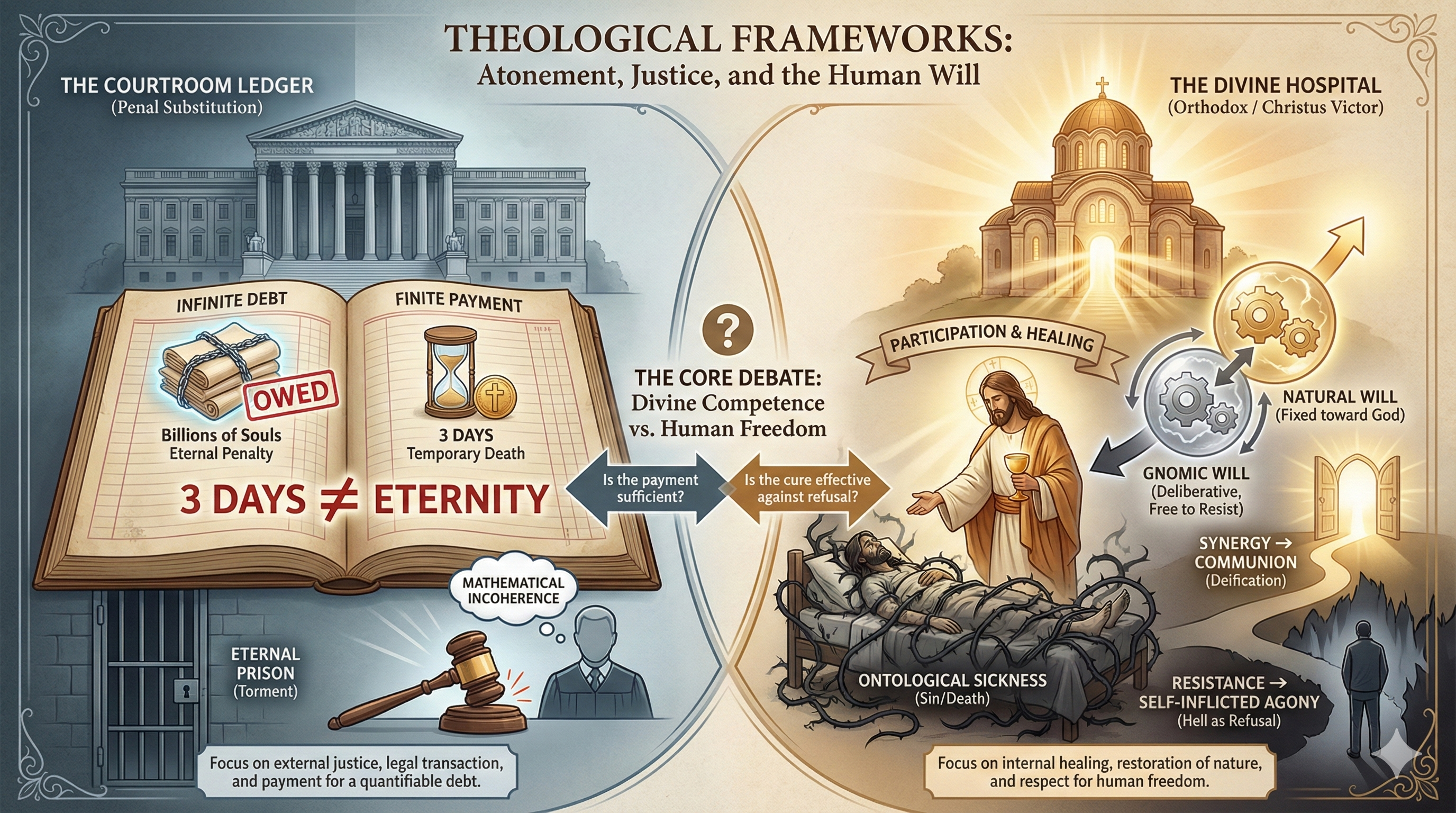
4. Satisfaction Theory (Anselm)
Summary
Anselm’s Satisfaction Theory argues that sin dishonors God, incurring a debt that Jesus’ death repays, restoring divine honor and satisfying God’s justice.
Critique
The content critiques this theory for shifting the Ransom model’s debt from Satan to God, yet retaining a transactional framework. It notes that this shift avoids the Ransom Theory’s flaw but introduces new issues. The PSA critique’s focus on logical transparency applies here: the Satisfaction Theory assumes Jesus’ death equates to humanity’s infinite debt without explaining how a finite act satisfies an infinite offense. The Solara analogy mirrors this: Ethan’s brief detention satisfying a million lifetimes lacks a rational basis, paralleling the theory’s failure to justify equivalence. Additionally, its legalistic focus on honor over relational reconciliation may oversimplify the atonement’s personal dimensions, as the content suggests a need for a more robust model.
5. Penal Substitutionary Theory
Summary
Developed by Reformers like Calvin and Luther, Penal Substitutionary Atonement (PSA) asserts that Jesus died to satisfy God’s wrath against sin, taking humanity’s punishment as a substitute, thus meeting divine justice’s legal demands.
Critique
The content provides an extensive critique of PSA, forming the backbone of this analysis. It argues that PSA relies on a circular moral economy: God sets the penalty (eternal separation), provides Jesus as substitute, and declares it sufficient without independent justification, as seen in the Solara analogy where Judge Marshall’s self-contained system lacks oversight. The critique highlights logical incoherence: Jesus’ finite suffering (6 hours on the cross, 3 days dead) cannot equate to an eternal penalty, lacking a mechanism to bridge this gap, despite claims of “infinite moral weight.” The content’s reductio ad absurdum—Jesus’ resurrection negating eternal separation—remains unaddressed, undermining substitution. Philosophically, PSA’s reliance on divine fiat mirrors Alice in Wonderland’s arbitrary decrees, failing to provide testable evidence for equivalence, rendering it rationally deficient.
6. Governmental Theory
Summary
Popular in Methodism, the Governmental Theory posits that Jesus’ death demonstrates God’s displeasure with sin and the high cost of forgiveness, acting as a deterrent rather than fully satisfying divine wrath.
Critique
The content does not directly critique this theory, but its PSA analysis applies. Like PSA, it uses a substitutionary model but avoids full wrath satisfaction, claiming Jesus suffers a punishment, not the punishment. This creates a logical issue: if sin’s penalty is eternal separation (per Revelation 20:14-15), a lesser punishment lacks equivalence, echoing the PSA critique’s demand for a clear link between penalty and act. The Solara analogy suggests that a partial act (Ethan’s detention) cannot justly represent a full penalty, making the theory incoherent. Its focus on deterrence over reconciliation also downplays the biblical emphasis on personal atonement, leaving it incomplete.
7. Scapegoat Theory
Summary
A modern theory from René Girard and James Alison, the Scapegoat Theory views Jesus as a victim of human violence, exposing the scapegoating mechanism and offering a non-violent atonement, distinct from traditional payment models.
Critique
The content lacks a direct critique, but its PSA analysis provides insight. By rejecting substitution and sacrifice, the Scapegoat Theory diverges from biblical motifs (e.g., Isaiah 53:5), focusing instead on social critique. The PSA critique’s emphasis on addressing sin’s guilt and divine justice reveals a weakness: it offers no mechanism for reconciliation or penalty satisfaction, as Judge Marshall’s system requires a resolution beyond revelation. Philosophically, its non-violent model may resonate ethically but lacks logical grounding to explain atonement’s redemptive power, reducing it to a socio-political statement rather than a theological solution.
Conclusion
Each atonement theory grapples with explaining Jesus’ death but falters under rigorous scrutiny:
- Moral Influence lacks a sin-resolution mechanism.
- Ransom is logically flawed in its payment premise.
- Christus Victor excels symbolically but neglects justice.
- Satisfaction relies on an unproven transactional equivalence.
- Penal Substitution collapses under circular logic and evidential gaps.
- Governmental fails to match penalty with act.
- Scapegoat abandons substitution for critique.
The content’s call for a “more robust theory” resonates: no single model fully integrates sin, justice, and reconciliation. The atonement remains a profound mystery, demanding ongoing critique beyond these frameworks’ limitations.
Formalizations of the Arguments & Counterarguments
This essay formalizes the central arguments presented in a discussion in a Christian Apologetics Facebook group on Penal Substitutionary Atonement (PSA). It will first construct the primary formulations used by the interlocutors to defend PSA, primarily focusing on the concepts of infinite worth and divine fiat. Subsequently, it will present counter-formulations that demonstrate the logical incoherence and category errors inherent in these defenses, based on the critiques found within the provided source materials.
◉ Argument 1: The Apologetic Formulation from Infinite Worth
The most common defense of PSA among the interlocutors is the claim that Jesus’s divine nature provides his finite suffering with infinite value, thereby satisfying an eternal penalty. This argument can be formalized by defining a set of predicates and constructing a logical sequence.
Let the following predicates be defined:
: x is a sinner.
: x deserves an eternal penalty,
.
: Jesus (j) serves as a substitute to atone for sinner x.
: Jesus suffers for a finite duration, providing satisfaction
.
: Jesus possesses infinite worth.
: Penalty p is justly satisfied by act q.
The apologetic argument proceeds as follows:
- All sinners deserve an eternal penalty.

- Jesus, as a substitute, suffers for a finite duration.

- The central premise: If Jesus possesses infinite worth, his finite suffering is sufficient to satisfy the eternal penalty.

- Jesus possesses infinite worth.
C: Therefore, by Modus Ponens on (3) and (4), Jesus’s finite suffering satisfies the eternal penalty.

The Counter-Formulation: Exposing the Category Error and Contradiction
The critique of the above formulation reveals that the bridge premise in step (3) is an unsubstantiated assertion that commits a category error. To demonstrate this, we must introduce predicates that distinguish between qualitative attributes and quantitative measures.
Let the following be defined:
: The quantitative duration of a penalty or act p.
: The value for infinite duration.
: A specific finite time value.
The critique can now be formalized:
- A core principle of commensurate justice is that for a substitution to be equivalent, the duration of the act must match the duration of the penalty.

- The penalty for sin has an infinite duration.

- Jesus’s suffering had a finite duration.

- The apologist concludes that the satisfaction is equivalent to the penalty,
Applying the principle of justice from (1) to the apologist’s conclusion in (4), we derive by Modus Ponens:
C1:

Substituting the known values from (2) and (3), we arrive at a contradiction:
C2:

This contradiction demonstrates that the apologists’ framework is internally incoherent. The predicate
◉ Argument 2: The Apologetic Formulation from Divine Fiat
A second common defense is the appeal to God’s sovereignty, where justice is defined as whatever God declares it to be.
Let the following predicates be defined:
: God.
: God declares that act q satisfies penalty p.
The apologetic argument from divine fiat is:
- The primary premise: An act is a just satisfaction if and only if God declares it so. This makes justice synonymous with divine decree.

- God declares that Jesus’s finite suffering satisfies the eternal penalty.

C: Therefore, by Biconditional Elimination on (1) and (2), Jesus’s finite suffering justly satisfies the eternal penalty.
The Counter-Formulation: Exposing the Tautology
The critique of this formulation is that it does not provide a model of justice but rather a tautology that renders the concept of justice meaningless and arbitrary.
- The apologist’s core premise,
, defines justice not by principles like proportionality or equivalence, but solely by divine will.
- Let
be the proposition “Act ‘a’ is just.” The argument effectively states
, where
means “God declares PSA to be just.”
- This formulation is a circular definition. It fails to provide any independent criteria for justice, instead creating a closed logical loop where the validator of the system is internal to the system itself. It does not prove that PSA is just; it merely asserts that whatever God does is labeled “just,” which is an unfalsifiable and trivial claim.
◉ Argument 3: The Reductio ad Absurdum of the Resurrection
The doctrine of the resurrection, when combined with the premises of PSA, creates a formal contradiction, demonstrating the system’s internal incoherence.
Let the following predicates be defined:
: Substitute s fully bears penalty p.
: Jesus was resurrected.
The reductio ad absurdum proceeds as follows:
- Premise from PSA: For a substitute to atone for a sinner, the substitute must fully bear the sinner’s penalty.

- Premise from PSA: The penalty for sin is eternal in duration.

- Premise from logic: To fully bear a penalty of eternal duration, the substitute’s suffering must also be of eternal duration.

- Premise from Christian doctrine: Jesus was resurrected.
- Premise from logic: Resurrection implies that the suffering was not of eternal duration.

From these premises, we can derive a contradiction:
- From (4) and (5) by Modus Ponens, we conclude that Jesus’s suffering was not eternal.

- From (6) and (3) by Modus Tollens, we conclude that Jesus did not fully bear the eternal penalty.

C: From (7) and (1) by Modus Tollens, we conclude that Jesus did not atone for the sinner.

This result contradicts the foundational Christian claim that Jesus’s act was atoning. Therefore, the set of premises held by the interlocutors—that the penalty is eternal, that the substitute must fully bear it, and that Jesus was resurrected—is logically inconsistent.
Conclusion
When formalized, the primary arguments defending Penal Substitutionary Atonement demonstrate a reliance on logically invalid steps. The argument from “infinite worth” commits a category error, fallaciously equating a qualitative attribute with a quantitative measure of duration. The argument from “divine fiat” is not a defense of justice but a tautological claim that renders the concept of justice arbitrary and unfalsifiable. Finally, the doctrine’s core tenets are shown to be mutually contradictory when analyzed through the reductio ad absurdum of the resurrection. For PSA to be considered logically coherent, its defenders must provide a valid formulation that resolves these formal contradictions without resorting to non-sequiturs or circular reasoning.


 Free of Faith
Leave a comment