
The Curious Silence: Why Apologists for Christianity Default to Deism
Among the more curious ironies in contemporary Christian apologetics is the marked preference for generic theism over a distinctively Christian defense. In a Sean McDowell survey of over one hundred prominent Christian apologists—ranging from J.P. Moreland to Frank Turek to anonymous professors at Biola—the data reveals a striking trend: the most frequently cited “best” arguments for God were arguments that would apply equally to Allah, the deistic God of Enlightenment philosophers, or even an undefined cosmic intelligence. Rarely were these arguments explicitly Trinitarian, Christocentric, or doctrinally unique to Christianity.
Core Question: Would the Apostles following the Great Commission recognize the deism-centric Gospel being preached today?
This is not merely a marketing oversight. It reflects a deeper epistemic and theological incongruity within Christian apologetics: that those most committed to defending the Christian God seem to recognize that the Christian God is not epistemically defensible on His own terms.
The Data Speaks: Deism, Not the Cross
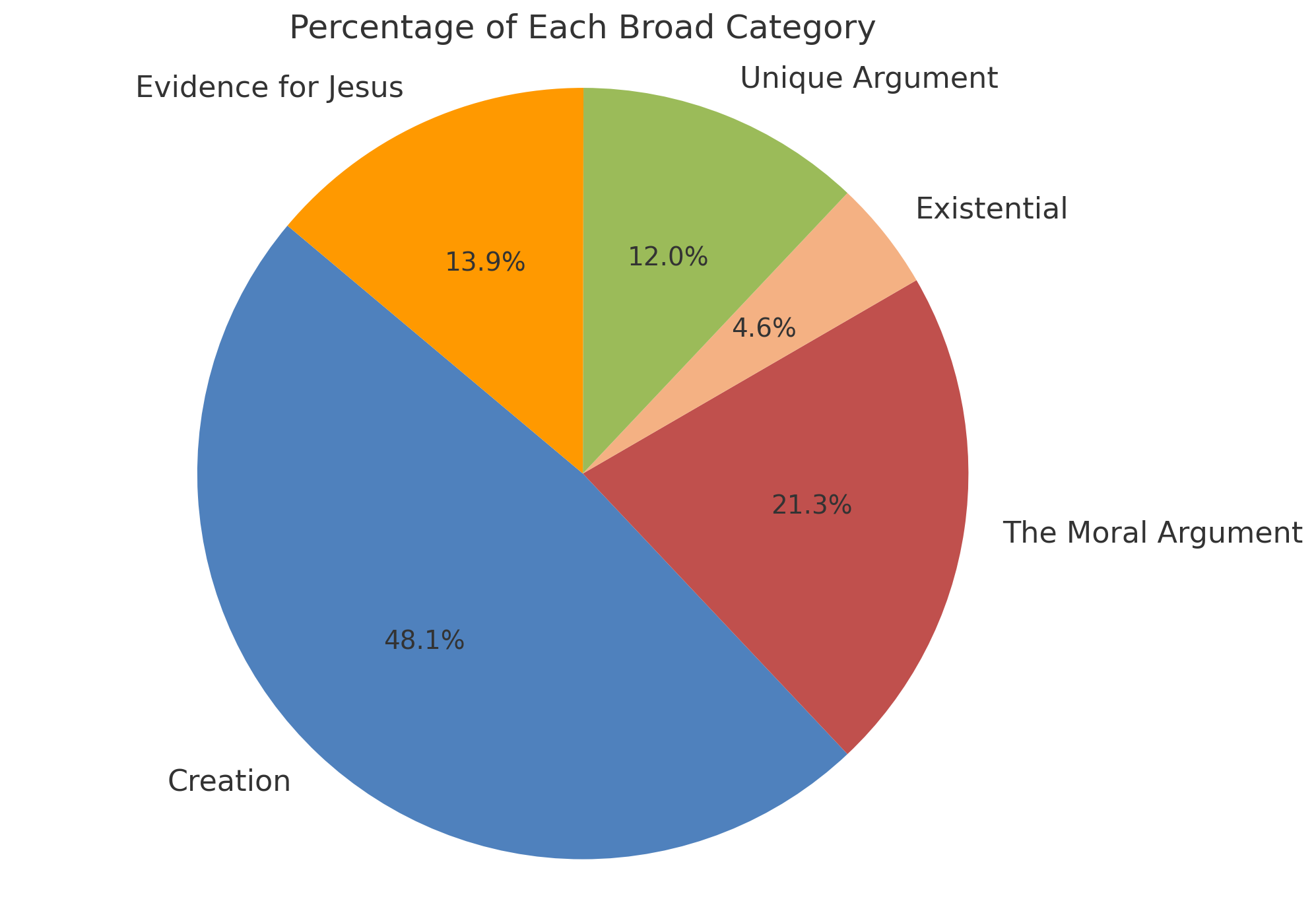
From the table of responses, several categories dominate:
| Argument Category | Count |
|---|---|
| Creation (incl. design, fine-tuning) | 52 |
| Moral Argument | 23 |
| Evidence for Jesus | 15 |
| Unique Arguments | 13 |
| Existential/Purpose | 5 |
Among these, creation-based arguments like the cosmological argument, intelligent design, and fine-tuning appear with overwhelming frequency. These are not arguments for the Christian God. They are arguments for a First Cause, a Designer, or a cosmic engineer—entities that fit comfortably within Islamic, Hindu, or generic theistic worldviews.
Yet this survey was directed at Christian apologists, most of whom affirm that Jesus is God, that God is Triune, and that salvation comes only through Christ. Why, then, do these distinctive doctrines vanish from their epistemic arsenal?
A Jealous God Who Hides?
The incongruity deepens when we recall that the Christian God describes Himself as jealous—not merely in the sense of emotional possessiveness, but in the sense of demanding unambiguous distinction from all false gods:
“You shall have no other gods before me.” (Exodus 20:3)
“For the LORD, whose name is Jealous, is a jealous God.” (Exodus 34:14)
If this God desires to be clearly and uniquely known, why are the very apologists charged with making His case defaulting to arguments that any other god could fulfill? It would seem the jealous God is also an oddly indistinct one.
The Missing Argument: Jesus
Only a small minority of respondents in the table cite the person of Jesus or the resurrection as their best argument. These include Stuart Knechtle, Rebecca McLaughlin, Lydia McGrew, and Mikel Del Rosario. And even within these cases, some frame Jesus more as a philosophical archetype or ethical north star than as the resurrected Son of God.
This is startling, given that the resurrection is the cornerstone of Christianity. As Paul writes in 1 Corinthians 15:14:
“And if Christ has not been raised, our preaching is useless and so is your faith.”
Why, then, is this existential lynchpin of Christianity not the go-to argument for the vast majority of these apologists? The answer may lie not in theology, but in epistemic risk management. Arguments from design or morality are vague, difficult to falsify, and rhetorically robust. The resurrection, on the other hand, is specific, historical, and potentially falsifiable. And apologists know this.
The Strategy of Ambiguity
By leaning on design, morality, or abstract causality, apologists can play it safe: they can invite skeptics into a vaguely spiritual worldview without having to defend the full weight of Christian doctrine. This is often framed as “building bridges” or “establishing plausibility structures”, but in practice, it amounts to a subtle bait-and-switch: lure with Deism, land with Jesus.
This strategy backfires on scrutiny. If the Christian God is real, jealous, loving, and wants to be known, why would He leave the strongest arguments for His existence indistinguishable from arguments for Zeus, Brahman, or Allah? More to the point: why do His defenders behave as if the uniquely Christian evidence is their weakest evidence?
Final Reflection: A Jealous God Betrayed by His Defenders
There is a revealing contradiction here. The Christian God is said to be relational, personal, and revealing—a God who wants to be known not just as a Creator, but as Father, Son, and Spirit. Yet when tasked with offering the best evidence for His reality, even His most ardent intellectual defenders decline to make Him the centerpiece of their case.
Instead, they present a God who is powerful but anonymous, intelligent but impersonal, explanatory but indistinct.
In this, the jealous God is betrayed—not by skeptics, but by those who claim to know Him best.
The Raw Data
| Names | Argument | Broad Category | |
|---|---|---|---|
| 1 | William Lane Craig | Kalaam cosmological arguement | Creation |
| 2 | Dave Holmquist | Morality | The Moral Argument |
| 3 | Adam Donyes | Creation | Creation |
| 4 | Austin Fruits | Morality | The Moral Argument |
| 5 | Jeff Hamilton | Internal struggle for meaning in human existance | Existential |
| 6 | Aaron Bond | intelligent design | Creation |
| 7 | J. Warner Wallace | Cosmological argument | Creation |
| 8 | John Randall | Creation | Creation |
| 9 | Dana Dill | Morality | The Moral Argument |
| 10 | Ryan Pauly | Consciousness | Unique Argument |
| 11 | Paul Copan | Morality | The Moral Argument |
| 12 | John Stonestreet | Jesus (He is objectively speaking the best argument for God in human history – the full revelation of God in bodily form and the final answer to “if God exists why doesn’t He show Himself” and “Where is God when I suffer?” And “Why doesn’t God do anything about the evil in the world?” And “Does God love me?” And “How do I know who God is?”) | Evidence for Jesus |
| 13 | Brett Kunkle | Kalam comological arguement | Creation |
| 14 | Alan Shlemon | intelligent design | Creation |
| 15 | Greg Koukl | Morality | The Moral Argument |
| 16 | Wes Huff | Morality | The Moral Argument |
| 17 | Micah Guy | Fine Tuning | Creation |
| 18 | Matthew Tingblad | Fine Tuning | Creation |
| 19 | Ben Bennett | Design | Creation |
| 20 | Lee Strobel | Kalam Cosmological Argument | Creation |
| 21 | Stuart Knechtle | Resurrection | Evidence for Jesus |
| 22 | Natasha Crain | Morality | The Moral Argument |
| 23 | J. Steve Miller | Near-Death experiences | Unique Argument |
| 24 | Scott Rae | Priviliage Planet thesis | Creation |
| 25 | Scott Smith | Morality | The Moral Argument |
| 26 | Greg Ganssle | Fine Tuning | Creation |
| 27 | Alisa Childers | Kalam Cosmological argument | Creation |
| 28 | Bobby Conway | morality | The Moral Argument |
| 29 | Hugh Ross | fine-tuning argument | Creation |
| 30 | Gary Habermas | Resurrection | Evidence for Jesus |
| 31 | John Lennox | A transformed life | Existential |
| 32 | Mary Jo Sharp | The Argument from Rationality | Unique Argument |
| 33 | Jeff Myers | Intelligent Design | Creation |
| 34 | Will Dembski | Argument from Extravagance | Unique Argument |
| 35 | Mike Licona | Design | Creation |
| 36 | J.P Moreland | Kalam Cosmological argument | Creation |
| 37 | Nancy Pearcey | cosmological argument | Creation |
| 38 | Os Guiness | The best argument is the best argument for the specific person. In other words, there is no best argument! | NaN |
| 39 | Grant Trout | Experienced the world without God, and a world withn him and theres no going back | Existential |
| 40 | Ross Douthat | Intelligibility Argument | Unique Argument |
| 41 | Nick Caldwell | Intelligent Design | Creation |
| 42 | Jonathon Morrow | kalam cosmological argument | Creation |
| 43 | Josh McDowell | prophecy | Evidence for Jesus |
| 44 | Larry Sanger | Design | Creation |
| 45 | Barry Correy | Morality | The Moral Argument |
| 46 | ED Stetzer | Resurrection | Evidence for Jesus |
| 47 | Tim Muehlhoff | argument from desire | Unique Argument |
| 48 | Thaddeus Williams | The existential argument. | Existential |
| 49 | Anonymous Talbot School of Theology Professor (Biola) | creation | Creation |
| 50 | Anonymous Talbot School of Theology Professor (Biola) | Design | Creation |
| 51 | Anonymous Talbot School of Theology Professor (Biola) | Creation | Creation |
| 52 | Anonymous Talbot School of Theology Professor (Biola) | Fine-tuning | Creation |
| 53 | Anonymous Talbot School of Theology Professor (Biola) | Morality | The Moral Argument |
| 54 | Anonymous Talbot School of Theology Professor (Biola) | Creation | Creation |
| 55 | Anonymous Talbot School of Theology Professor (Biola) | Giving birth | Creation |
| 56 | Anonymous Talbot School of Theology Professor (Biola) | Prophecy | Evidence for Jesus |
| 57 | Anonymous Talbot School of Theology Professor (Biola) | Resurrection | Evidence for Jesus |
| 58 | Anonymous Talbot School of Theology Professor (Biola) | Meaning | Existential |
| 59 | Anonymous Talbot School of Theology Professor (Biola) | The reality or existence of life itself. | Creation |
| 60 | Anonymous Talbot School of Theology Professor (Biola) | Cosmological argument | Creation |
| 61 | Anonymous Talbot School of Theology Professor (Biola) | cosmological argument | Creation |
| 62 | Anonymous Talbot School of Theology Professor (Biola) | cosmological argument | Creation |
| 63 | Anonymous Talbot School of Theology Professor (Biola) | Morality | The Moral Argument |
| 64 | Anonymous Talbot School of Theology Professor (Biola) | Design | Creation |
| 65 | Anonymous Talbot School of Theology Professor (Biola) | morality | The Moral Argument |
| 66 | Anonymous Talbot School of Theology Professor (Biola) | Resurrection | Evidence for Jesus |
| 67 | Anonymous Talbot School of Theology Professor (Biola) | Morality | The Moral Argument |
| 68 | Anonymous Talbot School of Theology Professor (Biola) | Beauty | Unique Argument |
| 69 | Anonymous Talbot School of Theology Professor (Biola) | Cosmological argument | Creation |
| 70 | Anonymous Talbot School of Theology Professor (Biola) | Resurrection | Evidence for Jesus |
| 71 | Anonymous Talbot School of Theology Professor (Biola) | Morality | The Moral Argument |
| 72 | Anonymous Talbot School of Theology Professor (Biola) | Design | Creation |
| 73 | Anonymous Talbot School of Theology Professor (Biola) | Moral | The Moral Argument |
| 74 | Anonymous Talbot School of Theology Professor (Biola) | Morality | The Moral Argument |
| 75 | Anonymous Talbot School of Theology Professor (Biola) | creation | Creation |
| 76 | Anonymous Talbot School of Theology Professor (Biola) | morality | The Moral Argument |
| 77 | Anonymous Talbot School of Theology Professor (Biola) | Love | Unique Argument |
| 78 | Anonymous Talbot School of Theology Professor (Biola) | cosmological argument | Creation |
| 79 | Neil Shenvi | Morality | The Moral Argument |
| 80 | Melissa Dougherty | Intelligent Design | Creation |
| 81 | Jonathan McLatchie | Biological Design | Creation |
| 82 | Becket Cook | Fine-tuning | Creation |
| 83 | Douglas Groothuis | I cannot do that. Too simplistic. It depends on what “best” means. I’m a cumulative case guy, so I think we need several to make the case. | NaN |
| 84 | Mike Winger | Design | Creation |
| 85 | John Marriott | Transcendental argument | Unique Argument |
| 86 | Mikel Del Rosario | Jesus’ Divine Claims and Resurrection | Evidence for Jesus |
| 87 | Mark Mittelberg | DNA | Creation |
| 88 | Randy Alcorn | Creation (Including the intelligent design of galaxies, sunsets, eclipses, mountain ranges, oceans, and the physical and metaphysical aspects of my wife, daughters and grandsons, each of my dogs, plus horses, lions, whales, dolphins, and manta rays. That one word creation covers a lot of ground!) | Creation |
| 89 | Gavin Ortlund | Morality | The Moral Argument |
| 90 | Michael Sherrard | Purpose | Unique Argument |
| 91 | Lydia McGrew | Resurrection | Evidence for Jesus |
| 92 | John Lovell | cosmological argument | Creation |
| 93 | Andrew Loke | cosmological argument | Creation |
| 94 | Rebecca McLaughlin | The divine claims and ethics of Jesus (If Jesus isn’t God, our deepest ethical beliefs have no secure foundation. Atheism leaves us ethically unmoored. But we don’t just need a generic idea of a Creator to ground universal human equality, care for the poor, equality of men and women, etc. We need Jesus’s ethics. And Jesus’s ethics are just wishful thinking if he isn’t God) | Evidence for Jesus |
| 95 | Ruslan KD | Reason | Unique Argument |
| 96 | Hillary Ferrer | Proteins and protein synthesis (“That’s easy!”) | Creation |
| 97 | Nata Sala | Moral Argument | The Moral Argument |
| 98 | Josh Swamidass | Resurrection | Evidence for Jesus |
| 99 | Trent Horn | Contingency | Unique Argument |
| 100 | Megan Almon | Morality/Beauty | The Moral Argument |
| 101 | Allen Parr | Fine-tuning (“for me for sure it would be fine-tuning”) | Creation |
| 102 | Titus Kennedy | cosmological argument | Creation |
| 103 | Cameron Bertuzzi | Fine-tuning | Creation |
| 104 | Justin Brierley | Morality | The Moral Argument |
| 105 | Stephanie Gray Connors | Resurrection | Evidence for Jesus |
| 106 | Tim Barnett | Fine- Tuning | Creation |
| 107 | George Hulse | cosmological argument | Creation |
| 108 | Jason Carlson | Resurrection | Evidence for Jesus |
| 109 | Frank Turek | Cosmological | Creation |
| 110 | Eric Hovind | Transcendental argument | Unique Argument |


 Free of Faith
Leave a comment