
The Inconsistent Retreat by Christians to Commonsensical Methods of Assessing the Reliability of our Minds

◉ Part I: The Apologist Claim — Faith Grounds Cognitive Reliability Across Time
Christian apologists—from C.S. Lewis and Alvin Plantinga to Cornelius Van Til—have vigorously argued that confidence in human reason presupposes a belief in God. Their claim is not just that reason functions better with faith, but that faith is the only coherent basis for trusting the reliability of our minds at all. Let us briefly review their strongest assertions:

- C.S. Lewis, in The Case for Christianity, argues that if our thoughts are accidental byproducts of material processes, we lose any rational basis to trust them. Therefore, it is only if our minds are designed by a rational God that we can reasonably believe they track truth.
- Alvin Plantinga, in his Evolutionary Argument Against Naturalism, claims that if evolution and naturalism are both true, we have a “defeater” for trusting any of our beliefs—including the belief in naturalism itself. For him, only a theistic framework in which God intends humans to know truth makes rational trust in cognition possible.
- Cornelius Van Til and Greg Bahnsen go even further, suggesting that the very possibility of logical thought presupposes Christian theism. In their presuppositional view, atheists who trust their minds are intellectually parasitic—they are borrowing epistemic capital from theism.
These arguments converge on one core claim:
Only if a rational God exists—and created humans with reliable cognitive faculties—can we justifiably trust our reasoning.
But there is a direct implication of this view that apologists rarely acknowledge:
If the source of our mind’s reliability is divine, then that reliability is not contingent on our biology, development, or life stage. God’s design does not fluctuate. The reliability of a person’s mind should be as fixed and trustable at birth, in adulthood, and in old age—since it is supposedly grounded in a timeless, perfect act of divine creation.
Indeed, any deviation from this would imply one of the following:
- That God designs minds of differing reliability, undermining the apologetic claim of secure epistemic grounding.
- That biological variables override God’s design, conceding the ground to naturalism.
- That human cognitive reliability is not actually a function of divine origin, thereby refuting the apologist’s position from within.
Thus, a theology-rooted epistemology should entail unwavering confidence in the reliability of minds across time and developmental stages—from infancy through senility—unless Christians wish to admit naturalistic processes play the dominant role.
Yet that is not what we observe.
◉ Part II: The Christian Retreat to Naturalistic Epistemic Practices
Despite the bold metaphysical assurances in apologetic writings, Christians demonstrably abandon this framework in real life. Their actual behavior shows a practical rejection of the very claim they defend in theory. Consider the following three life stages:

1. Childhood: Testing the Divine Image
Christian parents do not assume their children’s minds are reliably functioning merely because God supposedly endowed them with reason. Instead, they submit their children to:
- Developmental screenings
- Cognitive assessments by neurologists
- Psychological evaluations
- Standardized school tests
Why? To verify if the mind—allegedly a divinely rational faculty—is actually functioning reliably. They do not trust that divine origin ensures cognitive trustworthiness. They turn instead to empirical tools rooted in evidence-based developmental psychology.
2. Adulthood: Ranking the Image of God
In adulthood, Christians engage in:
- IQ tests
- Academic evaluations
- Job aptitude screenings
- Comparative assessments with peers
Again, none of these behaviors reflect a trust in divine design. Instead, these actions reveal a deeply naturalistic epistemic model: trust is earned through performance, measurement, and comparison—not presumed through divine fiat.
If they truly believed faith in God underwrote epistemic reliability, then why would any such empirical verification be necessary?
3. Old Age: Measuring the Decay of the Soul’s Instrument
As they age, Christians routinely:
- Take memory tests
- Engage in crossword puzzles to ward off dementia
- Visit neurologists to detect cognitive decline
Do they express confidence that God’s gift of reason remains intact throughout life? Not in practice. The moment aging casts doubt on their faculties, they pivot to secular medicine, cognitive therapy, and neuroscience. The implication is unmistakable: faith offers no actionable confidence in the mind’s reliability. When concern arises, they act exactly as a naturalist would.
Conclusion: A Performative Rebuttal of Faith-Based Epistemology
Apologists like Lewis and Plantinga make sweeping metaphysical claims about the necessity of God for rational thought. Yet in every observable practice, Christians rely on naturalistic metrics, empirical testing, and secular epistemology to determine whether minds are functioning reliably.
There is no reliance on God in their daily or lifelong assessment of cognitive health or capacity.
This yields a stark conclusion:
Christians live as though belief in God is irrelevant to knowing whether their minds are reliable.
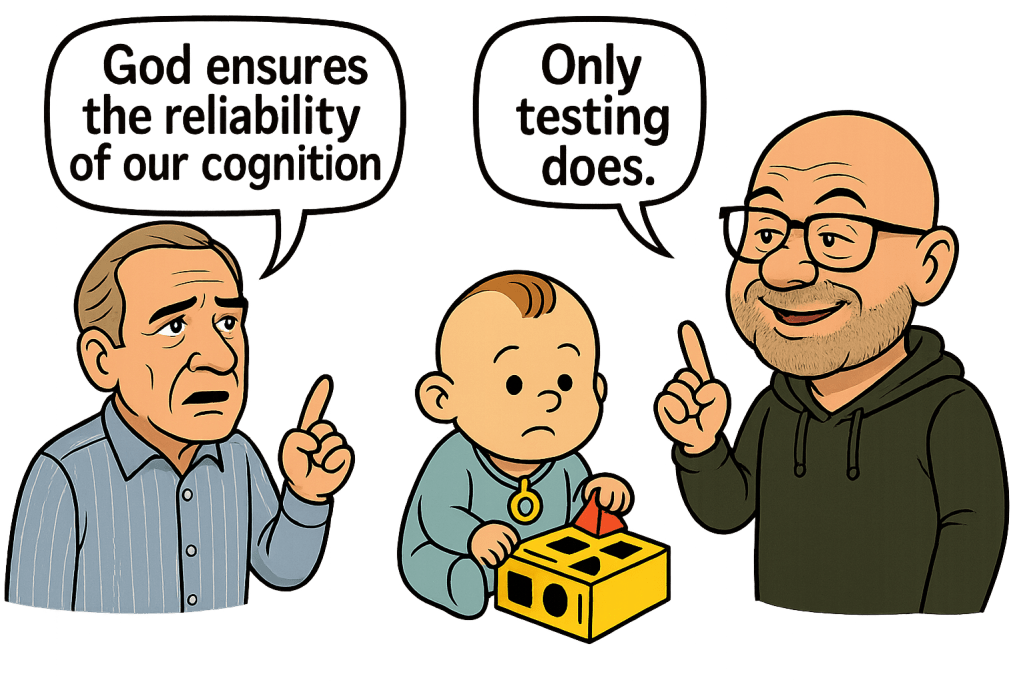
That is, their practice contradicts their profession. Their behaviors render their apologetics hollow—not merely inconsistent, but performatively self-defeating.
They may speak as though God guarantees cognitive reliability, but in the real world, they behave as though only observation, measurement, and science can justify such trust.
The Formalization:
Symbol Key:
= God exists and created human minds
= Human reasoning is generally reliable
= There is justification for trusting human reasoning
= Naturalistic (empirical) methods are used to assess mental reliability
= Christians claim that
= Christians act in accordance with the claim

Premises:


Conclusion:

Natural Language Interpretation:
Christians claim that faith in God provides sufficient justification for trusting the reliability of reason. However, they consistently act as though only empirical, naturalistic methods can verify that reliability. This behavioral pattern contradicts their professed epistemology, undermining the claim that faith alone grounds rational trust in the mind.
See also:
◉ CS Lewis’ Argument from Reason



 Free of Faith
Leave a comment