
◉ A Historical Analysis of Christian Dispositions Toward Slavery and Race

Introduction
This report provides an exhaustive historical analysis of the theological and ethical dispositions of Christian leaders toward the institution of slavery from the Apostolic Age to the present day. The primary scope traces the evolution of Christian thought from its origins within the Roman Empire, through the medieval and Reformation periods, to the age of abolition and the modern struggles for civil rights and racial justice.
The structure of this report is organized into major historical epochs to provide a coherent narrative of theological development. Within each epoch, key figures, texts, and events are situated chronologically, approximating a fifty-year assessment of the prevailing disposition toward slavery. It must be acknowledged that theological influence is not distributed evenly across time but is clustered around major thinkers and historical events. To quantify the qualitative data presented, this report introduces a scoring system, detailed in the final section, which facilitates a visual trendline analysis of the evolving disposition toward slavery.
For clarity, this report will adhere to precise historical definitions. “Slavery” refers to the system of chattel bondage prevalent in the Roman Empire and later in the Atlantic world, wherein an individual was legally considered property (res) of a master (dominus), devoid of legal personhood. “Racism” is defined as a modern, systematic ideology grounded in pseudo-scientific biological theories and hierarchical classifications of human groups, a concept distinct from ancient ethnic prejudice.
✓ I. The World They Inherited: Slavery in the Roman Empire
Christianity emerged and developed within a socio-economic landscape where slavery was not a peripheral issue but a foundational institution. To understand the responses of Christian leaders, one must first grasp the legal, economic, and social reality of slavery in the Roman Empire, which formed the unquestioned backdrop of their world.
Legal Framework
Under Roman law, the slave occupied a paradoxical position. The jurist Gaius (c. 161 AD) defined slavery as a condition under the ius gentium (the law of nations) “in which someone is subject to the dominion of another person contrary to nature”. This acknowledgment that slavery was contrary to ius naturale (natural law) yet sanctioned by common law created a legal and philosophical tension. Legally, the slave was not a person but a thing, an object of property. Slaves were considered instrumenta—tools or equipment—of a household or business. They possessed no personal rights, could not own property, enter into a legal contract, or form a legally recognized marriage. Any children born to an enslaved woman automatically became the property of her master. The master, or paterfamilias, held the power of life and death (vitae necisque potestas) over all members of his household, including his slaves.
Economic and Social Reality
The Roman economy was built on the backs of the enslaved. Historians estimate that between 10% and 20% of the empire’s population consisted of slaves, meaning a total of five to ten million people in the first century AD. This labor force was ubiquitous, working in every sector of the economy, from brutal manual labor in mines to skilled domestic occupations. Crucially, Roman slavery was not racialized in the modern sense. Enslavement was a consequence of circumstances—capture in war, piracy, or debt—not biology. Slaves came from all over the empire and could be of any ethnicity. While Romans held strong ethnic prejudices, these did not form a systematic racial hierarchy that predetermined who could be enslaved. The pervasiveness of slavery as a social “given” is the single most important context for understanding the early Christian response, which focused not on abolition but on regulating and spiritualizing relationships within the existing structure.
✓ II. The Apostolic and Ante-Nicene Era (c. 50–325 CE)
In the centuries before Christianity gained state sanction, its adherents were a minority sect, often persecuted and lacking political power. Their writings on slavery reflect this position, showing a complex mixture of accommodation to social norms, the use of slavery as a powerful spiritual metaphor, and the first signs of a distinctively Christian moral critique.
The New Testament itself presents an ambiguous picture. The Pauline epistles, the earliest Christian writings, command slaves to obey their masters “with respect and fear” (Ephesians 6:5) and masters to treat slaves justly, reminding them they share the same Master in heaven (Ephesians 6:9). In his letter to Philemon, Paul sends the runaway slave Onesimus back to his master, but urges Philemon to receive him “no longer as a slave, but as a beloved brother”. This approach did not challenge the institution’s legality but sought to transform the relationship within it through a shared Christian identity.
This pattern continued among the Apostolic Fathers. The Didache (c. 100-130 CE) instructs masters not to be bitter toward their slaves, who “hope in the same God,” while commanding slaves to submit to their masters “as to God’s image”. Ignatius of Antioch (c. 110 CE) cautioned against using church funds for mass manumission, fearing it would encourage false conversions and social disorder. His priority was ecclesiastical stability over social reform.
As the church’s intellectual tradition developed, competing views emerged. Tertullian (c. 160-225 CE), a trained lawyer, fiercely defended property rights, condemning the liberation of a slave as a form of theft from the master. In stark contrast, Clement of Alexandria (c. 150-215 CE) attacked the slave trade and affirmed the fundamental equality of the enslaved, declaring, “Slaves are men like ourselves”. This tension—between pragmatic acceptance of the social order and a moral critique rooted in the imago Dei (image of God)—would define the Christian debate on slavery for centuries.
✓ III. The Imperial Church and Early Middle Ages (c. 325–750 CE)
Following the conversion of Emperor Constantine, Christianity became the dominant religion of the Roman Empire, and its leaders gained significant political influence. This new status compelled a more direct theological engagement with slavery.
The most radical condemnation of slavery in all of Patristic literature came from Gregory of Nyssa (c. 335-395 CE). He argued that owning another human being was an arrogant usurpation of God’s authority, declaring, “You condemn man to slavery, when his nature is free and possesses free will…overturning his law for the human species”. His argument was a thoroughgoing theological abolitionism.
However, Gregory’s view was an outlier. More common was the ameliorative approach of John Chrysostom (c. 347-407 CE), who spiritualized the issue by defining “true slavery” as slavery to sin. He urged humane treatment but did not call for the institution’s abolition.
The most influential framework was formulated by Augustine of Hippo (354-430 CE). He argued that while slavery was not part of God’s original, natural design, it entered the world as a just and divinely ordained punishment for sin. This powerful synthesis allowed a Christian to simultaneously believe slavery was an evil resulting from the Fall and a legitimate institution in the fallen world. This Augustinian compromise would dominate Western Christian thought for over a millennium.
As the Western Roman Empire fragmented, the Church became a major landowner and thus a major slaveholder. Pope Gregory the Great (c. 540-604 CE) administered the papal estates according to the Augustinian model, upholding the institution’s legitimacy while urging masters to act with paternal care. He defended slaves from abuse but also advocated for the flogging of pagan slaves on Church lands who refused to convert. During this period, the Church’s insistence on the sanctity of slave marriage and the growing prohibition on enslaving fellow Christians helped catalyze the gradual transition from chattel slavery to medieval serfdom, a system of bonded labor tied to the land. Figures like the Frankish Queen Bathilde (d. 680), a former slave, outlawed the trade in Christian slaves within their realms. A notable voice against the institution was Theodore the Studite (d. 826), who forbade his monks from owning slaves, citing the imago Dei.
✓ IV. The High Middle Ages and Renaissance (c. 750–1500 CE)
Throughout the Middle Ages, the Augustinian framework remained dominant. The enslavement of fellow Christians was largely prohibited in Western Europe, a policy reinforced by councils like those of Koblenz (922) and London (1102). However, this prohibition did not extend to non-Christians. The ongoing conflict with Muslim powers and the presence of pagan peoples on the frontiers of Europe meant that a slave trade in non-Christians continued.
The great scholastic theologian Thomas Aquinas (c. 1225-1274) integrated the Patristic view with Aristotelian philosophy. He argued that while slavery was not part of nature’s “first intention,” it was a rational and punitive measure in a fallen world. He also adopted a version of Aristotle’s “natural slavery,” suggesting it was mutually beneficial for a “wiser man” to rule over a less intelligent one. This Thomistic synthesis provided a powerful philosophical reinforcement of the Augustinian compromise.
The dawn of the Age of Discovery created a new and terrible context for these long-standing views. As Portugal and Spain began their expansion into Africa and the Americas, the Church provided a crucial justification. A series of 15th-century papal bulls, most notoriously Dum Diversas (1452) and Romanus Pontifex (1455), granted the Portuguese crown the right to “invade, search out, capture, vanquish, and subdue all Saracens and pagans” and to “reduce their persons to perpetual slavery“. These decrees, issued in the context of crusading against the Ottoman Empire, became the theological and legal warrant for the burgeoning Atlantic slave trade, explicitly sanctioning the enslavement of non-Christians as a tool of state policy and religious conversion.
✓ V. Reformation and the Rise of Racial Slavery (c. 1500–1750 CE)
The 16th century saw both the first major challenges to New World slavery and the development of its racialized justification. The Dominican friar Bartolomé de las Casas (1484-1566), horrified by the brutal treatment of indigenous peoples, became their fierce defender, arguing for their natural rights and full humanity. His work represented a revival of the imago Dei argument. However, the institution’s power is evident in his early proposal to substitute enslaved Africans for indigenous laborers, a position he later deeply regretted. Meanwhile, religious orders like the Jesuits and Dominicans became vast slaveholders themselves, using enslaved labor on plantations in the Americas to fund their missions and schools.
The Protestant Reformers had an ambiguous inheritance. Martin Luther’s emphasis on remaining in one’s God-given “station” could be used to command slaves to accept their lot. John Calvin viewed slavery as “totally against all the order of nature” but accepted it as part of God’s permissive providence in a fallen world. This tension allowed some later Calvinists to become abolitionists, while others used his doctrines to defend the status quo.
This period saw the fusion of slavery with a systematic racial ideology. The Augustinian concept of slavery as a punishment for sin was merged with the biblical story of Noah’s curse on Ham’s son, Canaan (Genesis 9:20-27). Later theologians identified Ham’s descendants with the peoples of sub-Saharan Africa, creating the “Curse of Ham” narrative. This provided a specific divine warrant for the hereditary, racialized chattel slavery of the Atlantic world, arguing that Black Africans were biblically predestined for servitude.
✓ VI. The Age of Abolition (c. 1750–1900 CE)
While Christian theology had for centuries provided justification for slavery, it also contained the seeds of its destruction. From the mid-18th century, a powerful abolitionist movement emerged, driven primarily by Christian conviction. It began with American Quakers like John Woolman and Anthony Benezet, who successfully campaigned to have their denomination renounce slaveholding. They were joined by Methodists like John Wesley and Anglicans like Granville Sharp.
In Britain, the movement was spearheaded by a group of devout Christians, including William Wilberforce, who led the parliamentary campaign, and Thomas Clarkson, who gathered evidence of the trade’s horrors. They pioneered modern pressure-group tactics, mobilizing public opinion through petitions, logos, and rallies. Their arguments were explicitly theological, emphasizing the imago Dei and the Golden Rule to condemn the trade as a sin against God and humanity.
In the United States, the debate became deeply polarized, splitting denominations. Pro-slavery theologians in the South, such as the Baptist leader Richard Furman, developed a robust defense of chattel slavery as a biblically sanctioned institution, essential to social order and even a positive good. The Southern Baptist Convention was founded in 1845 in part to defend the right of missionaries to own slaves. Abolitionists, in contrast, argued that slavery violated the spirit of the Gospel.
In 1839, Pope Gregory XVI issued the bull In Supremo Apostolatus, which condemned the slave trade as “absolutely unworthy of the Christian name” and forbade Catholics from teaching that the trade was permissible. However, American bishops like John England of Charleston interpreted the bull as a condemnation of the international slave trade, not of domestic slaveholding, allowing the practice to continue among U.S. Catholics.
✓ VII. The Modern Era: Civil Rights and Reconciliation (c. 1900–Present)
The abolition of slavery in the 19th century did not end the legacy of racial hierarchy. In the United States, the era of Jim Crow segregation was often justified by the same Christian nationalist arguments that had defended slavery. White churches were largely segregated and often either supported or remained silent on the issue of racial injustice.
The primary challenge to this order came from the Black Church. The Civil Rights Movement of the 1950s and 1960s was led by Christian ministers like Dr. Martin Luther King Jr., who framed the struggle for equality in explicitly theological terms. King called segregation a “blatant denial of the unity which we have in Christ” and a “tragic evil which is utterly un-Christian”. He famously lamented that 11 o’clock on Sunday morning was the “most segregated hour in Christian America,” challenging the church to live up to its universalist creed.
In the late 20th and early 21st centuries, many Christian denominations began a process of formal repentance and reconciliation. In 1985, Pope John Paul II formally apologized for the Church’s role in the transatlantic slave trade. In 1995, the Southern Baptist Convention, which was founded in defense of slavery, passed a resolution repenting of its history of racism and apologizing to all African Americans. Other denominations, like the Conservative Congregational Christian Conference, have issued similar statements calling for racial reconciliation based on the biblical principle of unity in Christ. Today, many Christian organizations are at the forefront of the fight against modern slavery and human trafficking, applying the abolitionist principles of the 18th and 19th centuries to contemporary forms of exploitation.
➘ Common Arguments for Slavery
For much of its history, a significant number of Christian leaders and theologians developed a sophisticated and resilient body of arguments to defend, justify, or promote the institution of slavery. These arguments, drawn from scripture, philosophy, and tradition, were not fringe opinions but were central to the mainstream Christian acceptance of slavery for centuries, particularly in the American South.
Here is a comprehensive list of the most prominent scriptures and arguments they invoked.
➘ Arguments from Old Testament Law and Precedent
Pro-slavery theologians argued that the Old Testament, as God’s revealed word, not only permitted but actively sanctioned and regulated slavery, making it a divinely approved institution.
- The Curse of Ham (Genesis 9:20–27): This was arguably the most powerful and widely used justification for racialized slavery,. The narrative, in which Noah curses his son Ham’s descendants to be “the lowest of slaves,” was interpreted to apply specifically to people of African descent. Theologians in the 16th and 17th centuries fused this story with Aristotelian concepts of natural hierarchy to argue that Africans were biblically predestined for servitude. This argument was central to justifying the transatlantic slave trade and was used by prominent American theologians like George Armstrong.
- The Patriarchs as Slaveholders: Proponents of slavery pointed out that revered biblical figures like Abraham, Isaac, Jacob, and Job were all slaveholders,. They noted that Abraham, the “father of the faithful,” owned many slaves (Genesis 12:5, 24:35-36) and that God blessed him with this wealth. The argument, articulated by figures like A.B. Bledsoe, was that if these godly men held slaves, the practice could not be inherently sinful.
- Slavery in the Mosaic Law: Theologians argued that God explicitly sanctioned slavery by including it in the moral law given to Moses.
- The Ten Commandments: The Fourth and Tenth Commandments (Exodus 20:10, 17) mention the “manservant” and “maidservant,” which was interpreted as God’s implicit approval of the institution within the moral law,.
- Laws of Perpetual Bondage: Leviticus 25:44–46 was a key text, as it explicitly allows Israelites to purchase and hold foreigners as inheritable property in perpetuity, drawing a distinction between Hebrew indentured servants and foreign chattel slaves. This provided a direct scriptural model for the system of chattel slavery in the Americas.
- Regulation as Sanction: The existence of detailed laws regulating the treatment of slaves (e.g., Exodus 21) was itself seen as divine sanctioning of the institution.
➘ Arguments from the New Testament and the Early Church
Defenders of slavery argued that neither Jesus nor the Apostles condemned slavery, and in fact gave instructions that reinforced the institution.
- The Silence of Jesus: A common argument was that Jesus lived in a society where slavery was widespread, yet he never spoke a word against it. His use of slaves as characters in his parables (e.g., Matthew 25:14-30) was interpreted as an acceptance of slavery as a normal part of the social order [],.
- Apostolic Injunctions to Slaves: The “household codes” in the Pauline and Petrine epistles were the cornerstone of the New Testament defense of slavery. Ministers repeatedly preached these verses to enslaved populations,,,,.
- Ephesians 6:5: “Slaves, obey your earthly masters with respect and fear, and with sincerity of heart, just as you would obey Christ”,.
- Colossians 3:22: “Slaves, obey your earthly masters in everything; and do it, not only when their eye is on you and to curry their favor, but with sincerity of heart and reverence for the Lord”,.
- 1 Timothy 6:1: “All who are under the yoke of slavery should consider their masters worthy of full respect, so that God’s name and our teaching may not be slandered”,.
- Titus 2:9-10: “Teach slaves to be subject to their masters in everything, to try to please them, not to talk back to them, and not to steal from them, but to show that they can be fully trusted”, [].
- 1 Peter 2:18: “Slaves, in reverent fear of God submit yourselves to your masters, not only to those who are good and considerate, but also to those who are harsh”, [].
- The Example of Philemon: The Apostle Paul’s action of sending the runaway slave Onesimus back to his master Philemon was frequently cited as proof that the apostles respected the property rights of slaveholders,. Pro-slavery theologians emphasized that Paul did not demand Onesimus’s freedom but appealed for him to be received as a “brother,” which they argued did not negate the master-slave relationship.
- The Early Church Fathers: Theologians pointed to the fact that the majority of early Church Fathers accepted slavery as a legitimate social institution.
- Augustine of Hippo taught that slavery was a just consequence of sin, and while masters should be loving, they were permitted by God to use the whip for discipline.
- John Chrysostom taught that slaves should obey their masters to please God and that disciplining them was a commendable act.
- Tertullian condemned the liberation of slaves as an act of theft against the master.
➘ Theological and Philosophical Arguments
Beyond direct scriptural citation, Christian leaders constructed broader theological and philosophical systems to uphold slavery.
- Slavery as a Divinely Ordained Hierarchy: Especially in the American South, theologians like James Henley Thornwell argued that slavery was part of a God-ordained patriarchal order, with the master holding a position of authority analogous to that of a husband over a wife or a parent over a child,. The household codes, which address these relationships together, were used to support this view,.
- Slavery as a “Positive Good”: In the 19th century, Southern ministers shifted from defending slavery as a “necessary evil” to promoting it as a “positive good”. They argued that the institution was a benevolent one that brought “savage” Africans into contact with Christianity and civilization, thereby saving their souls ,.
- Natural Law and “Natural Slaves”: Drawing on Aristotle, scholastic theologians like Thomas Aquinas argued that while slavery was not part of nature’s “first intention,” some people were “slaves by nature” and benefited from being ruled by those who were wiser. This justified slavery as a rational, if not ideal, component of society.
- “Just Title” Servitude: For centuries, the Catholic Church distinguished between “unjust” enslavement (e.g., kidnapping) and “just title” servitude, which could be imposed on prisoners of war or criminals. This distinction allowed the Church to condemn certain abuses while tolerating the institution itself. This was reinforced by papal bulls in the 15th century, such as Dum Diversas, which authorized the enslavement of “Saracens and pagans” captured in war,.
✓ VIII. Synthesis and Visual Analysis:
A Trendline of Theological Disposition
(A Gemini Deep Research Project)
To synthesize the historical data, a 5-point scale is used to score the prevailing theological disposition of influential Christian leaders and texts toward slavery.
- Score 5: Radical Condemnation. The institution is condemned as contrary to fundamental Christian doctrine.
- Score 4: Moral Condemnation. The institution or its key components are denounced as immoral, without a clear program for abolition.
- Score 3: Theological Amelioration. The institution is not challenged, but its practice is reformed by emphasizing spiritual equality and humane treatment.
- Score 2: Pragmatic Acceptance. Slavery is accepted as a social given, often justified as a feature of a fallen world or a consequence of sin.
- Score 1: Active Defense/Justification. The institution is actively defended on theological or legal grounds.
Disposition Toward Slavery (50 CE – 2025 CE)
| Time (CE) | Key Figure/Text/Event | Disposition Summary | Disposition Score |
| 50 | St. Paul | Amelioration within existing structure; “brother in Christ.” | 3 |
| 100 | Ignatius of Antioch | Pragmatic acceptance; prioritizes church order. | 2 |
| 150 | Didache | Upholds hierarchy but urges mutual obligation. | 2 |
| 200 | Clement of Alexandria | Moral condemnation of the slave trade. | 4 |
| 250 | Tertullian | Active defense of master’s property rights. | 1 |
| 300 | Lactantius | Theological amelioration; “brothers after the spirit.” | 3 |
| 350 | Council of Gangra | Condemns encouraging slaves to flee their masters. | 2 |
| 400 | Gregory of Nyssa | Radical condemnation of slavery as sin against God. | 5 |
| 450 | Augustine of Hippo | Pragmatic acceptance; slavery as just punishment for sin. | 2 |
| 500 | Augustinian Synthesis | Dominant view of accommodation solidifies. | 2 |
| 550 | Justinian’s Code | Codifies slavery in law, with some protections. | 2 |
| 600 | Gregory the Great | Manages church slaves under Augustinian framework. | 2 |
| 650 | Queen Bathilde | Outlaws trade in Christian slaves. | 3 |
| 700 | Rise of Serfdom | Gradual shift away from chattel slavery for Christians. | 3 |
| 750 | Theodore the Studite | Forbids slave ownership in his monastery (localized). | 4 |
| 800 | Carolingian Era | Serfdom dominant; slavery of non-Christians continues. | 2 |
| 850 | Papal Policy | Reinforces ban on enslaving Christians. | 2 |
| 900 | Viking/Pagan Raids | Non-Christians seen as legitimate source of slaves. | 2 |
| 950 | Council of Koblenz | Prohibits sale of Christian slaves to non-Christians. | 2 |
| 1000 | Feudal System | Agricultural slavery largely gone from Western Europe. | 2 |
| 1050 | Norman Conquest | Further decline of slavery in England. | 3 |
| 1100 | Council of London | Prohibits the slave trade in England. | 3 |
| 1150 | Crusades | Enslavement of Muslim captives considered licit. | 2 |
| 1200 | Council of Armagh | Frees English slaves in Ireland. | 3 |
| 1250 | Thomas Aquinas | Scholastic justification of slavery as punitive/natural. | 2 |
| 1300 | Late Medieval Period | Slavery persists on the fringes of Christendom. | 2 |
| 1350 | Black Death | Weakens serfdom, but not the principle of bondage. | 2 |
| 1400 | Pre-Exploration | Augustinian/Thomistic view remains standard. | 2 |
| 1450 | Dum Diversas | Papal bull authorizes enslavement of non-Christians. | 1 |
| 1500 | Age of Discovery | Justification for colonial slavery established. | 1 |
| 1550 | Las Casas/Valladolid | First major debate on New World slavery’s morality. | 2 |
| 1600 | “Curse of Ham” | Racialized justification for slavery gains traction. | 2 |
| 1650 | Atlantic Slave Trade | Entrenchment of racial chattel slavery. | 1 |
| 1700 | Pro-Slavery Theology | Biblical arguments used to defend the institution. | 1 |
| 1750 | Quaker Abolitionism | First organized Christian movements against slavery. | 3 |
| 1800 | Wilberforce/Wesley | Mainstream abolitionist movements gain strength. | 3 |
| 1850 | U.S. Denominational Splits | Peak of pro-slavery vs. abolitionist Christian debate. | 3 |
| 1900 | Jim Crow Era | Christian nationalism used to justify segregation. | 2 |
| 1950 | Civil Rights Movement | Black churches lead theological challenge to racism. | 3 |
| 2000 | Papal Apologies/Reconciliation | Denominations repent for historical role in slavery/racism. | 4 |
| 2025 | Modern Abolitionism | Christian groups fight modern human trafficking. | 4 |
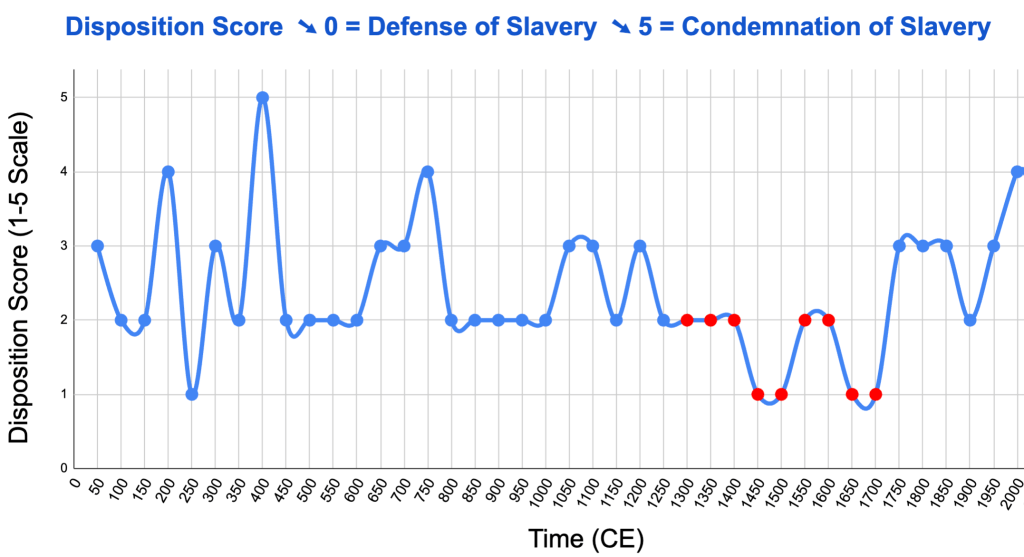
Interpretation of the Trendline
The historical data reveals a complex and often contradictory trajectory. The early Church (pre-400 CE) was not monolithic, containing a wide spectrum of views from active defense (Tertullian) to radical condemnation (Gregory of Nyssa). The Augustinian synthesis in the early 5th century was a monumental turning point, establishing a long, stable, and dominant theological framework of “Pragmatic Acceptance” that lasted for over a thousand years.
The line drops to its lowest point in the 15th century with papal bulls that actively authorized the enslavement of non-Christians, providing the theological fuel for the Atlantic slave trade. For the next 300 years, Christian theology was more often used to defend and justify racialized slavery than to condemn it.
A dramatic shift begins around 1750 with the rise of organized Christian abolitionism. This creates a new tension, pitting a revival of the imago Dei argument against entrenched pro-slavery interests. This conflict defines the next 200 years, through the abolitionist era and the subsequent Civil Rights Movement. The late 20th and early 21st centuries show a strong trend toward repentance for historical complicity and a renewed focus on applying Christian ethics to fight modern forms of slavery and racial injustice, bringing the dominant disposition closer to the moral condemnations first articulated by figures like Clement of Alexandria and Gregory of Nyssa over 1,500 years earlier.

◉ A Cross of Gold: Christian Justification and Dissent in the Age of New World Slavery (1300–1700)

The period between 1300 and 1700 marks one of the most consequential and contradictory eras in the history of Christian thought on slavery. It was a time when a long-standing theological consensus, which tolerated bondage as a regrettable consequence of a fallen world, was repurposed to authorize a new and brutal form of chattel slavery on an unprecedented scale. While the dominant voices within the Church—from popes and scholastic theologians to the new Protestant reformers—largely provided the moral and legal architecture for slavery, this period also gave rise to powerful internal critiques and dissenting movements. The comparison of these divergent Christian stances reveals a profound struggle between economic interest, institutional power, theological tradition, and a nascent moral conscience, a conflict that ultimately forged the racialized justifications for the Atlantic slave trade.
By 1300, the Christian West had largely settled into the theological framework established by Augustine and refined by scholastics like Thomas Aquinas. This view held that slavery was not part of God’s original, natural design but was a licit institution in a fallen world, serving as a just punishment for sin or a rational ordering of society. A crucial distinction, reinforced by various church councils, was that a free Christian could not be enslaved by a fellow Christian. This prohibition, however, created a clear and permissible category of the enslavable: the non-Christian. Throughout the late Middle Ages, the enslavement of Muslims and pagans captured in the persistent wars along the fringes of Christendom was considered legitimate. Religious orders like the Trinitarians and Mercedarians were even founded to ransom Christian captives from Muslim masters, an act of charity that nonetheless accepted the underlying mechanics of the slave system. This established a durable precedent: faith, not race, was the primary dividing line between the free and the bondman.
This precedent became the catastrophic launchpad for the Age of Discovery. As Portuguese and Spanish explorers pushed into the Atlantic, the papacy provided the explicit theological and legal authority for the new slave trade. In a series of 15th-century bulls, most infamously Dum Diversas (1452) and Romanus Pontifex (1455), Pope Nicholas V granted the Portuguese crown the right to “invade, search out, capture, vanquish, and subdue all Saracens and pagans” and to “reduce their persons to perpetual slavery”. These decrees, initially framed within the context of crusading against Islamic powers, became the foundational charter for the Atlantic slave trade, sanctioning the subjugation of non-Christian peoples as an instrument for conversion and a spoil of righteous conquest. For the first time, the highest authority in Western Christendom had given its blessing not merely to the existence of slavery but to the creation of a vast, commercial system for its propagation.
The horrific reality of this system in the Americas, however, provoked a crisis of conscience within the Catholic Church itself. The most prominent voice of dissent belonged to the Dominican friar Bartolomé de las Casas. Having participated in the conquest of Cuba, he was so sickened by the brutality he witnessed that he renounced his own slaves and lands and dedicated his life to defending the indigenous peoples. Arguing from the natural law tradition, Las Casas asserted the full humanity and rights of the native populations, denouncing Spanish cruelty as a mortal sin. His advocacy led to the famous Valladolid Debate (1550–1551), where he argued against Juan Ginés de Sepúlveda, who defended the conquest by reviving Aristotle’s theory of “natural slaves”. While Las Casas’s efforts resulted in some legal protections for indigenous peoples, his own moral journey reveals the complexity of the era; he initially proposed substituting enslaved Africans, whom he believed to be hardier, before coming to regret and condemn all forms of unjust slavery.
This internal conflict between institutional complicity and individual conscience was a defining feature of the Catholic experience. While Las Casas argued for justice, religious orders like the Jesuits and Dominicans became some of the largest slaveholders in the New World, operating vast plantations to fund their missions and schools. Yet even within these orders, dissenting voices emerged. In the 1580s, two Jesuits in Brazil, Miguel García and Gonçalo Leite, wrote to their superiors to condemn the enslavement of both Indigenous and African peoples they were witnessing. These critiques, however, were largely marginalized. The official Church position remained one of accommodation, distinguishing between “just” and “unjust” slavery and allowing the practice to continue, even as it condemned the worst abuses.
The Protestant Reformation introduced new theological dynamics but did not produce a unified abolitionist front. Martin Luther’s doctrine of the “two kingdoms” and his emphasis on accepting one’s God-given “station” in life tended to sanctify the existing social order, discouraging social change and urging slaves to accept their lot. John Calvin, in contrast, viewed slavery as “totally against all the order of nature,” a perversion caused by human sin. Yet, he too accepted its existence as part of God’s permissive providence in a fallen world. This inherent tension in Calvin’s thought allowed later followers to argue for either side of the issue, with some using his theology to defend the status quo and others eventually drawing on it to argue for abolition. As Protestant nations like England and the Dutch Republic built their own colonial empires, they readily adopted the institution of slavery, demonstrating that on this issue, economic and imperial interests superseded theological differences with their Catholic rivals.
Perhaps the most sinister development of this period was the creation of a new, racialized theology to justify the specific enslavement of Africans. As the line between Christian and non-Christian blurred with the conversion of enslaved people, a new justification was needed. Theologians of various denominations found it in the “Curse of Ham”. By misinterpreting the biblical story of Noah cursing Ham’s son, Canaan, and identifying Ham’s descendants with the peoples of sub-Saharan Africa, they created a powerful narrative that predestined Black people to perpetual servitude. This fused the Augustinian idea of slavery as a punishment for sin with a racial hierarchy, creating a divine warrant for a system of bondage that was both hereditary and based on skin color.
Between 1300 and 1700, the Christian world underwent a profound and terrible transformation in its relationship with slavery. It began the period with a settled, if morally compromised, acceptance of bondage as a feature of a fallen world, largely confined to the non-Christian frontiers of Europe. It ended the period as the primary engine of the Atlantic slave trade, having provided the legal, moral, and theological justifications for the enslavement of millions of Africans. While courageous voices of dissent arose, they were largely drowned out by the chorus of institutional authorities, scholastic theologians, and Protestant reformers who, in their various ways, accommodated, defended, and profited from the institution. By creating a theology that was explicitly racial, Christian leaders of this era laid the grim foundation for the centuries of chattel slavery that followed, a legacy of injustice that the faith is still grappling with today.

◉ The Divided Cross: Denominational Variation in Christian Thought on Slavery, 1300–1900
The six centuries between 1300 and 1900 represent a period of profound and violent contradiction in the history of Christianity and slavery. This era began with a largely unified Christian consensus that tolerated slavery as a regrettable feature of a fallen world and ended with a fractured landscape where Christian theology provided both the most robust justifications for racialized chattel slavery and the most potent moral fuel for its abolition. The journey between these two points was not linear. Instead, it was marked by deep divisions, first between the Catholic and nascent Protestant worlds, and later, more explosively, within the Protestant denominations themselves. An examination of these variations reveals how theological principles were bent to serve economic interests, how institutional power sanctioned exploitation, and how dissenting voices, often from the margins, slowly grew to challenge and ultimately overturn a millennium of accommodation.
The Unified Sanction of the Late Middle Ages and Renaissance (1300–1600)
In the late medieval period, the Catholic Church held a near-monopoly on Christian thought in Western Europe, and its position on slavery was built upon the Augustinian and Thomistic framework: slavery was contrary to natural law but a licit consequence of sin, permissible under the laws of nations, particularly in the case of prisoners captured in a “just war”. This created a crucial distinction: the enslavement of fellow Christians was forbidden, but the enslavement of non-Christians—pagans and Muslims—was deemed acceptable. This policy was reinforced by Church councils and the actions of religious orders founded to ransom Christian captives, which implicitly validated the system.
The Age of Discovery transformed this accepted principle into a catastrophic engine of expansion. In the 15th century, the Papacy issued a series of bulls, such as Dum Diversas (1452), that explicitly granted the Portuguese crown the authority to conquer and reduce non-Christians to “perpetual slavery”. This was the highest institutional sanction for the burgeoning Atlantic slave trade. However, the sheer brutality of New World colonization quickly created a crisis of conscience within the Catholic Church. Figures like the Dominican friar Bartolomé de las Casas passionately argued for the humanity and rights of indigenous peoples, prompting papal condemnations of their unjust enslavement. This created a deep internal conflict: while the papacy condemned the enslavement of some, religious orders like the Jesuits and Dominicans became vast slaveholders in the Americas, using enslaved African labor to fund their missions and schools. The Church navigated this contradiction by developing the concept of “just title” servitude, distinguishing between “unjust” enslavement for economic gain and “just” servitude for prisoners of war or criminals—a distinction that proved porous and easily abused in the colonies.
The Protestant Reformation in the 16th century did not initially offer a clear alternative. Martin Luther’s doctrine of the “two kingdoms” and his emphasis on remaining in one’s God-given “station” tended to sanctify the existing social order, discouraging challenges to slavery. John Calvin viewed slavery as “totally against all the order of nature” but accepted it as part of God’s permissive providence in a fallen world. This theological ambiguity meant that as Protestant nations like England and the Netherlands built their own empires, they readily adopted slavery, with the Church of England becoming deeply enmeshed in the colonial system and often reluctant to even convert the enslaved for fear of disrupting the social hierarchy.
The Great Fracturing: Abolitionism and Pro-Slavery Theology (1600–1900)
The 17th and 18th centuries saw the hardening of pro-slavery arguments across denominations. Theologians, both Catholic and Protestant, increasingly relied on the “Curse of Ham” narrative from Genesis to create a specific, racialized justification for the enslavement of Africans, arguing they were divinely predestined for servitude.
It was on the fringes of Protestantism that the first organized Christian opposition arose. The Religious Society of Friends (Quakers), driven by a theology of radical egalitarianism and the “Inner Light” present in all people, became the first denomination to take a collective stand. After a long internal struggle, they made it a requirement of membership to renounce slaveholding by the 1780s. They were soon joined by the Methodists, whose founder, John Wesley, was a fierce abolitionist. While early Methodism contained a strong anti-slavery impulse, its enforcement faltered as the denomination grew in the American South, leading to the formation of explicitly abolitionist offshoots like the Wesleyan Methodist Connection.
The most consistent and powerful Christian voice against slavery came from the enslaved themselves. The Black Church, born from the necessity of creating autonomous spiritual spaces away from the control and racism of white congregations, became the heart of the abolitionist movement. Forging a theology of liberation centered on the Exodus narrative, independent denominations like the African Methodist Episcopal (AME) Church and the AME Zion Church provided leadership, organization, and a prophetic moral clarity that condemned slavery as a profound sin against God and humanity.
The rise of abolitionism in the 19th century forced a violent schism within the major Protestant denominations in the United States. In response to Northern abolitionist pressure, Southern Baptists and Presbyterians developed a sophisticated and aggressive pro-slavery theology. They argued that slavery was not a necessary evil but a “positive good,” a divinely ordained institution sanctioned by a literal reading of the Bible. This conflict proved irreconcilable, leading to formal splits. The Southern Baptist Convention was formed in 1845, and the Southern Presbyterian Church broke away, both in large part to defend the right of Christians to own slaves.
By 1900, though chattel slavery was legally abolished, the theological divisions it created endured. The same arguments used to defend slavery were repurposed to support segregation and racial hierarchy. The history of this period is a stark reminder that Christian faith is not monolithic; it has been wielded as both a weapon of oppression and a tool of liberation, often by different groups reading the very same scriptures.
Chart: Variation in Christian Denominational Dispositions Toward Slavery (1300–1900)
| Period | Catholic Church | Anglicanism / Church of England | Lutheranism / Reformed (Calvinist) | Dissenting / Evangelical (Quakers, Methodists, Baptists) | The Black Church |
| 1300–1450 | Pragmatic Acceptance: Upholds Augustinian/Thomistic view. Forbids enslavement of Christians but permits enslavement of non-Christians captured in “just wars”. | Not Applicable | Not Applicable | Not Applicable | Not Applicable |
| 1450–1600 | Active Sanction & Internal Conflict: Papal bulls (Dum Diversas) authorize the African slave trade. Simultaneously, figures like Las Casas prompt bulls (Sublimis Deus) forbidding enslavement of Indigenous peoples. Religious orders (Jesuits, Dominicans) become major slaveholders. | Formation: As the state church of a colonial power, it becomes entwined with the slave economy from its inception. | Pragmatic Acceptance: Luther’s theology reinforces existing social order. Calvin views slavery as contrary to nature but permitted by providence. No unified anti-slavery stance emerges. | Emergence: Early Anabaptist groups hold seeds of egalitarianism, but no organized anti-slavery movement exists yet. | Not Applicable |
| 1600–1750 | Institutional Complicity: Religious orders continue as major slaveholders. Papacy issues some condemnations of the slave trade’s excesses but does not challenge the institution itself. | Active Complicity: The church is a major slaveholder in colonies like Barbados. Generally hesitant to convert the enslaved, fearing it would undermine planter authority. | Theological Justification: Generally accept slavery. Theologians develop and popularize the “Curse of Ham” to provide a racialized, biblical justification for African slavery. | Early Dissent: Quakers (Woolman, Benezet) begin organized internal protest against slaveholding based on egalitarian theology. | Formation: Enslaved people begin to synthesize Christianity with African traditions in “hush harbors,” focusing on themes of deliverance and Exodus. |
| 1750–1830 | Growing Condemnation (of Trade): Pope Gregory XVI’s In Supremo (1839) condemns the slave trade, but U.S. bishops interpret it as not applying to domestic slaveholding. | Internal Division: An influential abolitionist wing, led by Evangelicals like William Wilberforce, successfully campaigns to abolish the British slave trade. | Regional Division: Northern Presbyterians and Reformed churches develop anti-slavery sentiment, while Southern counterparts begin to formulate a defense of slavery. | Abolitionist Vanguard & Division: Quakers become the first denomination to ban slaveholding for members. Methodists have strong abolitionist leaders (Wesley) but struggle with enforcement in the U.S. South. Baptists are increasingly divided by region. | Institutionalization & Abolitionism: First independent Black denominations (AME, AME Zion) are founded in the North as a protest against racism. Become centers of abolitionist advocacy. |
| 1830–1900 | Ambiguous Tolerance: While officially against the slave trade, the Church tolerates domestic slavery in countries like the U.S. and Brazil until secular abolition. | General Opposition (in Britain) / Acquiescence (in U.S. South): After British abolition, the Church of England is largely anti-slavery. In the U.S., Episcopalians in the South tend to defend or avoid the issue. | Schism: Southern Presbyterians develop a robust pro-slavery theology, defending slavery as a “positive good” and a divine institution, leading to a formal split with Northern churches. | Schism: The issue of slavery causes formal splits, creating the Southern Baptist Convention (1845) and the Methodist Episcopal Church, South, both of which defend slavery. Wesleyan Methodists are explicitly abolitionist. | Abolitionist Leadership: The undisputed moral and organizational leaders of the abolitionist movement. Black preachers use a theology of liberation to condemn slavery. Churches serve as key nodes in the Underground Railroad. |
◉ The Bible’s Contradictory Legacy on Slavery: A Crisis of Truth and Hermeneutics

Across two millennia of Christian history, no issue better exposes the Bible’s epistemic instability and the failure of Christian hermeneutics than its shifting and often contradictory stance on slavery. Far from offering a consistent “biblical truth,” Scripture has been alternately used to defend, regulate, justify, spiritualize, and occasionally condemn the institution of slavery—each time by Christians claiming divine guidance. The result is not just moral dissonance but a collapse of confidence in the idea that the Bible is a clear or reliable guide to truth.
Let us be direct: If the Bible were authored by a being of perfect clarity and concern for human dignity, how could it have served for centuries as the foundational text for both slaveholders and abolitionists?
From the Apostolic Age onward, biblical authors failed to clearly denounce the practice of owning human beings. The Pauline epistles command slaves to obey their masters (Ephesians 6:5), send fugitive slaves back (Philemon), and offer no call for systemic abolition. The Old Testament includes explicit legal codes that regulate chattel slavery (Leviticus 25:44–46), permitting the perpetual ownership of foreigners as property. At no point is the entire system categorically rejected. These texts provided theological fuel for defenders of slavery for centuries.
And they were used.
From Tertullian’s defense of master property rights to the papal bulls of the 15th century (e.g., Dum Diversas), which formally authorized the enslavement of non-Christians, Christians repeatedly wielded scripture to justify slavery. In the American South, preachers declared slavery a “positive good”, invoking both Old Testament law and New Testament household codes. The infamous “Curse of Ham” narrative was fashioned into a theological rationale for racial slavery, suggesting Africans were divinely destined for servitude.
Yet at the very same time—and from the very same Bible—figures like Gregory of Nyssa, Clement of Alexandria, and later John Wesley and William Wilberforce found inspiration to condemn slavery as incompatible with human dignity. But these were outliers, not products of divine consensus. No authoritative biblical hermeneutic arose to clarify the contradiction.
Why is this significant? Because Christians claim to be indwelt by the Holy Spirit, the alleged revealer of truth and interpreter of scripture (John 16:13). But this spirit has either been silent, ineffective, or nonexistent, given the millennia of incompatible interpretations on an issue as fundamental as whether one human being can own another. If divine guidance were real and operative, the Church should not have taken 1,800 years to reach widespread moral clarity on slavery—and even then, it remains fractured.
This is not a mere matter of doctrinal diversity. It is a direct indictment of the Bible’s clarity and the Christian interpretive apparatus. If Scripture were divinely authored and divinely illuminated, how could it be deployed to justify both abolition and atrocity? How could entire denominations split—such as the Southern Baptist Convention, formed to defend the right to hold slaves—while all claiming to be guided by God’s word and God’s spirit?
Christians have no reliable hermeneutical principle that consistently yields non-destructive interpretations. Appeals to the “plain reading” of Scripture collapse under historical scrutiny. Alleged spiritual discernment has led to theological chaos, not unity. And the interpretive “fruit” of the tradition includes centuries of kidnapping, bondage, and intergenerational trauma, all carried out with open Bibles in hand.
In philosophical terms, this amounts to a failure of referential stability. The term “truth”, as used in Christian theology, floats—anchored neither in consistent textual meaning nor in reliable interpretive procedure. It is redefined generation by generation to suit prevailing norms. This is not the hallmark of a revealed truth system. It is the profile of a tradition built on semantic pliability and authoritarian retrofitting.
In conclusion, the Christian legacy on slavery illustrates not only a moral failure but an epistemic one. If Christians possessed divine guidance, consistent interpretive methods, or even an internally coherent text, the centuries-long defense of slavery under the banner of Christianity would never have occurred. The very existence of that defense—and its dominance for most of Christian history—should permanently discredit the claim that Christianity has a unique or divinely guaranteed grasp on truth.
The Bible did not clarify the issue. The Spirit did not intervene. And the Church, when finally persuaded, was not moved by revelation, but by secular enlightenment and human conscience.


 Free of Faith
Leave a comment