
➘ #04 Source Article
Language — Domains, constants, predicates
Domains: hypotheses 

Constants: 

Hypotheses:

Core predicates/functions:


Operationalization of the evidence
Define the explanandum as the specific absence claim:
Informally: the Bible lacks concise, generalizable, empirically testable preventive guidance whose historical implementation would have substantially reduced needless suffering (while containing only partial, largely ritual or non-generalizable hygiene content).
Bridge principles (predictive commitments)
Guidance-expectation under 
Constraint under


Formal premises from the paper’s comparative claims
Empirical observation (expectation gap):
Predictive asymmetry (from BP1–BP2):
Auxiliary-defense non-improvement (inscrutability, free-will, cultural accommodation, progressive revelation, selective preservation, soul-making do not raise 


Here 


Likelihood result
By definition,
From 


From 

so auxiliaries do not close the gap without incurring ad-hoc penalties that further reduce overall plausibility.


Evidential conclusion (likelihoodist)
Given observation
If one updates priors by Bayes’ theorem, then for any priors with 
so the posterior odds shift toward


Minimal expansion of for clarity (schematic)
Let 
Observation instantiated:
Predictive commitments:


Summary syllogism (schematic, likelihood form)


Plain English Gloss:
Given that the Bible’s lack of clear, broadly useful preventive guidance is far more expected if it was written by ordinary humans than if it were authored by an all-knowing, compassion-oriented deity, this absence strongly counts against
Here’s a set of technical explanations and reader-friendly notes for the symbolic logic in the content above, allowing a non-specialist to follow the reasoning without losing the rigor. We’ll move section by section, unpacking the notation and argument flow.
1. Domains, constants, and hypotheses
Technical:
We define a set of possible explanations (hypotheses)
We also define 
Reader-friendly note:
We start by setting out two competing explanations for where the Bible came from:
✓ Under
✓ Under
We also label “the Bible” as
2. The key predicate:
Technical:
This includes principles like sanitation, clean water, vaccination-like measures, or other knowledge that—if followed—would prevent large-scale suffering across cultures and centuries.
Reader-friendly note:
We have a yes-or-no test for whether a text contains the kind of practical, universally useful advice that could save lives—things like “boil water before drinking” or “wash hands to prevent disease.” If a text has such advice, it satisfies
3. Defining the evidence
Technical:
Reader-friendly note:
Our actual observation is that the Bible lacks clear, practical instructions that could have prevented huge amounts of human suffering—no unambiguous, easily testable advice that works across times and cultures.
4. Bridge principles: what each hypothesis predicts
Technical:
Under 
Under
Reader-friendly note:
If God wrote the Bible, we’d expect it to have this kind of advice—so finding it missing would be surprising.
If humans wrote it long ago, we’d expect it not to have this advice—so finding it missing would be exactly what we’d expect.
5. The observed “expectation gap”
Technical:
We observe 
From the bridge principles, 
This means the likelihood ratio 
Reader-friendly note:
We’ve got a mismatch between what
6. Considering “auxiliary hypotheses”
Technical:
Some defenders of
Formally, for any auxiliary 


Reader-friendly note:
Some people try to adjust
7. Minimal expansion of
Technical:
where

Reader-friendly note:
Formally, a text has
8. The conclusion
Technical:
From the likelihood ratio being much less than 1, the evidence
Bayesian updating shows that whatever your prior odds were, the posterior odds shift toward
Reader-friendly note:
Given what we see in the Bible, it’s much more reasonable to think it was written by ordinary people than by an all-knowing, compassion-oriented deity. The evidence pushes our confidence toward the human authorship explanation.
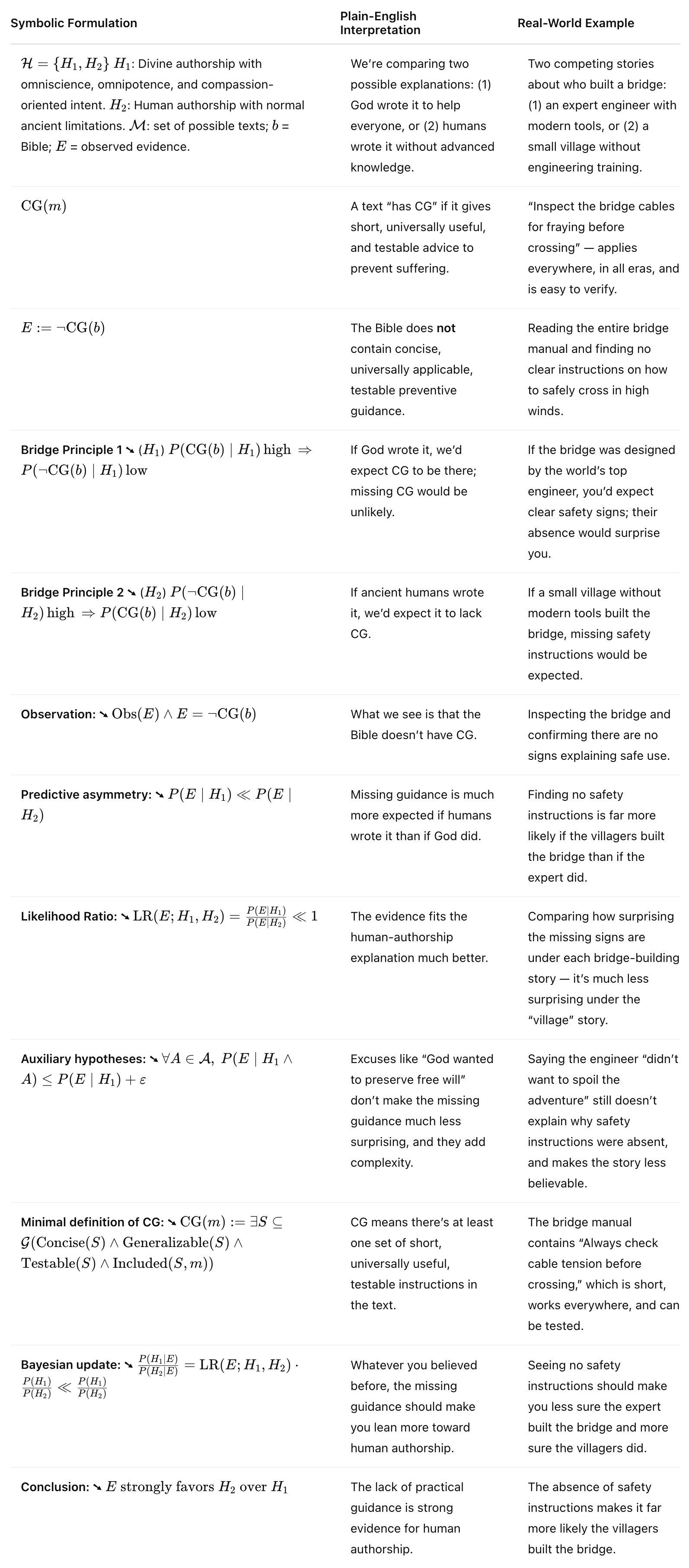
Comparative Table of Symbolic Logic, Plain-English Interpretation, and Real-World Analogies for the ‘God and Needless Suffering’ Argument



 Free of Faith
Leave a comment