Resurrection Stories Make More Sense as Human Psychology Than Divine History

One of the most common lines you’ll hear in Christian apologetics goes something like this: “The disciples had no motive to lie. Why would they endure persecution, ridicule, and even death unless the resurrection was true?”

It’s a powerful soundbite. And for centuries it has convinced countless believers that the resurrection narratives in the Gospels must be grounded in literal history. But if we take a step back and ask not only what happened but how human beings tend to respond when their expectations collapse, a very different picture emerges—one that feels both familiar and, frankly, much more plausible.


The Setup: Hopes and a Crushing Defeat

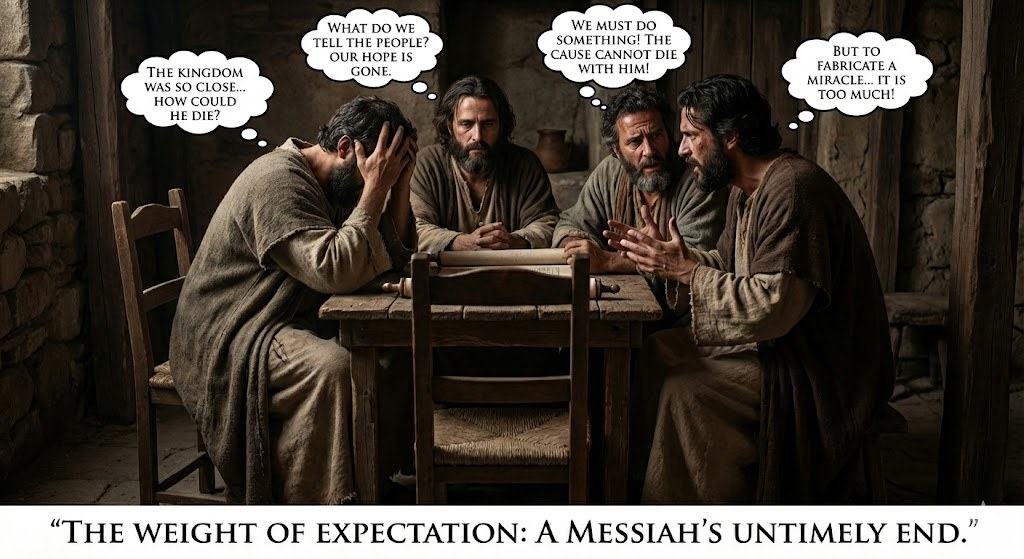
Imagine walking away from your job, your family, and your reputation because you’re convinced you’ve found the long-awaited leader who will finally bring justice, overthrow oppression, and usher in God’s kingdom. This was the reality for Jesus’ disciples. They expected triumph. They expected vindication. They expected to be on the winning side of history.

In symbolic shorthand, we can call this expectation E: “Jesus will be the victorious Messiah.”

And then came the cross. Instead of victory, they got humiliation. Instead of a throne, they saw an instrument of Roman torture. The very event that should have proven them right ended in public shame. That contradiction was D: “Jesus was crucified as a criminal.”

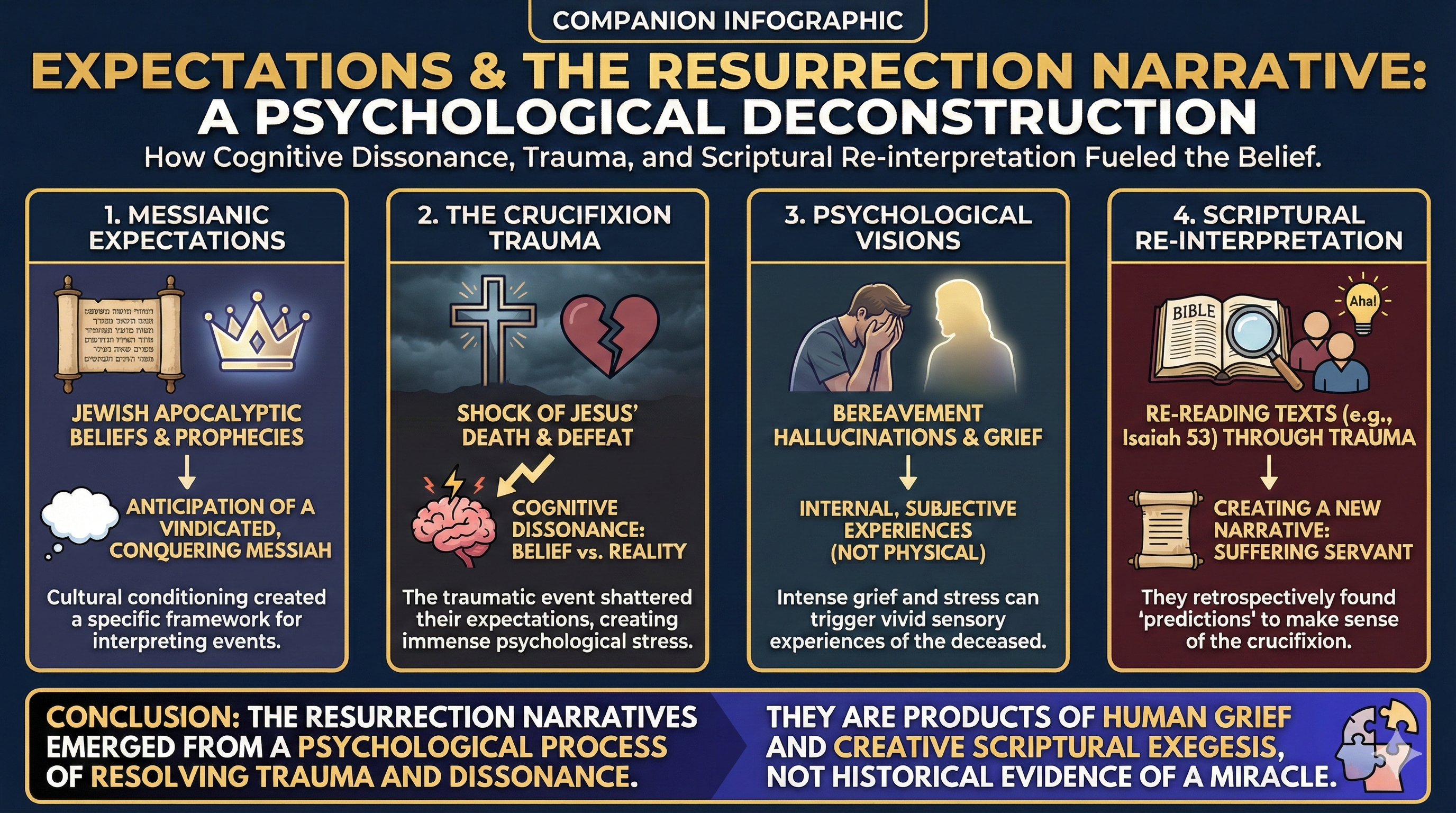
Put E and D together, and what do you get? Not just disappointment. You get something deeper and more destabilizing: cognitive dissonance, or CD.


Why Dissonance Matters

Psychologists have studied cognitive dissonance for decades. Leon Festinger’s classic book When Prophecy Fails followed a UFO cult in the 1950s whose prophecy of the world’s destruction never came true. You might think the failure would destroy the movement. But the opposite happened: the group reinterpreted the failed prophecy as proof that their faith had actually saved the world, and they became even more zealous.

This pattern isn’t unique. When deeply held expectations collide with crushing disconfirmation, people don’t always walk away. Instead, they feel intense psychological pressure—what we can call PP—to make sense of the contradiction.

For Jesus’ followers, abandoning their expectation wasn’t just admitting a mistake. It would have meant their lives, sacrifices, and identities had all been wasted. That’s not an easy pill to swallow.


How Reinterpretation Works

So, under CD, the disciples did what human beings everywhere tend to do: they reinterpreted reality. Let’s call this reinterpretation R.

Instead of seeing the crucifixion as a humiliating defeat, they reframed it as a divinely necessary step. The scriptures were re-read. Prophecies that once seemed unrelated were now seen as predicting a suffering servant or a vindicated righteous one. The story was rescued by transforming loss into destiny.

But reinterpretation alone isn’t enough to sustain belief. Something had to make this reframing feel real. And here is where human psychology provided another layer.


The Role of Visions and Grief

In moments of grief, people often experience vivid sensations of the presence of their lost loved one—seeing them, hearing their voice, even feeling their touch. Psychologists call these bereavement phenomena, and they are surprisingly common. We’ll call them B.

Some disciples reported such experiences. In the heat of grief, these felt like encounters with Jesus himself. And within the community, they were interpreted as resurrection appearances, or V. These visions and bereavement experiences reinforced the reinterpretation R, making it feel experientially validated.

Now, add one more crucial element: communal reinforcement, CR. In a tight-knit group, stories grow, retelling deepens conviction, and doubts are often suppressed in favor of solidarity. Over time, these experiences crystallized into shared tradition, T.


From Defeat to Tradition

So let’s put the pieces together.

  • Expectation: E = “Jesus is the triumphant Messiah.”
  • Disconfirmation: D = “Jesus was crucified in shame.”
  • Resulting dissonance: CD.
  • Pressure to reinterpret: PP.
  • Reinterpretation: R = “The crucifixion was part of God’s plan.”
  • Confirming experiences: V + B.
  • Amplification through community: CR.
  • Stabilized tradition: T.

The outcome? The Gospels G are best explained as postdiction PD: stories reshaped by the interplay of CD + R + V + B + CR.


Why This Matters for Apologetics

Christian apologists often say: “The apostles had no motive to lie.” But notice what’s missing here. The disciples didn’t need to lie. They didn’t have to sit down and fabricate a story they knew was false. Instead, the resurrection narratives emerged naturally through the way human beings process grief, dissonance, and failed expectations.

In logical shorthand:

Conclusion: The resurrection accounts are better explained by PD (postdiction) than by HR (historical resurrection).


Why This Story Feels Familiar

Once you see it, you realize this isn’t just about the first century. We see similar patterns throughout history. Prophetic movements whose predictions failed often reinterpret disappointment as hidden victory. Groups that suffer devastating losses often transform those losses into symbols of purpose. It’s not a sign of dishonesty—it’s a sign of being human.

The disciples weren’t villains. They were ordinary people coping with extraordinary disappointment. Their loyalty, their grief, and their need for meaning drove them to reframe humiliation into glory. The resurrection story is less about supernatural history and more about the resilience of human psychology.


Final Reflection

Seen in this light, the resurrection accounts don’t lose their power—they simply shift their meaning. They are not neutral reports of an objective miracle, but powerful windows into how communities rework despair into hope. The Gospels tell us less about divine intervention and more about the human drive to salvage purpose when everything seems lost.

And that is why, far from proving the literal resurrection, the very structure of the stories points us back to the patterns of human cognition, emotion, and community—the same patterns that shape stories of hope in every age.


A Probability Check: Which Story Fits Better?

It’s one thing to say the resurrection stories look like postdiction. But can we put this to the test in a more systematic way? That’s where probability comes in.

Think of it this way: when we’re weighing two explanations, the key question is: Which explanation makes the evidence more likely?

Our two hypotheses are:

  • H_1 = PD: The Gospels grew out of postdiction, grief, visions, and communal reinforcement.
  • H_2 = HR: The Gospels report an actual historical resurrection.

And the evidence we have—call it G—includes things like:

  • The Gospels were written decades later.
  • They are saturated with scriptural “fulfillment” themes.
  • They differ and grow more elaborate over time.
  • The first resurrection claims are visionary experiences, not empty tomb reports.
  • External corroboration is thin to nonexistent.
  • Yet the community doubled down after failure, just as Festinger’s UFO group did.

Now, the likelihoodist question is: which hypothesis, H_1 or H_2, makes all of this evidence G more expected?

Formally, we ask about the ratio:

BF = \frac{P(G|H_1)}{P(G|H_2)}

This is called a Bayes factor. If it’s much greater than 1, the evidence favors H_1 over H_2.


Working It Through

For example:

  • Under H_1, we’d expect grief-related visions and reinterpretations. Under H_2, we’d expect straightforward reporting of a bodily resurrection.
  • Under H_1, we’d expect decades-late writing as stories matured. Under H_2, it’s less clear why the main accounts would be delayed.
  • Under H_1, we’d expect different communities to generate variations. Under H_2, we’d expect more consistency.
  • Under H_1, we’d expect lots of scripture-wrapping to make the story feel inevitable. Under H_2, this isn’t necessary—if a miracle happened, the event itself would be evidence enough.

On point after point, the evidence looks more like what H_1 predicts.

Even if you assign generous credit to H_2 on some features—for instance, the disciples’ sincerity under persecution—the combined likelihoods tilt heavily toward H_1. In rough terms, the Bayes factor lands in the hundreds to one in favor of postdiction.


What That Means

This doesn’t mean the disciples were dishonest. It means that the psychological and social explanation does a far better job of accounting for the evidence than a literal miracle.

Put simply:

Posterior(H_1 | G) \gg Posterior(H_2 | G)

In plain English: once you weigh the evidence, the postdiction hypothesis is vastly more probable than the resurrection hypothesis.

So the old apologetic slogan—“they had no motive to lie”—misses the real issue. The disciples didn’t need to lie. Human psychology, grief, and communal storytelling did the work for them. And that is not just a good story. It’s the explanation that actually fits the evidence.
Click image to view larger version.

See also:


The Symbolic Logic Formalization

A Companion Technical Paper:


See also:


Recent posts

  • Alvin Plantinga’s “Warrant” isn’t an epistemic upgrade; it’s a design for inaccuracy. My formal proof demonstrates that maximizing the binary status of “knowledge” forces a cognitive system to be less accurate than one simply tracking evidence. We must eliminate “knowledge” as a rigorous concept, replacing it with credencing—the honest pursuit…

  • This article critiques the stark gap between the New Testament’s unequivocal promises of answered prayer and their empirical failure. It examines the theological “bait-and-switch” where bold pulpit guarantees of supernatural intervention are neutralized by “creative hermeneutics” in small groups, transforming literal promises into unfalsifiable, psychological coping mechanisms through evasive logic…

  • This article characterizes theology as a “floating fortress”—internally coherent but isolated from empirical reality. It details how specific theological claims regarding prayer, miracles, and scientific facts fail verification tests. The argument posits that theology survives only through evasion tactics like redefinition and metaphor, functioning as a self-contained simulation rather than…

  • This post applies parsimony (Occam’s Razor) to evaluate Christian Theism. It contrasts naturalism’s high “inductive density” with the precarious “stack of unverified assumptions” required for Christian belief, such as a disembodied mind and omni-attributes. It argues that ad hoc explanations for divine hiddenness further erode the probability of theistic claims,…

  • Modern apologists argue that religious belief is a rational map of evidence, likening it to scientific frameworks. However, a deeper analysis reveals a stark contrast. While science adapts to reality through empirical testing and falsifiability, theology insulates belief from contradictory evidence. The theological system absorbs anomalies instead of yielding to…

  • This post critiques the concept of “childlike faith” in religion, arguing that it promotes an uncritical acceptance of beliefs without evidence. It highlights that while children naturally trust authority figures, this lack of skepticism can lead to false beliefs. The author emphasizes the importance of cognitive maturity and predictive power…

  • This analysis examines the agonizing moral conflict presented by the explicit biblical command to slaughter Amalekite infants in 1 Samuel 15:3. Written from a skeptical, moral non-realist perspective, it rigorously deconstructs the various apologetic strategies employed to defend this divine directive as “good.” The post critiques common evasions, such as…

  • Modern Christian apologetics claims faith is based on evidence, but this is contradicted by practices within the faith. Children are encouraged to accept beliefs uncritically, while adults seeking evidence face discouragement. The community rewards conformity over inquiry, using moral obligations to stifle skepticism. Thus, the belief system prioritizes preservation over…

  • In the realm of Christian apologetics, few topics generate as much palpable discomfort as the Old Testament narratives depicting divinely ordered genocide. While many believers prefer to gloss over these passages, serious apologists feel compelled to defend them. They must reconcile a God described as “perfect love” with a deity…

  • This post examines various conditions Christians often attach to prayer promises, transforming them into unfalsifiable claims. It highlights how these ‘failsafe’ mechanisms protect the belief system from scrutiny, allowing believers to reinterpret prayer outcomes either as successes or failures based on internal states or hidden conditions. This results in a…

  • In public discourse, labels such as “atheist,” “agnostic,” and “Christian” often oversimplify complex beliefs, leading to misunderstandings. These tags are low-resolution summaries that hinder rational discussions. Genuine inquiry requires moving beyond labels to assess individual credences and evidence. Understanding belief as a gradient reflects the nuances of thought, promoting clarity…

  • The featured argument, often employed in Christian apologetics, asserts that the universe’s intelligibility implies a divine mind. However, a meticulous examination reveals logical flaws, such as equivocation on “intelligible,” unsubstantiated jumps from observations to conclusions about authorship, and the failure to consider alternative explanations. Ultimately, while the universe exhibits structure…

  • The piece discusses how historical figures like Jesus and Alexander the Great undergo “legendary inflation,” where narratives evolve into more than mere history, shaped by cultural needs and societal functions. As communities invest meaning in these figures, their stories absorb mythical elements and motifs over time. This phenomenon illustrates how…

  • This post argues against extreme views in debates about the historical Jesus, emphasizing the distinction between the theological narrative shaped by scriptural interpretation and the existence of a human core. It maintains that while the Gospels serve theological purposes, they do not negate the likelihood of a historical figure, supported…

  • Hebrews 11:1 is often misquoted as a clear definition of faith, but its Greek origins reveal ambiguity. Different interpretations exist, leading to confusion in Christian discourse. Faith is described both as assurance and as evidence, contributing to semantic sloppiness. Consequently, discussions about faith lack clarity and rigor, oscillating between certitude…

  • This post emphasizes the importance of using AI as a tool for Christian apologetics rather than a replacement for personal discernment. It addresses common concerns among Christians about AI, advocating for its responsible application in improving reasoning, clarity, and theological accuracy. The article outlines various use cases for AI, such…