
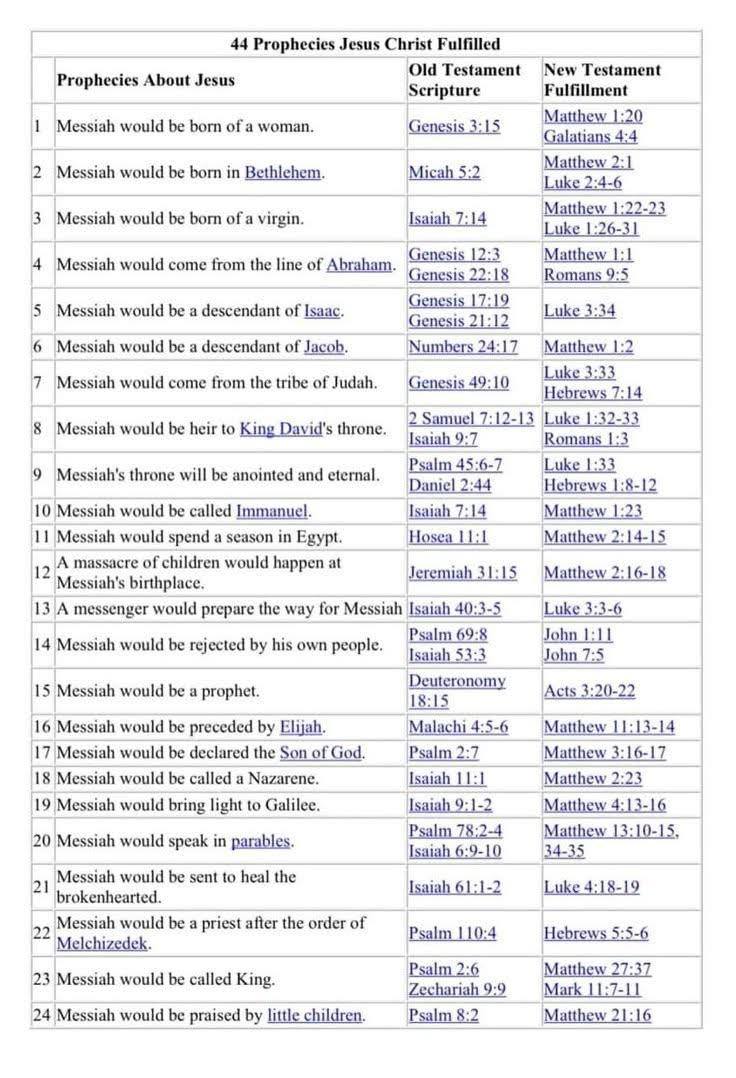
This list of alleged messianic prophecies, recently seen on social media, is an excellent example of the mendacity that is at the core of many Christian claims.
The “Fulfilled Prophecy” Lists: A Comprehensive Audit (Items 1–24)
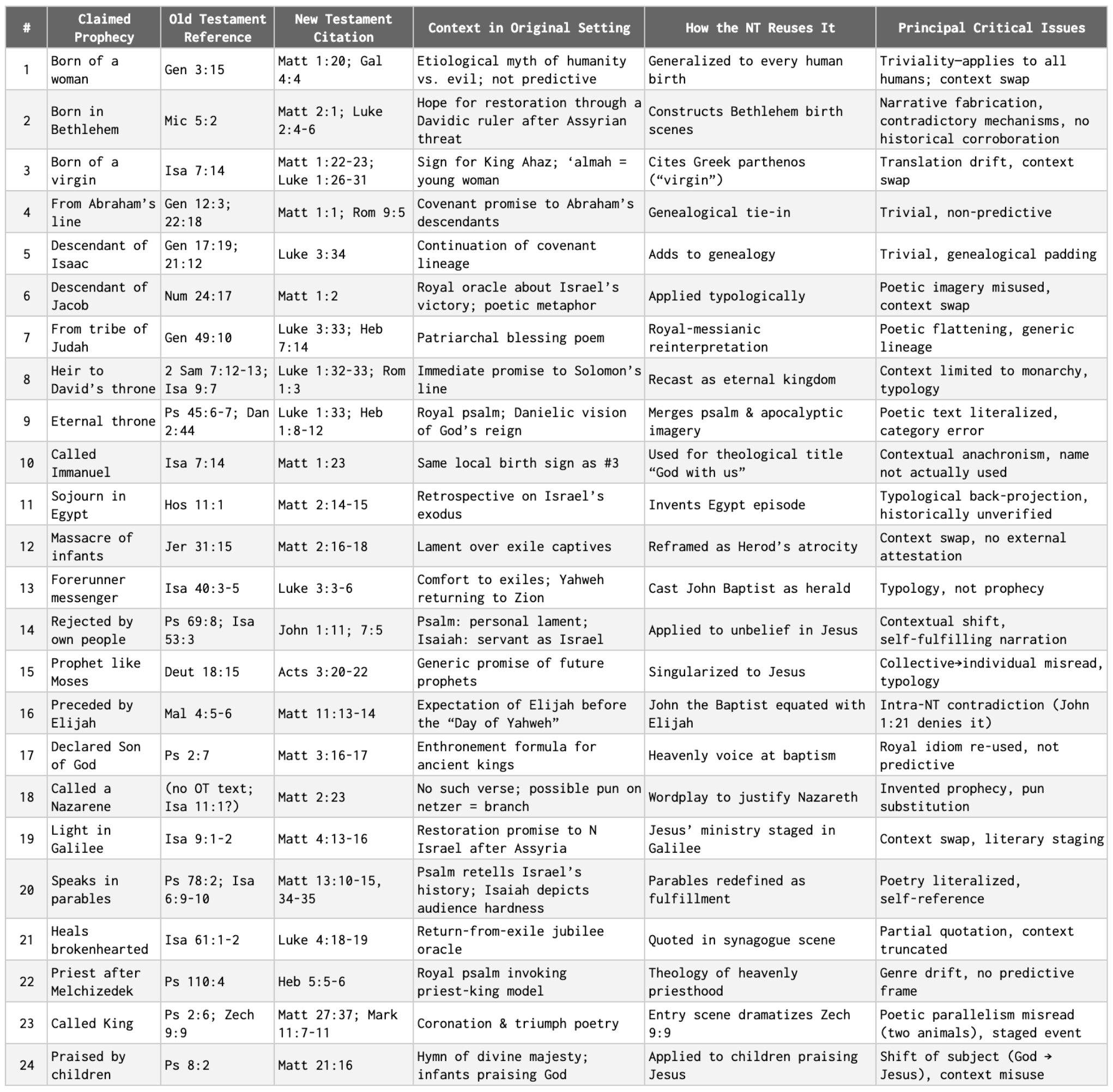
Apologetic charts that enumerate “prophecies Jesus fulfilled” depend on a small set of tactics: context‐swapping, translation drift, poetic flattening, typological retrofits, and self-contained storytelling by Gospel authors who already believed Jesus was the Messiah and therefore wrote to Scripture. Below I audit the first 24 items typically found on these charts (exactly those visible in your image), showing—in compact form—what each Old Testament (OT) passage meant in context, how the New Testament (NT) reuses it, and why the “fulfillment” claim fails as prediction.
How to Read This Audit
✓ Context = what the OT passage is about in its own historical/literary setting.
✓ NT Reuse = what the Gospel/NT author does with it.
✓ Failure Mode = the key problem(s):
- CTX: Context swap (not a prediction; about Israel/ancient king/event then)
- LXX: Septuagint/translation shift creates a “prophecy” not in Hebrew
- POET: Poetry read as literal reportage
- TYPO: Typology/midrash (literary echo, not prediction)
- TRIV: Trivial criterion anyone could meet
- SELF: Self-fulfillment inside the narrative
- CONTRA: Gospel contradictions in fulfillment staging
- HIST: No independent historical corroboration
A. Birth, Lineage, and Early-Life Claims (1–13)
- “Born of a woman” (Gen 3:15 → Matt 1:20; Gal 4:4)
- Context: Etiology of human struggle against evil; no messiah in view.
- NT Reuse: Generalized to Jesus.
- Failure Mode: TRIV (applies to all humans), CTX.
- “Born in Bethlehem” (Mic 5:2 → Matt 2:1; Luke 2:4–6)
- Context: Hope for a Davidic ruler from Bethlehem in Judah’s crisis.
- NT Reuse: Two incompatible infancy narratives engineer Bethlehem.
- Failure Mode: TYPO, CONTRA (Matt’s Magi/Herod vs Luke’s census route), HIST (implausible census logistics).
- “Born of a virgin” (Isa 7:14 → Matt 1:22–23; Luke 1:26–31)
- Context: A sign for King Ahaz about events in the 8th c. BCE; Hebrew ‘almah = young woman.
- NT Reuse: Lifts Septuagint parthenos (“virgin”).
- Failure Mode: CTX, LXX.
- “From Abraham’s line” (Gen 12:3; 22:18 → Matt 1:1; Rom 9:5)
- Context: Patriarchal promises about Israel’s vocation.
- NT Reuse: Genealogical linkage.
- Failure Mode: TRIV (for any Jewish claimant), TYPO.
- “Descendant of Isaac” (Gen 17:19; 21:12 → Luke 3:34)
- As above: TRIV, TYPO.
- “Descendant of Jacob/Israel” (Num 24:17 → Matt 1:2)
- Context: Balaam oracle using royal/star imagery about Israel’s rise.
- NT Reuse: Lineage scaffold.
- Failure Mode: CTX, POET, TRIV.
- “From the tribe of Judah” (Gen 49:10 → Luke 3:33; Heb 7:14)
- Context: Poetic blessings on Jacob’s sons.
- NT Reuse: Royal Judah theme to validate messianic claim.
- Failure Mode: POET, TRIV.
- “Heir to David’s throne” (2 Sam 7:12–13; Isa 9:7 → Luke 1:32–33; Rom 1:3)
- Context: Near-term dynasty promise to Davidic kings (Solomon and successors).
- NT Reuse: Reframed as eternal, heavenly kingship.
- Failure Mode: CTX (immediate royal line), TYPO (spiritualized after national monarchy collapsed).
- “Throne anointed and eternal” (Ps 45:6–7; Dan 2:44 → Luke 1:33; Heb 1:8–12)
- Context: Royal wedding psalm; apocalyptic kingdom vision in Daniel.
- NT Reuse: Christological appropriation.
- Failure Mode: POET, TYPO.
- “Called Immanuel” (Isa 7:14 → Matt 1:23)
- Context: Child born in Ahaz’s time as a sign (“God with us” = reassurance).
- NT Reuse: Name-theology, not a historical naming.
- Failure Mode: CTX (contemporary child), LXX (same verse as #3).
- “A season in Egypt” (Hos 11:1 → Matt 2:14–15)
- Context: Past tense of Israel’s exodus (“my son” = Israel).
- NT Reuse: Engineers temporary flight to Egypt to mirror exodus.
- Failure Mode: CTX, TYPO, HIST (unattested outside Matthew).
- “Massacre at birthplace” (Jer 31:15 → Matt 2:16–18)
- Context: Rachel weeping over Babylonian exile victims.
- NT Reuse: Recast as Herod’s slaughter.
- Failure Mode: CTX, HIST (no external record).
- “Messenger prepares the way” (Isa 40:3–5 → Luke 3:3–6)
- Context: Comfort to exiles: God returning to Zion.
- NT Reuse: John the Baptist framed as the forerunner.
- Failure Mode: TYPO (literary mapping), not a discrete prediction about a named future individual.
B. Reception, Role, and Titles (14–24)
- “Rejected by his own” (Ps 69:8; Isa 53:3 → John 1:11; 7:5)
- Context: Davidic lament; “suffering servant” within exilic prophecy.
- NT Reuse: Explains unbelief.
- Failure Mode: CTX, TYPO, SELF (claim validated only inside the narrative).
- “A prophet like Moses” (Deut 18:15 → Acts 3:20–22)
- Context: Deuteronomic provision for future prophets in Israel, plural over time.
- NT Reuse: Singularizes to Jesus.
- Failure Mode: CTX, TYPO.
- “Preceded by Elijah” (Mal 4:5–6 → Matt 11:13–14)
- Context: Expectation of Elijah’s return before “the Day of the LORD.”
- NT Reuse: John the Baptist is “Elijah” in spirit—until he denies it (John 1:21).
- Failure Mode: CONTRA (intra-NT tension), TYPO.
- “Declared Son of God” (Ps 2:7 → Matt 3:16–17)
- Context: Royal enthronement formula (“You are my son”).
- NT Reuse: Heavenly voice at baptism.
- Failure Mode: CTX (ancient coronation idiom), TYPO.
- “Called a Nazarene” (Isa 11:1? → Matt 2:23)
- Context: No verse says “He shall be called a Nazarene.” Apologists point to netzer (“branch”).
- NT Reuse: Wordplay to reconcile Nazareth with Scripture.
- Failure Mode: LACK (no source), PUN (branch pun), TYPO.
- “Light in Galilee” (Isa 9:1–2 → Matt 4:13–16)
- Context: Hope for restoration in northern Israel after Assyrian devastation.
- NT Reuse: Frames Jesus’ Galilean ministry.
- Failure Mode: CTX, TYPO.
- “Speaks in parables” (Ps 78:2; Isa 6:9–10 → Matt 13:10–15, 34–35)
- Context: Psalmist recounts Israel’s past “in parables”; Isaiah’s commission to a stubborn audience.
- NT Reuse: Makes parables a fulfillment device.
- Failure Mode: POET, TYPO, SELF.
- “Heals the brokenhearted” (Isa 61:1–2 → Luke 4:18–19)
- Context: Post-exilic proclamation of good news to the poor/exiles.
- NT Reuse: Program statement in Nazareth synagogue—then Luke omits “day of vengeance,” signaling selective reuse.
- Failure Mode: CTX, TYPO.
- “Priest after Melchizedek” (Ps 110:4 → Heb 5:5–6)
- Context: Royal psalm for Israel’s king; Melchizedek as a literary archetype.
- NT Reuse: Theological argument for Jesus’ heavenly priesthood.
- Failure Mode: GENRE drift (theology, not event), TYPO.
- “Called King” (Ps 2:6; Zech 9:9 → Matt 27:37; Mark 11:7–11)
- Context: Coronation language; jubilant poetic entry oracle.
- NT Reuse: Triumphal entry dramatizes Zech 9:9; Matthew misreads parallelism and has two animals (Matt 21:7).
- Failure Mode: POET (flattened), LXX/reading issue, TYPO.
- “Praised by little children” (Ps 8:2 → Matt 21:16)
- Context: Universal praise of God through creation and infants—about God, not a messiah.
- NT Reuse: Children praise Jesus in the Temple; verse repurposed.
- Failure Mode: CTX, TYPO.
Patterns That Explain the Whole List
✓ Midrashic Composition: Gospel authors are not neutral reporters; they are theologians crafting a sacred biography by weaving Israel’s Scriptures into Jesus’ life.
✓ Septuagint Dependence: Several marquee “prophecies” exist only because the Greek translation departed from the Hebrew (Isa 7:14; Ps 22:16).
✓ Poetry Treated as Blueprint: Royal psalms and oracles are mined line-by-line and staged in new scenes.
✓ Intra-Gospel Contradictions: Divergent mechanics for “fulfilling” the same text (Bethlehem; Elijah) expose the constructive aim.
✓ Silence Outside the Gospels: Key fulfillment props (Herod’s massacre, census travel to ancestral towns) have no independent attestation.
✓ Pseudostatistics: “Astronomical odds” claims treat literary dependence as if it were independent coincidence.
A Reader’s Quick-Check Matrix (drop-in for your post)
- Context test: In the OT, is this about a current king/event/Israel, or a clear future messiah?
- Language test: Does the claim ride on a Greek translation against the Hebrew?
- Genre test: Is poetry or metaphor being read as literal forecasting?
- Construction test: Does the NT author signal editorial intent (“this happened to fulfill…”)?
- Corroboration test: Is the event attested outside the Christian text?
- Consistency test: Do different Gospels tell mutually incompatible “fulfillment” stories?
- Triviality test: Could many people satisfy the criterion by default?
- Statistics test: Are big numbers hiding textual dependence?
If any claim fails two or more, you are looking at creative reuse, not verifiable prediction.
What Genuine Predictive Evidence Would Need
✓ Clarity: Plain prose, not poetry; no wordplay needed.
✓ Specificity: Names, dates, places, measurable results.
✓ Pre-event Custody: Manuscripts demonstrably older than the event.
✓ Independence: Multiple sources not borrowing from each other.
✓ Public Footprints: Events that appear in external records.
The charted items miss these criteria repeatedly.
Conclusion
The first 24 “prophecies” on the popular lists do not behave like predictions that later came true; they behave like scriptural templates that later authors intentionally echoed to present Jesus as Israel’s climax. That interpretive practice—typology, midrash, poetic reuse—was normal and sophisticated in its own literary world. But labeling the results “statistical proof” of supernatural foresight is a category error. Once you read each OT passage in context, then watch how the NT repurposes it, the force of “fulfilled prophecy” evaporates. What remains is an instructive case study in how communities author meaning backwards into their founding stories.
| Category | Description | Representative Examples |
|---|---|---|
| Context Swap (CTX) | Historical Israel/its kings passages construed as futuristic prophecy | Isa 7:14; Hos 11:1; Jer 31:15 |
| Translation Drift (LXX) | Greek mistranslation creates new meaning absent in Hebrew | Isa 7:14; Ps 22:16 |
| Poetic Flattening (POET) | Metaphor or parallelism treated as literal event | Zech 9:9; Ps 22; Ps 78 |
| Typology (TYPO) | NT writers consciously mirror OT motifs | Hos 11:1; Isa 53; Ps 110 |
| Triviality (TRIV) | Generic or universal trait claimed as prediction | Gen 3:15; Gen 22:18 |
| Self-Fulfillment (SELF) | Claim verified only inside Gospel narrative | John 1:11; Matt 13:14 |
| Contradiction (CONTRA) | Competing fulfillment mechanisms across Gospels | Bethlehem birth, Elijah identity |
| Historical Absence (HIST) | Event unattested outside Christian texts | Herod’s massacre, census travel |


 Free of Faith
Leave a comment