
Reluctant Jonah

In rational inquiry, the identity of the messenger has no bearing on the validity of the message. Whether information comes from a theologian, a scientist, or an artificial intelligence, the truth of a proposition depends solely on its logical structure and the evidence that supports it. The human tendency to reject or accept arguments based on the source rather than the reasoning—what philosophers call the genetic fallacy—remains one of the greatest obstacles to progress in clear thinking.

To ground this principle formally (unnecessary for most minds), consider the following symbolic formulations. They express how truth, validity, and justification are independent of any particular medium or messenger.
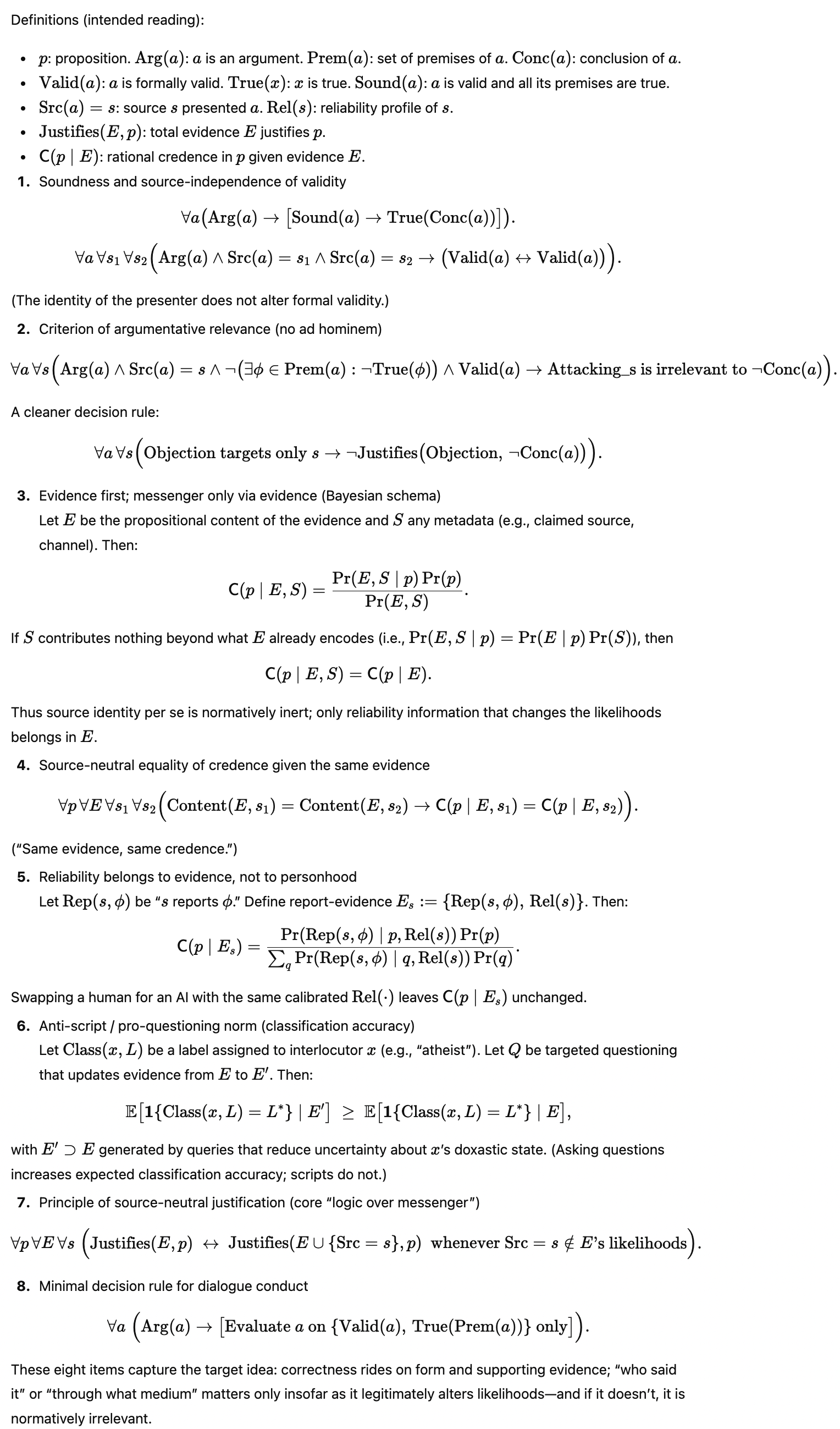
Plain English:

1. Truth Follows from Soundness

If an argument is both valid (its reasoning structure holds) and its premises are true, then its conclusion must also be true. This is the basic rule of sound reasoning: truth in, truth out.


2. Validity Is Independent of Who Speaks

An argument’s logical form does not change depending on who presents it. Whether a human, an AI, or a child expresses the same logical pattern, its validity remains the same. Logic is source-blind.


3. Attacking the Messenger Is Irrelevant

If an argument is valid and its premises are true, then attacking the person (or source) who made the argument does nothing to show that the conclusion is false. In other words, dismissing an argument because of who said it is not a rational objection.


4. Objections Must Target the Argument, Not the Person

If your criticism is directed only at the person who made the claim—rather than at the reasoning itself—then your objection provides no justification for rejecting the conclusion. This captures the fallacy of “ad hominem.”


5. Probability and Evidence Depend Only on Content

In a Bayesian sense, the rational confidence you assign to a claim should depend on the evidence for it, not on who presented it. The identity of the source matters only if it changes the probability that the evidence itself is reliable.


6. Same Evidence, Same Confidence

Two sources presenting identical evidence should lead to identical confidence in the claim. Whether the evidence comes from a human or an AI, the rational degree of belief in the claim should not change unless the content or quality of the evidence changes.


7. Reliability Is Part of the Evidence, Not the Person

When you evaluate a statement, you can treat the speaker’s reliability as part of your evidence. Once you’ve accounted for that reliability, the rest of the person’s identity—religious, social, or technological—no longer matters. A reliable AI and a reliable human carry the same epistemic weight.


8. Asking Questions Improves Accuracy

Instead of assuming someone’s position (for example, calling a person an “atheist” or “believer”), you improve your accuracy by asking clarifying questions. Inquiry always outperforms assumption in distinguishing what people actually believe.


9. Justification Does Not Depend on Source Identity

Adding information about who made a statement does not affect whether the evidence justifies believing it—unless the source’s reliability directly changes the evidential strength. Simply knowing who said something adds no epistemic value by itself.


10. Evaluate Only the Logic and the Premises

Every argument should be judged on two things only: whether its reasoning is valid and whether its premises are true. All else—emotion, authority, or identity—is noise that clouds rational assessment.


Summary

Together, these propositions formalize a single epistemic rule: truth is medium-independent. Whether the argument comes from a prophet, a professor, or an algorithm, what matters is not who said it but whether it logically follows from sound premises supported by evidence.

Truth does not bend to the reputation of its speaker, nor does logic shift under the glow of charisma or authority. Whether an argument is delivered by an ancient prophet, a professor, or a probabilistic model, its merit lies in its coherence and evidential strength. Once that is grasped, debates about who says something will give way to discussions about whether what is said is true.


Recent posts

  • Alvin Plantinga’s “Warrant” isn’t an epistemic upgrade; it’s a design for inaccuracy. My formal proof demonstrates that maximizing the binary status of “knowledge” forces a cognitive system to be less accurate than one simply tracking evidence. We must eliminate “knowledge” as a rigorous concept, replacing it with credencing—the honest pursuit…

  • This article critiques the stark gap between the New Testament’s unequivocal promises of answered prayer and their empirical failure. It examines the theological “bait-and-switch” where bold pulpit guarantees of supernatural intervention are neutralized by “creative hermeneutics” in small groups, transforming literal promises into unfalsifiable, psychological coping mechanisms through evasive logic…

  • This article characterizes theology as a “floating fortress”—internally coherent but isolated from empirical reality. It details how specific theological claims regarding prayer, miracles, and scientific facts fail verification tests. The argument posits that theology survives only through evasion tactics like redefinition and metaphor, functioning as a self-contained simulation rather than…

  • This post applies parsimony (Occam’s Razor) to evaluate Christian Theism. It contrasts naturalism’s high “inductive density” with the precarious “stack of unverified assumptions” required for Christian belief, such as a disembodied mind and omni-attributes. It argues that ad hoc explanations for divine hiddenness further erode the probability of theistic claims,…

  • Modern apologists argue that religious belief is a rational map of evidence, likening it to scientific frameworks. However, a deeper analysis reveals a stark contrast. While science adapts to reality through empirical testing and falsifiability, theology insulates belief from contradictory evidence. The theological system absorbs anomalies instead of yielding to…

  • This post critiques the concept of “childlike faith” in religion, arguing that it promotes an uncritical acceptance of beliefs without evidence. It highlights that while children naturally trust authority figures, this lack of skepticism can lead to false beliefs. The author emphasizes the importance of cognitive maturity and predictive power…

  • This analysis examines the agonizing moral conflict presented by the explicit biblical command to slaughter Amalekite infants in 1 Samuel 15:3. Written from a skeptical, moral non-realist perspective, it rigorously deconstructs the various apologetic strategies employed to defend this divine directive as “good.” The post critiques common evasions, such as…

  • Modern Christian apologetics claims faith is based on evidence, but this is contradicted by practices within the faith. Children are encouraged to accept beliefs uncritically, while adults seeking evidence face discouragement. The community rewards conformity over inquiry, using moral obligations to stifle skepticism. Thus, the belief system prioritizes preservation over…

  • In the realm of Christian apologetics, few topics generate as much palpable discomfort as the Old Testament narratives depicting divinely ordered genocide. While many believers prefer to gloss over these passages, serious apologists feel compelled to defend them. They must reconcile a God described as “perfect love” with a deity…

  • This post examines various conditions Christians often attach to prayer promises, transforming them into unfalsifiable claims. It highlights how these ‘failsafe’ mechanisms protect the belief system from scrutiny, allowing believers to reinterpret prayer outcomes either as successes or failures based on internal states or hidden conditions. This results in a…

  • In public discourse, labels such as “atheist,” “agnostic,” and “Christian” often oversimplify complex beliefs, leading to misunderstandings. These tags are low-resolution summaries that hinder rational discussions. Genuine inquiry requires moving beyond labels to assess individual credences and evidence. Understanding belief as a gradient reflects the nuances of thought, promoting clarity…

  • The featured argument, often employed in Christian apologetics, asserts that the universe’s intelligibility implies a divine mind. However, a meticulous examination reveals logical flaws, such as equivocation on “intelligible,” unsubstantiated jumps from observations to conclusions about authorship, and the failure to consider alternative explanations. Ultimately, while the universe exhibits structure…

  • The piece discusses how historical figures like Jesus and Alexander the Great undergo “legendary inflation,” where narratives evolve into more than mere history, shaped by cultural needs and societal functions. As communities invest meaning in these figures, their stories absorb mythical elements and motifs over time. This phenomenon illustrates how…

  • This post argues against extreme views in debates about the historical Jesus, emphasizing the distinction between the theological narrative shaped by scriptural interpretation and the existence of a human core. It maintains that while the Gospels serve theological purposes, they do not negate the likelihood of a historical figure, supported…

  • Hebrews 11:1 is often misquoted as a clear definition of faith, but its Greek origins reveal ambiguity. Different interpretations exist, leading to confusion in Christian discourse. Faith is described both as assurance and as evidence, contributing to semantic sloppiness. Consequently, discussions about faith lack clarity and rigor, oscillating between certitude…

  • This post emphasizes the importance of using AI as a tool for Christian apologetics rather than a replacement for personal discernment. It addresses common concerns among Christians about AI, advocating for its responsible application in improving reasoning, clarity, and theological accuracy. The article outlines various use cases for AI, such…