

Consider the Following:
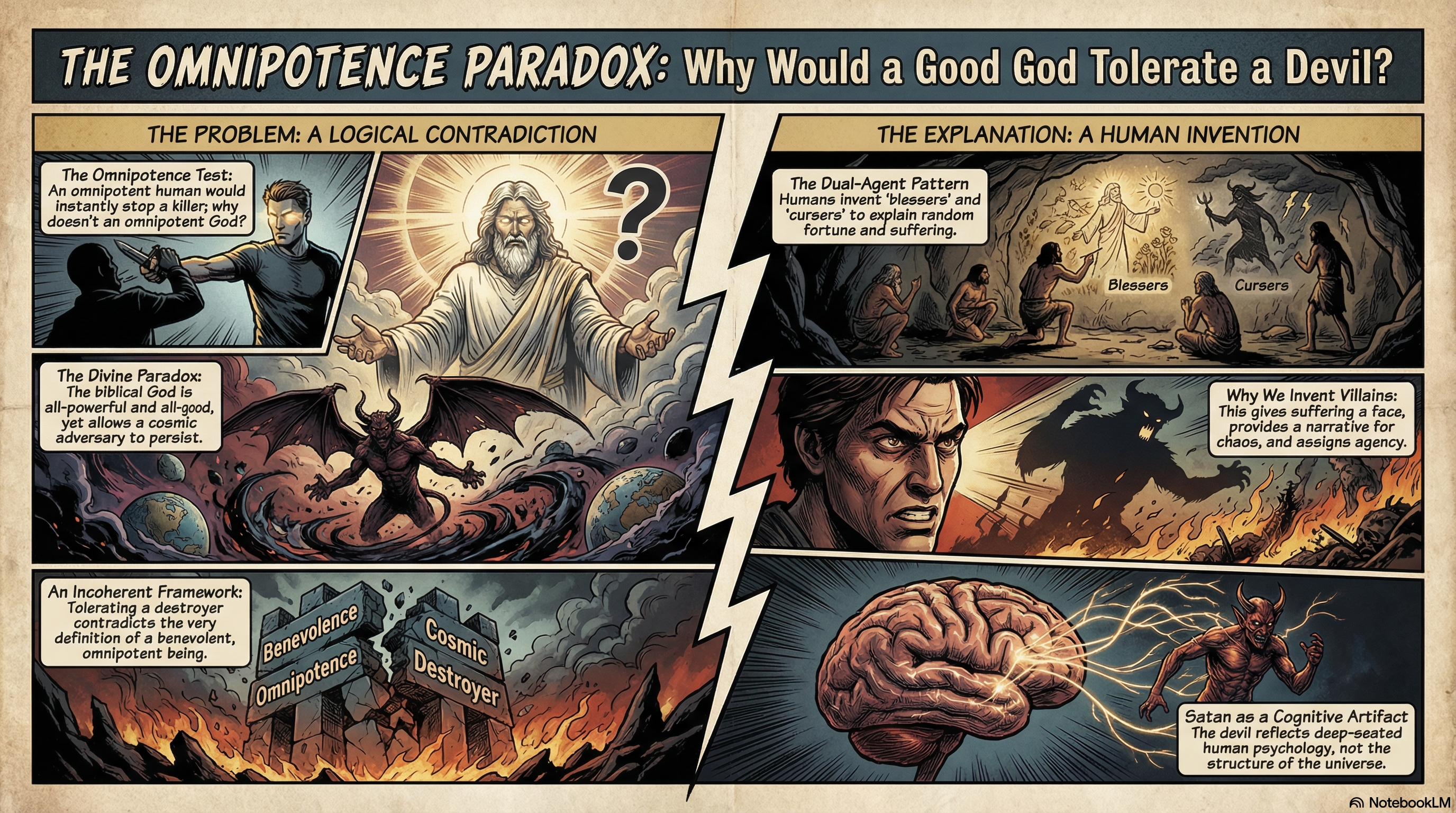
Summary: A thought experiment about omnipotence demonstrates that no rational agent would permit a malignant being to roam free. This frames a critique of the Bible’s Satan—an entity no real deity would logically tolerate. The final section explains how dual good/evil beings arise naturally from human imagination when belief is unconstrained by evidence or empirical accountability.
The Problem of a Tolerated Destroyer: A Logical Examination
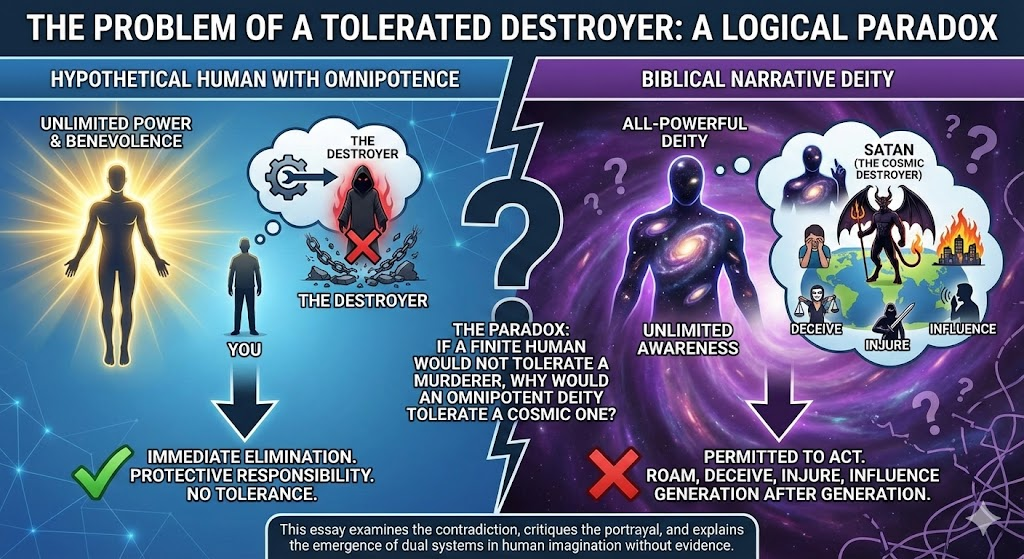
Imagine, for a moment, that you possessed unlimited power—genuine omnipotence. Not merely great strength or technological advantage, but absolute ability to alter any state of reality instantly and without effort. Now imagine learning that a single malicious human—let’s call him “the Destroyer”—was traveling from nation to nation committing unspeakable acts of violence. If you truly cared about humanity, would you allow such a man to exist for even one second? Would you watch as he inflicted suffering on person after person?
Any reasonable person with limitless power and benevolence would eliminate the threat immediately—not out of vengeance, but out of simple protective responsibility. Omnipotence removes all constraints: there is no logistical challenge, no risk of collateral harm, no diplomatic complication. You would snap your fingers and stop the Destroyer before he harmed a single additional person.
And yet, according to the Bible, the God of the Universe—unlimited in power, unlimited in awareness—does not eliminate the greatest destroyer in the theological narrative: Satan. He is permitted to act, roam, deceive, accuse, injure, and influence the world generation after generation. The paradox is unavoidable: if you, a finite human, would not tolerate a murderer for even a moment, why would an allegedly benevolent and all-powerful deity tolerate a cosmic one?
This essay examines that contradiction, critiques the biblical portrayal of Satan, and explains why dual systems of good and evil entities inevitably emerge whenever human imagination operates without the discipline of evidence.
The Biblical Satan: A Paradox in Divine Tolerance
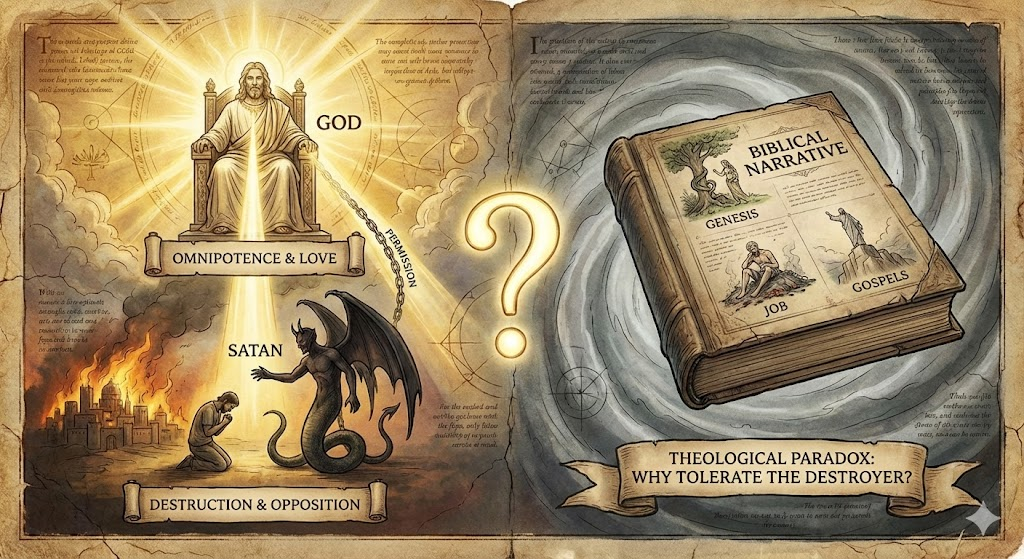
The biblical depiction of Satan is presented as that of a malevolent entity whose intentions stand directly opposed to the welfare of humanity. He deceives the first humans in Genesis, provokes divine tests in Job, tempts Jesus in the Gospels, and is described as the ongoing adversary of believers in the New Testament. In short: he is the Destroyer, the cosmic murderer, the enemy of all things good.
Yet he exists. He continues. He acts freely.
This creates a severe problem:
If God is both all-powerful and all-loving, why does He permit a being of pure opposition to persist?
The biblical narrative offers no coherent answer. Instead, it introduces scenarios that resemble narrative devices rather than metaphysical truths. For example:
- In Job, God grants Satan permission to inflict extreme suffering solely to test human loyalty.
- In the Gospels, Satan is allowed to tempt Jesus, despite divine foreknowledge rendering the test unnecessary.
- In Christian theology, Satan is permitted to influence minds, destroy families, deceive nations, and cause suffering across centuries.
These depictions raise an unavoidable question:
Why would an all-powerful deity tolerate—even collaborate with—a being whose sole purpose is destruction?
If a human with omnipotence would remove a murderous threat instantly, then any God who fails to do so either lacks power, lacks concern, or lacks coherence as typically defined. The biblical Satan is therefore not merely a dramatic antagonist; he is evidence of an internally inconsistent theological framework.
The toleration of Satan contradicts any concept of perfect goodness or omnipotent benevolence. A deity who permits a cosmic destroyer to exist is indistinguishable from a deity who endorses the consequences.
Why Humans Invent Dual Systems of Blessers and Cursers
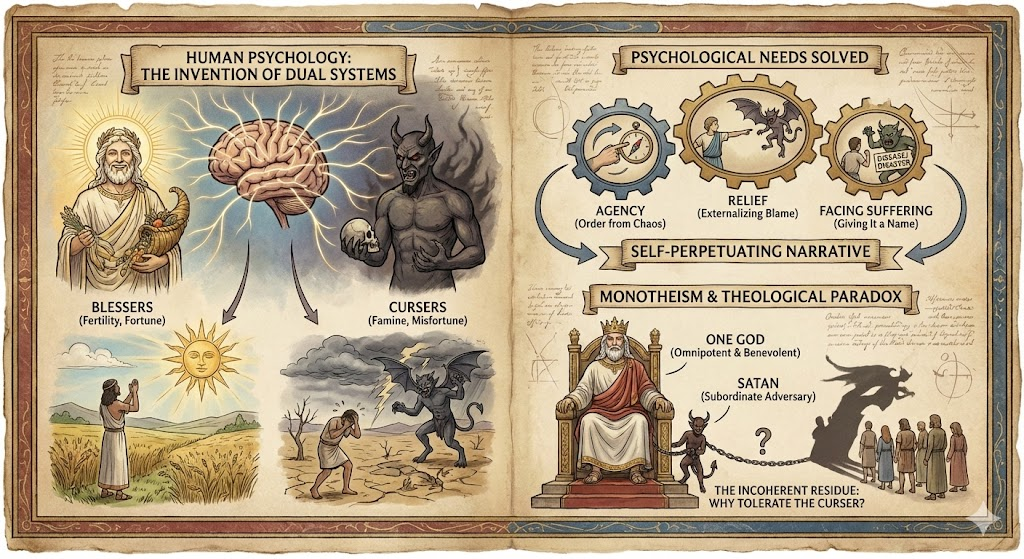
The persistence of figures like Satan becomes less mysterious once we step outside theology and examine human psychology. Throughout history, humans have routinely constructed dual entities—beings of blessing and beings of harm—to explain the unpredictable events of life. These systems appear in cultures worldwide long before monotheistic frameworks emerge:
- Fertility gods bring harvests; famine demons bring drought.
- Household spirits protect families; night spirits steal sleep or plague children.
- Ancestors bless good fortune; angry spirits cause misfortune.
Whenever a community lacked a reliable explanatory mechanism tied to evidence, it naturally invented invisible agents to map fortune and suffering onto.
This dualistic pattern solves several psychological needs:
- It provides agency where none is evident.
Randomness becomes intention; chaos becomes narrative. - It relieves personal responsibility.
Success can be attributed to a benevolent power; suffering can be blamed on a malevolent one. - It gives suffering a face.
Instead of confronting impersonal causes—disease, disaster, statistical variance—people can name a villain.
Once this cognitive system is established, it becomes self-perpetuating. Blessings must come from a good force; tragedies must come from a bad one. The human mind, untethered from evidence, fills the world with unseen agents because such narratives feel more satisfying than acknowledging uncertainty.
Thus, Satan is not evidence of divine truth; he is evidence of a deeply human impulse toward dualistic storytelling.
In monotheistic religion, dualism becomes a problem: one God, but two agents shaping human fate. To reconcile this, theologians transform Satan into a subordinate adversary—but cannot coherently explain why an omnipotent God tolerates him. The dualistic template remains, but squeezed into a framework that no longer accommodates it.
This is why the biblical Satan is fundamentally incoherent: he is the residue of older psychological patterns forced into a monotheistic mold.
The Omnipotence Test: A Clear Syllogistic Breakdown
The conflict between divine benevolence and Satan’s continued existence can be summarized with two clarifying syllogisms.
Syllogism 1: The Omnipotence Paradox
P1: A perfectly good and omnipotent being would prevent needless suffering.
P2: Satan causes needless suffering and continues to exist.
Conclusion: Therefore, a perfectly good and omnipotent being would not allow Satan to exist even momentarily—yet the biblical God does.
Syllogism 2: The Human-Origin Model of Dual Entities
P1: Cultures lacking evidence-based explanations naturally invent both benevolent and malevolent agents.
P2: The biblical God-Satan pair mirrors these dual-agent systems structurally.
Conclusion: Therefore, the God-Satan duality aligns with human imaginative patterns, not with actual properties of the universe.
These syllogisms reinforce the same core insight: the biblical Satan is best understood not as a supernatural reality but as an anthropological inheritance—an explanatory relic from a time before evidence-based reasoning.
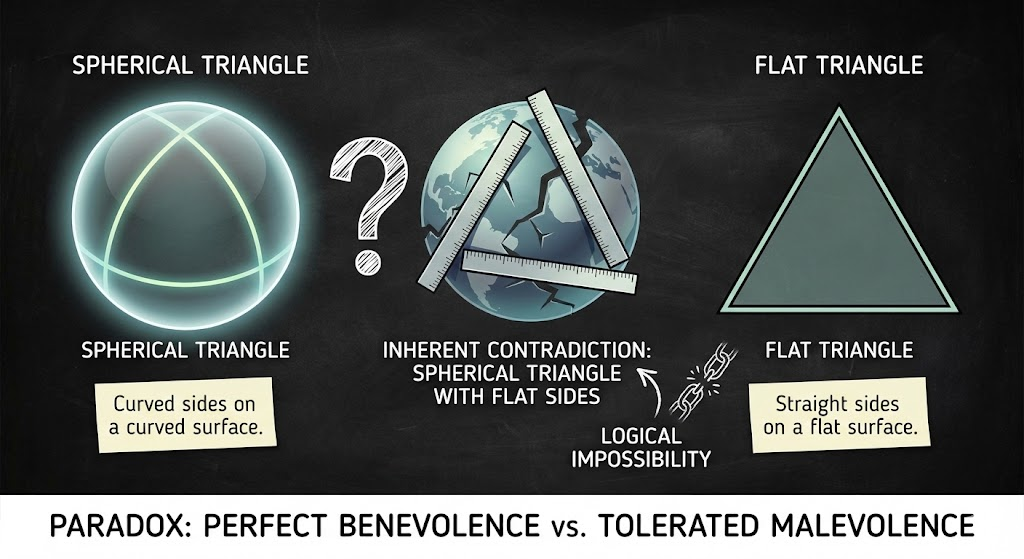
Spherical Triangles and Divine Contradictions
Consider a “spherical triangle” with three straight, perfectly flat sides. Such an object is inherently contradictory; you can imagine it linguistically, but its properties are mutually exclusive. No amount of evidence could ever justify belief in such an object because the concept itself is incoherent.
The biblical model of God tolerating Satan is similarly contradictory. A perfectly benevolent, omnipotent being cannot simultaneously allow a malevolent destroyer to ravage creation while remaining perfectly benevolent and omnipotent. The traits themselves cannot coexist.
The contradiction is not in the evidence—it is in the concept.
Conclusion
If you were omnipotent, you would not tolerate a murderous human for even a moment. Yet the biblical God—allegedly infinitely more powerful and infinitely more concerned with human welfare—tolerates an entity said to destroy lives, influence nations, and propagate suffering across millennia.
This reveals a deeper truth: the biblical Satan is not the product of divine reality but of human imagination shaped by pre-scientific patterns of dualistic thinking.
A dual system of blessers and cursers emerges naturally whenever people attempt to explain the world without the discipline of evidence. Satan persists not because he reflects the nature of an actual universe, but because he reflects the structure of human psychology.
The toleration of Satan exposes the incoherence at the heart of the biblical narrative:
Either God is not omnipotent, not benevolent, or the entire framework—God, Satan, and their cosmic conflict—originates in the human mind rather than the structure of reality.
This analysis underscores a simple point:
A coherent universe does not require a cosmic destroyer. A theological one seems unable to function without him.
The Logical Form
Against the Notion of a God Who “Permits” a World-Killer
- P1: A being with unlimited power and knowledge could eliminate any destructive agent instantly.
- P2: Allowing a destructive agent to continue harming others despite unlimited power to stop it indicates either indifference or contradiction in the claim of benevolence.
- P3: The biblical God is said to allow Satan—described as a global destroyer—to persist.
- Conclusion: Therefore, the biblical God’s tolerance of Satan is incompatible with the claim of an all-powerful, benevolent deity.

Evidence Requirements for Entities That Influence the World
- P1: Claims about entities that shape events in the world require evidence proportionate to their alleged influence.
- P2: The Bible asserts that Satan actively influences global outcomes while providing no independent evidence of such an entity.
- P3: Evidence-free entities cannot be rationally invoked to explain real-world events.
- Conclusion: Therefore, Satan cannot be rationally invoked as an explanatory cause for real-world suffering or behavior.
The Dual-Agency (Good vs. Evil Beings) Framework
- P1: Human cognition generates explanatory agents—gods, spirits, forces—when unconstrained by evidentiary requirements.
- P2: The good-agent/bad-agent dualism (God/Satan) mirrors this unconstrained pattern of invention.
- P3: Patterns consistent with human invention cannot be assumed to represent real entities without substantiating evidence.
- Conclusion: Therefore, the God/Satan dual-agency system is more plausibly a cognitive artifact than an account of real supernatural beings.
Tolerating Evil Agents Undermines Claims of Omnipotence
- P1: An omnipotent being cannot be thwarted or constrained by any lesser being.
- P2: The biblical narrative describes Satan as resisting, undermining, or counteracting God’s will.
- P3: If a lesser being successfully opposes an omnipotent being, the claim of omnipotence is violated.
- Conclusion: Therefore, the biblical description of Satan contradicts the claim that God is omnipotent.

A Dialogue
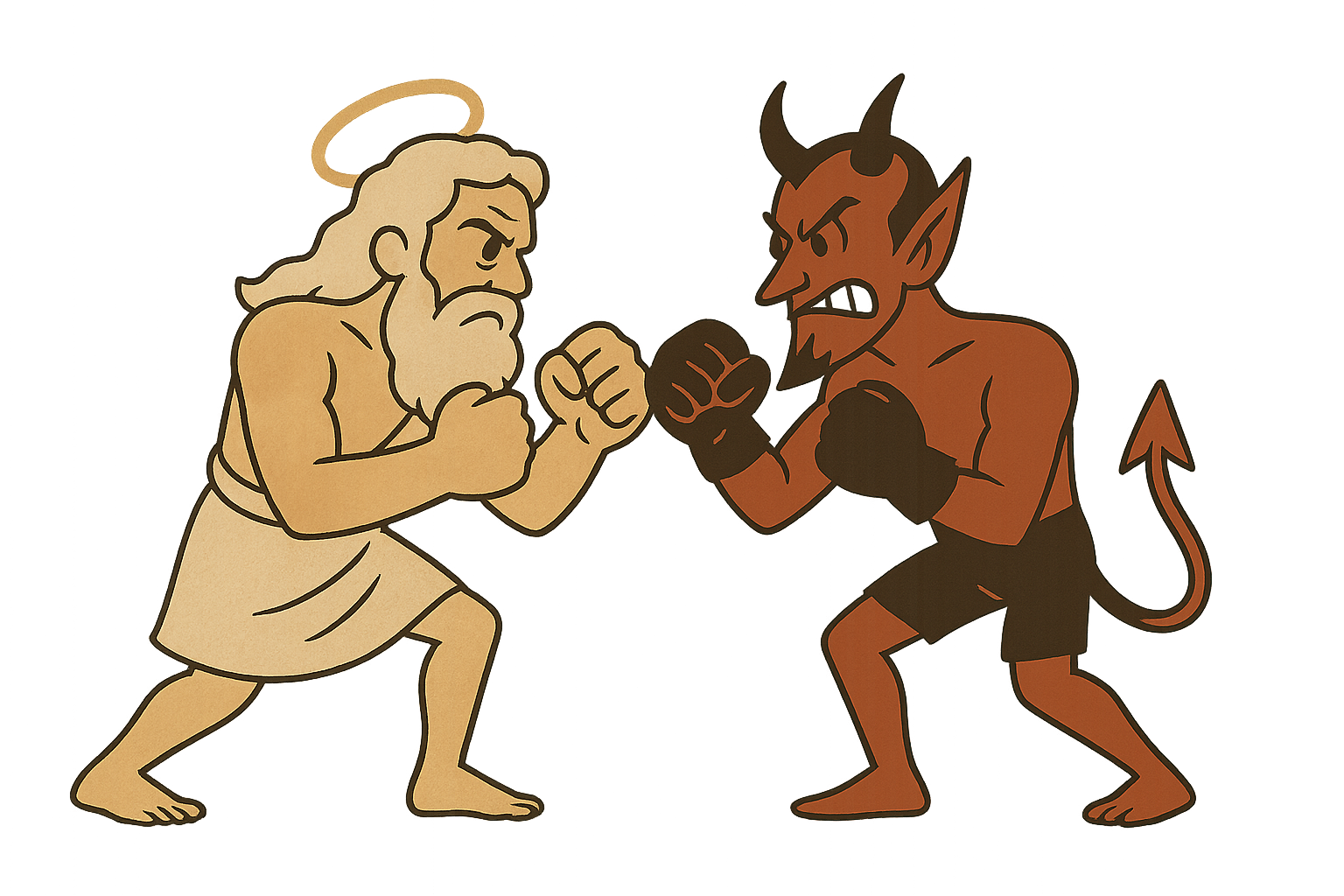
The Devil and the Christian God
DAVID: Evil exists because Satan is actively at work in the world. The suffering we see is largely due to his influence, and the Bible explains why God allows this.
CLARUS: If you were omnipotent and fully capable of preventing a dangerous being from harming humanity, would you allow that being to exist for even a moment? Most people wouldn’t. Why should an actual God of the universe be held to a lower standard of competence or compassion?
DAVID: But God allows Satan to exist because free will requires the possibility of rebellion. Eliminating Satan would compromise the moral drama central to human life.
CLARUS: That assumes the narrative itself is coherent. An omnipotent being does not need a cosmic antagonist to preserve human agency. Allowing a malevolent entity with global reach is not a requirement for freedom—it’s a design choice that reflects on the designer, not on the humans.
DAVID: Satan’s existence is part of God’s plan. Without him, people wouldn’t turn to God, and the contrast between good and evil wouldn’t be meaningful.
CLARUS: That presumes the contrast must be generated by an external villain. Humans generate enough harmful impulses on their own. Adding a supernatural predator only multiplies suffering without necessity. An all-powerful being who wants humans to grow could do so without unleashing an immortal killer.
DAVID: The Bible teaches that Satan is bound by God’s limits. He operates only with divine permission.
CLARUS: That raises a deeper problem: if Satan can harm only with permission, then every atrocity attributed to Satan is ultimately approved by God. The distinction collapses. Satan becomes a middleman used to outsource blame. The logic weakens rather than strengthens the theology you’re defending.
DAVID: Still, the presence of both God and Satan explains why some things are blessings and others are afflictions. It fits the dual structure of the world.
CLARUS: Humans naturally create dual-agent systems when lacking evidence but wanting explanations. Throughout history, cultures invented paired beings—gods and demons, light and dark spirits—to distribute credit and blame. The Bible’s God/Satan schema fits that cognitive pattern, but fitting a pattern isn’t the same as being true.
DAVID: You’re overlooking the spiritual dimension. Not everything can be evaluated purely by reason.
CLARUS: Reason is what allows us to distinguish substantiated entities from invented ones. If the only justification for Satan’s continued existence is a theological story, not evidence or logic, then the claim stands on the same footing as other mythical antagonists created to explain fortune and misfortune.
DAVID: You make it sound like the biblical picture of Satan is just another mythological construct.
CLARUS: If an omnipotent being would not tolerate a murderer for five minutes, it’s unclear why the biblical God tolerates a cosmic murderer for millennia. If the story cannot withstand that basic question, calling it “mysterious” doesn’t repair the conceptual holes—it only masks them.
DAVID: Then what would count as a coherent explanation for suffering?
CLARUS: A framework that does not rely on the prolonged existence of an unstoppable enemy permitted by an all-powerful deity. A coherent model must explain suffering without inventing a supernatural villain whose existence—if taken literally—only amplifies the theological contradictions.

Notes:
Helpful Analogies
The Locked Room and the Endless Killer
Imagine being omnipotent and standing before a locked room that contains a man who is actively killing innocent people around the world through remote devices. With limitless power, you could stop him instantly—erase him, restrain him, or prevent the harm entirely. Allowing him to continue for even a second would be unthinkable.
Yet the biblical story asks us to accept that an all-powerful deity knowingly allows Satan—depicted as far worse—to roam freely for millennia. If no sane omnipotent being would tolerate such evil for a moment, the Bible’s depiction of God’s tolerance of Satan strains rational coherence.
The Prisoner and the “All-Powerful” Warden
Imagine a prison warden who claims absolute control over every cell, every door, every guard, and every inch of the grounds. Now imagine that this warden knowingly allows the most violent inmate to leave his cell at will, attack anyone he wishes, and return whenever convenient—while insisting he remains “fully in charge.”
The Bible’s notion of Satan mirrors this contradiction. If God is truly all-powerful, allowing an enemy to sabotage creation for ages becomes inexplicable. A real sovereign would neutralize the threat instantly, not permit a cosmic criminal to thrive for generations.
The Vending Machine of Blessings and Blame
Imagine a culture in which every good event—finding money, healing from illness, good weather—is credited to a benevolent spirit, while every bad event—storms, accidents, disease—is blamed on a malevolent force. This dual-agent model arises naturally in human psychology when people explain events without demanding evidence.
The Bible’s pairing of God and Satan fits this familiar pattern: one entity receives credit for blessings; the other absorbs blame for suffering. This structure is exactly what humans invent when not constrained by evidence, forming a tidy but imaginary system of cosmic bookkeeping rather than a description of actual reality.
Addressing Theological Responses
Theological Responses
1. God Permits Satan for a Greater Purpose
Some Christians might argue that God allows Satan to exist because divine purposes extend beyond immediate human comprehension. They may claim that God can use even malevolent beings to accomplish testing, refinement, or demonstration of divine justice, and that eliminating Satan instantly would collapse the meaningful exercise of human freedom.
2. Human Logic Cannot Fully Capture the Divine Agenda
Christians could assert that calling Satan’s continued existence “illogical” reflects the limitations of human reasoning, not a flaw in God’s plan. They may argue that divine decisions operate within a higher epistemic framework, where what seems unnecessary or inconsistent to humans is coherent from a transcendent vantage point.
3. Satan’s Role Fits Within a Narrative of Free Will
A common Christian response is that Satan embodies the genuine possibility of choosing against God, making moral agency meaningful. They may argue that removing Satan would reduce choice to an illusion, undermining the authenticity of obedience, love, and spiritual growth.
4. The Bible Provides the Context That Natural Reason Cannot
Some may claim that the Bible’s portrayal of Satan is coherent once interpreted through special revelation. They might argue that scripture clarifies Satan’s limits, his temporary authority, and his ultimate defeat—concepts that, from within a Christian worldview, justify why God has not destroyed him immediately.
5. The Presence of Evil Demonstrates the Need for Redemption
Many Christians would say that the existence of Satan is integral to the story of redemption. They may claim that God allows Satan’s influence to highlight humanity’s need for salvation, and that eliminating Satan prematurely would disrupt the theological arc of fall, struggle, grace, and restoration.
6. Divine Restraint, Not Absence, Explains the Delay
Christians could argue that God is not indifferent but patiently delaying final judgment. They may cite scriptural themes that depict God as “slow to anger,” allowing time for repentance and transformation. Satan’s continued activity is viewed as a temporary condition rather than a permanent feature of reality.
7. Satan Is Already Defeated in a Metaphysical Sense
Another response is that Christians see Satan’s defeat as already accomplished spiritually, even if not yet manifested physically. They might argue that God tolerates Satan’s limited operations to fulfill prophecy or to reveal divine sovereignty in a final, dramatic resolution.
8. The Good/Evil Duality Reflects a Larger Spiritual Conflict
Christians might assert that the dual presence of God and Satan reflects a cosmic struggle in which humanity participates. They may claim that this duality is not a human invention but a divinely revealed truth explaining the moral and spiritual dimensions of human experience.
Counter-Responses
1. The “Greater Purpose” Claim Presupposes What It Must Prove
Appealing to a mysterious “greater purpose” assumes that such a purpose exists, yet provides no mechanism showing why an omnipotent being would need a homicidal cosmic adversary to achieve it. A truly omnipotent entity could accomplish refinement, justice, or moral development without permitting global suffering from an unrestrained supernatural predator. This explanation merely relocates, rather than resolves, the contradiction.
2. Invoking “Higher Logic” Eliminates Any Standard of Coherence
Saying that God’s tolerance of Satan is coherent from a “higher epistemic framework” dissolves all criteria for meaningful explanation. If divine decisions are exempt from logic, no claim about God’s goodness, justice, or intentions can be evaluated. The argument shields the doctrine from scrutiny by abandoning the very tools needed to assess it. A belief that rejects logic cannot simultaneously appeal to rational justification.
3. Free Will Does Not Require a Cosmic Serial Killer
The claim that free will requires Satan misrepresents what choice demands. Humans could freely choose cooperation, compassion, or selfishness without needing a supernatural mastermind engineering suffering at scale. Removing Satan would not eliminate alternative choices; it would merely remove one catastrophic, unnecessary option that an all-powerful being would have no reason to preserve.
4. Special Revelation Cannot Repair Internal Contradictions
Appeal to biblical context does not make the Satan narrative coherent; it simply reasserts the doctrine. The Bible itself portrays God as both omnipotent and unwilling to eliminate a being who allegedly causes worldwide suffering. Referencing scripture cannot resolve tensions introduced by scripture. A text cannot serve simultaneously as the source of a claim and the validation of its coherence.
5. A Designed Problem Cannot Justify the Designer
Arguing that Satan is needed to “demonstrate humanity’s need for redemption” concedes an even deeper problem: a deity intentionally creates or permits a catastrophic evil solely to manufacture a need for its own solution. This resembles setting a house on fire to highlight the importance of firefighters. A redemptive arc loses coherence when the architect of suffering is also the proposed savior.
6. “Divine Patience” Contradicts the Cost of Delay
Saying God is restraining judgment out of patience ignores the staggering human cost of that delay. If an omnipotent being permits Satan to continue killing, deceiving, or tormenting millions, patience becomes indistinguishable from negligence. The scale of preventable harm renders the patience explanation incoherent unless one first assumes that suffering has no moral weight—a claim Christians themselves reject.
7. “Already Defeated” Yet Fully Operational Is Contradictory
Calling Satan “already defeated” but still fully active introduces a contradiction. A defeated enemy who remains powerful, destructive, and uncontained is not defeated in any meaningful sense. The distinction between metaphysical defeat and empirical activity is a theological workaround, not an explanation. If God can metaphysically defeat Satan, God could metaphysically—and physically—remove him entirely.
8. Cosmic Dualism Looks Human-Made, Not Divine
Invoking a cosmic good-versus-evil battle mirrors long-standing human storytelling patterns, not divine necessity. The duality provides psychological comfort by giving abstract misfortune a personal agent and offering meaning in chaos. Without evidence of supernatural entities, this narrative reflects human cognitive tendencies, not the structure of reality. The claim explains belief formation—not the universe.
Clarifications
Dual-Agent Theistic Closure

Left Side (Science / Rationality)
✓ We start with observations — what we can see, measure, and test.
✓ From these observations, we can gather both confirming evidence (things that support a theory) and disconfirming evidence (things that go against it).
✓ Science accepts both kinds of evidence. If the evidence supports the theory, good. If it challenges the theory, also good — because it helps us refine or replace bad explanations.
➘ In this system, a theory has to survive possible challenges to remain credible.
Right Side (Ideology / Faith-based Explanations)
✓ Observations are still there, but the “explanation” is already assumed (e.g., “God did it,” “Satan did it,” or “souls exist”).
✓ Any evidence that seems to confirm the assumption is accepted.
✓ But disconfirming evidence is blocked out — it’s not allowed to count against the explanation.
➘ That means the explanation can never be proven wrong, no matter what is observed. It looks strong, but only because it refuses to admit being tested.
The Core Message
When you let all evidence count (science/rationality), your ideas can actually be tested, corrected, and improved.
When you block evidence that doesn’t fit your assumptions (ideology/faith), your system may seem airtight, but it actually explains nothing — because it would look the same no matter what happens.
See also:


 Free of Faith
Leave a reply to Phil Stilwell Cancel reply