A Symbolically Clear Diagnosis of the Fault

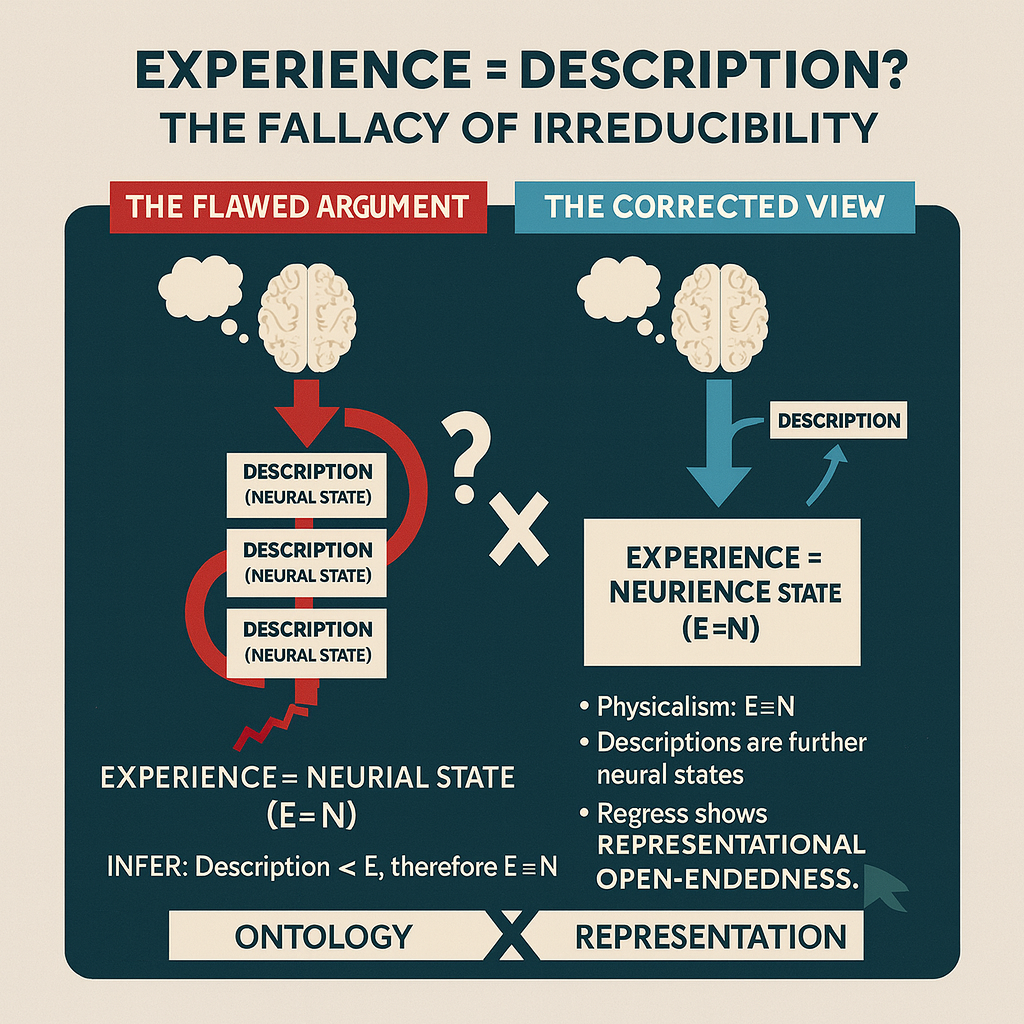
This post is a response to an argument for irreducibility that relies on an equivocation between an experience and a description of an experience. Making this explicit exposes the failure.

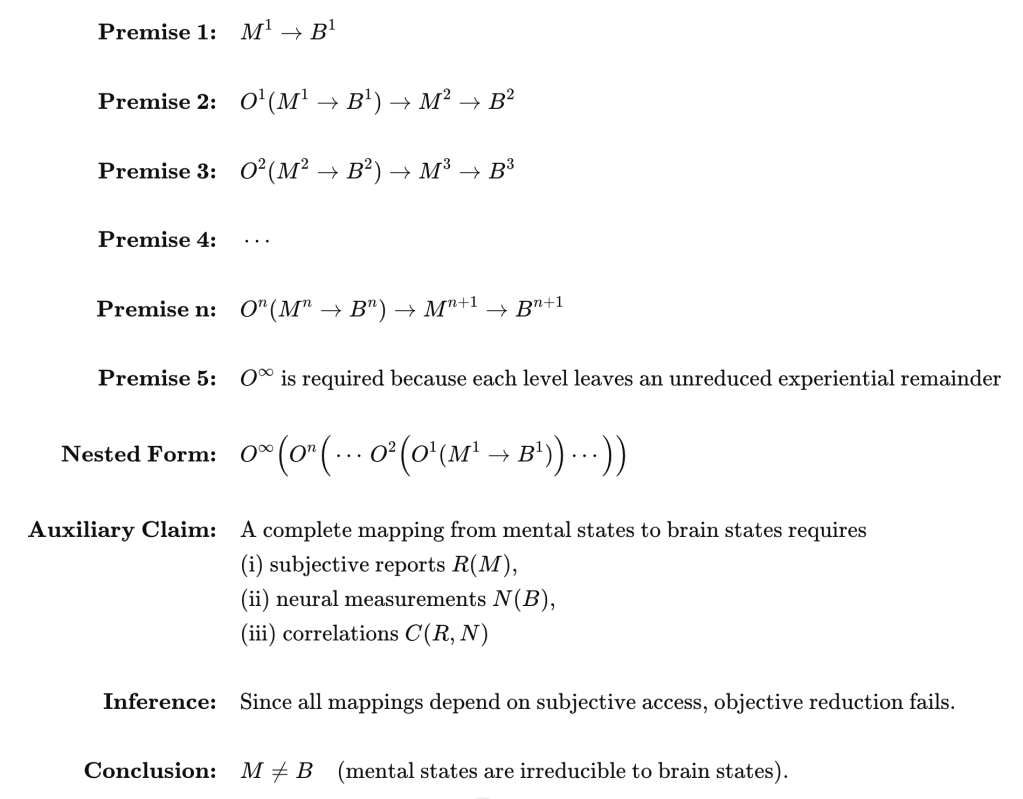
A Summary of the Original Argument:
Let E denote a conscious experience.
Let N denote the neural realization of that experience.
Let D(E \leftrightarrow N) denote a description or theoretical representation of the identity or correlation between E and N.
Let O(D(E \leftrightarrow N)) denote a meta-state in which the agent experiences or entertains that description.

The proponent’s regress expands this:

O(O(O(...O(D(E \leftrightarrow N))...)))

They infer that because any description leaves an additional experiential remainder, E cannot be identical to N.

The physicalist reduction does not claim that:

E = D(E \leftrightarrow N)

Rather, it claims something like:

E = N or at least E \prec N (supervenes on N, using \prec for supervenience).

Thus the actual target of reduction is the pair latex[/latex], not the meta-states O(D(...)) that refer to it. The regress merely shows that descriptions differ from what they describe, which is trivial and harmless.

Formally:

  1. The regress observes that for any D(E \leftrightarrow N), there exists an O(D(E \leftrightarrow N)) such that: O(D(E \leftrightarrow N)) \neq D(E \leftrightarrow N)
  2. It mistakenly infers that therefore: E \neq N

But the conclusion only follows if one inserts a hidden premise:

\forall X\ (X = N \Rightarrow \neg\exists O(D(X)))

That premise is not argued for; it is simply assumed. Hence the argument is circular.

The flawed reasoning structure is:

  1. \forall D\ \exists O(D) \wedge O(D) \neq D
  2. Conclude \exists F: F \neq N such that F constitutes the essence of E.

But showing that D and O(D) are distinct does not entail:

E \neq N

Because the existence of iterated representations is a fact about cognition:

\forall D\ \exists O(D)

not a fact about ontology:

E = N

The regress shows representational open-endedness, not metaphysical dualism.

The supplementary claim is that neural decoding requires first-person reports. Symbolically:

Let R(E) be subject reports.
Let M(N) be neural measurements.
Scientific mapping proceeds via:

f: R(E) \times M(N) \rightarrow D(E \leftrightarrow N)

The argument infers:

f depends on R(E)], therefore E \not= N.

This implicitly uses:

(\exists g: g\ depends\ on\ X) \Rightarrow X\ is\ metaphysically\ fundamental

This inference is invalid. Methodological dependence does not imply metaphysical primacy. We also rely on thermometers to access temperature, but that does not imply that temperature is irreducible to kinetic energy.

A physicalist reading can simply assert:

E = N

and

D(E \leftrightarrow N) and O(D(E \leftrightarrow N)) are further neural states:

D(E \leftrightarrow N) = N_D,\quad O(D(E \leftrightarrow N)) = N_O

This interpretation absorbs the regress:

O^{k}(D(E \leftrightarrow N)) = N_{O^{k}}

for arbitrarily large k, with no metaphysical residue required. The infinite representational tower is simply more neural dynamics, not evidence of ontological dualism.

The irreducibility argument equivocates between:

• identity of E with N at the ontological level
versus
• identity of E with a description D(E \leftrightarrow N) at the representational level.

Once this distinction is made explicit in symbols, the regress collapses into a trivial observation about the difference between a system and any finite description of it. It does not establish that E \neq N.


Recent posts

  • Hebrews 11:1 is often misquoted as a clear definition of faith, but its Greek origins reveal ambiguity. Different interpretations exist, leading to confusion in Christian discourse. Faith is described both as assurance and as evidence, contributing to semantic sloppiness. Consequently, discussions about faith lack clarity and rigor, oscillating between certitude…

  • This post emphasizes the importance of using AI as a tool for Christian apologetics rather than a replacement for personal discernment. It addresses common concerns among Christians about AI, advocating for its responsible application in improving reasoning, clarity, and theological accuracy. The article outlines various use cases for AI, such…

  • This post argues that if deductive proofs demonstrate the logical incoherence of Christianity’s core teachings, then inductive arguments supporting it lose their evidential strength. Inductive reasoning relies on hypotheses that are logically possible; if a claim-set collapses into contradiction, evidence cannot confirm it. Instead, it may prompt revisions to attain…

  • This post addresses common excuses for rejecting Christianity, arguing that they stem from the human heart’s resistance to surrendering pride and sin. The piece critiques various objections, such as the existence of multiple religions and perceived hypocrisy within Christianity. It emphasizes the uniqueness of Christianity, the importance of faith in…

  • The Outrage Trap discusses the frequent confusion between justice and morality in ethical discourse. It argues that feelings of moral outrage at injustice stem not from belief in objective moral facts but from a violation of social contracts that ensure safety and cooperation. The distinction between justice as a human…

  • Isn’t the killing of infants always best under Christian theology? This post demonstrates that the theological premises used to defend biblical violence collapse into absurdity when applied consistently. If your theology implies that a school shooter is a more effective savior than a missionary, the error lies in the theology.

  • This article discusses the counterproductive nature of hostile Christian apologetics, which can inadvertently serve the skepticism community. When apologists exhibit traits like hostility and arrogance, they undermine their persuasive efforts and authenticity. This phenomenon, termed the Repellent Effect, suggests that such behavior diminishes the credibility of their arguments. As a…

  • The post argues against the irreducibility of conscious experiences to neural realizations by clarifying distinctions between experiences, their neural correlates, and descriptions of these relationships. It critiques the regression argument that infers E cannot equal N by demonstrating that distinguishing between representations and their references is trivial. The author emphasizes…

  • The article highlights the value of AI tools, like Large Language Models, to “Red Team” apologetic arguments, ensuring intellectual integrity. It explains how AI can identify logical fallacies such as circular reasoning, strawman arguments, and tone issues, urging apologists to embrace critique for improved discourse. The author advocates for rigorous…

  • The concept of the Holy Spirit’s indwelling is central to Christian belief, promising transformative experiences and divine insights. However, this article highlights that the claimed supernatural benefits, such as unique knowledge, innovation, accurate disaster predictions, and improved health outcomes, do not manifest in believers. Instead, evidence shows that Christians demonstrate…

  • This post examines the widespread claim that human rights come from the God of the Bible. By comparing what universal rights would require with what biblical narratives actually depict, it shows that Scripture offers conditional privileges, not enduring rights. The article explains how universal rights emerged from human reason, shared…

  • This post exposes how Christian apologists attempt to escape the moral weight of 1 Samuel 15:3, where God commands Saul to kill infants among the Amalekites. It argues that the “hyperbole defense” is self-refuting because softening the command proves its literal reading is indefensible and implies divine deception if exaggerated.…

  • This post challenges both skeptics and Christians for abusing biblical atrocity texts by failing to distinguish between descriptive and prescriptive passages. Skeptics often cite descriptive narratives like Nahum 3:10 or Psalm 137:9 as if they were divine commands, committing a genre error that weakens their critique. Christians, on the other…

  • In rational inquiry, the source of a message does not influence its validity; truth depends on logical structure and evidence. Human bias towards accepting or rejecting ideas based on origin—known as the genetic fallacy—hinders clear thinking. The merit of arguments lies in coherence and evidential strength, not in the messenger’s…

  • The defense of biblical inerrancy overlooks a critical flaw: internal contradictions within its concepts render the notion incoherent, regardless of textual accuracy. Examples include the contradiction between divine love and commanded genocide, free will versus foreordination, and the clash between faith and evidence. These logical inconsistencies negate the divine origin…

  • The referenced video outlines various arguments for the existence of God, categorized based on insights from over 100 Christian apologists. The arguments range from existential experiences and unique, less-cited claims, to evidence about Jesus, moral reasoning, and creation-related arguments. Key apologists emphasize different perspectives, with some arguing against a single…