Click for larger version.

A fresh case study on this topic: https://freeoffaith.com/batting-for-beelzebub/

The Apologist as Unwitting Double Agent:

In the domain of religious discourse, the stated objective of Christian apologetics is typically the persuasion of the non-believer or the defense of the faith against intellectual critique. However, a pervasive sociopsychological phenomenon suggests that a significant subset of apologetic engagement is counter-productive. When the methodology of the apologist involves hostility, arrogance, or ad hominem attacks, they cross a theoretical threshold where they cease to be advocates for their position and effectively become assets for the opposing worldview. This dynamic, which we can term the Repellent Effect, suggests that the character of the messenger can possess a negative value high enough to cancel out the logical positive value of the argument.

The Sociopsychology of Self-Sabotage

The failure of hostile apologetics is not merely a matter of poor etiquette; it is a structural failure of the persuasive mechanism. It operates through three distinct vectors.

1. Performative Certainty and Out-Group Derogation

Many interactions on digital platforms are driven by a desire for in-group signaling rather than genuine persuasion. The apologist acts not to convince the skeptic, but to demonstrate strength and purity to fellow believers. In this context, cruelty is not a strategic error; it is a signaling mechanism. However, for the non-believing observer, this manifests as out-group derogation. The interaction shifts from a dialectic on truth to a display of tribal dominance.

2. The Incoherence of the Messenger

Christianity posits a specific metaphysical claim regarding the transformation of the human character. The doctrine asserts that the indwelling of the Holy Spirit produces specific ontological changes, historically categorized as the Fruit of the Spirit (love, patience, gentleness). When an apologist displays traits diametrically opposed to these—malice, impatience, arrogance—they provide empirical evidence against their own metaphysics. They are falsifying their doctrine in real-time. The skeptic observes a disconnect between the product description (a transformed life) and the actual product (the hostile interlocutor).

3. Inductive Density and Reactance

When an interlocutor perceives a threat to their intellectual autonomy via aggression or condescension, the psychological response is Reactance. The listener solidifies their current position to preserve their agency. Furthermore, repeated exposure to mean-spirited apologists builds what can be called Inductive Density. The skeptic begins to inductively reason that if n number of believers behave with hostility, the worldview itself likely incentivizes or fails to correct such behavior.

Modeling the Threshold of Counter-Evangelism

To understand when an apologist becomes a functional asset for the skepticism community, we can establish a theoretical model of Net Persuasion Value (NPV).

If we view an apologetic interaction as a transaction intended to transfer belief credibility, the outcome is determined by the quality of the argument minus the interaction costs imposed by the apologist’s behavior. We can express this relationship with the following equation:

NPV = A_{cogency} - \left( H_{ostility} \times I_{nconsistency} \right)

In this function:

A_{cogency} represents the logical soundness and intellectual rigor of the argument presented.

H_{ostility} represents the coefficient of aggression, sarcasm, or condescension in the delivery.

I_{nconsistency} represents the perceived gap between the apologist’s behavior and the ethical mandates of their specific theology (e.g., the command to provide a defense with gentleness).

The theoretical threshold where an apologist essentially joins the other team occurs when:

\left( H_{ostility} \times I_{nconsistency} \right) > A_{cogency}

When this inequality holds true, the NPV becomes negative. The interaction does not merely fail to persuade; it actively subtracts credibility from the Christian worldview.
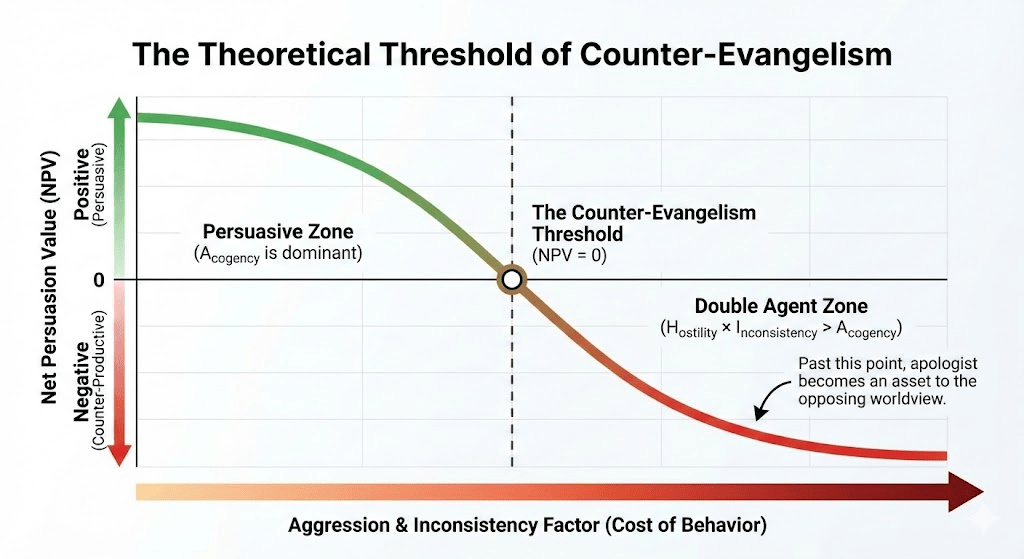
The Double Agent Threshold

Once the NPV drops below zero, the apologist triggers two specific failure states that aid the skeptic.

Reputational Contagion

At this stage, the observer concludes that mean-spiritedness is not an anomaly (a bug) but a feature of the system. The apologist has effectively immunized the skeptic against future evangelism. The skeptic no longer listens to the arguments of A_{cogency} because the source has been deemed epistemically untrustworthy due to moral failing.

Validation of Secular Moral Superiority

If the non-believer maintains composure while the apologist descends into vitriol, a comparative moral judgment occurs. The non-believer demonstrates the emotional regulation and charity that the Christian claims are supernatural fruits of their faith. By exhibiting superior behavior without the religious framework, the skeptic empirically invalidates the necessity of that framework.

Vice Subsidization

Ultimately, the mean-spirited apologist engages in a form of Vice Subsidization for the non-believing community. By lowering the intellectual cost required to reject the faith, they subsidize the skepticism of the observer. The non-believer does not need to engage in the laborious task of refuting complex ontological arguments; they need only point to the behavior of the messenger.

In game theory terms, the hostile apologist alters the payoff matrix. They make the rejection of Christianity a high-reward, low-effort move for the skeptic. The theoretical threshold is reached precisely when the behavior of the believer becomes a more compelling argument against the religion than their words could ever be for it.


One response to “✓ The Repellent Effect in Apologetics”

  1. J Avatar
    J

      Appreciated this piece. It was strangely timely given that I just recently went through the website of an “intellectual” apologist who exemplifies the aforementioned vitriol almost to a tee, it was strangely timely. (The site featured “my scholars are better than your scholars,” “Jesus will return when enough people repent,” and “once wrong, wrong in the future” lines of thought along with crude remarks toward skeptics’ responses. What was most egregious in my mind was a sort of calculus involving counting deceased scholars vs. living ones and asserting that only the later formed part of the consensus.)

       I related to the point about skeptics maintaining composure in the face of hostility and thus implicitly serving as a counter-demonstration to Christian understandings of religious moral superiority for the believer. (I think it is typical- though certainly not universal-among Christians to think that possessing an indwelling Holy Spirit or feeling persecuted validates this attitude.)

    A word of caution is in order for skeptics in general, though. I think because of the uncivil behavior displayed by select skeptics (who are sometimes portrayed almost as poster boys for the whole movement), they need to be really careful to maintain their composure and humility so as not to give believers more ammunition to use in their accusations against skepticism or free-thought.

    Also wanted to apologize if my comments seem excessive or as if I’m just being laudatory. I enjoy these pieces and just wish more skeptics (and believers) were aware of the material on the site. (Coming across the original Sufficient Reasons page in ‘23 was one of the strongest justifications for my skepticism and might just be the best written set of arguments on the web in regards to religion.)

Leave a comment

Recent posts

  • Alvin Plantinga’s “Warrant” isn’t an epistemic upgrade; it’s a design for inaccuracy. My formal proof demonstrates that maximizing the binary status of “knowledge” forces a cognitive system to be less accurate than one simply tracking evidence. We must eliminate “knowledge” as a rigorous concept, replacing it with credencing—the honest pursuit…

  • This article critiques the stark gap between the New Testament’s unequivocal promises of answered prayer and their empirical failure. It examines the theological “bait-and-switch” where bold pulpit guarantees of supernatural intervention are neutralized by “creative hermeneutics” in small groups, transforming literal promises into unfalsifiable, psychological coping mechanisms through evasive logic…

  • This article characterizes theology as a “floating fortress”—internally coherent but isolated from empirical reality. It details how specific theological claims regarding prayer, miracles, and scientific facts fail verification tests. The argument posits that theology survives only through evasion tactics like redefinition and metaphor, functioning as a self-contained simulation rather than…

  • This post applies parsimony (Occam’s Razor) to evaluate Christian Theism. It contrasts naturalism’s high “inductive density” with the precarious “stack of unverified assumptions” required for Christian belief, such as a disembodied mind and omni-attributes. It argues that ad hoc explanations for divine hiddenness further erode the probability of theistic claims,…

  • Modern apologists argue that religious belief is a rational map of evidence, likening it to scientific frameworks. However, a deeper analysis reveals a stark contrast. While science adapts to reality through empirical testing and falsifiability, theology insulates belief from contradictory evidence. The theological system absorbs anomalies instead of yielding to…

  • This post critiques the concept of “childlike faith” in religion, arguing that it promotes an uncritical acceptance of beliefs without evidence. It highlights that while children naturally trust authority figures, this lack of skepticism can lead to false beliefs. The author emphasizes the importance of cognitive maturity and predictive power…

  • This analysis examines the agonizing moral conflict presented by the explicit biblical command to slaughter Amalekite infants in 1 Samuel 15:3. Written from a skeptical, moral non-realist perspective, it rigorously deconstructs the various apologetic strategies employed to defend this divine directive as “good.” The post critiques common evasions, such as…

  • Modern Christian apologetics claims faith is based on evidence, but this is contradicted by practices within the faith. Children are encouraged to accept beliefs uncritically, while adults seeking evidence face discouragement. The community rewards conformity over inquiry, using moral obligations to stifle skepticism. Thus, the belief system prioritizes preservation over…

  • In the realm of Christian apologetics, few topics generate as much palpable discomfort as the Old Testament narratives depicting divinely ordered genocide. While many believers prefer to gloss over these passages, serious apologists feel compelled to defend them. They must reconcile a God described as “perfect love” with a deity…

  • This post examines various conditions Christians often attach to prayer promises, transforming them into unfalsifiable claims. It highlights how these ‘failsafe’ mechanisms protect the belief system from scrutiny, allowing believers to reinterpret prayer outcomes either as successes or failures based on internal states or hidden conditions. This results in a…

  • In public discourse, labels such as “atheist,” “agnostic,” and “Christian” often oversimplify complex beliefs, leading to misunderstandings. These tags are low-resolution summaries that hinder rational discussions. Genuine inquiry requires moving beyond labels to assess individual credences and evidence. Understanding belief as a gradient reflects the nuances of thought, promoting clarity…

  • The featured argument, often employed in Christian apologetics, asserts that the universe’s intelligibility implies a divine mind. However, a meticulous examination reveals logical flaws, such as equivocation on “intelligible,” unsubstantiated jumps from observations to conclusions about authorship, and the failure to consider alternative explanations. Ultimately, while the universe exhibits structure…

  • The piece discusses how historical figures like Jesus and Alexander the Great undergo “legendary inflation,” where narratives evolve into more than mere history, shaped by cultural needs and societal functions. As communities invest meaning in these figures, their stories absorb mythical elements and motifs over time. This phenomenon illustrates how…

  • This post argues against extreme views in debates about the historical Jesus, emphasizing the distinction between the theological narrative shaped by scriptural interpretation and the existence of a human core. It maintains that while the Gospels serve theological purposes, they do not negate the likelihood of a historical figure, supported…

  • Hebrews 11:1 is often misquoted as a clear definition of faith, but its Greek origins reveal ambiguity. Different interpretations exist, leading to confusion in Christian discourse. Faith is described both as assurance and as evidence, contributing to semantic sloppiness. Consequently, discussions about faith lack clarity and rigor, oscillating between certitude…

  • This post emphasizes the importance of using AI as a tool for Christian apologetics rather than a replacement for personal discernment. It addresses common concerns among Christians about AI, advocating for its responsible application in improving reasoning, clarity, and theological accuracy. The article outlines various use cases for AI, such…