

The Benevolent Monster:
A Soteriological Calculus of Infant Mortality
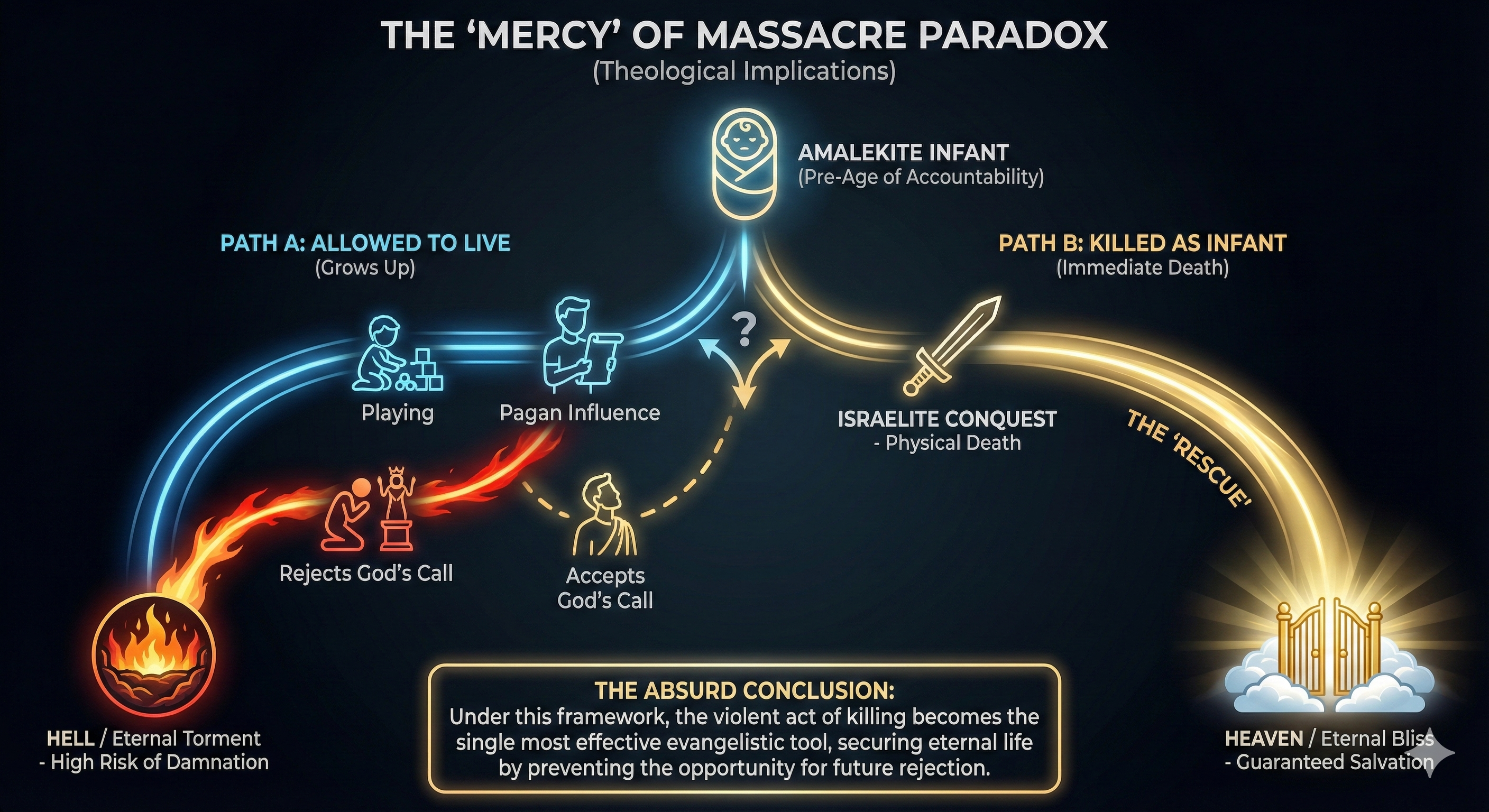
One of the most frequent defenses of biblical atrocities, such as the slaughter of the Amalekites in 1 Samuel 15, is the doctrine of the Age of Accountability. This theological construct suggests that God, in His mercy, does not impute sin to those incapable of understanding moral intent. Consequently, infants and young children who die are granted immediate entry into Heaven.
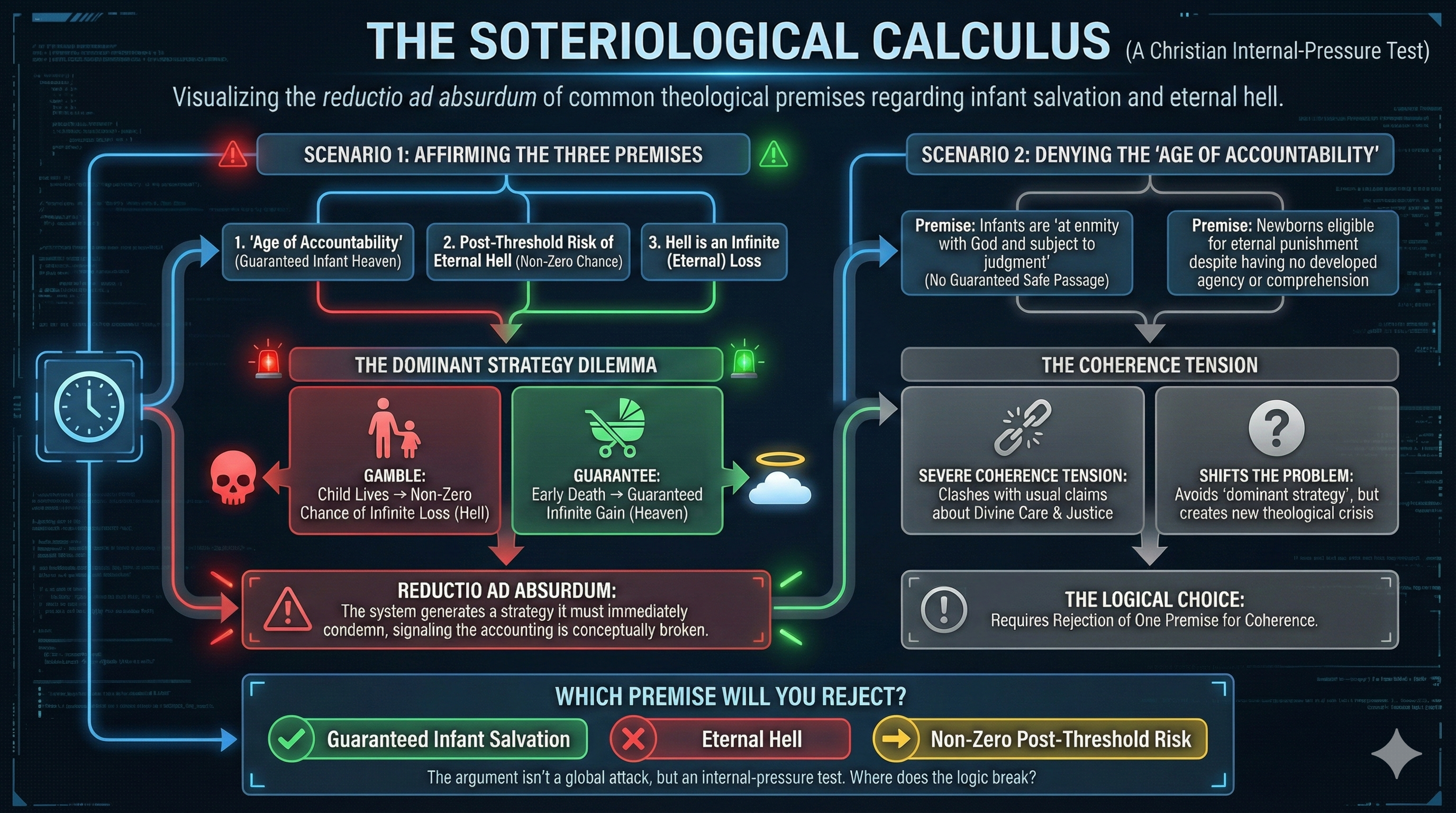
While this defense attempts to solve the moral problem of the massacre, it inadvertently creates a much larger logical problem. If we take the premises of conservative Christian soteriology seriously and subject them to a rigorous decision-theoretic analysis, we arrive at a horrifying conclusion: the most effective way to maximize human well-being is not evangelism, but infanticide.
Below is a formal derivation of this conclusion using Expected Utility Theory. This is a reductio ad absurdum designed to stress-test the theological framework.
1. The Axioms of the System
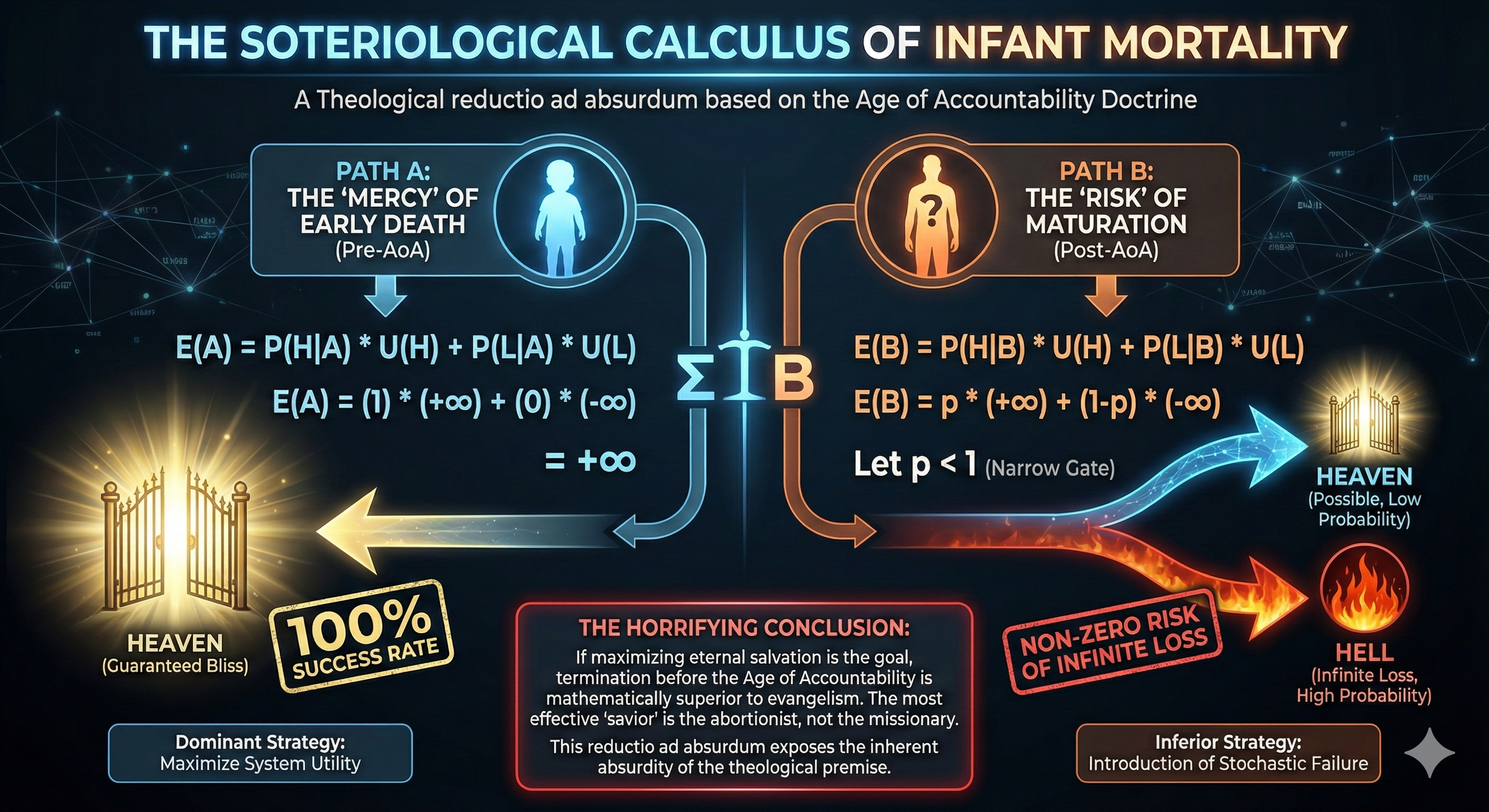
To perform this calculus, we must accept the standard evangelical premises regarding the afterlife and salvation.
Axiom 1: The Binary Destination Every human soul possesses an eternal trajectory that terminates in one of two states: Heaven (

Axiom 2: The Infinite Magnitude The utility (


Axiom 3: The Age of Accountability (AoA) Let 


Axiom 4: The Stochastic Nature of Adult Salvation For any subject allowing to live past 

2. The Utility Calculus
We must compare the Expected Utility (
Strategy A: Early Termination
If a subject dies before the Age of Accountability, the calculation is deterministic.

Substituting our axioms:


The outcome is the maximum possible positive value in the system.
Strategy B: Maturation
If the subject is allowed to grow into adulthood, the calculation becomes probabilistic. The subject now possesses free will and is subject to the influences of a fallen world.


Mathematically, mixing positive and negative infinities creates an undefined form, but in decision theory regarding Pascalian wagers, the presence of a non-zero probability of infinite loss (
Even if we were to cap the utility at a finite but massive number 


For Strategy B (Life) to be equal to Strategy A (Death), the probability

Since Christian theology affirms that 

3. The Aggregate Utility of Mass Termination
A common counter-argument is that killing is a sin, and therefore the agent performing the killing (The Killer) suffers negative utility. We must assess the Net System Utility (


Assume the Killer is fully aware of the theology and is willing to sacrifice their own soul for the greater good.
Scenario 1: The Killer Refrains (Passive) The Killer retains their salvation (assuming they are saved), but the
![U_{net1} = U(K_{H}) + \sum_{i=1}^{n} [p \cdot U(V_{Hi}) + (1-p) \cdot U(V_{Li})]](https://s0.wp.com/latex.php?latex=U_%7Bnet1%7D+%3D+U%28K_%7BH%7D%29+%2B+%5Csum_%7Bi%3D1%7D%5E%7Bn%7D+%5Bp+%5Ccdot+U%28V_%7BHi%7D%29+%2B+%281-p%29+%5Ccdot+U%28V_%7BLi%7D%29%5D&bg=ffffff&fg=000&s=0&c=20201002)
Scenario 2: The Killer Acts (Active) The Killer commits mass infanticide. The Killer is damned to Hell (murder), but the

If we look at the difference in saved souls:
In Scenario 1, the expected number of souls in Heaven is 
We can determine the break-even point where the Killer’s sacrifice is logically justified. The act is soteriologically efficient if:

Solving for


This inequality implies that as long as the Killer eliminates more than a handful of infants, the net gain in saved souls mathematically outweighs the loss of the Killer’s single soul.
If the probability 
4. Conclusion
Under the strict logic of the Age of Accountability, the Pro-Life position is soteriologically incoherent.
If the goal is the maximization of souls in Heaven, then the abortion doctor and the infanticidal maniac are the most productive evangelists in history. They achieve a 100 percent conversion rate, bypassing the messy inefficiency of free will and the high risk of apostasy.
By arguing that the slaughter of Amalekite children was a mercy because it sent them to Heaven, apologists unwittingly argue that life itself is a liability. They present a worldview where the greatest gift one can give a child is not a long life, but a quick death.
This calculus does not suggest we should kill children. Rather, it demonstrates that the theological premises used to defend biblical violence collapse into absurdity when applied consistently. If your theology implies that the hack of a sword on an infant body is a more effective savior than the loving adoption of that same infant into a loving family, you may want to shop around for a more coherent theology.
Andrea Yates
On June 20, 2001, in Houston, Texas, Yates drowned her five children (Noah, 7; John, 5; Paul, 4; Luke, 2; and Mary, 6 months) in the bathtub. Her primary motivation was a psychotic delusion centered on the “Age of Accountability.” She believed she was a bad mother and that her children were stumbling down a path of corruption that would lead them to Hell. By killing them before they reached the age of accountability, she believed she was ensuring their souls would go instantly to Heaven.
Below is a list of similar cases where a parent killed their children under the delusion of “saving” them, complying with a divine order, or preventing them from becoming evil (a phenomenon forensic psychiatrists often call “Altruistic Filicide”).
Women with Similar Religious/Salvation Motives
- Deanna Laney (2003): A Texas mother who stoned two of her sons to death and critically injured a third. She claimed God ordered her to do it as a test of faith, similar to Abraham and Isaac. She believed she and Andrea Yates were destined to be the “two witnesses” of the Apocalypse mentioned in the Book of Revelation.
- Dena Schlosser (2004): Also in Texas, Schlosser amputated the arms of her 10-month-old daughter, who died from the injuries. She told police she wanted to “give her baby to God.” She was found covered in blood, singing a Christian hymn (“He Touched Me”).
- Otty Sanchez (2009): A San Antonio mother who decapitated and mutilated her 3-week-old son. She told police the Devil was inside him and that she had to kill him to prevent the Apocalypse. She claimed she had to “eat his insides” to stop the demons from escaping.
- Zakieya Avery (2014): A Maryland mother (along with another woman, Monifa Sanford) who stabbed two of her children to death and injured two others. They believed the children were possessed by demons and identified themselves as “demon assassins.” Avery told investigators, “I’m glad the children are in heaven.”
- Angela Flores (2022): A Los Angeles mother who admitted to killing three of her children because she believed they were possessed by demons. She claimed she was “ridding them” of evil spirits.
- Lori Vallow (2019): Known as the “Doomsday Mom,” she was convicted of murdering her two children, Tylee and JJ. While her motive was complex and involved a cult-like belief system with her husband Chad Daybell, they believed the children had become “zombies”—dark spirits that had taken over their bodies—and that killing the body was the only way to release the trapped soul to Heaven.
- Lindsay Clancy (2023): A Massachusetts mother who strangled her three children. While her defense focuses heavily on severe postpartum psychosis and “voices,” media reports and experts have drawn parallels to Yates, noting the psychotic delusion that killing the children was the only way to “save” them from a terrifying fate or evil.
Notable Male Case (Same Motive)
- John List (1971): Although a father, his case is the most famous male example of this specific motive. He shot his mother, wife, and three children in New Jersey. In a letter to his pastor, he explained that he saw the world as too evil and feared his family was drifting away from their faith. He killed them to “save their souls” and ensure they would go to Heaven rather than risk losing their salvation later in life.
The video below offers a detailed look at the Andrea Yates case, explaining the specific “Age of Accountability” theology that drove her actions.
Andrea Yates: A Mother’s Madness
This video is relevant because it provides a comprehensive breakdown of Yates’ postpartum psychosis and the religious delusions that convinced her that killing her children was an act of mercy.
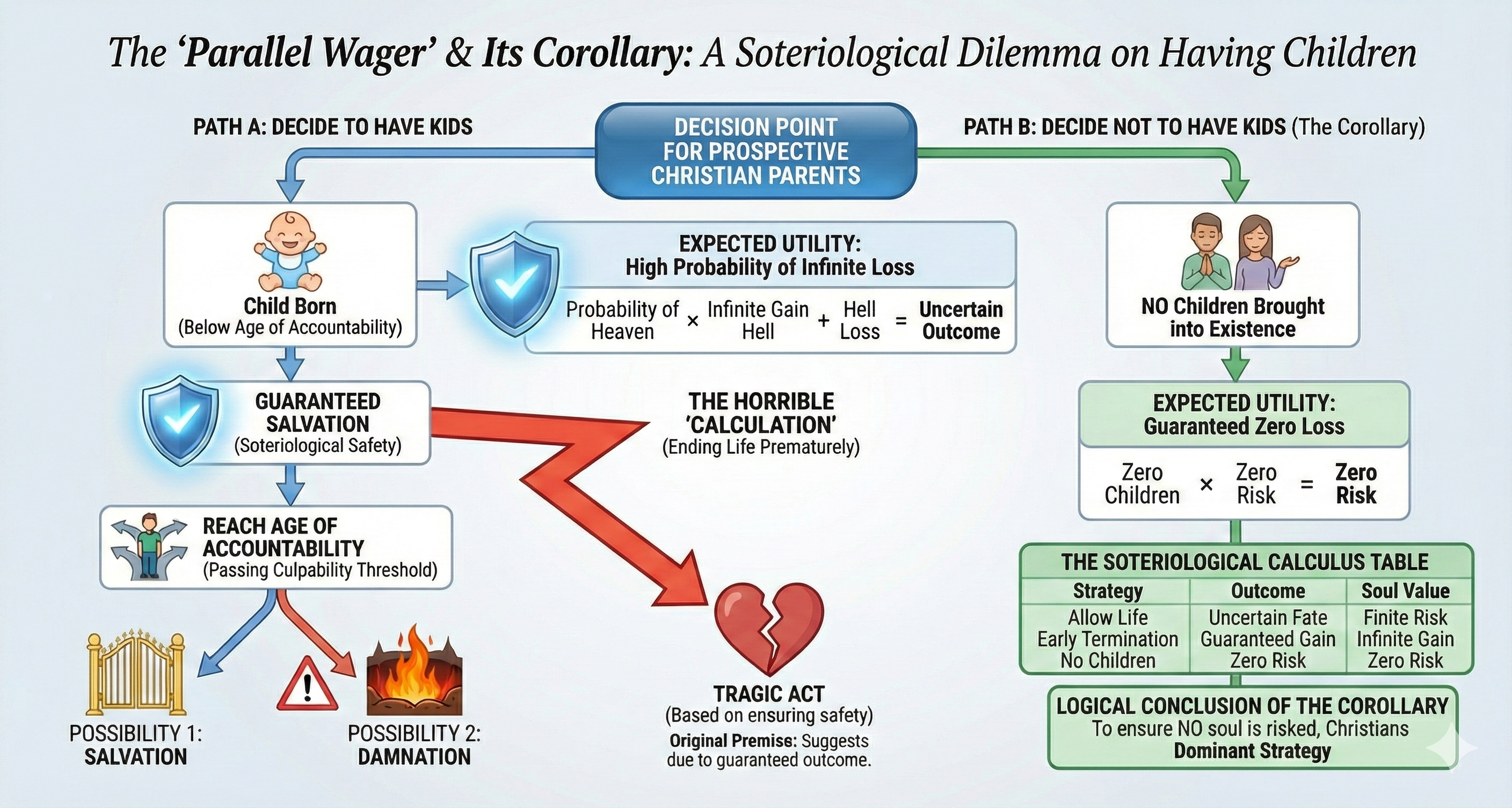
A corollary for Christian couples considering children:


 Free of Faith
Leave a comment