Each of the eight points is answered with an infographic.
Direct Challenge to Every Excuse That Keeps You From Jesus
People reject God for many reasons. Some sound intellectual. Some emotional. But Scripture tells us the real reason.
“People loved the darkness rather than the light because their deeds were evil.” (John 3:19)
At the core, excuses exist because the human heart does not want to surrender pride, autonomy, or sin.
So let’s be honest. What’s really stopping you?
EXCUSE #1: “There are too many religions. They all say different things.” Good observation. Now think.
By the law of non-contradiction:
Contradictory truth claims cannot all be true
They can all be wrong, or one can be right
They cannot all be right
World religions directly contradict each other about:
Who God is
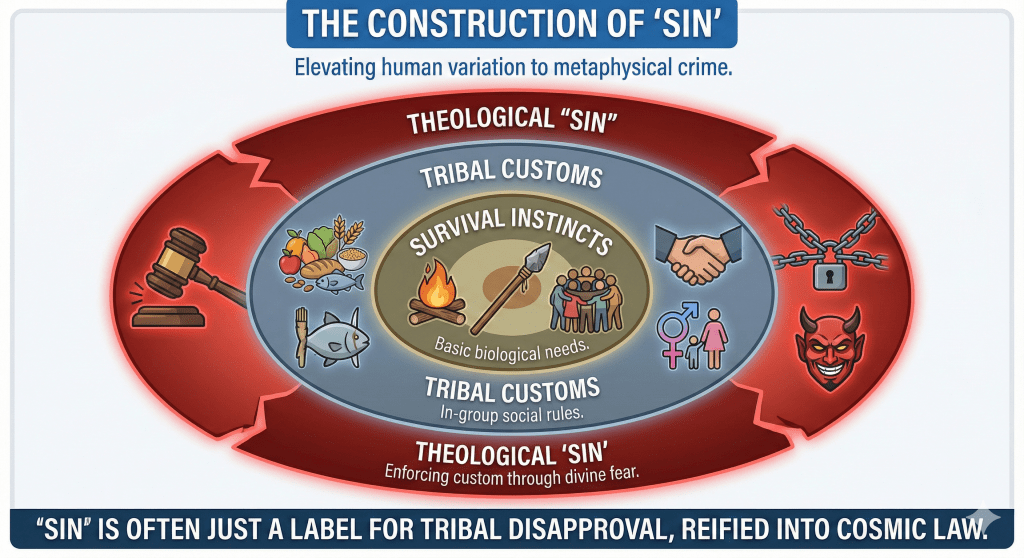
What sin is
How salvation works
Whether Jesus is God
So pluralism collapses logically.
Now ask the real question: Which worldview actually lines up with reality and history?
Christianity stands alone.
Over 2,000 fulfilled prophecies written centuries in advance
Over 25,000 archaeological discoveries confirming biblical history
A Messiah predicted in detail—birthplace, lineage, death, resurrection
A man who claimed to be God and predicted His own resurrection
A public execution under Rome
An empty tomb
Over 500 eyewitnesses over 40 days
Hostile witnesses unable to disprove it
Disciples who went to their deaths refusing to deny what they saw
The transformation of Jewish monotheists into worshipers of Jesus
Confirmation from non-Christian historians
False religions deny reality. Christianity explains it.
“I am the way, the truth, and the life.” (John 14:6)
You have no excuse.
EXCUSE #2: “There’s no proof for God.” That claim collapses the moment you think clearly.
Something cannot come from nothing
Nothing has no properties, no power, no potential
So something always was—the question is what
The universe did not create itself.
Every effect requires an adequate cause
Time, space, and matter came into existence together
Whatever caused them must be timeless, spaceless, immaterial, and powerful
That description fits God, not blind chance.
Order does not come from disorder.
Explosions do not create fine-tuned systems
Chaos does not produce laws
Laws of physics do not write themselves
Laws require a lawgiver.
Mathematical order is discovered, not invented
The constants of the universe are precisely tuned for life
Even slight changes would make life impossible
Life deepens the problem.
Life has never been observed coming from non-life
Chemistry does not explain consciousness
Biology runs on information, not just matter
DNA is a coded, programmed language.
Code is not material
Code contains instructions
Code always comes from intelligence
Every cell contains more information than entire libraries—and information only comes from a mind.
“In the beginning, God created the heavens and the earth.” (Genesis 1:1)
“He is before all things, and in Him all things hold together.” (Colossians 1:17)
“The heavens declare the glory of God.” (Psalm 19:1)
The issue isn’t lack of proof.
“They suppress the truth in unrighteousness.” (Romans 1:18)
You have no excuse.
EXCUSE #3: “God is against homosexuals.” This excuse misunderstands both sin and grace.
We are all born sinners (Romans 3:23)
Sin manifests itself in different ways
All sin is enslaving and addictive
No sin is morally neutral before a holy God
Homosexuality is not singled out because it is “worse.” It is named because it is sin, just like:
Lying
Stealing
Fornication
Adultery
Pornography
Greed
Pride
The Bible does not allow us to sugarcoat any sin. Love tells the truth.
Christ died for the ungodly, not the righteous (Romans 5:8)
We come to Jesus just as we are
But we do not stay as we are
Salvation always includes repentance.
“Repent therefore, and turn back, that your sins may be blotted out.” (Acts 3:19)
Repentance means:
Turning from sin
Turning to God
Surrendering pride, identity, and self-rule
Jesus said:
“If anyone would come after Me, let him deny himself, take up his cross, and follow Me.” (Luke 9:23)
“Whoever loses his life for My sake will find it.” (Matthew 16:25)
You come like a child, open-handed, saying: “Here is my life. I trust You. Do with me what You will.”
That is what you were made for:
To walk with God
To be His child
To grow daily in holiness and joy
You have no excuse.
EXCUSE #4: “I want to live my own way.” We all think this at first. It feels right—but it never satisfies.
Your way never brings lasting peace
Pleasure fades
Purpose disappears
Guilt remains
Death still comes
The Creator of the universe knows more than you do. The Creator of you knows why you exist.
God has put eternity in your heart (Ecclesiastes 3:11)
You were made for relationship with Him
Life will never make sense apart from Him
“Everyone who sins is a slave to sin.” (John 8:34)
What feels like freedom is actually bondage.
“If the Son sets you free, you will be free indeed.” (John 8:36)
You were created by God and for God. You will never be satisfied until that relationship is restored through Jesus Christ.
You have no excuse.
EXCUSE #5: “Christians are hypocrites.” This is one of the oldest excuses—and one of the weakest.
Hypocrites exist everywhere
Schools have hypocrites
Businesses have hypocrites
Governments have hypocrites
Why would you let hypocrites:
Keep you from God
Keep you from forgiveness
Keep you from eternal life
Even in a healthy church:
People are works in progress
The Holy Spirit convicts and changes them
Growth happens over time
A true church is:
A place to learn
A place to heal
A place to grow
A place to love one another
“By this all people will know that you are My disciples, if you have love for one another.” (John 13:35)
Don’t believe stereotypes planted in your mind. Ask God to lead you to a Bible-believing church. He will.
Jesus said, “Follow Me,” not “Follow perfect people.”
You have no excuse.
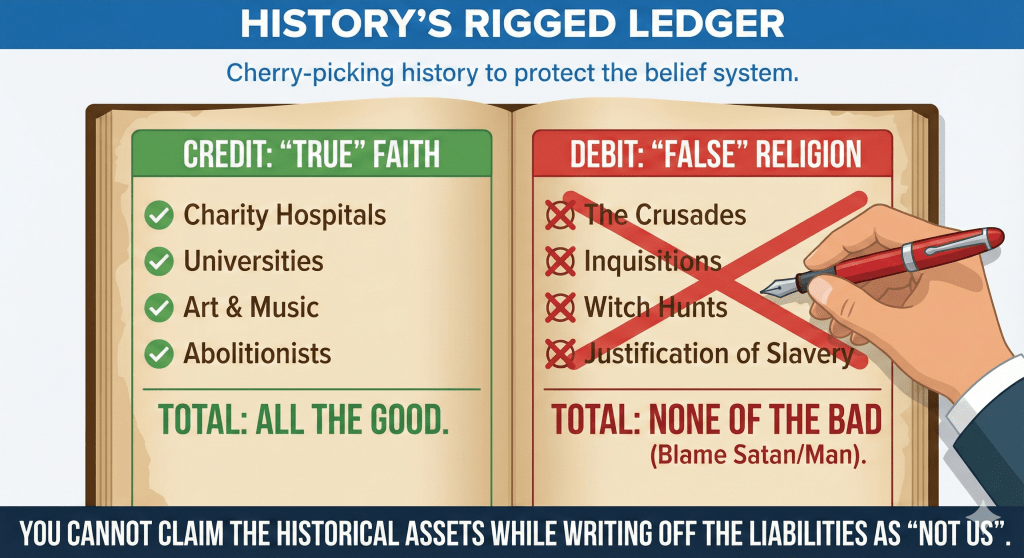
EXCUSE #6: “Horrible things were done in Jesus’ name.” This confuses false religion with true Christianity.
Satan is the father of lies
He creates cults and false religions
He twists Scripture for power and control
Many atrocities people blame on “Christianity” came from:
False systems
Power-hungry institutions
Religions that do not align with the Bible
Jesus said true believers would be known by:
Love
Humility
Obedience
Sacrificial service
“Love your enemies.” (Matthew 5:44)
Where Scripture is followed, violence is condemned. Where Scripture is twisted, evil follows.
Don’t reject Christ because of impostors. Judge Jesus by Jesus.
You have no excuse.
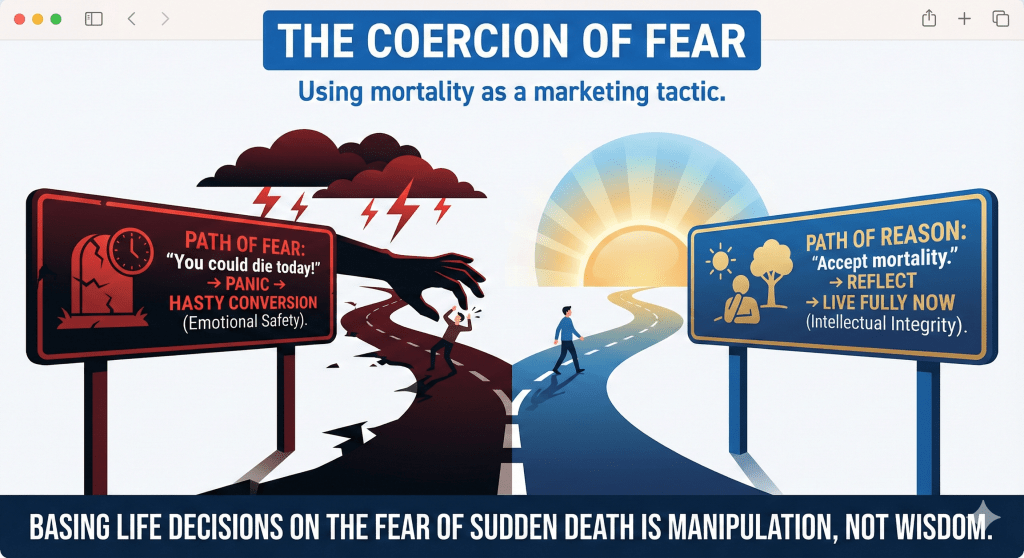
EXCUSE #7: “I’ll think about it later.” Later is not guaranteed.
You will die
Life is short
Accidents happen
Illness comes suddenly
Every moment you live apart from God:
Is wasted potential
Is lost purpose
Is stolen meaning
You were made to:
Serve God
Do good works prepared for you
Invest in what lasts forever
“It is appointed for man to die once, and after that comes judgment.” (Hebrews 9:27)
“Now is the day of salvation.” (2 Corinthians 6:2)
Delay is disobedience.
You have no excuse.
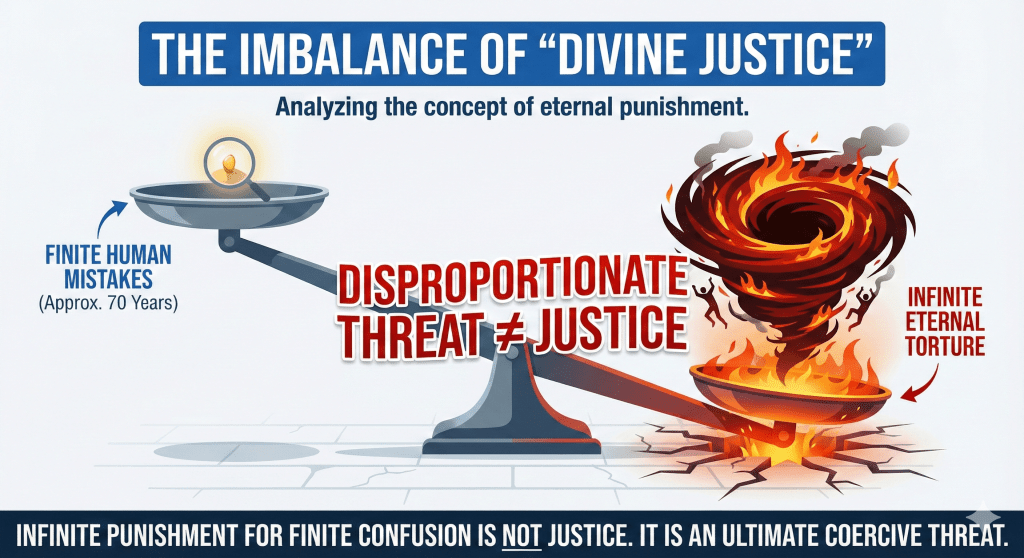
EXCUSE #8: “God wouldn’t send people to hell.” Hell is not God being cruel. Hell is God being just.
God is holy
Sin must be punished
One sin is enough to separate from God
God is also love.
He gives life
He gives joy
He gives sunlight and rain
He gives mercy even to rebels
But God is the source of all love and life. Separation from Him means:
Darkness
Emptiness
Eternal loss
That is what hell is.
And yet God did something astonishing.
God the Son became man
Took your punishment
Took hell in your place
Paid for every sin
“God purchased the church with His own blood.” (Acts 20:28)
In exchange:
Your sin for His righteousness
Your guilt for His forgiveness
Your emptiness for eternal life
Hell is not forced. It is chosen by rejecting Christ.
You have no excuse.
THE REAL ISSUE: THE HEART Let’s stop pretending.
You don’t want to repent
You don’t want to surrender
You don’t want God as Lord
“You will not come to Me that you may have life.” (John 5:40)
This is not intellectual. It’s moral and spiritual.
THE TRUTH: GOD CAME FOR YOU The Creator didn’t stay distant.
God became man
Took your punishment
Shed His own blood
Rose from the dead
“God purchased the church with His own blood.” (Acts 20:28)
God put eternity in your heart for a reason.
THE CALL: LORDSHIP SALVATION Jesus is not a suggestion. He is Lord.
“Deny yourself, take up your cross, and follow Me.” (Luke 9:23)
“Unless you believe that I AM, you will die in your sins.” (John 8:24)
“What does it profit a man to gain the world and lose his soul?” (Mark 8:36)
Until you are born again, you are wasting your life—because only what is done in God’s will lasts forever.
FINAL APPEAL Ask God to show you the truth. Ask Him to give you faith. Turn from sin. Surrender to Jesus Christ as Lord.
You can’t trust yourself. You can’t trust the world. But you can trust your Creator.
So… what’s your excuse now?
Click image to view larger version.
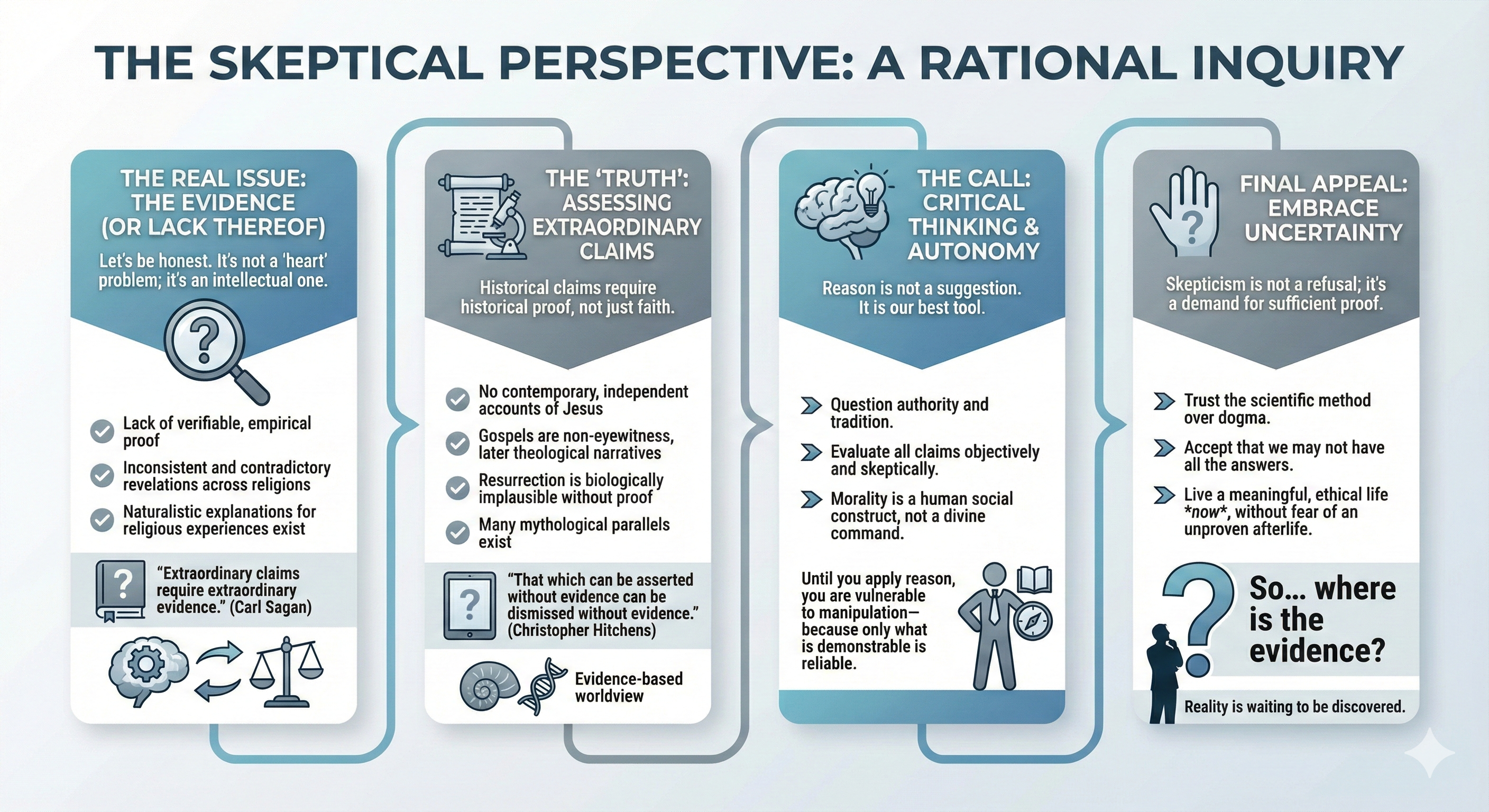
Core diagnosis: this is mostly rhetoric + assumption-loading, not argument
“Scripture tells us the real reason… ‘People loved the darkness…’ (John 3:19)… You have no excuse.”
✓ Begging the question: it treats the Bible as an authority before establishing that the Bible is a reliable authority. That’s circular for anyone not already inside the tradition. ✓ Mind-reading as a substitute for evidence: “you reject because you love darkness / don’t want to surrender” reduces diverse epistemic positions to a single psycho-spiritual motive. That’s not an argument; it’s a tactic that immunizes the claim from critique. ✓ Rhetorical coercion: “You have no excuse” is not a conclusion earned by premises; it’s a verdict declared in advance. It pressures assent rather than providing public, checkable support.
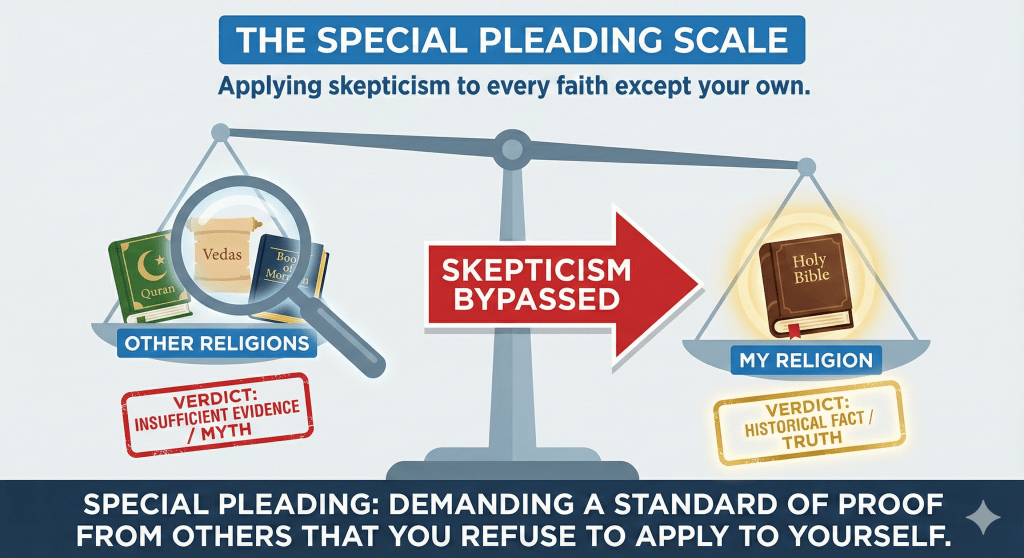
“Excuse #1: Too many religions” doesn’t get you to Christianity
“By the law of non-contradiction… pluralism collapses logically… Christianity stands alone.”
✓ Correct point, wrong landing: non-contradiction shows incompatible claims can’t all be true at once. It does not identify which one is true. ✓ False dilemma: “all wrong or one right” ignores hybrids (syncretism), partial overlap, non-literalism, different referents behind “God,” and cases where claims aren’t strictly contradictory. ✓ Self-undermining blind spot: Christianity itself contains major internal doctrinal divergence (atonement models, soteriology, ecclesiology, sacramental theology). That doesn’t refute Christianity, but it defeats the “pluralism collapses → therefore Christianity” leap.
The “2,000 prophecies / 25,000 discoveries” block is numbers-as-credibility theater
✓ No transparent ledger: the “~2,000 fulfilled prophecies” figure is widely repeated in apologetics, but typically without a standardized list, criteria, or method for adjudicating fulfillment (what counts as a prophecy, what counts as fulfillment, how ambiguity is handled). One prominent version of the claim appears in Hugh Ross’s Reasons to Believe piece (itself apologetic advocacy, not a neutral audit). (Reasons to Believe) ✓ Even pro-Christian audiences ask for the missing dataset: people explicitly go looking for a comprehensive prophecy analysis because the common figures circulate without a defensible inventory. (Christianity Stack Exchange) ✓ “25,000 archaeological discoveries” is similarly slogan-like: it shows up in popular apologetics materials, often alongside the Nelson Glueck quote, again typically without a catalog of “discoveries,” an operational definition, or peer-reviewed aggregation. (REASONED CASES FOR CHRIST) ✓ Category slippage risk: “25,000” is also a commonly cited figure for manuscript copies (textual transmission), which is a different category than archaeology—so the repetition of “25,000” functions more like a persuasive motif than an evidentially careful claim. (Rooted Ministry)
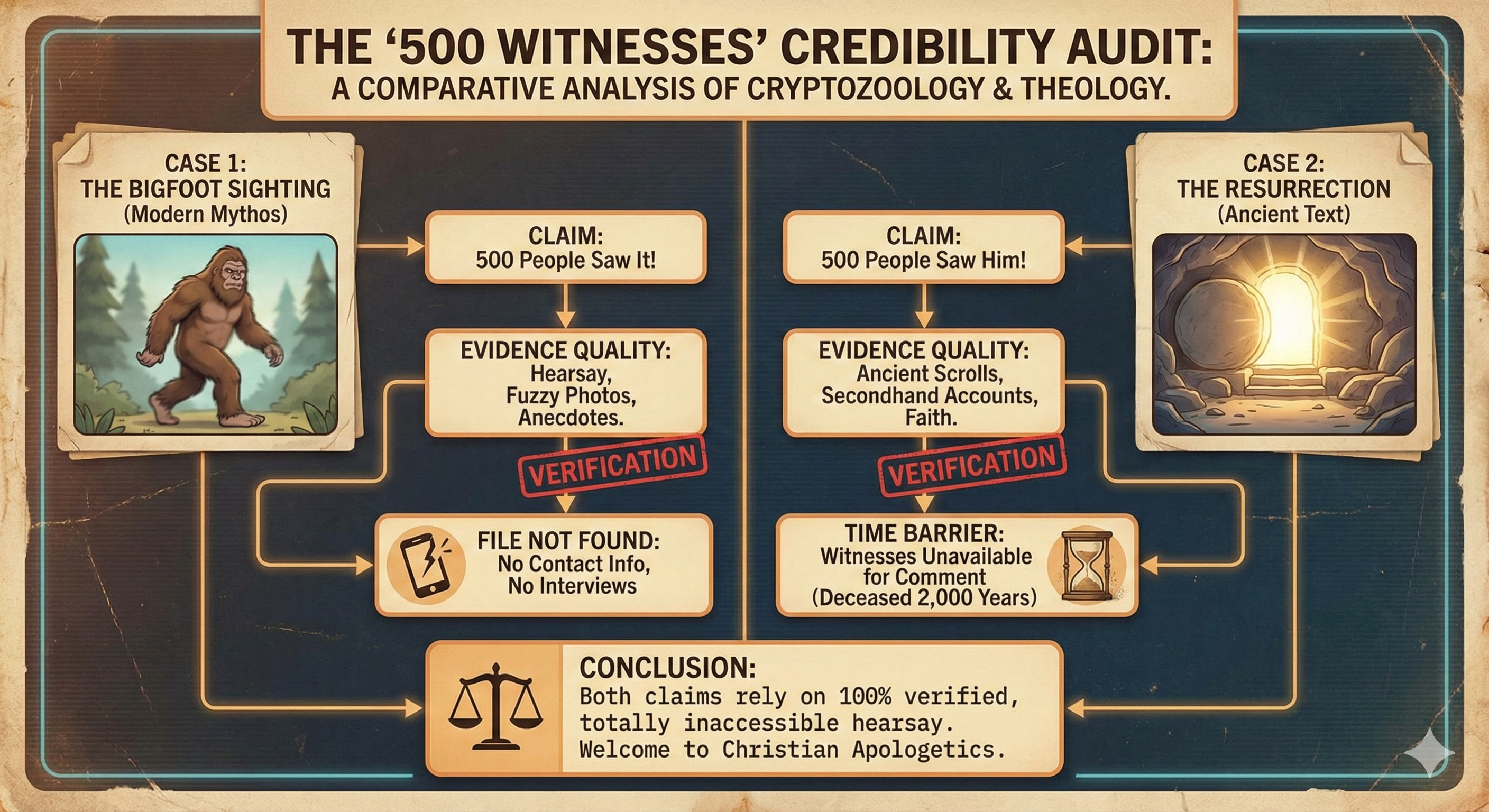
“Over 500 eyewitnesses” is not “we have 500 eyewitness testimonies”
“Over 500 eyewitnesses over 40 days… hostile witnesses unable to disprove it…”
✓ Textual claim ≠ independent testimony: what we have is Paul reporting that Jesus “appeared to more than five hundred” (1 Cor 15:6). That is not the same thing as 500 preserved depositions, names, interrogations, or cross-checkable reports. ✓ Serious critical scrutiny exists even among NT scholars: Bart Ehrman discusses the evidential gap between the tradition Paul reports and actual eyewitness evidence accessible to historians. (The Bart Ehrman Blog) ✓ “Hostile witnesses couldn’t disprove it” is asserted, not demonstrated: you’d need identified hostile sources, their arguments, and why they fail. The text offers none—just a confidence posture.
“Excuse #2: There’s no proof for God” relies on stacked equivocations
“Something cannot come from nothing… Every effect requires an adequate cause… Time, space, and matter came into existence together… Laws require a lawgiver.”
✓ Equivocation on “nothing”: in physics/cosmology talk, “nothing” often means “no classical matter,” not philosophical non-being. So “something can’t come from nothing” frequently attacks a straw target. A concise explainer of this common mismatch: “empty space” in quantum theory is not “nothing” in the philosophical sense. (The NESS) ✓ Overreach from “causality within spacetime” to “cause of spacetime”: “every effect requires a cause” is a principle learned inside the universe under its time-structure. Extending it to “before time” needs argument, not assertion. ✓ “Timeless, spaceless, immaterial, powerful” doesn’t uniquely pick your God: even if you granted a “first cause,” it doesn’t follow that it is triune, incarnational, resurrection-centric, scripture-authoring, or ethically/ritually aligned with any one denomination. ✓ “Laws require a lawgiver” is a metaphor smuggled in as ontology: many philosophers of science treat “laws” as descriptive regularities or model-based generalizations, not prescriptive commands that must be “issued.” Van Fraassen explicitly discusses how “law” talk can mislead by importing the “lawgiver” picture. (joelvelasco.net) ✓ Fine-tuning is a live debate, not a mic-drop: there are multiple competing explanatory frames (design, multiverse, necessity, selection effects). The Stanford Encyclopedia of Philosophy survey is a good map of why this is not settled by slogans. (plato.stanford.edu)
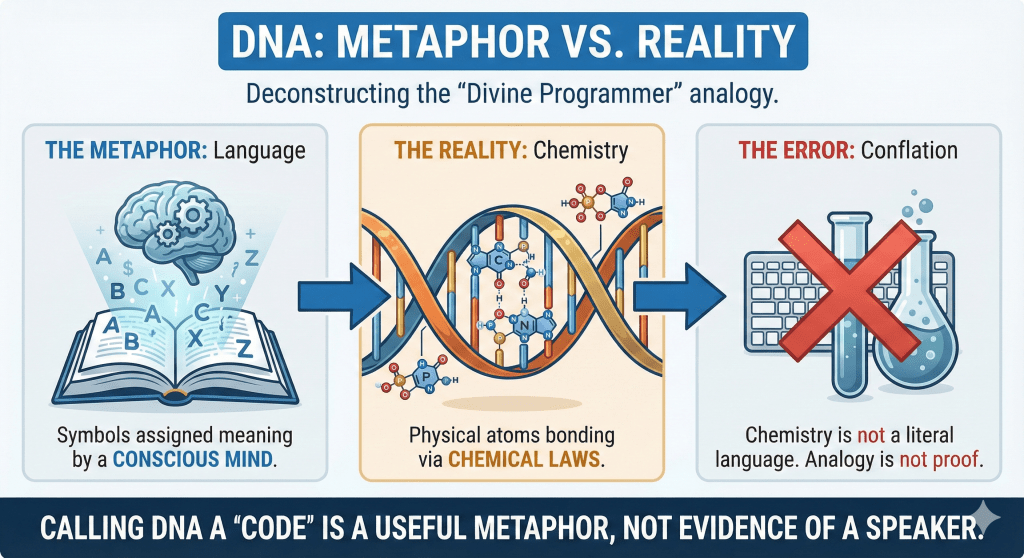
“DNA is a coded language, therefore a mind” treats metaphors as literals
“DNA is a coded, programmed language… Code always comes from intelligence… information only comes from a mind.”
✓ Metaphor-to-metaphysics fallacy: biologists and communicators use “code / information / language” as useful metaphors for explaining biochemical processes—not as a literal claim that DNA is a semantic language authored by an agent. (wired.com) ✓ “Information” is ambiguous: Shannon information (measurable uncertainty reduction) is not the same as semantic meaning. The argument slides between them to make “mind” feel mandatory. ✓ “Only minds make information” is empirically false under standard definitions: physical processes can increase, decrease, and transform Shannon information without any authoring mind; the interesting question is the origin of specific biological complexity, which this text doesn’t engage with at a technical level.
“Excuse #3: God is against homosexuals” is assumption-stacking + identity coercion
“No sin is neutral before a holy God… surrendering pride, identity, and self-rule…”
✓ It presupposes the very framework under dispute: “sin,” “holy God,” and “repentance” are treated as premises rather than conclusions. For a non-Christian reader, this is preaching, not persuasion. ✓ Conflation problem: placing sexual orientation alongside acts like lying/stealing blurs crucial distinctions (orientation vs behavior; harm-based vs non-harm-based categories). Even many Christians separate those. ✓ Practical upshot: the text frames “identity surrender” as the necessary entry fee, which predictably functions as social pressure rather than evidence-based reasoning—especially for people whose lived experience doesn’t fit the offered narrative.
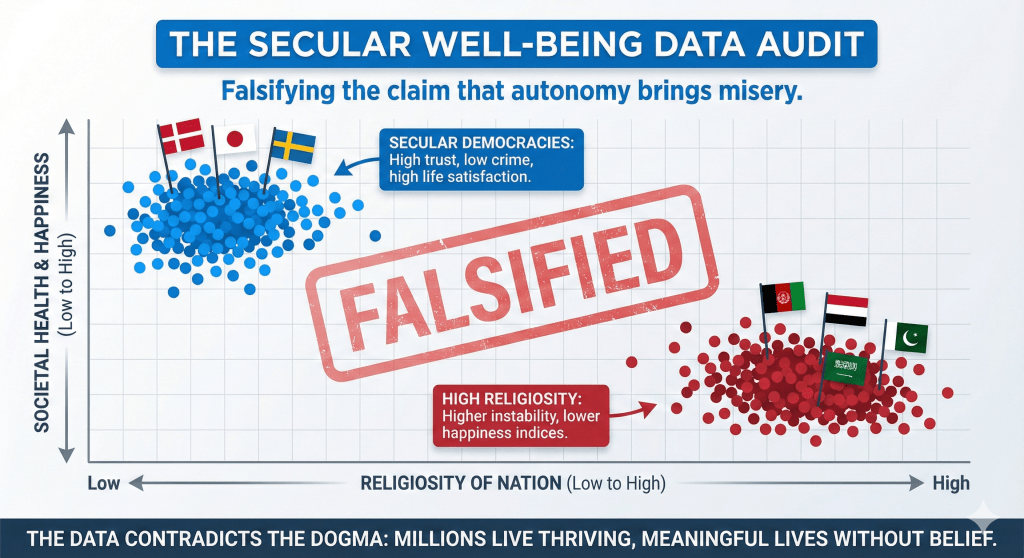
“Excuse #4: I want to live my own way” is another motive-attribution move
“It never satisfies… guilt remains… what feels like freedom is bondage.”
✓ Psychological universalizing: plenty of non-Christians report stable meaning, deep commitments, and improved well-being without Christian categories; plenty of Christians report guilt/anxiety because of certain doctrines. The claim is too global to be credible without data. ✓ Non-falsifiable framing: if someone says “I’m satisfied,” the script can always reply “you’re deceived / suppressing.” That’s not an evidential posture; it’s a closed loop.
“Excuse #5: Christians are hypocrites” minimizes what critics often mean
“Hypocrites exist everywhere… a true church is a place to heal…”
✓ Strawman: many critics mean not “some hypocrisy exists,” but “institutional abuse, cover-ups, manipulation, financial predation, or epistemic double standards.” “Hypocrites are everywhere” doesn’t touch those. ✓ Again, a directive replaces an argument: “Ask God to lead you…” assumes the conclusion (God exists, answers, guides) rather than establishing it.
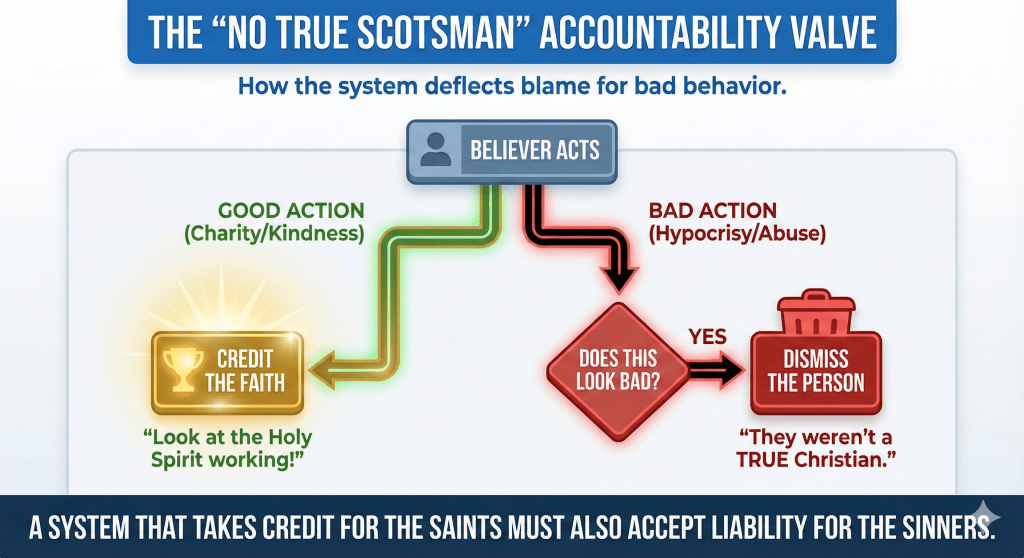
“Excuse #6: Horrible things were done in Jesus’ name” uses the No True Scotsman escape hatch
“That was false Christianity… Judge Jesus by Jesus.”
✓ Unfalsifiable boundary policing: if violence counts as “not real Christianity,” then Christianity is insulated from negative evidence by definition. You need principled criteria that don’t just track outcomes you like. ✓ Historical complexity ignored: many harms were justified by sincere believers using scripture, theology, and institutional authority. Hand-waving them as “impostors” dodges the real question: what interpretive constraints prevent recurrence?
“Excuse #7: I’ll think about it later” substitutes urgency for warrant
“Later is not guaranteed… Delay is disobedience.”
✓ Death-awareness ≠ evidence: the fact that life is short does not make a particular religion true. It only raises the stakes if the claims are already warranted. ✓ Manipulative structure: “act now or else” is common across mutually incompatible religions; it can’t function as a discriminator of truth.
“Excuse #8: God wouldn’t send people to hell” is a definitional re-labeling exercise
“Hell is God being just… One sin is enough… Hell is chosen.”
✓ “Just” is asserted, not defended: calling infinite punishment “just” doesn’t make it so; it requires an argument that connects finite human actions/limitations to infinite consequences. ✓ “Hell is chosen” hides coercive structure: if the options are “accept X on threat of infinite loss,” describing the outcome as “chosen” is rhetorically convenient but philosophically thin. ✓ Substitution claim needs coherence work: “God the Son took hell in your place” raises internal accounting questions (what exactly is transferred, how, and why is a finite event equal to infinite penalty) that the text simply declares solved.
“The real issue is the heart” is a conversation-stopper disguised as diagnosis
“This is not intellectual. It’s moral and spiritual.”
✓ Category erasure: people often disbelieve for plainly intellectual reasons (standards of evidence, conflicting claims, historical methods, the problem of divine hiddenness, etc.). Declaring it “not intellectual” is a way of refusing engagement. ✓ Predictable function: it makes disagreement itself count as evidence of bad character or bad motives—so the position becomes self-sealing.
A more rigorous version of what this could have been
✓ State the thesis without mind-reading: “Here are the reasons I think Christianity is more plausible than its competitors.” ✓ Separate claims by type: (a) cosmological arguments, (b) historical resurrection arguments, (c) experiential/pragmatic claims—each needs different standards of support. ✓ Provide auditable sources: if you claim “2,000 prophecies” or “25,000 discoveries,” link to the full list + criteria + counterexamples, and show how disputes are resolved. Right now it’s largely slogan repetition. (Reasons to Believe) ✓ Stop using “you have no excuse” as a substitute for warrant: if the case is strong, it can survive without verdict language.
Accompanying Symbolic Logic:
Symbol key in plain English
✓ B means the Bible as a source. ✓ Ch means the proposition Christianity is true. ✓ S(s,p) means source s asserts proposition p. ✓ R(s) means source s is reliable. ✓ W(p) means proposition p is warranted by publicly checkable support. ✓ Bel(x,p) means person x believes proposition p. ✓ MotiveDark(x) means person x rejects because of a dark motive. ✓ True(r) means religion r is true. ✓ Contradict(r1,r2) means the central claims of r1 and r2 are incompatible. ✓ U means the universe. ✓ Begins(y) means y began to exist. ✓ Cause(c,y) means c is an adequate cause of y. ✓ GodChristian(c) means c has distinctively Christian attributes.
The core circularity: biblical authority assumed to prove biblical authority
Annotation: This is the usual testimony rule being used implicitly: if a reliable source says something, then that thing is true.
Annotation: The apologetic posture treats scripture as asserting the Christian conclusion.
Annotation: To infer the Christian conclusion from scripture, the Bible’s reliability must already be in hand.
Annotation: A common move is to have scripture also testify to its own reliability.
Annotation: This shows the circularity: the reliability of scripture is required in order to infer the reliability of scripture from scripture.
Annotation: Scripture asserting the conclusion and asserting its own reliability does not by itself make the conclusion warranted for someone who is not already granting the reliability premise.
Motive attribution does not establish truth
Annotation: This formalizes the claim that nonbelief is caused by a corrupt motive rather than by evidential considerations.
Annotation: Even if every dissenter had a bad motive, that would not imply Christianity is true. Motives do not determine truth.
Annotation: The leap to “you have no excuse” requires additional premises about what evidence was available to each person and what counts as culpable nonbelief.
Non-contradiction blocks “all religions are true,” but does not select Christianity
Annotation: If at least two religions contradict, then not all of them can be true at the same time.
Annotation: From “not all are true,” it does not follow that Christianity is true. This is the classic invalid move from rejecting a conjunction to affirming one particular conjunct.
Annotation: Simple schema: from “not both” you cannot infer either one.
A first-cause style conclusion is underdetermined and does not yield the Christian God
Annotation: Even if you accept a causal principle and that the universe began, you only get that the universe has some cause.
Annotation: A cause of the universe does not automatically have distinctively Christian features such as incarnation, resurrection, or triune identity. Those require additional linking arguments.
Annotation: The cosmological line, even if granted, does not by itself entail the truth of Christianity.
Large-number claims without an auditable ledger do not generate warrant
Annotation: If a claim is warranted, there must exist some publicly checkable evidence for it.
Annotation: If the “two thousand prophecies” claim is asserted without a transparent, checkable dataset, it is not warranted by that assertion.
Annotation: Same point for the “twenty five thousand discoveries” claim.
Annotation: Reporting that there were many witnesses is not the same as providing independently checkable witness testimony.
The critique’s overall conclusion in one formal line
Annotation: When the main supports are circular, logically invalid, underdetermined, or evidentially un-audited, the conclusion Christianity is true is not warranted by the presented case.
Alvin Plantinga’s “Warrant” isn’t an epistemic upgrade; it’s a design for inaccuracy. My formal proof demonstrates that maximizing the binary status of “knowledge” forces a cognitive system to be less accurate than one simply tracking evidence. We must eliminate “knowledge” as a rigorous concept, replacing it with credencing—the honest pursuit…
This article critiques the stark gap between the New Testament’s unequivocal promises of answered prayer and their empirical failure. It examines the theological “bait-and-switch” where bold pulpit guarantees of supernatural intervention are neutralized by “creative hermeneutics” in small groups, transforming literal promises into unfalsifiable, psychological coping mechanisms through evasive logic…
This article characterizes theology as a “floating fortress”—internally coherent but isolated from empirical reality. It details how specific theological claims regarding prayer, miracles, and scientific facts fail verification tests. The argument posits that theology survives only through evasion tactics like redefinition and metaphor, functioning as a self-contained simulation rather than…
This post applies parsimony (Occam’s Razor) to evaluate Christian Theism. It contrasts naturalism’s high “inductive density” with the precarious “stack of unverified assumptions” required for Christian belief, such as a disembodied mind and omni-attributes. It argues that ad hoc explanations for divine hiddenness further erode the probability of theistic claims,…
Modern apologists argue that religious belief is a rational map of evidence, likening it to scientific frameworks. However, a deeper analysis reveals a stark contrast. While science adapts to reality through empirical testing and falsifiability, theology insulates belief from contradictory evidence. The theological system absorbs anomalies instead of yielding to…
This post critiques the concept of “childlike faith” in religion, arguing that it promotes an uncritical acceptance of beliefs without evidence. It highlights that while children naturally trust authority figures, this lack of skepticism can lead to false beliefs. The author emphasizes the importance of cognitive maturity and predictive power…
This analysis examines the agonizing moral conflict presented by the explicit biblical command to slaughter Amalekite infants in 1 Samuel 15:3. Written from a skeptical, moral non-realist perspective, it rigorously deconstructs the various apologetic strategies employed to defend this divine directive as “good.” The post critiques common evasions, such as…
Modern Christian apologetics claims faith is based on evidence, but this is contradicted by practices within the faith. Children are encouraged to accept beliefs uncritically, while adults seeking evidence face discouragement. The community rewards conformity over inquiry, using moral obligations to stifle skepticism. Thus, the belief system prioritizes preservation over…
In the realm of Christian apologetics, few topics generate as much palpable discomfort as the Old Testament narratives depicting divinely ordered genocide. While many believers prefer to gloss over these passages, serious apologists feel compelled to defend them. They must reconcile a God described as “perfect love” with a deity…
This post examines various conditions Christians often attach to prayer promises, transforming them into unfalsifiable claims. It highlights how these ‘failsafe’ mechanisms protect the belief system from scrutiny, allowing believers to reinterpret prayer outcomes either as successes or failures based on internal states or hidden conditions. This results in a…
In public discourse, labels such as “atheist,” “agnostic,” and “Christian” often oversimplify complex beliefs, leading to misunderstandings. These tags are low-resolution summaries that hinder rational discussions. Genuine inquiry requires moving beyond labels to assess individual credences and evidence. Understanding belief as a gradient reflects the nuances of thought, promoting clarity…
The featured argument, often employed in Christian apologetics, asserts that the universe’s intelligibility implies a divine mind. However, a meticulous examination reveals logical flaws, such as equivocation on “intelligible,” unsubstantiated jumps from observations to conclusions about authorship, and the failure to consider alternative explanations. Ultimately, while the universe exhibits structure…
The piece discusses how historical figures like Jesus and Alexander the Great undergo “legendary inflation,” where narratives evolve into more than mere history, shaped by cultural needs and societal functions. As communities invest meaning in these figures, their stories absorb mythical elements and motifs over time. This phenomenon illustrates how…
This post argues against extreme views in debates about the historical Jesus, emphasizing the distinction between the theological narrative shaped by scriptural interpretation and the existence of a human core. It maintains that while the Gospels serve theological purposes, they do not negate the likelihood of a historical figure, supported…
Hebrews 11:1 is often misquoted as a clear definition of faith, but its Greek origins reveal ambiguity. Different interpretations exist, leading to confusion in Christian discourse. Faith is described both as assurance and as evidence, contributing to semantic sloppiness. Consequently, discussions about faith lack clarity and rigor, oscillating between certitude…
This post emphasizes the importance of using AI as a tool for Christian apologetics rather than a replacement for personal discernment. It addresses common concerns among Christians about AI, advocating for its responsible application in improving reasoning, clarity, and theological accuracy. The article outlines various use cases for AI, such…
Hi Christopher, I just sent you a response by email. Cheers.
Dear Phil, I’ve been hanging onto Christianity out of fear for decades now. Back in college, I started doing some…
Thanks for another interesting piece (as usual). I might add that even the “flying” fortress theologians have tried to build…
Good insights! “William Philosophers” definitely refers to William of Ockham.
Given that I read a collection of Russell’s works on religion a few years ago, the reference to the teapot…
Alright, thanks for the insights. While I’ve read works on ethics and ethical theories (including some of Immanuel Kant’s more…
Hi J, I’m a moral non-realist. I hold that there are no legitimate moral obligations since a moral realm has…
Hi Phil: Apologies if this isn’t really related to skepticism, but I was wondering: What are your thoughts on the…
Has Juan considered the problems with divine command theory and could he address the following?: a.) What makes Christian versions…
Juan has been blocked. I ran out of both daylight and patience.A debriefing has been added above in the light…
Phil Stilwell
A Deep Dive into Common Faith-Based Concepts & Claims













 Free of Faith
Leave a comment