Hebrews 11:1 Doesn’t “Define Faith” — It Became a Slogan Because Christians Let It
Christians love to quote Hebrews 11:1 as if it cleanly defines “faith.” In actual practice, it functions more like a reusable semantic token: it gets treated as “evidence” when that’s rhetorically useful, and as “belief beyond evidence” when that’s socially convenient.
The predictable result is not just disagreement. It’s semantic sloppiness that makes serious conversation almost impossible, because the word faith keeps changing its job mid-sentence.
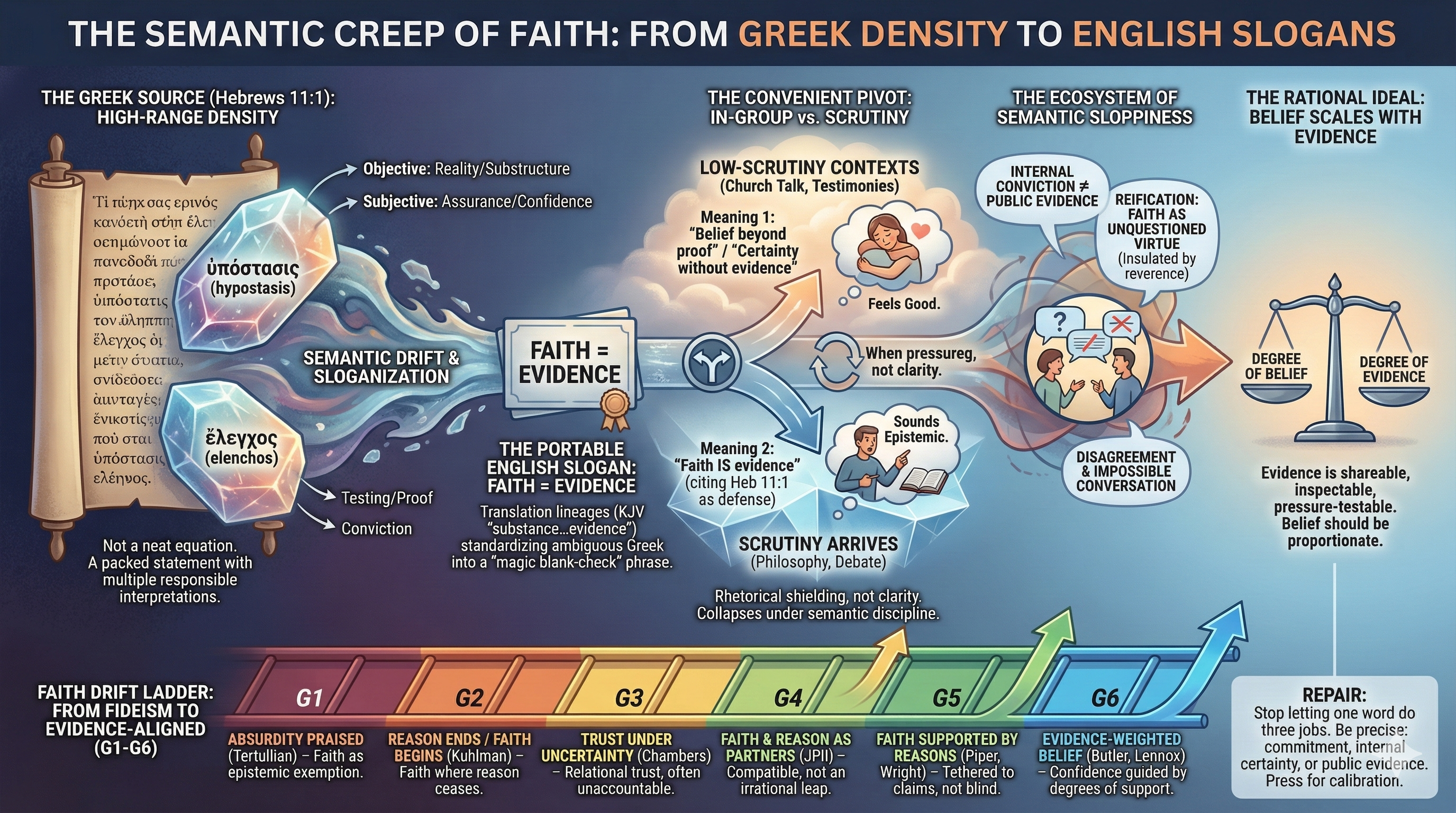
Here’s the one-screen drift map of what’s happening:
1) The Verse Is Built From High-Range Greek Words That Don’t Collapse Into One English Pair
✓ ὑπόστασις (hypostasis): can lean “objective” (reality/being/substructure) or “subjective” (assurance/confidence), depending on context. (Bible Gateway) ✓ ἔλεγχος (elenchos): in classical usage it can involve testing, cross-examination, and demonstrative proof; it can also land as “conviction” in later/interpretive renderings. (Scaife ATLAS)
So right out of the gate, Hebrews 11:1 is not a neat equation like:
faith = evidence
It’s a densely packed statement that can be responsibly unpacked in more than one direction.
2) Hebrews Itself Forces the Ambiguity: ὑπόστασις “Tilts” Two Ways Inside the Same Letter
This isn’t just a lexicon problem. Hebrews itself uses ὑπόστασις in contexts that pull differently:
✓ Hebrews 1:3 uses ὑπόστασις in an “essence/being” neighborhood (“character of his hypostasis”). (Bible Hub) ✓ Hebrews 3:14 uses ὑπόστασις in an “assurance/confidence” neighborhood (“hold fast the beginning of our hypostasis … firm to the end”). (Bible Hub)
One mainstream Catholic translation note flatly admits the situation: the author isn’t giving a precise definition, scholars dispute these terms, and the word normally means “substance/being” (1:3) or “reality” (3:14), but in 11:1 “connotes something more subjective.” (Bible Gateway)
So if someone says, “Hebrews 11:1 obviously means X,” that’s usually not scholarship. It’s wishful compression.
3) Translation Lineages Turned a Tense Greek Claim Into a Portable English Catchphrase
The semantic drift accelerates once the verse gets “standardized” into memorable English.
Here are the two big streams:
A) Latin → KJV stream (the slogan-friendly pairing) The Vulgate gives: substantia … argumentum (“substance … argument”). (Internet Sacred Text Archive) The KJV locks in: “substance … evidence.” (Bible Hub)
That pairing is sticky. It sounds like courtroom epistemology. It feels like “faith is evidence.”
B) Tyndale/modern stream (stance-language) Tyndale: “sure confidence … certainty.” (Bible Study Tools) NRSVue: “assurance … conviction,” while openly footnoting the ambiguity (“Or reality… Or evidence”). (Bible Gateway)
So now Christians inherit multiple “authorized” English faiths:
✓ faith-as-substance/evidence ✓ faith-as-confidence/certainty ✓ faith-as-assurance/conviction ✓ plus footnotes admitting the translators aren’t pretending it’s clean
And then the worst move happens: people treat whichever English rendering they grew up with as if it were the Greek.
4) Commentaries Didn’t Eliminate the Ambiguity — They Professionalized It
Once you hit commentary culture, the community’s meaning tends to settle into a few recurring “standardizer” interpretations:
✓ “basis/substructure/bedrock” (objective-leaning without claiming faith is a physical thing) ✓ “assurance/confidence” (subjective-leaning, perseverance and loyalty frame) ✓ “title deed/guarantee” (popular in sermons; sometimes promoted in study notes) (Blue Letter Bible)
But notice what did not happen: the verse did not become a stable, widely agreed “definition of faith.”
Even translation footnotes keep the dispute alive in plain sight. (Bible Gateway)
5) Where the Drift Gets Ugly: Common Christian Speech Slides Between Two Incompatible Senses
In everyday Christian conversation, “faith” usually defaults to one of two meanings:
✓ “Certitude even without evidence/proof.” ✓ “Trust grounded in reasons/evidence.”
The broader English language already recognizes that “faith” often implies certitude even where evidence is absent. (merriam-webster.com)
Christian apologetics organizations often push back and define faith as trusting what you have reason to believe is true. (Stand to Reason)
So you get a social ecosystem where both definitions circulate, and people don’t consistently notice when they swap them.
6) The Convenient Pivot: “Faith Means Belief Without Proof” Until Scrutiny Arrives
This is the recurring pattern:
✓ Low-scrutiny contexts (church talk, testimonies, in-group encouragement): “Faith means believing even when you can’t prove it.”
✓ Scrutiny fades: Back to “belief beyond proof” language.
That pivot works rhetorically, but it collapses as soon as anyone insists on basic semantic discipline.
Because “internal conviction” and “public evidence” are not the same kind of thing.
7) Reification: Faith Becomes an Intrinsically Praiseworthy Trait (Except in Other Religions)
Christian institutions don’t merely use faith; they routinely commend it as a virtue-trait. The Catholic Catechism, for example, explicitly calls faith “the theological virtue” by which one believes because God is truth. (vatican.va)
Once “faith” gets reified like that—treated as commendable in itself—it becomes insulated:
✓ If faith is praised as a virtue, it’s harder to evaluate whether it’s tracking reality. ✓ If other religions use the same posture, Christians often call it “blind faith.” ✓ When Christianity uses it, the same posture gets baptized as insight, humility, or spiritual maturity.
That is not careful reasoning. That is in-group semantics.
8) The Distance From a Rational Ideal: Belief Should Scale With Evidence
Here’s the clean contrast point you requested:
Rational belief is a degree of belief that maps to the degree of the relevant evidence.
That ideal forces clarity:
✓ Evidence is (at least in principle) shareable, inspectable, and pressure-testable. ✓ Conviction is a psychological stance that can be strong for good reasons, bad reasons, or no reasons. ✓ “Faith as conviction” may describe how a person feels. It does not automatically justify what a person claims.
Hebrews 11:1 might be gesturing at a lived posture of trust oriented toward unseen promises. But the modern rhetorical move—“faith is evidence”—often functions as a way to avoid evidence-proportionate belief while sounding like you’re doing epistemology.
9) A Simple Repair: Stop Letting One Word Do Three Jobs
If Christians want to talk coherently (and not merely win in-group applause), they can stop forcing Hebrews 11:1 to serve as a magic epistemic blank-check.
Here’s the repair in plain terms:
✓ If you mean commitment/loyalty: say that. ✓ If you mean internal certainty: say that. ✓ If you mean publicly checkable evidence: say that. ✓ Don’t slide between them depending on who’s listening.
And if someone insists that “faith is evidence,” the honest follow-up is:
What kind of evidence? Evidence for whom? Evidence under what methods of checking? Evidence that would still count if a rival religion produced the same feeling?
If those questions aren’t welcome, the phrase “faith is evidence” is functioning as rhetorical shielding, not clarity.
Closing
Hebrews 11:1 didn’t cause the confusion by itself. The verse is semantically rich and legitimately debated. The confusion comes from what Christians did next: they turned an ambiguous, high-density line of Greek into a slogan, treated the slogan as a definition, then used that “definition” opportunistically.
If faith is going to be discussed in intellectually serious contexts, it has to be kept tethered to semantic discipline and evidence-proportionate credence—not insulated by reverence, repetition, and convenient pivots.
✓ “prorsus credibile est, quia ineptum est.” — Tertullian Annotation: Faith is framed as creditable because it’s unfitting—a posture that treats ordinary plausibility checks as inverted. This sits far from evidence-proportionate credence and invites “faith” to function as an epistemic exemption.
✓ “certum est, quia impossibile.” — Tertullian Annotation: A maximal fideist posture: “impossible” is rhetorically upgraded into “certain.” If taken literally, it collapses the idea that contrary evidence should reduce confidence.
✓ “Reason is the greatest enemy that faith has…” — Martin Luther Annotation: Faith is cast as being in active tension with reason. This makes “faith” intrinsically praiseworthy because it resists scrutiny—precisely the drift that later gets defended via Hebrews 11:1 when challenged.
G2 — Reason ends / faith begins
✓ “Faith begins where reason and logic end.” — Kathryn Kuhlman Annotation: Faith is located after rational assessment stops. “Faith” becomes what you do when you’ve run out of rational traction, not what you do in proportion to support.
✓ “Faith begins where probabilities cease…” — George Müller Annotation: Faith is triggered by the absence of probability support. This is a softer version of G1: reason isn’t attacked, but it’s explicitly sidelined when it matters most.
✓ “I believe in order to understand.” — Anselm of Canterbury Annotation: Belief is epistemically prior; understanding is downstream. This easily turns into “commit first, interpret later,” which tends to immunize beliefs against correction.
G3 — Trust & obedience under uncertainty
✓ “Faith never knows where it is being led…” — Oswald Chambers Annotation: Faith is relational trust under incomplete information. This can be coherent if trust is grounded in warranted confidence in the guide, but it often drifts into “trust without accountability to evidence.”
✓ “Only he who believes is obedient…” — Dietrich Bonhoeffer Annotation: Faith is operationalized as obedience. This rung treats Hebrews 11 as a lived posture (acting without seeing outcomes), but it still doesn’t settle whether the claims deserve confidence.
✓ “He trusts in the unseen and in the invisible…” — C. H. Spurgeon Annotation: “Unseen” becomes the defining feature. This rung is where Hebrews 11:1 is most often used as an existential slogan—yet it can quietly slide into G1/G2 if “unseen” is treated as “evidence-free.”
G4 — Faith + reason as partners
✓ “Faith and reason are like two wings…” — John Paul II Annotation: Faith is positioned as compatible with rational inquiry. This is an institutional attempt to block the “faith-as-epistemic-pass” drift.
✓ “Our faith… is not an irrational leap…” — R. C. Sproul Annotation: Explicit rejection of the “leap” model. This rung requires clarity on what counts as justification, rather than letting Hebrews 11:1 do all the work.
✓ “Knowledge is indispensable to Christian life…” — John Stott Annotation: Cognitive accountability is affirmed. This pushes “faith” toward a reason-responsive posture rather than a virtue of believing-without-support.
G5 — Faith supported by reasons
✓ “I never said, ‘Just believe it anyway’…” — John Piper Annotation: A direct repudiation of G1/G2. The implication is that faith should not be deployed as a substitute for justification.
✓ “Faith… is not blind belief… (history & science).” — N. T. Wright Annotation: Faith is tethered to claims about the world (history/science). This pushes “faith” toward publicly discussable warrants—though it still leaves open how strong those warrants are.
✓ “Faith… goes beyond the evidence.” — Alister McGrath Annotation: The pivotal ambiguity: “beyond” can mean (a) not against evidence but extending past what’s strictly demonstrated, or (b) stepping past evidential constraints. This rung is where equivocation often enters: “evidence matters… but not enough to limit confidence.”
G6 — Evidence-weighted belief
✓ “Probability is the very guide of life.” — Joseph Butler Annotation: This most closely approximates evidence-proportionate credence. Confidence is guided by degrees of support, not by the perceived virtue of believing.
✓ “Don’t accept… if the weight of evidence is against it.” — C. S. Lewis Annotation: Evidence is allowed to be defeating—a crucial constraint. This blocks the common move where faith is praised for resisting counterevidence.
✓ “Faith… commitment based on evidence…” — John Lennox Annotation: Faith is explicitly reframed as commitment that is responsive to evidential considerations—closer to rational belief than to “faith as epistemic halo.”
How to use this ladder to prevent “Hebrews 11:1 equivocation”
✓ Ask the speaker to pick a rung: are they using “faith” as (G2) post-reason commitment, (G4) reason-compatible trust, or (G6) evidence-weighted belief? ✓ Don’t let them slide rungs mid-conversation: “Faith isn’t evidence” → “Faith IS evidence (Heb 11:1)” → “Faith is beyond proof anyway.” ✓ Force the key distinction: inner conviction vs publicly checkable support. Hebrews 11:1 can be read as describing a posture of trust, but that doesn’t automatically convert conviction into evidence. ✓ Press the calibration question: “If new contrary evidence appeared, would your confidence decrease? If not, you’re functionally in G1/G2 no matter what slogan you cite.”
Questions to locate a stance on the faith–evidence spectrum
A) Define your terms (force a stable meaning)
✓ When you say “faith,” do you mean (a) trust/commitment, (b) belief that a proposition is true, (c) loyalty/faithfulness, or (d) inner certainty?
✓ In one sentence, define “faith” without using the word “faith.”
✓ When you say “evidence,” do you mean (a) publicly checkable support, (b) personal experience, (c) testimony, (d) inner conviction, or (e) “what makes belief psychologically easier”?
✓ Do you treat “faith” as a virtue in itself, or as a stance that is only good when its object is true?
B) Calibration (does confidence track support?)
✓ Should confidence increase when supporting evidence increases?
✓ Should confidence decrease when counterevidence increases?
✓ Is there any possible observation or argument that would rationally reduce your confidence in your religion? If yes, name three examples.
✓ If nothing could reduce your confidence, what distinguishes your stance from “belief insulated from correction”?
✓ Do you think there’s ever a responsible reason to say, “I don’t know” about a central religious claim?
C) Thresholds (what “counts” as enough?)
✓ What minimum evidence threshold is needed before you should accept a major claim about reality (miracles, resurrection, revelation)?
✓ Does that threshold change depending on the stakes of the claim? If yes, how?
✓ Do extraordinary claims require stronger support than ordinary claims? If no, why not?
✓ What would be the difference between “I have enough reasons to trust” and “I have proof”?
D) Hebrews 11:1 diagnostic (do you treat conviction as evidence?)
✓ In Hebrews 11:1, do you read “evidence/conviction” as (a) inner conviction, (b) public proof, or (c) something else?
✓ Do you think faith itself is evidence, or that faith is a response to evidence?
✓ If faith is evidence, evidence for whom—only the believer, or also an outsider?
✓ If an outsider cannot evaluate it, in what sense is it “evidence” rather than “a feeling of certainty”?
E) The “convenient pivot” trap (prevent equivocation)
✓ In casual conversation, do you ever define faith as “believing without proof,” but in debate define it as “trust based on evidence”?
✓ If you switch definitions depending on context, which one is your considered view?
✓ Would you accept a rival religion making the same move—“my faith is evidence”—with equal legitimacy?
F) Comparative symmetry (apply your rule to others)
✓ If a Muslim says, “My faith is evidence,” do you regard that as a legitimate epistemic justification? Why or why not?
✓ If a Hindu claims “inner certainty” as proof of their tradition, does that count as evidence to you?
✓ If you reject their certainty as evidence, what makes yours different in principle rather than by identity-label?
✓ What rule would you propose that treats all religions equally before deciding which is true?
G) Experience claims (private certainty vs public warrant)
✓ Do you think religious experience is evidence? If yes, evidence of what exactly?
✓ How do you distinguish (a) genuine divine encounter from (b) psychological projection, social reinforcement, or coincidence?
✓ If two people report equally intense spiritual experiences pointing to incompatible religions, what should a rational observer conclude?
✓ Do you treat “peace,” “joy,” or “felt presence” as truth-indicators? If yes, how do you control for placebo and expectation effects?
H) Testimony and authority (how much weight do you assign?)
✓ What weight do you give to ancient testimony compared to contemporary testimony?
✓ How do you assess the reliability of miracle reports across cultures and eras?
✓ What would count as disconfirming evidence against a purported miracle?
✓ Do you treat the Bible/Church/Tradition as evidence, or as an authority that defines what counts as evidence?
I) Methods (what process do you trust to get truth?)
✓ Which method do you trust most: empirical investigation, historical reasoning, philosophical argument, inner experience, or authoritative revelation? Rank them.
✓ When methods conflict, which one wins—and why?
✓ Are you willing to submit religious claims to the same standards you use in non-religious claims (medicine, engineering, law)?
✓ If not, what justifies the exemption?
J) Falsifiability and risk (is there any exposure?)
✓ Can your core claims be shown false in principle?
✓ If not, what separates your claims from unfalsifiable narratives?
✓ Would you call it rational to be maximally confident in an unfalsifiable claim?
✓ Is there any cost to being wrong in your framework—and does that affect the evidence threshold?
K) Probability talk (do you allow degrees of belief?)
✓ On a 0–100 scale, what is your confidence that your religion is true?
✓ What specific evidence items moved you above 50%?
✓ What evidence items would move you down by 10 points? 30 points?
✓ Do you think it’s rational to hold 95–100% confidence without being able to specify what would reduce it?
L) Virtue reification (is believing praised independent of truth?)
✓ Do you praise “faith” even if it turns out the believer’s doctrine is false?
✓ Would you praise a person for “strong faith” in a false prophecy?
✓ Is “doubt” automatically a vice in your community? If yes, why?
✓ Do you think strong belief is intrinsically admirable, or only admirable when responsibly grounded?
M) Practical decision tests (how your rule behaves in real life)
✓ If a friend claimed God told them to stop medical treatment, would “faith” be a sufficient justification?
✓ If a pastor claimed a new revelation contradicting prior doctrine, what evidence would you demand?
✓ If a prophecy fails, do you reduce confidence, reinterpret, or compartmentalize?
✓ If you “reinterpret,” what prevents endless reinterpretation from protecting any claim?
N) Closing precision (lock their position)
✓ Give your best one-sentence principle connecting faith to evidence.
✓ Does your principle apply equally to all religions?
✓ Does your principle allow faith to be corrected by new information?
Which of the following ways of talking about “faith” do you consider proper, and which do you consider improper (and why)?
G1 — Absurdity praised / evidence inverted
❴ ❵ The fact that it sounds impossible is exactly why it takes real faith. ❴ ❵ If it made sense to reason, it wouldn’t be faith. ❴ ❵ God’s truth is meant to offend human logic—so I trust it more when it feels irrational.
G2 — Reason ends / faith begins
❴ ❵ Faith starts where reason stops. ❴ ❵ When you can’t find evidence, that’s when faith kicks in. ❴ ❵ If you had proof, you wouldn’t need faith.
G3 — Trust and commitment under uncertainty
❴ ❵ I don’t have all the answers, but I’m choosing to trust God anyway. ❴ ❵ Faith is moving forward even when the outcome isn’t visible yet. ❴ ❵ Faith is obedience when you can’t see the whole path.
G4 — Faith and reason as compatible
❴ ❵ Faith isn’t opposed to reason; it’s what you do with what reason can’t settle completely. ❴ ❵ Faith doesn’t fear questions—truth can handle scrutiny. ❴ ❵ My faith isn’t a substitute for thinking; it’s trust that can be examined.
G5 — Faith supported by reasons/evidence
❴ ❵ My faith is based on reasons—history, testimony, and cumulative evidence. ❴ ❵ Faith isn’t believing without evidence; it’s trusting what the evidence best supports. ❴ ❵ If the evidence turned strongly against my belief, my confidence should drop.
G6 — Evidence-weighted belief (credence calibrated to support)
❴ ❵ My confidence should match the strength of the evidence—no more, no less. ❴ ❵ It’s rational to have degrees of belief: some claims deserve high confidence, others deserve caution. ❴ ❵ If new information changes the balance of evidence, I should update what I believe and by how much.
Faith Tiers in Action: Prayer, Gambling, Investing
G1 — Absurdity praised / evidence inverted
🙏🏻 The more impossible it looks, the more confident I am that prayer will flip it. 🎲 If the odds look terrible, that’s exactly when I double down—because it “must” hit. 💰 If the market says it’s a terrible buy, that’s why I’m extra sure it’s the right one.
G2 — Reason ends / faith begins
🙏🏻 When there’s no reason to expect an answer, that’s when “real” prayer starts. 🎲 When the numbers don’t justify the bet, that’s when you play on “instinct.” 💰 When analysis can’t support it, that’s when you invest on “conviction.”
G3 — Trust & commitment under uncertainty
🙏🏻 I don’t know what will happen, but I’m praying and moving forward anyway. 🎲 I know it’s uncertain, but I’m placing a small bet and accepting the risk. 💰 I can’t see the full future, but I’m investing cautiously and staying patient.
G4 — Compatible with scrutiny
🙏🏻 Prayer shouldn’t fear questions—if it’s real, it can handle honest evaluation. 🎲 I’ll gamble only after checking the odds; feelings don’t outrank math. 💰 I invest with research, and I welcome critique of my thesis.
G5 — Supported by reasons/evidence
🙏🏻 I pray with specific reasons for confidence (track record, constraints, and outcomes), not just vibes. 🎲 I’ll place a bet only when the odds and information give me an edge. 💰 I invest because the fundamentals, valuation, and credible signals support the position.
🙏🏻 My confidence in prayer outcomes should scale with the strength of the relevant evidence—and update over time. 🎲 My stake size should match the expected value and uncertainty; new data changes my bet. 💰 My allocation should match the evidence and risk; as the evidence shifts, my position size shifts too.
Click image to view larger version.The Exclusivity of G5 and G6:
Why G5 and G6 cannot both be true (as governing norms)
The mutual exclusivity shows up as soon as G5 is treated in its common “threshold-to-certainty” form:
G5: “There is evidence/reasons for my claim, therefore my full-confidence faith is justified.”
G6: “Degree of belief must scale with degree of evidence.”
To formalize that conflict, define a simple evidential-strength model.
Vocabulary
= evidential support strength for proposition = rational credence (degree of belief) in = there exists nonzero support for
G5 as a tier-rule (threshold entitlement to certainty)
Interpretation: if there is any evidential support at all, full credence is warranted.
G6 as a tier-rule (calibration)
A minimal calibration rule is:
Interpretation: credence matches evidential strength (a deliberately strict version of “maps to”).
Non-degeneracy assumption (the world contains mixed-strength cases)
Interpretation: there exists at least one proposition that has some support but not decisive support.
Derivation of contradiction
(from )
Let such that . (existential instantiation)
. (from 2)
. (definition of from 3)
. (from and 4)
. (from )
. (from 5 and 6)
. (from 2)
. (from 7 and 8, contradiction)
Therefore:
Plain-English reading of the proof
If there exists any claim with “some but not decisive” evidential support, then a rule that says “any support justifies full certainty” cannot coexist with a rule that says “confidence must match evidential strength.” One forces ; the other forces .
Alvin Plantinga’s “Warrant” isn’t an epistemic upgrade; it’s a design for inaccuracy. My formal proof demonstrates that maximizing the binary status of “knowledge” forces a cognitive system to be less accurate than one simply tracking evidence. We must eliminate “knowledge” as a rigorous concept, replacing it with credencing—the honest pursuit…
This article critiques the stark gap between the New Testament’s unequivocal promises of answered prayer and their empirical failure. It examines the theological “bait-and-switch” where bold pulpit guarantees of supernatural intervention are neutralized by “creative hermeneutics” in small groups, transforming literal promises into unfalsifiable, psychological coping mechanisms through evasive logic…
This article characterizes theology as a “floating fortress”—internally coherent but isolated from empirical reality. It details how specific theological claims regarding prayer, miracles, and scientific facts fail verification tests. The argument posits that theology survives only through evasion tactics like redefinition and metaphor, functioning as a self-contained simulation rather than…
This post applies parsimony (Occam’s Razor) to evaluate Christian Theism. It contrasts naturalism’s high “inductive density” with the precarious “stack of unverified assumptions” required for Christian belief, such as a disembodied mind and omni-attributes. It argues that ad hoc explanations for divine hiddenness further erode the probability of theistic claims,…
Modern apologists argue that religious belief is a rational map of evidence, likening it to scientific frameworks. However, a deeper analysis reveals a stark contrast. While science adapts to reality through empirical testing and falsifiability, theology insulates belief from contradictory evidence. The theological system absorbs anomalies instead of yielding to…
This post critiques the concept of “childlike faith” in religion, arguing that it promotes an uncritical acceptance of beliefs without evidence. It highlights that while children naturally trust authority figures, this lack of skepticism can lead to false beliefs. The author emphasizes the importance of cognitive maturity and predictive power…
This analysis examines the agonizing moral conflict presented by the explicit biblical command to slaughter Amalekite infants in 1 Samuel 15:3. Written from a skeptical, moral non-realist perspective, it rigorously deconstructs the various apologetic strategies employed to defend this divine directive as “good.” The post critiques common evasions, such as…
Modern Christian apologetics claims faith is based on evidence, but this is contradicted by practices within the faith. Children are encouraged to accept beliefs uncritically, while adults seeking evidence face discouragement. The community rewards conformity over inquiry, using moral obligations to stifle skepticism. Thus, the belief system prioritizes preservation over…
In the realm of Christian apologetics, few topics generate as much palpable discomfort as the Old Testament narratives depicting divinely ordered genocide. While many believers prefer to gloss over these passages, serious apologists feel compelled to defend them. They must reconcile a God described as “perfect love” with a deity…
This post examines various conditions Christians often attach to prayer promises, transforming them into unfalsifiable claims. It highlights how these ‘failsafe’ mechanisms protect the belief system from scrutiny, allowing believers to reinterpret prayer outcomes either as successes or failures based on internal states or hidden conditions. This results in a…
In public discourse, labels such as “atheist,” “agnostic,” and “Christian” often oversimplify complex beliefs, leading to misunderstandings. These tags are low-resolution summaries that hinder rational discussions. Genuine inquiry requires moving beyond labels to assess individual credences and evidence. Understanding belief as a gradient reflects the nuances of thought, promoting clarity…
The featured argument, often employed in Christian apologetics, asserts that the universe’s intelligibility implies a divine mind. However, a meticulous examination reveals logical flaws, such as equivocation on “intelligible,” unsubstantiated jumps from observations to conclusions about authorship, and the failure to consider alternative explanations. Ultimately, while the universe exhibits structure…
The piece discusses how historical figures like Jesus and Alexander the Great undergo “legendary inflation,” where narratives evolve into more than mere history, shaped by cultural needs and societal functions. As communities invest meaning in these figures, their stories absorb mythical elements and motifs over time. This phenomenon illustrates how…
This post argues against extreme views in debates about the historical Jesus, emphasizing the distinction between the theological narrative shaped by scriptural interpretation and the existence of a human core. It maintains that while the Gospels serve theological purposes, they do not negate the likelihood of a historical figure, supported…
Hebrews 11:1 is often misquoted as a clear definition of faith, but its Greek origins reveal ambiguity. Different interpretations exist, leading to confusion in Christian discourse. Faith is described both as assurance and as evidence, contributing to semantic sloppiness. Consequently, discussions about faith lack clarity and rigor, oscillating between certitude…
This post emphasizes the importance of using AI as a tool for Christian apologetics rather than a replacement for personal discernment. It addresses common concerns among Christians about AI, advocating for its responsible application in improving reasoning, clarity, and theological accuracy. The article outlines various use cases for AI, such…
Hi Christopher, I just sent you a response by email. Cheers.
Dear Phil, I’ve been hanging onto Christianity out of fear for decades now. Back in college, I started doing some…
Thanks for another interesting piece (as usual). I might add that even the “flying” fortress theologians have tried to build…
Good insights! “William Philosophers” definitely refers to William of Ockham.
Given that I read a collection of Russell’s works on religion a few years ago, the reference to the teapot…
Alright, thanks for the insights. While I’ve read works on ethics and ethical theories (including some of Immanuel Kant’s more…
Hi J, I’m a moral non-realist. I hold that there are no legitimate moral obligations since a moral realm has…
Hi Phil: Apologies if this isn’t really related to skepticism, but I was wondering: What are your thoughts on the…
Has Juan considered the problems with divine command theory and could he address the following?: a.) What makes Christian versions…
Juan has been blocked. I ran out of both daylight and patience.A debriefing has been added above in the light…
Phil Stilwell
A Deep Dive into Common Faith-Based Concepts & Claims



= evidential support strength for proposition
= rational credence (degree of belief) in
= there exists nonzero support for

(from
)
such that
. (existential instantiation)
. (from 2)
. (definition of
from 3)
. (from
and 4)
. (from
)
. (from 5 and 6)
. (from 2)
. (from 7 and 8, contradiction)

.


 Free of Faith
Leave a comment