
How Biblical Promises Are Dissolved Into Metaphors
Preview:
Example:
When engaging with religious texts, a critical distinction must be made between overt metaphor and promise-shaped language. Overt metaphor, such as the statement “I am the door,” is easily categorized by the reader; the text itself signals a category shift where a literal interpretation is nonsensical. It is an identity statement with an obvious non-literal mapping.
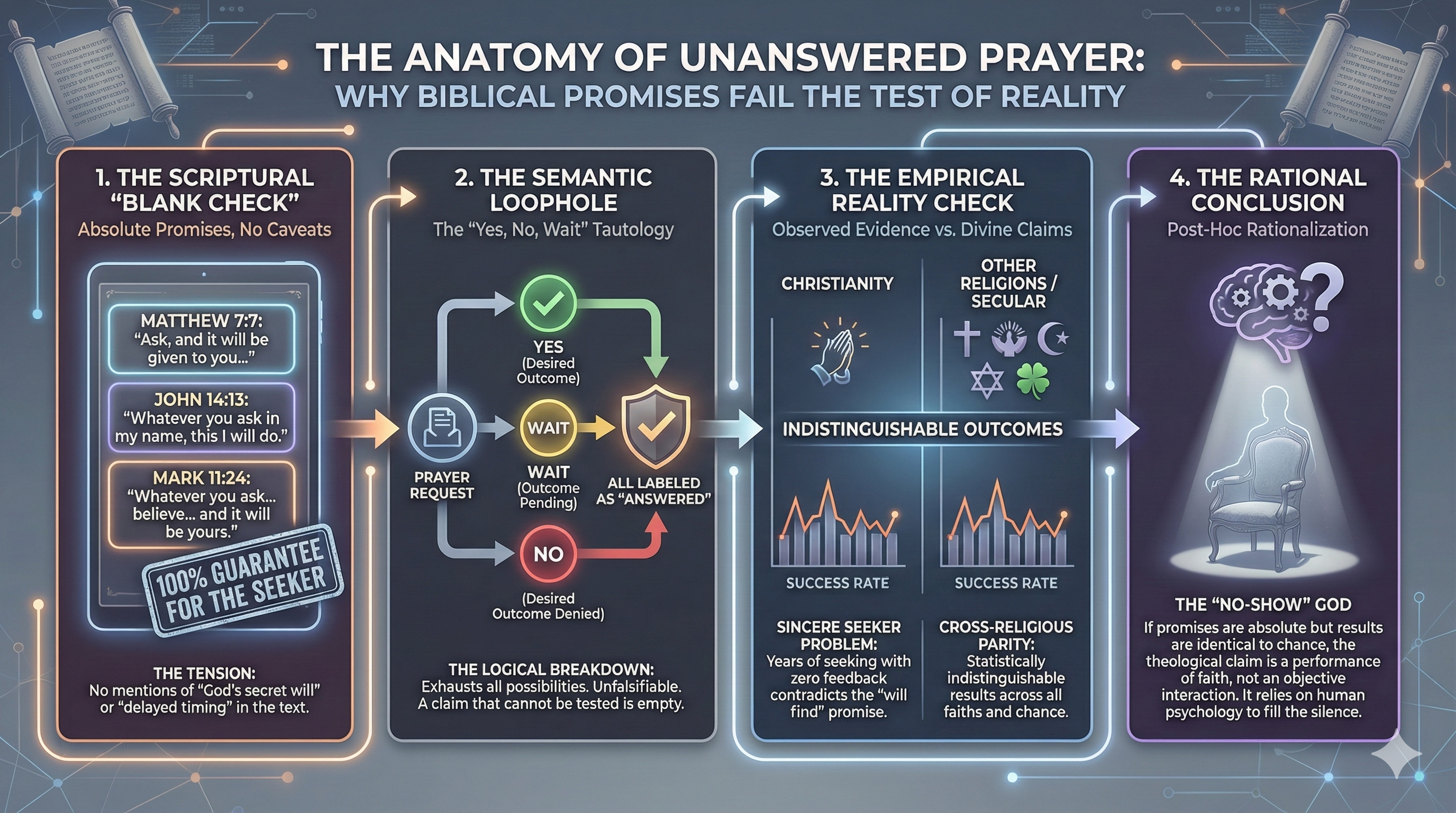
A significant hermeneutical issue arises, however, when passages framed as explicit promises collide with observational reality. When a text offers a directive followed by a stated result—for example, “ask and you will receive”—it presents itself as a claim about how reality behaves under specific conditions.
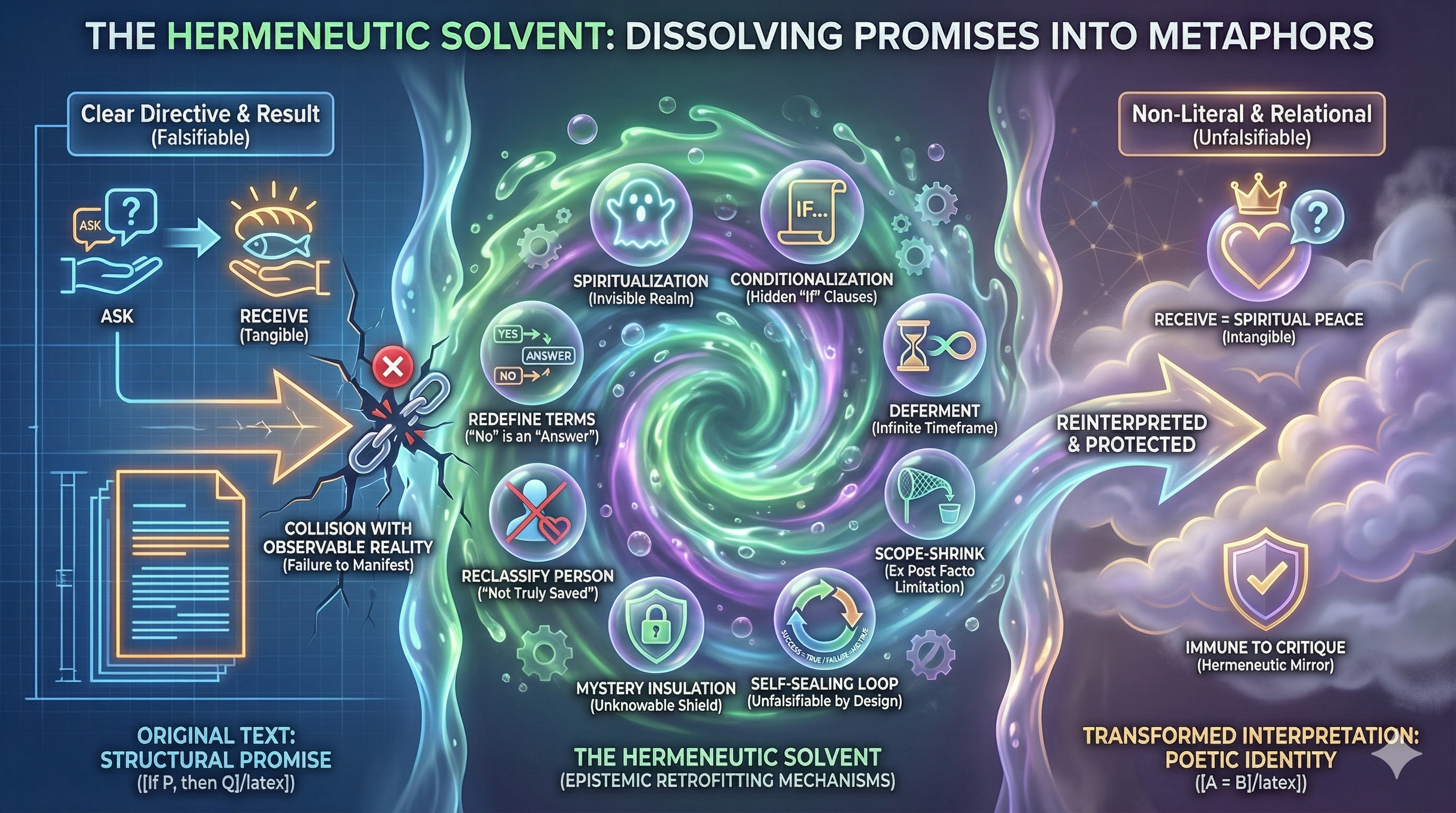
The problem emerges when these promise-shaped passages fail to materialize in observable experience. Rather than accepting the falsification of the claim, a specific interpretive method is often deployed. This method acts as a “hermeneutic solvent,” dissolving the structural integrity of the promise and recategorizing it as metaphor specifically to protect it from failure. This process is a form of epistemic retrofitting.
The Category Error
To understand this mechanic, we must distinguish between poetic identity statements and functional result structures using formal notation.
The Poetic Metaphor (Identity Statement)
This takes the form 
Example: “I am the vine.” Here, the predicates of 

The Structural Promise (Conditional Structure)
This takes the form If 

Example: Ask, and it will be given. This is conditional language signifying a causal or contractual claim. If condition
The hermeneutic error occurs when a proponent of the text treats the structure If
The Mechanics of the Solvent
This interpretive approach utilizes several mechanisms to insulate claims from reality, turning the text into a self-sealing belief system that cannot be falsified.
1. Spiritualization
This shifts the goalposts from the observable world to an invisible internal realm. A promise of provision is reinterpreted as “spiritual peace” rather than material needs. By moving the claim to an unsubstantiated, invisible reality, it mimics the absence of any tangible result.
2. Conditionalization and Inflation
This involves adding unstated requirements to the if clause. A simple If 
3. Semantic Redefinition
Key terms are redefined so that failure is linguistically impossible. If the word “answer” is redefined to include “no,” “wait,” or “invisible outcomes,” then a promise to answer every request becomes functionally identical to the statement “whatever happens, happens.” It loses all predictive power.
4. Chronological Deferment
The promised result
5. Identity Reclassification
This is a variation of the “No True Scotsman” fallacy. If a believer meets condition
6. Scope-Shrinking
Passages taught as universal principles are reclassified as being covenant-specific, era-specific, or limited only to apostles, only after they fail to manifest in the modern context.
7. The Mystery Insulation
When predictions fail, the system appeals to the unknowable “higher ways” of the deity. In any other field, an inability to explain why a prediction failed is a crisis of theory; here, it is used as a shield to avoid the demand for substantiation.
8. The Self-Sealing Loop
The culmination of these mechanics is a system unfalsifiable by design. If the event happens, the promise is fulfilled. If it does not happen, it is categorized as spiritual, delayed, conditional, or mysterious.
The Epistemic Collapse of the Text
When this hermeneutic is applied, the text ceases to be a source of clear commitments. It becomes a mirror that reflects the interpreter’s need to protect the ideology.
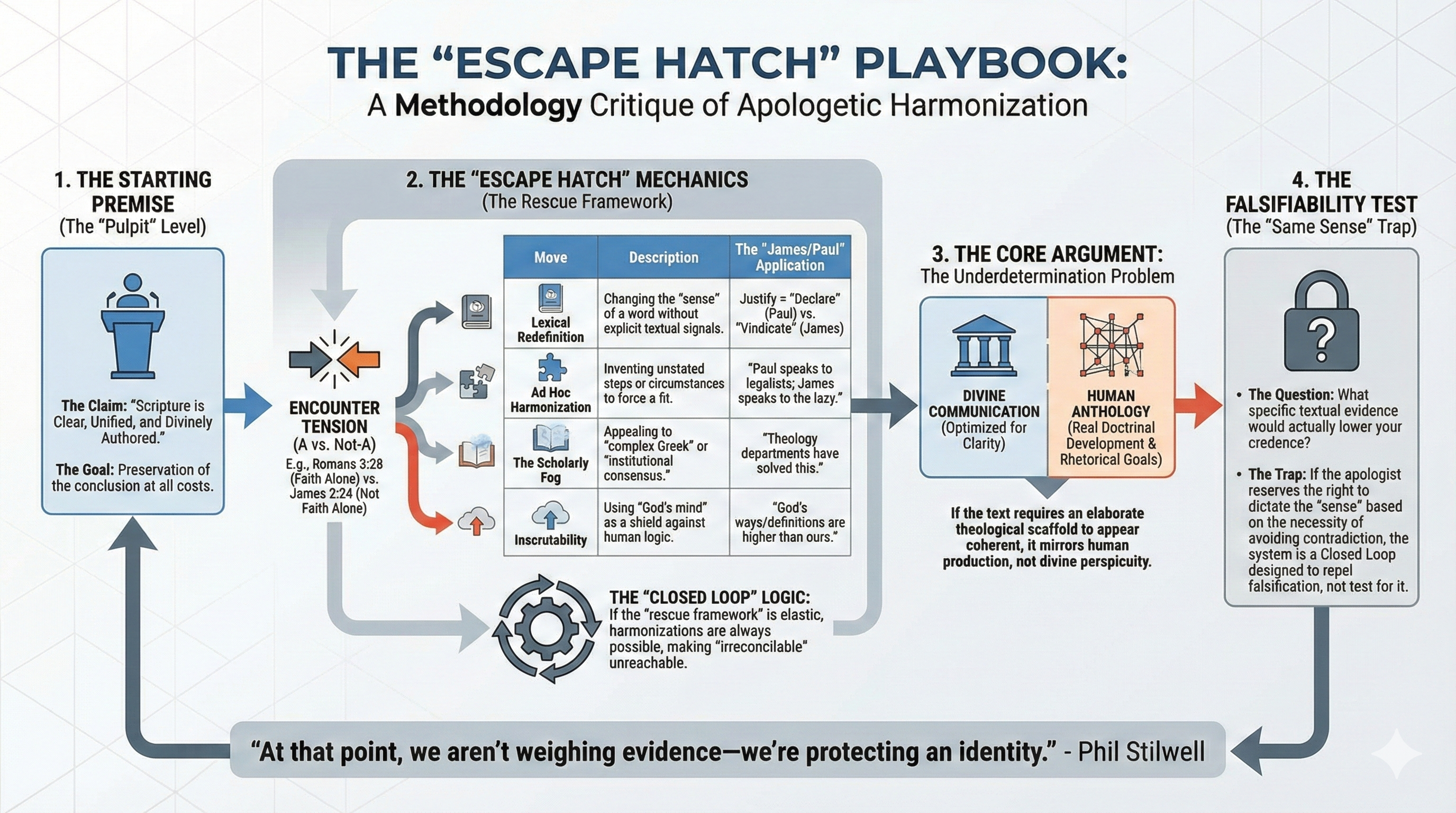
If “clear promise-language” can be reclassified as “not really a promise” after the fact, then nothing within the text is safe from reinterpretation. A text interpreted in a way that ensures it can never be wrong has lost its communicative value. It no longer conveys information or commitment; it merely demands submission to an ever-shifting interpretive authority. If a claim cannot meaningfully fail, it cannot meaningfully promise anything at all.


 Free of Faith
Leave a comment