
The Anatomy of the “Failsafe” Promise
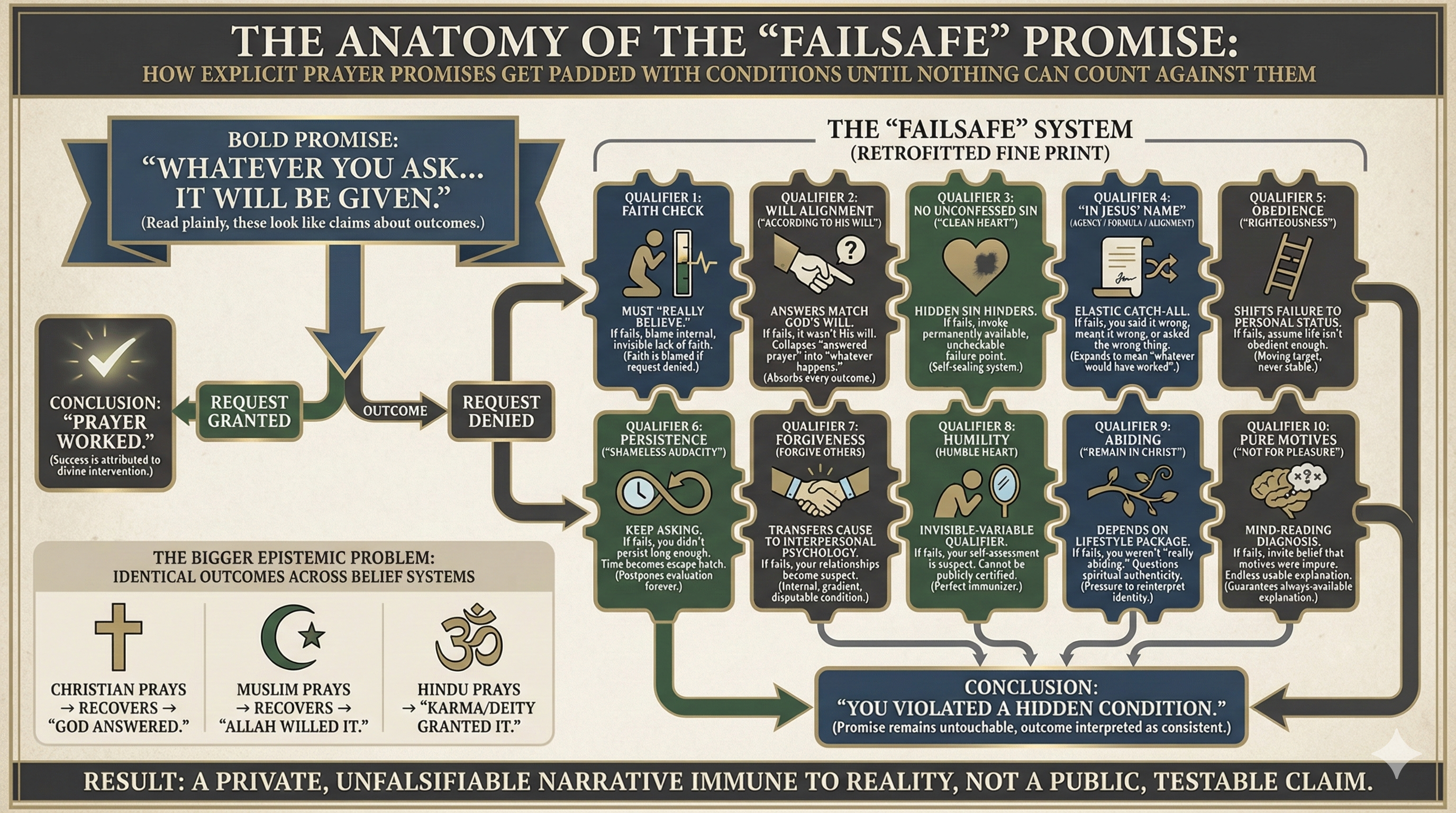
How explicit prayer promises get padded with conditions until nothing can count against them
Christians often quote prayer passages as if they’re straightforward commitments about how reality will behave:
✓ “Ask… and it will be given.” (Matthew 7:7)
✓ “Whatever you ask in my name, I will do it.” (John 14:13)
✓ “Whatever you ask… believe… and it will be yours.” (Mark 11:24)
✓ “If you abide in me… ask whatever you wish…” (John 15:7)
Read plainly, these are not “maybe” statements. They look like claims about outcomes.
But then the world does what it does: illnesses progress, jobs don’t appear, relationships collapse, tragedies land on the doorstep of people who prayed hard. And when that happens, a common defense isn’t to say, “Well, the text overstated the case.” Instead, the promise gets fitted with a “failsafe” system: a set of qualifiers that can always be invoked after the fact.
The result is a kind of rhetorical machine:
If the request is granted → prayer worked.
If the request is denied → you violated one (or more) hidden conditions.
That’s not a trivial tweak. It changes prayer from a public, testable claim into a private, unfalsifiable narrative.
Below are 10 qualifiers Christians commonly add—explicitly or implicitly—to “whatever you ask” promises, and how each one functions as an escape hatch.
The “failsafe mechanism” in one sentence
◉ A bold promise is offered (“whatever you ask”), then retrofitted with “fine print” so that every possible outcome can be interpreted as consistent with the promise.
Qualifier 1) Faith check
What it means: You must “really believe,” with minimal doubt—sometimes framed as certainty, sometimes as right kind of faith.
How it works as a failsafe: If the request fails, the explanation becomes internal and invisible: you didn’t believe enough. That shifts the claim from “God answers” to “God answers when your inner state meets an unmeasurable threshold.”
The hidden move: Faith becomes a sliding scale with no disclosed cutoff. You’re never allowed to say, “I met the condition.” The condition is always contestable after the outcome.
Why it blocks falsification:
✓ If you get what you want, faith is credited.
✓ If you don’t, faith is blamed.
Either way, the claim survives untouched.
What a test would require (but usually isn’t allowed): A clear operational definition like “faith = X” and a threshold like “faith above Y yields Z outcomes more often than baseline.”
Questions that force clarity:
✓ “How would we tell the difference between insufficient faith and a promise that simply isn’t reliable?”
✓ “What would count as a case where someone did meet the faith condition but still didn’t receive the outcome?”
Qualifier 2) Will alignment (“according to His will”)
What it means: God answers prayers that match God’s will. If it doesn’t happen, it wasn’t his will.
How it works as a failsafe: This one is the ultimate absorber because it’s compatible with every outcome. If you receive it, it was his will. If you don’t, it wasn’t.
The tautology problem:
Prayer request → filter: “according to his will” → outcome → conclusion: “his will was done.”
That collapses “answered prayer” into “whatever happens.”
What this changes: The promise becomes psychologically comforting rather than causally informative. It stops being “ask and receive” and becomes “ask, and then accept what happens.”
Why it blocks falsification:
✓ No possible result can count against it, because the result defines the will after the fact.
Questions that force clarity:
✓ “How do you distinguish ‘God did it’ from ‘this is what happened anyway’?”
✓ “If ‘God’s will’ always explains everything, what predictive content does the prayer promise actually have?”
Qualifier 3) No unconfessed sin (“clean heart”)
What it means: If there’s hidden sin, prayer is hindered; you need confession/repentance to restore “access.”
How it works as a failsafe: It introduces a permanently available, uncheckable failure point: maybe you forgot something, maybe you don’t see your own sin, maybe you’re deceived.
The hidden move: The system becomes self-sealing. If nothing happens, that fact itself can be used as evidence that something is wrong with you.
Why it blocks falsification:
✓ The condition can never be conclusively satisfied, because you can never prove you’ve confessed everything or that your repentance was “real enough.”
Questions that force clarity:
✓ “What would it look like to meet this condition in a way that can’t be retroactively denied?”
✓ “If unconfessed sin can always be invoked, isn’t the promise functionally void?”
Qualifier 4) “In Jesus’ name” (agency / formula / alignment)
What it means: You must pray “in Jesus’ name,” sometimes treated as a literal phrase, sometimes as “on his authority,” sometimes as alignment with his mission.
How it works as a failsafe: It creates interpretive wiggle room in three different ways:
✓ If you didn’t say the phrase, you “did it wrong.”
✓ If you did say it, maybe you didn’t mean it rightly.
✓ If you meant it rightly, maybe your request wasn’t the kind of thing Jesus would endorse.
The hidden move: A simple textual condition becomes an elastic catch-all. The more it fails, the more “in Jesus’ name” expands to mean “whatever would have worked.”
Questions that force clarity:
✓ “Is this a phrase requirement, an intention requirement, or a content requirement?”
✓ “Can you give three concrete examples of prayers that definitely qualify as ‘in Jesus’ name’—and how you know?”
Qualifier 5) Obedience (“righteousness”)
What it means: Obedience matters; the disobedient are “blocked,” while the obedient have “power.”
How it works as a failsafe: It shifts failure to personal status: if the outcome doesn’t arrive, you’re invited to assume your life is not obedient enough—often without specifying what level is required.
The hidden move: It installs a moving target: “obedience” can always be tightened after a failure. If you obeyed in the big things, the focus shifts to “small compromises.” If you cleaned those up, the focus shifts to “heart posture.”
Why it blocks falsification:
✓ You can never establish a stable class of “qualified obedient pray-ers” whose unmet requests would count against the promise.
Questions that force clarity:
✓ “What level of obedience is required, and where is that threshold stated?”
✓ “Do obedient believers in hospitals recover at meaningfully higher rates than disobedient believers?”
Qualifier 6) Persistence (“shameless audacity”)
What it means: Keep asking. Don’t stop. Pray again and again. If nothing happens, you didn’t persist long enough.
How it works as a failsafe: Time becomes the escape hatch. The promise is displaced into an indefinite future where it can’t be pinned down.
The hidden move: “Not yet” becomes indistinguishable from “no.” If the answer never comes, the story is that you should have kept going—or that the answer will come in ways you can’t verify.
Why it blocks falsification:
✓ A claim with no timeframe cannot fail in real time. It just postpones evaluation forever.
Questions that force clarity:
✓ “How long counts as persistence—weeks, years, decades?”
✓ “If the request is never granted, was the promise false, or was persistence by definition insufficient?”
Qualifier 7) Forgiveness (forgive others)
What it means: If you harbor unforgiveness, your own requests are hindered.
How it works as a failsafe: It transfers the causal story from God’s reliability to your interpersonal psychology: if prayer fails, your relationships become the suspect.
The hidden move: Forgiveness becomes a “purity test” with vague completion criteria. Did you forgive fully? Immediately? Emotionally? Behaviorally? Do you still feel hurt? If you feel hurt, maybe you didn’t forgive.
Why it blocks falsification:
✓ The condition is internal, gradient, and disputable—perfect for post-hoc explanation.
Questions that force clarity:
✓ “How do you distinguish ‘unforgiveness blocked it’ from ‘nothing external intervened’?”
✓ “Do people who report high forgiveness receive more successful outcomes on comparable prayer requests?”
Qualifier 8) Humility (humble heart)
What it means: Pride contaminates prayer; humility is required.
How it works as a failsafe: This is another invisible-variable qualifier. If the outcome fails, your self-assessment becomes suspect—especially because claiming you’re humble can itself be labeled pride.
The self-referential trap:
✓ If you say “I was humble,” that can be taken as proof you weren’t.
So the condition is almost impossible to satisfy in a publicly defensible way.
Why it blocks falsification:
✓ A condition that can be invoked without evidence, and can’t be certified even by the person who meets it, is a perfect immunizer.
Questions that force clarity:
✓ “What would humility look like in observable terms?”
✓ “Can two people agree on whether the humility condition was met before the outcome is known?”
Qualifier 9) Abiding (“remain in Christ”)
What it means: Prayer power depends on remaining/abiding—often interpreted as ongoing intimacy, discipleship, correct doctrine, or active spiritual life.
How it works as a failsafe: It makes “answered prayer” dependent on an entire lifestyle package. If the request fails, the response can always be: you weren’t really abiding.
The hidden move: The condition slides toward “true believer” policing. If you fail, your spiritual authenticity is questioned. That not only preserves the promise—it pressures you to reinterpret your identity.
Why it blocks falsification:
✓ Anyone with an unanswered prayer can be moved out of the “abiding” category after the fact.
Questions that force clarity:
✓ “Can someone be genuinely abiding and still not receive what they asked for?”
✓ “If yes, how is the promise meaningfully different from ordinary uncertainty?”
Qualifier 10) Pure motives (“not for pleasure”)
What it means: God won’t grant requests rooted in selfishness, status, indulgence, or ego.
How it works as a failsafe: It turns the failure into a mind-reading diagnosis. If the request fails, you’re invited to believe your motives were impure—even if the request looked reasonable.
The hidden move: Motives are mixed in almost every human request. That makes the condition endlessly usable. It also allows the community to reframe almost any request as “not the right heart.”
Why it blocks falsification:
✓ Mixed motives guarantee an always-available explanation for failure.
Questions that force clarity:
✓ “What counts as a ‘pure’ motive in practice?”
✓ “If your motives were mostly pure, does God partially answer? If not, why does a small impurity nullify the promise?”
The bigger epistemic problem: identical outcomes across belief systems
The infographic’s point is blunt and hard to dodge: people of different religions report the same pattern.
✓ Christian prays for healing → recovers → “God answered.”
✓ Muslim prays for healing → recovers → “Allah willed it.”
✓ Hindu prays for healing → recovers → “Karma/deity granted it.”
When recoveries and non-recoveries occur across all belief systems at similar rates, the interpretations look like post-hoc meaning assignment, not evidence of a distinctive causal channel.
Once you add enough qualifiers, every tradition can protect its own “prayer works” narrative in the same way.
What these qualifiers accomplish (whether intended or not)
They convert a public claim (“ask and you will receive”) into a private interpretive loop:
✓ Success is attributed to divine intervention.
✓ Failure is attributed to hidden conditions.
✓ No outcome can count against the claim.
✓ The believer remains “at fault” or “not aligned” whenever reality refuses to cooperate.
That’s not a small theological adjustment. It’s an epistemic transformation: the promise becomes immune to reality.
A simple way to keep the conversation honest
If someone insists the promise stands, ask them to do one thing: freeze the conditions before the outcome.
✓ “Which of the 10 conditions are you claiming were satisfied right now?”
✓ “What result, within what timeframe, would count as ‘answered’?”
✓ “What outcome would count as evidence that the claim is overstated—or that the conditions are functioning as after-the-fact excuses?”
If the answer is “nothing could count against it,” then the “promise” is no longer a claim about the world. It’s a story that can be told about any world.

◉ A Lawyer’s Approach when Clarity Matters:
In real contracts, limitations have to be explicit, local, and operational. If a seller markets “whatever you ask, you’ll receive,” but the “scope” only becomes visible after you assemble ten other scattered documents (and several clauses depend on invisible, unprovable inner states), that’s not “reading the contract as a whole.” That’s turning the promise into a moving target.
Here’s what a clear “answered prayer” legal instrument would look like if it meant what the pulpit rhetoric sounds like it means.
➘ EXAMPLE A: A contract that is actually a promise (clear, enforceable, falsifiable)
Definitions
- ✓ “Request” = a single, specific, time-bound petition with a measurable outcome (e.g., “Job offer from Company X by March 31”).
- ✓ “Answer” = the measurable outcome occurs in the stated timeframe.
- ✓ “Denied” = the measurable outcome does not occur in the timeframe.
- ✓ “Delayed” = the outcome does not occur in timeframe, but Provider commits to a new stated deadline in writing.
- ✓ “Good thing” (if used) = an enumerated list (e.g., food, shelter, healing outcomes defined by clinical criteria), not a word that can be expanded to include the opposite.
Grant of Performance
- ✓ If the Request satisfies Conditions 3–6, Provider shall cause the Answer to occur within N days.
Condition: “In faith” (made objective)
- ✓ Petitioner must sign a Faith Affirmation at time of request: “I believe Provider exists and will perform this Request.”
- ✓ Provider may not later redefine “faith” post hoc (e.g., “you secretly doubted”) unless Provider can show a pre-declared, objective metric was not met.
Condition: “In my name / as agent” (made operational)
- ✓ Request must be submitted using the authorized format and authorized authority (e.g., “In the name of X” is defined as “submitted under X’s delegated scope as listed in Appendix A”).
- ✓ Appendix A lists what is and isn’t within scope.
Condition: “Aligned with Provider’s will” (made non-illusory)
- ✓ Provider’s will must be published as enumerated categories:
- ✓ Approved categories (A1–A20)
- ✓ Prohibited categories (P1–P20)
- ✓ Provider cannot deny a request in an approved category without citing a specific prohibited category.
Conditions: “Sin,” “motives,” “abiding,” “humility,” “obedience,” “forgiveness,” “persistence” (made testable)
✓ Each must be defined in observable terms:
✓ “Unconfessed sin” = a listed set of disqualifying actions occurring within a defined lookback window (e.g., 30 days), and the disqualification must be triggered by a documented criterion.
✓ “Pure motives” = defined as “not primarily for personal luxury beyond threshold X,” with examples.
✓ “Forgiveness” = defined as “no ongoing retaliatory actions,” etc.
✓ If Provider relies on one of these to deny performance, Provider must issue a written Denial Notice specifying:
✓ which condition failed
✓ the evidence for failure
✓ the cure process (how to fix it)
✓ whether resubmission is permitted
Remedies
- ✓ If Provider fails to perform a qualified Request, Petitioner receives a clear remedy (damages, refund, specific performance, arbitration, etc.).
- ✓ “No remedy, no recourse, no explanation” would be a giant red flag in any document pretending to be a guarantee.
That is what it looks like when “whatever you ask… you will receive” is treated as an actual promise rather than a rhetorical flourish.
Now compare that to what you’re proposing the Bible’s prayer language becomes once we “take the whole document.”
➘ EXAMPLE B: What your combined conditions look like when translated honestly into contract language
- ✓ “Provider will do whatever is requested except Provider may deny any request that is not aligned with Provider’s will.”
- ✓ “Provider’s will is not disclosed in advance, may not be inferable, and will be known only after the outcome.”
- ✓ “If the request is not granted, Petitioner agrees the request was not aligned with Provider’s will.”
That’s a textbook escape clause. In contract terms, it’s an illusory promise: “I promise to do X, unless I decide not to.” It preserves the sound of guarantee while ensuring there is no possible failure.
And the other conditions compound the same issue:
- ✓ Faith becomes unfalsifiable: if granted, you “had faith”; if not, you “doubted.”
- ✓ Unconfessed sin is unlimited in scope: any failure can be blamed on an unknown disqualifier.
- ✓ Motives are private and reinterpretable: any denied request can be reframed as “wrong motives.”
- ✓ Abiding/obedience/humility are elastic: no objective threshold, no stable test, no pre-declared standard.
- ✓ Persistence is non-terminating: if you stop, you “weren’t persistent”; if you continue and nothing happens, you’re told to continue anyway.
So yes, you can stitch together a cross-referenced “document.” But once you draft it like a real legal instrument, it reads like this:
- ✓ Marketing line: “Ask and receive.”
- ✓ Operational reality: “You may receive, and if you don’t, the disqualifier can always be located in invisible conditions or undisclosed will.”
And that’s the point: if you need a roaming network of clauses—many of them non-operational and non-verifiable—to prevent the “whatever / everyone who asks receives” language from ever being allowed to fail, then you don’t have a promise. You have promissory-sounding rhetoric insulated from accountability.
If you want the contract analogy to work against my critique, then do this: take your ten conditions and rewrite them as a single, self-contained clause-set with (1) definitions, (2) objective thresholds, (3) a denial notice requirement, and (4) a remedy for non-performance. If that can’t be done without collapsing into “Provider may deny for undisclosed reasons,” then the “blank check” language is functioning exactly like a sales pitch—impressive on the brochure, non-committal in the fine print.


 Free of Faith
Leave a comment