
Anatomy of an Apologetic Sleight of Hand
In the realm of Christian apologetics, few topics generate as much palpable discomfort as the Old Testament narratives depicting divinely ordered genocide.
While many believers prefer to gloss over these passages, serious apologists feel compelled to defend them. They must reconcile a God described as “perfect love” with a deity who issues explicit commands to slaughter entire populations.
The most ethically indefensible aspect of these narratives is not the killing of armed combatants, or even wicked adults, but the explicit instructions to eradicate children.
“Now go and strike Amalek and utterly destroy all that he has, and do not spare him; but put to death both man and woman, child and infant, ox and sheep, camel and donkey.” (1 Samuel 15:3, NASB95, emphasis added)
When skeptics press apologists on the morality of butchering “child and infant,” we rarely get a direct answer. Instead, we encounter a highly practiced rhetorical maneuver—a sleight of hand designed to make the horrific appear justifiable.
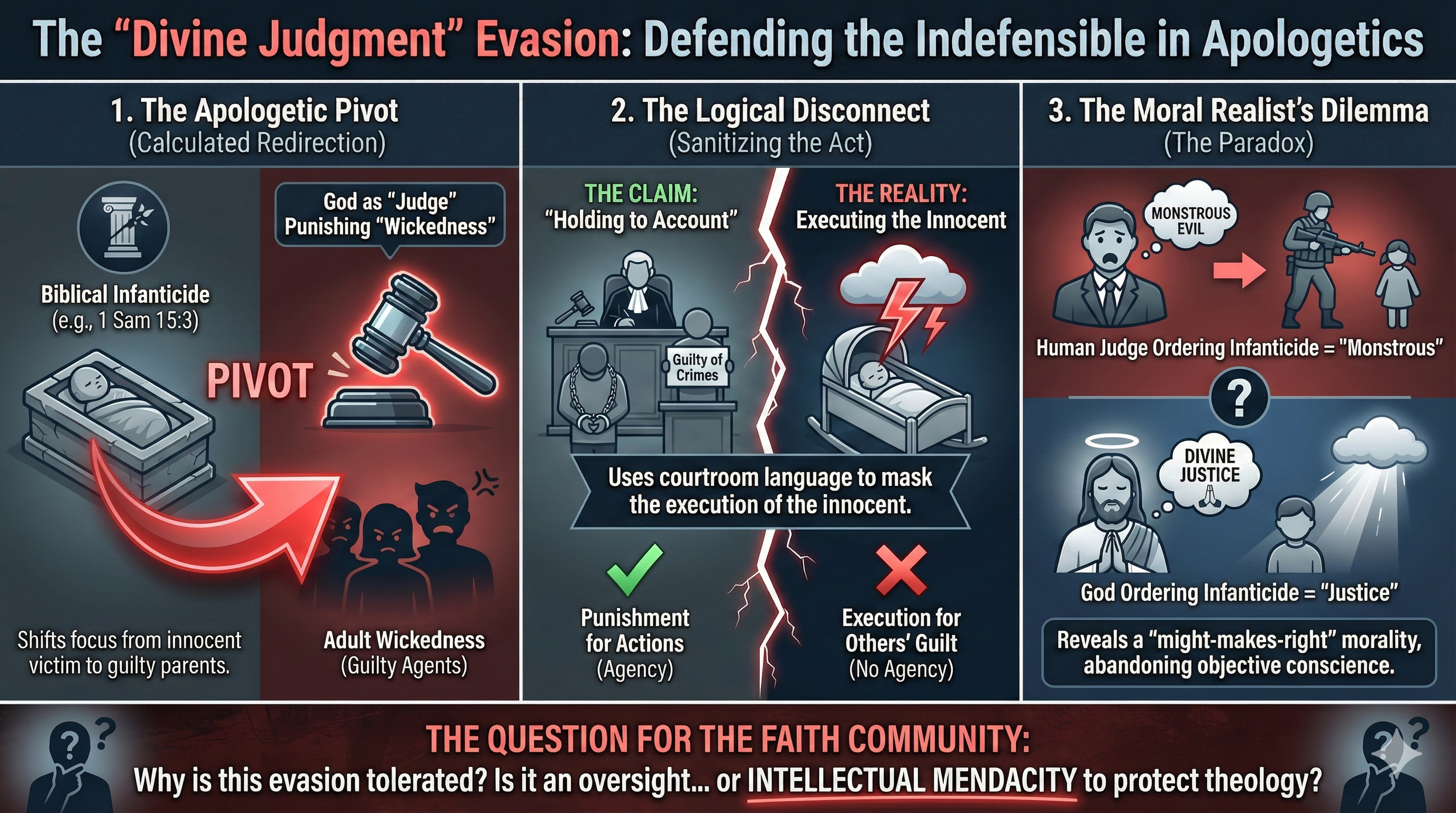
I call this tactic the Divine Judgment Evasion. It is a three-step process of deflection, sanitization, and moral capitulation that demands closer scrutiny.
Step 1: The Calculated Pivot
The first step in this evasion is a refusal to remain focused on the actual victims in question.
When an atheist asks, “How do you justify God ordering a soldier to run a sword through a nursing baby?“, the apologist almost never talks about the baby. Instead, they immediately pivot to the behavior of the adults in that culture.
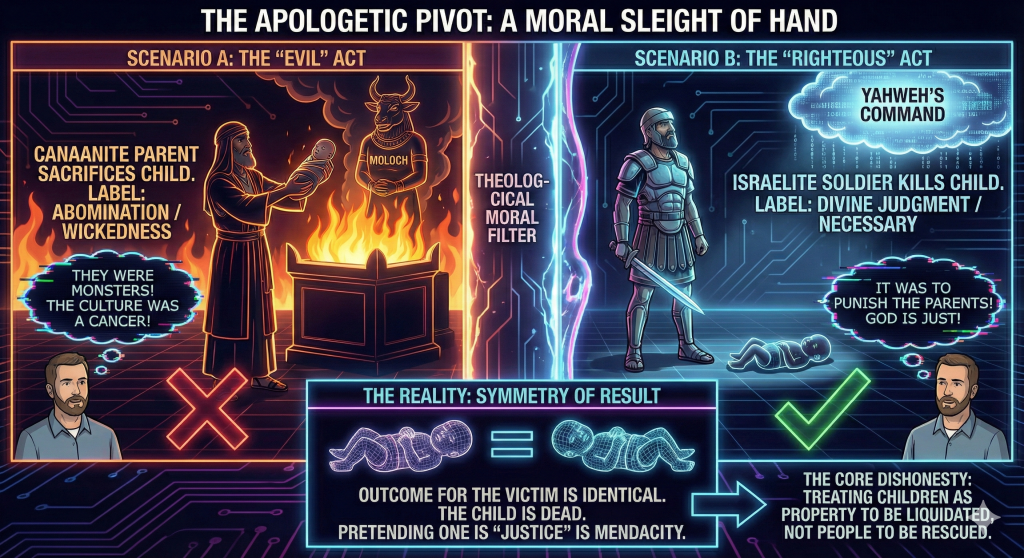
You will hear lengthy dissertations on the wickedness of the Canaanites, their sexual deviancy, or their own practices of child sacrifice. The apologist floods the conversation with the sins of the parents.
Why this is a deflection: The wickedness of an adult culture is entirely irrelevant to the moral status of a newborn. By shifting the focus to adult depravity, the apologist hopes the listener will forget that the subject of the inquiry is an innocent life that has committed no depravity whatsoever.
Step 2: The Language of Sanitization
Once the pivot to adult wickedness is complete, the apologist introduces courtroom terminology to reframe the massacre.
We are told that God is a righteous “Judge” and that these actions are His way of “holding a culture to account” for their sins. This language is strategically chosen. We respect judges. We believe in holding criminals to account. It sounds civilized.
Why this fails logically: A judge holds moral agents responsible for their actions.
An infant has no agency. A toddler has committed no crime. They cannot possess “wickedness” and they cannot be “judged” in any intelligible moral sense.
When an apologist uses judicial language to describe the killing of a child based on the sins of their parents, they are defending collective punishment—a practice condemned by modern international law and most moral philosophers as inherently unjust. They are attempting to sanitize an atrocity by dressing it up in the robes of a courtroom.
Step 3: The Moral Realist’s Dilemma
If forced to confront the reality that infants are being killed for the sins of others, the apologist plays their final card: Divine Command Theory.
This is the argument that because God is the ultimate authority and creator of life, He has the right to take it whenever and however He sees fit. What would be evil for a human to do is “good” when God commands it.
This position is fatal to the Christian claim of “objective moral realism.”
If morality is objective, then the act of slaughtering an innocent child is wrong, regardless of who orders it. If an action becomes “good” simply because a powerful deity commands it, morality is arbitrary. It reduces “goodness” to obedience. It is a theological version of “might makes right.”
The hypocrisy is stark: If a human general ordered the execution of a terrorist’s baby to “judge” the father’s wickedness, Christians would rightly call that general a moral monster. Yet, when their text attributes the same action to God, they call it “Divine Justice.”
The Crucial Question: Oversight or Intellectual Mendacity?
This brings us to a difficult question regarding the apologists who employ this evasion.
Many of these individuals are highly intelligent, educated, and in other contexts, deeply moral people who would fight to protect living children. Yet, when defending their theology, they repeatedly employ a tactic that relies on a fundamental category error—treating an infant as a culpable criminal.
Why?
Is it a genuine cognitive blind spot? Is the dissonance created by these texts so powerful that their minds subconsciously block the realization that they have changed the subject from the innocent to the guilty?
Or is it something darker? Is it intellectual mendacity—a calculated, dishonest refusal to engage with the text as it is written, because doing so would cause their entire theological framework to collapse?
When an apologist defends the indefensible by pretending a baby is a criminal, they are not protecting God’s reputation. They are sacrificing their own intellectual and moral integrity on the altar of theological preservation.
Update:
The Pivot in Real-Time: A Study in Cognitive Dissonance
The following interactions from a recent discussion in the Facebook group “Christian Apologetics” serve as a live demonstration of the “Apologetic Pivot.” Rather surprisingly, these comments were in direct response to a post pointing out the very deflections they exemplified. These responses illustrate how, when confronted with the state-sponsored execution of infants, the apologist’s immediate instinct is to shield their theology by shifting the focus toward adult behavior, fatalistic outcomes, or unsubstantiated claims of “mercy.”
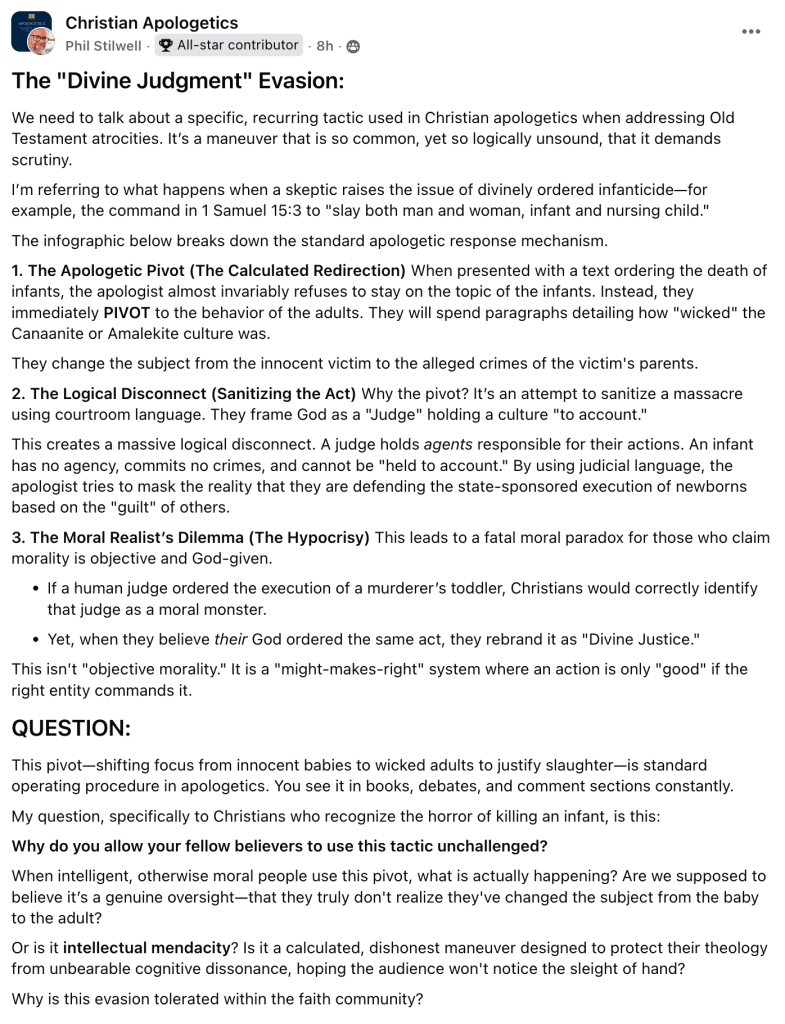
The Initial Post:
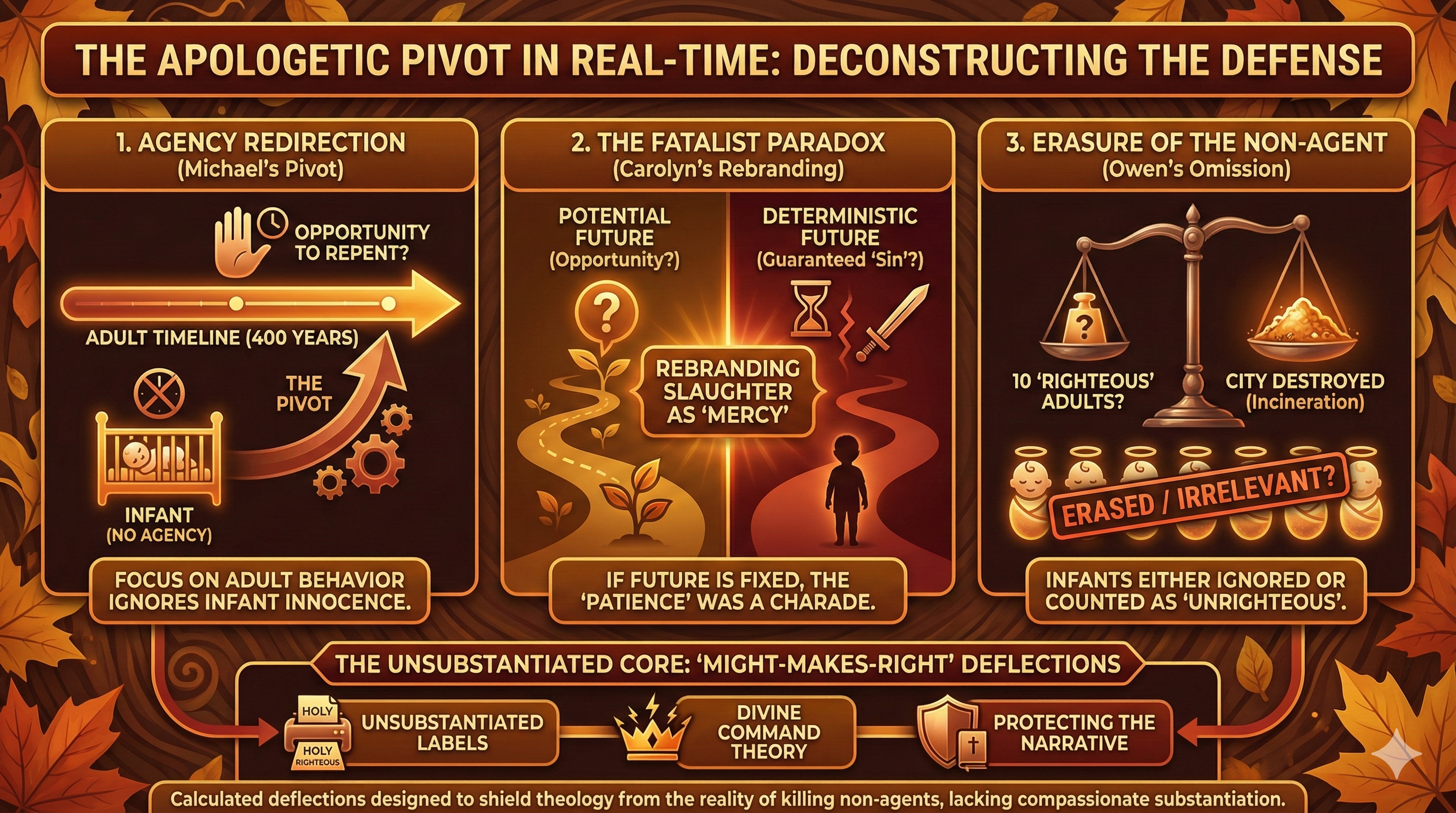
This table deconstructs three specific deflections, highlighting the logical incoherence required to maintain these positions.
| Excerpt from Comment | The Pivot in Practice |
| MI-BO: “By the time God ordered the Israelites to slaughter every man, woman, and child… they were given plenty of time to repent… it wasn’t a first or second generation ordeal, but a continuous, cultural cycle… because ‘their iniquity was not yet full.’“ | The Agency Redirection: MI-BO focuses entirely on a 400-year timeline of adult behavior. This is an attempt to use judicial language to justify an act that has no judicial basis. By centering the argument on “time to repent,” he ignores the fact that an infant has no agency to repent or change a “cultural cycle.” He effectively changes the subject from the victim’s innocence to the parents’ stubbornness. |
| CA-BR: “The fate of the infants and children in reality? Before they were old enough to know the difference between good and evil, they were spared a life of dishonoring their maker. They would neither live a life displeasing to God nor suffer eternal separation from him.“ | The Fatalist Paradox: CA-BR rebrands the slaughter as “mercy”—an unsubstantiated claim that relies on a deterministic future. She suggests that the termination of a life before it can “sin” is a pro-social benefit. This implies that life itself is a liability and that slaughter is the most compassionate outcome. This fatalism contradicts any claim that the victims had a genuine opportunity for a positive existence. |
| OW-AS: “Suppose ten [righteous] are found there… Each time, God replies that He will not destroy the city for the sake of that number… This is essentially saying that in Sodom and Gomorrah there are not 1 righteous person there.“ | The Erasure of the Non-Agent: OW-AS uses a bargaining narrative to erase the existence of the infant. If “ten righteous” would save a city, and the city was destroyed, OW-AS‘s logic implies that infants are either “unrighteous” or irrelevant. He focuses on the “rape culture” of adult men to sanitize the incineration of newborns, failing to substantiate why the lack of “righteous” adults justifies the destruction of children. |
The Inability to Substantiate
These responses share a common failure: the inability to stay on the topic of the infant. The apologist must pivot because a direct defense of killing a non-agent is impossible within any compassionate or pro-social framework. Instead, they retreat into “might-makes-right” assertions, labeling the acts as “holy” or “righteous” without providing any objective substantiation for these terms.
When believers appeal to “objective moral values” to justify these events, they are making an unsubstantiated claim. There is no compassionate logic that leads to the conclusion that slaughtering a nursing child is a “good.” These maneuvers are not genuine arguments but are calculated deflections designed to protect a theological narrative from the unbearable reality of its own implications.


 Free of Faith
Leave a comment