Why Christian Practice Contradicts Apologetic Rhetoric

Modern Christian apologetics has attempted a “rational” rebrand. Increasingly, apologists claim that their faith is not a blind leap but a calculated response to data. They argue that their degree of belief maps precisely to the degree of evidence available.

However, when we observe the actual behavior, pedagogical structures, and social pressures within these communities, this claim of “evidence-mapping” is revealed to be a rhetorical facade rather than a functional reality.
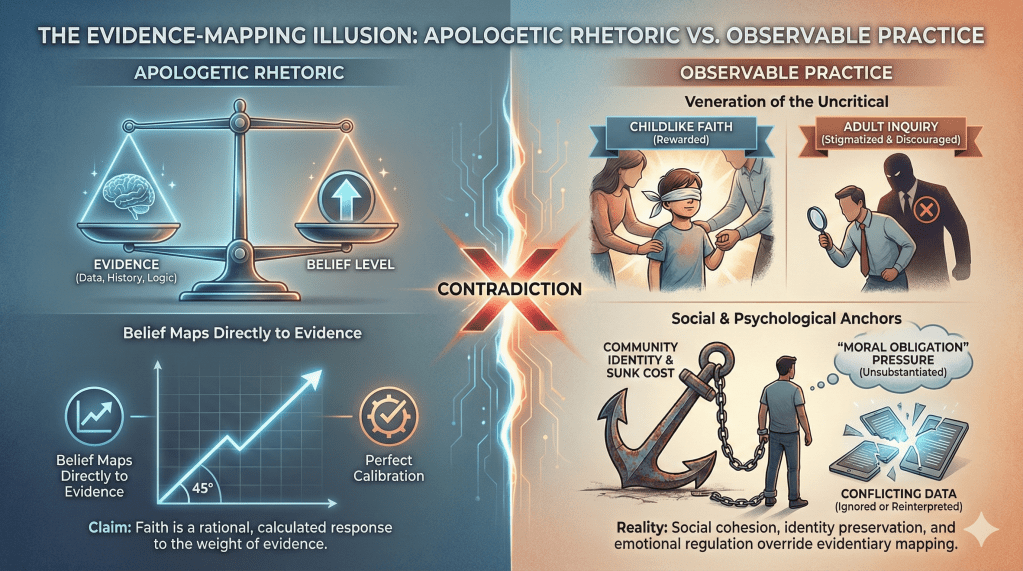

1. The Veneration of the Uncritical

If belief were truly intended to map to evidence, the “ideal” believer would be a rigorous investigator. Yet, the religious framework consistently prizes the opposite.

The Child’s “Faith”

Children are the primary demographic for recruitment, yet they are the least equipped to evaluate complex historical or philosophical evidence. They are encouraged to believe not because they have weighed the evidence, but as a pro-social act of obedience. When a child “comes to Jesus,” there is no inquiry into their evidentiary grounding. If mapping were the priority, this would be seen as a failure of the system; instead, it is celebrated as its greatest success.

The Praise of “Childlike Faith”

Adults are frequently told to emulate the uncritical acceptance of a child. If mapping belief to data were the goal, this would be viewed as a cognitive regression. Instead, it is heralded as a virtue. This suggests that the goal is not a calibrated internal state, but an unshakeable one.


2. The Stagnation of Adult Inquiry

For an adult within the faith, the “evidence-mapping” claim is tested the moment they seek to “increase” their belief.

  • The “Doubting Thomas” Narrative: In most traditions, the figure who demands physical or logical evidence is not treated as a model of rationality. Instead, they are used as a cautionary tale.
  • The Missing Advice: When an adult’s belief is wavering, they are rarely told to “go find more evidence.” Instead, they are told to pray or “wait on the Lord.” This is a direct instruction to ignore the lack of evidence and rely on emotional regulation to artificially maintain the degree of belief.

3. Behavioral Contradictions: Rhetoric vs. Reality

Apologetic ClaimObservable PracticeUnderlying Objective
Belief maps to the weight of evidence.Praise for “childlike” (uncritical) acceptance.Community cohesion and early-life anchoring.
Doubt is a search for more data.Doubt is framed as a “test” or a “spiritual struggle.”Protection of the belief system from falsification.
Faith is a rational response to history.Converts are never asked to present an evidentiary case.Social alignment and group identity.
Belief should increase with evidence.Adults are discouraged from demanding more proof.Maintenance of certainty regardless of data quality.

4. The Substantiation Vacuum: The “Moral” Smokescreen

When evidence-mapping fails, apologists often retreat to the claim that there is a “moral obligation” to believe.

A Note on Substantiation: The term “moral” is frequently used in these contexts as an unsubstantiated placeholder. Those who employ it rarely, if ever, substantiate the underlying system that grants them the authority to dictate “oughts.” Without a proven, objective foundation, these “moral” claims are merely social pressures disguised as universal truths. They should be disparaged as empty assertions until a coherent system is demonstrated.

Instead of pursuing a compassionate or pro-social inquiry into truth, the “moral” label is used to shame the skeptical and silence the inquisitive. It functions as a tool for community control rather than an intellectual framework.


5. Identity Anchoring and Sunk Costs

The social structure of the faith makes true evidence-mapping nearly impossible.

  • Social Consequences: In many communities, the “degree of belief” is a prerequisite for belonging. To lower one’s belief in response to new evidence is to risk losing family, friends, and social standing.
  • The Loop of Self-Persuasion: Rituals like “testimony” require the individual to publicly state their certainty. This behavioral commitment triggers a psychological need for consistency, forcing the internal belief to rise to meet the public declaration, regardless of what the external evidence suggests.

Conclusion: A Marketing Tactic, Not a Methodology

The claim that religious belief maps to evidence is a defensive posture used to gain “rational” credibility in a secular age. However, a system that rewards uncritical children, stigmatizes inquisitive adults, and relies on unsubstantiated “moral” demands is not interested in mapping belief to reality. It is interested in the preservation of the system at the expense of the evidence.

For those interested in a truly pro-social and rational approach to the world, the first step is demanding that all claims—especially those employing the term “moral”—be substantiated by something more than the desire to be right.


Would you like me to draft a specific response to a common apologetic counter-argument, such as the claim that “naturalism” also requires a leap of faith?


One response to “✓ The Evidence-Mapping Illusion”

  1. J Avatar
    J

    Interesting, I never really thought about “The Loop of Self-Persuasion” model for bolstering faith in a given community. Maybe by encouraging someone to testify regarding their beliefs, you only ignore any reasons (no matter how sound) they might have for doubt. It seems related to some of the more annoying tactics commonly found among apologists (in particular, W.L. Craig’s assertion that he has “the inner testimony of the spirit” when responding to skeptics.) The fact that believers are wont to portray skeptics as the “arrogant” ones only makes the whole situation more frustrating.

    This piece also reminded me of a few other things:

    1.) The discussion of children being a prime target for conversion is something I can relate to given how much I was involved in a church until my late teens. If I am recalling correctly, I think Bertrand Russell once quipped about how habitual exposure to Christian teachings every week among churchgoers (especially a young age) was a primary reason for lack of critical inquiry into the faith.

    2.) The “need to belong” also is part of why life feels difficult for the new skeptic. Throughout history, Christians have tried to present themselves as the “persecuted group” or argue that it takes more moral courage to be a believer since it is easy (in their eyes) to be a skeptic. This ignores both the social ostracism that avowed atheists, agnostics, etc. face in a religious society as well as the fact that since the Late Roman Empire, it was socially fashionable to be a Christian in large parts of the world (no to mention that until the last two centuries, there weren’t really any atheists around to be blamed for the persecution of religions.)

    3.) Relating to the other piece you recently posted, isn’t it odd that Christians of the inerrant Bible, divine-command morality belief system extol children as paradigms of faith (as the New Testament says) but have to explain why it was permittable for them to killed as “collateral damage” in Numbers, Joshua, etc.?

    4.) On the question posed by believers regarding naturalism as a leap of faith, I wonder if a short answer is that it’s less of a leap than religions like Christianity. As Graham Oppy has apparently argued, naturalism explains “just as much” as theism with less “excess.”

    (I’m agnostic and open to belief in God compatible with rational inquiry, but think it’s best to generally operate as if naturalism were the working truth.)

    Thanks,

    J.

Leave a comment

Recent posts

  • Modern Christian apologetics claims faith is based on evidence, but this is contradicted by practices within the faith. Children are encouraged to accept beliefs uncritically, while adults seeking evidence face discouragement. The community rewards conformity over inquiry, using moral obligations to stifle skepticism. Thus, the belief system prioritizes preservation over…

  • In the realm of Christian apologetics, few topics generate as much palpable discomfort as the Old Testament narratives depicting divinely ordered genocide. While many believers prefer to gloss over these passages, serious apologists feel compelled to defend them. They must reconcile a God described as “perfect love” with a deity…

  • This post examines various conditions Christians often attach to prayer promises, transforming them into unfalsifiable claims. It highlights how these ‘failsafe’ mechanisms protect the belief system from scrutiny, allowing believers to reinterpret prayer outcomes either as successes or failures based on internal states or hidden conditions. This results in a…

  • In public discourse, labels such as “atheist,” “agnostic,” and “Christian” often oversimplify complex beliefs, leading to misunderstandings. These tags are low-resolution summaries that hinder rational discussions. Genuine inquiry requires moving beyond labels to assess individual credences and evidence. Understanding belief as a gradient reflects the nuances of thought, promoting clarity…

  • The featured argument, often employed in Christian apologetics, asserts that the universe’s intelligibility implies a divine mind. However, a meticulous examination reveals logical flaws, such as equivocation on “intelligible,” unsubstantiated jumps from observations to conclusions about authorship, and the failure to consider alternative explanations. Ultimately, while the universe exhibits structure…

  • The piece discusses how historical figures like Jesus and Alexander the Great undergo “legendary inflation,” where narratives evolve into more than mere history, shaped by cultural needs and societal functions. As communities invest meaning in these figures, their stories absorb mythical elements and motifs over time. This phenomenon illustrates how…

  • This post argues against extreme views in debates about the historical Jesus, emphasizing the distinction between the theological narrative shaped by scriptural interpretation and the existence of a human core. It maintains that while the Gospels serve theological purposes, they do not negate the likelihood of a historical figure, supported…

  • Hebrews 11:1 is often misquoted as a clear definition of faith, but its Greek origins reveal ambiguity. Different interpretations exist, leading to confusion in Christian discourse. Faith is described both as assurance and as evidence, contributing to semantic sloppiness. Consequently, discussions about faith lack clarity and rigor, oscillating between certitude…

  • This post emphasizes the importance of using AI as a tool for Christian apologetics rather than a replacement for personal discernment. It addresses common concerns among Christians about AI, advocating for its responsible application in improving reasoning, clarity, and theological accuracy. The article outlines various use cases for AI, such…

  • This post argues that if deductive proofs demonstrate the logical incoherence of Christianity’s core teachings, then inductive arguments supporting it lose their evidential strength. Inductive reasoning relies on hypotheses that are logically possible; if a claim-set collapses into contradiction, evidence cannot confirm it. Instead, it may prompt revisions to attain…

  • This post addresses common excuses for rejecting Christianity, arguing that they stem from the human heart’s resistance to surrendering pride and sin. The piece critiques various objections, such as the existence of multiple religions and perceived hypocrisy within Christianity. It emphasizes the uniqueness of Christianity, the importance of faith in…

  • The Outrage Trap discusses the frequent confusion between justice and morality in ethical discourse. It argues that feelings of moral outrage at injustice stem not from belief in objective moral facts but from a violation of social contracts that ensure safety and cooperation. The distinction between justice as a human…

  • Isn’t the killing of infants always best under Christian theology? This post demonstrates that the theological premises used to defend biblical violence collapse into absurdity when applied consistently. If your theology implies that a school shooter is a more effective savior than a missionary, the error lies in the theology.

  • This article discusses the counterproductive nature of hostile Christian apologetics, which can inadvertently serve the skepticism community. When apologists exhibit traits like hostility and arrogance, they undermine their persuasive efforts and authenticity. This phenomenon, termed the Repellent Effect, suggests that such behavior diminishes the credibility of their arguments. As a…

  • The post argues against the irreducibility of conscious experiences to neural realizations by clarifying distinctions between experiences, their neural correlates, and descriptions of these relationships. It critiques the regression argument that infers E cannot equal N by demonstrating that distinguishing between representations and their references is trivial. The author emphasizes…

  • The article highlights the value of AI tools, like Large Language Models, to “Red Team” apologetic arguments, ensuring intellectual integrity. It explains how AI can identify logical fallacies such as circular reasoning, strawman arguments, and tone issues, urging apologists to embrace critique for improved discourse. The author advocates for rigorous…