
The Infantilization of the Intellect:
Why “Childlike Faith” Fails the Real-World Test
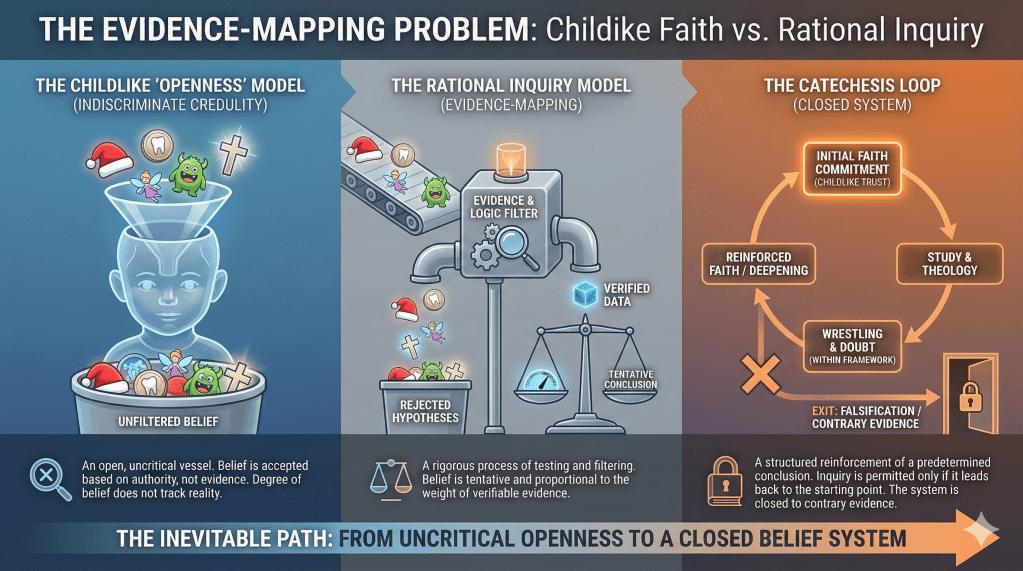
One of the most common, and intellectually debilitating, defenses of religious belief is the appeal to “childlike faith.” When pressed on the lack of historical evidence, cosmological inconsistencies, or moral contradictions within scripture, the apologist often pivots. They claim that the demand for rigor is itself the problem, and that the ideal posture toward the divine is one of trusting unguardedness—like a child looking up to a parent.
This is often framed emotionally as a beautiful “openness” or “willingness to learn.” But if we strip away the sentimentality and examine this cognitively, what is actually being advocated is indiscriminate credulity.
A worldview that insists on starting with a conclusion based on trust, rather than deriving a conclusion from evidence, is a worldview destined to fail the test of reality. To mature intellectually is to move from a posture of unguarded trust to a demand for predictive success.
The Epistemology of the Tooth Fairy
Let us be precise about what “childlike openness” means in practice.
A young child’s mind is a sponge, evolutionarily primed to accept the testimony of authority figures. This is a survival mechanism; if a parent says “don’t touch the fire,” the child must accept this as truth without first demanding a peer-reviewed study on thermodynamics.
However, this mechanism has a critical flaw: it possesses no inherent filter for truth value. It is a gate left wide open.
Because of this, a child is equally “open” to the existence of:
- Dogs and cats.
- Santa Claus.
- The monster under the bed.
- The specific deity of their parents’ culture.
The child does not believe in these things because they have weighed the metaphysical data. They believe them because the information came from a trusted source. Their degree of belief—which is often absolute certainty—has zero correlation with actual evidence.
When apologists valorize this state as the ideal starting point for faith, they are conceding a devastating point: Christian belief is rooted in a pre-critical stage of cognitive development where belief does not track with reality.
The Necessity of Predictive Success
We do not remain children forever. Part of cognitive maturation is the development of skepticism—the realization that not everything we are told is true, and that our internal map of the world must be constantly updated to match the actual territory.
Why do children eventually stop believing in Santa Claus?
They stop because the “Santa Hypothesis” ceases to provide predictive success. They begin to notice anomalies in the data: the wrapping paper matches the one in Mom’s closet; Santa’s handwriting looks like Dad’s; the physics of traveling to every house in one night don’t add up.
A mature intellect realizes that a belief system is only valuable if it accurately describes how the world works. If your map tells you there is a bridge where there is actually a canyon, you will fall. A viable worldview must have predictive power.
- Science has predictive power: We trust aerodynamics because planes reliably fly. The belief maps to the outcome.
- Childlike faith lacks predictive power: If you pray to Santa for a bike, or pray to God to heal an amputated limb, the results are functionally identical to random chance. The belief does not reliably predict the outcome.
To insist on maintaining a “childlike” posture toward claims about the fundamental nature of reality is to deliberately arrest one’s own intellectual development. It is choosing a comforting map over the actual terrain.
The “Virtue” of Arrested Development
The tragedy of contemporary apologetics is that it expends enormous energy trying to rationalize why adults should remain in this pre-critical state regarding one specific area of life.
While we encourage skepticism in politics, finance, and medicine, religion is carved out as a special zone where the demand for evidence is framed as a moral failing—a lack of trust.
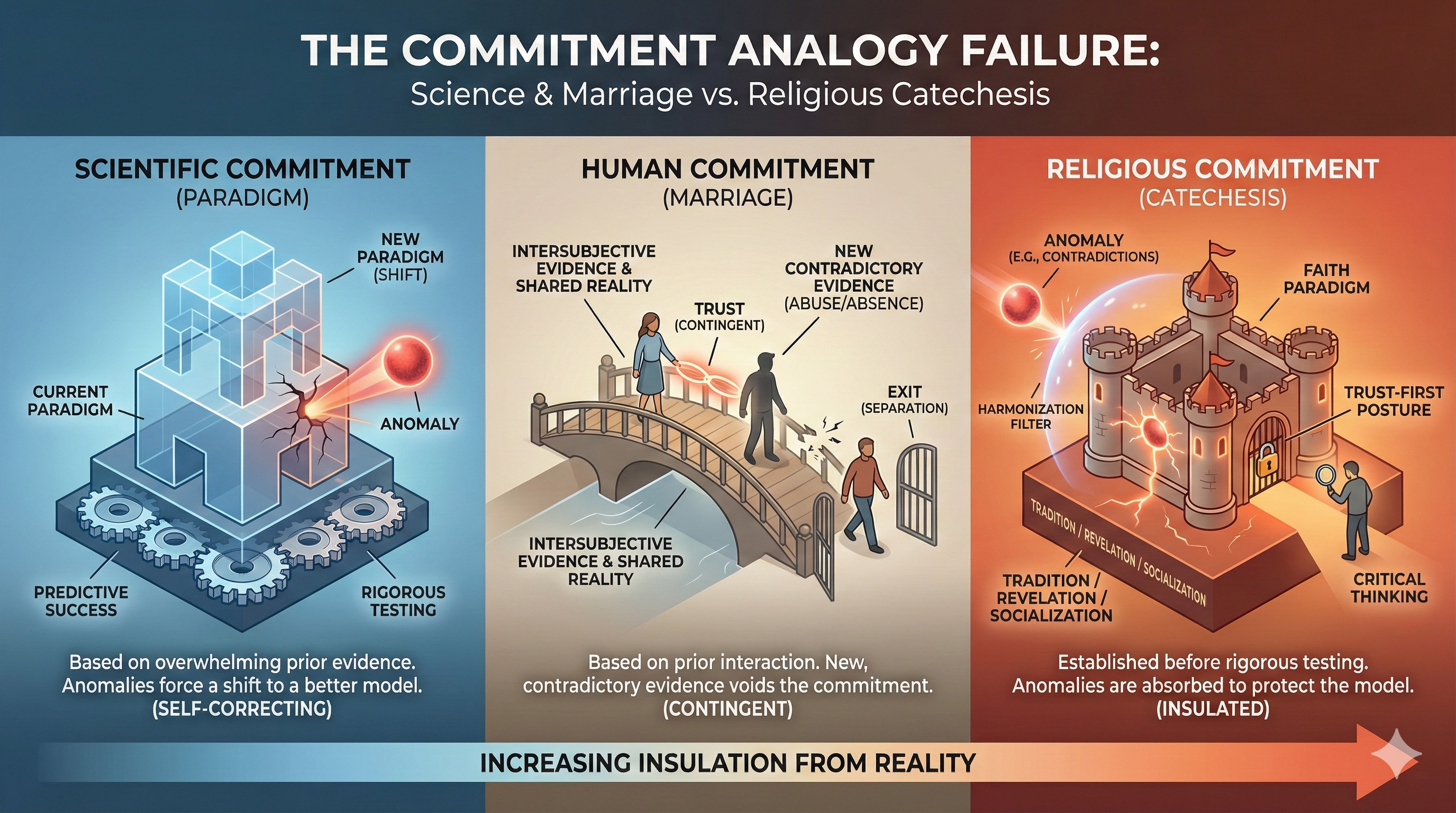
When an adult asks hard questions, the church often attempts to funnel them into what I have previously called the “Catechesis Loop.” They are encouraged to study, read theology, and “wrestle with doubt,” but only within a closed system where the foundational premise—that the faith is true—is never actually on the table for falsification.
This is not the “openness to learning” they claim it is. It is the intellectual equivalent of an adult refusing to analyze the handwriting on Christmas presents because doing so would ruin the magic.
A truly mature worldview does not fear inquiry. It demands it. It does not prize the credulity of a child; it prizes the rigorous, evidence-based testing of an adult. If a faith cannot survive that testing without retreating to the nursery, it does not deserve to survive at all.


 Free of Faith
Leave a comment