
The Theology of Slaughter:
Deconstructing Apologetics for Infanticide
Content Warning: This post discusses biblical descriptions of genocide and infanticide.
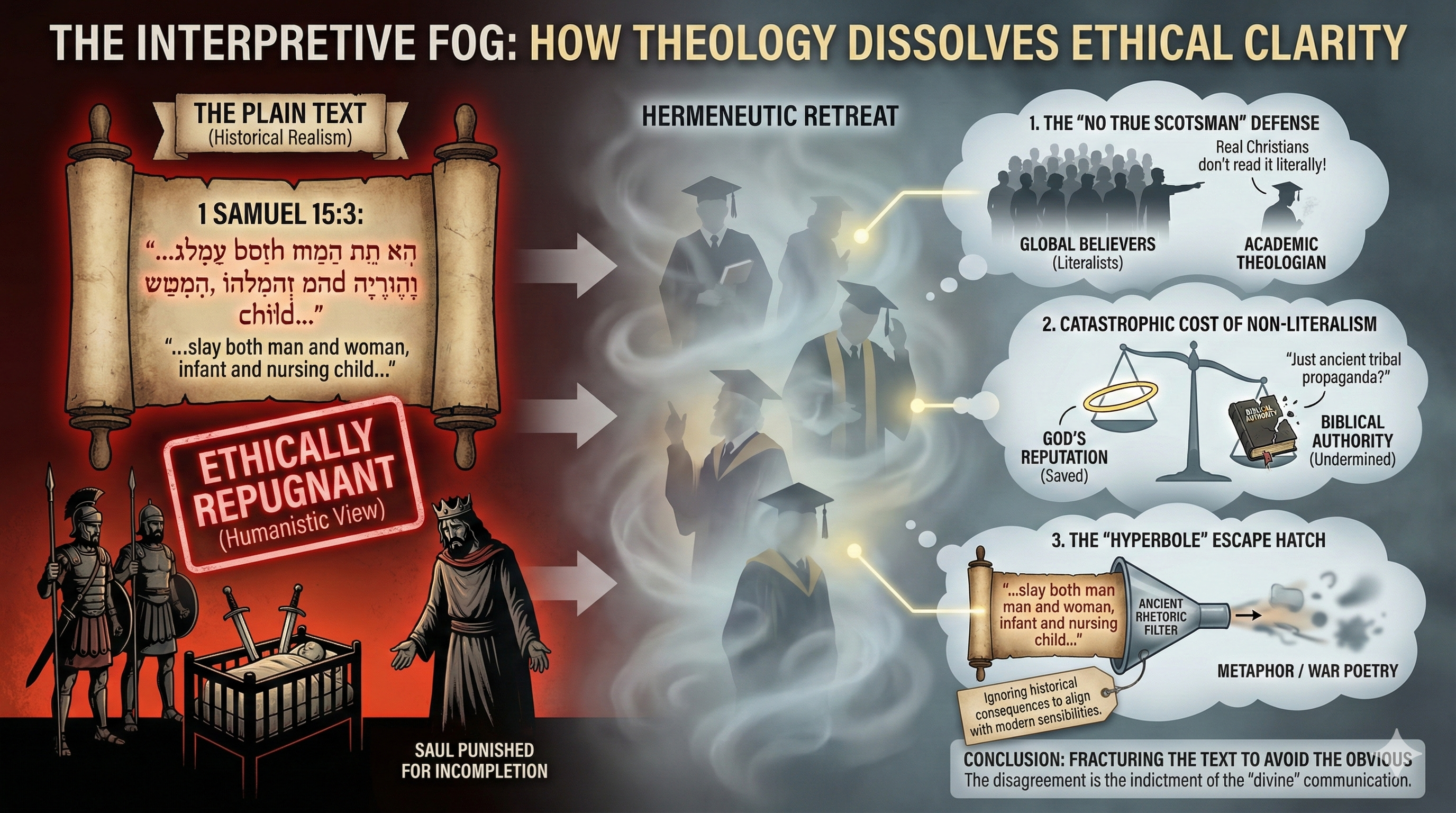
Few texts expose the “moral” fragility (moral anihilism?) of theistic ethics like 1 Samuel 15:3. The command, attributed directly to God via the prophet Samuel, is explicit and total:
“Now go and attack Amalek, and utterly destroy all that they have; do not spare them, but kill both man and woman, infant and nursing child, ox and sheep, camel and donkey.” (Emphasis added)
This is not a battle; it is a directive for systematic extermination, specifically targeting non-combatants, including newborns.
For the skeptic, this text is an egregious incoherence. For the believer who claims God is “maximally good” and the source of “objective morality,” it is an agonizing source of cognitive dissonance.
To resolve this tension, apologists have developed a complex arsenal of defenses. These range from rhetorical sleights of hand to deeply disturbing theological redefinitions of “guilt” and “justice.” By analyzing these defenses, we find that saving the reputation of the biblical deity requires sacrificing the very concept of substantive human moral intuitions. These “moral” intuitions have no non-affective weight.
From my perspective as a moral non-realist—someone who views pro-social behavior not as a cosmic law code, but as an evolved, pro-social construct rooted in biology and empathy—these theological justifications are not just unconvincing; they are deeply anti-human.
Here is an analysis of the mechanisms used to sanitize atrocity.
1. The Standard Maneuver: The “Apologetic Pivot”
The most common defense mechanism is the simplest: evasion.
When faced with the command to slaughter infants, the average apologist immediately shifts focus away from the babies and onto the adults. They will spend enormous energy detailing the wicked culture of the Amalekites (or Canaanites, or Sodomites). They frame God as a “Judge” holding a corrupt civilization to account.
The Logical Breakdown: This pivot is a calculated redirection. It attempts to sanitize a massacre using courtroom language. But a judge holds agents responsible for their actions. An infant has no agency, commits no crimes, and cannot participate in cultural corruption.
By focusing on adult wickedness to justify the death of newborns, the apologist attempts to mask the reality that they are defending the execution of victims based on the “guilt” of their parents.
2. The Soft Defense: Redefining Reality
When pressed on the infants, sophisticated apologists (like “Owen” in our previous exchange) attempt to soften the blow by redefining the nature of the act and reality itself.
A. The “Collateral Damage” Fallacy
The argument is made that judgment was directed at a “social order,” and the death of non-agents was merely a “tragic consequence,” not the primary target.
The Critique: In an omnipotent framework, there is no such thing as “collateral damage.” An all-powerful being is capable of surgical precision. If a deity has the power to remove corrupt agents but chooses to incinerate everyone—including infants—that outcome is intentional design, not a tragic byproduct.
B. The “Naturalistic” Tu Quoque
Apologists often argue: “Babies die in natural disasters and famines in a naturalistic world, so why complain when God does it?”
The Critique: This is a severe category error. We do not hold an earthquake accountable because it has no mind. We do hold persons accountable if they cause intentional harm. By equating the deliberate commands of a Deity with mindless geological processes, the apologist effectively strips their God of moral agency.
C. The Afterlife “Escape Hatch”
Perhaps the most pernicious defense is the claim that because God grants eternal life, temporal death is “not the ultimate harm.” The idea is that God can “reset” the wrong in heaven.
The Critique: This is moral nihilism dressed as hope. If killing isn’t truly harmful because a deity can fix it later, then the foundation of morality crumbles. Under this logic, any atrocity can be rebranded as a temporary inconvenience. It uses a theological speculation to bypass the tangible, undeniable reality of suffering in this world.
3. The Hard Defense: Stripping Innocence
When the “soft” defenses fail, more rigorous apologists (like “Brad” in our exchange) abandon the pretense that the infants were innocent “collateral damage.” They take the darker, more consistent theological route: the infants deserved to die.
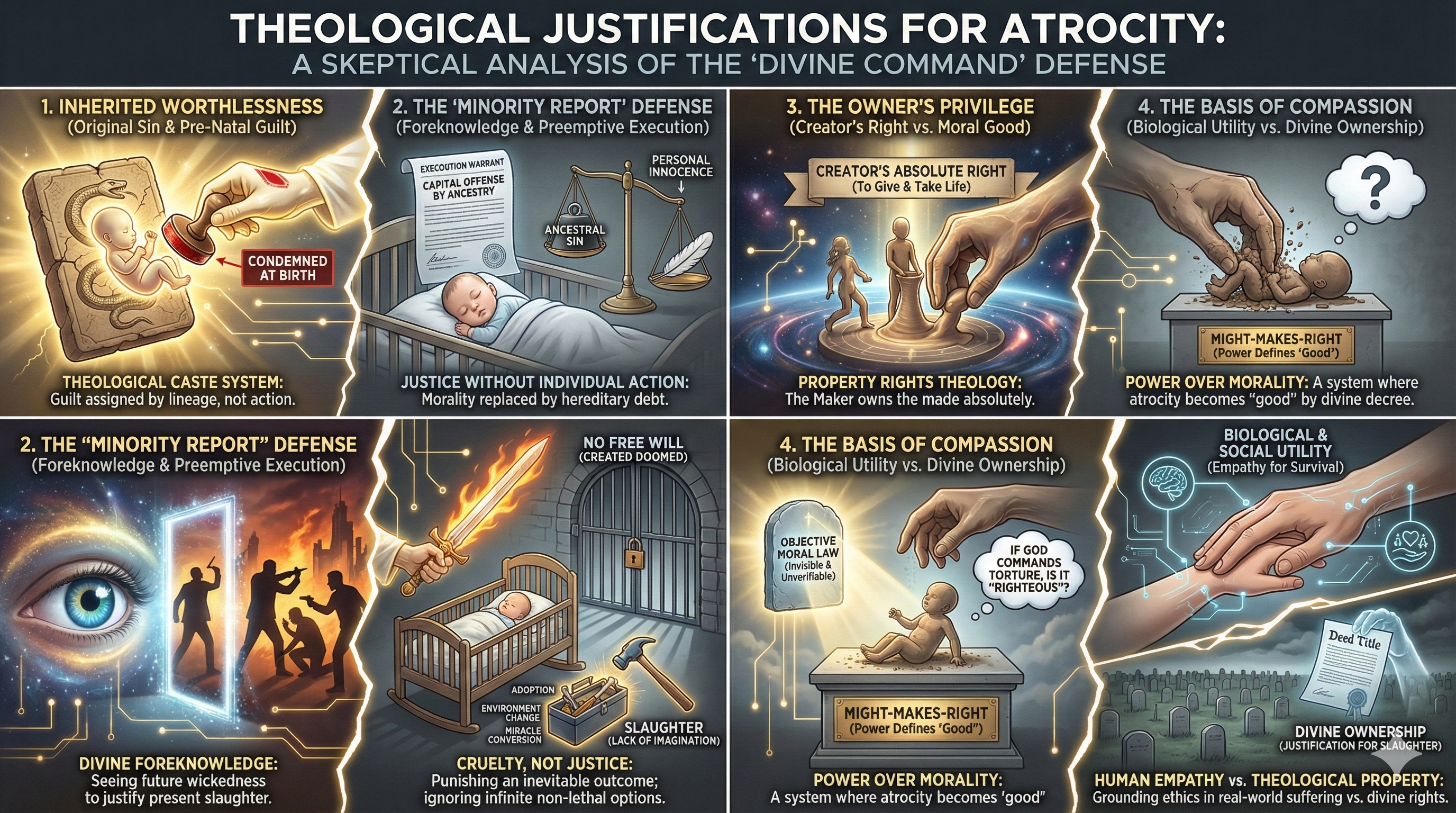
A. The Doctrine of Inherited Worthlessness (Original Sin)
The argument posits that infants are not innocent. Due to Adam’s fall, they are born “under condemnation,” inheritors of a sin nature that renders them guilty before they have breathed their first breath.
The Critique: This replaces individual justice with a theological caste system. If “justice” includes hacking a newborn to death based on the transgression of a distant ancestor, the word has lost all connection to fairness. It asserts that human beings possess inherent, inherited worthlessness sufficient to justify capital punishment at birth.
B. The “Minority Report” Defense (Divine Foreknowledge)
Another justification is that an omniscient God knew these Amalekite infants would grow up to be wicked, so He preemptively slaughtered them to prevent future evil.
The Critique: This creates insurmountable philosophical disasters:
- The Elimination of Free Will: If God knew they would be wicked, they were created doomed. Punishing entities for an inevitable outcome they did not choose is cruelty, not justice.
- The Impotence of Omnipotence: This defense implies an all-powerful being looked at a generation of babies and determined the only solution to their potential future behavior was immediate extermination. An omnipotent being could change their environment, secure their adoption, or perform mass conversion. Choosing slaughter when infinite non-lethal options exist is a failure of imagination or mercy.
4. The Ultimate Foundation: Might-Makes-Right
When all analogies to human justice break down, the apologist plays their final card. They argue that analogies fail because God is the Creator. As the Maker, He has the absolute right to give life and take it away as He sees fit.
The Critique: This is the moment “objective morality” collapses into raw power.
This defense admits that the system is not based on morality, but on property rights. The argument is essentially that God owns human beings absolutely, and therefore cannot commit murder, just as a potter cannot “murder” a clay pot by crushing it.
If the Creator’s commands define “good,” regardless of the content of those commands, then morality is arbitrary. If God commanded the torture of every infant on earth tomorrow, the faithful would be forced by this logic to call it “righteous.”
A moral framework that requires you to accept the premise that “God has the right to order the slaughter of babies because He owns them” is not a moral framework at all. It is a statement of ultimate, totalitarian power.
Conclusion: The Necessity of Moral Non-Realism
The defense of 1 Samuel 15:3 highlights the stark difference between theological ethics and humanistic ethics.
The Christian apologist starts with the conclusion—God is good—and must twist logic, redefine justice, and strip infants of their innocence to make the atrocities in their text fit that conclusion.
As a moral non-realist, I have no such burden. I do not believe in “objective” moral laws floating in the ether. My opposition to killing children is rooted in biological empathy and social utility—the evolved understanding that protecting the vulnerable is essential for human flourishing.
I do not need a “Maximally Moral Author” to tell me that the command in 1 Samuel 15:3 is abhorrent. My actions are grounded in the reality of human suffering. The apologist’s morality is grounded in the unverifiable will of a Deity whose “property rights” supersede the value of human life.
Between behavior rooted in real-world compassion, and a theology that justifies genocide as a divine prerogative, the choice is clear.


 Free of Faith
Leave a comment