
Why Theology Thrives in the Clouds and Dies on the Ground
If you step inside the grand halls of systematic theology, you will find an impressive intellectual structure. It is a cathedral of the mind, built with the intricate stonework of ancient languages, the soaring arches of philosophical metaphysics, and the stained glass of centuries-old hermeneutical traditions. Internally, it is magnificent. The logic is often consistent, the cross-referencing rigorous, and the deductions follow neatly from their premises.
It is a fortress of ideas, designed to withstand any internal contradiction.
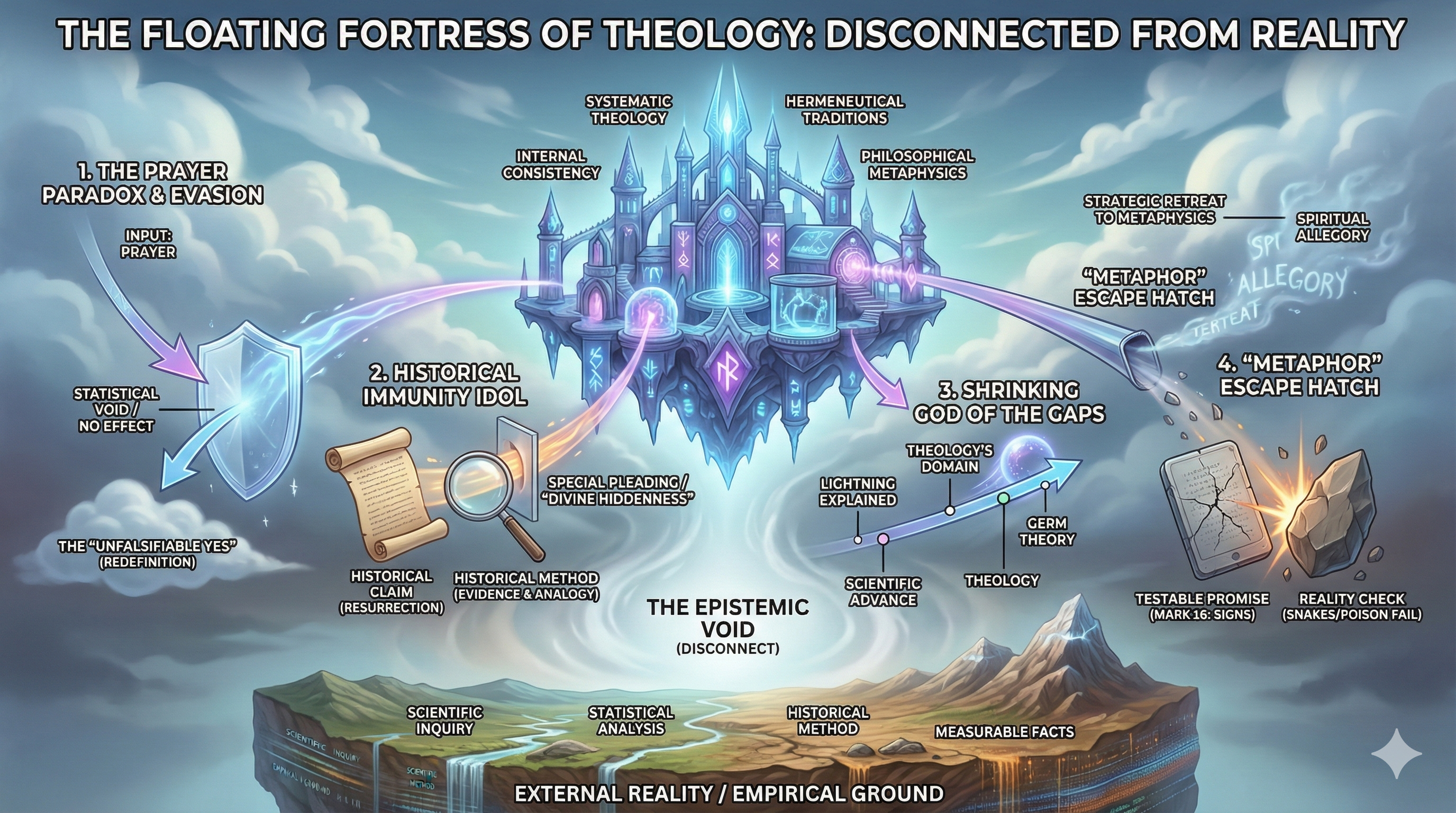
But step outside and look down. You will notice a terrifying feature of this structure: It is floating.
This theological fortress hangs suspended in an epistemic void, utterly disconnected from the hard ground of empirical reality beneath it. The defenders of the fortress will fiercely debate the arrangement of the furniture inside, but they refuse to look down at the gap between their floorboards and the earth.
This disconnect is not an accident; it is a necessary survival mechanism. Theology survives only by insulating its core claims from the standards of verification that we apply to every other aspect of human existence. When the internal claims of the fortress try to land on the external ground of reality, they evaporate upon impact.
Here is a rigorous examination of the mechanisms that keep the fortress afloat and the evasions used when reality comes calling.
1. The Prayer Paradox: Causal Claims Without Causal Evidence
The most glaring disconnect between the fortress and the ground is the issue of prayer. Inside the fortress, the doctrine is clear: God is a personal agent who interacts with spacetime, hears petitions, and intervenes in human affairs. The Bible is replete with promises that faith can alter physical outcomes (Matthew 17:20, Mark 11:24, James 5:15).
This is a causal claim. It asserts that an input (prayer) leads to a detectable output in the physical world (healing, safety, provision).
However, on the ground of reality, this causal link is non-existent.
The Statistical Void
When subjected to rigorous, double-blind empirical studies (such as the 2006 STEP project on intercessory prayer for cardiac patients), intercessory prayer shows no statistically significant effect on health outcomes. In fact, in some cases, those who knew they were being prayed for fared slightly worse due to performance anxiety.
If God were reliably answering prayers in the physical world, we would see a statistical anomaly. Christian hospitals would have vastly better recovery rates than secular ones. Christian nations would be immune to certain natural disasters. They are not. The rainfall falls on the just and the unjust alike.
The Evasion Mechanism: The “Unfalsifiable Yes”
How does the fortress defend against this data? By shifting goalposts and utilizing confirmation bias.
The theologian redefines “answered prayer” to include any outcome. If the patient recovers, God said “Yes.” If they stay the same, God said “Wait.” If they die, God said “No,” or “I have a better plan.”
By counting every possible outcome as a validation of the premise, the claim becomes unfalsifiable. A hypothesis that cannot be proven wrong by any conceivable event is totally useless as a description of reality. It is not a truth claim; it is an emotional coping strategy.
2. The Historical Immunity Idol
Christianity famously claims to be a “historical faith,” rooted in real events, most notably the Resurrection of Jesus. Inside the fortress, this is treated as the supreme historical fact, defended with elaborate apologetic arguments about empty tombs and eyewitness criteria.
Yet, when these claims touch the ground of actual historical methodology, special pleading is immediately invoked.
Historians operate on the principle of analogy: we understand the past by analogy to present experience. In our present experience, dead human beings stay dead. To establish a unique, supernatural exception to biological law requires extraordinary evidence, not just ancient, partisan texts written decades after the fact.
The apologist demands that we apply standard historical skepticism to Caesar crossing the Rubicon, but suspend that same skepticism for the Resurrection. They want the intellectual prestige of “history” without playing by the rules of the historical method. When pressed on why God doesn’t perform undeniable miracles today to confirm this history, the fortress retreats into talk of “divine hiddenness”—a convenient theological cover for the absence of evidence.
3. The Shrinking God of the Gaps
Historically, the theological fortress used to float much closer to the ground. Theology once dared to make direct claims about the physical universe: the age of the earth, the cause of lightning, the origin of disease, and the centrality of humanity in the cosmos.
Over the last four centuries, the “ground”—scientific inquiry—has risen up to challenge these claims. In every instance where theology staked a claim on physical reality and science investigated it, theology lost. We now know that lightning is electricity, not divine wrath; that disease is germ theory, not demonic possession; that the universe is ancient and indifferent.
The response of the fortress has been a perpetual strategic retreat. With every scientific advance, theology has had to surrender territory, redefining formerly literal truths as “metaphors” or “poetry.” The fortress now floats in the high altitude of pure metaphysics—dealing in untestable concepts like “being itself” or “ground of existence”—because it is no longer safe near the ground of measurable facts.
4. The “Metaphor” Escape Hatch for Biblical Promises
The biblical texts—the very blueprints of the fortress—contain specific, testable promises regarding the capabilities of a believer infused with the Holy Spirit.
“And these signs will accompany those who believe: in my name they will cast out demons; they will speak in new tongues; they will pick up serpents with their hands; and if they drink any deadly poison, it will not hurt them; they will lay their hands on the sick, and they will recover.” (Mark 16:17-18, ESV)
This is not ambiguous language. It is a series of testable predictions.
On the ground, these predictions fail spectacularly. Christians die from snakebites and poison at the same rate as anyone else. Faith healers cannot empty cancer wards.
When confronted with this reality, the inhabitants of the fortress immediately activate the “Metaphor Escape Hatch.” Suddenly, these clear instructions aren’t about physical snakes or actual poison; they are spiritual allegories about overcoming sin.
This pattern is pervasive: If a biblical claim aligns with reality, it is literal truth. If it contradicts reality, it is immediately reclassified as metaphor, poetry, or mystery. This hermeneutical shell game ensures that the text can never be proven false.
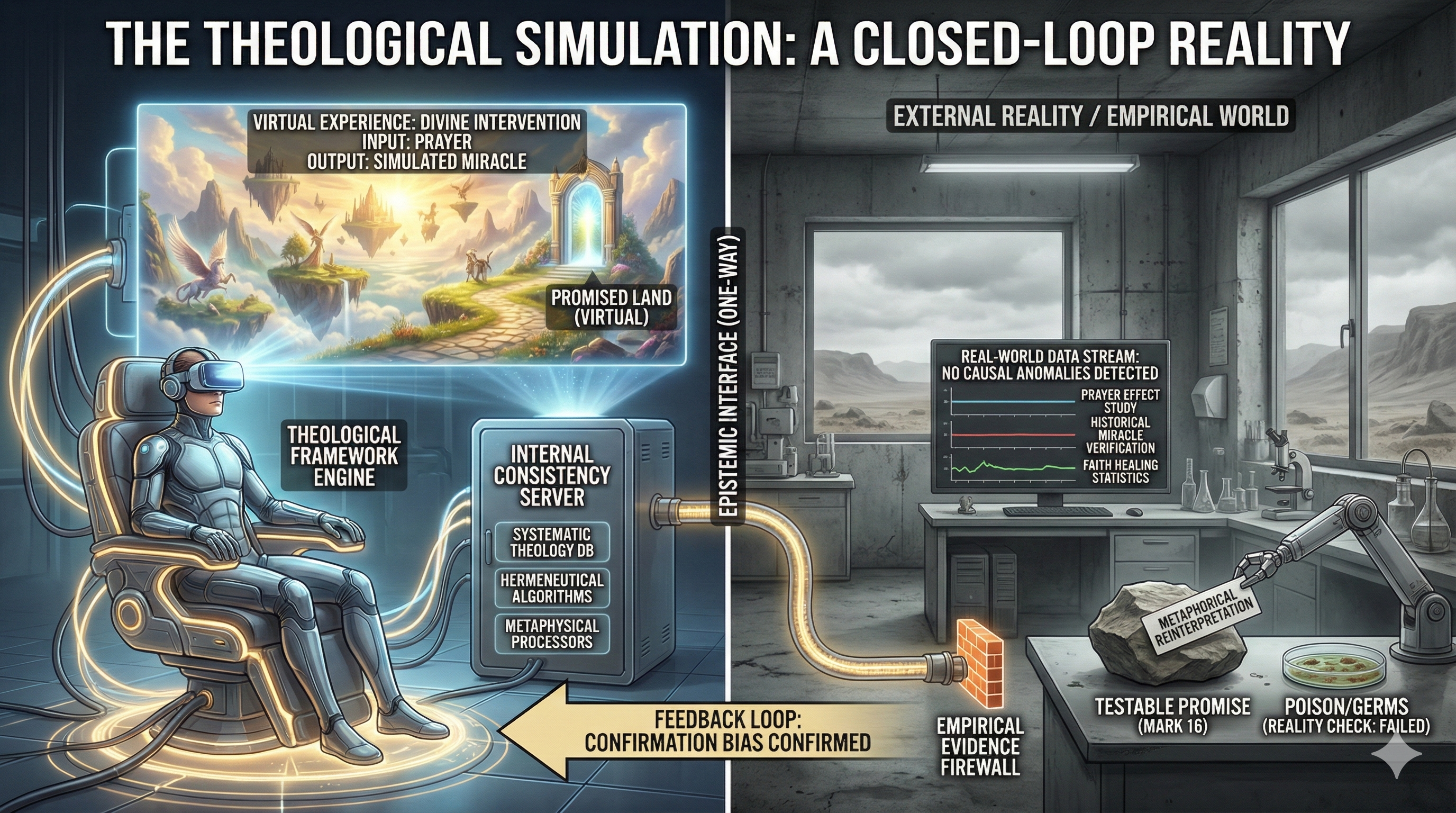
Conclusion: The Simulation of Truth
The theological fortress is a marvel of internal consistency, much like the rules of Middle-earth are consistent within J.R.R. Tolkien’s novels. You can spend a lifetime studying the elven languages or the lineage of the kings of Gondor with immense rigor.
But the moment you ask, “Where on a map of Europe is Mordor?” you have committed a category error. You have confused a self-contained simulation with external reality.
Theology remains a coherent academic discipline only as long as it remains a closed loop—a study of human ideas about God, rather than a study of God as an existing reality. The evasions, the handwaving, and the retreat into mystery are not flaws in the system; they are the anti-gravity engines that keep the fortress aloft.
To live inside the fortress is to prioritize comfort over truth. It is to choose a beautiful, consistent map over the rugged, often confusing territory of the real world. The fortress is safe, warm, and intellectually stimulating—as long as you never, ever look down.


 Free of Faith
Leave a comment