Click image for larger version.

Why “Warrant” is an Epistemic Downgrade: A Mathematical Proof

In philosophy, we are obsessed with trophies. We don’t just want to believe things; we want to know them. We treat “Knowledge” as the gold medal of cognition—a magical state that is qualitatively different from just having a pretty good guess.

For decades, the heavyweight champion of this view has been Alvin Plantinga. His theory of “Warrant” is brilliant, sophisticated, and, I believe, fundamentally broken.

I recently finished a paper, Credence First, where I argue that “knowledge” is actually a conceptual hallucination. It’s a linguistic artifact that confuses us more than it helps. To show why, I ran a formal proof demonstrating that if you design a mind to get Plantinga’s “Warrant,” you firmly require that mind to be less accurate about the world.

Here is the breakdown of why aiming for knowledge actually makes us dumber.

The Obsession with “The Badge”

Plantinga’s theory solves a lot of technical problems in philosophy (like the Gettier problem) by moving the goalposts. He argues that you have Warrant (and thus knowledge) if your belief is produced by:

  1. Properly functioning faculties…
  2. …operating in the environment they were designed for…
  3. …according to a design plan aimed at truth.

If you meet these criteria, you get the badge. You don’t just believe; you know.

This sounds great on paper. But there is a hidden cost.

The Accuracy vs. Warrant Trade-off

Let’s look at this mathematically (but simply).

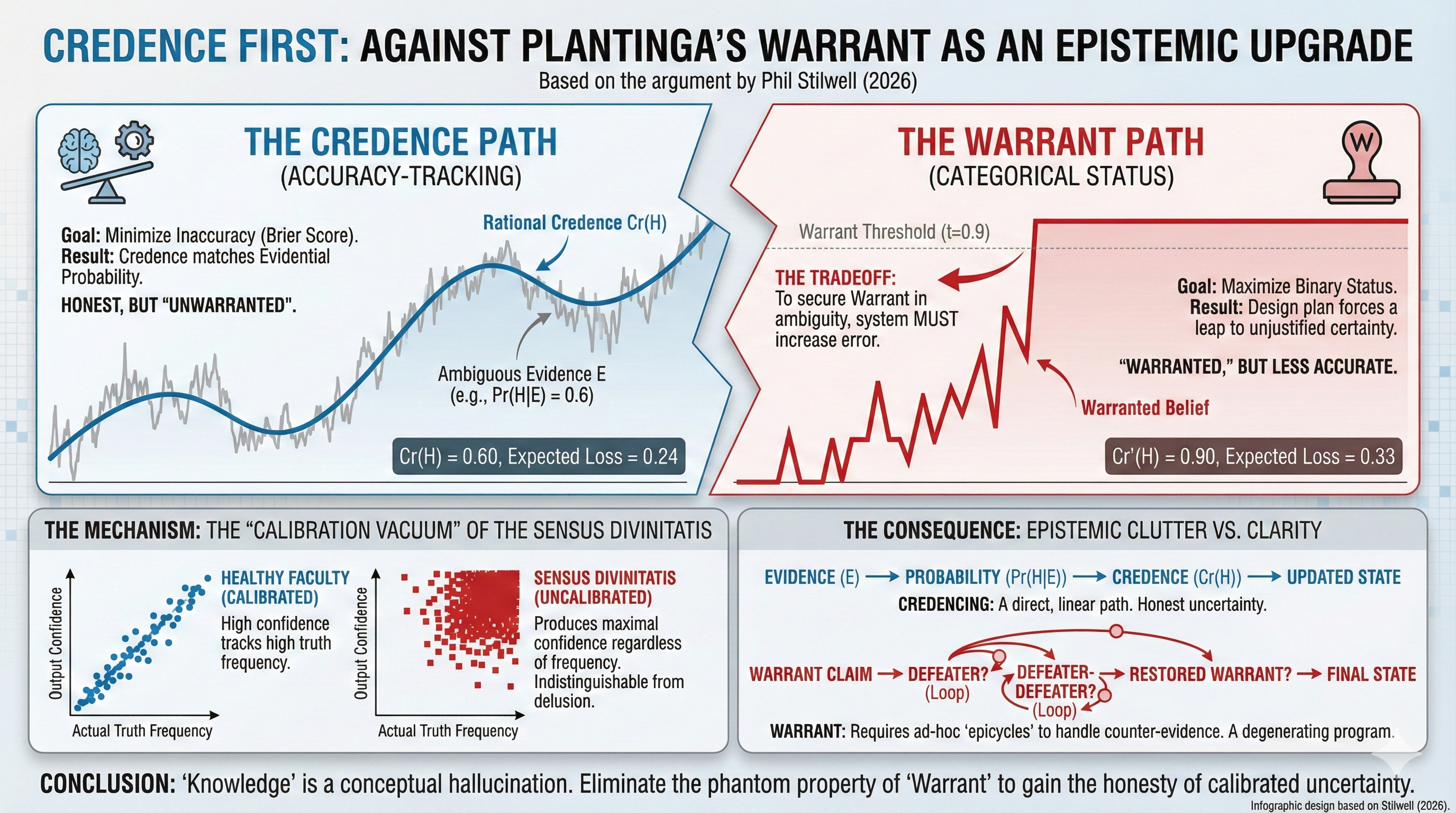
Imagine you are looking at some ambiguous evidence. Maybe you’re looking at historical data about a miracle, or complex arguments for a political policy. The evidence is leaning “Yes,” but it’s messy. Let’s say the probability based on the evidence is 60%.

You now have two options for how to form your belief.

Option A: The Accuracy Approach (Credencing) Your goal is to map reality exactly as it is. Since the evidence is 60%, you set your confidence at 60%.

  • Result: You are perfectly calibrated. You are honest about the uncertainty.
  • The Problem: 60% isn’t “knowledge.” It’s a guess. You don’t get the “Warrant” badge because you aren’t “settled” or firm enough.

Option B: The Warrant Approach Your goal is to achieve Warrant. Plantinga requires a belief to be “firmly held” or “settled” to count as knowledge. Let’s say the threshold for “settled” is 90% confidence. To get the badge, your brain must push your confidence from 60% up to 90%.

  • Result: You get the badge! You “know” it (assuming it turns out to be true).
  • The Problem: You have deliberately miscalibrated yourself. The evidence only supported 60%, but you are feeling 90%. You are now arguably delusional.

This is the central irony: To secure Warrant, the system must be designed to punish accuracy.

In my paper, I used a scoring rule called the Brier Score, which measures the distance between your belief and the truth. It proves that a mind designed to chase Warrant will, in ambiguous situations, generate more error than a mind that just tries to track the evidence honestly.

The “God-Sense” and the Calibration Vacuum

Plantinga applies his theory to religion using something called the Sensus Divinitatis (Sense of the Divine). He argues this is a cognitive module that, when triggered (like when looking at a starry sky), immediately produces a belief in God.

He claims that if this module is working properly, the belief is Warranted.

But here is the catch: Phenomenology is not Probability.

From the inside, the Sensus Divinitatis just feels like certainty. It pushes your confidence dial to 100%. But unlike your eyesight or your hearing, you can’t check it against anything.

  • If your eyes tell you “there is a cat,” you can reach out and touch the cat. You can calibrate your eyes.
  • If your God-sense tells you “God exists,” you cannot step outside the universe to check.

The Sensus Divinitatis operates in what I call a Calibration Vacuum. It produces maximum confidence regardless of the evidence.

If I built a fuel gauge for your car that read “FULL” regardless of how much gas was in the tank, you wouldn’t say the gauge was “warranted.” You would say it was broken. Plantinga’s theory tries to tell us that if the gauge was designed to always read “FULL,” then you “know” you have gas.

Abandoning “Knowledge”

The solution to this mess is radical but liberating: Eliminativism.

We should stop talking about “knowledge” entirely in rigorous contexts. It’s a folk concept, like “sunrise”—useful for casual conversation, but scientifically false (the sun doesn’t rise; the earth spins).

Instead, we should focus on Credencing.

  • What is the evidence?
  • What is the probability?
  • Does my confidence match that probability?

If we do this, we lose the comfort of saying “I know X.” But we gain the honesty of being calibrated to reality. We trade the illusion of a destination for the utility of an accurate map.


The full paper, “Credence First: Against Plantinga’s Warrant as an Epistemic Upgrade,” includes the formal proofs and is available for those interested in the technical details.


Recent posts

  • Alvin Plantinga’s “Warrant” isn’t an epistemic upgrade; it’s a design for inaccuracy. My formal proof demonstrates that maximizing the binary status of “knowledge” forces a cognitive system to be less accurate than one simply tracking evidence. We must eliminate “knowledge” as a rigorous concept, replacing it with credencing—the honest pursuit…

  • This article critiques the stark gap between the New Testament’s unequivocal promises of answered prayer and their empirical failure. It examines the theological “bait-and-switch” where bold pulpit guarantees of supernatural intervention are neutralized by “creative hermeneutics” in small groups, transforming literal promises into unfalsifiable, psychological coping mechanisms through evasive logic…

  • This article characterizes theology as a “floating fortress”—internally coherent but isolated from empirical reality. It details how specific theological claims regarding prayer, miracles, and scientific facts fail verification tests. The argument posits that theology survives only through evasion tactics like redefinition and metaphor, functioning as a self-contained simulation rather than…

  • This post applies parsimony (Occam’s Razor) to evaluate Christian Theism. It contrasts naturalism’s high “inductive density” with the precarious “stack of unverified assumptions” required for Christian belief, such as a disembodied mind and omni-attributes. It argues that ad hoc explanations for divine hiddenness further erode the probability of theistic claims,…

  • Modern apologists argue that religious belief is a rational map of evidence, likening it to scientific frameworks. However, a deeper analysis reveals a stark contrast. While science adapts to reality through empirical testing and falsifiability, theology insulates belief from contradictory evidence. The theological system absorbs anomalies instead of yielding to…

  • This post critiques the concept of “childlike faith” in religion, arguing that it promotes an uncritical acceptance of beliefs without evidence. It highlights that while children naturally trust authority figures, this lack of skepticism can lead to false beliefs. The author emphasizes the importance of cognitive maturity and predictive power…

  • This analysis examines the agonizing moral conflict presented by the explicit biblical command to slaughter Amalekite infants in 1 Samuel 15:3. Written from a skeptical, moral non-realist perspective, it rigorously deconstructs the various apologetic strategies employed to defend this divine directive as “good.” The post critiques common evasions, such as…

  • Modern Christian apologetics claims faith is based on evidence, but this is contradicted by practices within the faith. Children are encouraged to accept beliefs uncritically, while adults seeking evidence face discouragement. The community rewards conformity over inquiry, using moral obligations to stifle skepticism. Thus, the belief system prioritizes preservation over…

  • In the realm of Christian apologetics, few topics generate as much palpable discomfort as the Old Testament narratives depicting divinely ordered genocide. While many believers prefer to gloss over these passages, serious apologists feel compelled to defend them. They must reconcile a God described as “perfect love” with a deity…

  • This post examines various conditions Christians often attach to prayer promises, transforming them into unfalsifiable claims. It highlights how these ‘failsafe’ mechanisms protect the belief system from scrutiny, allowing believers to reinterpret prayer outcomes either as successes or failures based on internal states or hidden conditions. This results in a…

  • In public discourse, labels such as “atheist,” “agnostic,” and “Christian” often oversimplify complex beliefs, leading to misunderstandings. These tags are low-resolution summaries that hinder rational discussions. Genuine inquiry requires moving beyond labels to assess individual credences and evidence. Understanding belief as a gradient reflects the nuances of thought, promoting clarity…

  • The featured argument, often employed in Christian apologetics, asserts that the universe’s intelligibility implies a divine mind. However, a meticulous examination reveals logical flaws, such as equivocation on “intelligible,” unsubstantiated jumps from observations to conclusions about authorship, and the failure to consider alternative explanations. Ultimately, while the universe exhibits structure…

  • The piece discusses how historical figures like Jesus and Alexander the Great undergo “legendary inflation,” where narratives evolve into more than mere history, shaped by cultural needs and societal functions. As communities invest meaning in these figures, their stories absorb mythical elements and motifs over time. This phenomenon illustrates how…

  • This post argues against extreme views in debates about the historical Jesus, emphasizing the distinction between the theological narrative shaped by scriptural interpretation and the existence of a human core. It maintains that while the Gospels serve theological purposes, they do not negate the likelihood of a historical figure, supported…

  • Hebrews 11:1 is often misquoted as a clear definition of faith, but its Greek origins reveal ambiguity. Different interpretations exist, leading to confusion in Christian discourse. Faith is described both as assurance and as evidence, contributing to semantic sloppiness. Consequently, discussions about faith lack clarity and rigor, oscillating between certitude…

  • This post emphasizes the importance of using AI as a tool for Christian apologetics rather than a replacement for personal discernment. It addresses common concerns among Christians about AI, advocating for its responsible application in improving reasoning, clarity, and theological accuracy. The article outlines various use cases for AI, such…