
I dislike Trump. I have no interest in defending his vanity, his bluster, or his attraction to dominance theater. But disliking Trump does not require me to abandon proportion, distinctions, or basic rational standards. That is exactly what too many alleged skeptics now seem willing to do, especially when social and political issues are involved.
The Exchange
A recent exchange made this very clear.
An image was posted comparing Trump and the leader of the Islamic Republic as though they were roughly equivalent figures. The implication was obvious: these are basically the same kind of authoritarian menace, merely wearing different costumes. I pushed back by pointing out something glaringly important: one regime has intentionally killed massive numbers of its own citizens, disappeared dissidents, crushed protests with lethal force, and built an actual apparatus of internal terror. That difference is not small. It is immense.
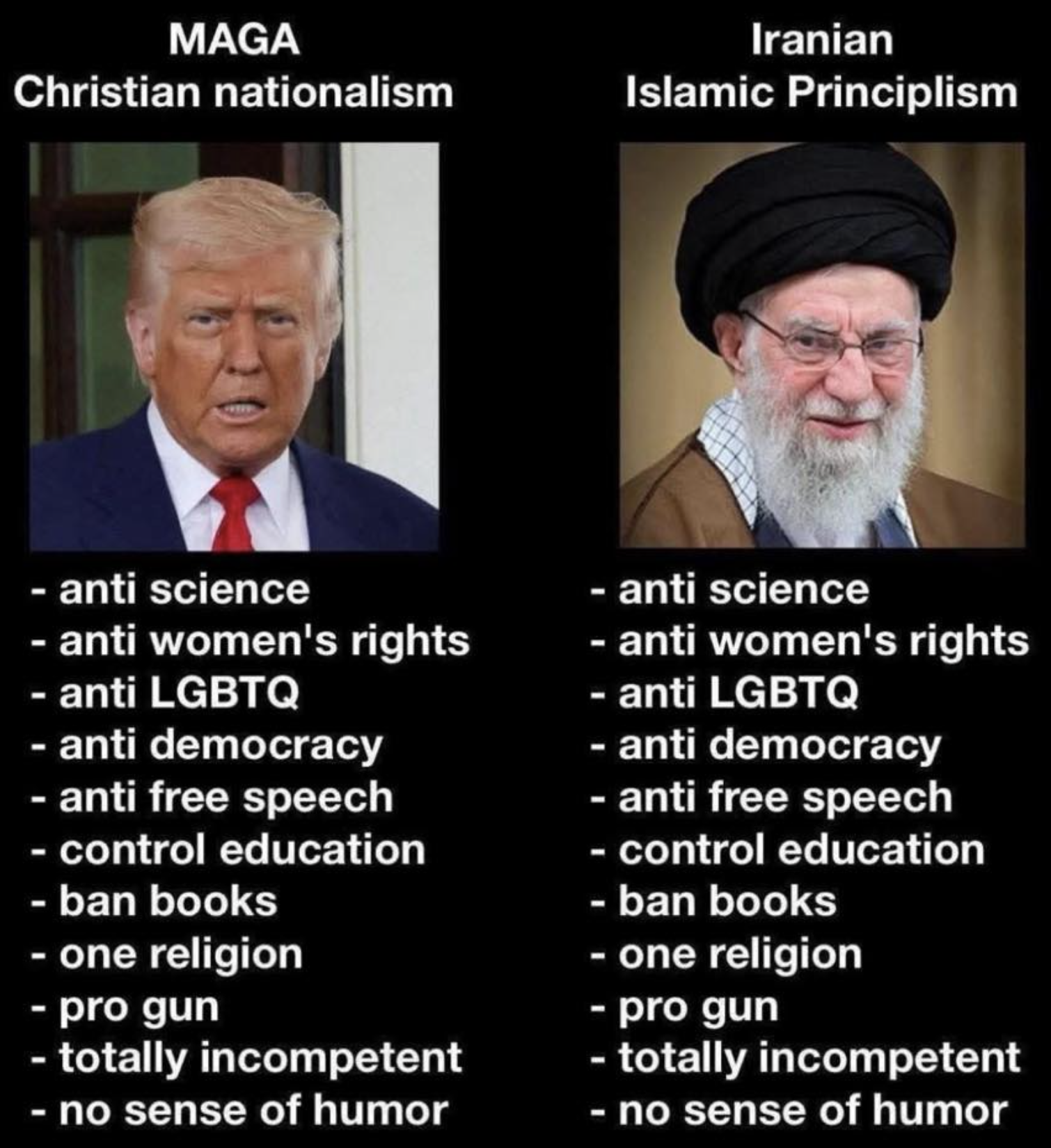
In response, the alleged skeptic did not seriously engage that distinction. Instead, he brushed it aside and claimed that he was not focused on what the Iranian regime had already done, but on how the Trump camp supposedly wants to do the same things. That is already a wild claim, but he then escalated it further. He said, in effect, that if one names any evil thing done by an authoritarian regime, he could find a video clip or some other record of Trump or Trump’s enablers saying they wanted to do the same.
That is an enormous claim. It is not the kind of claim a careful skeptic should make casually. If you say that Trump and his circle want to do the same things that actual terror regimes do, then you are taking on a serious burden of proof. You are no longer talking about vague temperament, bad rhetoric, or authoritarian vibes. You are claiming substantive equivalence in intention.
So I asked for specifics.
What Was Offered as “Evidence”
What followed was revealing.
The alleged skeptic eventually offered, as “evidence,” a clip of Trump saying that when the leader of North Korea speaks, his people sit up and pay attention, and that he would like his own people to do the same. That was apparently supposed to count as proof that Trump wants to do the same kinds of things done by North Korea or the Islamic Republic.
But that is precisely where the irrationality becomes impossible to ignore.
A remark about wanting obedience, deference, or visible attentiveness is not remotely the same thing as wanting prison camps, mass executions, torture systems, disappearances, religious police, or the deliberate killing of one’s own citizens. A boastful admiration for command presence is not equivalent to endorsing the machinery of a totalitarian or theocratic terror state. The gap between those things is not narrow. It is vast.
That is the foundation that must be kept in view: the alleged skeptic made a maximal claim about equivalence, was challenged to substantiate it, and then produced a clip that does not come remotely close to supporting the claim he made.
That is not skepticism. That is rhetorical inflation.
Why This Is Not Skepticism
A real skeptic is supposed to care about distinctions. A real skeptic is supposed to care about degrees, categories, evidence, and whether a conclusion actually follows from the premises. A real skeptic does not say, “Here is a politician saying something narcissistic and authoritarian-sounding; therefore he is equivalent to rulers who oversee torture, disappearances, massacres, and systemic internal repression.” That is not disciplined thought. That is tribal reasoning wearing skeptical clothing.
The absurdity is easy to expose once the exchange is stated plainly.
The alleged skeptic’s claim required evidence that Trump wants to do things like these:
✓ systematically execute political prisoners
✓ disappear dissidents into secret detention
✓ torture prisoners into false confessions
✓ massacre protesters by the hundreds or thousands
✓ impose a totalizing system of theocratic coercion
✓ operate prison-camp-style population control
✓ execute minors or mutilate citizens through state punishment
✓ construct a dynastic-totalitarian society
But what was offered instead?
✓ a clip suggesting Trump likes the idea of people showing deference and attention
That is not a close miss. That is not partial support. That is not “same basic thing.” That is a complete failure to meet the standard required by the original claim.
The Decay of the “Skeptical” Movement
And this matters because this tactic is becoming common among those who still like to present themselves as part of the “skeptical” movement. Many of them are no longer functioning as skeptics when politics enters the room. They are functioning as partisans with a preferred aesthetic. The labels remain, but the habits of mind have decayed.
Too many alleged skeptics now reason like this:
✓ identify a political target they strongly dislike
✓ grab the harshest comparison available
✓ flatten distinctions of scale, structure, and outcome
✓ treat resistance to the comparison as evidence of sympathy for the target
✓ call this process “skepticism”
It is not skepticism.
It is the abandonment of calibration.
It is the refusal to distinguish between rhetoric and regime, between vanity and atrocity, between authoritarian flavor and authoritarian implementation. Once those distinctions are erased, the conversation is no longer being governed by evidence. It is being governed by animus.
The Larger Problem
And yes, Trump gives critics plenty to work with. He says reckless things. He clearly enjoys domination optics. He often sounds contemptuous of restraint. He has narcissistic and authoritarian tendencies that deserve direct criticism. But none of that entitles anyone to smuggle in equivalence with the Islamic Republic or North Korea unless they can actually defend equivalence at the level of state conduct and intended policy.
That was not done here. Not even close.
Instead, what we saw was a pattern that is increasingly familiar: an alleged skeptic makes a dramatic claim, gets asked to support it, produces evidence that is much weaker than the claim requires, and then acts as though the burden has been met simply because the evidence carries the right emotional charge.
This is one reason public trust in the so-called skeptical movement has eroded. Many who wear that label are highly skeptical only when addressing religion, fringe paranormal claims, or the out-group errors they already enjoy criticizing. But once the topic becomes politically charged, some of them become astonishingly sloppy. Their standards loosen. Their analogies become hysterical. Their conclusions outrun their evidence. Their tribal impulses start doing the reasoning.
That should concern anyone who actually values skepticism.
Because the whole point of skepticism is that you do not get to overstate just because overstatement feels good. You do not get to erase crucial differences because your audience will applaud. You do not get to treat resemblance as equivalence merely because both comparisons serve your narrative.
And that is exactly what happened in this exchange.
The Broader Political Point
An alleged skeptic was confronted with a basic and obvious distinction: the difference between an American politician with ugly authoritarian-sounding rhetoric and regimes that have actually brutalized, terrorized, imprisoned, disappeared, tortured, and slaughtered their own populations. Rather than respecting that distinction, he tried to dissolve it through insinuation and weak analogy. That is not careful thought. That is intellectual decay.
There is deep irrationality on the right. I remain far more preoccupied with that, because it has been especially destructive and conspicuous. But the left is increasingly showing its own deep irrationality as well, and one of its most damaging forms is this compulsive drive toward false equivalence and maximal denunciation. When that impulse takes over, people stop thinking in gradients and start thinking in slogans.
That helps no one.
In fact, it often helps the very people they oppose. When critics make absurd comparisons, they destroy their own credibility. They make it easier for observers to dismiss even the criticisms that are actually warranted. They lower the level of discourse until serious distinctions are treated as betrayal.
That is exactly why this tactic should be called out firmly.
Conclusion
If Trump says something authoritarian-sounding, say so.
If Trump displays contempt for restraint, say so.
If Trump indulges fantasies of loyalty and obedience, say so.
But do not claim equivalence with the Islamic Republic or North Korea unless you are prepared to support that claim with evidence that actually matches its scale.
A clip about wanting people to “sit up and pay attention” does not do that. It is not even in the neighborhood.
And when an alleged skeptic pretends otherwise, he is no longer modeling skepticism. He is modeling the very irrationality he once claimed to oppose.


 Free of Faith
Leave a comment