

This collection of arguments critically examines the common claim made by Christian apologists that secular systems “borrow” essential concepts—such as morality, justice, free will, and human dignity—from the Christian worldview. The essays delve into the motivations behind this claim, which include portraying Christianity as the indispensable source of truth while framing secular worldviews as ideologically inferior or incoherent. By addressing these claims through historical evidence, philosophical critique, and symbolic logic, the discussions demonstrate that such arguments often oversimplify the origins of universal human values. Concepts like love, compassion, and justice are shown to have emerged across diverse cultures, predating Christianity and existing independently of its theological framework.
The essays below will also reveal the self-defeating nature of the borrowing argument. If borrowing renders a worldview inferior, then Christianity itself—built on ideas borrowed from Judaism, Stoicism, and Greek philosophy—would fail by the same standard. Through formal logical analysis, contradictions in the apologists’ reasoning are exposed, demonstrating that the claim lacks consistency and validity. Rather than dismissing borrowing as a flaw, the essays argue that it reflects the collaborative and evolving nature of human thought. Readers are invited to explore how the universality of values and the shared heritage of ideas enrich our understanding of morality, justice, and human purpose, providing a foundation for more constructive and inclusive dialogue.
A Comic Prelude







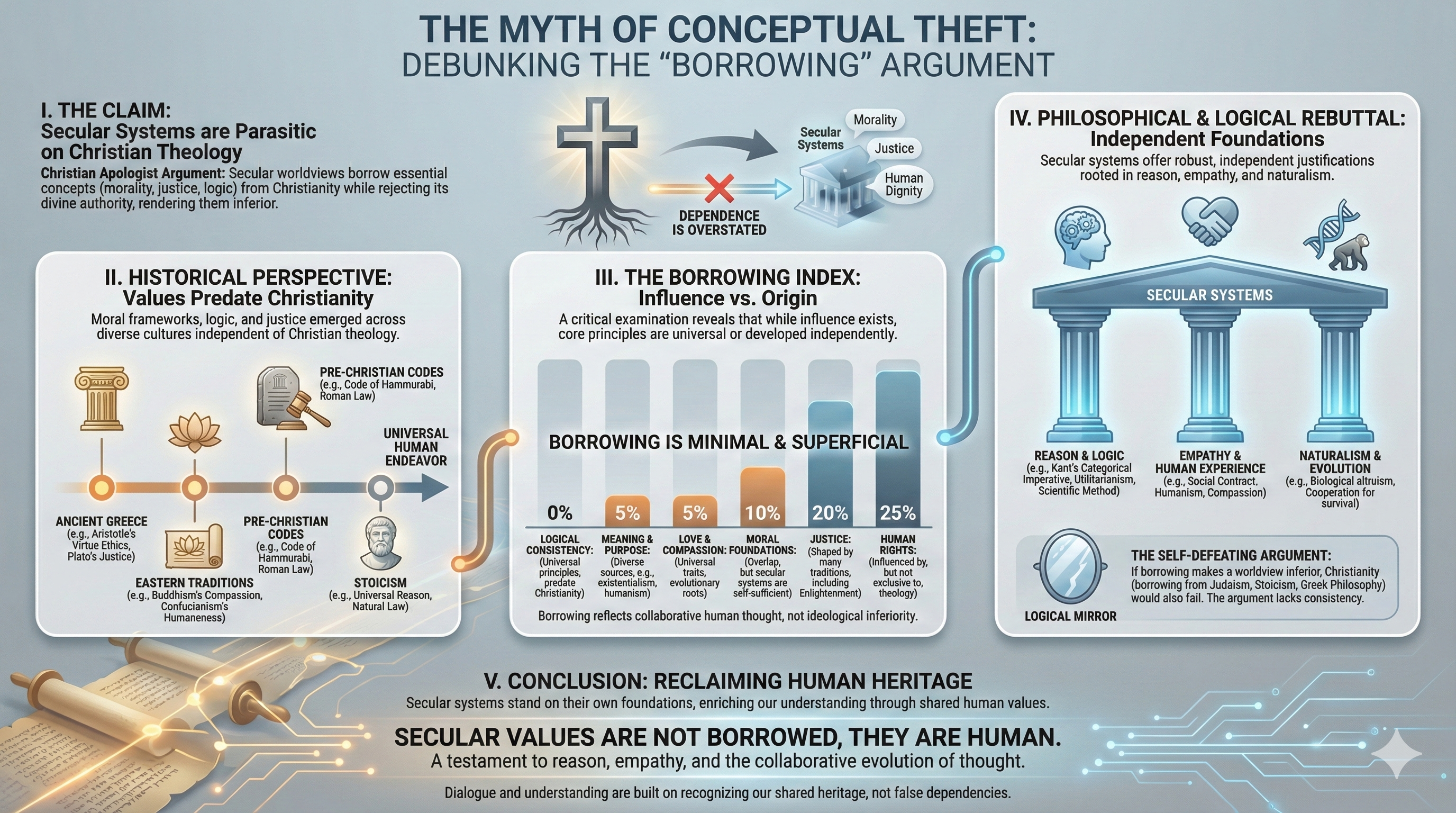
Borrowing Percentages and Commentary
| Category |  | Comment |
|---|---|---|
| Moral Foundations | 10% | Secular morality shares some historical overlap with Christian teachings. |
| Logical Consistency | 0% | Logical principles predate Christianity and are universal in application. |
| Meaning and Purpose | 5% | Christianity influenced Western ideas of purpose but is not the sole source. |
| Ethical Accountability | 15% | The concept of accountability is partly tied to Christian theological systems. |
| Justice | 20% | Christian doctrines shaped Western ideas of justice, though not exclusively. |
| Human Rights | 25% | Human rights language was heavily influenced by Christian theological ideas. |
| Meaning in Suffering | 10% | Christianity emphasizes redemptive suffering, shared in some secular ideas. |
| Love and Compassion | 5% | These are universal values found across cultures, not uniquely Christian. |
| Free Will | 5% | Free will has roots in earlier traditions and secular philosophical systems. |
| Gratitude | 5% | Gratitude is a universal human emotion, though expressed in theology. |
| Sense of Transcendence | 10% | Transcendence is often framed theologically but also exists in secular awe. |
- Those who disagree with the content of this table and the relevant arguments are strongly encouraged to provide counter-arguments in the comments section below.
01
Do Secular Moral Foundations Borrow from Christianity?
The claim that secular moral foundations borrow from Christianity is a recurring theme in Christian apologetics. This argument typically asserts that secular worldviews are parasitic on the moral teachings of Christianity, relying on its core values while rejecting its divine authority. However, this assertion does not hold up to scrutiny when examined through historical, philosophical, and logical lenses. Let us unpack the claim, counter it with reason, and delve into why secular moral foundations stand independently of Christianity.
A Historical Perspective: Morality Predates Christianity
To claim that morality stems exclusively from Christianity is to disregard the rich moral traditions that predate its emergence. Ancient Greek philosophy, for instance, offered comprehensive moral frameworks. Socrates, Plato, and Aristotle debated justice, virtue, and the good life long before the advent of Christian theology. Similarly, Eastern philosophies such as Confucianism and Buddhism emphasized compassion, respect, and ethical living centuries earlier.
Even in pre-Christian pagan societies, moral codes governed communal life. The Code of Hammurabi (circa 1754 BCE) laid down principles of fairness and justice, illustrating that moral systems arose organically to maintain social cohesion. These examples demonstrate that morality is not an exclusive byproduct of Christianity but rather a universal human endeavor.
A Philosophical Perspective: Secular Moral Frameworks
Philosophers like Immanuel Kant, John Stuart Mill, and John Rawls developed moral theories independent of Christian theology. Kant’s categorical imperative provides a rational basis for ethical behavior by appealing to universal principles, while Mill’s utilitarianism evaluates morality based on the consequences of actions and the promotion of happiness.
Such secular frameworks do not require divine intervention to justify moral behavior. Instead, they appeal to reason, empathy, and the intrinsic value of human relationships. Moreover, evolutionary biology provides compelling evidence that moral behaviors such as cooperation, fairness, and altruism evolved because they enhanced group survival. This naturalistic explanation renders the need for divine commandments unnecessary.
Logical Rebuttal: Independence of Secular Morality
The claim that secular morality borrows from Christianity can be rigorously dismantled using logical reasoning. Consider the following syllogism:
Premises:
(Moral systems can exist independently of Christianity and are therefore secular.)
(There are moral systems, such as those from Greek and Indian philosophies, that do not borrow from Christianity.)


Conclusion:
(Secular moral systems do not necessarily borrow from Christianity.)

This formulation demonstrates that secular morality does not rely on Christian teachings for its coherence or validity.
A Thought Experiment: The Atheist and the Samaritan
Imagine an atheist who helps a stranger in need. When asked why, they might reply, “Because it’s the right thing to do.” This instinct to assist stems from empathy and a shared sense of humanity, not from a belief in divine commandments. The Christian apologist might argue that the notion of “doing the right thing” is itself a borrowed Christian value. But is it?
If we strip the act of its cultural trappings, we find that altruism and cooperation are inherent to human nature. Studies in primatology reveal that even chimpanzees display rudimentary fairness and empathy. These behaviors suggest that morality is rooted in biology and social dynamics rather than theology.
The Borrowing Percentage: Minimal at Best
While it’s true that Christian teachings have shaped Western moral discourse, their influence on secular morality is superficial. Secular systems are largely self-sufficient, drawing from reason, experience, and shared human values. Borrowing is limited to linguistic or cultural expressions, not foundational principles.
Borrowing percentage: 10%.
Conclusion: Secular Morality Stands on Its Own
The notion that secular moral foundations borrow heavily from Christianity collapses under scrutiny. Historical evidence reveals that morality existed long before Christianity, and philosophical reasoning shows that secular systems can independently justify ethical behavior. Logical analysis confirms that borrowing is not a necessity but, at most, a cultural byproduct.
Secular morality, grounded in reason, empathy, and human experience, requires no divine scaffolding. It is a testament to humanity’s ability to navigate the complexities of life ethically and compassionately—on its own terms. Far from being parasitic, secular morality is an independent and vibrant moral ecosystem.
The editor of this site actually holds that secular morality also fails to establish any system of morality that does not, once scrutinized, dissipate into mere emotions and emotionally-derived values with no obligatory force. Articulate your disagreements in the comments section below if you are willing and ready for a deep dive into metaethics.
Dialogue
CHRIS: You secularists amuse me. You walk around with your talk of morality, justice, and compassion, but you’re really borrowing it all from Christianity. Without the moral foundations laid out by the Bible, your whole ethical framework would crumble.
CLARUS: That’s a bold claim, Chris, but one I’d challenge. I don’t deny that Christianity has influenced Western moral discourse, but to suggest that secular morality borrows from Christianity is both historically and philosophically flawed. Morality predates Christianity and can be grounded in natural, rational principles.
CHRIS: Oh, please. Morality predating Christianity? I’d like to see your evidence for that. Christianity introduced the concept of universal human dignity—rooted in humans being made in the image of God. That’s the foundation of everything you secularists cherish today.
CLARUS: Universal human dignity is indeed a valuable concept, but it is neither unique to Christianity nor its invention. Ancient Greek philosophers like Aristotle and Plato discussed virtues, justice, and the good life long before the Bible came into play. Aristotle, for example, outlined a framework of ethics based on human flourishing (eudaimonia), achieved through cultivating virtues like courage, generosity, and fairness. This isn’t derived from theology but from observing human nature and relationships.
CHRIS: But those Greek ideas were elitist. Aristotle didn’t believe everyone had equal moral worth. Christianity is what brought the radical idea that all people, regardless of status, are equal in the eyes of God.
CLARUS: I concede that early Greek thought often reflected the hierarchical structures of their societies, but the idea of equality didn’t emerge solely from Christianity. Stoic philosophers, such as Seneca and Epictetus, argued that all humans share the capacity for reason and are part of a universal community. These principles are remarkably egalitarian and entirely secular. Moreover, many societies long before Christianity had moral codes emphasizing reciprocity and fairness, such as the Code of Hammurabi.
CHRIS: Codes of Hammurabi? Come on! Those were primitive laws designed to enforce order through fear, not a true moral framework. Christianity brought love and selflessness into the equation.
CLARUS: Love and selflessness weren’t invented by Christianity either. Buddhism, which predates Christianity by centuries, teaches karuṇā (compassion) and mettā (loving-kindness) as central virtues. Confucianism emphasizes ren (humaneness) and reciprocity as foundational to ethical living. These traditions demonstrate that love and selflessness are universal human values, not exclusive to Christianity.
CHRIS: Fine, let’s say these values existed in some form before Christianity. But what gives secular morality any authority? Without God as the ultimate source, how can you justify your moral claims? They’re just opinions, floating in the void.
CLARUS: On the contrary, morality doesn’t need a divine source to have authority. Philosophers like Immanuel Kant grounded morality in reason, introducing the categorical imperative: act according to principles you’d want as universal laws. John Stuart Mill and utilitarians justified morality based on the consequences of actions, aiming to maximize happiness and minimize harm. These frameworks are rooted in logic, empathy, and human experience, not divine commands.
CHRIS: But those frameworks are subjective. God’s moral laws are objective—they come from a perfect, unchanging source. Secular morality is just people making things up as they go along.
CLARUS: I’d argue the opposite. Claiming morality comes from God doesn’t make it objective; it simply ties morality to one interpretation of one deity’s will. What happens when different believers disagree about God’s moral laws? That’s hardly a stable foundation. Secular morality, on the other hand, relies on shared human experiences and rational deliberation. It evolves as societies learn and grow, making it adaptable and inclusive.
CHRIS: That adaptability is exactly the problem. Without a fixed foundation, secular morality is just moral relativism in disguise. Anything can be justified if enough people agree on it.
CLARUS: Adaptability isn’t the same as relativism, Chris. Secular ethics can hold universal principles, such as the value of human life or the importance of fairness, while remaining open to refinement. We base these principles on evidence, reason, and empathy—universal human traits that transcend religious boundaries. This approach allows us to challenge unjust practices, like slavery, even when they’re sanctioned by religious texts.
CHRIS: Slavery? That’s a cheap shot. Christianity ended slavery!
CLARUS: Did it? Christianity coexisted with slavery for centuries, and biblical texts condone the practice. The abolitionist movement succeeded largely because of Enlightenment ideas emphasizing universal human rights, which were often secular. Christian abolitionists certainly played a role, but so did secular thinkers and humanists, drawing on rational arguments rather than divine commands.
CHRIS: You’re still dodging the main point. Without God, what motivates someone to act morally? If there’s no ultimate judgment or divine accountability, why not just do whatever you want?
CLARUS: People act morally for many reasons that have nothing to do with divine accountability. Empathy, social bonds, and the desire to live in a cooperative society motivate ethical behavior. Evolutionary biology shows that humans—and even other animals—develop altruistic behaviors because they benefit the group. Morality isn’t about fear of divine punishment; it’s about fostering trust, cooperation, and well-being.
CHRIS: So you’re saying morality is just a product of evolution? That reduces it to survival instincts. Where’s the higher purpose in that?
CLARUS: Survival instincts are just the foundation. Morality evolves as societies develop more complex ways of living and thinking. Higher purposes, like pursuing justice or alleviating suffering, arise from our capacity for reason and empathy. These purposes are human-made, yes, but that doesn’t diminish their significance. We create meaning, Chris—it isn’t handed to us from above.
CHRIS: You make a lot of clever points, but I still think you’re borrowing without realizing it. The very language of morality you use—dignity, compassion, justice—is steeped in Christian tradition.
CLARUS: Language evolves with culture, and Western culture has undoubtedly been shaped by Christianity. But that doesn’t mean these concepts originated there. Human dignity, compassion, and justice are universal ideas, found in diverse traditions worldwide. Secular systems refine and expand these ideas through reason and experience, proving that they’re not borrowed but independently developed.
CHRIS: So you’re saying secular morality stands on its own?
CLARUS: Precisely. Morality doesn’t belong to Christianity or any single tradition. It’s a shared human endeavor, rooted in our nature as social beings and enriched by millennia of cultural and philosophical exchange. Secular morality builds on this rich heritage, offering a framework that is rational, inclusive, and adaptable—without the need to borrow from religion.
CHRIS: I’ll admit, Clarus, you’ve given me a lot to think about. But I still believe God is the ultimate source of morality.
CLARUS: That’s fair, Chris. Faith is your foundation, and I respect that. But I hope I’ve shown you that secular morality is a robust, independent alternative—not a borrowed shadow of your beliefs.
CHRIS: You’ve shown me you’re stubborn, at least! Let’s pick this up again sometime.
CLARUS: Anytime, Chris. Conversations like this are how we both grow.
02
Do Secular Systems Borrow Logical Consistency from Christianity?
Christian apologists often assert that the secular use of logical consistency—reasoning rooted in universal and coherent principles—depends on the Christian worldview. They argue that logic requires a divine foundation, such as the rationality of a Christian God, and that secular individuals unwittingly rely on this framework. However, this claim falls apart when examined through historical, philosophical, and logical perspectives. Below, we explore the origins of logic, the independence of secular reasoning, and the robust frameworks that render logic autonomous from theology.
A Historical Perspective: The Origins of Logic
Logic predates Christianity by centuries. Its foundations were laid in ancient Greece by philosophers like Aristotle, whose Organon formalized deductive reasoning, and the Stoics, who explored propositional logic. Similarly, Indian philosophers in the Nyaya school developed complex logical systems as early as the 6th century BCE.
These logical traditions emerged not from divine revelation but from human curiosity about the world’s order. By observing patterns and relationships in nature, early thinkers deduced principles of reasoning. For example, Aristotle’s law of non-contradiction (
The notion that logic depends on Christianity dismisses the rich history of logical inquiry in non-Christian contexts. The universality of logical principles shows that they are accessible through human reason, independent of any specific religious framework.
A Philosophical Perspective: The Universality of Logic
Logic is not contingent on any theological premise. Instead, it is a tool derived from human observation of consistent patterns in the universe. For example:
- Laws of Logic Are Descriptive: Logical principles describe relationships between propositions and are rooted in the structure of reality, not in divine fiat. The validity of a syllogism, such as “All men are mortal; Socrates is a man; therefore, Socrates is mortal,” is evident without reference to a deity.
- Logic’s Cross-Cultural Presence: Cultures worldwide, including those without exposure to Christianity, independently arrived at logical systems. This universality underscores that logic is not the proprietary product of any one worldview.
- Rationality Without Theology: Philosophers like David Hume and Bertrand Russell demonstrated that logic can stand on empirical and conceptual grounds. Hume famously critiqued theological arguments for relying on unwarranted assumptions, further separating logic from religious dogma.
Logical Rebuttal: Analyzing the Claim
To dismantle the assertion that secularism borrows logical consistency from Christianity, we can frame the issue symbolically.
Variable Definitions:
:
uses logical consistency.
:
:
Argument:
(If logical systems exist and predate Christianity, they do not borrow from it.)
(Logic exists and predates Christianity, as seen in Greek and Indian traditions.)


Conclusion:
(Logical consistency does not necessarily depend on Christianity.)

This argument demonstrates that logic’s existence and coherence are independent of theological frameworks, undermining the apologists’ claim.
A Thought Experiment: The Atheist Mathematician
Imagine an atheist mathematician solving a complex proof. Their use of deductive reasoning follows principles such as transitivity (
This example highlights that logic’s efficacy arises from its alignment with observable reality, not divine authorship. Logic is a neutral tool, applicable across religious and non-religious contexts alike.
The Borrowing Percentage: Zero
Logic’s foundations are universal, arising naturally from the structure of existence and human reasoning. It does not depend on Christianity for its coherence or applicability. While Christianity may have historically preserved or promoted logical inquiry in certain contexts, it is by no means the origin of logical principles.
Borrowing percentage: 0%.
Conclusion: Logic Is Independent of Christianity
The claim that secular systems borrow logical consistency from Christianity lacks historical, philosophical, and logical support. Logic existed long before Christianity and continues to function universally without reference to any theological premise. Its principles are grounded in observation and human reasoning, not divine revelation.
Logic, in its universality, transcends religious boundaries. It is a testament to humanity’s capacity for reason, enabling both theist and secular thinkers to navigate the complexities of reality. Far from borrowing from Christianity, secular logic operates on its own terms, as a robust and self-sufficient intellectual framework.
Dialogue
CHRIS: You secularists are always going on about logic and reason, but you don’t realize that even logic itself depends on Christianity. Without God, there’s no reason the universe should be orderly or that our minds should be capable of reasoning. You’re standing on Christian foundations without even knowing it.
CLARUS: That’s quite the assertion, Chris. But logic doesn’t depend on Christianity—or any religion, for that matter. Logic is a universal tool that arises from the patterns we observe in the world and the structure of our thoughts. It’s not tied to any specific worldview.
CHRIS: Nonsense. Logic only works because we live in a universe created by a rational God. If everything were just random, as secularists believe, then there’d be no reason to trust logic. Without God, it’s all chaos.
CLARUS: The order we observe in the universe isn’t evidence of divine intervention—it’s evidence of consistent natural laws. Logic doesn’t rely on God; it’s a system we’ve developed to describe relationships and patterns. The Greeks, for example, formalized logical principles like the law of non-contradiction (
CHRIS: Sure, the Greeks formalized it, but they didn’t explain why logic works. Christianity explains that: the universe is rational because it was created by a rational God.
CLARUS: That’s an explanation you might find satisfying, but it isn’t necessary to account for logic. The Greeks didn’t invoke a god to explain why logic works because logic isn’t dependent on metaphysics. It arises from how humans experience the world. For instance, if a rock can’t both exist and not exist at the same time, we don’t need divine intervention to recognize that as a fundamental truth.
CHRIS: But secularism gives you no reason to trust your mind in the first place. If your brain is just the product of evolution, why assume it produces reliable thoughts? Without God, you’ve got no guarantee that logic even applies.
CLARUS: Evolution actually provides a strong foundation for trusting our cognitive faculties. Creatures with unreliable reasoning wouldn’t survive very long—they’d make fatal errors. Logical thinking is an adaptive trait that helps us navigate reality. If my ancestors couldn’t distinguish between a predator and a harmless shadow, they wouldn’t be my ancestors for long.
CHRIS: That just reduces logic to survival, though. If logic is just about what works for survival, then it’s not really true in an objective sense. Christianity grounds logic in an unchanging God who guarantees its objectivity.
CLARUS: But Chris, tying logic to God doesn’t make it objective either—it just makes it contingent on one interpretation of God’s nature. What if another religion claims a different god with different logical rules? Logic’s objectivity comes from its universality—it applies everywhere and to everyone, regardless of their beliefs. That’s why cultures around the world independently discovered logical principles.
CHRIS: Oh, come on. Name one culture outside the West that developed a comparable system of logic.
CLARUS: Certainly. The Indian Nyaya school developed formal systems of logic around the same time as the Greeks. They studied inference, causation, and valid argumentation without relying on a monotheistic worldview. In China, the Mohist school also developed logical methods, such as categorization and deductive reasoning. These examples show that logic is a universal human endeavor, not a Christian invention.
CHRIS: Fine, let’s grant that different cultures have used logic. But how do you secularists justify logic? If there’s no divine guarantee that logic will keep working, why trust it?
CLARUS: We trust logic because it works, Chris. It’s an inductive trust, based on repeated success. Every time I reason that “if it’s raining, then the ground is wet,” and I find that the ground is indeed wet when it rains, I reinforce my trust in logical principles. This doesn’t require divine guarantees—it just requires consistency in observable phenomena.
CHRIS: That consistency itself is what I’m talking about! Without God, why assume the universe will stay consistent? Why should the laws of logic hold tomorrow if they’re just human inventions?
CLARUS: The laws of logic aren’t inventions; they’re descriptions of relationships we observe. They hold tomorrow for the same reason they hold today: they’re tied to the structure of reality. Saying “God guarantees logic” doesn’t explain anything further—it just moves the question back a step. Why should God be consistent? If consistency is just part of reality, we don’t need God as a middleman.
CHRIS: But that just sounds like blind faith in the universe. At least Christianity gives a reason for consistency—it’s grounded in God’s unchanging nature.
CLARUS: It’s not blind faith, Chris—it’s an inference based on experience. We observe consistent patterns in the universe, and logic is how we describe those patterns. Adding God to the equation doesn’t make logic more consistent; it just adds unnecessary complexity. Logic works because reality is structured in ways we can observe and understand.
CHRIS: You may say that, but I still think you’re borrowing from Christianity without realizing it. You secularists love logic and reason, but Christianity is the only worldview that can truly justify them.
CLARUS: I disagree, Chris. Logic is universal and transcends any one worldview. It was formalized long before Christianity, and it’s been developed independently by many cultures. Secular reasoning builds on this rich heritage, offering a framework grounded in human experience and observation, not divine authority.
CHRIS: So you’re saying logic doesn’t need God?
CLARUS: Exactly. Logic is a tool we’ve developed to understand the world. It stands on its own, not on theological foundations. Far from borrowing, secular systems refine and expand our understanding of logic, proving that it’s a human achievement, not a divine gift.
CHRIS: Well, Clarus, you’ve given me a lot to think about. But I’m still convinced God is the ultimate foundation of logic.
CLARUS: That’s your faith, Chris, and I respect that. But I hope I’ve shown you that secular reasoning has its own robust foundation—one that doesn’t need to borrow from religion.
CHRIS: You’ve certainly shown me you’re stubborn. Let’s pick this up again sometime.
CLARUS: Anytime, Chris. These conversations are how we sharpen our thinking.
03
Do Secular Systems Borrow Meaning and Purpose from Christianity?
Christian apologists frequently argue that meaning and purpose in life cannot exist without a Christian framework. They claim that secular worldviews, which reject divine authorship, must borrow their sense of purpose from Christianity’s teachings about divine creation and ultimate goals. However, a closer examination reveals that meaning and purpose are deeply personal, culturally diverse, and philosophically independent of any religious doctrine. Below, we explore the origins of meaning, the secular frameworks that provide purpose, and the philosophical rigor that debunks the borrowing claim.
A Historical Perspective: Diverse Sources of Meaning
The search for meaning and purpose has been a universal human endeavor, transcending cultural and religious boundaries. Long before Christianity, ancient civilizations grappled with existential questions and developed their own frameworks of purpose:
- Greek Philosophy: Aristotle posited the concept of eudaimonia—human flourishing—as the highest purpose of life. Achieving this involved cultivating virtue and living in harmony with reason, independent of divine intervention.
- Eastern Traditions: Buddhism emphasizes liberation from suffering (nirvana) as life’s ultimate goal, while Confucianism identifies purpose in fulfilling social roles and promoting harmony.
- Pre-Christian Cultures: Many pagan societies viewed purpose as contributing to the survival and well-being of the tribe or community. The notion of purpose tied to relationships and social roles emerged organically, without theological underpinnings.
These examples demonstrate that meaning and purpose do not require a Christian framework. Humans naturally seek goals and values that align with their experiences, relationships, and aspirations.
A Philosophical Perspective: Secular Meaning and Purpose
Secular philosophy offers robust frameworks for meaning that are entirely independent of Christianity. These frameworks derive purpose from intrinsic human characteristics and external relationships:
- Existentialism: Philosophers like Jean-Paul Sartre and Albert Camus argue that humans create their own meaning through choice and action. Sartre famously declared, “Man is nothing else but what he makes of himself,” rejecting the idea that meaning is imposed externally.
- Humanism: Secular humanism emphasizes deriving meaning from human potential, relationships, and contributions to society. It finds purpose in improving the human condition, fostering creativity, and embracing scientific inquiry.
- Naturalism: From a naturalistic perspective, meaning arises from our evolutionary and cultural context. Humans are social creatures who find purpose in bonding, creating, and contributing to the survival of their communities.
These perspectives provide coherent, fulfilling purposes for life, without borrowing from Christian doctrines about divine creation or ultimate destiny.
Logical Rebuttal: Analyzing the Claim
To systematically refute the idea that secular worldviews borrow meaning and purpose from Christianity, we can present the argument symbolically.
Variable Definitions:
:
Argument:
(Meaning and purpose can exist in secular frameworks without borrowing from Christianity.)
(There are sources of meaning and purpose that are secular, such as existentialism and humanism.)


Conclusion:
(Secular meaning and purpose do not necessarily borrow from Christianity.)
This reasoning shows that meaning and purpose arise naturally from secular frameworks and are not contingent on Christian teachings.
A Thought Experiment: The Atheist Artist
Consider an atheist artist who finds profound purpose in creating works that move others emotionally and intellectually. When asked about their purpose, they reply, “To share beauty, provoke thought, and connect with others.”
The apologist might argue that such a purpose reflects the Christian idea of glorifying God through one’s talents. However, the artist’s sense of purpose is grounded in their relationships with their audience, their creative process, and their personal aspirations. These sources of purpose are human-centric and entirely secular.
This thought experiment illustrates that meaning and purpose do not need divine origin; they can emerge from intrinsic human values and goals.
The Borrowing Percentage: Minimal
While Christian narratives have historically influenced Western thought about purpose, their role in shaping modern secular frameworks is marginal. Secular views on meaning are grounded in personal choice, social relationships, and the pursuit of knowledge, none of which depend on religious borrowing.
Borrowing percentage: 5%.
Conclusion: Secular Meaning and Purpose Stand Alone
The claim that secular meaning and purpose borrow from Christianity collapses under historical, philosophical, and logical scrutiny. Humans have always sought purpose through relationships, creativity, and self-reflection, long before Christian teachings emerged. Secular philosophies like existentialism, humanism, and naturalism offer comprehensive and fulfilling accounts of purpose that are rooted in the human experience rather than divine commandments.
Secular meaning is not borrowed but created, reflecting humanity’s ability to find significance in the vastness of existence. Far from relying on Christianity, secular worldviews affirm that purpose is a human achievement, not a theological inheritance.
Dialogue
CHRIS: Clarus, I honestly don’t know how you secularists live without Christianity. Without God, life is meaningless. Any purpose you think you have is just borrowed from Christian teachings, like humanity being created for a divine purpose. Without that, what’s the point of it all?
CLARUS: That’s a familiar argument, Chris, but it doesn’t hold up to scrutiny. Meaning and purpose don’t need to come from a divine source. They can be created by individuals, rooted in human relationships, and grounded in naturalistic frameworks. Far from borrowing from Christianity, secular systems offer independent and fulfilling ways to find meaning.
CHRIS: Come on, Clarus. You can’t create meaning from nothing. Without God, you’re just a cosmic accident—atoms banging around in a purposeless universe. Any purpose you think you have is just make-believe.
CLARUS: Purpose doesn’t need to be handed down from on high to be meaningful. Sure, the universe itself may not have a grand, predetermined purpose, but that doesn’t mean my life is meaningless. I find purpose in relationships, creativity, and contributing to others’ well-being. That’s no less valid than believing in a divine purpose.
CHRIS: So your purpose is just something you make up? That sounds hollow compared to the Christian purpose of glorifying God and fulfilling His plan for humanity. That’s an objective purpose.
CLARUS: But is it really objective? If purpose comes from God, then it’s still tied to one specific being’s will—God’s. That makes it subjective to God’s nature and preferences. Secular purpose, on the other hand, is something I actively shape, and that makes it deeply personal. It may not be universal, but it’s no less real to me.
CHRIS: But a purpose you invent is fleeting. It’s like a game—you set the rules and then pretend it matters. With God, purpose is eternal. Secularists like you are just borrowing Christian ideas of purpose but stripping away their foundation.
CLARUS: Not at all. People have been contemplating purpose and meaning long before Christianity existed. Take Aristotle, for example. He focused on eudaimonia—living a flourishing, virtuous life. This wasn’t about serving a deity but achieving human excellence. Similarly, Buddhism emphasizes personal enlightenment and reducing suffering, which is entirely secular in its framework.
CHRIS: But Aristotle’s “flourishing” was elitist, and Buddhism’s idea of enlightenment is vague. Christianity offers something far greater: a universal purpose for everyone, rooted in God’s love.
CLARUS: Buddhism and Aristotle may not be perfect, but they show that meaning and purpose are diverse and don’t require Christianity. And let’s be honest—Christianity’s “universal purpose” hasn’t always included everyone. For centuries, Christian teachings excluded women, enslaved people, and those deemed heretics. Secular frameworks, like humanism, are far more inclusive, focusing on shared humanity and mutual respect.
CHRIS: You say that, but I don’t see how secular humanism can provide anything deeper than surface-level satisfaction. If there’s no afterlife, no eternal significance, what’s the point of it all?
CLARUS: The lack of an afterlife doesn’t make life meaningless; it makes it precious. Knowing my time is limited motivates me to cherish relationships, pursue my passions, and make a positive impact. I don’t need eternal significance to find value in the here and now.
CHRIS: But isn’t that just another way of saying “enjoy life while it lasts”? That’s not purpose—it’s distraction. Without God, there’s no reason to endure suffering or strive for anything beyond immediate pleasure.
CLARUS: Not at all. Secular philosophies like existentialism argue that meaning is created through our choices, even in the face of suffering. Viktor Frankl, for instance, found profound purpose in enduring the horrors of a concentration camp by helping others and finding meaning in his suffering. His approach didn’t rely on a deity but on his inner resolve and commitment to others.
CHRIS: But Frankl’s approach sounds a lot like Christianity—finding meaning in suffering is a deeply Christian idea. Aren’t you just borrowing that concept and leaving out God?
CLARUS: Finding meaning in suffering isn’t exclusive to Christianity. Many traditions, including Stoicism and Buddhism, have explored this idea. The difference is that secular perspectives don’t attribute suffering to a divine plan. Instead, they focus on how we respond to suffering—whether by building resilience, helping others, or growing through adversity.
CHRIS: But what stops a secularist from just giving up when life gets hard? Without God, where’s the motivation to keep going?
CLARUS: Motivation comes from within. It comes from the people I care about, the goals I’ve set, and the legacy I want to leave. Secular meaning is flexible, but it’s also deeply personal and authentic. It isn’t borrowed—it’s built.
CHRIS: I still think you’re borrowing without realizing it. The very language of meaning and purpose you use—helping others, striving for growth—sounds like it’s been lifted straight out of Christian teachings.
CLARUS: Language is shaped by culture, and in the West, Christianity has certainly influenced how we talk about purpose. But these ideas aren’t uniquely Christian. They’re universal human concerns, found in countless traditions and frameworks. Secular systems refine these ideas through reason, empathy, and shared experience.
CHRIS: So you’re saying secular meaning and purpose stand on their own?
CLARUS: Precisely. Meaning doesn’t come pre-packaged with the universe—it’s something we create. That doesn’t make it less real or less valuable. It makes it ours. Secular meaning is robust, adaptive, and deeply rooted in human nature, not borrowed from any religion.
CHRIS: You’ve certainly given me a lot to think about, Clarus. But I still believe God is the ultimate source of purpose.
CLARUS: That’s your faith, Chris, and I respect it. But I hope I’ve shown you that secular frameworks offer a compelling, independent alternative—one that doesn’t need to borrow from Christianity.
CHRIS: You’ve shown me you’re passionate about your views, that’s for sure. Let’s keep this conversation going another time.
CLARUS: Anytime, Chris. Meaningful conversations like this are part of what makes life worth living.
04
Do Secular Systems Borrow Ethical Accountability from Christianity?
Christian apologists often claim that secular ethical systems borrow their sense of accountability from Christianity. They argue that without belief in a divine lawgiver and ultimate judge, secular worldviews cannot account for why individuals should act ethically or be held accountable for their actions. However, this claim falters when examined from historical, philosophical, and logical perspectives. Ethical accountability can be fully explained without reliance on Christian teachings or divine oversight. Below, we explore the origins of ethical accountability, its secular frameworks, and the logical structure that debunks the apologists’ assertion.
A Historical Perspective: Ethical Accountability Before Christianity
The idea of ethical accountability predates Christianity and exists across diverse cultures and philosophical traditions. Early societies recognized the need for accountability as a practical necessity for maintaining order and social cohesion:
- Greek Philosophy: Plato and Aristotle discussed ethical accountability in terms of justice and virtue. Aristotle, for example, argued that individuals are accountable for cultivating virtues through their actions to achieve eudaimonia (human flourishing). This framework is entirely secular.
- Legal Codes: Ancient legal systems, such as the Code of Hammurabi (circa 1754 BCE), emphasized accountability through laws and consequences. These systems were designed to ensure fairness and social order, not to align with a deity’s will.
- Eastern Traditions: Confucianism stressed ethical accountability through adherence to social roles and responsibilities, while Buddhism emphasized accountability for one’s actions through karma, a concept unrelated to Christian theology.
These examples reveal that ethical accountability arises naturally in human societies as a response to social and moral challenges, independent of Christianity.
A Philosophical Perspective: Secular Accountability
Secular frameworks offer robust explanations for ethical accountability without invoking divine judgment or religious doctrines:
- Social Contract Theory: Philosophers like Thomas Hobbes, John Locke, and Jean-Jacques Rousseau argued that individuals are accountable to one another through implicit social contracts. Ethical behavior and accountability emerge from mutual agreements to maintain social harmony.
- Humanism: Secular humanism promotes accountability based on empathy, reason, and the intrinsic value of human relationships. Ethical actions are grounded in their impact on others, fostering cooperation and mutual respect.
- Naturalism: From an evolutionary perspective, ethical behavior and accountability evolved to enhance group survival. Cooperation, fairness, and punishment of wrongdoers are behaviors observed in non-human animals, demonstrating that accountability is a natural phenomenon.
These secular approaches provide a coherent basis for ethical accountability, rooted in human relationships and societal needs rather than divine oversight.
Logical Rebuttal: Analyzing the Claim
To refute the assertion that secular ethical systems borrow accountability from Christianity, we can construct a formal logical argument.
Variable Definitions:
:
Argument:
(Ethical accountability can exist in secular systems without borrowing from Christianity.)
(There are examples of secular ethical accountability, such as humanism and social contract theory.)


Conclusion:
(Secular ethical accountability does not necessarily borrow from Christianity.)
This argument demonstrates that ethical accountability is logically and conceptually independent of Christianity.
A Thought Experiment: The Secular Judge
Imagine a secular judge tasked with sentencing a criminal. The judge’s decision is based on evidence, legal principles, and the need to maintain social order. Their sense of accountability lies in ensuring fairness and justice, both to the victims and society as a whole.
The Christian apologist might argue that the judge’s sense of fairness and justice reflects Christian influence. However, the judge’s decisions are grounded in secular legal principles and the social contract, not divine commandments. Their accountability is to the law, the community, and their own conscience.
This thought experiment highlights that ethical accountability arises naturally from human relationships and societal structures, not from theology.
The Borrowing Percentage: Limited
While Christian teachings have historically shaped Western ideas of accountability, secular frameworks have evolved independently and comprehensively. Modern ethical systems draw primarily from reason, empathy, and the social contract, borrowing little from Christian theology.
Borrowing percentage: 15%.
Conclusion: Ethical Accountability Without Christianity
The claim that secular systems borrow ethical accountability from Christianity fails when scrutinized through historical, philosophical, and logical analysis. Ethical accountability predates Christianity and exists across diverse cultures and traditions. Secular frameworks like social contract theory and humanism provide robust foundations for accountability based on human relationships, mutual respect, and societal needs.
Far from being borrowed, ethical accountability in secular systems is an inherent feature of human cooperation and justice. It reflects humanity’s capacity to build moral structures grounded in reason and empathy, independent of religious dogma. Secular systems offer a vision of accountability that is practical, universal, and free from theological constraints.
Dialogue
CHRIS: Let me ask you something, Clarus. Without God, what’s the point of being good? If there’s no ultimate accountability—no divine judgment—why would anyone bother to act ethically? You secularists love to talk about morality, but it’s all borrowed from Christianity. You just don’t want to admit it.
CLARUS: Chris, ethical accountability doesn’t need a divine judge to make sense. It arises from our relationships, our empathy for others, and the practical needs of living in a society. Secular frameworks offer plenty of reasons to act ethically without invoking God.
CHRIS: Oh, come on. Without God, morality is just a matter of opinion. Why should anyone take accountability seriously if there’s no eternal consequence for their actions?
CLARUS: Accountability doesn’t have to be eternal to be meaningful. It’s rooted in how our actions affect others and the relationships we care about. For example, if I lie to my friend, I’m accountable to them because it damages trust. Ethical accountability is built into our social fabric—it’s about maintaining trust, cooperation, and fairness.
CHRIS: But those are just social conventions. They’re not objective. With God, accountability is grounded in His unchanging moral law. Without that, there’s no real reason to be accountable to anyone but yourself.
CLARUS: I’d argue that grounding accountability in human relationships makes it far more real and immediate than grounding it in a divine moral law. For example, secular humanism emphasizes accountability to others because we’re interconnected. When we act ethically, we strengthen those connections and create a better society. That’s more compelling than behaving well out of fear of divine punishment.
CHRIS: You’re dodging the issue. Why should anyone care about “strengthening connections” or “creating a better society” if there’s no ultimate authority? Without God, people can just do whatever they want and justify it however they like.
CLARUS: People care because they’re social beings. Humans evolved to live in groups, and accountability is essential for cooperation and survival. Altruism and fairness aren’t arbitrary—they’re deeply ingrained in our nature. Studies even show that primates have a sense of fairness and punish those who don’t cooperate. This isn’t a divine gift; it’s part of our biology.
CHRIS: So you’re saying morality is just an evolutionary accident? That reduces ethics to survival instincts. Where’s the higher purpose in that?
CLARUS: Survival instincts are the foundation, but morality has grown beyond that. It’s about creating the kind of world we want to live in. Philosophers like John Locke and Jean-Jacques Rousseau explained that accountability arises from the social contract—we hold each other accountable because it benefits everyone. Kant’s categorical imperative provides another foundation: act only according to principles you’d want everyone else to follow. These ideas are rational, not theological.
CHRIS: But “social contracts” and “categorical imperatives” are just fancy ways of saying “we make it up as we go.” That’s moral relativism. At least Christianity gives us an unchanging standard.
CLARUS: Is it really unchanging, though? Christian moral standards have evolved significantly over time. The Bible condones slavery, yet Christians today reject it. Secular morality, by contrast, is adaptable and rooted in reason. It evolves as we learn and grow, allowing us to correct injustices like slavery and expand our circle of compassion.
CHRIS: But that adaptability is the problem. If morality changes, how can anyone know what’s right or wrong? Without God, it’s just subjective.
CLARUS: Adaptability isn’t the same as subjectivity. Secular ethics relies on universal principles like fairness and well-being, grounded in shared human experiences. These principles provide a stable foundation while allowing for growth. For example, human rights movements have expanded over time to include marginalized groups. That’s not relativism—it’s progress.
CHRIS: Progress according to whom? Without God, you have no ultimate standard to judge what counts as progress.
CLARUS: Progress is judged by its effects on human well-being. Does it reduce suffering? Does it promote fairness and dignity? These questions guide secular ethics. We don’t need an ultimate standard handed down by a deity; we can reason our way to better outcomes through empathy and evidence.
CHRIS: But what happens when people don’t agree? If there’s no divine authority, who decides what’s right and wrong?
CLARUS: Disagreement is inevitable, but that’s why we have dialogue, reason, and democratic processes. Secular accountability involves holding each other to shared values that we’ve developed together. It’s not perfect, but it’s grounded in mutual respect and cooperation rather than the dictates of a higher power.
CHRIS: You make it sound noble, but I still think you’re borrowing. The very concept of accountability comes from Christianity, where God is the ultimate judge.
CLARUS: Respectfully, Chris, accountability predates Christianity. Ancient legal systems like the Code of Hammurabi and the laws of ancient Egypt established rules for justice and fairness long before the Bible. In Greek philosophy, Socrates and Aristotle explored ethical responsibility without invoking a deity. Accountability is a universal human concern, not a uniquely Christian concept.
CHRIS: But those systems weren’t about true moral accountability—just legal consequences. Christianity made accountability about the heart, not just actions.
CLARUS: That’s an important distinction, but even secular systems recognize internal accountability. Philosophers like Immanuel Kant emphasized moral duty, where accountability comes from within, not from fear of punishment. Humanists encourage self-reflection and responsibility to others, rooted in empathy and reason. Secular systems address both external and internal accountability without relying on divine judgment.
CHRIS: I still think you’re borrowing. You may not admit it, but you’re standing on Christian foundations.
CLARUS: I’d say we’re standing on shared human foundations, Chris. Accountability isn’t a religious invention—it’s a product of our social nature and our ability to reason. Secular systems refine and expand these ideas, offering a framework that’s independent of religion yet deeply meaningful.
CHRIS: You’ve given me a lot to think about, Clarus. But I still believe God is the only true source of accountability.
CLARUS: And that’s your faith, Chris, which I respect. But I hope I’ve shown you that secular frameworks offer a robust and independent way to understand and practice ethical accountability.
CHRIS: You’ve shown me you’re persistent, at least! Let’s keep this debate going sometime.
CLARUS: Anytime, Chris. Accountability in dialogue is how we both grow.
05
Do Secular Systems Borrow Justice from Christianity?
Christian apologists often argue that secular systems of justice borrow from Christian theology. They claim that principles such as fairness, equality, and the rule of law stem from biblical teachings and the influence of Christian doctrine. However, this argument unravels when examined historically, philosophically, and logically. Justice systems are not the exclusive domain of Christianity; they predate it, emerge naturally in human societies, and find robust grounding in secular frameworks. Below, we explore the origins of justice, secular systems of justice, and the logical reasoning that refutes the claim of borrowing.
A Historical Perspective: Justice Before Christianity
Justice systems have existed for millennia, long before Christianity emerged, and many were grounded in practical considerations rather than religious doctrine:
- The Code of Hammurabi (circa 1754 BCE): One of the earliest legal codes, it established principles of justice based on fairness and proportionality (“an eye for an eye”), addressing disputes and ensuring social stability in Babylonian society. This system predates Christianity by over a thousand years.
- Greek Philosophy: Plato’s Republic and Aristotle’s Nicomachean Ethics explored the nature of justice as a fundamental virtue, emphasizing the balance between individual and societal good. These philosophical frameworks were secular and relied on reason rather than divine revelation.
- Roman Law: The Roman legal system, foundational to modern Western legal traditions, emphasized fairness, property rights, and legal protections for citizens. It was developed primarily through practical governance rather than religious influence.
These historical examples demonstrate that justice is a universal concern rooted in human society’s need for order and fairness, not a product of Christian theology.
A Philosophical Perspective: Secular Justice Systems
Secular systems of justice are grounded in reason, empathy, and the practical requirements of living in a cooperative society. They offer robust alternatives to religiously inspired justice:
- Enlightenment Principles: Philosophers like John Locke and Montesquieu emphasized justice as a human right, advocating for the separation of church and state and the establishment of laws based on reason and equality.
- Utilitarian Justice: John Stuart Mill argued for justice that maximizes overall happiness and minimizes harm, a principle grounded in the consequences of actions rather than divine commands.
- Rawlsian Justice: John Rawls’ A Theory of Justice introduced the concept of justice as fairness, where principles are chosen under a “veil of ignorance,” ensuring that laws treat everyone equitably regardless of their position in society.
These secular frameworks provide coherent and effective systems of justice without relying on Christian theology, demonstrating the independence of secular justice.
Logical Rebuttal: Analyzing the Claim
To refute the assertion that secular systems borrow justice from Christianity, we can construct a formal logical argument.
Variable Definitions:
:
Argument:
(If justice systems exist and predate Christianity, they do not borrow from it.)
(Justice systems, such as Hammurabi’s Code and Greek philosophy, predate Christianity.)


Conclusion:
(Justice systems do not necessarily depend on Christianity.)

This argument demonstrates that secular justice systems have an independent basis, separate from Christian influence.
A Thought Experiment: The Atheist Judge
Consider an atheist judge presiding over a criminal case. Their rulings are guided by secular principles of fairness, impartiality, and adherence to the law. They aim to protect the rights of the accused and ensure justice for victims, all while upholding societal standards.
Christian apologists might argue that the judge’s sense of fairness derives from Christian teachings. However, their decisions are based on secular legal principles shaped by Enlightenment ideas, human rights, and constitutional law. The judge’s accountability lies in their adherence to these principles, not divine commandments.
This thought experiment illustrates that justice can be entirely secular, relying on rational, human-centered frameworks rather than religious doctrine.
The Borrowing Percentage: Moderate
While Christian theology has influenced Western ideas of justice, the core principles of fairness and law are universal and rooted in human reasoning. Secular systems have developed comprehensive frameworks for justice that draw minimally, if at all, from Christianity.
Borrowing percentage: 20%.
Conclusion: Secular Justice Systems Are Independent
The claim that secular systems of justice borrow from Christianity is historically and philosophically unfounded. Justice systems existed long before Christianity and have evolved in diverse cultures and contexts. Secular frameworks such as Enlightenment principles, utilitarianism, and Rawlsian fairness provide coherent and independent accounts of justice that require no theological foundation.
Justice is a universal human concern, not the monopoly of any religion. Secular systems of justice reflect humanity’s capacity for reason, fairness, and the pursuit of societal harmony, standing as robust alternatives to religiously inspired frameworks. Far from borrowing, they demonstrate the richness of human creativity in addressing ethical and social challenges.
A Deeper Dive: The Incompatibility of Biblical and Secular Justice
The Christian apologists who frequently assert that secular justice systems have “borrowed” from biblical notions of justice, frame Christianity as the foundation of modern ethical and legal principles. However, a closer examination reveals that many core principles of biblical justice are fundamentally incompatible with the modern secular understanding of justice. This is particularly evident in the soteriological framework of Christianity, where concepts like vicarious punishment and intergenerational guilt contradict the fairness, individual accountability, and rehabilitation that define secular justice today. Far from serving as a model for secular systems, the biblical approach to justice often represents a stark deviation from the principles that underpin modern ethical and legal thought. Thus, the claim that secular systems “borrow” from Christianity becomes untenable when the two frameworks diverge so drastically.
One of the clearest points of divergence lies in the doctrine of substitutionary atonement, which posits that Jesus, an innocent figure, was punished for the sins of humanity. This notion of vicarious punishment is celebrated within Christian theology as an act of divine justice and mercy, but it directly conflicts with modern secular standards of justice. In contemporary legal systems, punishing an innocent person for another’s crimes would be regarded as a profound miscarriage of justice. Accountability in modern systems is rooted in the principle of individual responsibility—wrongdoers are held accountable for their own actions, not the actions of others. By contrast, the Christian concept of justice allows the guilty to evade punishment while an innocent party suffers in their place. Secular justice would reject this outright, considering it both unethical and ineffective in addressing wrongdoing. It is therefore inconsistent for Christians to claim that secular justice “borrows” from their worldview when secular systems categorically reject one of its foundational tenets.
Additionally, the Christian doctrine of original sin—which holds that all humanity inherits guilt from Adam and Eve—stands in sharp opposition to modern secular principles of justice, which reject intergenerational guilt. Secular frameworks are grounded in the principle that individuals cannot be held responsible for the actions of their ancestors. For example, modern human rights laws, such as those articulated in the Universal Declaration of Human Rights, explicitly prohibit discrimination based on lineage or ancestry. Biblical justice, however, endorses collective and inherited guilt, punishing not only the guilty but also their descendants. This is evident in passages such as Exodus 20:5, where God declares that the sins of the fathers will be visited upon their children to the third and fourth generation. Such a notion is irreconcilable with secular justice, which demands that culpability be based solely on personal actions and not on inherited status. Given this clear contradiction, it is difficult to argue that modern secular justice has its roots in biblical principles.
Modern secular justice systems also emphasize rehabilitation and restoration, focusing on repairing harm and reintegrating offenders into society. By contrast, biblical justice often reflects a retributive framework, where punishment serves to satisfy divine wrath rather than address the needs of victims or society. The Christian soteriological model exemplifies this approach, portraying Jesus’ death as a necessary payment to satisfy God’s sense of justice. In secular systems, however, justice is not transactional; it prioritizes healing and forward-looking solutions rather than perpetuating suffering. The stark differences between these approaches further challenge the notion that secular systems have borrowed their understanding of justice from biblical teachings.
In conclusion, the claim that secular justice systems borrow from biblical principles fails to hold up under scrutiny. The core tenets of biblical justice, including vicarious punishment, intergenerational guilt, and retributive frameworks, are at clear odds with modern secular notions of fairness, individual accountability, and rehabilitation. Secular justice, far from borrowing from biblical teachings, represents a deliberate rejection and evolution away from these antiquated concepts. By acknowledging these profound differences, it becomes evident that modern justice systems are not indebted to Christianity but are instead rooted in universal human principles that prioritize fairness, equality, and the inherent dignity of all individuals. As such, Christians cannot coherently claim that secular justice borrows from their worldview when the two systems fundamentally diverge in their conception of what justice truly means.
Dialogue
CHRIS: Let’s cut to the chase, Clarus. Secular systems talk a big game about justice, but justice itself is a Christian invention. The very idea of fairness, equality, and protecting the vulnerable comes straight from the Bible. Without Christianity, there’s no real foundation for justice.
CLARUS: Justice is a universal human concern, Chris, not a Christian invention. Long before Christianity, civilizations developed systems of justice based on fairness, reciprocity, and social harmony. Secular systems refine these principles without relying on religious foundations.
CHRIS: Oh, please. Ancient systems like Hammurabi’s Code were all about harsh punishments and enforcing power structures. They didn’t care about true justice—protecting the weak, loving your neighbor, or turning the other cheek. Christianity introduced those radical ideas.
CLARUS: Respectfully, Chris, Hammurabi’s Code and other ancient systems weren’t just about punishment. They emphasized fairness and proportionality—“an eye for an eye” was about preventing excessive retribution. Greek philosophers like Plato and Aristotle also grappled with justice as a virtue, exploring how it promotes social harmony and human flourishing. These ideas emerged from reason and observation, not theology.
CHRIS: But those systems didn’t recognize the equal worth of all people. Justice in the ancient world was for the elite. Christianity brought the revolutionary idea that everyone is equal in the eyes of God, laying the foundation for modern justice.
CLARUS: I agree that equality is a powerful idea, but it didn’t originate with Christianity. Stoic philosophers, for instance, argued that all humans share a common rational nature and belong to a universal community. This idea of shared humanity influenced Western thought long before Christian theology took hold. And let’s not forget that Christian societies often upheld deeply unequal systems, like slavery and feudalism, for centuries.
CHRIS: You’re cherry-picking. Sure, Christian societies weren’t perfect, but the principles of justice they espoused—compassion, mercy, and equality—came straight from Jesus’ teachings. Secular systems wouldn’t even know where to begin without those moral foundations.
CLARUS: On the contrary, secular systems have independently developed robust frameworks for justice. Enlightenment thinkers like John Locke, Jean-Jacques Rousseau, and Montesquieu laid the groundwork for modern legal and political systems, emphasizing natural rights, equality, and the separation of powers. These ideas are rooted in reason and human experience, not divine revelation.
CHRIS: But the Enlightenment built on Christian values. Locke himself was deeply influenced by his Christian faith. You can’t just separate those ideas from their theological roots.
CLARUS: Locke’s personal faith is irrelevant to the validity of his arguments. His ideas about natural rights and the social contract stand on their own merit, grounded in reason and evidence. Moreover, other Enlightenment thinkers, like Voltaire and Spinoza, were explicitly secular in their critiques of religion and their defense of justice.
CHRIS: But without God, what gives those principles any authority? Why should anyone care about fairness or equality if there’s no divine lawgiver to back it up?
CLARUS: Principles of justice don’t need divine backing to have authority. They’re rooted in our shared humanity and the practical requirements of living in a cooperative society. For example, fairness ensures stability and trust, which benefits everyone. Secular frameworks like utilitarianism and Rawls’ theory of justice focus on maximizing well-being and ensuring fairness for all, without appealing to a deity.
CHRIS: But secular systems are subjective. What happens when people disagree about what’s fair? Christianity offers an unchanging standard of justice through God’s laws.
CLARUS: Is it really unchanging, Chris? The Bible contains passages that condone slavery, patriarchy, and other practices we now reject as unjust. Secular systems, by contrast, are adaptable—they evolve as we learn and grow. This adaptability allows us to correct injustices and expand our understanding of equality and fairness.
CHRIS: That’s just moral relativism. If justice keeps changing, how can anyone know what’s truly right or wrong?
CLARUS: It’s not relativism; it’s progress. Secular justice relies on universal principles like fairness and human dignity while adapting to new contexts. For example, the abolition of slavery and the expansion of civil rights were guided by these principles, even when religious institutions resisted those changes.
CHRIS: But those principles—fairness, human dignity—they’re Christian values! You’re just borrowing them and stripping away their foundation.
CLARUS: Fairness and dignity are universal values, not exclusive to Christianity. They’re found in many cultures and philosophies. For example, Confucianism emphasizes justice through harmonious relationships, while Buddhist teachings promote compassion and the alleviation of suffering. Secular systems refine and expand these values using reason and evidence.
CHRIS: So you’re saying secular justice stands on its own?
CLARUS: Exactly. Justice isn’t a divine gift—it’s a human achievement. Secular systems are grounded in reason, empathy, and the recognition of our shared humanity. They don’t borrow from Christianity; they build on universal principles that transcend any single tradition.
CHRIS: You’ve given me a lot to think about, Clarus. But I still believe God is the ultimate source of justice.
CLARUS: And that’s your faith, Chris, which I respect. But I hope I’ve shown you that secular systems offer a compelling, independent vision of justice—one that doesn’t need to borrow from religion.
CHRIS: You’ve shown me you’re persistent, at least. Let’s continue this another time.
CLARUS: Anytime, Chris. Justice is worth discussing—and improving—together.
06
Do Secular Systems Borrow Human Rights from Christianity?
Christian apologists often claim that the modern concept of human rights owes its existence to Christianity. They argue that values such as the intrinsic worth of individuals, equality, and the protection of rights derive from the Christian belief in humans being created in the “image of God.” However, a detailed examination of history, philosophy, and logic reveals that the idea of human rights is a product of diverse intellectual and cultural traditions, many of which predate Christianity or developed independently of it. Below, we explore the historical roots of human rights, secular frameworks that champion these principles, and the logical reasoning that refutes the borrowing claim.
A Historical Perspective: The Roots of Human Rights
The notion of human rights existed long before Christianity and emerged in a variety of cultural and philosophical contexts:
- Classical Antiquity:
Ancient Greek and Roman thinkers discussed ideas that align with modern human rights. The Stoics, for instance, believed in the equality of all humans under natural law, arguing that every person possesses reason and is a part of a universal human community. Roman law enshrined principles of citizenship and legal protection, providing early models of rights. - Eastern Traditions:
Confucianism emphasized respect for individuals through social harmony and reciprocal relationships. Buddhism highlighted compassion and the inherent value of all beings, advocating for non-violence and the alleviation of suffering. - Secular Enlightenment Thinkers:
During the Enlightenment, secular philosophers like John Locke and Voltaire developed the modern framework for human rights. Locke’s theory of natural rights—life, liberty, and property—was explicitly grounded in reason and human nature, not theology. The U.S. Declaration of Independence and the French Declaration of the Rights of Man and of the Citizen were direct products of Enlightenment secularism.
These historical examples demonstrate that the principles underpinning human rights evolved from diverse traditions, not exclusively from Christianity.
A Philosophical Perspective: Secular Foundations of Human Rights
Secular frameworks provide coherent and independent justifications for human rights, rooted in reason, empathy, and shared human experience:
- Natural Rights Philosophy:
John Locke and other Enlightenment thinkers argued that human rights arise from human nature itself. As reasoning beings, humans have intrinsic dignity and entitlements that protect their freedom and well-being. These rights are inherent, not granted by a deity. - Humanism:
Secular humanism emphasizes the value and dignity of every individual based on their shared humanity. It grounds rights in empathy, fairness, and the understanding that society flourishes when all individuals are treated with respect and equality. - Legal Positivism:
Modern legal systems establish rights through collective agreements codified in laws and international charters, such as the Universal Declaration of Human Rights. These frameworks rely on consensus and reasoned debate rather than religious doctrine.
These secular perspectives provide robust and independent foundations for human rights, demonstrating that they do not depend on Christianity for their validity or justification.
Logical Rebuttal: Analyzing the Claim
To refute the assertion that secular systems borrow human rights from Christianity, we can construct a logical argument.
Variable Definitions:
:
:
Argument:
(Human rights rooted in secular Enlightenment traditions do not borrow from Christianity.)
(Human rights principles, such as those in the Declaration of Independence, are rooted in Enlightenment thought.)


Conclusion:
(Human rights do not necessarily depend on Christianity.)

This logical structure demonstrates that human rights are philosophically independent of Christian theology.
A Thought Experiment: The Secular Activist
Imagine a secular human rights activist campaigning for universal healthcare. Their argument is grounded in the belief that every person deserves access to medical care as a matter of dignity and fairness. They cite empirical evidence, societal benefits, and legal principles to support their cause.
A Christian apologist might argue that the activist’s belief in the dignity of individuals is borrowed from the Christian notion of humans being made in the “image of God.” However, the activist’s reasoning stems from empathy, scientific understanding of well-being, and the shared human experience—not religious doctrine.
This thought experiment illustrates that human rights principles are naturally accessible and do not require theological justification.
The Borrowing Percentage: Moderate
While Christian teachings have influenced Western ideas about human dignity and rights, these principles are not exclusive to Christianity. Secular traditions, particularly those of the Enlightenment, have developed comprehensive frameworks for human rights that are largely independent of religious influence.
Borrowing percentage: 25%.
Conclusion: Human Rights Without Christianity
The claim that secular systems borrow human rights from Christianity lacks historical and philosophical support. The roots of human rights extend far beyond Christianity, encompassing classical, Eastern, and Enlightenment traditions. Secular frameworks like humanism and natural rights philosophy provide robust justifications for human rights based on reason, empathy, and shared humanity.
Human rights are not borrowed but are a testament to humanity’s capacity for ethical reasoning and compassion. They reflect universal values that transcend religious boundaries, offering a vision of justice and dignity that belongs to all people, regardless of creed. Far from being dependent on Christianity, secular systems of human rights are a triumph of human thought and progress.
The Old Testament God as an Inadequate Foundation for Human Rights
The Christian tradition often touts the Bible as the foundation for modern human rights, presenting its God as the ultimate moral authority and source of universal dignity. While some may argue that the New Testament marks a moral progression, emphasizing forgiveness, compassion, and love, the Old Testament portrayal of God often presents a starkly different image. The Old Testament God commands acts that are irreconcilable with the principles of human rights, including justice, equality, and the inherent dignity of every individual. From the massacres of entire populations to the subjugation and exploitation of women, and the execution of rebellious children, the actions attributed to the Old Testament God serve as examples of values that contradict the very idea of universal human dignity.
Far from being a foundation for human rights, the Old Testament reflects the harsh realities of ancient tribal culture, where divine commands often align with violence, authoritarianism, and collective punishment. By modern standards, these acts violate the most basic ethical principles, rendering the claim that the Old Testament God represents a model for human rights untenable.
The Killing of Amalekite Infants
One of the most disturbing examples of Old Testament morality is God’s command to annihilate the Amalekites, including their infants. In 1 Samuel 15:3, God orders Saul to “attack the Amalekites and totally destroy all that belongs to them. Do not spare them; put to death men and women, children and infants, cattle and sheep, camels and donkeys.” This directive reflects not only the indiscriminate slaughter of an entire population but also the inclusion of infants who could not possibly be guilty of any wrongdoing. Such a command embodies the concept of collective punishment, a practice explicitly condemned by modern principles of justice and human rights. The Geneva Conventions, for example, prohibit attacks on civilians, especially children, under any circumstances.
The killing of infants raises profound moral questions about the supposed justice of the Old Testament God. Modern human rights are built on the recognition of individual accountability and the protection of the innocent, particularly the most vulnerable members of society. The idea that infants could be targets of divine wrath directly undermines these principles, making the Old Testament God an implausible foundation for human rights.
The Exploitation of Enemy Women and Girls
The treatment of women in the Old Testament also starkly contrasts with modern understandings of human rights and gender equality. In Numbers 31:17-18, Moses, under God’s command, instructs the Israelites to kill all Midianite men, women, and male children but to “keep for yourselves every girl who has never slept with a man.” These virgins were often taken as spoils of war, effectively to be used as slaves or concubines. This directive not only objectifies women as property but also condones sexual exploitation under the guise of divine sanction.
Modern human rights frameworks, such as the Universal Declaration of Human Rights (1948), reject the treatment of women as property and emphasize their right to dignity, autonomy, and protection from exploitation. By contrast, the Old Testament God permits practices that dehumanize women and reduce them to commodities in the aftermath of conquest. This clear violation of women’s rights highlights the inadequacy of the Old Testament as a moral or legal foundation for the dignity and equality of all human beings.
The Stoning of Rebellious Children
Perhaps one of the most chilling examples of Old Testament justice is the law prescribing the execution of rebellious children. In Deuteronomy 21:18-21, parents are instructed to bring a disobedient son to the elders of the city, where the men of the town are to stone him to death. This harsh punishment for disobedience exemplifies an authoritarian approach to justice that disregards the intrinsic worth of the individual. Modern societies recognize that children are not fully mature and therefore require guidance, education, and support—not execution—for their misbehavior.
The stoning of rebellious children violates basic principles of proportionality in justice, which dictate that the punishment must fit the crime. Furthermore, it contradicts the Convention on the Rights of the Child (1989), which emphasizes the need to protect children from violence and to promote their well-being. Such practices demonstrate that the Old Testament God’s concept of justice is incompatible with contemporary human rights values, particularly the protection of children as vulnerable members of society.
Other Human Rights Violations
The Old Testament is replete with additional practices that starkly oppose modern human rights principles. Among these are the endorsement of slavery, as seen in Leviticus 25:44-46, where Israelites are permitted to purchase slaves from other nations and treat them as property; and the unequal treatment of women, such as in Deuteronomy 22:28-29, where a rapist is required to marry his victim. These laws reflect a society rooted in patriarchal and hierarchical norms that devalue certain groups based on gender, nationality, or social status.
Slavery, gender inequality, and forced marriage are all rejected by modern human rights frameworks, which are based on the principles of freedom, autonomy, and equality. The contrast between these values and the practices sanctioned in the Old Testament further demonstrates that the biblical God, as portrayed in these texts, cannot serve as a credible foundation for human rights.
The New Testament: A Step in the Right Direction
While the New Testament softens some of the harsher elements of Old Testament morality, emphasizing compassion, forgiveness, and the equality of all people before God (e.g., Galatians 3:28), it still inherits many problematic concepts. The doctrine of original sin, for example, perpetuates the idea of collective guilt, and the substitutionary atonement of Jesus reinforces the notion of vicarious punishment. Although the New Testament represents a moral progression in some respects, it does not fully align with modern human rights principles.
It is important to recognize that human rights, as we understand them today, were developed not through biblical teachings but through centuries of philosophical, political, and social evolution. Thinkers of the Enlightenment, such as John Locke and Immanuel Kant, laid the groundwork for individual rights and human dignity, drawing on reason and empirical observation rather than divine revelation.
Conclusion
The Old Testament God, as depicted in the Bible, cannot be regarded as a foundation for human rights. Commands to annihilate entire populations, exploit women, stone rebellious children, and endorse slavery starkly contradict the principles of justice, equality, and human dignity that underpin modern rights frameworks. While the New Testament offers some moral improvements, it still retains problematic elements that prevent it from fully aligning with contemporary values. Human rights, rather than being rooted in biblical teachings, are the product of human reason and collective progress, evolving to protect the vulnerable and promote fairness in ways that far surpass the morality of ancient texts. To claim otherwise is to overlook the profound ethical contradictions within the Bible itself.
Dialogue
CHRIS: Let’s be honest, Clarus. The whole concept of human rights—that every person has intrinsic worth and deserves dignity—comes from Christianity. Secularists like you love to claim these values, but they’re built on the foundation of humans being made in the image of God. Without that, your human rights talk collapses.
CLARUS: That’s a common claim, Chris, but it doesn’t hold up. The idea of human rights didn’t originate with Christianity. It’s a universal concept, developed and refined over centuries by diverse traditions, many of which predate or exist independently of Christian theology.
CHRIS: Oh, really? Show me a system that talks about the equal worth of every person before Christianity came along.
CLARUS: Let’s start with the Stoics. They argued that all humans share a capacity for reason, which makes us part of a universal human community. Roman law also introduced principles of fairness and legal equality, establishing rights for citizens, even if imperfectly. These ideas aren’t rooted in religion—they’re grounded in reason and the practical needs of governance.
CHRIS: But the Stoics didn’t go far enough. They didn’t talk about universal human rights the way Christianity does. It was Christianity that elevated the dignity of every individual by teaching that we’re all equal in the eyes of God.
CLARUS: I’ll admit that Christianity played a role in shaping the language of dignity in Western culture, but it didn’t create the concept. Eastern traditions like Buddhism emphasized compassion and the inherent value of all beings centuries before Christianity. Confucianism, too, emphasized the importance of treating others with respect and reciprocity. These frameworks don’t rely on divine revelation—they’re based on shared human experience.
CHRIS: You keep bringing up these other systems, but none of them have the radical universality of Christianity. “All are equal in the eyes of God”—that’s the foundation of modern human rights.
CLARUS: It sounds universal, but in practice, Christian societies didn’t treat everyone equally for much of history. Women, enslaved people, and non-believers were often excluded. The real push for universal human rights came from the Enlightenment, driven by thinkers like John Locke, who argued for natural rights based on reason, not theology.
CHRIS: But Locke was influenced by Christianity! He wasn’t an atheist, Clarus. You can’t separate his ideas from his faith.
CLARUS: Locke’s personal beliefs don’t undermine the secular foundations of his arguments. His appeal to natural rights was grounded in reason and the idea that humans, as rational beings, are entitled to life, liberty, and property. Moreover, many Enlightenment thinkers, like Voltaire and Thomas Paine, were critical of religion and argued for rights on entirely secular grounds.
CHRIS: But without God, what gives human rights any authority? If we’re just products of evolution, why assume anyone has inherent dignity or worth?
CLARUS: Human dignity doesn’t need divine authority—it’s rooted in our shared humanity. The recognition of rights arises from empathy and the understanding that societies function best when people are treated fairly. Evolution, too, plays a role; cooperative behaviors enhance group survival, and treating others with respect fosters trust and stability.
CHRIS: So you’re saying human rights are just practical? That reduces them to social convenience. Christianity gives them a higher purpose—rooting them in God’s eternal nature.
CLARUS: Practicality doesn’t diminish their importance, Chris. In fact, it makes them more relevant. Rights aren’t abstractions handed down from a deity—they’re tools for building a just society. Secular frameworks, like Rawls’ theory of justice, ground rights in fairness and mutual respect, ensuring they’re applicable to everyone, regardless of belief.
CHRIS: But those frameworks are subjective. Without God, who decides what rights people have? One society might value freedom, another might value control—who’s right?
CLARUS: Rights aren’t arbitrary. They’re based on principles like equality, fairness, and minimizing harm—principles that can be reasoned out and debated. The Universal Declaration of Human Rights, for example, was crafted through collaboration between diverse cultures and philosophies, not divine revelation. It reflects shared human values, not the dictates of any one religion.
CHRIS: But those shared values are clearly influenced by Christianity. You’re still borrowing, whether you admit it or not.
CLARUS: Shared values don’t belong to any single tradition. Christianity may have shaped how we talk about rights in the West, but the principles themselves—dignity, fairness, respect—are found in cultures around the world. Secular systems refine and expand these ideas, proving they don’t depend on Christianity.
CHRIS: So you’re saying secular human rights stand on their own?
CLARUS: Exactly. Human rights are a product of human reasoning, empathy, and experience. They aren’t borrowed—they’re built collaboratively over time by diverse cultures and philosophies. Secular systems don’t need a divine foundation; they’re grounded in our shared humanity.
CHRIS: You’ve given me a lot to think about, Clarus. But I still believe God is the ultimate source of human rights.
CLARUS: And that’s your faith, Chris, which I respect. But I hope I’ve shown you that secular frameworks offer a compelling, independent vision of human rights—one that doesn’t need to borrow from Christianity.
CHRIS: You’ve certainly shown me you’re stubborn. Let’s pick this up again sometime.
CLARUS: Anytime, Chris. Discussions like this are what help us grow—and fight for a more just world.
07
Do Secular Systems Borrow Meaning in Suffering from Christianity?
Christian apologists often assert that secular systems cannot provide a coherent framework for finding meaning in suffering without borrowing from Christianity. They claim that the Christian narrative of redemptive suffering—where suffering leads to spiritual growth, salvation, or divine purpose—is indispensable for making sense of human pain. However, secular systems offer alternative perspectives on suffering that are rooted in reason, human experience, and naturalism. These approaches demonstrate that meaning in suffering is not dependent on Christian theology.
Below, we explore the historical and philosophical perspectives on suffering, secular frameworks for its meaning, and the logical structure that dismantles the apologists’ claim.
A Historical Perspective: Suffering and Meaning Before Christianity
Long before Christianity emerged, various cultures and philosophies grappled with the question of suffering and its meaning:
- Stoicism:
Stoic philosophers such as Epictetus and Marcus Aurelius taught that suffering is an inevitable part of life but can be a source of personal growth and resilience. They emphasized accepting events outside one’s control and focusing on virtue as the key to enduring hardship. - Buddhism:
Central to Buddhism is the recognition of suffering (dukkha) as a fundamental aspect of existence. The Four Noble Truths outline a path to transcend suffering through mindfulness, ethical living, and mental discipline, without appealing to a divine purpose. - Greek Tragedy:
Greek dramas often explored suffering as a means of catharsis, offering audiences an emotional and moral understanding of life’s trials. These narratives framed suffering as a part of the human condition, with lessons to be learned through reflection.
These traditions show that the search for meaning in suffering is a universal human concern, not exclusive to Christianity.
A Philosophical Perspective: Secular Meaning in Suffering
Secular systems provide robust frameworks for understanding and finding meaning in suffering, grounded in naturalistic and humanistic principles:
- Existentialism:
Philosophers like Jean-Paul Sartre and Viktor Frankl argue that individuals create their own meaning, even in the face of suffering. Frankl, in Man’s Search for Meaning, famously wrote about finding purpose during his time in a Nazi concentration camp. He argued that suffering can become meaningful when individuals adopt the right attitude or use it as a catalyst for growth. - Humanism:
Secular humanism views suffering as an opportunity for empathy, solidarity, and action. By alleviating the suffering of others or striving to improve conditions for oneself and the community, individuals create purpose and meaning. - Naturalism:
Naturalistic perspectives frame suffering as a biological and psychological phenomenon. Meaning is derived from understanding its causes (e.g., evolution, environment, health) and working toward solutions. This approach encourages resilience, scientific inquiry, and proactive responses to pain.
These secular perspectives demonstrate that suffering can be understood and addressed meaningfully without invoking Christian theology.
Logical Rebuttal: Analyzing the Claim
To dismantle the argument that secular systems borrow meaning in suffering from Christianity, we can construct a formal logical argument.
Variable Definitions:
:
Argument:
(Meaning in suffering can exist within secular traditions without borrowing from Christianity.)
(Secular traditions, such as existentialism and humanism, provide meaning in suffering.)


Conclusion:
(Meaning in suffering does not necessarily depend on Christianity.)
This logical structure demonstrates that secular perspectives on suffering are independent of Christian theology.
A Thought Experiment: The Secular Caregiver
Imagine a secular caregiver supporting someone through terminal illness. The caregiver believes suffering is part of the human experience but finds meaning in offering compassion, dignity, and comfort to the individual. They also help the patient reflect on the legacy they will leave and the relationships they have nurtured.
A Christian apologist might claim that this approach borrows from Christian ideas of redemptive suffering. However, the caregiver’s actions are grounded in empathy, shared humanity, and the belief that life has intrinsic value, irrespective of divine purpose.
This thought experiment illustrates that secular frameworks can ascribe profound meaning to suffering without theological assumptions.
The Borrowing Percentage: Limited
While Christian narratives of redemptive suffering have influenced Western culture, secular systems offer independent frameworks for understanding and addressing suffering. Secular perspectives focus on personal growth, scientific inquiry, and compassionate action, borrowing minimally, if at all, from Christian theology.
Borrowing percentage: 10%.
Conclusion: Suffering and Meaning Without Christianity
The claim that secular systems borrow meaning in suffering from Christianity does not hold up to scrutiny. Historical evidence shows that pre-Christian and non-Christian traditions have long grappled with the meaning of suffering. Secular philosophies like existentialism, humanism, and naturalism provide comprehensive and fulfilling ways to interpret and respond to suffering, grounded in human experience rather than divine intervention.
Suffering is a universal human experience, and the search for its meaning transcends religious boundaries. Secular systems affirm that meaning is not imposed by theology but created through resilience, compassion, and understanding. Far from borrowing, secular perspectives on suffering represent humanity’s capacity to face life’s challenges with courage and creativity.
Dialogue
CHRIS: Let’s face it, Clarus. Without Christianity, suffering has no meaning. It’s just random pain in a purposeless universe. Christianity teaches us that suffering is redemptive—it has a divine purpose. Secularists like you, whether you realize it or not, borrow this concept to make sense of suffering.
CLARUS: I see where you’re coming from, Chris, but I don’t think suffering needs to be tied to a divine purpose to have meaning. Secular perspectives can find meaning in suffering through human resilience, growth, and connection. We don’t borrow this idea from Christianity—it’s rooted in the human condition.
CHRIS: Come on, Clarus. Without God, suffering is just pointless agony. Christians know suffering leads to spiritual growth and redemption. Secularism can’t explain why suffering happens, let alone find meaning in it.
CLARUS: Secularism doesn’t claim there’s a grand cosmic reason for suffering, but that doesn’t make it meaningless. Meaning comes from how we respond to suffering, not its cause. Philosophers like Viktor Frankl, who survived the Holocaust, found profound meaning in suffering by helping others and maintaining inner dignity. His approach was entirely secular.
CHRIS: But Frankl’s ideas are clearly influenced by Christian teachings—turning suffering into growth and helping others? That’s straight out of the Bible.
CLARUS: Respectfully, Chris, those ideas aren’t exclusive to Christianity. Many traditions emphasize finding meaning in hardship. For example, Stoicism teaches us to focus on what we can control and use adversity to strengthen our character. Buddhism frames suffering as a fundamental part of life, offering a path to transcend it through mindfulness and compassion. These philosophies existed centuries before Christianity.
CHRIS: But those systems don’t explain why we suffer. Christianity does. God allows suffering to test and refine us, like gold in fire. Without that higher purpose, secular systems are just grasping at straws.
CLARUS: That’s one interpretation, but it assumes suffering must have a divine cause to matter. Secular perspectives focus on the human capacity to create meaning. Suffering can deepen our empathy, inspire art, or drive us to improve society. For example, many social movements—like the fight for civil rights—were born out of collective suffering.
CHRIS: But if suffering has no ultimate purpose, what’s the point of enduring it? Why not just give up?
CLARUS: Endurance doesn’t need an ultimate purpose—it’s about what we can build in the present. When we face suffering, we often find strength we didn’t know we had. Relationships deepen, communities unite, and individuals grow. These outcomes are deeply meaningful, even if they’re not eternal.
CHRIS: You make it sound noble, but isn’t it just wishful thinking? Without God, aren’t you just pretending suffering has meaning to make yourself feel better?
CLARUS: Not at all. Secular meaning is rooted in tangible experiences and outcomes. For example, caregivers find meaning in easing the suffering of others. Artists channel their pain into creativity. Scientists work to solve the problems that cause suffering. These aren’t fantasies—they’re real, practical ways we create meaning.
CHRIS: But that kind of meaning is temporary. Christianity offers something eternal. Our suffering on Earth is nothing compared to the glory we’ll experience in Heaven.
CLARUS: That’s a comforting belief, but it’s not the only way to find meaning. Secular systems emphasize the here and now—our actions, relationships, and legacies. Just because something isn’t eternal doesn’t mean it’s insignificant. In fact, knowing our time is limited often makes it more precious.
CHRIS: But isn’t it bleak to think suffering is just random? Without God, there’s no reason for it—no justice for those who suffer unfairly.
CLARUS: It can be difficult to accept that suffering isn’t always just or deserved, but that’s reality. What matters is how we respond. Secular frameworks encourage us to confront suffering with courage and compassion, to fight for justice where we can, and to care for each other when life is unfair. We may not control the cause of suffering, but we do control our response.
CHRIS: You make it sound noble, but I still think you’re borrowing from Christianity. The very idea of redeeming suffering is rooted in Christian thought.
CLARUS: I’d argue that redemption through suffering is a universal human theme. It’s found in literature, philosophy, and traditions across cultures. Secular systems build on these ideas through reason and experience, showing that meaning in suffering is a human creation, not a divine gift.
CHRIS: So you’re saying suffering can have meaning without God?
CLARUS: Exactly. Meaning in suffering comes from our choices—how we grow, connect, and help others. It’s not borrowed from Christianity; it’s a reflection of our shared humanity.
CHRIS: You’ve given me a lot to think about, Clarus. But I still believe God is the only true source of meaning in suffering.
CLARUS: And that’s your faith, Chris, which I respect. But I hope I’ve shown you that secular perspectives offer a powerful, independent way to find meaning—even in the hardest times.
CHRIS: You’ve certainly shown me you’re persistent. Let’s continue this conversation sometime.
CLARUS: Anytime, Chris. Wrestling with questions like these is part of what makes life meaningful.
08
Do Secular Systems Borrow Concepts of Love and Compassion from Christianity?
Christian apologists often claim that the secular embrace of love and compassion derives from Christianity. They argue that the Christian emphasis on unconditional love and selfless compassion—epitomized by Jesus’ teachings—has profoundly shaped Western culture, such that secular individuals unconsciously borrow these values from Christian theology. However, historical, philosophical, and logical analyses reveal that love and compassion are universal human traits, deeply rooted in human nature and evolution, and not exclusive to Christianity.
A Historical Perspective: Love and Compassion Before Christianity
Long before the rise of Christianity, cultures across the globe emphasized the importance of love and compassion:
- Greek Philosophy:
Ancient Greek philosophers like Aristotle and Plato explored love (philia and eros) as fundamental to human relationships and societal cohesion. Aristotle emphasized philia (friendship and mutual care) as essential for human flourishing (eudaimonia). - Buddhism:
Buddhism, predating Christianity by centuries, placed compassion (karuṇā) at the heart of ethical living. The Buddha taught that loving-kindness (mettā) and compassion for all beings are necessary for enlightenment and liberation from suffering. - Confucianism:
Confucian teachings highlight ren (humaneness or benevolence) as the cornerstone of moral behavior, urging individuals to treat others with kindness and empathy.
These traditions demonstrate that love and compassion are not unique to Christianity but have been central to human ethical thought across time and cultures.
A Philosophical Perspective: Secular Foundations of Love and Compassion
Secular systems provide robust accounts of love and compassion, grounded in human nature, reason, and evolutionary biology:
- Humanism:
Secular humanism emphasizes the intrinsic value of every individual and promotes love and compassion as foundational to human relationships. Humanists advocate for fostering care and empathy based on shared humanity rather than divine command. - Evolutionary Biology:
Love and compassion have evolutionary roots. Altruism and caregiving behaviors enhance group survival, fostering cooperation and mutual support. This is evident not only in humans but also in other social animals, such as primates and dolphins. - Psychological Perspectives:
Modern psychology identifies love and compassion as critical for mental well-being and societal harmony. These traits arise from emotional bonding, empathy, and a desire for connection, independent of religious frameworks.
These perspectives demonstrate that love and compassion are natural human capacities, explainable without invoking Christian theology.
Logical Rebuttal: Analyzing the Claim
To refute the assertion that secular systems borrow concepts of love and compassion from Christianity, we can construct a formal logical argument.
Variable Definitions:
Argument:
(Love and compassion, as universal traits, do not borrow from Christianity.)
(Love and compassion are evolutionary and observed across cultures and species.)


Conclusion:
(Love and compassion do not necessarily depend on Christianity.)
This logical structure underscores the independence of love and compassion from Christian theology.
A Thought Experiment: The Secular Volunteer
Imagine a secular volunteer dedicating their time to help at a refugee camp. Their motivation stems from empathy for the displaced individuals and a belief in the universal dignity of all humans. They find purpose in alleviating suffering and fostering connection, without attributing their actions to divine commands or religious principles.
A Christian apologist might argue that such selfless compassion reflects Christian values. However, the volunteer’s actions are rooted in humanist principles, psychological empathy, and an innate desire for social harmony, not in theology.
This thought experiment illustrates that love and compassion arise from shared humanity, not exclusively from Christian teachings.
The Borrowing Percentage: Negligible
While Christianity has undoubtedly shaped Western cultural expressions of love and compassion, these traits are universal and deeply embedded in human nature. Secular systems build on these innate capacities without reliance on religious borrowing.
Borrowing percentage: 5%.
Conclusion: Love and Compassion Without Christianity
The claim that secular systems borrow concepts of love and compassion from Christianity is historically, philosophically, and logically weak. Love and compassion existed long before Christianity and are central to many non-Christian traditions. Secular systems find ample grounding for these values in human nature, evolutionary biology, and shared societal needs.
Love and compassion are not borrowed but innate to the human experience. They transcend religious boundaries and reflect humanity’s capacity to build meaningful relationships and nurture social bonds. Secular perspectives on love and compassion celebrate these qualities as fundamental to human thriving, free from theological dependence.
Dialogue
CHRIS: Clarus, let’s talk about love and compassion. Secularists like you throw those words around as if they mean something, but you’re borrowing them from Christianity. Jesus’ teachings about loving your neighbor and your enemy revolutionized the world. Without Christianity, those concepts wouldn’t exist.
CLARUS: Love and compassion are indeed profound values, Chris, but they’re not exclusive to Christianity. They’re universal human traits that have been emphasized in many traditions long before Christianity. Secular perspectives don’t borrow them—we draw on our shared human experience.
CHRIS: Oh, come on. Show me a system that preaches loving your enemy before Jesus said it. Christianity introduced this radical idea. Without God, secularists wouldn’t even know what love truly is.
CLARUS: Loving your enemy is a challenging and admirable teaching, but it’s not unique to Christianity. For example, Buddhism, which predates Christianity by centuries, emphasizes mettā (loving-kindness) and karuṇā (compassion) for all beings, including those who harm us. The Stoics, too, advocated treating everyone with dignity and rational kindness, recognizing our shared humanity.
CHRIS: But those systems don’t emphasize love the way Christianity does. Jesus didn’t just talk about kindness—He demonstrated sacrificial, unconditional love through His death on the cross. That’s the ultimate expression of love, and secular systems can’t come close to it.
CLARUS: I respect that you see Jesus’ sacrifice as central to your faith, but love and compassion are far broader than any one story. Secular systems emphasize love through human connection, empathy, and mutual care. We see examples of sacrificial love in parents who dedicate their lives to their children, activists who risk their safety for justice, and even strangers who help others in crisis. These acts are profoundly meaningful without needing divine inspiration.
CHRIS: But secular love is limited. You love people because it benefits you or because you feel connected to them. Christianity calls us to love everyone, even when it costs us everything. That kind of universal love can only come from God.
CLARUS: I disagree. Secular love can also be universal. Humanism, for example, emphasizes the dignity and worth of all people, regardless of their background or behavior. Compassion for others doesn’t require divine motivation—it arises from our shared humanity and the recognition that we’re all interconnected.
CHRIS: But where does that compassion come from? Evolution? If love is just a product of survival instincts, it loses its depth. Christianity grounds love in God’s nature, which gives it true meaning.
CLARUS: Evolution does play a role. Love and compassion have adaptive benefits—they strengthen social bonds and promote cooperation, which help communities survive. But that doesn’t make them shallow. If anything, it shows how deeply ingrained they are in who we are as a species. Beyond evolution, love’s meaning comes from the relationships we build and the care we show to others. It’s real because we experience it, not because it’s dictated by a higher power.
CHRIS: But if love is just a biological mechanism, it’s not really a choice. Christianity teaches that love is a moral obligation—we love because God commands it. Without that command, why should anyone love their enemies?
CLARUS: Love doesn’t have to be a command to be valuable. Secular ethics argue for love and compassion because they create better relationships and a more just society. Loving your enemies might not always feel natural, but it can arise from reason and empathy. For example, understanding your enemy’s perspective can lead to reconciliation and peace, which benefits everyone.
CHRIS: But that’s still borrowing from Christianity’s vision of love. You’re just rephrasing Jesus’ teachings and stripping out God.
CLARUS: Respectfully, Chris, love and compassion are older than Christianity. They’ve been central to human life for as long as we’ve lived in groups. The Epic of Gilgamesh, written thousands of years before Jesus, celebrates friendship and selflessness. Confucianism emphasizes compassion (ren) as essential for social harmony. These ideas are universal, not borrowed.
CHRIS: You can name other systems all you want, but I still don’t see how secular love can be truly selfless. Without God, it’s always about personal benefit, not sacrifice.
CLARUS: Not at all. Secular love often involves profound sacrifice. Think of first responders risking their lives to save strangers or humanitarians dedicating themselves to alleviating suffering in distant countries. These acts aren’t done for personal gain—they’re driven by empathy and a sense of shared responsibility.
CHRIS: But that empathy itself is a Christian idea! You’re borrowing Christian values and pretending they’re secular.
CLARUS: Empathy is a human capacity, Chris, not a religious one. Neuroscience even shows that our brains are wired for empathy. The fact that different cultures around the world, from Buddhist monks to African tribal societies, emphasize compassion proves that love transcends any single tradition, including Christianity.
CHRIS: So you’re saying secular systems don’t need Christianity to talk about love and compassion?
CLARUS: Exactly. Love and compassion are universal human values. Secular systems celebrate them as part of what it means to be human. We don’t borrow these ideas from Christianity—we refine and expand them based on reason, experience, and shared humanity.
CHRIS: You’ve given me a lot to think about, Clarus. But I still believe love and compassion are rooted in God’s nature.
CLARUS: That’s your faith, Chris, and I respect it. But I hope I’ve shown you that secular frameworks offer a powerful, independent way to understand and practice love and compassion—one that doesn’t require borrowing from Christianity.
CHRIS: You’ve certainly shown me you’re passionate. Let’s continue this another time.
CLARUS: Anytime, Chris. Exploring love and compassion is a conversation worth having—for both of us.
09
Do Secular Systems Borrow the Concept of Free Will from Christianity?
Christian apologists often assert that the concept of free will—human autonomy to make moral choices—originates from Christianity and that secular worldviews borrow this notion while rejecting its theological foundations. They argue that free will depends on the Christian belief in a divine Creator who grants humans the capacity to choose between good and evil. However, historical, philosophical, and logical analyses reveal that free will is neither exclusive to Christianity nor reliant on its theological framework. Secular systems offer robust accounts of free will, rooted in reason and human nature, independent of religious influence.
A Historical Perspective: Free Will Before Christianity
The concept of free will predates Christianity and has been explored extensively in pre-Christian philosophical traditions:
- Greek Philosophy:
Ancient Greek thinkers such as Socrates, Plato, and Aristotle examined human autonomy and moral responsibility. Aristotle’s idea of voluntary action highlighted the importance of rational deliberation in moral choices. These discussions framed free will as a natural aspect of human reasoning. - Hindu and Buddhist Traditions:
Indian philosophies addressed questions of agency and choice in spiritual practice. The Bhagavad Gita discusses the importance of intentional action aligned with one’s moral duties (dharma), while Buddhism emphasizes mindfulness and self-discipline in navigating one’s life path. - Roman Stoicism:
Stoic philosophers like Epictetus and Marcus Aurelius emphasized human agency and the capacity to choose one’s responses to external events. Their view of free will focused on inner freedom and rational control over emotions.
These examples demonstrate that free will is a universal philosophical concern, not a uniquely Christian concept.
A Philosophical Perspective: Secular Accounts of Free Will
Secular systems provide comprehensive frameworks for understanding free will, grounded in naturalistic and rational principles:
- Compatibilism:
Philosophers like David Hume and Daniel Dennett argue that free will is compatible with determinism. From this perspective, free will arises when individuals act according to their desires and rational deliberations, even if those desires are shaped by prior causes. This view requires no appeal to a divine Creator. - Existentialism:
Existentialist thinkers like Jean-Paul Sartre emphasize radical human freedom. Sartre famously stated, “Man is condemned to be free,” meaning individuals are always free to make choices, even under external constraints, and bear responsibility for those choices. This freedom is existential, not theological. - Psychological and Neuroscientific Perspectives:
Modern psychology and neuroscience study decision-making and agency as natural phenomena. Free will is understood as the cognitive process by which humans weigh options, evaluate consequences, and make choices, all of which are explainable without invoking divine intervention.
These secular accounts demonstrate that free will can be fully understood through reason, science, and human experience.
Logical Rebuttal: Analyzing the Claim
To refute the assertion that secular systems borrow the concept of free will from Christianity, we can construct a formal logical argument.
Variable Definitions:
:
:
Argument:
(Free will grounded in Greek or other pre-Christian traditions does not borrow from Christianity.)
(Free will concepts, such as those in Aristotle’s philosophy and Stoicism, predate Christianity.)


Conclusion:
(Free will does not necessarily depend on Christianity.)

This logical structure shows that free will’s origins and coherence are independent of Christian theology.
A Thought Experiment: The Secular Philosopher
Imagine a secular philosopher exploring the concept of free will. They argue that humans are free when they act according to reason and deliberate thought, even if external influences shape their decisions. The philosopher sees free will as a function of human cognition and societal interactions, not as a gift from a divine being.
A Christian apologist might claim that this reasoning borrows from the Christian idea of God granting humans free will. However, the philosopher’s framework is based entirely on naturalistic principles, drawing from pre-Christian traditions and modern scientific understanding.
This thought experiment highlights that free will can be comprehensively explained without reference to theology.
The Borrowing Percentage: Negligible
While Christianity has contributed to discussions of free will, the concept is neither original to nor reliant upon Christian theology. Secular systems draw primarily from pre-Christian traditions, Enlightenment thought, and scientific inquiry.
Borrowing percentage: 5%.
Conclusion: Free Will Without Christianity
The claim that secular systems borrow the concept of free will from Christianity does not withstand scrutiny. Historical evidence shows that free will was a central topic in Greek, Roman, and Indian philosophies long before Christianity. Secular frameworks like compatibilism, existentialism, and neuroscience offer coherent and comprehensive accounts of free will, grounded in human reasoning and natural processes.
Free will is not a uniquely Christian concept but a universal human concern. Secular perspectives affirm that human autonomy is a natural and rational phenomenon, independent of theological assumptions. Far from borrowing, secular systems demonstrate that free will is part of humanity’s shared intellectual heritage.
Dialogue
CHRIS: Clarus, let me ask you something. How can secularists even talk about free will without borrowing it from Christianity? Free will is the gift of a loving God, enabling us to choose between good and evil. Without God, there’s no basis for free will—just determinism and chaos.
CLARUS: Free will is an important concept, Chris, but it doesn’t belong exclusively to Christianity. Philosophers and cultures throughout history have explored human agency without tying it to divine intervention. Secular frameworks provide robust accounts of free will grounded in reason and observation, not theology.
CHRIS: That’s nonsense. If the universe is just matter and energy, as you secularists claim, then everything is determined by physical laws. Where’s the room for free will in your worldview? Christianity gives free will meaning because it comes from God.
CLARUS: Determinism doesn’t eliminate free will, Chris—it redefines how we understand it. Philosophers like David Hume and Daniel Dennett argue for compatibilism, the idea that free will exists even in a determined universe. As long as our actions are the result of our desires and reasoning, rather than external coercion, we can be considered free.
CHRIS: But that’s not real free will! If everything you desire is predetermined, then you’re just a puppet of physics. True free will, the kind Christianity teaches, requires a soul created by God.
CLARUS: Let’s explore that. If free will comes from a soul created by God, doesn’t that mean God determined the nature of that soul? If so, then even in your view, our choices are influenced by something external—God’s design. Compatibilism offers a clearer picture: free will is about our capacity to deliberate and act according to our understanding of the world, whether or not determinism is true.
CHRIS: But secularism has no reason to value free will in the first place. Christianity teaches that free will is essential for moral responsibility—without it, you can’t truly love or obey God. Why would a secular worldview even care about free will?
CLARUS: Secular perspectives value free will because it underpins autonomy, creativity, and moral responsibility in a social context. Even without a deity, our ability to make decisions matters—it’s how we solve problems, build relationships, and improve our world. Philosophers like Jean-Paul Sartre emphasized this in existentialism, arguing that humans are “condemned to be free” and bear responsibility for their choices.
CHRIS: But Sartre’s freedom is bleak. It’s freedom without purpose. Christianity gives free will meaning because it’s tied to God’s purpose for our lives. Without that, it’s just chaos and despair.
CLARUS: I disagree. Secular free will doesn’t need divine purpose to be meaningful. It’s meaningful because it allows us to create our own purpose. Viktor Frankl, for instance, found profound freedom even in the horrors of a concentration camp by choosing his attitude and finding meaning in his suffering. His framework was entirely secular and rooted in human resilience.
CHRIS: But that’s still borrowing. Choosing your attitude in suffering? That’s just another version of Christian teachings about free will and redemption.
CLARUS: Not at all. The idea of agency in suffering predates Christianity. Stoic philosophers like Epictetus taught that while we can’t control external events, we can control how we respond to them. This emphasis on inner freedom is universal—it’s found in traditions worldwide, including Buddhism and Confucianism. Christianity may echo these ideas, but it doesn’t own them.
CHRIS: But if free will is just a social or biological phenomenon, it’s not really free. Christianity explains why we have free will: we’re made in the image of God, with the ability to choose between good and evil. Secularism can’t justify free will at all.
CLARUS: Free will doesn’t need to be justified by theology. It’s a natural extension of our cognitive abilities. Neuroscience shows that our brains process information, weigh options, and make decisions based on experience and reasoning. These processes are compatible with the kind of free will that matters—the ability to act on our intentions.
CHRIS: But what if those intentions are just determined by biology and environment? That’s not freedom—it’s just programming.
CLARUS: Even if biology and environment influence us, that doesn’t negate free will. Influence isn’t the same as coercion. If I choose to help someone because I value kindness, that’s still my choice, even if my upbringing shaped my values. Free will is about acting in alignment with our desires and reasoning, not being completely free of influence.
CHRIS: But that’s such a watered-down version of free will. Christianity offers something far deeper—the freedom to choose between eternal life with God or eternal separation from Him. Without that, your free will is just a shadow of the real thing.
CLARUS: Your version of free will is deeply tied to your faith, and I respect that. But many people find profound freedom and responsibility in the secular understanding of choice. The ability to shape our lives, navigate challenges, and contribute to the world doesn’t need to be tied to eternal stakes to be meaningful.
CHRIS: I still think you’re borrowing, even if you don’t realize it. Free will as you describe it sounds suspiciously like Christian ideas stripped of their theological roots.
CLARUS: Respectfully, Chris, free will is a universal concept that has been explored in many traditions, long before Christianity. The Greeks, Stoics, Buddhists, and many others wrestled with the nature of human choice. Secular systems refine and expand these ideas, demonstrating that free will is part of our shared humanity, not a divine gift.
CHRIS: So you’re saying secular free will stands on its own?
CLARUS: Exactly. Secular free will is grounded in reason, experience, and the human capacity for reflection and growth. It doesn’t borrow from Christianity—it draws from universal principles that transcend any one tradition.
CHRIS: You’ve given me a lot to think about, Clarus. But I still believe free will only makes sense if it’s given by God.
CLARUS: And that’s your faith, Chris, which I respect. But I hope I’ve shown you that secular perspectives offer a robust, independent account of free will—one that doesn’t need divine intervention.
CHRIS: You’ve shown me you’re persistent, at least. Let’s keep this conversation going.
CLARUS: Anytime, Chris. Free will is worth discussing—it’s part of what makes us human.
10
Do Secular Systems Borrow the Concept of Gratitude from Christianity?
Christian apologists often assert that secular expressions of gratitude owe their origins to Christianity. They argue that gratitude—as an ultimate expression of thankfulness—derives from the Christian view of God as the source of all blessings. Without this theistic framework, they claim, secular gratitude lacks coherence or a transcendent object toward which to direct thanks. However, a closer examination of history, philosophy, and natural human behavior reveals that gratitude is a universal phenomenon deeply rooted in human nature, social interaction, and psychology. It does not require borrowing from Christianity or any religious framework.
A Historical Perspective: Gratitude Before Christianity
Expressions of gratitude have existed in diverse cultures and traditions long before Christianity:
- Ancient Greek Philosophy:
Aristotle recognized gratitude as an essential virtue in fostering reciprocal relationships. He described gratitude as part of justice, emphasizing its role in maintaining harmony within communities. - Buddhism:
Gratitude (kataññutā) is central to Buddhist practice, where it is directed toward parents, teachers, and others who contribute to one’s life. This gratitude is rooted in mindfulness and interconnectedness, not in a divine giver. - Confucianism:
Confucian teachings emphasize gratitude within familial and societal relationships, particularly filial piety. This gratitude is expressed through respect, care, and dutiful action, grounded in human relationships rather than theology.
These traditions demonstrate that gratitude is a universal human experience, independent of Christianity.
A Philosophical Perspective: Secular Gratitude
Secular frameworks provide compelling explanations for gratitude, grounded in human relationships, natural processes, and psychological well-being:
- Humanism:
Secular humanism emphasizes gratitude as a recognition of interdependence and mutual aid. It views thankfulness as an ethical and emotional response to the contributions of others, fostering social cohesion and empathy. - Evolutionary Biology:
Gratitude has evolutionary roots as a mechanism for strengthening social bonds. By promoting reciprocity and cooperation, gratitude enhances group survival. This biological perspective shows that gratitude is a natural trait, not dependent on religion. - Psychological Perspectives:
Modern psychology identifies gratitude as a critical factor in mental health and well-being. Practices of gratitude, such as journaling or expressing thanks, are shown to increase happiness and strengthen relationships. These effects are rooted in human nature, not theology.
These secular perspectives demonstrate that gratitude arises naturally in human life, without requiring a religious or theistic framework.
Logical Rebuttal: Analyzing the Claim
To dismantle the assertion that secular systems borrow gratitude from Christianity, we can construct a logical argument.
Variable Definitions:
:
Argument:
(Gratitude expressed naturally or secularly does not borrow from Christianity.)
(Gratitude arises naturally as a social and psychological trait.)


Conclusion:
(Gratitude does not necessarily depend on Christianity.)

This logical structure demonstrates that gratitude is a universal human expression, independent of Christian theology.
A Thought Experiment: The Atheist Scientist
Imagine an atheist scientist reflecting on the advances in their field. They express gratitude toward the collaborative efforts of colleagues, the mentors who guided them, and the scientists of the past whose discoveries laid the groundwork for current knowledge. Their gratitude is directed toward human contributors and the processes of nature that allow progress.
A Christian apologist might claim that this gratitude implicitly borrows from the Christian worldview, which acknowledges God as the ultimate source of all good things. However, the scientist’s gratitude is clearly grounded in tangible relationships and natural processes, with no need for a divine figure.
This thought experiment highlights that gratitude can be fully expressed within a secular framework, directed toward human and natural sources.
The Borrowing Percentage: Minimal
While Christianity has influenced cultural expressions of gratitude in the West, gratitude itself is a universal human trait with deep roots in psychology, biology, and cultural traditions. Secular expressions of gratitude rely on these natural foundations, not on theological borrowing.
Borrowing percentage: 5%.
Conclusion: Gratitude Without Christianity
The claim that secular systems borrow gratitude from Christianity is historically, philosophically, and logically flawed. Gratitude has been a cornerstone of human interaction and well-being across cultures, long before the rise of Christianity. Secular perspectives on gratitude are rooted in human relationships, evolutionary processes, and psychological insights, providing robust and independent accounts.
Gratitude is not a uniquely Christian concept but a universal human expression. Secular systems affirm that thankfulness arises from natural and social contexts, celebrating the interconnectedness of life without theological assumptions. Far from borrowing, secular gratitude reflects humanity’s capacity for appreciation and reciprocity, grounded in shared existence and mutual support.
Dialogue
CHRIS: Let’s talk about gratitude, Clarus. You secularists like to talk about being thankful, but who are you thanking? Gratitude without God doesn’t make sense—it’s just empty words. True gratitude is rooted in recognizing God as the ultimate source of all good things. Without that, you’re borrowing from Christianity.
CLARUS: Gratitude is a beautiful concept, Chris, but it’s not exclusive to Christianity. People across cultures and belief systems express gratitude for the kindness of others, the beauty of nature, or the opportunities in life. Gratitude is deeply human and doesn’t require a divine source.
CHRIS: But that’s my point! Who are you thanking? If you’re just thanking other people or random chance, it’s not real gratitude. True gratitude is directed toward the giver of all blessings—God.
CLARUS: Gratitude doesn’t have to be directed at a deity to be meaningful. When I thank someone who helps me, I’m expressing appreciation for their kindness and effort. When I feel gratitude for the beauty of nature, I’m acknowledging my sense of awe and connection to the world. These experiences are real and fulfilling, even without invoking a higher power.
CHRIS: But without God, your gratitude is incomplete. Christianity teaches that every good thing ultimately comes from God. When you stop at thanking people or nature, you’re ignoring the true source of those blessings.
CLARUS: That’s your theological perspective, Chris, and I respect it. But for those of us who don’t believe in God, gratitude is just as rich and meaningful. I’m grateful to the people who support me, the scientists who develop life-saving technologies, and the communities that make the world a better place. These are tangible sources of good that deserve recognition.
CHRIS: But secular gratitude is shallow. It’s just about immediate benefits. Christian gratitude is deeper because it recognizes God’s eternal plan and our dependence on Him.
CLARUS: Secular gratitude isn’t shallow, Chris—it’s grounded in the interconnectedness of life. For example, when I feel gratitude for a meal, I think about the farmers who grew the food, the workers who transported it, and the chefs who prepared it. This web of effort and care is deeply moving. It doesn’t require an eternal plan to feel profound.
CHRIS: But secular gratitude is ultimately selfish. You’re only thankful for things that benefit you. Christianity teaches us to be grateful even in suffering because God is working for our ultimate good. Without that perspective, secular gratitude falls apart when life gets hard.
CLARUS: I’d argue the opposite. Secular gratitude acknowledges the challenges of life while appreciating the good that exists. Viktor Frankl, a Holocaust survivor, found meaning in even the smallest comforts and acts of kindness amidst unimaginable suffering. His gratitude wasn’t directed toward a deity but arose from his awareness of humanity’s resilience and capacity for goodness.
CHRIS: But that’s exactly what I mean—you’re borrowing! Gratitude in suffering is a Christian idea. Without God, it’s just wishful thinking.
CLARUS: Respectfully, Chris, the idea of gratitude in suffering isn’t unique to Christianity. Stoic philosophers like Epictetus taught that we should focus on what we can control and be grateful for the lessons adversity teaches us. Buddhism emphasizes mindfulness and appreciation for the present moment, even in difficult times. These ideas existed long before Christianity.
CHRIS: But those ideas don’t explain why we should be grateful. Christianity gives a foundation—gratitude is our response to God’s love and provision. Without that, it’s just arbitrary.
CLARUS: Gratitude isn’t arbitrary in a secular worldview—it’s a natural response to recognizing the interconnectedness of life and the efforts of others. It fosters empathy, strengthens relationships, and improves well-being. Research even shows that practicing gratitude has measurable benefits for mental health. These are practical, human-centered reasons to be grateful.
CHRIS: But those benefits are just side effects. Christian gratitude has a higher purpose—it glorifies God. Without that ultimate purpose, secular gratitude is incomplete.
CLARUS: Gratitude doesn’t need to glorify anything beyond the human experience to be complete. When we express thanks, we strengthen bonds, acknowledge effort, and find joy in the present. These are deeply meaningful outcomes that stand on their own.
CHRIS: I still think you’re borrowing. The very language of gratitude—thankfulness, blessings—it all points back to Christianity.
CLARUS: Language evolves, Chris, and Western culture has certainly been shaped by Christianity. But gratitude as a concept transcends any one tradition. It’s a universal human emotion found in cultures worldwide, from Buddhist monks expressing thanks for a simple meal to Indigenous peoples giving thanks for the land. Secular gratitude draws on this shared heritage, not exclusively on Christianity.
CHRIS: So you’re saying gratitude doesn’t need God?
CLARUS: Exactly. Gratitude is a universal human capacity, grounded in our relationships, experiences, and appreciation for life. Secular frameworks celebrate gratitude as part of what makes us human, without borrowing from religion.
CHRIS: You’ve given me a lot to think about, Clarus. But I still believe true gratitude is rooted in God.
CLARUS: And that’s your faith, Chris, which I respect. But I hope I’ve shown you that secular perspectives offer a robust, independent way to experience and express gratitude—one that doesn’t rely on Christianity.
CHRIS: You’ve certainly shown me you’re committed to your ideas. Let’s continue this discussion sometime.
CLARUS: Anytime, Chris. Gratitude is a conversation worth having—it enriches all of us.
11
Do Secular Systems Borrow a Sense of Transcendence from Christianity?
Christian apologists often claim that secular expressions of transcendence—experiences of awe, wonder, and connection to something greater than oneself—are borrowed from Christianity. They argue that the sense of transcendence inherently points to a divine source, such as the Christian God, and that secular individuals unknowingly draw on Christian ideas when they articulate these feelings. However, transcendence is a universal human experience deeply rooted in psychology, nature, and culture, with historical and philosophical traditions demonstrating its independence from Christianity. Below, we examine the origins of transcendence, secular frameworks for its expression, and the logical reasoning that refutes the claim of borrowing.
A Historical Perspective: Transcendence Before Christianity
Transcendent experiences are not unique to Christianity. Cultures and philosophies throughout history have explored feelings of awe and connection:
- Greek Philosophy:
Plato’s philosophy addressed transcendence through the realm of the Forms—eternal and unchanging ideals that represent the ultimate reality beyond the material world. Aristotle also explored awe as part of the human quest for knowledge and contemplation of the cosmos. - Buddhism:
Buddhism emphasizes transcendence through mindfulness and meditation, leading to enlightenment and liberation from suffering. This transcendence involves connecting with a profound sense of peace and awareness, independent of any deity. - Hinduism:
Hindu philosophies describe transcendence as union with the ultimate reality (Brahman), achieved through devotion, self-discipline, or knowledge. These teachings predate Christianity and offer a non-Christian framework for transcendent experiences.
These traditions illustrate that a sense of transcendence is a common human phenomenon, not exclusive to Christianity.
A Philosophical Perspective: Secular Transcendence
Secular systems provide robust accounts of transcendence rooted in human experience, natural phenomena, and intellectual exploration:
- Naturalism:
Secular naturalism finds transcendence in the vastness of the universe and the beauty of nature. Experiences such as contemplating the stars, witnessing a sunrise, or marveling at the complexity of life evoke feelings of awe and wonder without invoking the supernatural. - Humanism:
Humanism offers a sense of transcendence through connection with others and participation in something greater than oneself, such as art, science, or social movements. This form of transcendence arises from collective human achievement and shared values. - Existentialism:
Existentialist thinkers like Albert Camus and Viktor Frankl argue that individuals can find transcendence in creating meaning within a vast and indifferent universe. This personal transcendence affirms the human capacity to rise above challenges and find purpose in life.
These secular frameworks demonstrate that transcendence is a natural aspect of human consciousness, independent of Christian theology.
Logical Rebuttal: Analyzing the Claim
To refute the assertion that secular systems borrow a sense of transcendence from Christianity, we can construct a formal logical argument.
Variable Definitions:
Argument:
(Transcendence experienced naturally or secularly does not borrow from Christianity.)
(Transcendence is a natural human experience, observed in secular contexts such as nature, art, and science.)


Conclusion:
(Secular transcendence does not necessarily depend on Christianity.)

This logical framework establishes that transcendence is not contingent on Christian theology.
A Thought Experiment: The Secular Astronomer
Imagine a secular astronomer standing beneath a clear night sky, overwhelmed by the immensity of the universe. They feel a profound sense of connection to something greater, marveling at the cosmos’ complexity and beauty. This awe inspires them to explore and understand more about the natural world.
A Christian apologist might claim that such awe is borrowed from the Christian sense of God’s creation. However, the astronomer’s experience is rooted in a naturalistic appreciation of the universe, arising from scientific understanding and curiosity, not from religious beliefs.
This thought experiment highlights that transcendence is a universal human experience that does not rely on Christianity.
The Borrowing Percentage: Limited
While Christian theology has shaped some cultural expressions of transcendence in the West, the concept itself is universal and deeply embedded in human nature. Secular systems find transcendence in nature, human connection, and intellectual pursuit, borrowing minimally, if at all, from Christian ideas.
Borrowing percentage: 10%.
Conclusion: Transcendence Without Christianity
The claim that secular systems borrow a sense of transcendence from Christianity is unfounded. Transcendence has been a central theme in human culture, philosophy, and spirituality long before the advent of Christianity. Secular frameworks provide rich and meaningful ways to experience transcendence through nature, art, human connection, and intellectual exploration.
Far from being borrowed, secular transcendence reflects humanity’s capacity to find awe and wonder in the natural world and human endeavors. It affirms that transcendence is not the exclusive domain of any religion but a universal aspect of the human condition.
Dialogue
CHRIS: Let’s get real, Clarus. Secularists love talking about awe, wonder, and transcendence, but those feelings are just echoes of the divine. Without Christianity and the concept of God, you wouldn’t even have a sense of transcendence. You’re borrowing from us and don’t even realize it.
CLARUS: Transcendence is a profound experience, Chris, but it’s not exclusive to Christianity or even religion. People across cultures and belief systems feel awe and wonder when they contemplate the universe, connect with nature, or experience something greater than themselves. These feelings are deeply human and don’t require a divine origin.
CHRIS: But how do you even explain those feelings without God? Christianity teaches that transcendence comes from connecting with the infinite—God Himself. Secular awe is just an empty shell.
CLARUS: Awe doesn’t need a supernatural explanation. It arises from our capacity to recognize the vastness of the universe and our small place within it. When I look up at the stars or marvel at the complexity of life, I feel deeply connected to something greater—not because of divine intervention, but because of the beauty and interconnectedness of nature.
CHRIS: That’s just romanticizing nature. True transcendence is about experiencing God’s presence. Without that, it’s just a fleeting emotion, not a real connection to something greater.
CLARUS: I understand why you feel that way, Chris, but secular transcendence is no less meaningful. For example, Carl Sagan described the “pale blue dot”—Earth seen from space—as a humbling reminder of our shared humanity and fragility. That sense of interconnectedness and responsibility for our planet is deeply transcendent, even without invoking a deity.
CHRIS: But where does that sense of interconnectedness come from? Christianity teaches that we’re connected because we’re all God’s creation. Without God, why would you even feel awe or connection?
CLARUS: Awe and connection arise naturally from our biology and social nature. Humans evolved to recognize patterns and relationships, which help us navigate the world. Feelings of transcendence often reflect our brain’s response to overwhelming beauty or complexity. They’re not evidence of God—they’re evidence of our capacity for wonder.
CHRIS: So you’re saying transcendence is just brain chemistry? That reduces it to nothing more than a survival instinct. Christianity gives it meaning by tying it to God’s infinite love and purpose.
CLARUS: I wouldn’t say it reduces it to “nothing.” Understanding the biological and psychological basis of transcendence doesn’t make it any less profound. It means these feelings are an inherent part of being human. They inspire us to explore, create, and connect, which are meaningful pursuits in their own right.
CHRIS: But secular transcendence is limited. It’s tied to the material world. Christianity offers something infinite—a connection to the eternal God. Without that, it’s just temporary and hollow.
CLARUS: Transcendence doesn’t need to be eternal to be meaningful. Knowing our time is finite often makes these experiences even more precious. When I feel awe at a symphony, a work of art, or a scientific discovery, it’s deeply fulfilling in the moment. Secular transcendence is rooted in the richness of life, not in longing for something beyond it.
CHRIS: But without eternity, what’s the point? Christianity gives us a sense of transcendence that lasts forever. Secularism can’t offer that.
CLARUS: Secular perspectives focus on the present—on the depth and beauty of the experiences we have now. They’re no less meaningful for being temporary. In fact, the knowledge that life is fleeting often drives people to cherish it even more. Secular transcendence reminds us to be fully present and to connect deeply with others and the world.
CHRIS: You make it sound noble, but I still think you’re borrowing. The very idea of transcendence—of feeling connected to something greater—comes from Christianity. You’re just stripping God out of it.
CLARUS: Respectfully, Chris, transcendence is a universal human experience. Long before Christianity, people found awe and connection in the natural world and their communities. The Greeks contemplated the sublime, Buddhists sought enlightenment, and Indigenous cultures celebrated their bond with the land. These traditions show that transcendence doesn’t belong to any one religion.
CHRIS: But none of those traditions explain why we have those feelings in the first place. Christianity ties transcendence to our relationship with God, who made us to seek Him. Without that, your sense of transcendence is just directionless.
CLARUS: Transcendence doesn’t need a divine direction to be meaningful. It’s a reflection of our curiosity, creativity, and sense of wonder. Secular systems celebrate these feelings as part of what makes us human, encouraging us to explore the world and connect with others. These experiences aren’t borrowed—they’re universally human.
CHRIS: So you’re saying secular transcendence stands on its own?
CLARUS: Exactly. Secular transcendence is grounded in the awe we feel when we encounter beauty, complexity, and connection. It’s not lesser for being rooted in the natural world—it’s deeply meaningful because it reflects our shared humanity and the richness of life.
CHRIS: You’ve given me a lot to think about, Clarus. But I still believe true transcendence comes from God.
CLARUS: That’s your faith, Chris, and I respect it. But I hope I’ve shown you that secular perspectives offer a profound, independent sense of transcendence—one that doesn’t rely on Christianity.
CHRIS: You’ve certainly shown me you’re passionate. Let’s pick this up again sometime.
CLARUS: Anytime, Chris. Exploring transcendence—whether secular or religious—is a conversation worth continuing.
The Practice of Claiming Borrowing from the Christian Worldview: Motivations and Implications

One recurring argument advanced by Christian apologists is the claim that secularists, atheists, or followers of other worldviews must “borrow” elements of their ethical, logical, or philosophical systems from Christianity. This claim often revolves around themes like moral values, human dignity, justice, free will, or a sense of transcendence, with the apologist asserting that these concepts are fundamentally rooted in Christian theology and cannot stand independently in a secular framework. While at first glance this claim might appear to be a mere debate tactic, a closer analysis reveals underlying motivations that are both strategic and psychological in nature. Chief among these motivations is the desire to portray Christianity as an indispensable source of truth and to render competing worldviews ideologically inferior.
The Borrowing Claim: A Closer Examination
At its core, the “borrowing” argument posits that secular worldviews are parasitic, reliant on Christianity for their intellectual coherence and moral compass while denying the theological framework that allegedly sustains these concepts. For example, apologists often argue that the concept of universal human rights—so central to secular liberal thought—is inconceivable without the Christian belief in humans being made in the “image of God.” Similarly, they may claim that secular morality is ultimately hollow without divine authority, or that logic itself requires a rational Creator for it to hold any validity.
Such arguments are presented as sweeping critiques, suggesting that non-Christian worldviews cannot account for the principles they profess to hold dear. The rhetoric is often paired with a sense of incredulity, implying that secularists are either delusional or dishonest for not acknowledging the supposed Christian roots of their values.
Motivations Behind the Borrowing Argument
1. Reinforcing the Primacy of Christianity
One primary motivation for advancing the borrowing argument is to reinforce Christianity’s position as the ultimate and indispensable source of truth. By claiming ownership of universally admired concepts like morality, justice, and human rights, apologists frame Christianity as the intellectual foundation of civilization itself. This strategy elevates Christianity above all other worldviews, asserting its indispensability and suggesting that any attempt to discover or build a humanistic system apart from it is doomed to failure.
2. Undermining Competing Worldviews
The borrowing argument functions as a direct critique of alternative worldviews, particularly secularism, atheism, and naturalism. By accusing these systems of relying on Christian ideas while denying Christianity itself, apologists position secularists as inconsistent, incoherent, or hypocritical. This line of reasoning seeks to cast doubt on the intellectual integrity of secular frameworks, portraying them as unable to stand on their own two feet.
3. Deflecting Criticism of Christianity
Another motivation lies in deflection. By focusing attention on the supposed borrowing of secularists, apologists can shift the conversation away from weaknesses or criticisms of Christianity itself. Instead of addressing issues such as biblical inconsistencies, problematic historical practices, or theological dilemmas, the apologist redirects attention to perceived deficiencies in secular systems.
4. Psychological and Evangelical Appeal
The borrowing argument is also psychologically and rhetorically powerful within evangelical contexts. For Christian audiences, it reinforces a sense of superiority and security in their faith, affirming the belief that their worldview is not only morally right but intellectually necessary. At the same time, it functions as a subtle form of evangelism, aiming to unsettle secularists by making them feel ideologically dependent and potentially nudging them toward reconsidering Christianity.
5. Creating a False Dichotomy
The borrowing argument often relies on a false dichotomy: either a concept like morality comes from Christianity, or it is entirely baseless. This binary framing excludes the possibility that philosophical ideas can emerge independently across cultures or traditions. By insisting on this dichotomy, apologists leave little room for secular or non-Christian systems to claim legitimacy.
Christians Borrowing from Other Traditions
Ironically, if we apply the same “borrowing” criteria to Christianity itself, we see that it too is guilty of drawing heavily from pre-Christian traditions. Many of the concepts Christians claim as uniquely their own were developed in earlier philosophical, religious, or cultural systems.
- Morality in Greek Philosophy:
The ethical frameworks of Plato and Aristotle, emphasizing virtues like justice, courage, and moderation, laid the groundwork for much of Christian ethical thought. These ideas were absorbed into Christian theology during the Scholastic period, particularly through the work of Thomas Aquinas. - Universal Human Dignity in Stoicism:
The Stoics taught that all humans are part of a universal brotherhood and share the same rational nature, a concept remarkably similar to the Christian idea of universal human worth. These ideas were prevalent in the Roman Empire long before Christianity’s rise. - Love and Compassion in Buddhism and Confucianism:
Teachings of loving-kindness (mettā) in Buddhism and compassionate reciprocity (ren) in Confucianism predate Christian notions of love your neighbor by centuries. These traditions demonstrate that love and compassion are not exclusive to Christianity. - Mythological Parallels:
Many elements of Christian theology, such as the resurrection, virgin birth, and atonement through sacrifice, have precedents in earlier mythologies, including Egyptian, Greek, and Roman religions.
If borrowing ideas from other traditions renders a worldview inferior or dependent, Christianity itself would fall into this category. Yet, apologists often ignore these parallels, selectively applying the borrowing argument to secular systems while exempting Christianity from the same scrutiny.
Implications of the Borrowing Argument
1. Undermining Intellectual Discourse
The borrowing argument frequently oversimplifies complex philosophical issues, reducing rich historical and cultural developments to a single theological explanation. For instance, principles like fairness and empathy, which are observable across a wide range of human societies and predate Christianity, are dismissed as merely derivative of Christian teachings. This diminishes the possibility of genuine intellectual engagement between competing worldviews.
2. Promoting Ideological Superiority
By claiming ownership of universal concepts, the borrowing argument promotes a hierarchical view of worldviews, with Christianity at the top. This rhetorical move can alienate individuals from other traditions, portraying them as ideologically inferior and dismissing their contributions to human intellectual progress.
3. Ignoring the Universality of Human Values
The borrowing argument often fails to acknowledge the universality of many of the values it claims are uniquely Christian. For instance, ideas about justice, human dignity, and compassion are found in diverse traditions, from ancient Greek philosophy to Confucianism and Buddhism. By insisting on Christian ownership, apologists disregard the shared human origins of these values, undermining the rich tapestry of global thought.
Conclusion
The claim that secularists borrow from Christianity is a rhetorically powerful but ultimately flawed argument. It overlooks the universality of human values, dismisses the contributions of other traditions, and simplifies the complex interplay of history, culture, and philosophy. Moreover, by its own logic, Christianity would be guilty of borrowing extensively from pre-Christian sources, undermining its claim to originality. While the argument serves the purpose of reinforcing faith and undermining competitors, it often comes at the expense of intellectual honesty and mutual respect. A more constructive approach would acknowledge the shared human heritage of values like justice, and compassion, fostering dialogue rather than division. By embracing this perspective, we can better appreciate the diverse sources of meaning that enrich our shared human experience.
The Logical Incoherence of the “Borrowing” Argument
To demonstrate the incoherence of the “borrowing” argument, we can analyze it using symbolic logic. The key claim made by Christian apologists is that when a worldview borrows concepts from another, it becomes inferior, incomplete, or untenable because it allegedly relies on a foundation it denies or fails to acknowledge. However, this claim, when applied consistently, backfires—Christianity itself would also be guilty of borrowing from earlier traditions (e.g., Greek philosophy, Stoicism, Judaism) and thus would fail by the same standards.
Below, we construct and analyze the logical framework underlying the borrowing argument to reveal its incoherence.
Variable Definitions
: Worldview
.
: Worldview
: Worldview
Premises of the Borrowing Argument
- Borrowing and Inferiority:
If worldview - Christianity Does Not Borrow:
Christianity is original and does not borrow from other worldviews. - Other Worldviews Borrow from Christianity:
All other worldviews borrow from Christianity.

Logical Analysis
1. Self-Defeating Nature of Premise 1
If “borrowing” renders a worldview inferior, then Christianity itself would be inferior due to its documented borrowing from Judaism, Greek philosophy, and Stoicism. For example:
- Judaism: Christianity inherits monotheism, moral codes, and the concept of a covenant from Judaism.
- Greek Philosophy: Christian theology integrates Platonism (the concept of the soul and the ideal realm) and Aristotelian logic (used extensively in Scholasticism).
- Stoicism: The notion of universal brotherhood and natural law in Christianity parallels Stoic teachings.
Thus, if 


2. Inconsistency in Borrowing Standards
If borrowing renders other worldviews inferior, then originality (

However, this premise would exclude Christianity, since it demonstrably borrows. By its own logic, Christianity cannot simultaneously be original (

3. Universality of Borrowing
All worldviews, including Christianity, are built on earlier ideas. If borrowing universally leads to inferiority, then no worldview, including Christianity, can be coherent (

This results in the conclusion that all worldviews are untenable, which is an absurd position.
Formal Proof of the Borrowing Argument’s Incoherence
- Assume
.
Borrowing renders a worldview inferior. - Christianity borrows from Judaism, Greek philosophy, and Stoicism.
.
- By premise (1), this implies:
- But apologists claim
: Christianity is coherent, complete, and tenable.
.
- This is a contradiction. Christianity cannot be both inferior and coherent simultaneously.
- Therefore, premise (1)—that borrowing renders a worldview inferior—must be false.
An Alternative View of Borrowing
Instead of treating borrowing as a sign of inferiority, a more reasonable interpretation is that borrowing is a natural and inevitable part of human intellectual development. Ideas evolve over time, building on the insights and achievements of earlier traditions. For example:
- Christianity builds on Judaism, incorporating its monotheism, moral teachings, and sacred texts.
- The Enlightenment builds on Christianity, adapting ideas of equality and justice into a secular framework.
- Modern secular ethics build on both religious and philosophical traditions, refining universal principles of human dignity and rights.
Borrowing, therefore, is not evidence of inferiority but of intellectual synthesis and progress.
Conclusion
The “borrowing” argument collapses under logical scrutiny. The claim that borrowing renders a worldview inferior, incomplete, or untenable is inconsistent when applied to Christianity itself, as Christianity borrows extensively from earlier traditions like Judaism and Greek philosophy. Symbolically, this leads to contradictions and undermines the argument’s validity. Rather than denigrating worldviews for borrowing, we should recognize borrowing as an essential feature of intellectual growth and cultural evolution. By embracing the universality of ideas, we foster dialogue, mutual respect, and shared understanding—values that transcend any one tradition.
◉ When “Borrowing” Becomes Divine Strategy:
In many Christian apologetic frameworks, especially those influenced by presuppositional thought, secular reasoning is often portrayed as “borrowing” from the Christian worldview. This rhetorical move attempts to undermine the legitimacy of non-Christian belief systems by suggesting that their use of logic, morality, or meaning depends—often unknowingly—on conceptual foundations laid by Christianity. According to this line of thought, rationality, moral norms, and coherent thought are only possible because the Christian God created the universe and the human mind. Therefore, when non-believers reason or affirm human dignity, they are allegedly standing on borrowed metaphysical ground.
But this argument becomes unstable when apologists retreat into a more theologically generous stance—claiming that such “borrowing” is actually evidence of God’s universal work in the world, often framed under the doctrine of common grace. On this view, God’s truth is dispersed throughout human cultures and histories, not exclusively within Christian circles. Insights from Confucius, Plato, Buddha, or Darwin can all be woven into God’s overarching providence. According to this softer framing, the cognitive and moral achievements of non-Christians are not illegitimate thefts from Christianity, but rather the unfolding of God’s truth across humanity.
From the perspective of a non-believer, however, this shift is not just theological—it is epistemically revealing. If Christian apologists are willing to treat non-Christian insights as valid expressions of God’s grace or providential design, then their entire critique of “borrowing” loses its force. It is no longer a meaningful accusation against secular thought. Instead, it becomes a kind of retrospective absorption—claiming credit for anything that aligns with Christian theology, regardless of origin.
This raises several problems:
1. The Inconsistency of the “Borrowing” Critique
If a Christian says, “Secular ethics only make sense because they unknowingly borrow from the Christian worldview,” they are making a philosophical critique—one that implies secular frameworks are incoherent without Christianity.
But if, when challenged, they say, “Well, God has spread His truth through all cultures; it’s common grace,” they have abandoned critique for theological assimilation. This is a conceptual retreat that transforms an objection into a rebranding: the very reasoning once condemned as parasitic is now interpreted as part of God’s design.
One cannot both accuse secularism of theft and then say the borrowed insights were gifted by divine benevolence. These are incompatible explanations. Either secular systems are conceptually incoherent and only function by borrowing illegitimately, or they are valid vehicles of general revelation. It cannot be both.
2. The Unfalsifiability Problem
From the non-believer’s standpoint, the maneuver to reinterpret all intellectual success—even outside of Christian tradition—as part of “God’s plan” is not merely theologically self-serving. It’s unfalsifiable. No matter where insight arises—from Buddhist compassion to Stoic rationalism to Enlightenment humanism—the apologist can retroactively claim it was God’s doing. This means no conceivable counterexample can challenge the theological claim. But if a theory is structured so that it can accommodate every possible outcome, it loses explanatory power. It becomes immune to revision and therefore epistemically inert in any public, rational discourse.
Such a strategy is also indistinguishable in form from any other religious system making the same move. A Hindu could just as easily claim that all valid insight is the result of divine sparks scattered by Brahman. A Muslim might argue the same about Allah’s guidance. These are not competing arguments—they are narrative overlays applied post hoc. From a rational perspective, they are symmetrical in their explanatory impotence.
3. The Dilution of Christianity’s Distinctiveness
Ironically, if Christian apologists overextend divine providence to include all truth found anywhere, they risk diluting the very distinctiveness they seek to preserve. If every culture’s wisdom is already part of God’s plan, then Christianity becomes one voice among many in the divine choir. This universalizing approach may soften interreligious tensions, but it also makes the exclusivist claims of Christianity (e.g., “Jesus is the only way”) much harder to defend as epistemically privileged.
Apologists may try to navigate this by distinguishing between general revelation (truth scattered throughout the world) and special revelation (truth found in Christ and scripture). But if the general is sufficient to generate reason, morality, and meaning, then one must ask: What does special revelation actually add that is evidentially necessary? And if it is necessary, why do the general features appear to function so well without it?
4. The Rational Autonomy of Secular Frameworks
Finally, it’s worth emphasizing that secular reasoning is not merely functional—it is coherently self-grounded. Logical principles, moral intuition, and scientific inquiry can be—and are—explained in terms of evolutionary development, cognitive psychology, and intersubjective human experience. These explanations may be imperfect, but they are naturalistic, testable, and improvable. They do not require the postulation of a deity to remain operational or intelligible.
Therefore, even if the Christian God existed, it would still be the case that secular reasoning works on its own terms. The claim that reason “presupposes” the Christian worldview is not supported by either historical usage or current functionality. Cultures long predating Christianity reasoned with sophistication, developed ethics, and built complex societies—often without any contact with Christian doctrine. From a secular standpoint, this is not a mystery needing a theological explanation. It is simply evidence that reason and moral awareness are human, not theological phenomena.
◉ Conclusion
If Christian apologists wish to treat the successes of secular reasoning as part of God’s universal activity, they are welcome to that theological interpretation. But they must then abandon the claim that secular worldviews are incoherent without Christianity. One cannot simultaneously dismiss secularism as conceptually bankrupt and absorb its achievements as providential.
From the perspective of the non-believer, this double move reveals not the superiority of Christian epistemology, but rather its elasticity—its ability to claim credit in all scenarios while never accepting disconfirmation. In contrast, secular reasoning remains tethered to standards that demand coherence, evidence, and proportionality. It may lack divine backing, but it also avoids special pleading—and that, in itself, is a virtue worth defending.
See also:


 Free of Faith
Leave a comment