
The Deistic God and the Theistic Leap
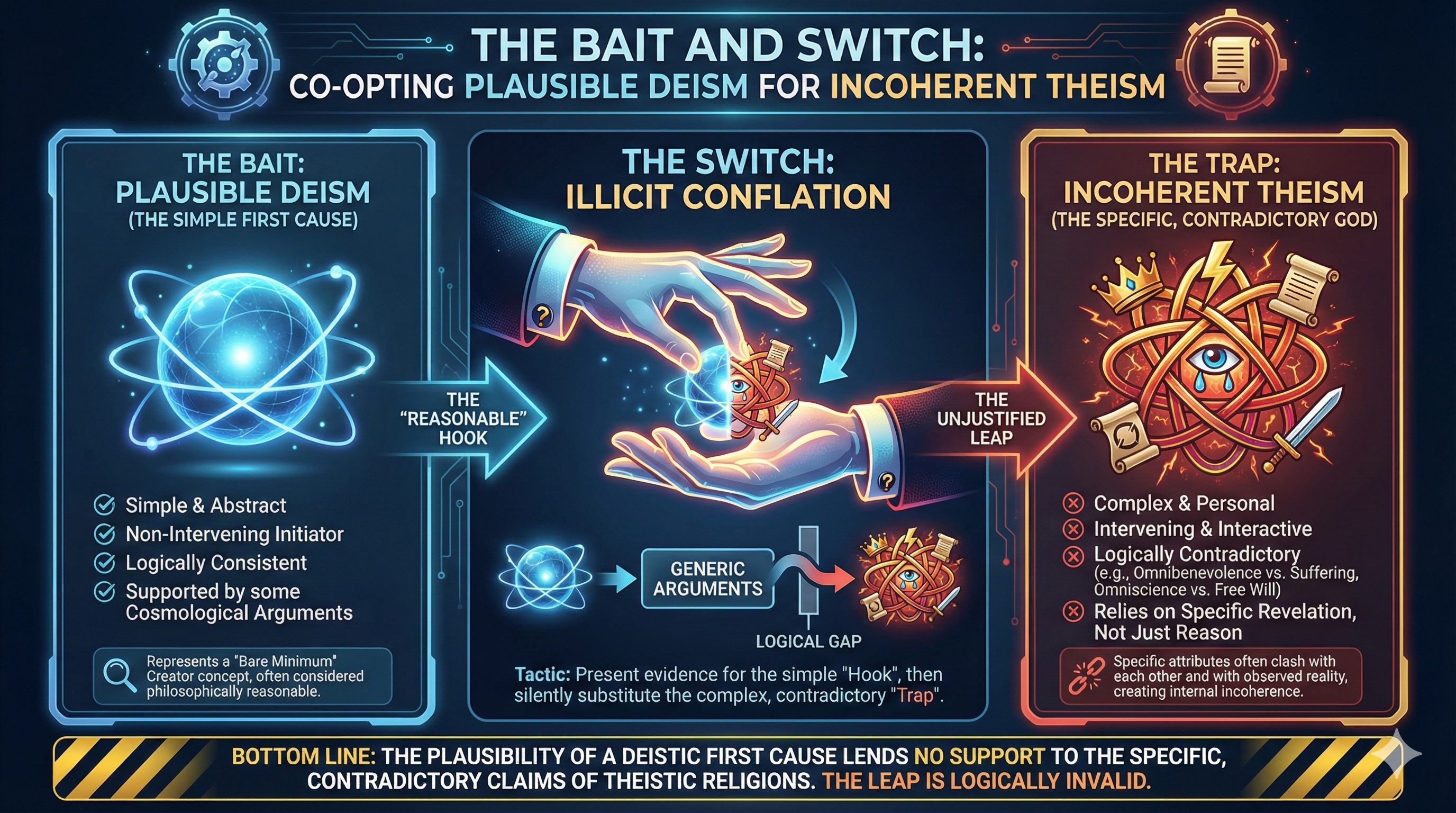
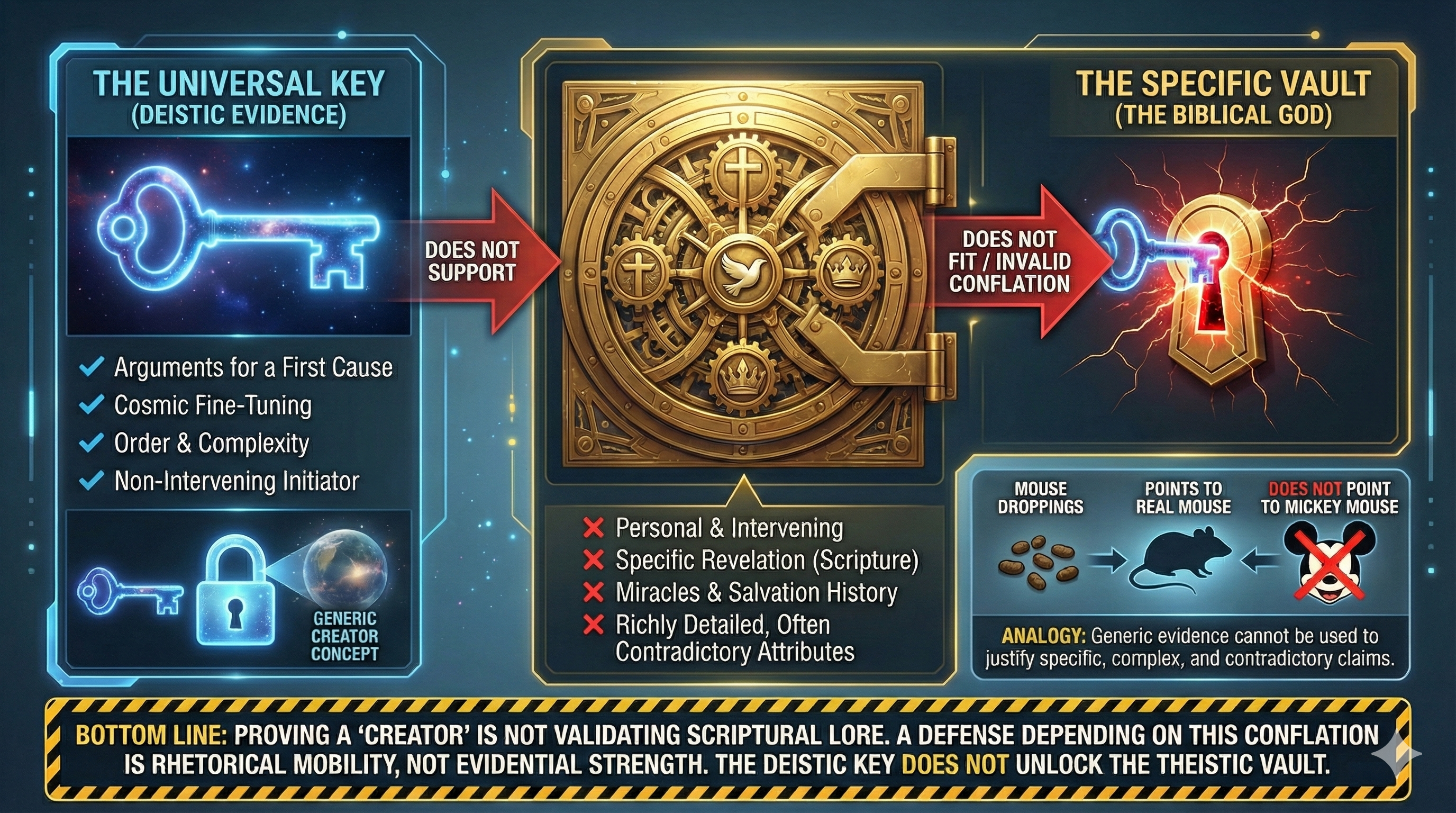
Throughout the history of theological argumentation, Christian and Muslim apologists alike have often turned to evidence for a deistic god to bolster their claims about their own, often anthropomorphic, theistic deity. The strategy is deceptively simple: first, appeal to cosmological wonders or the fine-tuning of the universe to suggest an originator of all things—a deistic creator. Then, having planted this philosophical placeholder, they take a bold leap, insisting that this creator must be none other than their specific God, complete with all the characteristics and demands of their respective religions.
But this maneuver is not as seamless as it might seem. While evidence for a deistic creator may be compelling, the transition to a theistic God is far from straightforward. It requires a leap over vast logical chasms—challenges of coherence, attributes, and implications that remain largely unexamined in these apologetic approaches.
The Evidence for a Deistic Creator
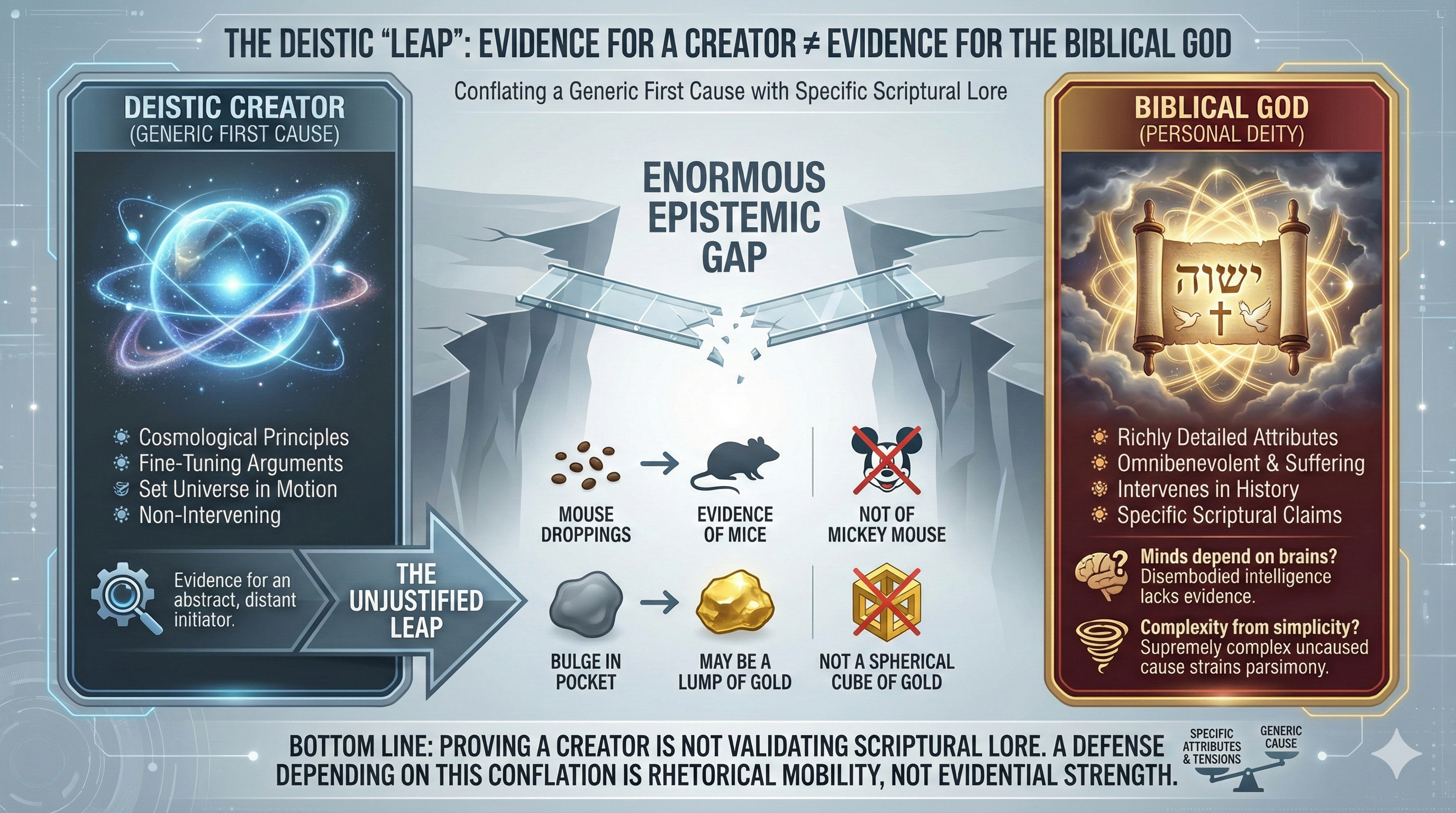
Let us first consider the case for a deistic god. Deism posits a creator who initiates the universe and its laws but does not intervene in its ongoing affairs. This creator need not possess omni-properties such as omniscience or omnipotence. Instead, the deistic god is a minimalist architect, a being whose sole act was to bring the cosmos into being.
This notion finds support in cosmological evidence. For instance:
- The Big Bang suggests a beginning to the universe, prompting questions about what initiated this event.
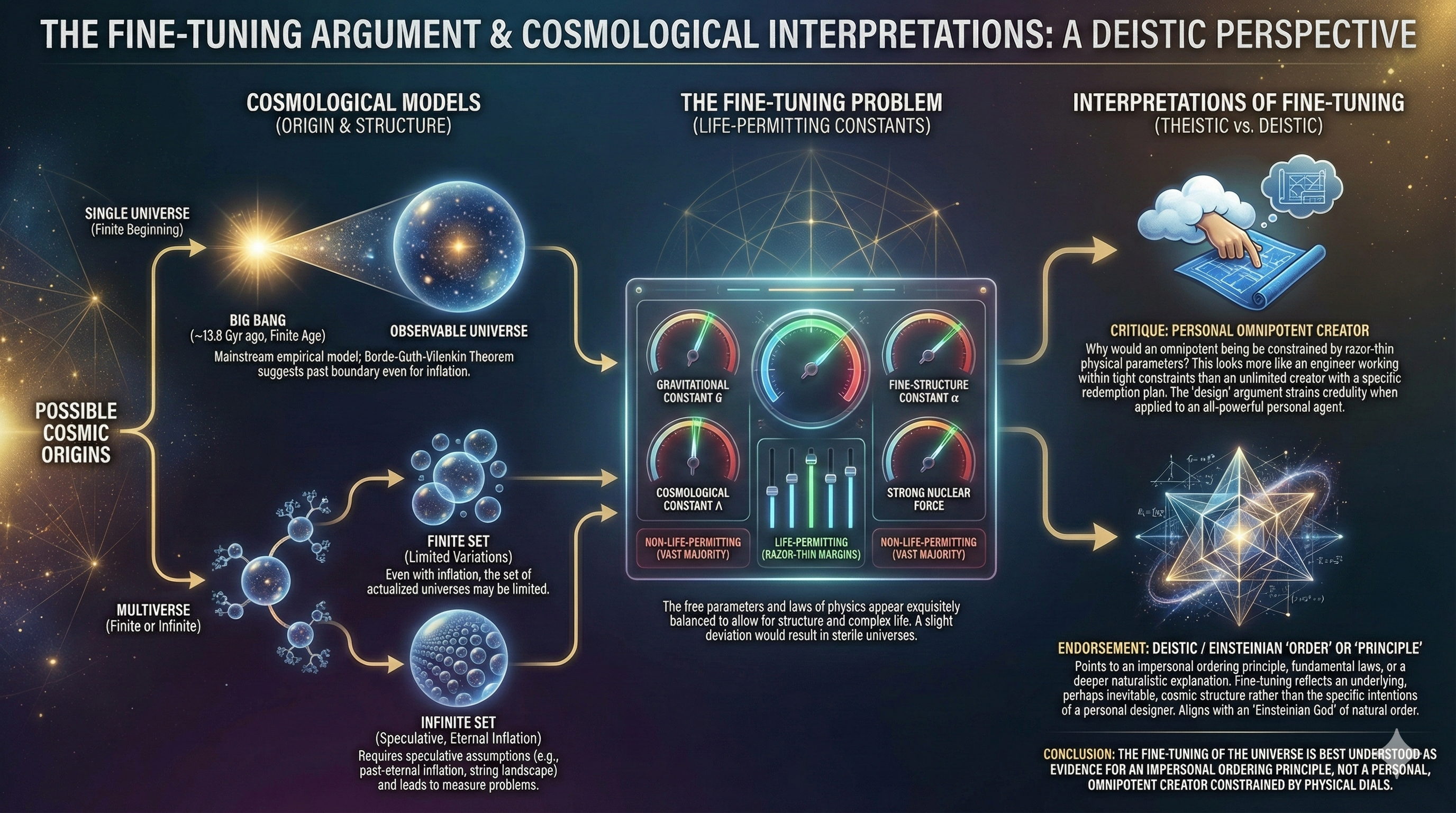
- The fine-tuning of physical constants—such as the gravitational constant or the cosmological constant—hints at the delicate conditions required for a universe capable of sustaining life.
While these phenomena do not definitively prove the existence of a creator, they provide a foundation for a plausible hypothesis: that some kind of initiating force, a deistic god, may have been involved in setting the universe into motion.
The Illegitimate Leap to Theism
Having established the possibility of a deistic creator, apologists often move swiftly to claim this creator as their theistic deity—one endowed with attributes such as omniscience, omnipotence, omnibenevolence, and personal intervention. However, this leap is fraught with difficulties.
- The Problem of Assumptions
The transition from deism to theism assumes without justification that the minimalist creator of deism would necessarily possess the attributes of a theistic god. Why must the creator care about human morality? Why must it intervene in human affairs, answer prayers, or judge souls? These attributes are not logically required of a creator who merely brought the universe into existence. - The Problem of Complexity
A deistic god is conceptually simple, defined only by the act of creation. By contrast, a theistic god is an extraordinarily complex construct, saddled with contradictory and anthropomorphic attributes. Adding omniscience, omnipotence, and omnibenevolence to the deistic god is not a small step—it is a massive expansion requiring justification. Yet apologists rarely examine the profound implications of these additional attributes. - The Problem of Religious Specificity
Even if one grants the existence of a creator, why must it be the God of Christianity or Islam? Apologists often treat the transition from a general creator to their specific deity as obvious, but this is an enormous leap. A deistic god could just as easily align with entirely different religions—or none at all. - The Problem of Evidence Mismatch
The evidence often cited for a deistic god—cosmic origins and fine-tuning—does not support the claims of a theistic god. Fine-tuning does not suggest a being that intervenes in human affairs or dictates moral codes. Apologists conflate evidence for a general creator with evidence for a specific, interventionist deity, a leap that is unsupported by the evidence itself.
The Apologist’s Shortcut
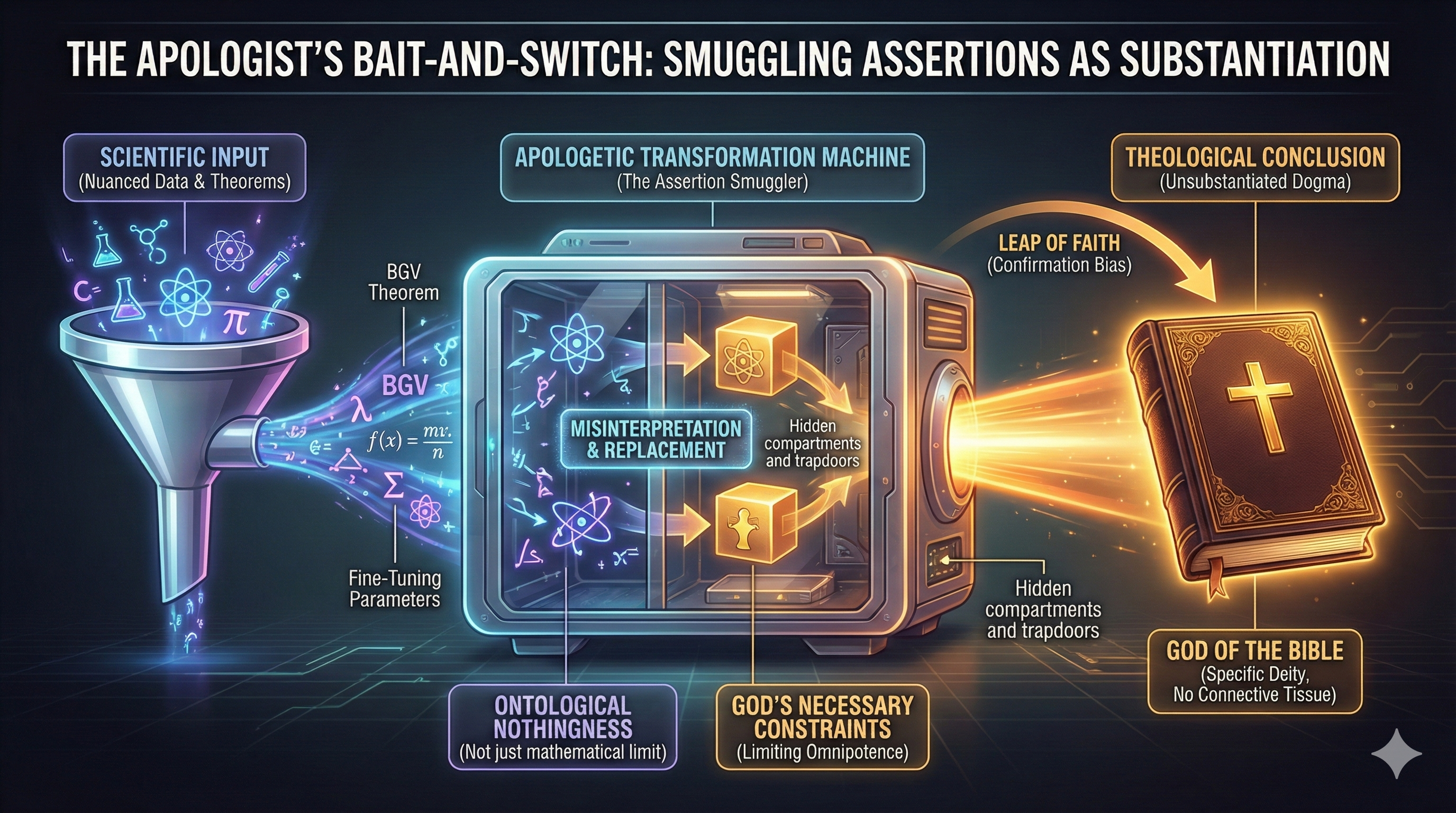
Christian and Muslim apologists use this leap as a rhetorical shortcut, bypassing the rigorous scrutiny that a theistic god demands. Once the existence of a creator is tentatively accepted, they rush to assign this role to their favorite deity, complete with its accompanying doctrines and dogmas. This move shifts the burden of proof away from themselves and onto the skeptic, who is now asked to disprove not only the existence of a creator but also the intricate web of claims associated with their specific religion.


This strategy often succeeds in rhetorical contexts, where quick analogies or emotional appeals can mask the logical gaps. However, under philosophical scrutiny, the leap from deism to theism is revealed as an act of intellectual overreach.
Conclusion
Evidence for a deistic creator is not evidence for a theistic god. The minimalist concept of a creator is logically and conceptually distinct from the intricate, anthropomorphic constructs of specific religions. Apologists who attempt to bridge this gap without examining the profound implications of a theistic god’s attributes do so illegitimately, relying on rhetorical sleight of hand rather than reasoned argument.
By conflating evidence for a deistic creator with proof of their deity, Christian and Muslim apologists risk undermining their own credibility. The deistic creator may offer a tantalizing hint of cosmic origins, but the leap to theism remains a leap too far—one that demands far greater scrutiny and justification than it is typically afforded.
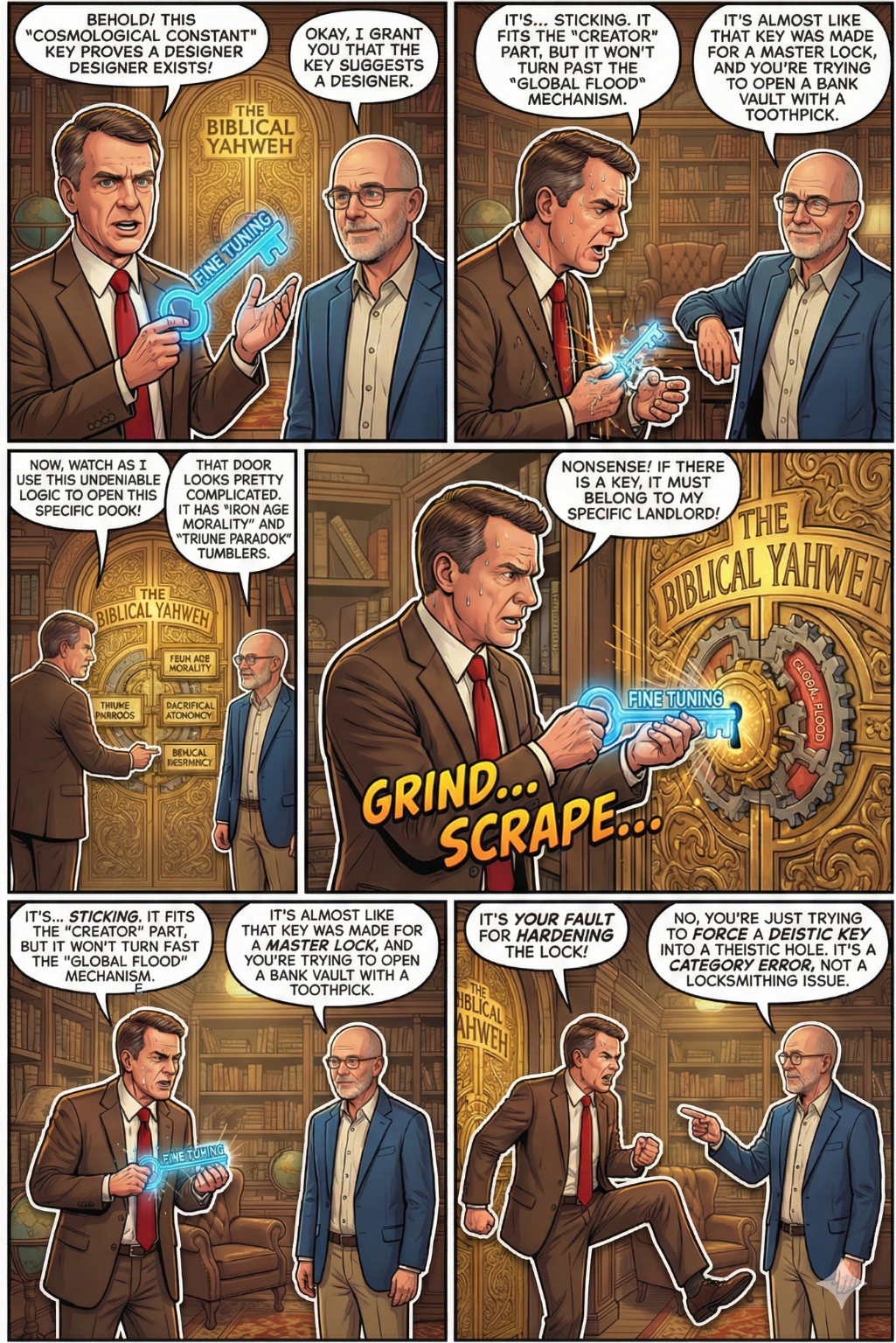
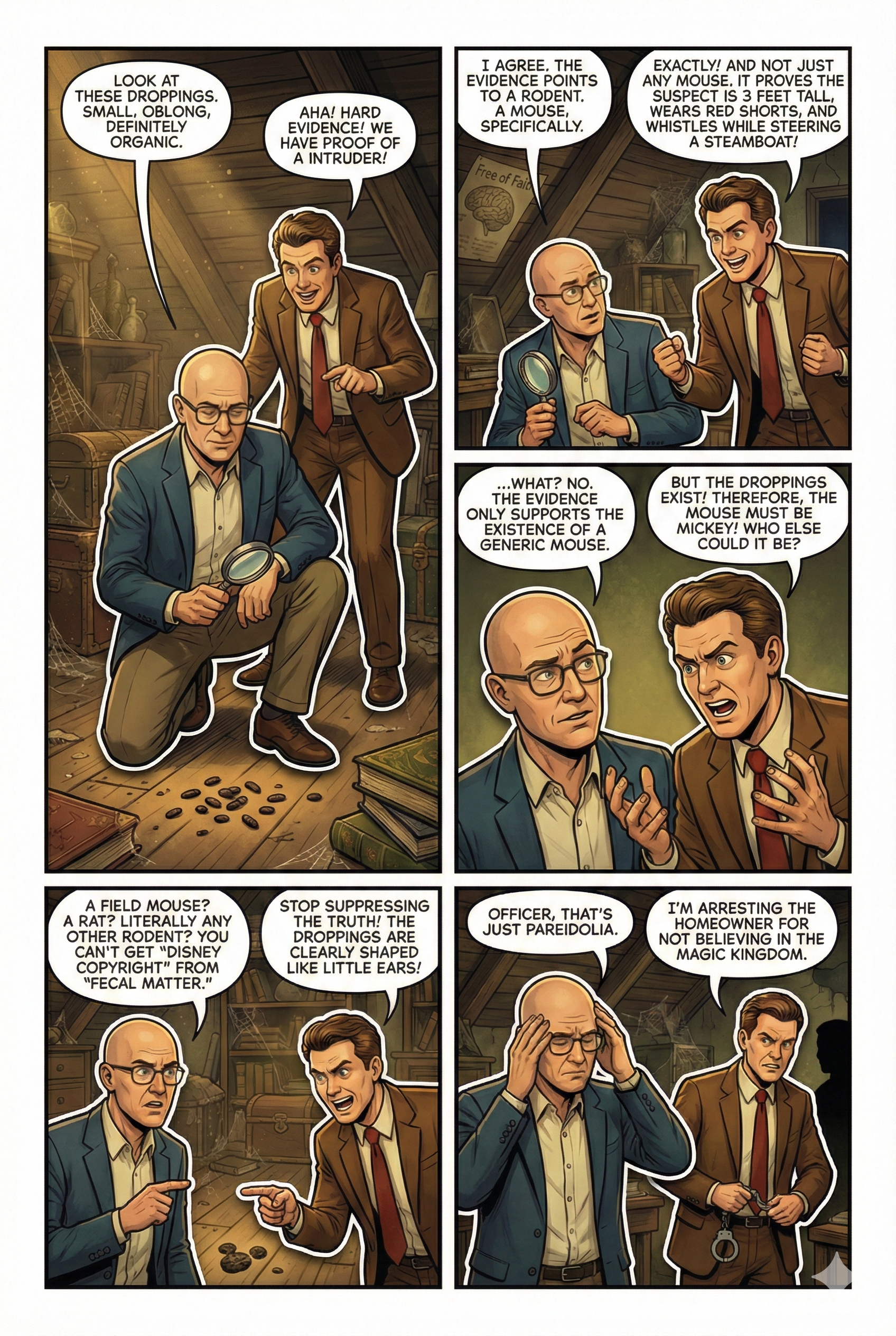
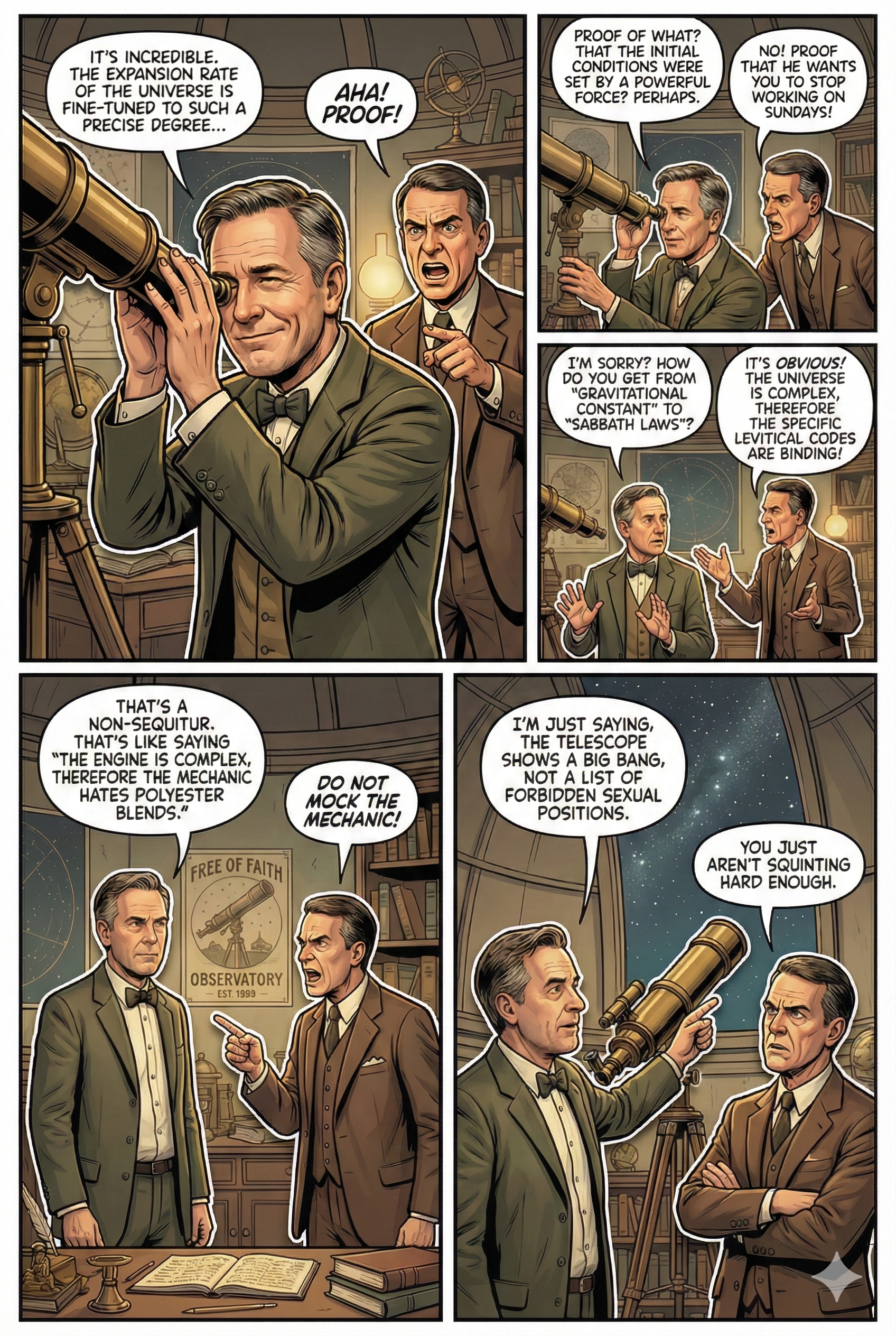
Comic Depictions

A More Rigorous Formulation:
Two main claims:
- It is logically coherent to acknowledge evidence for a deistic creator—an originator of the universe with non-contradictory attributes.
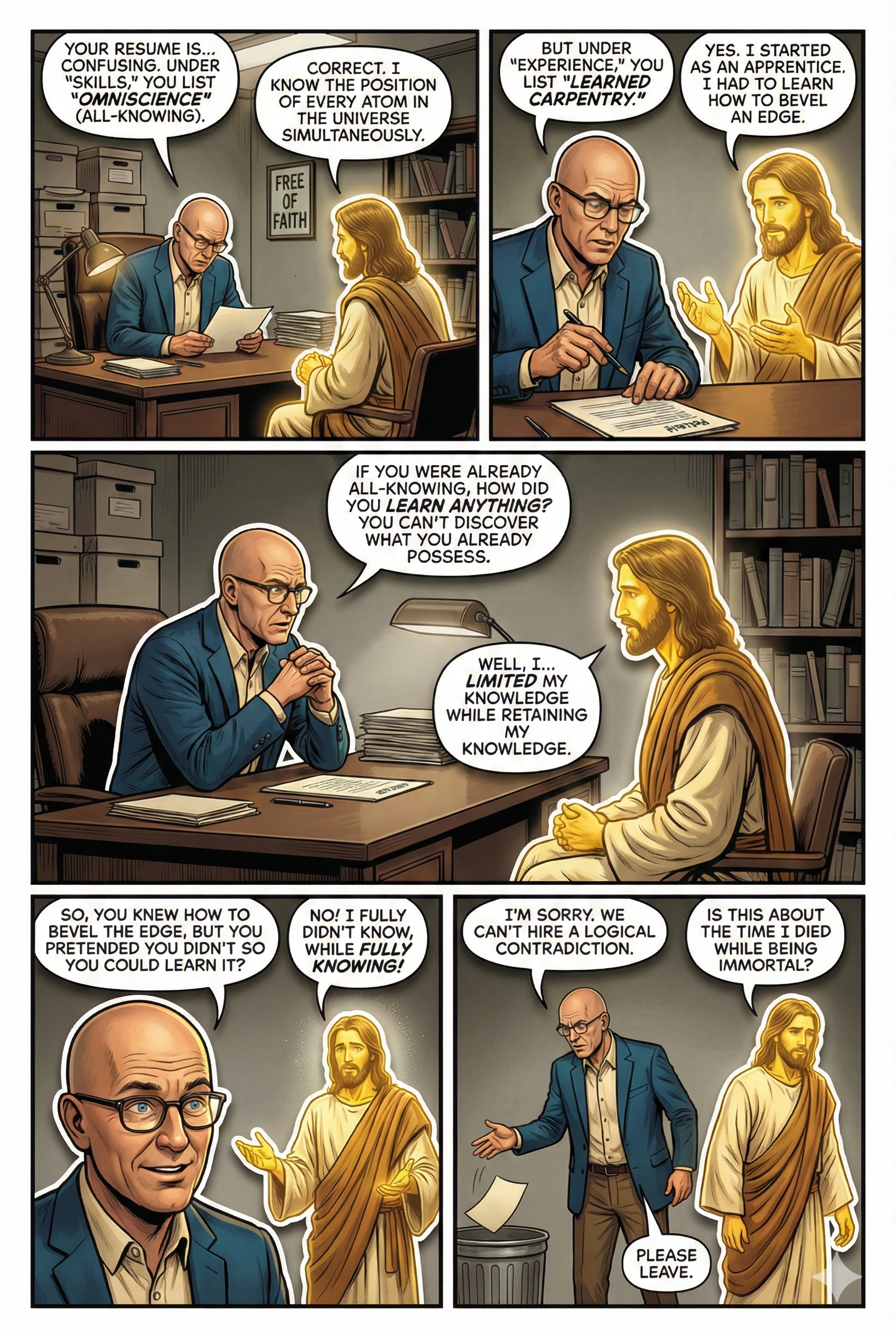
- It is deductively demonstrable that a certain deity (for example, one who is claimed to be both fully human and fully God) is logically impossible.
We will use symbolic logic to illustrate (a) why believing in a deistic creator involves no internal contradiction, and (b) how the claim of “full divinity plus full humanity” leads to contradiction.
Part I: No Contradiction in Accepting a Deistic Creator
- Definition of a Deistic Creator
Let D(x) denote “x is a deistic creator.” By deistic, we mean:caused or initiated the universe (e.g., the Big Bang).
- Consistency of a Deistic Creator
- By construction,
does not assert contradictory properties (such as “mortal and immortal” or “omniscient and not omniscient”).
- Therefore, from
- We can then posit
without implying any logical contradiction.
- By construction,
Thus,
Part II: Deductive Disproof of a Deity Claimed to Be Fully Human and Fully God
Next, we show how an entity said to be fully human and fully God, as just one example, falls into logical contradiction, making its existence impossible.
- Predicates
: x is fully God.
From: x is fully human.
From
- Symbolic Statements (for any being
- The Contradiction
Consider the proposition, meaning “There exists some being
- etc.


Because we derive a direct contradiction, classical logic tells us ![\neg \exists x ,\bigl[G(x) \wedge H(x)\bigr]](https://s0.wp.com/latex.php?latex=%5Cneg+%5Cexists+x+%2C%5Cbigl%5BG%28x%29+%5Cwedge+H%28x%29%5Cbigr%5D&bg=ffffff&fg=000&s=0&c=20201002)
Part III: Symbolic Logic Showing No Contradiction Between Believing in Deism and Disproving “Fully God–Fully Human”
We now show there is no logical inconsistency in simultaneously:
- Affirming that a deistic creator (or some being with non-contradictory attributes) may well exist.
- Denying that a being with contradictory attributes (such as “fully God and fully human”) can exist.
The following article introduces this “fully human, fully God” incoherency. It is just one of many logical incoherencies found in traditional definitions of the Christian God.
Define two key statements:
- Deistic Statement:
“There exists an - Contradictory Theistic Statement:
“There exists an

![\text{T-claim} = \exists x , [G(x) \land H(x)]](https://s0.wp.com/latex.php?latex=%5Ctext%7BT-claim%7D+%3D+%5Cexists+x+%2C+%5BG%28x%29+%5Cland+H%28x%29%5D&bg=ffffff&fg=000&s=0&c=20201002)
We have shown:
is consistent (does not inherently yield contradictory properties). Symbolically:
.
is contradictory, thus:
.
No contradiction arises in accepting
- Accepting
. The latter requires a different set of properties (full divinity plus full humanity) which we have identified as self-contradictory.
- Logically, one can hold:
without contradiction, because these statements concern different sets of attributes.
![(\exists x , D(x)) \land (\neg \exists x , [G(x) \land H(x)])](https://s0.wp.com/latex.php?latex=%28%5Cexists+x+%2C+D%28x%29%29+%5Cland+%28%5Cneg+%5Cexists+x+%2C+%5BG%28x%29+%5Cland+H%28x%29%5D%29&bg=ffffff&fg=000&s=0&c=20201002)
Hence, there is no logical obstacle to proposing a non-contradictory deistic creator while deductively disproving the existence of a contradictory theistic entity. One may believe a feather may be evidence for a biological duck without believing the absurdity of a living Donald Duck.

Conclusion
- Deistic Creator: A being that originates the universe without possessing contradictory attributes can be proposed as an evidence-based hypothesis (although not definitively proven).
- Disproof of Fully Human–Fully God Deity: Symbolic logic shows that the combined attribute set of “full divinity” (omniscience, omnipotence, immortality, infallibility) and “full humanity” (limited knowledge, limited power, mortality, fallibility) leads inevitably to mutually exclusive conditions, causing a contradiction. Therefore, such a being cannot exist.
- No Contradiction Between the Two Positions: Affirming a deistic creator and denying a contradictory theistic claim are logically compatible stances, since the deistic creator’s attributes do not overlap with those that generate the contradiction in the “fully God, fully human” assertion.
Thus, one can accept evidence for a deistic creator while deductively disproving the coherence of a being that is, for example, fully human and fully God.


 Free of Faith
Leave a comment