
Introduction

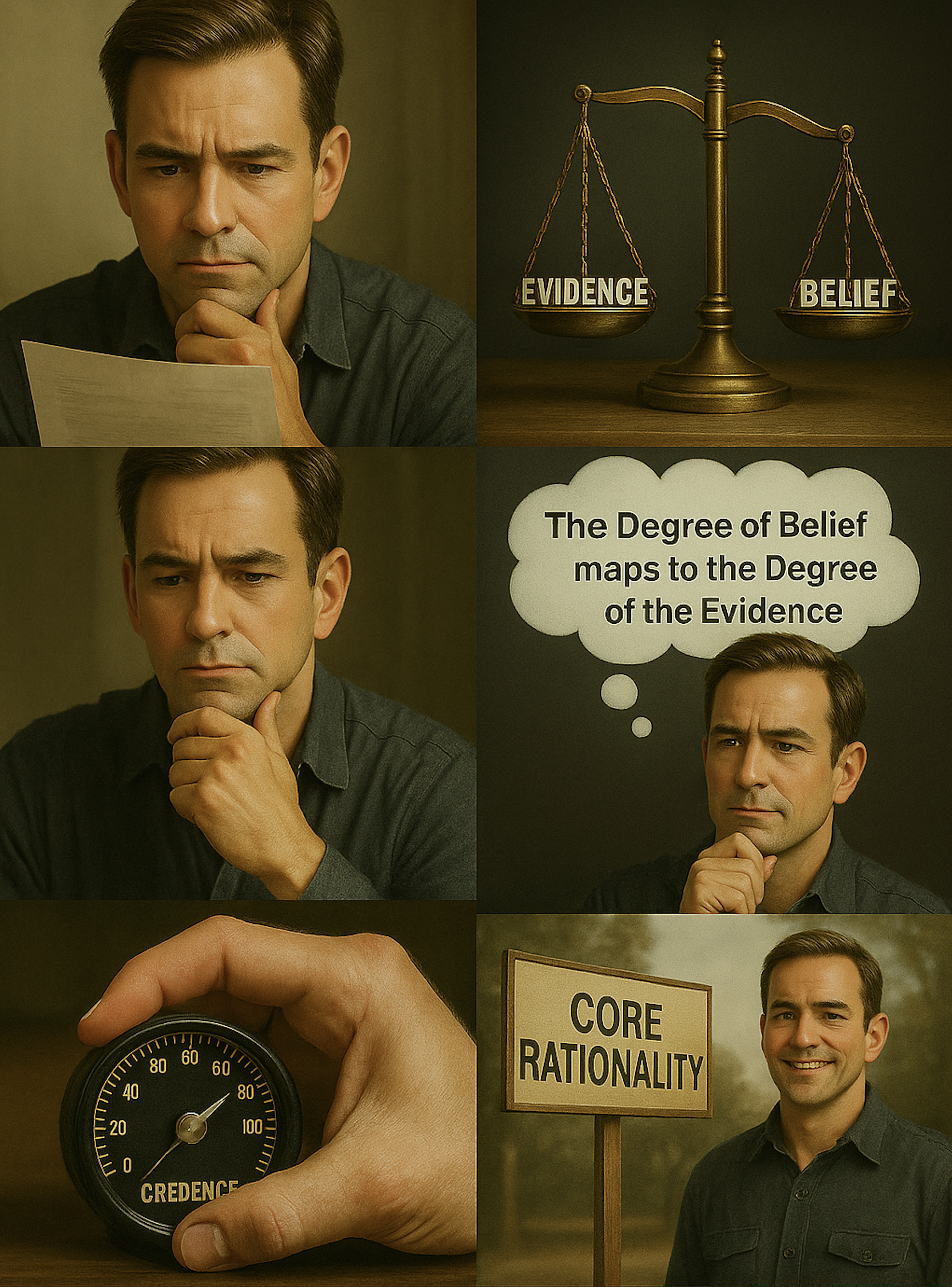
At the heart of rational inquiry lies a simple yet powerful commitment to align one’s credence with the strength of the evidence. We term this foundational discipline core rationality. It differs from deep rationality, which encompasses the extensive repertoire of analytical techniques, formal tools, and specialized methods acquired over time. Core rationality is the conscious, immediate practice of adjusting belief in proportion to available data—nothing more, nothing less.
Defining Faith and Its Irrationality
Faith can be commonly defined as a conscious severing of the degree of belief from the degree of the evidence. This deliberate decoupling is intrinsically irrational because it violates the fundamental requirement that belief strength not exceed evidential support. Moreover, faith is not limited to religious beliefs. It is a human propensity to gravitate toward greater certainty than is warranted by the evidence, whether in politics, personal relationships, or any other domain.
The Bayesian Foundation of Core Rationality
Bayesian thinking provides the formal framework for core rationality, though core rationality, in most settings, requires less mathematical rigor. In most settings, all that is required is an honest commitment to the following: Rational belief is a degree of belief that maps to the degree of the relevant evidence. Under the formalization of Bayes’ theorem, the posterior probability of a hypothesis H given evidence E is

Every component of this formula—prior 


- Prior encapsulates our initial credence before seeing the new data.
- Likelihood quantifies how expected the evidence is if the hypothesis were true.
- Evidence normalization ensures consistency across competing hypotheses.
By updating beliefs according to this rule, one maintains fidelity to the epistemic gradient, ensuring that belief adjustments never exceed what the evidence warrants.
The Necessity of Bayesian Thinking
- Precision of Belief Updates
Without a Bayesian framework, belief revision often relies on vague intuitions or rhetorical persuasion. Bayesian thinking forces us to assign concrete values—even if only implicitly—to our degrees of belief, making clear when evidence should substantially shift our stance or merely tweak it marginally. - Transparency and Accountability
Bayesian methods demand that every step in belief revision be justifiable. By specifying how likely one expects the evidence under different hypotheses, one exposes hidden assumptions and invites constructive critique. - Mitigation of Cognitive Biases
Adhering to Bayes’ theorem counteracts well-known fallacies such as the base-rate fallacy or overconfidence by embedding checks on how new information interacts with our prior assumptions.
Implementing Core Rationality in Practice
- Quantify Your Uncertainty: Even if exact numerical probabilities are impractical, adopt a mindset of relative ordering—ask yourself whether the evidence is twice as supportive of H as alternative ¬H.
- Seek Disconfirming Data: Proactively search for evidence that would lower your credence, rather than only collecting confirmatory signals.
- Document the Update: Whether in writing or mentally, note how a given datum changed your belief. This practice sharpens awareness of the epistemic gradient in action.
Contrasting Core and Deep Rationality
| Aspect | Core Rationality | Deep Rationality |
|---|---|---|
| Definition | Simple commitment to proportion belief to evidence | Mastery of formal tools such as decision theory, logic |
| Accessibility | Immediate and universal available to any thinker | Requires study and practice to acquire specialized skills |
| Function | Guides everyday judgments and belief updates | Enables complex modeling, simulation, and formal proofs |
| Goal | Avoid unwarranted polarization and dogmatism | Solve intricate problems and build high-level theories |

A Syllogism for Core Rationality
P1: Any belief whose strength exceeds its evidential support is irrational.
P2: Beliefs revised solely by Bayesian thinking never exceed their evidential support.
Conclusion: Therefore, beliefs governed by Bayesian thinking are rational.
Conclusion
Core rationality—the conscious commitment to let one’s credence mirror the evidence—is indispensable for preventing unwarranted polarization, overconfidence, and dogmatic stances. By embedding Bayesian thinking at our epistemic center, we ensure that every belief update is transparent, accountable, and precisely calibrated to what the data truly justifies. Mastery of deep rationality enriches analytical capabilities, but without the bedrock of core rationality, even the most sophisticated tools risk being applied with irrational bias.
◉ Contexts in which Core Rationality Outperforms Faith

Science: The Reluctant Paradigm Shifter
Dr. Reyes spends years championing a theory of planetary formation, convinced by early simulations that her model explains every observation. Then, an intern’s telescope data arrives, showing a star system that defies her predictions. Rather than dismiss the anomaly, she runs the numbers, quantifying how unlikely the data are under her hypothesis. Guided by her commitment to core rationality, she adjusts her model parameters and publishes a revised theory—one that better fits all the evidence. Meanwhile, her colleague clings to his cherished framework, dismissing the outlier as an error. Over time, his reputation fades as his theory stalls, while Dr. Reyes’ evidence-driven flexibility propels her to the forefront of her field.
Stock Investing: The Analyst and the Oracle
Amara, a quantitative analyst, builds a dynamic portfolio model that updates daily based on earnings reports, macroeconomic releases, and shifting volatility. One afternoon, a tech stock tumbles on unexpected guidance. Amara’s algorithm recalculates the posterior probability of further declines and reduces her position automatically. Across town, Jerome insists that the company’s “unstoppable innovation” guarantees a rebound—he invests his life savings on faith. Weeks later, the stock slides further. Amara’s fund weathers the storm and even buys opportunistically at lower prices, while Jerome faces ruin. This story shows how Bayesian updates can guard against the human propensity to seek unwarranted certainty.
Casino Gambling: The Disciplined Strategist
In a dimly lit back room of a casino, Mei keeps meticulous records of every blackjack hand she plays. She estimates the changing deck composition, updating her estimate of her edge after each dealt card. When the count turns against her, she shrinks her bets; when it swings back, she raises them. At the next table sits Tony, who palms a rabbit’s foot and swears he’ll hit his lucky streak any minute. He always doubles down on 16 because “tonight is the night.” By closing time, Tony’s bankroll is gone, while Mei walks away with modest, consistent gains. The contrast illustrates how aligning wagers with real-time probabilities outperforms faith in luck.
Prediction Markets: The Collective Intelligence Engine
On an online platform, dozens of traders buy and sell shares predicting the outcome of an upcoming election. Each new poll release, each public debate performance, triggers an update in market prices. Carla, a newcomer, watches the prices move from 40 cents to 60 cents on the “Candidate A wins” contract after a strong debate showing. She buys in, guided by the shifting odds. Meanwhile, her cousin Leo stubbornly insists the race is already decided in his candidate’s favor, refusing to change his views. On election night, Carla’s position pays out, reflecting the aggregate evidence, while Leo’s conviction rings hollow. This scenario highlights how Bayesian-like updates aggregate diverse evidence better than static belief.
Romance and Social Relationships: The Trust Calculator
When Marcus first meets Elena, he’s charmed by her warmth. Over weeks, he notes how often she keeps promises—calls, dates, small favors. He mentally updates his credence incrementally: after three no-shows, his trust dips; when she surprises him with a thoughtful gesture, it rises. He communicates openly about his evolving expectations. Across the street, Nina launches headlong into a whirlwind relationship, convinced her partner is “the one” without noticing red flags. Months later, her heartbreak stems from untested optimism. Marcus’ evidence-driven approach builds a stable partnership, illustrating that applying core rationality to emotional bonds leads to healthier outcomes than blind faith in romance.
Medical Diagnosis and Treatment: The Evidence-First Practitioner
Dr. Patel faces a perplexing patient whose symptoms overlap multiple conditions. Rather than leaping to her favorite diagnosis, she assigns prior probabilities to each possibility based on prevalence. As lab results trickle in, she updates her assessments: the likelihood of a bacterial infection drops sharply when cultures return negative, raising the posterior probability of an autoimmune cause. She adjusts her treatment plan accordingly. By contrast, a practitioner who “just knows” what’s wrong prescribes an aggressive antibiotic course—unsuitable for the actual condition—leading to complications. Dr. Patel’s disciplined Bayesian updates ensure the patient receives the right care at the right time.
Public Policy and Forecasting: The Adaptive Regulator
Governor Alvarez faces a spike in waterborne illness after historic flooding. Initially, she estimates a high risk based on models from similar events. As real-time health data and environmental readings arrive, her team updates the projected spread rate, adapting quarantine zones and resource allocation. When infection rates fall faster than expected, restrictions are eased; if a new hotspot emerges, measures tighten immediately. Citizens see clear communication about how evidence drives policy changes. In another region, officials stick to a pre-planned response, blaming “public morale” when infections surge again. The governor’s core rationality—continuously calibrating policy to the data—minimizes harm and maintains public trust far better than rigid, faith-based governance.


 Free of Faith
Leave a comment