

/#1/ Lewis’ Argument from Innate Desires
Examining the Principle of Correspondence for Innate Desires

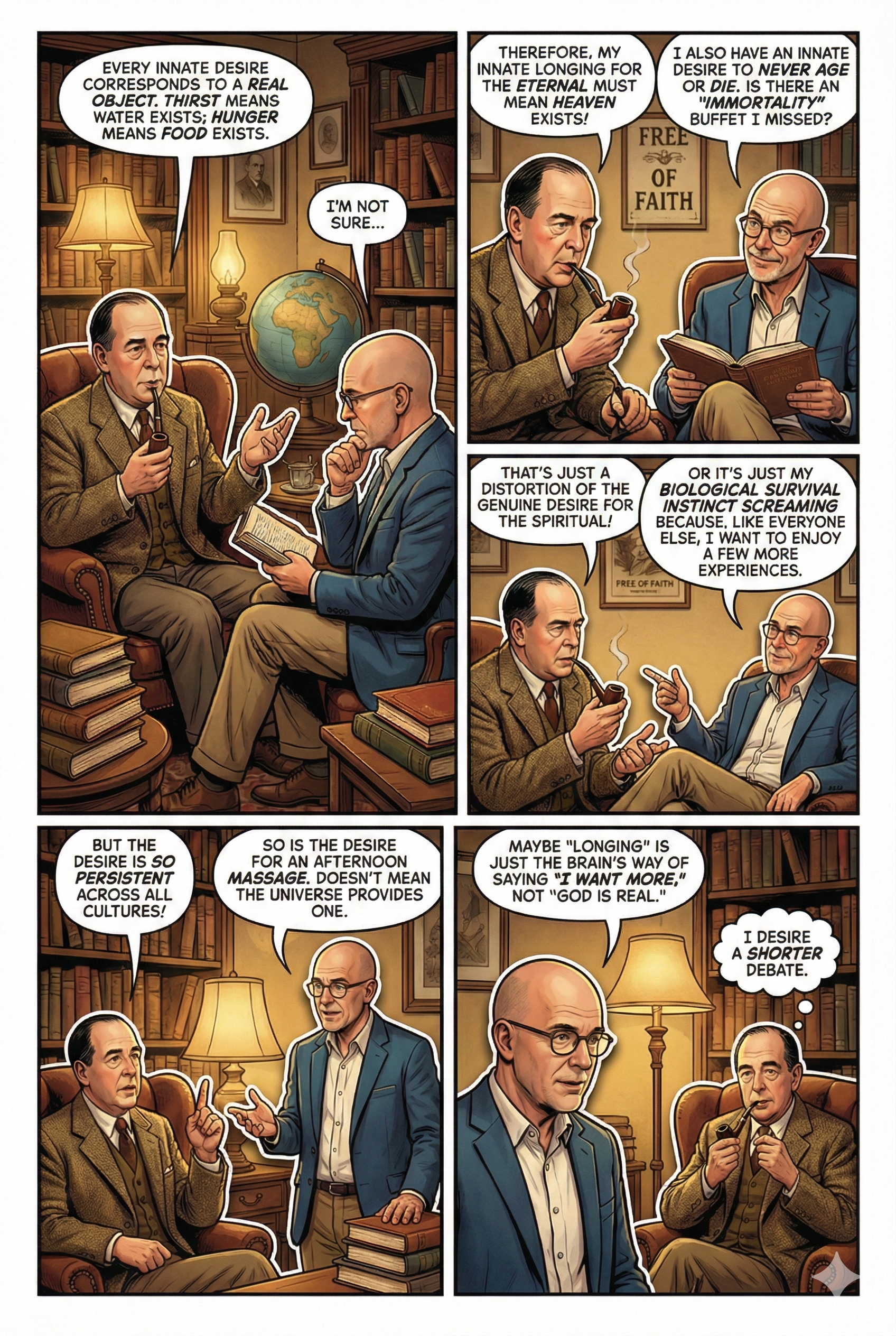
C.S. Lewis’ Argument from Desire suggests that every innate human desire corresponds to a real object capable of fulfilling it. While this argument resonates emotionally and appears logically sound at first glance, it relies on the unproven principle that every innate desire corresponds to reality. This essay critiques the universality of this principle by presenting examples of innate desires that fail to correspond to real objects. Each counterargument includes syllogistic formulations, symbolic logic, and accompanying commentary to clarify the argument and its critique.
C.S. Lewis’ Argument from Desire
Lewis’ argument can be summarized as follows:
- Every innate human desire corresponds to a real object that can satisfy it.
- Humans possess an innate desire for something transcendent and infinite that no earthly object can satisfy.
- Therefore, a transcendent and infinite reality (e.g., Heaven or God) must exist to fulfill this desire.
Symbolic Logic:
- Let
represent an innate desire.
- Let
represent a real object satisfying
- The principle assumes:
.
- Applied to transcendence:
- Conclusion:

Commentary:
This formulation is valid in its structure, but the soundness of the argument depends on the truth of the universal premise (
Counterarguments
1. Desire for Immortality
Humans universally long for immortality, yet there is no evidence that such a state exists.
Syllogistic Formulation:
- Humans desire immortality, but there is no evidence for its existence.
- The desire for immortality is better explained as a psychological response to the fear of death.
- Therefore, the desire for immortality does not imply its existence.
Symbolic Logic:
- Let
represent the innate desire for immortality.
- Counterexample:

Commentary:
The counterexample shows that the desire for immortality exists (
2. Desire for Perfect Justice
Humans innately desire perfect justice, yet the observable world fails to provide such a reality.
Syllogistic Formulation:
- Humans desire perfect justice, but the world demonstrates persistent injustice.
- The desire for perfect justice likely arises from evolved social instincts for fairness and cooperation.
- Therefore, the desire for perfect justice does not necessitate its existence.
Symbolic Logic:
- Let
represent the innate desire for justice.
- Counterexample:

Commentary:
While the desire for justice (
3. Desire for Absolute Control
Humans often long for complete control over their circumstances. However, this desire is inherently unattainable in a world governed by randomness and external forces.
Syllogistic Formulation:
- Humans desire absolute control, but no one can achieve it in a world influenced by chance and determinism.
- The desire for control is a psychological response to anxiety, not evidence of attainable control.
- Therefore, the desire for absolute control does not imply its existence.
Symbolic Logic:
- Let
represent the desire for absolute control.
- Counterexample:

Commentary:
The universal premise (
4. Desire for Cosmic Purpose
Many people long for a cosmic purpose that transcends individual existence. However, there is no empirical evidence for such a purpose.
Syllogistic Formulation:
- Humans have an innate desire for cosmic purpose, but no evidence supports the existence of such a purpose.
- The desire for purpose is likely a by-product of human abstraction and imagination.
- Therefore, the desire for cosmic purpose does not prove its existence.
Symbolic Logic:
- Let
represent the desire for a cosmic purpose.
- Counterexample:

Commentary:
The symbolic logic shows that abstract desires (
5. Desire for Eternal Happiness
Eternal happiness, defined as a state devoid of suffering, is a universal human desire. Yet the natural world provides no evidence for such a reality.
Syllogistic Formulation:
- Humans desire eternal happiness, but no observable evidence suggests such a state exists.
- The desire for happiness reflects idealized notions of transient pleasures, not evidence of eternal fulfillment.
- Therefore, the desire for eternal happiness does not correspond to reality.
Symbolic Logic:
- Let
represent the desire for eternal happiness.
- Counterexample:

Commentary:
The universal premise (
Conclusion
The principle that “every innate desire corresponds to a real object” fails to account for several significant counterexamples. Desires for immortality, perfect justice, absolute control, cosmic purpose, and eternal happiness are better explained as psychological or evolutionary by-products, not evidence of metaphysical realities. Each counterexample illustrates that innate desires (
The Arbitrary Selection of Desires in C.S. Lewis’ Argument from Desire
C.S. Lewis’ Argument from Desire asserts that every innate human desire corresponds to a real object capable of fulfilling it. From this, Lewis reasons that humanity’s deep longing for transcendence and ultimate fulfillment points to the existence of a corresponding transcendent reality (e.g., Heaven or God). While rhetorically powerful, this argument suffers from a critical oversight: Lewis arbitrarily selects a subset of human desires to support his conclusion while ignoring other desires that do not align with his theological framework. This selective approach undermines the argument’s coherence and universality.
C.S. Lewis’ Core Assumption
Lewis’ argument is grounded in the principle that every innate desire must correspond to a real object. He cites examples such as hunger (corresponding to food) and thirst (corresponding to water) as evidence of this principle. From this, he extrapolates that humanity’s longing for transcendence implies the existence of a transcendent reality.
Symbolic Logic:
- Let
- Let
- Principle:
- Applied to transcendence:
.
This principle assumes universality, yet Lewis only cites desires that support his conclusion. Desires for sexual partners, power, and wealth—equally innate and widespread—are conspicuously absent from his analysis.
1. Desire for Sexual Partners
The desire for sexual relationships is among the most universal and powerful human drives. It arises biologically, culturally, and emotionally in nearly all societies.
Counterpoint to Lewis:
- The desire for sexual partners is innate and fundamental, yet it does not correspond to a singular or universal real object.
- For example, not all individuals attain satisfying or lasting relationships, and some remain celibate by choice or circumstance.
- This desire is often frustrated or redirected, undermining the assumption that all desires correspond directly to external realities.
Implications: If the argument hinges on the universality of fulfillment, the unfulfilled desires for sexual relationships cast doubt on Lewis’ premise. A more plausible explanation is that human desires often reflect biological imperatives or cultural constructs, not metaphysical truths.
2. Desire for Power
Humans frequently desire power—over others, over circumstances, or over their own lives. This desire manifests in political ambitions, social hierarchies, and personal autonomy.
Counterpoint to Lewis:
- The desire for power is not universally satisfied, even for those who attain positions of authority.
- Many leaders find that the pursuit of power is insatiable or ultimately unfulfilling.
- This suggests that innate desires can exist independently of external realities that fully satisfy them.
Implications: Lewis’ principle cannot accommodate desires like power, which are often infinite in scope and subjectively defined. The longing for power highlights that human desires are shaped as much by psychological and societal factors as by any correspondence to real objects.
3. Desire for Wealth
The desire for wealth—resources, material possessions, or financial security—is a pervasive human drive. This desire varies in intensity but is undeniably present across cultures and historical periods.
Counterpoint to Lewis:
- The desire for wealth often leads to disappointment or dissatisfaction, even among those who achieve great riches.
- Studies in psychology reveal a phenomenon known as the “hedonic treadmill,” where individuals quickly adapt to increased wealth without sustained happiness.
- This undermines the notion that wealth as a desire corresponds to an ultimate or enduring external fulfillment.
Implications: Wealth provides a clear example of an innate desire that fails to meet Lewis’ standard of a corresponding reality. Its fulfillment is fleeting, context-dependent, and often illusory.
4. Desire for Fame
The desire for fame or recognition reflects a fundamental human need for social validation and esteem. Yet fame is ephemeral, culturally contingent, and often destructive.
Counterpoint to Lewis:
- Not everyone achieves fame, and those who do frequently find it hollow or detrimental to well-being.
- Historical examples of disillusioned celebrities underscore this point.
- This desire exemplifies how innate human drives can lead to outcomes that are not enduring or inherently fulfilling.
Implications: The desire for fame directly challenges Lewis’ assertion that every desire corresponds to a real and satisfying object. Fame may exist as an external reality, but its fulfillment is highly subjective and rarely aligns with expectations.
5. Desire for Transcendence: A Special Pleading?
Lewis’ argument uniquely elevates the desire for transcendence above other innate desires, claiming it uniquely points to a corresponding reality. Yet the mechanism for distinguishing transcendence from other desires is unclear and inconsistent.
Counterpoint to Lewis:
- If desires for transcendence are innate and correspond to an external reality, why not apply the same reasoning to other desires like power or wealth?
- By arbitrarily excluding certain desires, Lewis engages in special pleading, selecting evidence that aligns with his conclusion while ignoring counterexamples.
- Desires for transcendence may arise not from metaphysical truths but from existential fears, cognitive abstraction, or cultural narratives.
Symbolic Logic of Special Pleading:
- Let
represent the desire for transcendence.
- Let
,
, and
represent desires for wealth, power, and sexual relationships, respectively.
- Lewis asserts:
- He does not assert:
,
, or
.

Commentary:
Lewis’ exclusion of desires such as wealth (
Conclusion
C.S. Lewis’ Argument from Desire falters due to its selective focus on desires that align with his theological framework while ignoring others. Universal human desires such as those for sexual partners, power, wealth, and fame are equally innate yet often go unfulfilled or result in dissatisfaction. These examples demonstrate that desires do not reliably correspond to external realities. Lewis’ selective methodology and special pleading undermine the argument’s logical foundation, making it an unpersuasive case for the existence of a transcendent reality.
#1 — Dialogue: Lewis’ Argument from Innate Desires
Dialogue: C.S. Lewis and an Interlocutor on the Argument from Innate Desires
| C.S. Lewis | Interlocutor |
|---|---|
| It seems self-evident that every innate human desire corresponds to some real object. Hunger points to food, thirst to water, and tiredness to sleep. Why, then, would the human longing for transcendence and ultimate fulfillment not correspond to a real, transcendent reality—God? | That analogy works well for biological desires, but it doesn’t hold up for abstract or imaginative longings. For example, people have longed for immortality, utopia, or even the ability to fly, yet there’s no evidence that these correspond to real objects. Why should the longing for transcendence be any different? |
| But these longings—like immortality or utopia—often represent distortions of genuine desires. For example, the desire to fly could be seen as an exaggerated form of our need for freedom or exploration. The longing for transcendence, on the other hand, is universal and deeply rooted in the human experience, suggesting it corresponds to something real. | The universality of a longing doesn’t necessarily imply the reality of its object. Consider the widespread human desire for perfect justice. Despite its universality, there’s no evidence that perfect justice exists in any tangible or achievable form. Why should transcendence escape the same scrutiny? |
| That’s an interesting point, but universality is not the only evidence. The human longing for transcendence is distinct in that it isn’t simply wishful thinking or escapism. It arises from the profound sense that the material world cannot fully satisfy us. This dissatisfaction points us toward a higher, transcendent source. | That dissatisfaction might say more about human psychology than the existence of a transcendent reality. People’s dissatisfaction often stems from unmet expectations or emotional needs. Just because we feel unfulfilled by the material world doesn’t mean there’s a transcendent realm waiting to satisfy us. |
| Then how do you explain the depth and persistence of this longing? Surely its endurance across cultures and eras points to something more than mere emotional or social conditioning. If the longing for God were an illusion, wouldn’t it have faded away or become irrelevant over time? | Not necessarily. Persistent longings often reflect enduring psychological or evolutionary traits rather than external realities. For instance, humans have long desired immortality, yet this desire persists not because immortality exists, but because it’s a byproduct of our survival instinct and fear of death. The same could be true for the longing for transcendence. |
| But doesn’t this explanation reduce the richness and beauty of human experience to mere evolutionary mechanisms? Surely such an approach robs life of its meaning and fails to account for the profundity of aesthetic and spiritual experiences. | On the contrary, understanding the natural origins of our desires enriches our understanding of what it means to be human. The beauty and richness of life don’t require an external source for their value. We create meaning through our relationships, achievements, and experiences. The profundity you describe is a testament to human creativity and imagination, not necessarily evidence of God. |
| You’re assuming that meaning and value can be self-created, but if that’s true, how do we account for the longing for something eternal—something beyond the limits of human creativity? Surely our deepest desires point to a reality greater than ourselves. | We often long for things beyond our reach, but that doesn’t mean they exist. The desire for transcendence might simply reflect our awareness of limitations and mortality. It’s a powerful and meaningful aspect of being human, but it doesn’t require the existence of a transcendent source to make sense. |
| Then isn’t it bleak to conclude that our deepest desires might lead nowhere? Without God, what hope or purpose remains? | Not at all. The fact that we create our own meaning and purpose is empowering. It means we’re not dependent on external forces to live meaningful lives. Instead, we can find fulfillment in our finite existence, embracing the richness of the human condition without needing to project our desires onto the cosmos. |
/#2/ Lewis’ Argument from Morality
Challenging C.S. Lewis’ Argument from Morality

C.S. Lewis’ Argument from Morality asserts that the existence of a universal and objective moral law implies the existence of a transcendent source—a moral Lawgiver, identified as God. While rhetorically compelling, this argument is deeply flawed. It assumes the existence of a monolithic morality across all cultures and neglects how simple emotions, shaped by evolution and social conditioning, ground altruistic behaviors and dispositions. This essay critiques the argument with rigorous syllogistic formulations and symbolic logic, demonstrating that Lewis’ premises are neither universally valid nor logically necessary.
Lewis’ Argument from Morality
C.S. Lewis argues that the existence of a universal and objective moral law points to a transcendent Lawgiver. His reasoning is summarized as follows:
- If there exists a universal and objective moral law, then it must originate from a transcendent Lawgiver.
- A universal and objective moral law exists, recognized across human societies.
- Therefore, a transcendent Lawgiver exists.
Symbolic Logic and Definitions
Symbols Defined
: Represents a universal and objective moral law.
: Represents a transcendent Lawgiver.
: Represents variations in moral behavior across cultures.
: Represents emotional or evolutionary grounding for behaviors.
Symbolic Logic
- Premise 1:
Annotation: If there exists a universal moral law, it must originate from a transcendent Lawgiver. - Premise 2:
Annotation: A universal and objective moral law exists. - Conclusion:
Annotation: Therefore, a transcendent Lawgiver exists.


Critique of Lewis’ Premises
Lewis’ argument rests on the assumption that a universal and objective moral law exists. However, examining cross-cultural examples demonstrates that behaviors often described as “moral” are better explained by emotional and social conditioning than by universal principles.
Critiquing the Universality of Morality
1. Killing in Self-Defense vs. Honor Killings
Example: In Western societies, killing in self-defense is widely accepted, while honor killings are condemned. In contrast, some traditional societies endorse honor killings as a means of preserving family reputation.
Syllogistic Formulation:
- Premise 1: Human behaviors labeled as “moral” vary significantly between cultures (e.g., self-defense vs. honor killings).
- Premise 2: These behaviors are better explained by context-specific emotional responses, such as fear, anger, or shame, rather than by a universal moral law.
- Conclusion: Therefore, what is labeled “moral” reflects emotional and social conditioning, not a universal standard.
Symbolic Logic:
- Premise 1:
Annotation: There are variations in moral behavior across cultures. - Premise 2:
Annotation: Variations in behavior are grounded in emotional responses. - Conclusion:
Annotation: The variability in moral behavior contradicts the existence of a universal moral law.


Analysis: The emotional triggers—fear in self-defense and shame in honor killings—account for these behavioral differences, undermining Lewis’ claim of a universal standard.
2. Sharing Resources: Individualism vs. Collectivism
Example: Collectivist societies, such as traditional East Asian cultures, emphasize sharing resources as a duty to the community. Conversely, individualist cultures, like the United States, prioritize personal ownership and autonomy.
Syllogistic Formulation:
- Premise 1: Behaviors like resource-sharing depend on cultural norms, which vary widely between collectivist and individualist societies.
- Premise 2: These norms are grounded in emotions like empathy, guilt, pride, or autonomy, not in a universal moral principle.
- Conclusion: Therefore, the variability of resource-sharing undermines the claim of a universal moral law.
Symbolic Logic:
- Premise 1:
Annotation: Cultural differences in moral behavior exist. - Premise 2:
Annotation: These differences are grounded in emotional responses. - Conclusion:
Annotation: The variability undermines the claim of a universal moral law.
Analysis: Social harmony is achieved differently depending on cultural priorities, reflecting emotional foundations rather than a universal standard.
3. Honesty: Pragmatism vs. Absolute Truth
Example: Western cultures often view honesty as a fundamental virtue, while many East Asian cultures prioritize harmony over truth, favoring “white lies” to avoid conflict.
Syllogistic Formulation:
- Premise 1: Attitudes toward honesty vary by culture, with some valuing it as absolute and others treating it pragmatically.
- Premise 2: These attitudes stem from context-specific emotions, such as trust, guilt, empathy, or fear of conflict.
- Conclusion: Therefore, honesty is not governed by a universal moral law but by situational emotional factors.
Symbolic Logic:
- Premise 1:
Annotation: Variations in honesty exist across cultures. - Premise 2:
Annotation: These variations are grounded in emotional responses. - Conclusion:
Annotation: Honesty reflects emotional and cultural differences, not a universal standard.
Analysis: Honesty is applied differently depending on cultural and emotional contexts, contradicting the idea of a universal moral law.
4. Altruism as an Evolutionary Trait
Example: Behaviors like helping others or sharing resources can be explained as evolutionary adaptations that enhance group survival.
Syllogistic Formulation:
- Premise 1: Altruistic behaviors promote group survival and are selected for through evolution.
- Premise 2: These behaviors do not require a transcendent source but arise naturally from evolutionary pressures.
- Conclusion: Therefore, altruistic behaviors do not depend on a universal moral law.
Symbolic Logic:
- Premise 1:
Annotation: Altruistic behaviors are explained by evolution. - Premise 2:
Annotation: Evolutionary origins negate the need for a universal moral law. - Conclusion:
Annotation: Altruism does not depend on a universal moral law.


Analysis: Evolutionary pressures explain altruism without invoking a transcendent or universal source.
Conclusion
C.S. Lewis’ argument from morality hinges on the existence of a universal moral law (

Jack Johnston’s Response to C.S. Lewis’s Moral Argument
The Emotional Basis of Human Behavior Often Mistaken for Universal Morality
Human behaviors frequently described as reflections of a universal morality are better explained as manifestations of common human emotions and socially conditioned emotional values. These behaviors arise not from adherence to an objective moral standard but from the shared emotional landscape of humanity and the diverse ways in which communities prioritize and interpret these emotions. This essay demonstrates that both the commonality in human behaviors and their diversity are grounded in emotional dynamics rather than a universal moral framework.
The Commonality of Human Behaviors Explained by Shared Emotions
Human beings share a suite of emotions—such as empathy, fear, anger, guilt, and pride—that are biologically ingrained and evolutionarily advantageous. These shared emotions underpin many behaviors that are mistakenly attributed to universal moral principles.
1. Empathy Drives Cooperative Behavior
Empathy, the ability to understand and share the feelings of others, is a cornerstone of cooperative behavior. Humans universally exhibit behaviors such as helping those in distress or protecting vulnerable members of their communities. These actions are often labeled as moral but are better explained by empathy’s role in fostering group cohesion and survival.
Example:
- Behaviors like rescuing a drowning child or assisting an injured stranger transcend cultural boundaries. However, these actions arise not from an abstract moral principle but from the emotional discomfort of witnessing suffering and the empathetic desire to alleviate it.
Conclusion:
The ubiquity of empathetic behaviors across cultures reflects a common emotional capacity, not adherence to a universal moral standard.
2. Fear Regulates Harmful Actions
Fear, particularly the fear of retaliation or social exclusion, plays a critical role in discouraging behaviors that might harm others. Rules against theft, violence, and betrayal are often framed as moral universals but are grounded in the practical need to maintain safety and social harmony.
Example:
- Societies across the world condemn murder, but this consensus arises from the shared fear of living in a chaotic, unsafe environment rather than from an inherent moral truth.
Conclusion:
The avoidance of harm is an emotional response to fear, reinforced by practical considerations, not a reflection of a transcendent moral law.
3. Pride and Guilt Shape Altruistic Actions
Pride in fulfilling social expectations and guilt over violating them are powerful motivators of altruistic behavior. These emotions ensure that individuals align their actions with the values of their communities.
Example:
- In collectivist cultures, sharing resources with extended family elicits pride, while failing to do so brings guilt. In individualist societies, pride is tied to self-sufficiency, and guilt stems from perceived selfishness.
Conclusion:
The underlying emotional mechanisms of pride and guilt explain altruistic actions far more convincingly than an appeal to universal moral rules.
The Diversity of Human Behaviors Explained by Emotional Values
While certain emotions are common to all humans, how they are prioritized and expressed varies widely across cultures. This diversity accounts for the apparent contradictions in behaviors often labeled as moral.
1. Cultural Differences in Honesty
Honesty is praised in some cultures as a cardinal virtue, while others emphasize harmony over truthfulness, permitting or even encouraging “white lies” to maintain social peace.
Example:
- In Western societies, individuals are often praised for candidly expressing their thoughts, even if it causes discomfort. In contrast, East Asian cultures may prioritize avoiding conflict, viewing small untruths as necessary for preserving relationships.
Emotional Basis:
- Western Approach: Pride in authenticity and trustworthiness.
- East Asian Approach: Empathy for others’ feelings and fear of social discord.
Conclusion:
These differences are best explained by the emotional values each culture emphasizes, not by adherence to conflicting moral universals.
2. Approaches to Resource Sharing
Resource-sharing norms vary drastically between collectivist and individualist societies, reflecting different emotional priorities.
Example:
- Among hunter-gatherer groups, sharing resources is an expected behavior driven by compassion and reciprocity. Conversely, in capitalist societies, individual ownership is celebrated, and resource-sharing is often seen as charity rather than duty.
Emotional Basis:
- Collectivist Approach: Empathy for community members and fear of ostracism.
- Individualist Approach: Pride in self-reliance and guilt over perceived dependency.
Conclusion:
The diversity of sharing practices reflects community-specific emotional priorities rather than universal moral laws.
3. Variations in Justice Practices
Justice is another domain where cultural diversity challenges the idea of a universal moral standard. Some cultures prioritize retributive justice, while others emphasize reconciliation.
Example:
- In many tribal societies, acts of revenge are considered just and necessary to restore honor. In contrast, modern legal systems often focus on rehabilitation or restorative justice.
Emotional Basis:
- Retributive Approach: Anger and a desire for honor.
- Restorative Approach: Empathy for offenders and a hope for social harmony.
Conclusion:
These differences arise from contrasting emotional responses to conflict, not from fundamentally different moral codes.
The Emotional Grounding of Both Commonality and Diversity
The Common Thread: Universal Emotions
The shared emotional capacities of humans, such as empathy, fear, anger, and pride, account for the commonality of behaviors across cultures. These emotions naturally lead to behaviors that promote cooperation, reduce harm, and sustain social harmony—traits advantageous for survival.
The Divergence: Culturally Conditioned Values
Cultural diversity in behaviors arises from how societies prioritize and interpret these shared emotions. For example:
- Empathy: In one culture, it may prioritize family, while in another, it may extend to strangers.
- Fear: In one context, fear may discourage theft, while in another, it may enforce group loyalty.
These variations reflect the adaptability of emotional dispositions, not adherence to conflicting moral universals.
Conclusion
Human behaviors often labeled as moral are better understood as reflections of common human emotions and their culturally specific expressions. Both the commonality and diversity in these behaviors arise from shared emotional capacities and community-defined emotional values, rather than from a universal or transcendent moral standard. By grounding altruistic behaviors and social norms in emotions, we gain a more coherent and empirically supported understanding of human conduct—one that recognizes its deep emotional roots without invoking unnecessary metaphysical explanations.
#2 — Dialogue: Lewis’ Argument from Morality
Dialogue: C.S. Lewis and an Interlocutor on the Argument from Morality
| C.S. Lewis | Interlocutor |
|---|---|
| It seems clear to me that without God, there is no grounding for objective moral values. If morality is purely subjective or culturally relative, we lose the foundation for declaring anything truly right or wrong. The existence of objective moral values and duties points directly to a moral Lawgiver—God. | I don’t think that follows. Morality doesn’t need a divine source to be objective. It can emerge from shared human experiences, logical consistency, and the requirements for social cooperation. Societies develop moral systems because they work, not necessarily because they’re dictated by a higher being. |
| But if morality arises only from social or evolutionary pressures, it becomes arbitrary. What’s right in one society could be wrong in another, and we’d have no grounds to condemn practices like slavery or genocide in other cultures. Only a transcendent moral law can provide the absolute standard we need. | I agree that morality varies between cultures, but that doesn’t mean it’s arbitrary. Human morality evolves as societies learn from experience. We condemn slavery and genocide today not because of divine revelation, but because we’ve developed empathy and rational principles like fairness and equality over time. Those principles arise naturally from human interaction, not from a divine command. |
| If morality is the result of human evolution, it’s still subjective, isn’t it? What one society sees as moral might contradict the values of another. Without a universal standard, how can we say that one culture’s morality is better or worse than another’s? | We can judge moral systems by their consequences—how well they promote well-being, reduce harm, and encourage cooperation. This doesn’t require a universal moral standard imposed by God, only shared human values and reasoning. For example, societies that reject slavery have thrived, while those that perpetuated it have faced significant internal conflict and collapse. |
| But consequences aren’t enough to ground morality. Without an absolute standard, morality becomes a matter of convenience rather than truth. For instance, if a society benefits from oppression, would that make oppression moral in that context? | Not at all. Oppression might benefit a select group temporarily, but it inevitably harms others and creates instability. Rationality and empathy allow us to see beyond immediate benefits to long-term consequences. Morality isn’t about convenience; it’s about principles that maximize well-being and fairness for all. |
| Yet rationality and empathy can differ from person to person, and even within a single society. Isn’t it dangerous to base morality on such shifting foundations? Only a divine moral Lawgiver can provide the unchanging standard we need to guide us. | I’d argue that unchanging standards are actually problematic because they fail to adapt to new knowledge and circumstances. Consider how religious texts condoned slavery or gender inequality in the past. Morality improves when it evolves alongside human understanding. A static, divine standard would freeze morality in time, making it less relevant to modern challenges. |
| Then what do you say about the human sense of moral obligation? People everywhere feel a deep sense of “oughtness,” even when it conflicts with their self-interest. Doesn’t this universal moral intuition point to something beyond human society? | Moral intuition is a product of evolution and social conditioning. It’s an adaptive mechanism that fosters cooperation and social harmony. Feeling a sense of “oughtness” doesn’t mean there’s a divine source behind it—it just means we’ve internalized norms that help us survive and thrive in groups. |
| But doesn’t this explanation strip morality of its depth and importance? If it’s all just evolution and social conditioning, where’s the meaning? | On the contrary, understanding morality’s origins enhances its importance. It shows us how deeply connected we are to one another and how much we depend on cooperation to flourish. Morality’s meaning comes from the role it plays in human life, not from a supposed divine origin. |
| The position of the editor is that of moral anti-realism. Comment on your interest in this position in the comments section if you’d like to explore or debate this. |
/#3/ Lewis’ Argument from Reason
Testing Reasoning Without Assuming Divine Origins

C.S. Lewis’ Argument from Reason posits that the reliability of human reasoning depends on its divine origin. He asserts that under naturalism, human reasoning, being a product of non-rational processes, would be untrustworthy. This argument, however, is both circular and inconsistent with how reasoning is tested in real-world contexts. Both Christians and non-Christians validate reasoning not by assuming it is divinely grounded but by testing it against reality. This essay will demonstrate, with robust examples and logical formulations, that the reliability of reasoning is grounded in its practical success and alignment with external reality, not in metaphysical assumptions.
1. Testing Reasoning in Education
Argument
Children do not assume their reasoning is divinely grounded when learning new concepts. Instead, they repeatedly test their reasoning against external standards, refining it through feedback and observation.
Example:
A child learning basic arithmetic initially might believe 
Syllogistic Formulation:
- Reliable reasoning is validated through consistent alignment with observed results, not assumptions about its origin.
- Children test their reasoning through external feedback and correction.
- Therefore, reliable reasoning is established through practical testing, not assumptions of divine origin.
Symbolic Logic:
- Let
- Let
represent testing reasoning against external reality.
- Let
represent the assumption of divine origin.
- Premise 1:
- Premise 2:
- Conclusion:


2. Testing Cognitive Decline in Old Age
Argument
Elderly individuals assess the reliability of their reasoning not by assuming divine origins but by comparing their cognitive performance to objective standards, such as memory tests or problem-solving exercises.
Example:
A senior citizen concerned about potential dementia might undergo a cognitive test administered by a doctor. The test evaluates their reasoning objectively, without invoking metaphysical claims about its source.
Syllogistic Formulation:
- Reasoning reliability is assessed through observable performance, not assumptions about its origin.
- The elderly evaluate reasoning against objective criteria, not theological assumptions.
- Therefore, reasoning reliability is validated by its observable functionality, not divine origins.
Symbolic Logic:
- Let
- Let
represent observable functionality.
- Let
- Premise 1:
- Premise 2:
- Conclusion:


3. Testing Theories in Science
Argument
Scientists validate reasoning through empirical testing, reproducibility, and peer review. These methods rely on the practical success of reasoning, not its purported divine origin.
Example:
A physicist testing a new theory relies on experiments and data to confirm its validity. Reasoning is trusted to the extent that it produces reliable, repeatable results, not because of metaphysical assumptions about its source.
Syllogistic Formulation:
- Reasoning is validated through empirical testing and reproducibility.
- Empirical testing evaluates reasoning based on its practical success, not assumptions about divine origins.
- Therefore, reasoning reliability is grounded in empirical validation, not metaphysical assumptions.
Symbolic Logic:
- Let
- Let
- Let
- Premise 1:
- Premise 2:
- Conclusion:


4. Everyday Practical Decisions
Argument
In everyday life, reasoning is tested against reality through its success in achieving practical outcomes, not by assuming its divine origin.
Example:
A hiker navigating with a map tests their reasoning by comparing expected landmarks with observed landmarks. If their reasoning leads them astray, they adjust it based on reality.
Syllogistic Formulation:
- Reasoning reliability is judged by its practical success in aligning with reality.
- Practical success does not require assumptions about divine origins.
- Therefore, reasoning reliability is established by its success, not metaphysical assumptions.
Symbolic Logic:
- Let
- Let
represent practical success.
- Let
- Premise 1:
- Premise 2:
- Conclusion:


5. The Circularity of Lewis’ Position
Lewis argues that human reasoning is reliable because it comes from God, and that God exists because human reasoning is reliable. This creates a circular problem:
Syllogistic Formulation:
- Human reasoning is reliable because it comes from God.
- We know God exists because human reasoning is reliable.
- Therefore, the argument assumes what it seeks to prove.
Symbolic Logic:
- Let
represent the existence of God.
- Let
- Premise 1:
- Premise 2:
- Conclusion:
- Circularity: The reliability of reasoning (


6. The Wristwatch Analogy
Argument
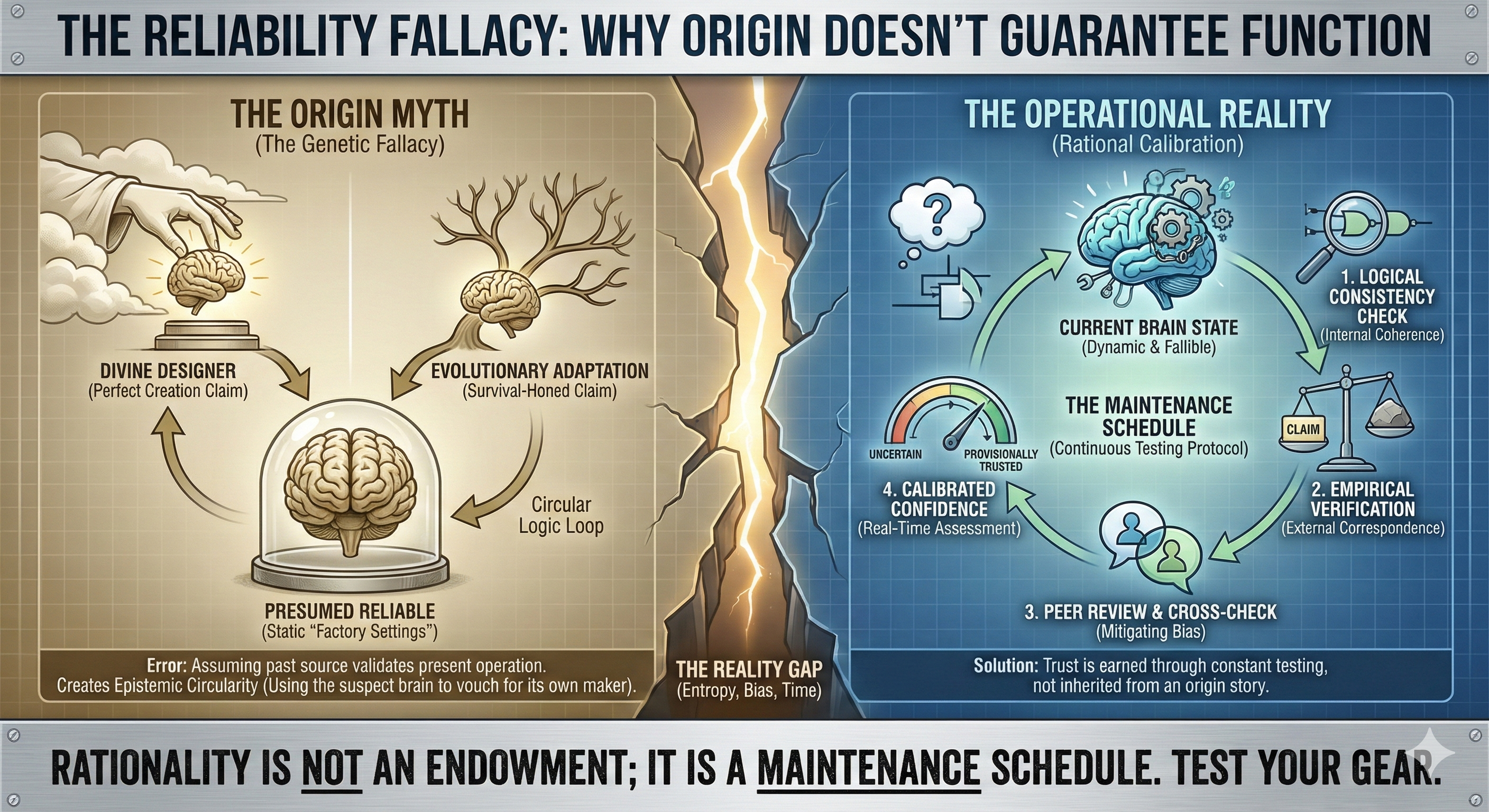
The reliability of reasoning is like the functionality of a wristwatch: it must be tested directly against reality. Just as a watch’s accuracy is judged by comparing it to a reliable clock, reasoning is validated by its success in navigating the world, not by appealing to its origins.
Example:
If you find a watch in the forest, you don’t assume it works simply because it has a manufacturer. You test it by comparing its timekeeping to a known standard, such as the position of the sun or another clock.
Syllogistic Formulation:
- Reliability is determined by comparison to external standards, not assumptions about origins.
- Reasoning, like a wristwatch, is validated through testing, not assumptions about its manufacturer.
- Therefore, reasoning reliability is established through testing, not metaphysical assumptions.
Symbolic Logic:
- Let
- Let
- Let
represent assumptions about origins (e.g., manufacturer).
- Premise 1:
- Premise 2:
- Conclusion:


Conclusion
Both Christians and non-Christians validate reasoning not by assuming its divine origin but by testing it against reality. Children refine their reasoning through education, the elderly assess cognitive health through external tests, and scientists evaluate reasoning through empirical methods. Practical success, not metaphysical assumptions, establishes reasoning’s reliability. C.S. Lewis’ argument is circular, as it assumes reasoning is reliable because of God and God exists because reasoning is reliable. Reasoning is better understood as a practical tool, validated like a wristwatch—through direct testing, not by appealing to its origins.

A Mind Awoken: Testing the Reliability of Reason After Memory Loss
Imagine a man waking up in an unfamiliar room after brain surgery. His memory is blank—he has no recollection of ever relying on his mind and no belief in a mind-creating God. He finds himself surrounded by basic household objects: a chair, a clock, a book, a ball, and a mirror. Stripped of assumptions about the reliability of his mind, he must use these items to test its functionality. His journey of discovery demonstrates how reasoning can be validated through interactions with reality, without invoking metaphysical beliefs.
1. Testing Consistency: The Ball and Gravity
The man notices a ball on the floor. He picks it up, holds it at chest height, and lets it go. The ball falls to the floor. He repeats the action several times, from different heights, observing the same result: the ball always falls downward.
Rationale:
By observing consistent outcomes, the man begins to form a rudimentary understanding of cause and effect. His reasoning aligns with external reality if he can predict that the ball will fall each time he lets it go.
Test:
- Drop the ball from different positions and heights.
- Predict its behavior and check if the prediction matches the outcome.
Conclusion:
Consistency in observed phenomena (e.g., the ball always falls) validates the mind’s ability to identify patterns and make reliable predictions.
2. Testing Perception: The Mirror
The man spots a mirror on the wall. He approaches it, startled to see his own reflection. He moves his hand, observing the reflected hand move in synchrony.
Rationale:
The mirror allows the man to test the accuracy of his sensory perception. If the image in the mirror behaves consistently with his movements, he can confirm that his visual and motor systems are in alignment.
Test:
- Wave a hand, tilt the head, and make facial expressions to see if the reflection behaves predictably.
Conclusion:
The mirror demonstrates that sensory input corresponds to external stimuli, strengthening confidence in the reliability of perception.
3. Testing Memory: The Chair Experiment
The man decides to test his memory. He places the chair in one corner of the room and walks away. After some time, he tries to recall where he placed the chair and walks back to check if his memory was correct.
Rationale:
Memory is an essential component of reliable reasoning. If he can consistently recall the chair’s location, it suggests that his mind retains information accurately over short periods.
Test:
- Place objects in specific locations, wait a while, and test the ability to recall their positions.
Conclusion:
Accurate recall of object locations validates the mind’s capacity for retaining and retrieving information.
4. Testing Problem-Solving: The Book and the Clock
The man notices a clock on the wall and a book on the table. The clock shows the time, but he wonders if it’s accurate. He decides to use the book, which includes a diagram of how the sun’s position correlates with the time of day, to verify the clock.
Rationale:
Using the book to interpret the position of the sun and comparing it to the clock’s reading tests the man’s ability to integrate information, reason logically, and evaluate the reliability of tools.
Test:
- Match the book’s diagram to the sun’s position and verify whether the clock shows the expected time.
Conclusion:
Successful problem-solving demonstrates that reasoning can synthesize information and produce accurate conclusions.
5. Testing Language and Communication: Naming Objects
The man begins naming the objects around him: “chair,” “ball,” “clock.” He uses these labels consistently as he interacts with them, forming connections between words and items.
Rationale:
Language allows the mind to organize thoughts and communicate ideas. If the man can consistently associate specific labels with objects, it confirms his ability to create and use a structured system of symbols.
Test:
- Assign names to objects and confirm that these names remain consistent in repeated interactions.
Conclusion:
Consistency in language use validates the mind’s capacity for structured, symbolic reasoning.
6. Testing Cause and Effect: The Door and the Doorknob
The man notices a door in the room and examines its knob. He pushes the door without turning the knob, and it doesn’t open. He then turns the knob and pushes again, and the door swings open.
Rationale:
This simple action tests his ability to infer cause and effect. Turning the knob changes the door’s state from locked to unlocked, demonstrating a direct relationship between action and outcome.
Test:
- Experiment with opening and closing the door using different methods to confirm the causal relationship.
Conclusion:
The ability to identify and replicate cause-and-effect relationships confirms the reliability of deductive reasoning.
7. Testing Logic: Sorting Objects
The man gathers the objects in the room and begins categorizing them. He places the chair and table in a group labeled “furniture” and the book and clock in a group labeled “tools.”
Rationale:
Sorting tests the ability to recognize shared characteristics and apply logical rules to create categories. Logical consistency is a fundamental aspect of reliable reasoning.
Test:
- Categorize objects based on observable traits and check for consistency in classification.
Conclusion:
Logical organization demonstrates the mind’s ability to process abstract relationships and maintain coherence in thought.
8. Testing Predictive Reasoning: Shadows and Light
The man observes sunlight streaming through a window and notices the movement of shadows. He predicts where the shadows will move as time passes and observes to see if his predictions are correct.
Rationale:
Predictive reasoning tests whether the mind can extrapolate patterns from observations. If his predictions about shadow movement are accurate, it validates his reasoning.
Test:
- Predict the future positions of shadows based on current observations and verify accuracy.
Conclusion:
Accurate predictions confirm the mind’s ability to project patterns into the future reliably.
9. Testing Error Correction: The Ball Again
The man picks up the ball again, but this time he predicts that if he throws it upward, it will remain in the air. When the ball falls back down, he realizes his prediction was wrong. He adjusts his reasoning, concluding that objects must fall due to some unseen force.
Rationale:
Error correction is a hallmark of reliable reasoning. The ability to recognize mistakes and refine understanding ensures adaptability.
Test:
- Form hypotheses, test them, and refine them based on observed outcomes.
Conclusion:
The iterative process of hypothesis testing and error correction demonstrates the self-improving nature of reasoning.
10. Reflecting on Reasoning: Meta-Cognition
Finally, the man sits down and reflects on his thought process. He considers whether his conclusions about the room and its objects align with his observations.
Rationale:
Meta-cognition—thinking about thinking—allows the mind to evaluate its own reliability. This reflective process provides a feedback loop for improving reasoning.
Test:
- Review the steps taken to test reasoning and check for consistency and coherence.
Conclusion:
The ability to evaluate one’s own reasoning confirms the mind’s capacity for self-correction and improvement.
Conclusion
The man in the room validates the reliability of his mind not through metaphysical assumptions but through direct, practical engagement with reality. By testing perception, memory, logic, and problem-solving, he demonstrates that reasoning can be self-validating. This process resembles testing a wristwatch against observable phenomena: its reliability is judged by its functionality, not by appealing to its manufacturer. Reasoning, like the man’s mind, is best understood as a tool that proves its worth through use, adaptation, and alignment with reality.
In-Depth Analysis of C.S. Lewis’ Argument from Reason
C.S. Lewis’ argument asserts that the reliability of human reasoning can only be grounded in the presupposition of a reliable God. According to Lewis, if human cognition arises from blind, unguided natural processes, it cannot reliably lead to truth. This claim raises several philosophical issues, particularly regarding circular reasoning, empirical justification, and alternative naturalistic explanations. Below, we will provide an in-depth analysis and critique of Lewis’ argument, using symbolic logic to clarify and evaluate the premises and conclusions.
1. The Core Argument: Reason Requires a Reliable God
Lewis’ Argument
- Premise 1: If human reasoning is reliable, it must be grounded in a rational and reliable God.
- Premise 2: Human reasoning is reliable.
- Conclusion: Therefore, a rational and reliable God exists.
Symbolic Logic
- Definitions:
: A rational and reliable God exists.
- Lewis’ Argument in Symbolic Form:
Annotation: If human reasoning is reliable, it must be grounded in God.
Annotation: Human reasoning is reliable.
Annotation: Therefore, God exists.

Critique of Lewis’ Argument
- Circular Reasoning: The argument presupposes the existence of a reliable God (
).
- Lack of Empirical Evidence: The assumption that reasoning must be grounded in God lacks empirical support. Cognitive science and evolutionary biology provide naturalistic explanations for reasoning abilities (
).
- Alternative Explanations: Reliable reasoning can emerge through natural selection, where accurate perception and reasoning confer survival advantages. Thus,
2. Rebuttal: Christians Do Not Rely on This Argument
Even Christians do not practically rely on Lewis’ grounding argument for their confidence in reasoning. Instead, Christians assess the reliability of their reasoning through testing, practice, and empirical feedback, much like non-Christians.
Counterargument
- Premise 1: If Christians rely on the belief in God as the sole basis for rationality, they would not engage in empirical testing of their reasoning.
- Premise 2: Christians frequently test their reasoning through empirical methods (e.g., education, discussion, cognitive exercises).
- Conclusion: Therefore, Christians do not rely solely on their belief in God to ground the reliability of reasoning.
Symbolic Logic
- Definitions:
: Christians believe in God as the sole basis for rationality.
- Phil’s Argument in Symbolic Form:
Annotation: If Christians rely solely on God for rationality, they would not test their reasoning empirically.
Annotation: Christians test their reasoning empirically.
Annotation: Therefore, Christians do not rely solely on God to ground rationality.


Analysis
The counterargument demonstrates that Christians, like non-Christians, rely on empirical methods to evaluate and hone their reasoning. This undermines Lewis’ claim that belief in God is the sole or necessary foundation for reliable cognition.
3. The Alternative Explanation: Naturalistic Evolution
A naturalistic explanation for reasoning posits that reliable cognition evolved as an adaptive trait. Accurate reasoning and perception increase an organism’s chances of survival and reproduction, providing a clear natural mechanism for the development of reliable cognitive faculties.
Naturalistic Argument
- Premise 1: Reliable reasoning enhances survival and reproductive success.
- Premise 2: Evolution selects for traits that enhance survival and reproduction.
- Conclusion: Therefore, reliable reasoning is an expected product of natural evolution.
Symbolic Logic
- Definitions:
- Naturalistic Argument in Symbolic Form:
Annotation: If reasoning evolves through natural selection, it is likely to be reliable.
Annotation: Reliable reasoning evolves through natural selection.
Annotation: Therefore, human reasoning is reliable.


Analysis
This explanation avoids the circular reasoning inherent in Lewis’ argument and provides empirical support through evolutionary theory and cognitive science. Reliable reasoning can emerge naturally without invoking God.
4. Circular Reasoning in Lewis’ Argument
Lewis’ argument presupposes the reliability of human reasoning to construct and evaluate the premises of his argument. If human reasoning is unreliable without God, then Lewis cannot use reasoning to establish God’s existence without assuming his conclusion.
Symbolic Logic of Circularity
- Definitions:
- Circular Dependency:
Annotation: Reliable reasoning requires God.
Annotation: Reasoning is reliable (assumed to construct the argument).
Annotation: God exists, based on the reliability of reasoning.
- Circularity: The conclusion (
5. Broader Epistemological Critiques
Alternative Epistemologies
- Empiricism: Knowledge is grounded in sensory experience and observation, not in a presupposed deity.
- Coherence Theory: Knowledge is justified through the internal consistency of beliefs.
- Pragmatism: The reliability of reasoning is assessed based on its practical success in navigating the world.
Symbolic Logic for Non-Theistic Grounds
- Definitions:
: Coherent belief system.
Annotation: Pragmatic success implies reliable reasoning.
Annotation: Coherent beliefs imply reliable reasoning.


These frameworks demonstrate that reliable reasoning does not require God (
Conclusion
C.S. Lewis’ argument that reliable reasoning must be grounded in God is undermined by logical weaknesses, including circular reasoning and a lack of empirical support. Phil’s rebuttal demonstrates that even Christians do not rely on Lewis’ argument to assess their rationality, instead testing their reasoning empirically like anyone else. Furthermore, naturalistic explanations, grounded in evolution and alternative epistemologies, provide robust frameworks for understanding the reliability of reasoning without invoking a deity. This comprehensive critique reveals that Lewis’ argument is both unnecessary and invalid as a foundation for rationality. Would you like to refine or expand on any specific section?
See also:
#3 — Dialogue: Lewis’ Argument from Reason
Dialogue: C.S. Lewis and an Interlocutor on the Argument from Reason
| C.S. Lewis | Interlocutor |
|---|---|
| If our reasoning is the result of blind, unguided natural processes, then we have no reason to trust it. Why should random evolutionary mechanisms produce reliable faculties for discovering truth? Our ability to reason must come from a rational, trustworthy source—namely, God. | That assumes evolution is random in its outcomes, which isn’t accurate. Evolution favors traits that enhance survival and reproduction. Reliable reasoning would have clear survival advantages, such as accurately identifying threats or solving problems, which makes it an expected result of evolution, not a random occurrence. |
| But evolution only selects for survival, not truth. What’s useful for survival might not align with what is true. For example, an illusion might help an organism survive better than the truth. If naturalism is true, there’s no guarantee that our reasoning leads to truth, only to survival. | That distinction isn’t as sharp as you suggest. Survival often depends on accurately perceiving and understanding reality. For instance, recognizing a predator correctly or understanding cause and effect in the environment increases an organism’s chances of survival. Thus, evolution selects for faculties that are at least approximately reliable in tracking truth. |
| Even if evolution produces reliable reasoning for survival, it doesn’t explain why we trust abstract reasoning, like mathematics or logic. These don’t have direct survival value, yet they work remarkably well for understanding the universe. Isn’t it more reasonable to believe that a rational God designed our minds to grasp these truths? | Abstract reasoning could still have evolutionary origins. For example, early humans who could plan ahead or understand patterns likely had a survival advantage. Over time, these cognitive tools were refined and applied to abstract domains like mathematics and logic. Their success in describing the universe reflects the human ability to generalize and adapt, not necessarily the existence of a divine designer. |
| But how do you account for the trustworthiness of reason itself? If naturalism is true, reason is just a byproduct of chemical reactions in the brain. Why should we trust such processes to deliver truth? | Trust in reason comes from its demonstrated reliability, not from presupposing a divine source. We test our reasoning constantly—through experiments, discussions, and real-world applications. The fact that reason works is enough to justify using it, regardless of its origins. |
| Yet by testing reason, aren’t you assuming its reliability? That’s circular. You’re using reason to prove reason, which means you can’t ultimately justify it without appealing to something greater, like God. | The same critique applies to your argument. You assume reason is reliable to argue for God’s existence, which also uses reason to prove reason. The difference is that I don’t need an external justification for reason—it works, and its success in explaining and predicting the world is its own validation. |
| But without grounding reason in something transcendent, isn’t it arbitrary? If it’s just the result of evolutionary processes, it seems like an accident rather than something we can truly trust. | It’s not arbitrary—it’s adaptive. Evolution selects for reasoning because it enhances survival. Far from being an accident, it’s a deeply ingrained trait that reflects its usefulness. Trusting reason because it works is more practical and evidence-based than assuming it requires a divine source. |
| So, you’re saying that the reliability of reason can be explained purely through naturalistic processes? Doesn’t that strip reason of its deeper meaning and purpose? | Not at all. Understanding that reason evolved naturally doesn’t diminish its value—it shows how remarkable and adaptive the human mind is. The meaning and purpose of reason come from how we use it to navigate and understand the world, not from presuming it was gifted to us by a deity. |
/#4/ Lewis’ Trilemma Argument
The Multifaceted Jesus: A Reflection of the Trilemma (+1) Categories

C.S. Lewis’ Trilemma argues that Jesus must be either a liar, a lunatic, or Lord. However, this oversimplification neglects the complexities of human behavior and history. Jesus likely embodied qualities of all four categories—liar, lunatic, Lord, and legend—to varying degrees. This essay argues that Jesus’ life and legacy reflect a mixture of these elements, using logical formulations with explanatory commentary to illustrate how this nuanced view resolves the shortcomings of the Trilemma.
1. Jesus as a Partial Liar
Argument
Jesus may have exaggerated or strategically allowed misunderstandings about his divinity to persist, using hyperbole or ambiguous claims to inspire followers and reinforce his mission. Such actions could reflect partial dishonesty without negating his sincerity in other areas.
Examples:
- Allowing followers to interpret him as divine while emphasizing his unique relationship with God.
- Using rhetorical devices to highlight his message, such as predicting apocalyptic events (Mark 13:30).
Syllogistic Formulation:
- Exaggerations or strategic misstatements do not negate sincerity in one’s overall mission.
- Jesus might have used exaggerations to inspire or solidify his authority.
- Therefore, Jesus could be partly a liar without being fully deceitful.
Symbolic Logic:
- Let
represent Jesus as a liar.
- Let
- Premise 1:
- Commentary: This means that instances of exaggeration or misrepresentation support the idea that Jesus exhibited some degree of dishonesty.
- Premise 2:
- Commentary: Exaggeration combined with sincerity (e.g., believing in the overall mission) implies that Jesus was not a continuous or wholly deceitful liar.
- Conclusion:
- Commentary: The conclusion shows that Jesus may have been partially a liar without his entire mission being based on dishonesty.


2. Jesus as a Partial Lunatic
Argument
Jesus may have sincerely believed in his divine mission or unique connection to God, even if such beliefs were partially delusional or exaggerated. Religious conviction often involves blending genuine insight with overconfidence.
Examples:
- Believing he fulfilled Jewish prophecy, even if the belief was exaggerated.
- Claiming unity with God in a way that reflected profound conviction rather than literal truth.
Syllogistic Formulation:
- Sincere beliefs can coexist with partial delusions.
- Jesus might have held sincere but exaggerated beliefs about his divine mission.
- Therefore, Jesus could be partly a lunatic without being fully delusional.
Symbolic Logic:
- Let
represent Jesus as a lunatic.
- Let
represent sincerity of belief.
- Premise 1:
- Commentary: Sincerity combined with some degree of delusion supports the possibility of partial lunacy.
- Premise 2:
- Commentary: Lunacy need not be absolute; Jesus could be mistaken about certain aspects of his mission while retaining clear thinking in others.
- Conclusion:
- Commentary: The conclusion shows that partial lunacy does not disqualify Jesus from having profound moral conviction.


3. Jesus as Partially Lord
Argument
Despite potential exaggerations and delusions, Jesus’ teachings reflect profound moral and spiritual wisdom. His ethical insights and leadership demonstrate genuine authority, aligning with the concept of partial Lordship.
Examples:
- Ethical teachings such as “Love your enemies” (Matthew 5:44) reflect deep moral insight.
- The loyalty and transformation inspired among his followers indicate his spiritual leadership.
Syllogistic Formulation:
- Profound moral insight indicates partial spiritual authority.
- Jesus’ teachings reflect wisdom and leadership that align with partial lordship.
- Therefore, Jesus could be partly Lord without literal divinity.
Symbolic Logic:
- Let
represent Jesus as Lord.
- Let
represent wisdom and moral insight.
- Premise 1:
- Commentary: Demonstrating wisdom and moral insight suggests that Jesus had partial authority as a spiritual leader.
- Premise 2:
- Commentary: Being “Lord” in this sense does not require literal divinity, only moral and spiritual leadership.
- Conclusion:
- Commentary: The conclusion confirms that Jesus’ teachings and leadership justify partial lordship.


4. Jesus as Partially Legend
Argument
The Gospel accounts, written decades after Jesus’ death, reflect layers of embellishment and theological interpretation. These legendary elements coexist with historical truths, creating a partial legend.
Examples:
- Stories like walking on water or feeding thousands could be later additions meant to emphasize Jesus’ divine status.
- Selective memory and theological priorities shaped how Jesus’ life was recorded.
Syllogistic Formulation:
- Oral traditions often evolve, incorporating embellishments and interpretations.
- The Gospel accounts likely reflect both historical events and legendary elements.
- Therefore, Jesus could be partly legend without being fully fabricated.
Symbolic Logic:
- Let
represent Jesus as a legend.
- Let
- Premise 1:
- Commentary: The influence of oral tradition suggests that legendary elements naturally arose in the Gospel accounts.
- Premise 2:
- Commentary: Legendary elements do not imply that the entire story of Jesus is false.
- Conclusion:
- Commentary: The conclusion acknowledges the coexistence of historical and legendary elements in Jesus’ narrative.


5. Integrating the Four Categories
Argument
Jesus’ life likely reflected a mixture of all four categories, blending sincerity, exaggeration, delusion, profound wisdom, and later mythologizing. This view resolves the rigidity of Lewis’ Trilemma and aligns with the complexities of human nature.
Syllogistic Formulation:
- Human beings exhibit complex and multifaceted traits.
- Jesus could have simultaneously displayed qualities of liar, lunatic, Lord, and legend to varying degrees.
- Therefore, Jesus’ identity cannot be reduced to a trilemma but must be understood as a blend of these categories.
Symbolic Logic:
- Let
represent Jesus as a mixture of categories.
- Premise 1:
- Commentary: The presence of any combination of the four categories supports the idea of Jesus as a complex figure.
- Premise 2:
- Commentary: Each category contributes to understanding Jesus’ identity in degrees, rather than as absolutes.
- Conclusion:
- Commentary: The conclusion integrates all four categories into a coherent, multifaceted understanding of Jesus.


Conclusion
C.S. Lewis’ Trilemma oversimplifies the complexities of Jesus’ life and legacy. A nuanced perspective reveals that Jesus likely embodied elements of all four categories—liar, lunatic, Lord, and legend—to varying degrees. This multifaceted view accounts for his profound moral teachings, possible exaggerations, sincere but potentially delusional beliefs, and the mythologizing of his story over time. By recognizing this complexity, we move beyond rigid frameworks to appreciate Jesus as a deeply human figure whose legacy has inspired countless interpretations. This richer understanding aligns with human nature and the dynamics of history, making Jesus more relatable and impactful.

A More Rigorous Examination of Lewis’ Trilemma
C.S. Lewis’ Trilemma asserts that Jesus must be either a liar, a lunatic, or the Lord, based on his claims of divinity. This argument assumes exhaustive and mutually exclusive categories and rests on several unstated premises that do not withstand rigorous logical scrutiny. Below is a step-by-step symbolic logic refutation that dismantles the Trilemma.
Definitions and Symbols
Let:
: Jesus existed as a historical figure.
: Jesus claimed divinity.
: Jesus was Lord (his claims of divinity were true).
Step 1: Lewis’ Trilemma in Symbolic Form
Lewis claims:
- If
.
- Natural language annotation: If Jesus existed and claimed divinity, then he must be a liar, a lunatic, or Lord.
.
- Natural language annotation: Jesus was neither a liar nor a lunatic.
- Therefore,
- Natural language annotation: Jesus must be Lord.
Step 2: Adding Legend and Mixed Categories
Lewis’ trilemma assumes three mutually exclusive and exhaustive categories. However, this assumption neglects:
- Legendary accounts (
- Mixed traits (
To account for these possibilities:
.
- Natural language annotation: Jesus must belong to at least one of five categories: liar, lunatic, Lord, legend, or a mix.
Step 3: Contradicting the Exclusivity of the Trilemma
1. Overlapping Categories
The categories
- A person can be partly a liar and partly delusional (
).
- Natural language annotation: Jesus might have sincerely believed in his mission but exaggerated or misrepresented aspects of it.
- A person can inspire legendary accounts (
- Natural language annotation: Jesus might have existed and made claims that were later embellished by followers.
2. Exhaustiveness Violated
Lewis’ trilemma fails to consider
does not account for:
- Embellishments (
- Mixed categories (
- Embellishments (
Revised Logical Space:
- Natural language annotation: The addition of legend and mixed categories refutes the completeness of the Trilemma.

Step 4: Refuting Specific Claims
1. Refuting 
Lewis claims Jesus was not a liar because of his moral teachings:
- Natural language annotation: Jesus could be partly a liar if he knowingly exaggerated claims, even if sincere about other aspects of his mission.
- Evidence for

2. Refuting 
Lewis claims Jesus was not a lunatic because his teachings were rational:
- Natural language annotation: Jesus could exhibit partial lunacy if his self-perception included delusions.
- Evidence for

3. Refuting
Lewis concludes that Jesus must be Lord. However:
Jesus’ claims about divinity are literally true
- Natural language annotation: The burden of proof lies on establishing the literal truth of divinity claims.
- Evidence against

4. Affirming
Jesus’ life and teachings were embellished by followers.
- Natural language annotation: Oral traditions and theological agendas likely contributed to legendary elements in the Gospel accounts.
- Evidence for
: Stories like walking on water or the virgin birth align with common mythologizing patterns in religious traditions.
Step 5: Formal Refutation of Lewis’ Trilemma
1. Trilemma’s Claim:

- Natural language annotation: If Jesus existed and claimed divinity, he must be liar, lunatic, or Lord.
2. Refutation:
- Natural language annotation: Jesus could be liar, lunatic, Lord, legend, or a mix.
- Natural language annotation: The inclusion of legend and mixed categories invalidates the Trilemma’s claim to completeness.


Conclusion
C.S. Lewis’ Trilemma fails because it assumes three mutually exclusive and exhaustive categories while ignoring the possibilities of partial traits (
#4 — Dialogue: Lewis’ Trilemma Argument
Dialogue: C.S. Lewis and an Interlocutor on the Trilemma Argument (Liar, Lunatic, or Lord)
| C.S. Lewis | Interlocutor |
|---|---|
| Jesus made claims about His divinity that leave us with only three logical possibilities: He was either lying, deluded, or telling the truth. A man who claims to be God is either a deceiver, a lunatic, or truly the Lord. Given the profound wisdom and moral character of Jesus, it seems absurd to label Him as a liar or a lunatic. Therefore, He must be Lord. | Your trilemma assumes there are only three options, but that’s a false trichotomy. A fourth possibility is that Jesus’ divine claims were exaggerated or misinterpreted over time—what we might call the “legend” hypothesis. The Gospels were written decades after Jesus’ death, in a context where oral traditions often transformed stories significantly. |
| The “legend” hypothesis doesn’t hold up when we consider the historical reliability of the Gospels. These texts were written by those who knew Jesus or their close associates, and their accounts are remarkably consistent. If Jesus never claimed divinity, how do you explain the early Church’s belief in His divinity, even to the point of enduring persecution and martyrdom? | Even reliable texts can exaggerate or mythologize key figures over time. The belief in Jesus’ divinity could have emerged from His followers’ reverence for Him, amplified by cultural expectations of messianic figures. Persecution doesn’t prove the truth of a belief—it only demonstrates the depth of conviction, which we see in other religions too, like Islam or Mormonism. |
| But Jesus’ claims to divinity are explicit, not vague or ambiguous. For instance, He said, “I and the Father are one,” and accepted worship from His disciples. These are not the words or actions of someone uncertain about His divine identity. | Even if Jesus made some statements that appear to suggest divinity, they could be understood metaphorically or within a Jewish context where “Son of God” didn’t necessarily mean ontological equality with God. Moreover, these statements are filtered through later theological interpretations, making it difficult to separate historical fact from doctrinal development. |
| If Jesus wasn’t lying or deluded, and if His claims weren’t exaggerated, then we’re left with the most plausible explanation: He was Lord. Someone with the moral wisdom and profound teachings of Jesus wouldn’t deceive or mislead others about something so central. | But your premise assumes that Jesus must fall neatly into one of these categories, when in reality, a person can exhibit traits from all of them to varying degrees. He could have genuinely believed some aspects of His mission while exaggerating others, or He might have used hyperbolic language to emphasize His message. Humans are complex, and reducing Him to a trilemma oversimplifies the possibilities. |
| Such complexity risks undermining the coherence of Jesus’ teachings. A person who exaggerates or distorts their role isn’t likely to produce the kind of consistent moral and spiritual wisdom we see in the Gospels. How do you reconcile this? | Human complexity doesn’t negate the value of wisdom. Great leaders throughout history have been flawed, yet their teachings endure because they address universal truths. Jesus’ moral insights don’t require Him to have been divine; they could simply reflect a profound understanding of human nature and ethics. |
| But isn’t it remarkable that no other moral teacher has made claims of divinity and inspired such a global movement? Wouldn’t this uniqueness point to the truth of His claims? | Uniqueness isn’t proof of divinity. Other figures, like Buddha or Muhammad, inspired transformative global movements without claiming to be divine. Jesus’ influence is significant, but it doesn’t validate His divine claims—it only shows the power of His message and the devotion of His followers. |
| Then how do you account for the resurrection? Isn’t that the ultimate validation of His claims? Without it, the early Church’s growth is inexplicable. | The resurrection accounts themselves are deeply contested and can be explained naturalistically, such as through visionary experiences or the power of collective belief. The early Church’s growth could have resulted from the social and psychological appeal of its teachings, rather than the literal truth of a resurrection. |
/#5/ Lewis’ Free Will Defense of Pain
Gratuitous Suffering and the Problem of Pain

The existence of gratuitous suffering—pain and anguish that appear unnecessary and serve no discernible greater good—presents one of the strongest challenges to the idea of an omnipotent, omnibenevolent deity. Proponents of theism, such as C.S. Lewis, have argued that suffering can be justified through the Free Will Defense or by claiming that suffering fosters moral and spiritual growth. However, these arguments fail to adequately address the sheer scale and apparent purposelessness of certain forms of suffering in our world. This essay explores examples of gratuitous suffering and argues that they are inconsistent with the existence of an omnipotent and omnibenevolent God, using rigorous syllogistic formulations and symbolic logic to make the case.
1. Gratuitous Suffering: Natural Disasters
Example
The 2004 Indian Ocean tsunami killed over 230,000 people and displaced millions. Victims, including children and the elderly, experienced prolonged agony before death. Survivors were left with immense grief, trauma, and hardship.
Argument
- Premise 1: Gratuitous suffering is suffering that serves no discernible purpose or greater good.
- Premise 2: Natural disasters like tsunamis cause immense suffering that cannot reasonably be attributed to free will or moral development.
- Premise 3: An omnipotent God could prevent natural disasters without interfering with human free will.
- Premise 4: An omnibenevolent God would prevent gratuitous suffering if possible.
- Conclusion: Therefore, gratuitous suffering caused by natural disasters is inconsistent with the existence of an omnipotent, omnibenevolent God.
Symbolic Logic
- Let
represent an omnipotent God.
- Let
represent an omnibenevolent God.
- Let
represent gratuitous suffering.
- Let
represent natural disasters.
Annotation: Gratuitous suffering lacks a discernible greater good or purpose.

Annotation: Natural disasters cause gratuitous suffering.

Annotation: An omnipotent God could prevent natural disasters.

Annotation: An omnibenevolent God would prevent gratuitous suffering.

Annotation: The existence of gratuitous suffering caused by natural disasters negates the possibility of an omnipotent, omnibenevolent God.

2. Gratuitous Suffering: Disease and Epidemics
Example
Childhood cancer, such as leukemia, causes immense suffering in young children who lack the capacity for moral or spiritual growth. Many children die in excruciating pain despite medical interventions, leaving families devastated.
Argument
- Premise 1: Gratuitous suffering includes suffering that affects those incapable of moral or spiritual growth.
- Premise 2: Diseases like childhood cancer cause immense suffering to children, who cannot gain moral or spiritual benefit from it.
- Premise 3: An omnipotent God could create a world where diseases like cancer do not exist.
- Premise 4: An omnibenevolent God would not permit suffering that serves no purpose for its victims.
- Conclusion: Therefore, suffering caused by diseases like childhood cancer is inconsistent with the existence of an omnipotent, omnibenevolent God.
Symbolic Logic
- Let
represent childhood cancer.
- Let
- Let
represent moral or spiritual growth.
Annotation: Gratuitous suffering lacks moral or spiritual growth as justification.

Annotation: Childhood cancer causes gratuitous suffering.

Annotation: An omnipotent God could prevent childhood cancer.

Annotation: An omnibenevolent God would prevent gratuitous suffering.
Annotation: The existence of childhood cancer negates the possibility of an omnipotent, omnibenevolent God.

3. Gratuitous Suffering: War and Genocide
Example
The Holocaust saw the murder of six million Jews, including over one million children. Victims experienced unimaginable suffering in concentration camps before their deaths. The extent of the suffering served no apparent higher purpose for many victims.
Argument
- Premise 1: Gratuitous suffering includes suffering inflicted by human actions that far exceed what is necessary for moral consequences.
- Premise 2: Genocides like the Holocaust cause immense suffering, much of which does not result in any discernible moral or spiritual growth.
- Premise 3: An omnipotent God could intervene to prevent such extreme atrocities without eliminating human free will.
- Premise 4: An omnibenevolent God would not permit gratuitous suffering on this scale.
- Conclusion: Therefore, suffering caused by atrocities like the Holocaust is inconsistent with the existence of an omnipotent, omnibenevolent God.
Symbolic Logic
- Let
represent war and genocide.
- Let
Annotation: Gratuitous suffering lacks moral or spiritual justification.

Annotation: War and genocide cause gratuitous suffering.

Annotation: An omnipotent God could prevent war and genocide without eliminating free will.

Annotation: An omnibenevolent God would prevent gratuitous suffering.
Annotation: The existence of gratuitous suffering caused by war and genocide negates the possibility of an omnipotent, omnibenevolent God.

Conclusion
The examples of gratuitous suffering from natural disasters, diseases, and human atrocities demonstrate the scale and intensity of suffering that cannot be reconciled with the existence of an omnipotent and omnibenevolent God. Each case reveals suffering that serves no discernible purpose, affecting those incapable of moral or spiritual growth or resulting from forces beyond human control. Symbolic logic formalizes these arguments, showing that gratuitous suffering directly contradicts the attributes of omnipotence and omnibenevolence. This challenges traditional theistic defenses, such as the Free Will Defense, and raises profound questions about the compatibility of such suffering with a benevolent divine being.

The Danger of Trusting Before Scrutinizing: The Illogic of “God’s Ways Are Above Our Ways”
In religious discourse, it is often suggested that humans should trust in a God unconditionally, deferring judgment on divine actions or commands by invoking the phrase, “God’s ways are above our ways.” This assertion demands that humans suspend their moral and rational faculties, assuming God’s actions are justifiable even when they appear unjust or incomprehensible. Such deference, however, is both illogical and dangerous. In this essay, I argue that the principle of trust without scrutiny fails under logical analysis, as it undermines meaningful definitions of justice and morality, opens the door to moral absurdities, and relies on circular reasoning.
1. The Principle of Scrutiny: Why We Judge
Argument
Humans judge entities and systems by their discernible actions and effects. This principle is foundational to reasoning and moral evaluation. To exempt God from scrutiny negates the very faculties that proponents of God claim are God-given.
Syllogistic Formulation
- Premise 1: All beings and systems claiming moral authority must be subject to scrutiny based on observable evidence and moral consistency.
- Premise 2: God is claimed to possess ultimate moral authority.
- Conclusion: Therefore, God must be subject to scrutiny based on observable evidence and moral consistency.
Symbolic Logic
- Let
- Let
- Premise 1:
- Annotation: Any being claiming moral authority must be scrutinized.
- Premise 2:
- Conclusion:
- Annotation: God, as a claimant of ultimate moral authority, must be scrutinized.


2. The Illogic of “God’s Ways Are Above Our Ways”
Core Problem
The claim “God’s ways are above our ways” suggests that human faculties of reason and morality are inadequate to judge God. However, this position is self-undermining, as it implies that we lack the capacity to identify God’s goodness, rendering the concept of divine morality meaningless.
Syllogistic Formulation
- Premise 1: If humans cannot comprehend God’s morality, then humans cannot affirm God’s goodness.
- Premise 2: The claim “God is good” presupposes human capacity to recognize divine morality.
- Conclusion: Therefore, the claim “God’s ways are above our ways” is inconsistent with the assertion that “God is good.”
Symbolic Logic
- Let
represent human comprehension of morality.
- Let
- Premise 1:
- Annotation: If humans cannot understand morality, they cannot affirm God’s goodness.
- Premise 2:
- Annotation: Affirming God’s morality requires human comprehension.
- Conclusion:
- Annotation: It is logically inconsistent to claim both that we cannot understand God’s morality and that God is good.


3. The Circularity of Deferring Judgment to God
Core Problem
The assertion “God is good” based on “God’s ways are above our ways” involves circular reasoning. It presupposes what it seeks to prove: that God is morally perfect.
Syllogistic Formulation
- Premise 1: Trusting that “God is good” requires evidence of divine goodness.
- Premise 2: The claim “God’s ways are above our ways” precludes humans from evaluating evidence of divine goodness.
- Conclusion: Therefore, trusting that “God is good” is circular reasoning.
Symbolic Logic
- Let
represent evidence of God’s goodness.
- Let
represent trusting that God is good.
- Premise 1:
- Annotation: Trusting God’s goodness requires evidence of it.
- Premise 2:
- Annotation: If humans cannot evaluate morality, they cannot assess evidence of God’s goodness.
- Conclusion:
- Annotation: Trusting God’s goodness while rejecting human judgment leads to circular reasoning.


4. The Dangers of Unconditional Trust
Argument
Unconditionally trusting a being or system without scrutiny enables moral absurdities and abuses of power. If divine actions are exempt from evaluation, any action can be justified under the guise of divine will.
Example: The Euthyphro Dilemma
- If actions are good because God wills them, then morality is arbitrary.
- If God wills actions because they are good, then goodness exists independently of God.
- Either way, morality cannot be grounded solely in God without undermining its coherence.
Symbolic Logic
- Let
- Let
represent actions that are good.
- Premise 1:
- Annotation: The Euthyphro dilemma equates divine will and moral goodness.
- Premise 2:
- Annotation: If actions are good because God wills them, morality is arbitrary.
- Premise 3:
- Annotation: If God wills actions because they are good, morality exists independently of God.
- Conclusion:
- Annotation: Divine command cannot coherently ground morality.


5. The Principle of Rational Accountability
Argument
For trust in God to be rational, it must be based on transparent, scrutable evidence of divine justice and benevolence. Blind trust negates rational accountability and undermines moral reasoning.
Syllogistic Formulation
- Premise 1: Rational trust requires accountability to moral and rational scrutiny.
- Premise 2: Blind trust exempts God from moral and rational scrutiny.
- Conclusion: Therefore, blind trust in God is irrational.
Symbolic Logic
- Let
represent rational trust.
- Let
- Premise 1:
- Annotation: Rational trust requires accountability.
- Premise 2:
- Annotation: If God is not accountable, trust in God is irrational.
- Conclusion:
- Annotation: Blind trust in God without scrutiny is irrational.


Conclusion
The claim “God’s ways are above our ways” is a dangerous and illogical foundation for trust. It exempts God from scrutiny, undermines the coherence of divine morality, and leads to circular reasoning. Rational accountability is essential for meaningful trust, and exempting God from judgment negates the very faculties humans use to discern good and evil. By scrutinizing claims of divine morality, we uphold the principles of reason and justice, ensuring that trust is earned, not assumed. Blind deference, in contrast, invites moral absurdities and erodes the integrity of moral reasoning. Rational minds must resist the call to suspend judgment and instead demand clarity and coherence in matters of ultimate significance.
#5 — Dialogue: Lewis’ Free Will Defense of Pain
Dialogue: C.S. Lewis and an Interlocutor on the Free Will Defense of Pain
| C.S. Lewis | Interlocutor |
|---|---|
| Pain and suffering are often seen as arguments against the existence of a good and omnipotent God. But pain is not incompatible with God’s existence; it is a necessary consequence of free will. Without free will, there would be no genuine love or goodness. Suffering exists because humans misuse their freedom, not because God is absent or indifferent. | Free will might explain moral evils caused by human actions, but it doesn’t account for natural suffering—like earthquakes, diseases, or natural disasters—that cause immense harm. These events have nothing to do with human choices, so how does free will justify their existence? |
| Natural suffering also plays a role in God’s plan. It serves to challenge and refine us, deepening our character and dependence on God. Through adversity, humans grow in courage, compassion, and understanding. Without these trials, life would lack moral depth and purpose. | That might sound meaningful in theory, but it doesn’t explain the sheer scale of gratuitous suffering. Millions of children die each year from diseases they didn’t cause and couldn’t avoid. How does such extreme suffering contribute to moral growth when it only brings pain and loss? |
| While such suffering is deeply troubling, it’s important to remember that we cannot see the full scope of God’s plan. From our limited perspective, some suffering might seem gratuitous, but it could have purposes beyond our understanding. Trust in God’s wisdom is necessary to make sense of this mystery. | That’s an appeal to ignorance. You’re asking me to trust in something I can’t verify or understand, which isn’t a justification—it’s deferring the problem. Moreover, if an all-powerful God exists, surely He could create a world where growth and moral development occur without such extreme suffering. Why does pain have to be the tool? |
| Pain is the tool because it awakens us to our need for God. A world without suffering might tempt us into complacency, making us believe we could live independently of Him. Suffering reminds us of our limitations and directs our hearts toward the divine. | But this assumes suffering is the only way to achieve these ends. Couldn’t an omnipotent God find other, less harmful methods to encourage spiritual growth? It seems unnecessary to allow so much pain when alternative means could achieve the same result. |
| Any alternative method would involve interfering with human freedom. If God constantly intervened to prevent harm, humans wouldn’t truly have free will. Pain arises as a consequence of God respecting the freedom He has given us. | This still doesn’t address natural suffering, which doesn’t result from human freedom. Diseases, natural disasters, and genetic disorders don’t require anyone’s free will. Why wouldn’t a good God intervene to minimize these forms of suffering? |
| Perhaps natural suffering exists to remind us of the brokenness of creation and the need for redemption. It points to a deeper reality beyond this world, where all pain will eventually be healed. This world is not the final destination—it’s a place of preparation for eternity. | That explanation hinges on an unproven assumption about an afterlife. Using suffering as a preparation for redemption feels like an unjustifiable cost, especially when countless beings suffer and die without ever knowing this supposed purpose. Why not simply create a world where redemption isn’t necessary? |
| To create such a world would mean removing freedom and the possibility of love. A world without suffering might seem ideal, but it would be devoid of the depth, beauty, and significance that come from overcoming adversity. God’s ultimate goal isn’t our comfort but our sanctification. | That assumes suffering inherently leads to sanctification, but many people are destroyed by pain rather than transformed. If God’s ultimate goal is sanctification, it’s hard to see why He allows suffering that seems to serve no purpose and causes only harm. It looks more like indifference or limitation than divine love. |
/#6/ Lewis on the Historicity of the Resurrection
Reevaluating the Resurrection: Aggregated Probabilities and Inference to the Best Explanation

The Resurrection of Jesus is often presented as the best explanation for the empty tomb, the disciples’ transformation, and post-resurrection appearances. This argument typically relies on Inference to the Best Explanation (IBE), positing that no single naturalistic explanation accounts for these phenomena. However, this approach overlooks critical issues: the cumulative probability of all naturalistic explanations, the possibility of an unknown natural explanation, and the inherent weakness of IBE when applied to extraordinary claims. This essay argues that the Resurrection is far less probable than the aggregate of naturalistic explanations and that rational inquiry must consider unknown possibilities rather than prematurely concluding a supernatural cause.
1. Aggregation of Naturalistic Probabilities
The Resurrection argument often critiques individual naturalistic explanations as inadequate. However, the combined probability of all plausible naturalistic scenarios surpasses the likelihood of a supernatural Resurrection. While any single naturalistic explanation (e.g., body theft or hallucinations) might seem improbable, their aggregate probability significantly diminishes the plausibility of a supernatural event.
Syllogistic Formulation
- Premise 1: The probability of a phenomenon is determined by the sum of all plausible explanations for that phenomenon.
- Premise 2: Multiple naturalistic explanations exist for the empty tomb, the disciples’ transformation, and post-resurrection appearances (e.g., body theft, hallucinations, misinterpretation).
- Premise 3: The combined probability of all naturalistic explanations exceeds the probability of a supernatural Resurrection.
- Conclusion: Therefore, the aggregate probability of naturalistic explanations outweighs the probability of the Resurrection.
Symbolic Logic
- Let
represent the probability of the Resurrection.
- Let
represent the probabilities of individual naturalistic explanations.
- Premise 1:
- Annotation: The total probability of naturalistic explanations is the sum of individual probabilities.
- Premise 2:
- Annotation: The combined probability of naturalistic explanations is greater than the probability of the Resurrection.
- Conclusion:
- Annotation: The aggregate naturalistic probability diminishes the likelihood of the Resurrection.


2. The Possibility of Unknown Explanations
History demonstrates that phenomena once attributed to divine or supernatural causes were later explained by natural mechanisms. Lightning, for instance, was once considered an act of God but is now understood through electromagnetism. Similarly, the Resurrection may reflect an event for which we currently lack a naturalistic explanation.
Syllogistic Formulation
- Premise 1: Many phenomena once attributed to supernatural causes were later explained by natural mechanisms (e.g., electromagnetism explaining lightning).
- Premise 2: The Resurrection may belong to the category of events for which naturalistic explanations are currently unknown.
- Conclusion: Therefore, it is rational to withhold judgment and remain open to unknown naturalistic explanations.
Symbolic Logic
- Let
represent unknown explanations.
- Let
- Premise 1:
- Annotation: Phenomena can have either unknown natural or supernatural explanations.
- Premise 2:
- Annotation: If a natural explanation exists, a supernatural explanation is unnecessary.
- Conclusion:
- Annotation: Judgment should be reserved until unknown explanations are explored.


3. The Weakness of Inference to the Best Explanation
IBE is a common tool in reasoning, but it has limitations, especially when applied to extraordinary claims like the Resurrection. An explanation deemed “best” does not necessarily mean it is probable. In a context where all explanations are improbable, the aggregate probability of competing explanations can outweigh the likelihood of the “best” explanation.
Syllogistic Formulation
- Premise 1: The best explanation is not necessarily the most probable explanation, especially when all explanations are improbable.
- Premise 2: Competing naturalistic explanations collectively hold a higher probability than the Resurrection.
- Conclusion: Therefore, the Resurrection is not the most probable explanation, even if it appears to be the “best” explanation.
Symbolic Logic
- Let
- Let
- Premise 1:
- Annotation: The best explanation does not guarantee the highest probability.
- Premise 2:
- Annotation: The combined probability of naturalistic explanations exceeds the probability of the Resurrection.
- Conclusion:
- Annotation: The Resurrection is not the most probable explanation.


4. Historical Examples Undermining Supernatural Conclusions
The Resurrection argument assumes that the absence of a current naturalistic explanation justifies a supernatural one. History, however, shows this assumption to be premature:
- Lightning and Electromagnetism: Once attributed to divine wrath, lightning was later explained as a natural phenomenon.
- Epilepsy and Neurology: Seizures were once considered evidence of demonic possession but are now understood through neuroscience.
Key Lessons:
- Rational Conservatism: History teaches us to reserve judgment and avoid prematurely invoking supernatural explanations.
- Principle of Parsimony: Naturalistic explanations align with methodological naturalism, the foundation of scientific inquiry.
Conclusion
The argument for the Resurrection as a historical event is weakened by several factors. First, the cumulative probability of all naturalistic explanations surpasses the likelihood of the Resurrection, even if no single explanation is entirely satisfactory. Second, history demonstrates the recurring emergence of naturalistic explanations for phenomena once deemed supernatural, suggesting that unknown mechanisms may account for the Resurrection. Finally, Inference to the Best Explanation does not guarantee probability, especially in cases involving extraordinary claims. Rational inquiry demands that we aggregate probabilities, consider unknown possibilities, and resist the temptation to prematurely conclude a supernatural explanation. By adhering to these principles, we honor the integrity of reason and the pursuit of truth.

Theological Inconsistency of the Three-Day Death as Atonement
The doctrine of substitutionary atonement asserts that Jesus’ death serves as the payment for humanity’s sins, traditionally understood as the penalty of eternal separation from God or eternal death. However, this claim becomes theologically inconsistent when we examine the finite nature of Jesus’ death—lasting three days—against the infinite penalty required by sin. This essay presents a deductive argument to show that Jesus’ three-day death cannot logically satisfy the infinite penalty for sin. Each argument is accompanied by syllogistic formulations and annotated symbolic logic.
1. The Nature of the Penalty for Sin
The penalty for sin, as described in Christian theology, is eternal separation from God or eternal death. This infinite penalty underscores the severity of sin and the need for divine intervention through atonement.
Syllogistic Formulation
- Premise 1: The penalty for sin is eternal death (infinite in duration).
- Premise 2: Jesus’ death lasted three days (finite in duration).
- Premise 3: A finite penalty cannot satisfy an infinite penalty.
- Conclusion: Therefore, Jesus’ three-day death cannot satisfy the penalty for sin.
Symbolic Logic
- Let
represent the penalty for sin (eternal death).
- Let
represent Jesus’ death (three days).
Annotation: The penalty for sin is infinite (eternal death).

Annotation: Jesus’ death lasted three days, which is finite.

Annotation: A finite duration cannot be equivalent to an infinite penalty.

Annotation: Jesus’ finite death does not satisfy the infinite penalty for sin.

2. Substitutionary Atonement and Equivalence
The doctrine of substitutionary atonement requires equivalence between the penalty due for sin and the penalty borne by Jesus. This equivalence is necessary to uphold the justice of God. If Jesus’ finite suffering and death are not equivalent to the infinite penalty for sin, then the requirements of divine justice are unmet.
Syllogistic Formulation
- Premise 1: Substitutionary atonement requires equivalence between the penalty for sin and the atonement made.
- Premise 2: The penalty for sin is infinite (eternal death).
- Premise 3: Jesus’ atonement was finite (three days of death).
- Conclusion: Therefore, Jesus’ atonement does not satisfy the requirements of substitutionary atonement.
Symbolic Logic
- Let
- Let
- Let
Annotation: Substitutionary atonement requires equivalence between the penalty for sin and Jesus’ death.

Annotation: The penalty for sin is infinite (eternal death).

Annotation: Jesus’ death lasted three days (finite).

Annotation: Jesus’ finite death does not satisfy the infinite penalty for sin.

3. Objections and Counterarguments
Objection: Jesus’ divine nature gives infinite value to his finite suffering and death, satisfying the infinite penalty for sin.
- Counterargument: Infinite value does not address the issue of equivalence in duration. A finite act, regardless of its perceived value, cannot fulfill the requirements of an infinite penalty rooted in eternal separation.
Objection: The Resurrection demonstrates the sufficiency of Jesus’ sacrifice, making the duration of his death irrelevant.
- Counterargument: The Resurrection does not negate the logical requirement for equivalence. If the penalty is eternal death, overcoming it through resurrection undermines the concept of fully satisfying the penalty.
Conclusion
The claim that Jesus’ three-day death satisfies the penalty for sin fails under logical scrutiny. The penalty for sin, as defined in Christian theology, is infinite (eternal death), while Jesus’ death was finite (three days). This inconsistency undermines the doctrine of substitutionary atonement. Unless the requirement for equivalence between the penalty and the atonement is redefined, the claim that Jesus’ death satisfies the penalty for sin remains theologically incoherent. Rational analysis demands that doctrines be consistent with their own internal logic, and this doctrine fails to meet that standard.
#6 — Dialogue: Lewis’ Argument for the Historicity of the Resurrection
Dialogue: C.S. Lewis and an Interlocutor on the Historicity of the Resurrection
| C.S. Lewis | Interlocutor |
|---|---|
| The resurrection of Jesus is the cornerstone of Christianity. Without it, the faith collapses. The Gospel accounts, coupled with the rapid growth of the early Church and the willingness of the apostles to die for their beliefs, provide strong evidence that the resurrection is a historical event. How else could such a transformative movement have begun? | The rapid growth of the early Church doesn’t necessarily require the resurrection to be historical. Many movements, religious or otherwise, have grown quickly without being based on literal events. People are often motivated by the power of belief itself, whether or not the belief is grounded in fact. |
| But the apostles’ willingness to face persecution and martyrdom shows they genuinely believed in the resurrection. People don’t die for something they know to be a lie. This sincerity makes the resurrection the most plausible explanation for their convictions. | While their sincerity is not in question, sincerity doesn’t equal truth. People in other faiths, such as Islam or Buddhism, have also faced persecution and death for their beliefs. This only shows conviction, not the factuality of the resurrection. The apostles may have been convinced of a resurrection without it being a literal, physical event. |
| Then how do you explain the empty tomb? The Gospels describe how Jesus’ body was placed in a known tomb, guarded by Roman soldiers. The fact that His body was never found strongly supports the claim that He rose from the dead. | The empty tomb could have multiple natural explanations. For example, Jesus’ body might have been moved or stolen, either by followers or opponents. Additionally, the empty tomb story could have been a later addition to the narrative, crafted to bolster the claims of the resurrection. |
| But the resurrection appearances were witnessed by many people, including skeptics like Paul and James. These encounters transformed them and gave them the conviction to spread Christianity. Hallucinations or fabrications can’t account for the diversity and impact of these experiences. | Group visions or shared religious experiences are well-documented phenomena, especially under conditions of grief and expectation. Paul’s experience could have been a visionary event rather than an encounter with a resurrected body. The transformation of individuals doesn’t necessarily require a physical resurrection; it could stem from profound psychological or spiritual experiences. |
| Yet the Gospels are remarkably consistent in their resurrection accounts, despite being written by different authors. Such consistency indicates their reliability. If the resurrection were a fabrication, wouldn’t the accounts show more divergence or contradiction? | The Gospels aren’t as consistent as you suggest. They differ on key details, such as who discovered the empty tomb, the timing of the appearances, and the specific events surrounding the resurrection. These inconsistencies suggest that the narratives were shaped by theological concerns rather than strict historical reporting. |
| Even with minor discrepancies, the core message is consistent: Jesus rose from the dead. The weight of the evidence—from the empty tomb to the appearances—makes the resurrection the best explanation for the birth of Christianity. Alternative explanations simply fail to account for all the facts. | The “best explanation” is only as good as the evidence supporting it. Alternative explanations, like the development of legend, collective grief experiences, or the spiritualization of Jesus’ teachings, don’t need to account for all the details because the details themselves may not be historical. Summing the probabilities of natural explanations often surpasses the likelihood of a literal resurrection. |
| Then what about the fact that Christianity arose in a Jewish context, where the idea of a dying and rising Messiah was unheard of? Such a belief would have been unthinkable unless it was grounded in real, extraordinary events. | The Jewish context also included apocalyptic beliefs and symbolic uses of resurrection language. Early Christians could have reinterpreted Jesus’ death and resurrection symbolically, aligning with messianic hopes and eschatological visions. The movement’s success reflects its appeal, not necessarily the historicity of the resurrection. |
/#7/ Lewis’ Argument from Aesthetics
The Fallacy of Innate Longings as Evidence for External Realities

C.S. Lewis’ argument from aesthetic experience hinges on the assertion that all innate human longings correspond to real objects. From this premise, Lewis concludes that the universal human longing for beauty and transcendence points to the existence of God. However, this claim falters under scrutiny. Many innate human longings, such as immortality, utopia, perfect justice, and eternal happiness, do not correspond to real objects. These examples illustrate that longing itself does not entail the existence of its object, undermining the argument’s logical foundation.
1. The Longing for Immortality
Argument
The widespread human longing for immortality has been evident throughout history, reflected in religious doctrines, myths, and even modern pursuits of life extension. However, there is no empirical evidence to suggest immortality exists or is achievable.
Syllogistic Formulation
- Premise 1: If all innate longings correspond to real objects, then the longing for immortality must correspond to a real object.
- Premise 2: There is no evidence that immortality exists or is achievable.
- Conclusion: Therefore, the longing for immortality does not correspond to a real object, falsifying the claim that all longings correspond to real objects.
Symbolic Logic
- Let
- Let
represent real objects corresponding to longings.
- Let
represent immortality.
Annotation: All innate longings correspond to real objects.

Annotation: Immortality is an innate longing, but no evidence suggests it corresponds to a real object.

Annotation: Not all longings correspond to real objects, falsifying Lewis’ premise.

2. The Longing for a Perfect Utopia
Argument
The human longing for a perfect society, or utopia, has driven political ideologies and philosophical speculation. Yet every attempt to create such a society has failed, and the concept remains abstract and unrealized.
Syllogistic Formulation
- Premise 1: If all innate longings correspond to real objects, the longing for utopia must correspond to a real object.
- Premise 2: The concept of a perfect utopia is unattainable and unrealized.
- Conclusion: Therefore, the longing for utopia does not correspond to a real object, further challenging Lewis’ claim.
Symbolic Logic
- Let
- Let
- Let
represent a perfect utopia.
Annotation: All innate longings correspond to real objects.
Annotation: Utopia is an innate longing, but it is unattainable and unrealized.

Annotation: Not all longings correspond to real objects, contradicting the premise.
3. The Longing for Perfect Justice
Argument
The desire for perfect justice—a world where every wrong is righted—is deeply embedded in human psychology. However, history and experience show that justice is often partial, flawed, and incomplete.
Syllogistic Formulation
- Premise 1: If all innate longings correspond to real objects, the longing for perfect justice must correspond to a real object.
- Premise 2: Perfect justice is an unattainable ideal with no basis in reality.
- Conclusion: Therefore, the longing for perfect justice does not correspond to a real object, undermining the premise.
Symbolic Logic
- Let
- Let
- Let
Annotation: All innate longings correspond to real objects.
Annotation: Perfect justice is an innate longing but is unattainable.

Annotation: Not all longings correspond to real objects, invalidating Lewis’ premise.
4. The Longing for Eternal Happiness
Argument
The universal longing for eternal happiness is central to many religious doctrines and philosophical systems. Despite this, no evidence suggests eternal happiness is achievable, even conceptually.
Syllogistic Formulation
- Premise 1: If all innate longings correspond to real objects, the longing for eternal happiness must correspond to a real object.
- Premise 2: Eternal happiness is an abstract concept, with no evidence of its existence or attainability.
- Conclusion: Therefore, the longing for eternal happiness does not correspond to a real object.
Symbolic Logic
- Let
- Let
- Let
represent eternal happiness.
Annotation: All innate longings correspond to real objects.
Annotation: Eternal happiness is an innate longing, but it is unattainable.

Annotation: Not all longings correspond to real objects.
Conclusion
C.S. Lewis’ argument from aesthetic experience relies on the premise that all innate longings correspond to real objects. However, numerous examples—such as the human desires for immortality, utopia, perfect justice, and eternal happiness—illustrate that this premise is false. While these longings may reflect deep aspects of human psychology and imagination, they do not necessarily point to external realities. The logical inconsistency in Lewis’ argument undermines its conclusion, leaving the longing for transcendence as a subjective human experience rather than evidence of the divine.

Aesthetic Impulses and the Fallacy of Divine Evidence
Aesthetic impulses—the deep emotional responses to beauty, art, and the sublime—are often invoked by Christian apologists as evidence of a divine being. They argue that these experiences awaken a longing for transcendence, pointing to God as the source of all beauty. Similarly, apologists often assert that humanity’s shared sense of dissatisfaction with the world—”We all know something is wrong with the world”—confirms the need for divine redemption. These arguments, however, rest on flawed reasoning. The leap from subjective human experiences to the existence of a deity betrays a failure to distinguish between human perception and objective reality. This essay explores the logical errors in such claims, focusing on aesthetic experience and dissatisfaction with the world as alleged evidence of divine truth.
1. The Problem of Subjectivity
Aesthetic Impulses as Internal States
Aesthetic experiences are deeply personal, rooted in human emotion and cognition. The beauty of a painting, a landscape, or a piece of music exists not as an objective property of the object itself but as a subjective experience within the observer. To conclude that these impulses point to an external divine source conflates subjective perception with external reality.
Flawed Reasoning: Conflating Inner and Outer Realities
- Premise 1: Humans experience profound emotional responses to beauty.
- Premise 2: These responses evoke a longing for transcendence.
- Conclusion: Therefore, a transcendent source (God) must exist to satisfy this longing.
This reasoning is invalid. Emotional responses to beauty do not necessitate the existence of an external source. Aesthetic impulses arise from complex interactions between our brain, environment, and evolutionary predispositions. To declare that these responses point to God is to project internal experiences onto the cosmos without justification.
Counter-Argument in Symbolic Logic
- Let
- Let
- Let
Annotation: Aesthetic experiences evoke a sense of transcendence.

Annotation: The sense of transcendence does not logically entail the existence of God.

2. The Error of Universalizing Dissatisfaction
“We All Know Something is Wrong with the World”
Christian apologists often claim that humanity’s universal sense of dissatisfaction—”something is wrong with the world”—is evidence of divine truth. They argue that this sense reflects our alienation from God and points to the need for salvation. However, dissatisfaction is not evidence of a metaphysical reality; it is merely a reflection of human desires and expectations clashing with the contingencies of life.
Flawed Reasoning: Misinterpreting Dissatisfaction
- Premise 1: Humans universally feel dissatisfaction when the world does not align with their desires.
- Premise 2: This dissatisfaction indicates that the world is inherently flawed.
- Conclusion: Therefore, this dissatisfaction points to humanity’s alienation from God.
This reasoning is deeply flawed. Dissatisfaction arises not because the world is objectively flawed but because human expectations are inherently at odds with reality. The world is not designed to align with individual desires, and interpreting dissatisfaction as a cosmic defect is a projection of subjective feelings onto the external world.
Counter-Argument in Symbolic Logic
- Let
- Let
- Let
Annotation: Dissatisfaction reflects a mismatch between expectations and reality.

Annotation: Dissatisfaction does not logically entail an objectively flawed world or the existence of God.

3. The Evolutionary and Psychological Basis of Aesthetic Impulses
Evolutionary Explanations
Aesthetic impulses can be explained through evolutionary psychology. For instance, humans may find certain landscapes beautiful because they signal resources or safety. Similarly, art and music foster social cohesion and emotional regulation, conferring evolutionary advantages. These natural explanations negate the need for invoking a deity.
Flawed Reasoning: The “God of the Gaps” Fallacy
When apologists attribute aesthetic impulses to God, they commit the “God of the Gaps” fallacy—filling gaps in scientific understanding with divine explanations. As our understanding of psychology and neuroscience grows, the role of God in explaining aesthetic experiences diminishes.
4. The Misinterpretation of Longing
The Argument from Longing
C.S. Lewis famously argued that the universal human longing for beauty and transcendence must correspond to a real object, just as hunger corresponds to food and thirst to water. However, this analogy is flawed. Longing for something does not guarantee its existence. People long for immortality, perfect justice, and utopia—none of which are demonstrably real.
Flawed Reasoning: Equivocation on Longing
- Premise 1: Humans long for beauty, transcendence, and meaning.
- Premise 2: Every innate longing corresponds to a real object.
- Conclusion: Therefore, these longings correspond to a transcendent God.
This reasoning equivocates between biological longings (e.g., hunger, which corresponds to food) and abstract longings (e.g., transcendence, which may not correspond to anything external). Longing alone is insufficient evidence of existence.
Counter-Argument in Symbolic Logic
- Let
- Let
- Let
represent transcendence.
Annotation: Longings like hunger correspond to real objects because they are biologically driven.

Annotation: Longings for transcendence do not necessarily correspond to real objects.

5. The Real Lesson of Dissatisfaction
Dissatisfaction Reflects Human Expectations, Not Divine Truth
The universal human experience of dissatisfaction reflects the mismatch between human expectations and the indifferent reality of the universe. People interpret this dissatisfaction differently, but there is no reason to leap to a divine explanation. The fact that “things don’t go our way” tells us nothing more than that our desires often conflict with reality.
Conclusion
The argument that aesthetic impulses or dissatisfaction with the world point to God is riddled with flawed reasoning. Subjective experiences do not necessitate objective realities, and dissatisfaction reflects only the conflict between expectations and reality—not divine alienation. By understanding the natural and psychological origins of these experiences, we can reject the projection of internal states onto the cosmos. This recognition preserves the integrity of reason and shields us from unwarranted metaphysical conclusions.
#7 — Dialogue: Lewis’ Argument from Aesthetic Experience
Dialogue: C.S. Lewis and an Interlocutor on the Argument from Aesthetic Experience
| C.S. Lewis | Interlocutor |
|---|---|
| When we experience profound beauty in nature, art, or music, it evokes a longing for something transcendent—a beauty beyond the material world. This longing points to the existence of God, who is the ultimate source of all beauty. | Aesthetic experiences are indeed powerful, but they don’t necessarily point to something beyond the material world. They could simply be a reflection of our evolved capacity to find meaning and connection in patterns, harmony, or symbolism, which enhances social and cognitive survival. |
| But the universality of aesthetic longing suggests that it isn’t merely a product of evolution. Across cultures and eras, humans have sought beauty and experienced it as something deeply meaningful. How could such universal longing exist if it didn’t correspond to a real, transcendent source? | Universality doesn’t imply external reality. Many universal human desires—like immortality or perfect justice—don’t correspond to actual objects. Aesthetic longing might reflect our shared psychology, shaped by evolution and culture, rather than evidence of a transcendent beauty. |
| Yet beauty often stirs in us a sense of wonder and reverence that seems to transcend our everyday experiences. Doesn’t this suggest that beauty is a window to the divine, revealing a reality greater than the material world? | That sense of wonder can be explained by how beauty engages our emotions and cognition. It stimulates awe, which is a natural response to complexity, vastness, or harmony. These feelings enrich our lives, but they don’t necessarily point to a divine source—they reflect our capacity for emotional depth. |
| But why would we have this capacity for emotional depth if not for a higher purpose? Surely, the fact that beauty inspires us to look beyond ourselves suggests that we are meant for something greater. | Emotional depth serves practical purposes, like fostering empathy, social bonds, and creativity. Our appreciation of beauty might feel transcendent, but it’s more likely rooted in evolutionary advantages than in divine intention. Just because something feels profound doesn’t mean it’s evidence of a higher reality. |
| Then how do you explain the harmony and order we observe in the universe? The laws of physics, the intricate patterns of nature, and the elegance of mathematics all reflect a deep, underlying beauty. Isn’t this evidence of an intelligent creator? | The harmony and order in the universe are fascinating, but they can be explained through natural laws and mathematical principles. Our perception of them as beautiful comes from our evolved tendency to recognize patterns and seek meaning, not necessarily from an intelligent creator. |
| But if the universe is purely material, why should it have such elegance? Why isn’t it chaotic or meaningless? The very existence of beauty suggests a purposeful design behind it all. | Elegance is a human judgment, not an inherent property of the universe. We perceive certain patterns as beautiful because our minds are wired to find them meaningful. The universe isn’t chaotic or meaningless—it simply follows natural laws, and our brains interpret those laws in ways that resonate with us emotionally and intellectually. |
| Then you’re reducing beauty to a mere byproduct of evolution and neural wiring. Doesn’t that strip it of its depth and significance? | Not at all. Understanding beauty’s natural origins doesn’t diminish its value. If anything, it deepens our appreciation for how our minds and cultures create meaning. Beauty remains profoundly significant as a human experience, even without invoking a transcendent source. |
| But doesn’t this leave you with a sense of incompleteness? If beauty is purely human-made, then the longing it evokes—the sense that there is “something more”—goes unanswered. Isn’t that longing evidence of its ultimate fulfillment? | The longing itself is meaningful without needing to be fulfilled by something external. It reflects our capacity for imagination, aspiration, and emotional richness. The fact that beauty inspires us to seek and create meaning is a testament to human creativity, not necessarily to a divine reality. |


 Free of Faith
Leave a comment