
◉ Why Rational Belief Must Track the Evidence

In our everyday thinking, we constantly form beliefs about uncertain events: whether it will rain tomorrow, whether a friend is being honest, or whether a new treatment is effective. These beliefs are not binary — we aren’t simply certain or unsure. Instead, we assign degrees of belief, or what philosophers and statisticians call credences.
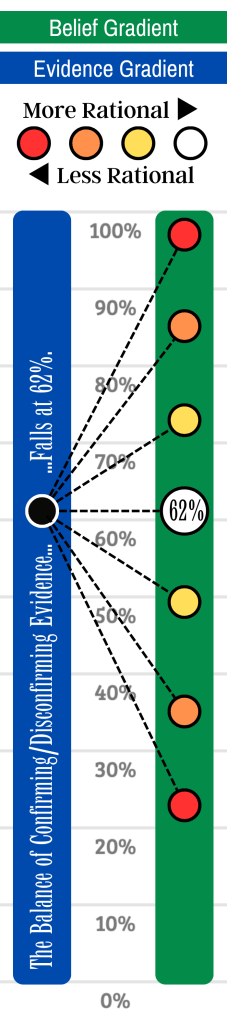
But what makes a belief rational? The answer lies in how well your belief tracks the available evidence. Rational belief is a degree of belief that maps to the degree of the relevant evidence. If the evidence strongly supports a proposition, a rational person assigns a high degree of belief. If the evidence weakly supports it, the belief should be proportionally low. Rationality, in this sense, is not about gut feelings, confidence, or intuition — it’s about proportion.
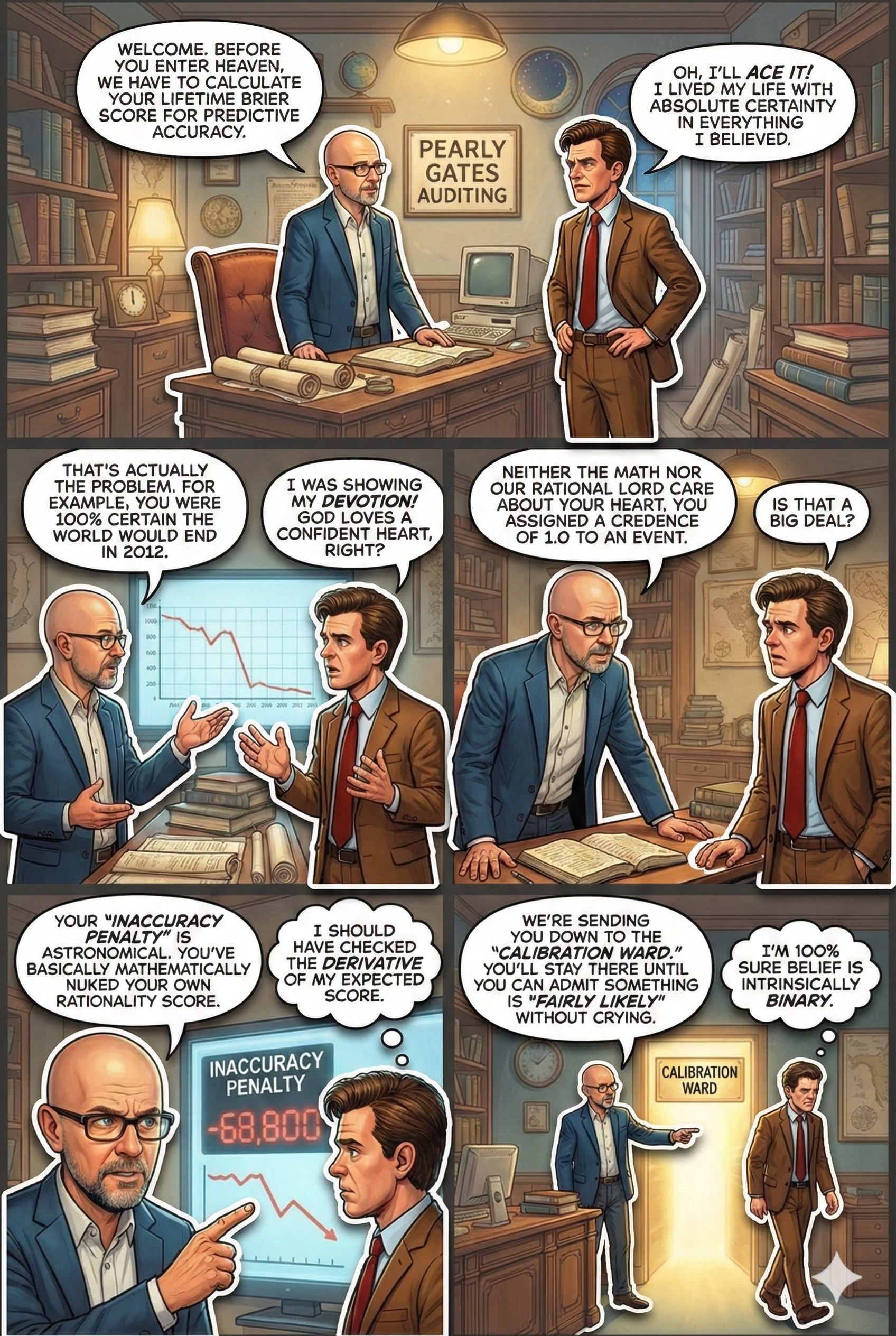
This isn’t just a philosophical ideal; it’s mathematically demonstrable. Under reasonable assumptions, it can be proven that those who assign degrees of belief that deviate from the degree of evidential support will, over time, make systematically worse predictions. That is, their beliefs will be less accurate and less successful in anticipating outcomes.
The technical apparatus behind this conclusion involves proper scoring rules — mathematical functions that measure how good or bad a probabilistic forecast is. These rules prove that if you want to maximize predictive accuracy (and avoid systematic error), then your credence in a proposition should exactly match the strength of the evidence for it. No more, no less.
So, when we speak of someone being epistemically rational, we are saying that their beliefs are not just reasoned but calibrated — finely tuned to what the evidence actually supports. To believe more than the evidence warrants is to invite failure. To believe less is to miss opportunities for insight. In both cases, the math makes it clear: only by aligning belief with evidence do we stand the best chance of being right.
The mathematical reflection of this concept is often known as the Dutch Book Theorem (for coherence) and more importantly, the Cox-Jaynes Theorem and related accuracy dominance theorems (for credence-evidence matching). Below is a structured mathematical proof sketch (with key citations) that demonstrates the claim:
Mapping one’s degree of belief (credence) to the degree of evidence (i.e., assigning probabilities proportionate to the evidence) uniquely maximizes expected predictive accuracy under proper scoring rules. Any deviation from this mapping leads to provably inferior predictive success.
◉ Part 1: Preliminaries
Let:
be a proposition (e.g., “It will rain tomorrow”).
be the agent’s credence (degree of belief).
- Let the objective chance (or expected long-run frequency given all evidence) be denoted
.
Assume:
- The scoring rule
measures how good it is to assign credence
to a proposition that is actually true (
) or false (
).
- We use a strictly proper scoring rule such as the Brier score or logarithmic score, which are known to uniquely reward truthful probabilistic forecasts.
◉ Part 2: The Brier Score Framework
The Brier Score for a single proposition

where:
is your credence.
is the actual outcome.
The expected Brier score, given a known probability 
![\mathbb{E}[BS(c)] = p \cdot (c - 1)^2 + (1 - p) \cdot (c - 0)^2 = p (1 - c)^2 + (1 - p) c^2](https://s0.wp.com/latex.php?latex=%5Cmathbb%7BE%7D%5BBS%28c%29%5D+%3D+p+%5Ccdot+%28c+-+1%29%5E2+%2B+%281+-+p%29+%5Ccdot+%28c+-+0%29%5E2+%3D+p+%281+-+c%29%5E2+%2B+%281+-+p%29+c%5E2&bg=ffffff&fg=000&s=0&c=20201002)
Take the derivative with respect to
![\frac{d}{dc} \mathbb{E}[BS(c)] = -2p (1 - c) + 2(1 - p)c = 2c - 2p](https://s0.wp.com/latex.php?latex=%5Cfrac%7Bd%7D%7Bdc%7D+%5Cmathbb%7BE%7D%5BBS%28c%29%5D+%3D+-2p+%281+-+c%29+%2B+2%281+-+p%29c+%3D+2c+-+2p&bg=ffffff&fg=000&s=0&c=20201002)
Set derivative to zero:

Thus, the expected Brier score is minimized when your credence matches the evidence-based probability 
◉ Part 3: Interpretation
Let’s spell out the result:
- If your credence
- This holds all else being equal (same information, same world, same calibration opportunity).
This is the core normative argument for Bayesian epistemology: credences should match the degree of evidential support. Otherwise, you’re guaranteed to do worse in predictive performance over time.
◉ Part 4: Extension: Logarithmic Scoring Rule
A similar derivation can be done using the logarithmic scoring rule:

Expected score:
![\mathbb{E}[LS(c)] = -p \log(c) - (1 - p) \log(1 - c)](https://s0.wp.com/latex.php?latex=%5Cmathbb%7BE%7D%5BLS%28c%29%5D+%3D+-p+%5Clog%28c%29+-+%281+-+p%29+%5Clog%281+-+c%29&bg=ffffff&fg=000&s=0&c=20201002)
Minimized again at 
◉ Conclusion: Predictive Dominance of Evidence-Matching Credence
Theorem (Scoring Rule Argument for Epistemic Rationality):
Under any strictly proper scoring rule (such as the Brier score or logarithmic score), the unique credence function that minimizes expected inaccuracy is the one that assigns to each proposition a degree of belief equal to the degree of evidential support for that proposition.
Any deviation from this—assigning more or less belief than the evidence warrants—is guaranteed to lead to inferior predictive accuracy over time.
◉ Key Citations
Joyce, James M. (1998).
Title: A Nonpragmatic Vindication of Probabilism
Published in: Philosophy of Science, Vol. 65, No. 4, pp. 575–603
Summary:
Joyce argues that rational agents should conform to the probability axioms not merely to avoid Dutch Books (as in the traditional pragmatic justification), but because degrees of belief that violate these axioms will, by proper scoring rules, be less accurate in representing the truth. This is central to the principle that belief should map to evidence.
Leitgeb, Hannes & Pettigrew, Richard (2010).
Titles:
- An Objective Justification of Bayesianism I: Measuring Inaccuracy
- An Objective Justification of Bayesianism II: The Consequences of Minimizing Inaccuracy
Published in: Philosophy of Science, Vol. 77, No. 2
Summary:
Across two papers, Leitgeb and Pettigrew develop a formal framework using inaccuracy measures to justify Bayesian credence assignments. Their core claim is that Bayesian updating and probabilistic coherence objectively minimize expected inaccuracy, again reinforcing the principle that credence should track evidence.
Oddie, Graham (2014).
Title: Truthlikeness and Epistemic Utility: A Bi-Conditional Connection
Published in: Synthese, Vol. 191, pp. 3181–3197
Summary:
Oddie connects the notion of truthlikeness to epistemic utility theory, arguing that the most rational beliefs are those that maximize expected accuracy. His work supports the thesis that beliefs should reflect the degree of evidential support they have to be closer to the truth.
◉ Why Humans Resist Mapping Belief to Evidence

On its face, the principle that rational belief should scale with evidence is both elegant and intuitive. If evidence strongly supports a claim, belief should be strong. If the evidence is weak, belief should be tentative. Mathematically, this is the cornerstone of Bayesian reasoning, and empirically, it is how one avoids systematic predictive failure. Yet despite its clarity and rational appeal, many people do not — and often cannot — adopt this principle as a guiding standard for belief. Why?
The reasons span both psychological architecture and ideological commitments.
1. The Comfort of Certainty
One of the most fundamental psychological reasons people resist calibrating belief to evidence is the discomfort of uncertainty. Human cognition evolved not in scientific laboratories but in survival environments where decisiveness, not nuance, was often rewarded. A belief system that allows for graduated uncertainty — degrees of credence rather than black-and-white conviction — feels alien to many, even threatening. To admit only 60% confidence in a cherished belief feels like betrayal to identity or tribe. Certainty, in contrast, provides emotional security and decisional clarity — even when unjustified.
2. Identity-Protective Cognition
Beliefs, particularly religious or ideological ones, are often entangled with personal and group identity. In these cases, evidence is not evaluated in a vacuum. Instead, it is filtered through social consequences. If aligning one’s belief to the available evidence would create tension with one’s community, mentors, or worldview, many will override the evidence to preserve group cohesion. This is known in cognitive psychology as identity-protective cognition, and it often leads people to rationalize beliefs that exceed the evidential warrant.
3. Faith as a Virtue
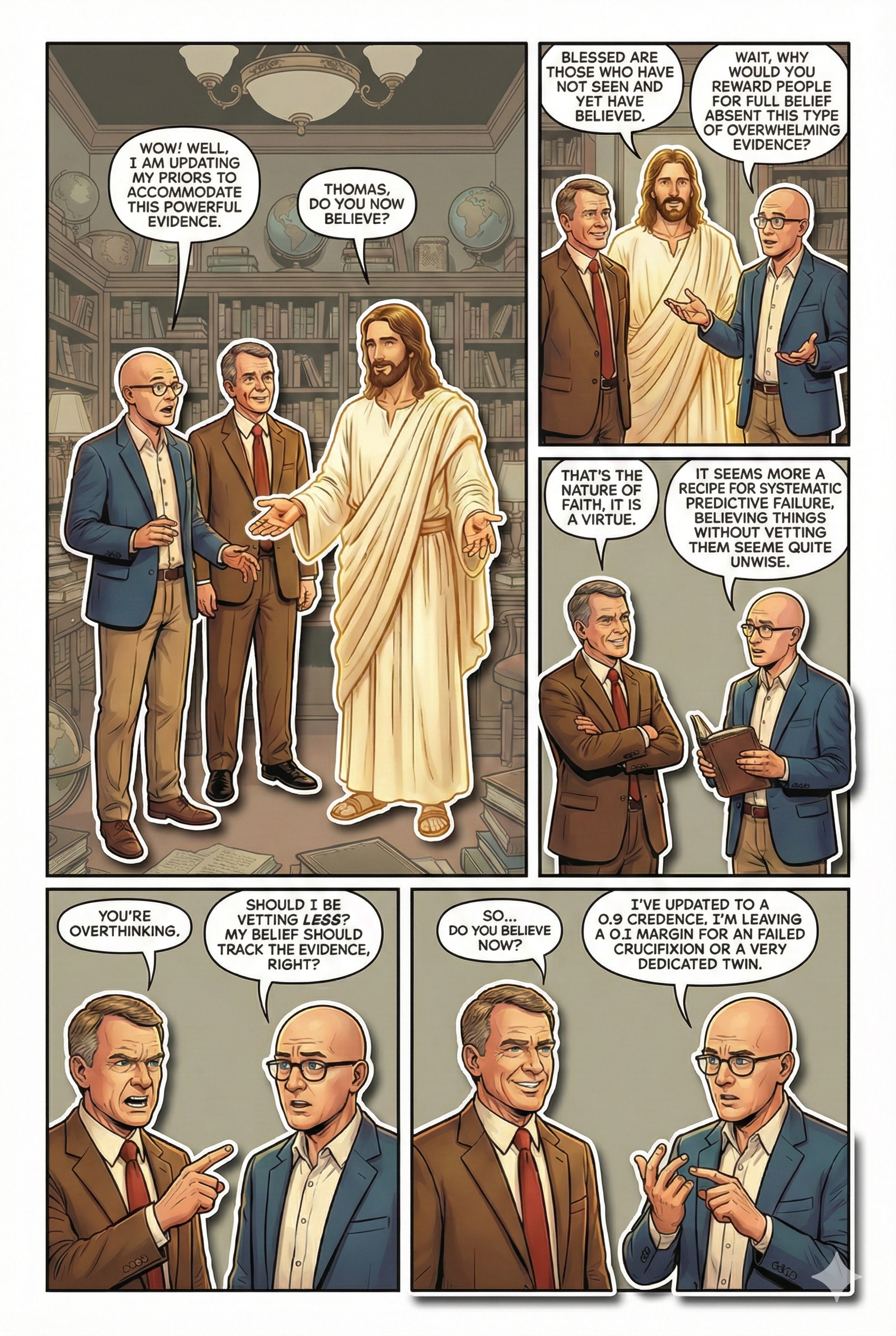
In many religious contexts, faith is not merely tolerated as a pragmatic placeholder for evidence; it is exalted. The belief that commitment beyond evidence is noble recasts epistemic caution as weakness. The figure of “doubting Thomas” is treated less as a rational inquirer and more as a moral cautionary tale. In this framework, belief that maps strictly to evidence appears cold, untrusting, or insufficiently reverent. The believer is rewarded not for epistemic accuracy but for loyalty under uncertainty.
4. Misconceptions About Evidence
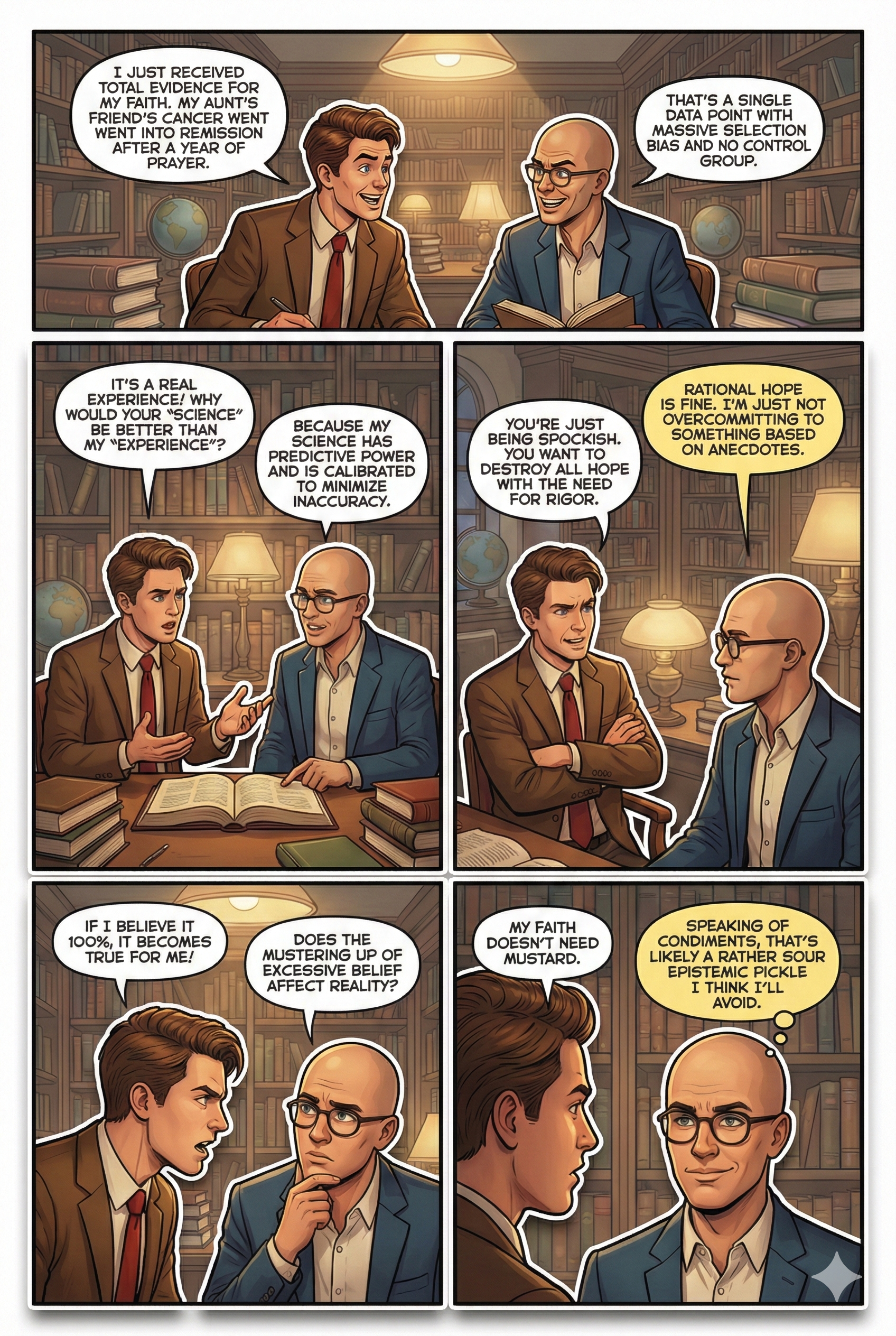
Some resistance stems from a poor understanding of what “evidence” is and how it justifies belief. Theists often cite historical testimony, personal experience, or theological coherence as “evidence,” placing it on equal footing with controlled observation, repeatability, and predictive power. If all sources are flattened into a generic notion of “support,” the demand that belief map to evidence loses its discriminatory force — and people see no problem in overcommitting belief.
5. Double Standards and Epistemic Compartmentalization
Many who claim to embrace evidence-based thinking in one domain (e.g., medicine or finance) suspend that very standard in another (e.g., theology or politics). The psychological mechanism here is compartmentalization — the ability to preserve conflicting epistemic rules in distinct mental silos. In one compartment, belief is subject to calibration. In the other, it is exempt because it serves symbolic, communal, or existential needs. These conflicting standards rarely get reconciled because doing so threatens coherence, and coherence often threatens comfort.
6. Misplaced Intuitions About Rationality
Some individuals argue that belief can be rational even when it exceeds the evidence, provided it’s supported by trust, tradition, or non-empirical forms of justification. This stems from an overly permissive definition of “rational,” one that blends epistemic and emotional needs. But rationality, in its epistemic sense, is precisely about belief proportional to evidential support. Redefining rationality to accommodate conviction beyond evidence may serve social or emotional goals, but it dilutes the concept beyond utility.
◉ Conclusion
The resistance to the idea that rational belief is a degree of belief that maps to the degree of the relevant evidence is deeply human. It reflects evolved cognitive biases, emotional yearnings, social pressures, and ideological incentives. But these reasons — however understandable — do not refute the standard. They only explain the struggle to meet it. Like nutrition or fitness, epistemic rationality is not what comes most naturally, but it is what delivers the most robust long-term outcomes when consistently applied.



A Companion Technical Paper:



 Free of Faith
Hi Christopher, I just sent you a response by email. Cheers.