
The Equivocation Game

In apologetic discourse, especially within the framework of Christian theism, it is not uncommon to find a rhetorical sleight of hand: the equivocation between the immaterial and the spiritual. This maneuver is either mendacious — a deliberate attempt to smuggle in metaphysical commitments under the guise of linguistic vagueness — or confused, stemming from a lack of conceptual clarity. In either case, the effect is the same: it obfuscates rather than illuminates.
The strategy typically unfolds like this: the apologist begins by noting that thoughts, intentions, and moral values are not physical objects — they cannot be seen, touched, or measured in the way rocks or neurons can. From this observation, they leap to the claim that such phenomena are spiritual in nature, and therefore inexplicable within a materialist or naturalist framework. This rhetorical move allows the apologist to assert that the mind points to a non-physical, and thus spiritual, dimension of reality — one that conveniently aligns with their broader theological commitments, such as the existence of a soul or a deity.
But this conclusion does not follow. That a phenomenon is immaterial does not mean it is spiritual — just as not being a brick does not mean something must be a ghost. The category of the immaterial includes a wide range of natural but abstract phenomena: language, mathematics, institutions, software, and, crucially, thoughts. These may lack material form, but they are dependent on material substrates, such as brains, cultures, or machines. The spiritual, by contrast, is defined precisely by its independence from the material — it is that which exists in an ontologically separate realm.
This distinction — between the immaterial and the spiritual — is not a semantic quibble. It is a philosophical necessity for any serious discussion of mind, consciousness, or metaphysics. This essay sets out to draw that line clearly and to defend the claim that thoughts are immaterial, but not spiritual. They are emergent phenomena, arising from — and wholly dependent on — the neuronal architecture of the brain. The common objection that “you can’t open up a brain and find the thought of one’s mother” reveals a category mistake, not a spiritual mystery.
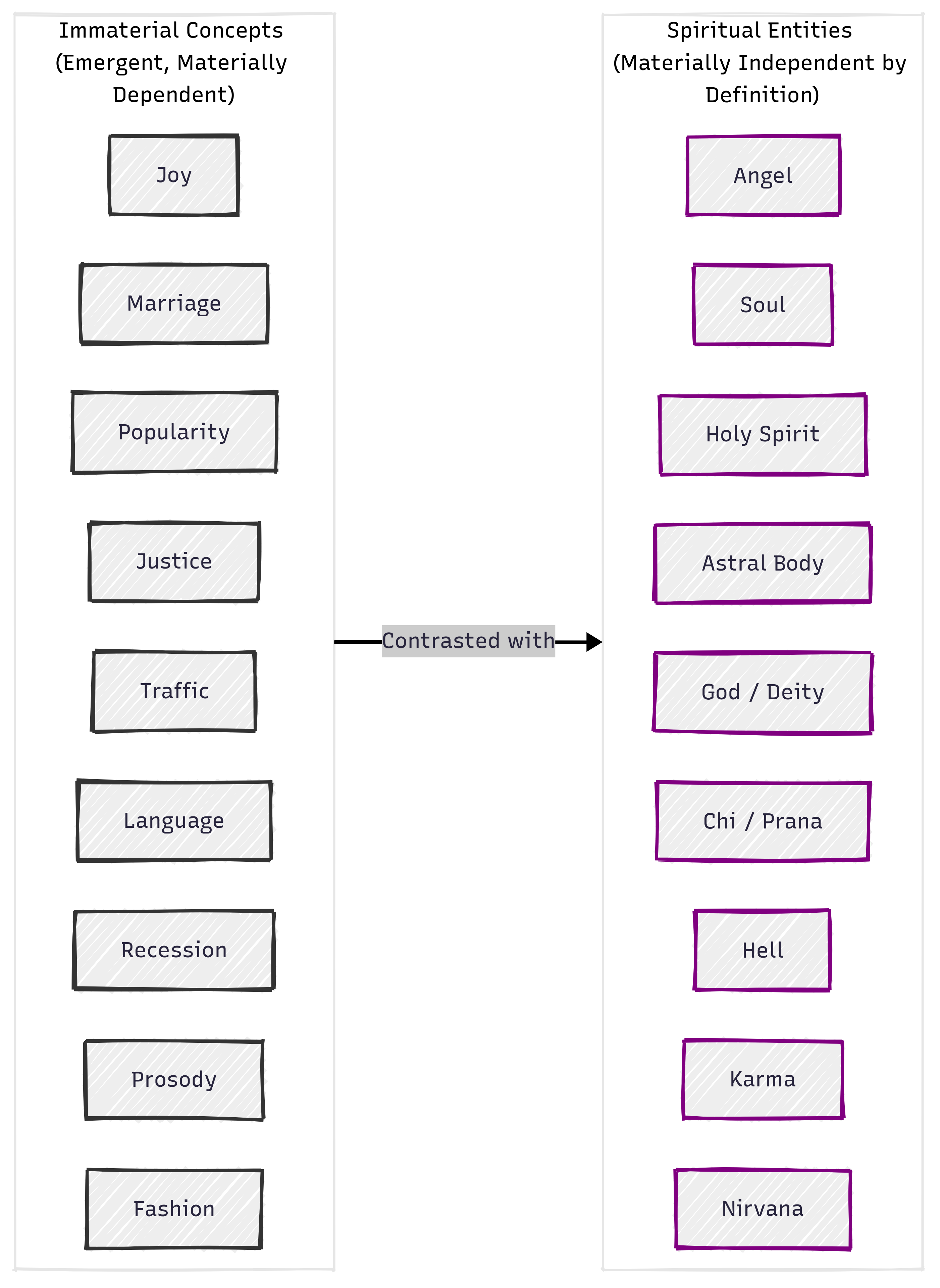
In contemporary discourse — whether in everyday speech, theological reflection, or even academic philosophy — the terms immaterial and spiritual are often used interchangeably. This conflation, however, blurs a critical metaphysical distinction. Not all that is immaterial is spiritual. The immaterial can be entirely dependent on the material, emerging from physical systems, whereas the spiritual — as commonly defined — exists independently of any physical or material substrate. Clarifying this distinction is vital for conceptual clarity, especially in debates over consciousness, the mind, metaphysics, and religious belief.
This essay argues that thoughts are immaterial phenomena in that they lack physical extension or location in space, but they are not spiritual entities, because they are demonstrably dependent on the material substrate of the brain. It further critiques the simplistic objection that because thoughts are not visible within the brain, they therefore transcend physical explanation.
I. Defining the Terms: Immaterial vs. Spiritual
Let us begin by disentangling the two core terms:
Immaterial
- Definition: Lacking material extension or physical substance; not directly observable via the senses.
- Examples: Thoughts, concepts, language, software, mathematical truths, mental states, legal systems.
- Characteristic: Typically emergent — arising from complex arrangements of physical systems (e.g., thoughts from brains, software from hardware).
Spiritual
- Definition: Existing in a realm independent of material reality; often posited as eternal, non-contingent, or divine.
- Examples: Souls, deities, angels, karma, the Holy Spirit.
- Characteristic: Not only non-material, but not emergent from matter — instead, said to exist in an ontologically separate domain.
While both categories involve entities or concepts not directly accessible via the five senses, they differ radically in metaphysical grounding. The immaterial is still materially entangled; the spiritual is posited to be materially transcendent.
II. Thoughts as Immaterial Phenomena
Thoughts are commonly invoked in discussions about consciousness, identity, and the mind-body problem. While thoughts cannot be weighed, touched, or observed in the way neurons or neurotransmitters can, they nonetheless emerge from — and are utterly dependent upon — the material structures of the brain.
A. The Emergent Nature of Thoughts
Modern neuroscience has mapped myriad correlations between mental states and neural activity. Functional MRI scans can identify regions of the brain associated with memory, fear, language, decision-making, and abstract reasoning. Strokes, brain trauma, and degenerative diseases like Alzheimer’s all demonstrate the causal dependence of thought and memory on neural integrity.
Destroy or damage the physical substrate, and the immaterial content degrades or disappears. This is not evidence of a non-physical soul being suppressed; it is evidence of emergence, not transcendence.
B. The Category Error of “Finding the Thought”
A common objection goes something like this:
“If thoughts are physical, then why can’t you open up the brain and find the thought of someone’s mother?”
This objection commits a category error by treating a process-dependent, immaterial phenomenon as though it were a static object. It is akin to saying:
“If a computer runs a chess program, why can’t I open it up and find the game of chess inside?”
The failure to find the thought inside the brain reflects a misunderstanding of what thoughts are. They are states, processes, representations — not discrete, spatially located objects. One cannot find “the thought” because thoughts are not things but functionally embedded phenomena, encoded in transient patterns of neuronal firing, synaptic plasticity, and brain-body-environment interaction.
III. Why Thoughts Are Not Spiritual
Having established that thoughts are immaterial but materially emergent, we can now challenge their misclassification as spiritual.
A. No Ontological Independence
Spiritual entities are typically defined as ontologically independent — that is, they would continue to exist even if the physical universe disappeared. A soul exists without a body; God exists outside of time and space.
But thoughts clearly do not fit this profile:
- They vanish with brain death.
- They change with neurochemistry.
- They arise with developmental biology.
- They degrade with dementia.
There is no evidence — empirical or philosophical — that a thought can exist without a brain, nor that it “transmigrates” across bodies, nor that it exists in a disembodied realm.
B. The Illusion of Transcendence
Because thoughts feel private, non-physical, and ineffable, they are often romanticized as spiritual. But this feeling of transcendence is best understood as a phenomenological quality — part of how consciousness feels, not how it is.
Much like a rainbow appears in the sky but has no physical location or substance, so too do thoughts appear in the “mind” without occupying physical space. Yet both are explainable as emergent effects — one of light and water, the other of neurons and patterns.
IV. Why This Distinction Matters
The philosophical payoff for maintaining the immaterial/spiritual distinction is significant:
1. Clarifies Debates in Philosophy of Mind
- It avoids unproductive confusion between emergent mental states and eternal souls.
- It grounds consciousness in biology without reducing it to crude physicalism.
2. Challenges Pseudospiritual Language
- It prevents the re-enchantment of secular experiences (like love or beauty) by cloaking them in unjustified mysticism.
3. Supports a Naturalist Ontology
- It enables us to acknowledge the reality of thoughts, values, and meaning without resorting to supernaturalism.
- One can be a rich, non-reductive materialist — accepting the immaterial as real and as natural.
Conclusion
The conflation of the immaterial with the spiritual is both intellectually careless and metaphysically misleading. Thoughts, while immaterial in form, are neither free-floating nor divine. They are biological phenomena, emergent from the dynamic complexity of the brain, and as such, they are contingent, transient, and dependent.
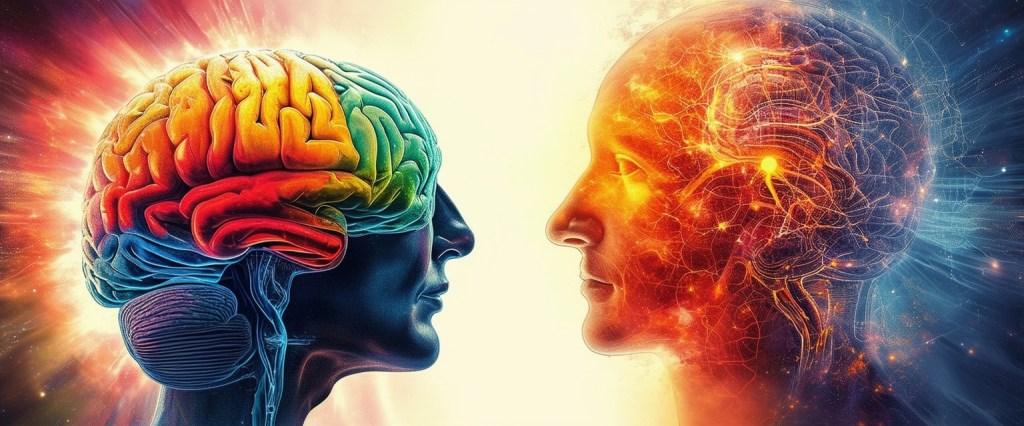
To say “you can’t find the thought of one’s mother in the brain” is no more profound than saying “you can’t find the flavor of music in the piano.” The thought — like the melody — is not in the object, but through it. Recognizing this allows us to appreciate the richness of the immaterial without invoking a realm of the spiritual.
We do not need the supernatural to explain the sublime.
See also:


 Free of Faith
Hi Christopher, I just sent you a response by email. Cheers.